REVIEW 5 minor 16 references
Refinements on higher order Weil-Oesterl\'e bounds via a Serre type argument
T0 review · 0 major / 5 minor · reviewed 2026-08-07 · deepseek-v4-flash
Pith's one-line read The paper proves a closed-form upper bound on how many points a curve of genus g over a finite field can have, one that always matches or beats Ihara's bound and is strictly better whenever a certain fractional part is nonzero.
desk verdict A genuine, checkable refinement of Ihara's bound by combining Serre's integrality trick with the HP19 SDP hierarchy, whose main theorem holds up despite minor presentational gaps. read the letter →
The pith
A machine-rendered reading of the paper's core claim, the machinery that carries it, and where it could break.
The reading
What carries the argument
The central object is the $2\times 2$ Gram block $M = [[2gq + t_2, t_1], [t_1, g]]$, which appears in the intersection-theoretic Gram matrix of $\Gamma_0, \Gamma_1, \Gamma_2$ on $X \times X$ and is positive semidefinite by the Hodge index theorem. Per Frobenius eigenvalue $\omega_j$ it decomposes into rank-one matrices $M(\omega_j) = [[2q + \tau_2(\omega_j), \tau_1(\omega_j)], [\tau_1(\omega_j), 1]]$ with $\tau_k(\omega) = \omega^k + \bar{\omega}^k$. Duality with a positive definite matrix $A = [[d, a], [a, b]]$ turns positivity into the affine inequality $d\tau_2 + 2a\tau_1 + 2qd + b > 0$, and Lemma 2.1 converts sums of such inequalities into linear constraints on $(t_1, t_2)$ exactly as Serre's trick converts pointwise positivity plus integrality into a lower bound on $t_1$. Optimizing over $A$ with $d = 1$ yields the closed-form bound of Theorem 2.5.
What would settle it
Search the published tables of curves with many points for all pairs $(q,g)$ with $q \le 100$ and $g \le 50$; if any tabulated curve has more rational points than the right-hand side of the Theorem 2.5 inequality, the theorem is false.
Extended reading notes
Core claim
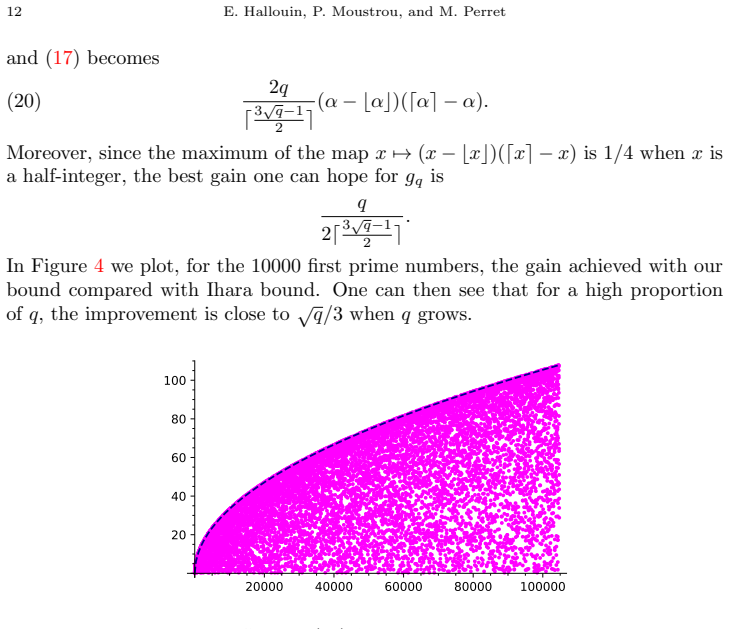
Writing $t_k = 1 + q^k - N_k$ for the trace of the $k$-th Frobenius power and $t_I = g(1 - \sqrt{1 + 8q + 4(q^2-q)/g})/2$ for Ihara's lower bound on $t_1$, the paper defines $\alpha = -t_I/g$ and proves that for every curve of genus $g \ge \sqrt{q}(\sqrt{q}-1)/2$ over $\mathbb{F}_q$, the number of rational points satisfies $N_q(g) \le (q+1) - t_I - g(\alpha-\lfloor\alpha\rfloor)(\lceil\alpha\rceil-\alpha)/(2\lceil\alpha\rceil)$. The gain relative to Ihara's bound is exactly the last term. The optimal auxiliary matrix has top-left entry $1$ and form $A = [[1, a], [a, \lfloor a^2\rfloor + 1]]$ with $a = \lfloor\alpha\rfloor + 1/2$; choosing a half-integer $a$ makes the bound strictly better than Ihara's whenever $\alpha$ is not an integer, while an integer $a$ collapses the bound back to Ihara's value.
Load-bearing premise
The argument inherits from earlier work the assertion that the matrix in equation (3) is positive semidefinite for every curve, a consequence of the Hodge index theorem on $X \times X$; every bound in the paper collapses if that geometric input fails.
Editorial extensions
If this is right
- For every prime power $q$ and every genus $g \ge \sqrt{q}(\sqrt{q}-1)/2$, the new upper bound is computed by a closed formula and is never worse than Ihara's bound; it is strictly better whenever $\alpha = -t_I/g$ is not an integer.
- For fixed $q \ne 3$, the gain over Ihara's bound grows at least linearly with $g$, improving the asymptotic constant $\limsup_{g\to\infty}(N_q(g) - (q+1))/g$.
- Inside the range $g_2 \le g \le g_3$ where Ihara's bound is not improved by higher Weil-Oesterlé orders, the new bound improves twenty entries of the published tables of curves with many points and matches the best known value in more than 130 further cases.
- For the third-order Weil-Oesterlé bound, the same Serre-type argument yields new upper bounds on the maximum point count: $N_5(19) \le 53$, $N_7(21) \le 76$, $N_8(36) \le 129$, $N_{11}(35) \le 163$.
Reading between the lines
- The same rank-one-duality mechanism should apply at every order of the Weil-Oesterlé hierarchy; the paper's order-3 experiments show the improvement exists but is weaker, suggesting the affine truncation of the feasible spectrahedron becomes less efficient as the order grows.
- Because the asymptotic gain vanishes for $q = 3$, any further improvement there cannot come from this fractional-part mechanism; a different arithmetic input would be needed.
- The closed-form optimal matrix for order 2 hints at a general rounding rule: a near-optimal $A$ may always be obtained from a half-integer parameter derived from the tangent hyperplane at the Oesterlé-optimal point, a pattern the paper observes in its numerical search but does not formalize.
Editorial analysis
A structured set of objections, weighed in public.
Referee Report
Summary. The paper refines Ihara's upper bound on N_q(g), the maximum number of F_q-rational points of a smooth projective geometrically irreducible curve of genus g. The authors extend Serre's arithmetic trick, which uses positivity and Galois invariance to force a product of algebraic integers to be a positive integer, to the Hallouin-Perret semidefinite-programming framework in which Ihara's bound is the order-2 Weil-Oesterlé bound. Their main result, Theorem 2.5, states that for g at least sqrt(q)(sqrt(q)-1)/2, with t_I the Ihara trace and alpha = -t_I/g, one has N_q(g) at most (q+1) - t_I - g(alpha-floor(alpha))(ceil(alpha)-alpha)/(2ceil(alpha)), so the upper bound improves on Ihara's by an explicit positive gain whenever alpha is not an integer. The paper also analyzes the gain as g grows, compares the bound with the manYPoints tables (reporting 20 new records), and gives an experimental order-3 extension together with a discussion of why a closed-form generalization is difficult.
Significance. Theorem 2.5 is a genuine and nontrivial improvement: it applies exactly in the Ihara range where higher-order Weil-Oesterlé bounds do not help, and the gain is explicit and often large (linear in g for fixed q except q=3). The proof is self-contained modulo the published PSD Gram-matrix construction of Hallouin-Perret: Lemma 2.1's Galois-integer/AGM step, Lemma 2.3's PSD trace inequalities, and the half-integer optimization in Theorem 2.5 all check out. The order-3 results are presented honestly as experimental, with explicit matrices, and the claimed comparisons with manYPoints are concrete and falsifiable. I view the main theorem as correct and within the scope of the journal.
minor comments (5)
- [§2.5.1] The statement "By pushing the analysis further, one finds that our gain ... has an asymptote ..." is presented as a proved consequence, but no argument is supplied. Since the preceding displayed limit already proves the main consequence that the gain tends to infinity for q≠3, please either include the short computation for the constant term or explicitly label this part as a sketch; as written, the introduction's phrase "We prove that ... has an asymptote" overstates the support given.
- [§2.5.1] The parenthetical "namely whenever q≠3" after "α∞ is not an integer" is a claim about prime powers q that is true but not demonstrated. It would help to add the elementary factorization argument: if m^2−8q=1 with q=p^r, then (m−1)(m+1)=8p^r, and the coprimality of (m−1)/2 and (m+1)/2 forces q=3. Without this, the reader cannot easily verify the equivalence.
- [Theorem 3.1] In the displayed formula for the lower bound on t_1, the bracket around 2q^{3/2}d+2b√q is not rendered as an explicit floor; the proof and the numerical applications in Theorem 3.2 use the floor, and the unfloored statement is weaker than what is proved. Please ensure the typesetting shows the floor.
- [References] The reference [vdGHLR09] still contains the placeholder "Retrieved [insert date here]" and should be completed before publication.
- [Theorem 2.5] There is a typographical duplication in the statement ("an an absolutely"); this should be corrected.
Circularity Check
No substantive circularity: the Ihara-Serre bound follows from an explicit algebraic optimization over the independent [HP19] PSD framework, with no fitted parameter disguised as a prediction.
full rationale
No circular step is present. Theorem 2.5 is derived from three independent ingredients: the PSD Gram matrix (3) imported from [HP19], itself a published, peer-reviewed consequence of the Hodge index theorem that does not assume the new bound; Lemma 2.1, whose Galois-invariance and arithmetic-geometric-mean argument forces a product of positive algebraic integers to be a positive integer; and the explicit one-variable optimization over a, showing that the matrix A with a = floor(alpha) + 1/2 and b = floor(a^2) + 1 is optimal. The key difference t_IS(a) - t_I = g(alpha - floor(alpha))(ceil(alpha) - alpha)/(2 ceil(alpha)) is an algebraic identity, not a fitted relation, and it correctly reduces to zero when alpha is an integer. The statement that this is the best bound with upper-left coefficient 1 is proved by inspecting the two cases 2a even and 2a odd. Section 3 is explicitly experimental: the matrices in Theorem 3.2 are search candidates reported with their computed lower bounds, not fitted parameters later relabeled as predictions. The only load-bearing external input is [HP19], a self-citation of two of the authors, but this is not circular because the cited PSD and block-decomposition facts are independent published results whose content does not include the new Ihara-Serre bound. The paper also candidly states in Section 3.2 that the higher-order generalization lacks a canonical optimal matrix, which is an acknowledged limitation rather than a circularity. The apparent missing floor in the displayed statement of Theorem 3.1 is a formatting typo, and the proof uses the floored constant, so it does not affect the main derivation.
Assumptions & free parameters
free parameters (1)
- Matrix A entries in Theorem 3.2 =
e.g. [[1,7/2],[7/2,28-7*sqrt(5)]] for (q,g)=(5,19)
assumptions (4)
- domain assumption Frobenius eigenvalues exist as algebraic integers of modulus sqrt(q) with Galois-stable conjugates.
- domain assumption The Gram matrix in equation (3) is positive semidefinite for every curve, from the Hodge index theorem on X times X.
- standard math N_k is at least N_1 for every k, hence t_k is at most t_1 + q^k - q.
- standard math A Galois-invariant algebraic integer that is a positive real number is a positive integer, so the product in Lemma 2.1 is at least 1.
Cite this review
Pith. "Pith review of Refinements on higher order Weil-Oesterl\'e bounds via a Serre type argument." pith.science (2026). https://pith.science/paper/ID2FWT4W
@misc{pith2026250605212,
  author       = {Pith},
  title        = {Pith review of: Refinements on higher order Weil-Oesterl\'e bounds via a Serre type argument},
  year         = {2026},
  howpublished = {\url{https://pith.science/paper/ID2FWT4W}},
  note         = {Machine review of arXiv:2506.05212}
}
read the original abstract
Weil's theorem gives the most standard bound on the number of points of a curve over a finite field. This bound was improved by Ihara and Oesterl\'e for larger genus. Recently, Hallouin and Perret gave a new point of view on these bounds, that can be obtained by solving a sequence of semi-definite programs, and the two first steps of this hierarchy recover Weil's and Ihara's bounds. On the other hand, by taking into account arithmetic constraints, Serre obtained a refinement on Weil's bound. In this article, we combine these two approaches and propose a strengthening of Ihara's bound, based on an argument similar to Serre's refinement. We show that this generically improves upon Ihara's bound, even in the range where it was the best bound so far. Finally we discuss possible extensions to higher order Weil-Oesterl\'e bounds.
Figures


Figures from the paper (1 more)
Reference graph
Works this paper leans on
-
[1]
Yves Aubry and Annamaria Iezzi, On the maximum number of rational points on singular curves over finite fields, Mosc. Math. J. 15 (2015), no. 4, 615--627. 3438824
work page 2015
-
[2]
Jonas Bergstr\"om, Everett W. Howe, Elisa Lorenzo Garc\'ia, and Christophe Ritzenthaler, Refinements of K atz- S arnak theory for the number of points on curves over finite fields , Canad. J. Math. 77 (2025), no. 2, 400--425. 4876845
work page 2025
-
[3]
Reinier Br\"oker, Everett W. Howe, Kristin E. Lauter, and Peter Stevenhagen, Genus-2 curves and J acobians with a given number of points , LMS J. Comput. Math. 18 (2015), no. 1, 170--197. 3349314
work page 2015
-
[4]
E. W. Howe and K. E. Lauter, Improved upper bounds for the number of points on curves over finite fields, Ann. Inst. Fourier (Grenoble) 53 (2003), no. 6, 1677--1737. 2038778
work page 2003
-
[5]
Everett W. Howe and Kristin E. Lauter, Corrigendum to: `` I mproved upper bounds for the number of points on curves over finite fields'' [ A nn. I nst. F ourier ( G renoble) 53 (2003), no. 6, 1677--1737; mr2038778] , Ann. Inst. Fourier (Grenoble) 57 (2007), no. 3, 1019--1021. 2336837
work page 2003
-
[6]
, New methods for bounding the number of points on curves over finite fields, Geometry and arithmetic, EMS Ser. Congr. Rep., Eur. Math. Soc., Z\"urich, 2012, pp. 173--212. 2987661
work page 2012
-
[7]
Everett W. Howe, New bounds on the maximum number of points on genus-4 curves over small finite fields, Arithmetic, geometry, cryptography and coding theory, Contemp. Math., vol. 574, Amer. Math. Soc., Providence, RI, 2012, pp. 69--86. 2961401
work page 2012
-
[8]
Number Theory 220 (2021), 320--329
, The maximum number of points on a curve of genus eight over the field of four elements, J. Number Theory 220 (2021), 320--329. 4177546
work page 2021
Show all 16 references
-
[9]
Emmanuel Hallouin and Marc Perret, A unified viewpoint for upper bounds for the number of points of curves over finite fields via E uclidean geometry and semi-definite symmetric T oeplitz matrices , Trans. Amer. Math. Soc. 372 (2019), no. 8, 5409--5451. 4014282
2019
-
[10]
Yasutaka Ihara, Some remarks on the number of rational points of algebraic curves over finite fields, J. Fac. Sci. Univ. Tokyo Sect. IA Math. 28 (1981), no. 3, 721--724 (1982). 656048 (84c:14016)
1981
-
[11]
Jean-Pierre Serre, Sur le nombre des points rationnels d'une courbe alg\'ebrique sur un corps fini, C. R. Acad. Sci. Paris S\'er. I Math. 296 (1983), no. 9, 397--402. 703906
1983
-
[12]
18, Soci\'et\'e Math\'ematique de France, Paris, [2020] 2020, With contributions by Everett Howe, Joseph Oesterl\'e and Christophe Ritzenthaler
, Rational points on curves over finite fields, Documents Math\'ematiques (Paris) [Mathematical Documents (Paris)], vol. 18, Soci\'et\'e Math\'ematique de France, Paris, [2020] 2020, With contributions by Everett Howe, Joseph Oesterl\'e and Christophe Ritzenthaler. 4242817
2020
-
[13]
Vl a du t and Vladimir Drinfeld, Number of points of an algebraic curve, Funksional Anal i Prilozhen 17 (1983), 53--54
Sergei G. Vl a du t and Vladimir Drinfeld, Number of points of an algebraic curve, Funksional Anal i Prilozhen 17 (1983), 53--54
1983
-
[14]
Howe, Kristin E
Gerard van der Geer, Everett W. Howe, Kristin E. Lauter, and Christophe Ritzenthaler, Tables of curves with many points, 2009, Retrieved [insert date here]
2009
-
[15]
Andr\'e Weil, Sur les fonctions alg\'ebriques \`a corps de constantes fini , C. R. Acad. Sci. Paris 210 (1940), 592--594. 2863
1940
-
[16]
, On the R iemann hypothesis in functionfields , Proc. Nat. Acad. Sci. U.S.A. 27 (1941), 345--347. 4242
1941
Reviewed August 7, 2026 · model on record in the stance chip above.
Discussion (0). Sign in to comment.