An isometric immersion of a flat Klein bottle into Euclidean 3-space
Pith reviewed 2026-05-25 06:10 UTC · model grok-4.3
The pith
An explicit piecewise linear map provides an isometric immersion of the flat Klein bottle into Euclidean 3-space.
A machine-rendered reading of the paper's core claim, the machinery that carries it, and where it could break.
Core claim
We present an explicit piecewise linear map from a flat Klein bottle into Euclidean 3-space that is an isometric immersion -- a path isometry that is locally injective. The image is a self-intersecting polyhedron with embedded vertex figures where each vertex has zero angle defect. The construction of the map enforces the path isometry property so long as certain numerically-verifiable inequalities are satisfied, and we show that checking the local injectivity property at each vertex via another set of inequalities suffices. This work generalizes features from known piecewise linear isometric embeddings of flat tori and known piecewise smooth path isometries of flat Klein bottles, and is the
What carries the argument
The explicit piecewise linear map from the flat Klein bottle, with path isometry enforced by numerically verifiable inequalities and local injectivity verified at each vertex by another set of inequalities.
Load-bearing premise
The numerically verifiable inequalities that enforce path isometry and local injectivity at vertices are satisfied by the chosen map.
What would settle it
Discovery of a pair of paths on the Klein bottle that have equal length but map to unequal lengths in R^3, or a point where the map is not locally injective.
Figures


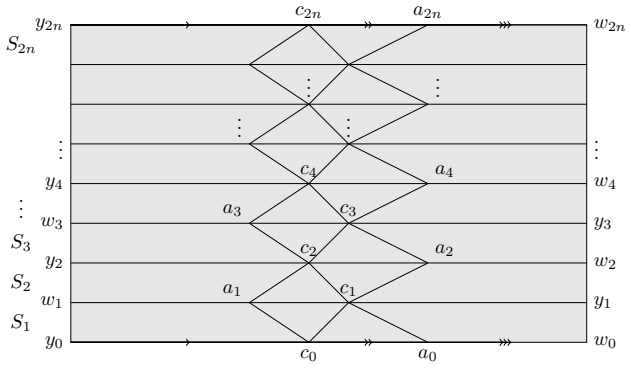


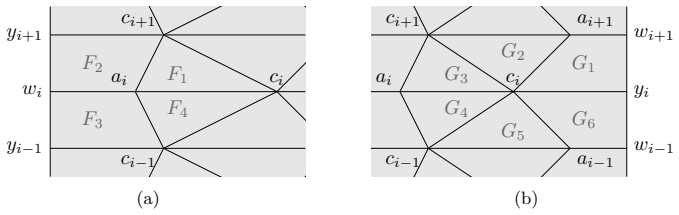
read the original abstract
We present an explicit piecewise linear map from a flat Klein bottle (i.e. one that is locally isometric to the Euclidean plane) into Euclidean 3-space an that is an isometric immersion -- a path isometry that is locally injective. The image is a self-intersecting polyhedron with embedded vertex figures where each vertex has zero angle defect. The construction of the map enforces the path isometry property so long as certain numerically-verifiable inequalities are satisfied, and we show that checking the local injectivity property at each vertex via another set of inequalities suffices. This work generalizes features from known piecewise linear isometric embeddings of flat tori and known piecewise smooth path isometries of flat Klein bottles, and apparently is the first explicit isometric immersion of a flat Klein bottle into $\mathbb{R}^3$.
Editorial analysis
A structured set of objections, weighed in public.
Referee Report
Summary. The paper presents an explicit piecewise linear map from a flat Klein bottle into Euclidean 3-space that is claimed to be an isometric immersion (a path isometry that is locally injective). The image is a self-intersecting polyhedron with embedded vertex figures and zero angle defect at each vertex. The construction enforces path isometry when a first collection of inequalities holds and local injectivity at vertices when a second collection holds; both are described as numerically verifiable. The work generalizes features from known PL isometric embeddings of flat tori and piecewise smooth path isometries of Klein bottles, and claims to be the first explicit isometric immersion of a flat Klein bottle into R^3.
Significance. If the inequalities can be shown to hold rigorously, the result would supply the first explicit isometric immersion of a flat Klein bottle into R^3. This would extend the known repertoire of PL constructions for flat tori and smooth immersions for Klein bottles, providing a concrete polyhedral model with zero angle defect whose path-isometry and local-injectivity properties are controlled by explicit (if numerically checked) conditions.
major comments (2)
- [Abstract / construction of the map] Abstract and construction description: the central claim that the map is a path isometry rests on a collection of inequalities being satisfied, yet the manuscript supplies only the statement that they are 'numerically verifiable' without interval-arithmetic bounds, exact rational comparisons, or an analytic proof that the chosen parameters place every quantity strictly on the correct side of its threshold. This verification step is load-bearing for the immersion property.
- [Local injectivity at vertices] Local-injectivity argument: the claim that checking a second collection of inequalities at each vertex suffices for local injectivity likewise relies on numerical verification. In a PL setting, local injectivity fails if any two adjacent triangles in a vertex star overlap by an arbitrarily small angle; a floating-point check near equality therefore leaves open the possibility that the reported map is not an immersion.
minor comments (2)
- [Abstract] Abstract contains a typographical error: 'into Euclidean 3-space an that is' should read 'into Euclidean 3-space and that is'.
- [Introduction / abstract] The phrase 'apparently is the first' is informal; a precise statement of the novelty relative to the cited torus and smooth-Klein-bottle constructions would strengthen the introduction.
Simulated Author's Rebuttal
We thank the referee for the careful reading and for identifying the load-bearing role of the inequality verifications. We agree that numerical checks alone are insufficient for a rigorous proof and will strengthen the manuscript with exact verification methods.
read point-by-point responses
-
Referee: [Abstract / construction of the map] Abstract and construction description: the central claim that the map is a path isometry rests on a collection of inequalities being satisfied, yet the manuscript supplies only the statement that they are 'numerically verifiable' without interval-arithmetic bounds, exact rational comparisons, or an analytic proof that the chosen parameters place every quantity strictly on the correct side of its threshold. This verification step is load-bearing for the immersion property.
Authors: We agree that the current presentation relies on numerical verification and that this is insufficient for a complete proof. In the revised manuscript we will replace the numerical checks with explicit interval-arithmetic bounds (or exact rational comparisons) that certify every inequality holds strictly. These bounds will be stated and justified in a new subsection on the verification of path-isometry conditions. revision: yes
-
Referee: [Local injectivity at vertices] Local-injectivity argument: the claim that checking a second collection of inequalities at each vertex suffices for local injectivity likewise relies on numerical verification. In a PL setting, local injectivity fails if any two adjacent triangles in a vertex star overlap by an arbitrarily small angle; a floating-point check near equality therefore leaves open the possibility that the reported map is not an immersion.
Authors: We accept the referee's observation that floating-point checks near equality are inconclusive. The revision will supply rigorous (interval or exact-arithmetic) verification of the local-injectivity inequalities. We will also expand the surrounding argument to explain why the listed inequalities are sufficient to preclude arbitrarily small overlaps in the vertex stars. revision: yes
Circularity Check
Explicit construction with independent inequality checks; no circularity
full rationale
The paper defines an explicit piecewise-linear map from the flat Klein bottle and states that path-isometry holds whenever a listed collection of inequalities is satisfied while local injectivity at vertices holds under a second collection. These inequalities are presented as numerically verifiable design constraints rather than fitted parameters or self-referential definitions. No step equates the claimed immersion to its own inputs by construction, invokes a self-citation as the sole justification for a uniqueness theorem, or renames a known result. The central claim therefore remains a direct geometric construction whose verification steps stand outside the result itself.
Axiom & Free-Parameter Ledger
axioms (2)
- domain assumption A flat Klein bottle admits a metric that is locally isometric to the Euclidean plane.
- domain assumption A piecewise linear map is an isometric immersion when path lengths are preserved and local injectivity holds at vertices via verifiable inequalities.
Reference graph
Works this paper leans on
-
[1]
Vincent Borrelli, Sa¨ ıd Jabrane, Francis Lazarus, and Boris Thibert. Flat tori in three-dimensional space and convex integration.Proceedings of the National Academy of Sciences, 109(19):7218–7223, 2012
work page 2012
- [2]
-
[3]
American Mathematical Society Providence, 2001
Dmitri Burago, Yuri Burago, and Sergei Ivanov.A course in metric geom- etry, volume 33. American Mathematical Society Providence, 2001
work page 2001
-
[4]
Polyhedral realizations of developments.Vestnik Leningrad
Yuriy Dmitrievich Burago and Viktor Abramovich Zalgaller. Polyhedral realizations of developments.Vestnik Leningrad. Univ, 15:66–80, 1960
work page 1960
-
[5]
Yuriy Dmitrievich Burago and Viktor Abramovich Zalgaller. Isometric piecewise-linear embeddings of two-dimensional manifolds with a polyhe- dral metric intoR 3.Algebra i Analiz, 7(3):76–95, 1995
work page 1995
-
[6]
Cambridge University Press, 1997
Peter R Cromwell.Polyhedra. Cambridge University Press, 1997
work page 1997
-
[7]
Polyhedra of constant gaus- sian curvature, 2025
Soto Hisakawa, Shizuo Kaji, and Ryo Kawai. Polyhedra of constant gaus- sian curvature, 2025. arXiv:2512.19106
-
[8]
Nicolaas H Kuiper. On C1-isometric imbeddings. I. InIndagationes Math- ematicae (Proceedings), volume 58, pages 545–556. Elsevier, 1955
work page 1955
- [9]
-
[10]
C1 isometric imbeddings.Annals of mathematics, pages 383– 396, 1954
John Nash. C1 isometric imbeddings.Annals of mathematics, pages 383– 396, 1954
work page 1954
-
[11]
The flat Klein bottle rendered in curved-crease origami
Stepan Paul. The flat Klein bottle rendered in curved-crease origami. In David Swart, Frank Farris, and Eve Torrence, editors,Proceedings of Bridges 2021: Mathematics, Art, Music, Architecture, Culture, pages 47– 54, Phoenix, Arizona, 2021. Tessellations Publishing
work page 2021
-
[12]
A piecewise-linear isometrically immersed flat Klein bottle in Euclidean 3-space, 2025
Stepan Paul. A piecewise-linear isometrically immersed flat Klein bottle in Euclidean 3-space, 2025. arXiv:2504.08826
-
[13]
Stepan Paul. Flat Klein bottle. Folded Paper, 2026. Maison Poincar´ e, Paris
work page 2026
-
[14]
Tanessi Quintanar. An explicit PL-embedding of the square flat torus into E3.Journal of Computational Geometry, 11(1):615–628, 2020. A Appendix: Local Injectivity Proof Proof of Theorem 5.5.As in the theorem, letV=V 6,4, π 3 ,π, 3π 2 , and let⃗ α, ⃗ γbe the parameter sets generated byα 3 = 3.1, γ3 = 2.5 at 3. We will show that Φ = ΦV,⃗ α,⃗ γis locally inj...
work page 2020
discussion (0)
Sign in with ORCID, Apple, or X to comment. Anyone can read and Pith papers without signing in.