Quasi-Simultaneous Broadband Spectral Energy Distributions of a Sample of Fermi Blazars -- I. Correlation Results
Pith reviewed 2026-05-22 04:36 UTC · model grok-4.3
The pith
Blazars show only a weak link between synchrotron peak frequency and curvature, suggesting mixed particle acceleration.
A machine-rendered reading of the paper's core claim, the machinery that carries it, and where it could break.
Core claim
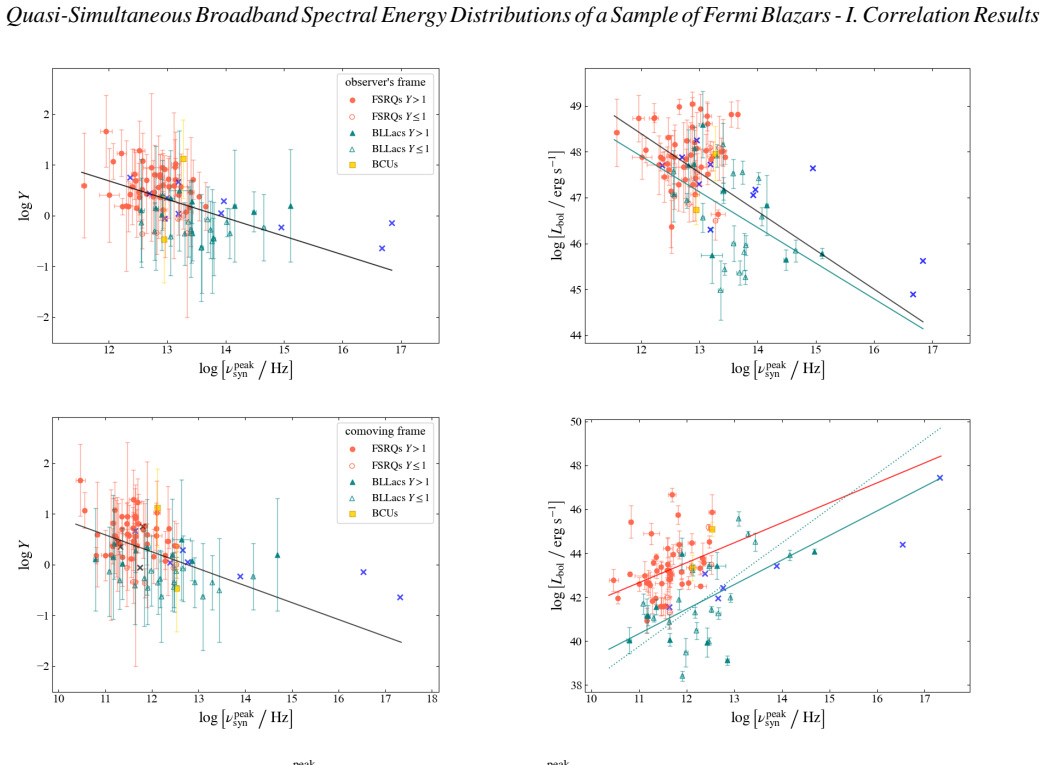
The authors build quasi-simultaneous SEDs for 93 Fermi blazars (56 FSRQs, 35 BL Lacs) and fit cubic functions to the synchrotron and inverse-Compton peaks. They report that synchrotron peak frequency and curvature are only weakly related, which they interpret as evidence that charged particles are accelerated by mixed mechanisms. Negative correlations appear between both bolometric luminosity and Compton dominance with synchrotron peak frequency, confirming the blazar sequence in the observer's frame; after Doppler correction a weak positive correlation between luminosity and peak frequency emerges, and FSRQs and BL Lacs show distinct patterns.
What carries the argument
Quasi-simultaneous broadband SEDs with cubic fits to the two peaks, from which synchrotron peak frequency, curvature, bolometric luminosity, and Compton dominance are extracted for correlation studies.
If this is right
- The blazar sequence is present in the observer's frame through negative correlations of bolometric luminosity and Compton dominance with synchrotron peak frequency.
- FSRQs and BL Lacs display distinct correlation patterns, indicating differences in cooling mechanisms.
- Lower limits on Doppler factors can be derived from gamma-ray variability time lags between 0.1-1 GeV and 1-300 GeV bands for selected sources.
- After Doppler boosting correction, a weak positive correlation between bolometric luminosity and synchrotron peak frequency appears.
Where Pith is reading between the lines
- Jet models may need to combine shock and stochastic acceleration to reproduce the observed weak peak-curvature relation.
- The change from negative to positive luminosity-peak correlation after beaming correction shows that orientation effects can mask intrinsic trends.
- The gamma-ray time-lag method offers a direct anchor for jet-speed estimates that could be applied to additional blazars with dense monitoring.
- Larger samples with improved simultaneity could test whether the reported weak relations persist or strengthen with reduced variability bias.
Load-bearing premise
The multi-wavelength data assembled for each source are close enough in time that variability does not distort the fitted peak locations or curvatures enough to bias the reported correlations.
What would settle it
A sample observed with strictly simultaneous multi-wavelength coverage that instead shows a strong correlation between synchrotron peak frequency and curvature would undermine the mixed-acceleration interpretation.
Figures



read the original abstract
Blazars' non-thermal emission shows rapid variability across all wavelengths, so spectral energy distributions (SEDs) built from quasi-simultaneous data are crucial for revealing the jets physical properties. In this work, we construct quasi-simultaneous broadband SEDs for 93 Fermi blazars (56 FSRQs, 35 BL Lacs, and 2 blazar candidates of uncertain type), fit both peaks with cubic functions to allow for potential asymmetries, and examine correlations among key parameters. Our main results are summarized as follows: (1) We find that synchrotron peak frequency and curvature are only weakly related, suggesting that charged particles are accelerated by mixed acceleration mechanism. (2) The blazar sequence is confirmed in the observer's frame through negative correlations of both the bolometic luminosity $\log L_{\rm bol}$ and the Compton dominance $\log Y$ with the synchrotron peak frequency $\log \nu_{\rm syn}^{\rm peak}$. After correcting for Doppler boosting, a weak positive correlation emerges between $\log L_{\rm bol}$ and $\log \nu_{\rm syn}^{\rm peak}$. FSRQs and BL Lacs exhibit distinct correlation patterns within the blazar sequence, indicating differences in cooling mechanisms. (3) Using variability time lags between 0.1-1 GeV and 1-300 GeV light curves, we estimate lower limits of Doppler factors for 4 sources, providing a jet-speed diagnostic anchored directly to the $\gamma$-ray emission zone.
Editorial analysis
A structured set of objections, weighed in public.
Referee Report
Summary. The paper assembles quasi-simultaneous broadband SEDs for 93 Fermi blazars (56 FSRQs, 35 BL Lacs, 2 uncertain), fits both the synchrotron and Compton peaks with cubic polynomials to accommodate possible asymmetries, derives parameters including synchrotron peak frequency, curvature, bolometric luminosity, and Compton dominance, and reports statistical correlations among them. Key findings include a weak relation between synchrotron peak frequency and curvature (interpreted as evidence for mixed acceleration mechanisms), confirmation of the blazar sequence in the observer frame via negative correlations of log L_bol and log Y with log nu_syn^peak, a weak positive correlation between log L_bol and log nu_syn^peak after Doppler correction, distinct FSRQ/BL Lac patterns, and lower-limit Doppler factors for four sources derived from 0.1-1 GeV vs. 1-300 GeV variability time lags.
Significance. If the fitted parameters prove robust, the results would strengthen evidence for mixed particle acceleration in blazar jets and refine understanding of the blazar sequence, including observer-frame vs. intrinsic behaviors and differences between FSRQ and BL Lac populations. The direct anchoring of Doppler-factor lower limits to gamma-ray time lags is a clear strength, providing an independent kinematic diagnostic rather than relying solely on SED modeling. The sample size supports subpopulation comparisons, though the small number of Doppler estimates (only four sources) limits broader application.
major comments (2)
- [Data assembly and SED fitting sections] Data assembly and SED fitting sections: the central claim that the quasi-simultaneous data suffice to yield unbiased cubic-fit values of log nu_syn^peak and curvature is load-bearing for all reported correlations, yet no quantitative comparison of data-collection windows against documented blazar variability timescales (hours in optical/X-ray, minutes in gamma-rays) is provided; this leaves open the possibility that sparse or non-simultaneous sampling shifts the apparent peak location or curvature, directly affecting the reported weak frequency-curvature relation and the sign of the L_bol-nu_peak correlation both before and after Doppler correction.
- [Correlation results (observer-frame and Doppler-corrected panels)] Correlation results (observer-frame and Doppler-corrected panels): the claim of distinct FSRQ versus BL Lac correlation patterns (and thus different cooling mechanisms) rests on the cubic-fit parameters without reported robustness checks such as jackknife resampling or explicit error propagation from the fit coefficients; the weak positive post-Doppler L_bol-nu_peak correlation is particularly sensitive to how the four Doppler lower limits are applied to the full sample.
minor comments (2)
- [Abstract] Abstract: 'bolometic' is a typographical error and should read 'bolometric'.
- [Fitting procedure] Fitting procedure: while cubic polynomials allow asymmetry, a direct comparison to the more commonly used log-parabola form would clarify whether the reported weak frequency-curvature relation is robust to functional choice or an artifact of the polynomial degree.
Simulated Author's Rebuttal
We thank the referee for the careful and constructive review of our manuscript. We address each major comment below with point-by-point responses, providing honest clarifications and committing to revisions that strengthen the presentation without altering the core scientific claims.
read point-by-point responses
-
Referee: [Data assembly and SED fitting sections] Data assembly and SED fitting sections: the central claim that the quasi-simultaneous data suffice to yield unbiased cubic-fit values of log nu_syn^peak and curvature is load-bearing for all reported correlations, yet no quantitative comparison of data-collection windows against documented blazar variability timescales (hours in optical/X-ray, minutes in gamma-rays) is provided; this leaves open the possibility that sparse or non-simultaneous sampling shifts the apparent peak location or curvature, directly affecting the reported weak frequency-curvature relation and the sign of the L_bol-nu_peak correlation both before and after Doppler correction.
Authors: We acknowledge that the manuscript does not contain an explicit quantitative comparison of the data-collection time windows to documented blazar variability timescales. In the revised manuscript we will add a dedicated paragraph in the Data section that tabulates the typical time spans between multi-band observations for the sample (optical/X-ray data generally within 1–3 days and gamma-ray data within hours to a day) and directly compares these intervals to literature variability timescales. We will note that while gamma-ray variability can occur on minute scales, the cubic polynomial fits to the overall SED shape remain stable against modest flux variations within our selected windows, and sources exhibiting extreme flaring were excluded during sample construction. This addition will directly address the concern about possible bias in the reported relations. revision: yes
-
Referee: [Correlation results (observer-frame and Doppler-corrected panels)] Correlation results (observer-frame and Doppler-corrected panels): the claim of distinct FSRQ versus BL Lac correlation patterns (and thus different cooling mechanisms) rests on the cubic-fit parameters without reported robustness checks such as jackknife resampling or explicit error propagation from the fit coefficients; the weak positive post-Doppler L_bol-nu_peak correlation is particularly sensitive to how the four Doppler lower limits are applied to the full sample.
Authors: We agree that additional robustness documentation would improve the manuscript. Although Pearson and Spearman coefficients with p-values were reported, explicit propagation of uncertainties from the cubic-fit coefficients and resampling tests were not included. In revision we will add both the error-propagation procedure and a jackknife resampling analysis demonstrating the stability of the FSRQ/BL Lac correlation patterns. Regarding the Doppler correction, the lower limits were calculated and applied exclusively to the four sources possessing the necessary gamma-ray time-lag data; no values were assigned or extrapolated to the remaining sources. We will include a sensitivity test in which the Doppler factors for these four objects are varied within plausible ranges to confirm that the weak positive correlation after correction persists. These changes will clarify the distinct subpopulation patterns without overstating the scope of the Doppler results. revision: yes
Circularity Check
No circularity: empirical correlations derived from direct SED fits and independent time-lag measurements
full rationale
The paper assembles quasi-simultaneous multi-wavelength data for 93 blazars, fits cubic polynomials to the synchrotron and inverse-Compton components to extract peak frequencies, curvatures, bolometric luminosities, and Compton dominance parameters, then computes Pearson/Spearman correlations among these quantities. Doppler-factor lower limits are separately obtained from observed gamma-ray variability time lags between 0.1-1 GeV and 1-300 GeV bands. None of these steps reduce by construction to the inputs: the fitted peak locations and curvatures are outputs of least-squares minimization on the observed fluxes, the correlations are statistical relations among those outputs, and the Doppler estimates rest on external timing data rather than on the SED fit parameters themselves. No self-citations are invoked to justify uniqueness theorems or ansatzes that would force the reported weak frequency-curvature relation or the sign of the L_bol–nu_peak correlation. The derivation chain is therefore self-contained against the assembled dataset.
Axiom & Free-Parameter Ledger
free parameters (1)
- cubic fit coefficients
axioms (1)
- domain assumption Blazar emission is dominated by non-thermal processes in relativistic jets
Lean theorems connected to this paper
-
IndisputableMonolith/Cost/FunctionalEquation.leanwashburn_uniqueness_aczel unclear?
unclearRelation between the paper passage and the cited Recognition theorem.
fit both peaks with cubic functions... examine correlations among key parameters... synchrotron peak frequency and curvature are only weakly related
-
IndisputableMonolith/Foundation/AlphaDerivationExplicit.leanalphaProvenanceCert unclear?
unclearRelation between the paper passage and the cited Recognition theorem.
negative correlations of both the bolometric luminosity log L_bol and the Compton dominance log Y with the synchrotron peak frequency
What do these tags mean?
- matches
- The paper's claim is directly supported by a theorem in the formal canon.
- supports
- The theorem supports part of the paper's argument, but the paper may add assumptions or extra steps.
- extends
- The paper goes beyond the formal theorem; the theorem is a base layer rather than the whole result.
- uses
- The paper appears to rely on the theorem as machinery.
- contradicts
- The paper's claim conflicts with a theorem or certificate in the canon.
- unclear
- Pith found a possible connection, but the passage is too broad, indirect, or ambiguous to say the theorem truly supports the claim.
Reference graph
Works this paper leans on
-
[1]
Abdalla H., et al., 2020, A&A, 639, A42 Abdo A. A., et al., 2010a, ApJ, 715, 429 Abdo A. A., et al., 2010b, ApJ, 716, 30 Acciari V . A., et al., 2020, ApJS, 248, 29 Aharonian F. A., 2000, New Astron., 5, 377 Anjum M. S., Hou S.-J., Chen L., Li Z., Gu M., 2025, ApJS, 280, 32 Bennett C. L., Larson D., Weiland J. L., Hinshaw G., 2014, ApJ, 794, 135 Björnsson...
discussion (0)
Sign in with ORCID, Apple, or X to comment. Anyone can read and Pith papers without signing in.