REVIEW 3 major objections 5 minor 33 references
Spectral Analysis of Cyg X-3 using simultaneous AstroSat and Insight-HXMT Observations
T0 review · 3 major / 5 minor · reviewed 2026-08-16 · deepseek-v4-flash
Pith's one-line read The soft-state X-ray spectrum of Cygnus X-3 is consistent with pure reflection of the intrinsic source off a funnel-shaped shroud, and the same funnel geometry can reproduce the polarization degrees observed in both the soft and hard…
desk verdict Competent spectral/funnel analysis of Cyg X-3 with an honest caveat at its core: the pure-reflection premise and the luminosity estimate that rides on it are not tested against a direct-component alternative. read the letter →
The pith
A machine-rendered reading of the paper's core claim, the machinery that carries it, and where it could break.
The reading
What carries the argument
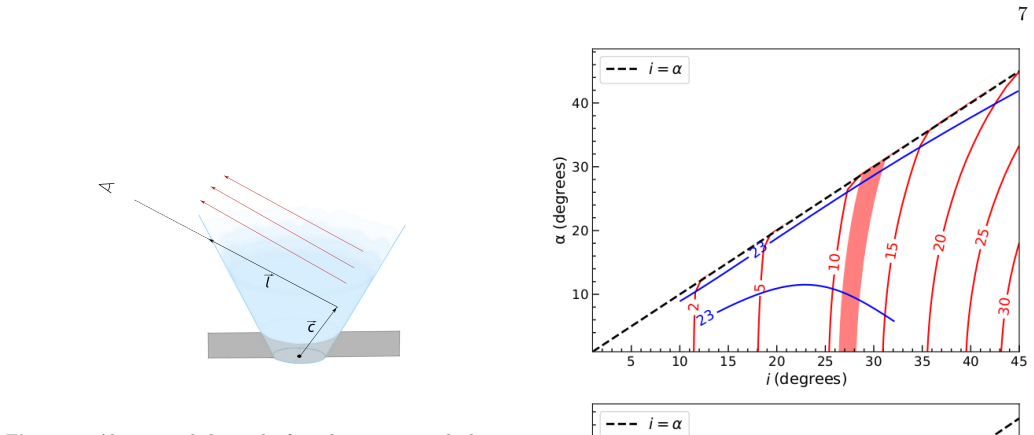
The central object is the funnel geometry: a conical, optically thick channel through which the intrinsic source's radiation escapes — either by scattering off gas inside the funnel volume or by reflection from the funnel's inner walls. The argument is carried by an analytic radiative-transfer model that integrates the scattered/reflected intensity over the visible part of the funnel, using Thomson scattering's angle-dependent polarization (PD = (1−cos²ψ)/(1+cos²ψ)) and accounting for absorption along both the incoming and outgoing path. The model's output is a contour map of constant polarization degree as a function of observer inclination and funnel opening angle, plus flux ratios (Rf,s or Rf,r) that, when compared with the plane-parallel disk ratio Rd, determine how much higher the intrinsic luminosity must be than the plane-disk estimate.
What would settle it
A single simultaneous IXPE + broadband spectral observation that measures both the soft-state polarization degree and the iron line equivalent width would settle the picture: if the EW is close to 1 keV (cosmic abundance) or if the PD exceeds the scattering maximum of ~14.3% at 30° inclination, the pure-reflection/scattering funnel model as presented cannot be the whole story. Alternatively, detecting an orbital-phase modulation of the polarization degree or angle in excess of the model's predictions would falsify the fixed single-funnel geometry.
Extended reading notes
Core claim
On the paper's own terms, the central discovery is that Cygnus X-3's broadband soft-state spectrum can be described as a purely reflected/scattered component — using the XSPEC reflect model with rel_refl=-1, thermal Comptonization (thcomp) of disk blackbody seed photons, an edge near 9 keV, and Gaussian emission lines for S XVI at ~2.6 and ~3.3 keV, Si XIV at ~2.0 keV, and Fe Kα at ~6.8 keV — yielding reduced χ² near 1.1 for the full orbit. The spectral shape does not change across orbital phase except for normalization, which increases by a factor of about three between superior and inferior conjunction. Combining this with IXPE polarization results, the paper finds that reflection from the funnel walls can produce a polarization degree of 23% (hard state) but not 12%, while scattering within the funnel's gas produces 10–12% (soft state) but not 23%, at a fixed observer inclination of 30°; including absorption after scattering makes the polarization degree fall sharply as the funnel opening angle grows. There exist funnel parameters — inclination near 30° and moderate opening angles — that reproduce both observed polarization degrees under the two scenarios. By scaling the plane-disk reflected flux to the funnel-geometry flux, the intrinsic luminosity is estimated at ~7×$10^{40}$ erg/s for the scattering (12% PD) case and ~5×$10^{41}$ erg/s for the reflection (23% PD) case, possibly as low as ~$10^{40}$ erg/s if 23% PD is a lower limit.
Load-bearing premise
The load-bearing premise is that the observer sees no direct light from the intrinsic source in the soft state — the entire observed spectrum is reflected or scattered radiation from the funnel; the paper itself notes the fit may be phenomenological because the iron line is much weaker than pure reflection predicts.
Editorial extensions
If this is right
- If the funnel interpretation holds, Cygnus X-3's intrinsic luminosity is roughly 10^40–10^41 erg/s, i.e., super-Eddington for a stellar-mass compact object, placing it among ultraluminous X-ray sources.
- The same geometric model explains both the ~12% soft-state and ~23% hard-state polarization degrees without invoking state-dependent changes in geometry; only the dominant radiative process (scattering vs reflection) changes.
- The lack of spectral variation across the orbit, combined with a factor ~3 normalization change, implies the orbital flux modulation is driven by the viewing geometry of the reflector/scatterer rather than by varying line-of-sight absorption.
- The weakness of the iron line (EW ~0.1 keV) relative to pure reflection expectations (~1 keV) suggests iron depletion or that the reflection fit is partly phenomenological; discriminating between these requires tracking the line in other spectral states.
- A broad-band, simultaneous polarimetric and spectral campaign would test whether the predicted PD–opening-angle relation holds across states, as the paper itself emphasizes.
Reading between the lines
- If the funnel interpretation is right, the polarization angle should track the funnel axis orientation, and combined radio/X-ray polarization angle measurements could measure the jet-funnel alignment — a testable prediction not fully developed in the paper.
- The rise in intrinsic luminosity by a factor ~25 over the plane-disk estimate implies that similar 'hidden' super-Eddington sources could be systematically under-luminous in apparent flux; population surveys might need to revisit Eddington-bias corrections for shrouded binaries.
- The model's sensitivity of PD to absorption after scattering suggests that, at higher energies where absorption is weaker, the PD should rise; comparing PD energy dependence across the 2–8 keV band in a single IXPE observation could distinguish the scattering parameters.
- The approach of matching two observed PDs with one funnel could be extended to the intermediate states of Cyg X-3, where the PD would be expected to interpolate between 12% and 23% if the funnel stays fixed.
Signed reviews
Editorial analysis
A structured set of objections, weighed in public.
Referee Report
Summary. The paper presents a broadband (1–20 keV) spectral analysis of Cygnus X-3 using simultaneous AstroSat (SXT, LAXPC20) and Insight-HXMT (LE, ME) observations covering one 4.8-hour orbital cycle during the soft state. The adopted spectral model is tbabs*(reflect*edge*thcomp*diskbb + four Gaussian lines), with rel_refl fixed to -1, so that the fitted continuum is a pure reflection component with no direct emission. The fit is statistically good (χ²/dof ≈ 1.1), and orbital phase-resolved fitting shows no significant parameter variation except normalization. Motivated by IXPE polarization results, the authors then construct an analytic funnel model with two scenarios: scattering inside the funnel volume (with and without post-scattering absorption) and reflection from the funnel walls. They compute scattered/reflected flux ratios and polarization degrees as functions of funnel parameters and observer inclination, calibrate the model to reproduce the observed soft-state PD of ~12% and hard-state PD of ~23%, and infer intrinsic luminosities of ~7×10^40 erg/s for the scattering scenario and ~5×10^41 erg/s for the reflection scenario, with a possible reduction to ~10^40 erg/s if 23% is a lower limit. The paper explicitly notes that the IXPE data are not simultaneous with the AstroSat/HXMT observations and that the weak Fe line (EW ~0.1 keV) may make the pure-reflection fit phenomenological.
Significance. If the central premise is accepted, the paper would strengthen the case that Cygnus X-3 is viewed through a funnel-like scattering/reflection geometry and that its intrinsic luminosity is super-Eddington. The work has several genuine strengths: it uses simultaneous multi-instrument broadband data, provides a detailed analytic treatment of the funnel geometry with explicit radiative transfer in the appendix, reproduces the earlier Veledina et al. conclusions for the no-absorption scattering case, and is commendably explicit about its limitations in Section 6. However, the significance of the luminosity and geometry claims is conditional on the pure-reflection assumption, which is not tested against a model containing a direct component. The paper's own stated Fe-line equivalent-width discrepancy and the possibility that the fit is phenomenological mean that the central interpretive step is currently an assumption rather than a demonstrated result.
major comments (3)
- [§3, Table 2, §6] The load-bearing assumption that the observed spectrum is purely reflected/scattered light with no direct view of the intrinsic source is imposed rather than tested. In the XSPEC model, rel_refl is fixed to -1, which forces the continuum to contain only the reflection component; no alternative model with a free reflection fraction or an added direct component is fitted and compared. The paper's own Section 6 acknowledges that the fitted Fe Kα line equivalent width (~0.1 keV) is far below the ~1 keV expected for pure reflection and that the fit 'may be of a phenomenological nature rather than a physically motivated one.' Since the luminosity estimates in Section 5 and the polarization-to-geometry mapping in Section 4 both scale with the reflected fraction, the central claim is not yet supported unless the pure-reflection hypothesis is tested against a model that allows a direct component.
- [§5, Eqs. (1)-(6), Tables 3-4] The intrinsic luminosity estimates are conditional on funnel parameters that are calibrated to reproduce the observed IXPE polarization degrees, so the luminosity is inferred from the very quantity the model is meant to explain. For the scattering model, the six rows of Table 3 show a factor of ~1.8 spread in luminosity (7.15–13.2 × 10^40 erg/s) while remaining within the 10.8–12.4% PD band, and the quoted ~7×10^40 erg/s corresponds to one selected configuration. No uncertainty or degeneracy band is propagated into the luminosity from the range of funnel parameters, inclinations, or PD errors. The paper should present the luminosity as a range over acceptable parameter sets, and should assess how the luminosity changes if a small direct component is admitted.
- [§2, §6, §4] The IXPE polarization measurements used for calibrating the funnel geometry were not simultaneous with the AstroSat/Insight-HXMT observations, as the paper itself states in Section 6. Cygnus X-3 is highly variable, and the soft-state PD values from Veledina et al. (2024b) are from a different epoch than the spectra analyzed here. The mapping from observed PD to funnel parameters therefore carries an unquantified systematic uncertainty from source variability, and the resulting luminosity estimates inherit that uncertainty. The paper should either restrict the claimed quantitative results to the epochs covered, or provide a sensitivity estimate showing how the inferred luminosities vary when the input PD is varied within the IXPE measurement errors and between epochs.
minor comments (5)
- [Abstract and §3] The abstract describes 'emission lines of iron, silica, and sulfur,' but the text refers to Si XIV and S XVI lines; 'silica' should be 'silicon' to avoid confusion with SiO2.
- [Appendix A.3, Eq. (A16)] Equation (A16) contains a typo: the polarization degree for Thomson scattering should be PD = (1 − cos²ψ)/(1 + cos²ψ), but the printed denominator reads '1 − cos²ψ', which would give an undefined or incorrect result.
- [Figure 6] The red band in Figure 6 is labeled '10.8◦–12.4◦'; this should be '10.8%–12.4%' since it denotes polarization degree, not an angle.
- [Table 2] The table header 'Diskbb Norm (10 3)' and several line-normalization columns use inconsistent scientific notation; these should be unified (e.g., 10^−3) for readability.
- [§1 and §6] The statement in Section 1 that the funnel opening angle is 'less than 15°' from Veledina et al. should be cross-checked with the funnel-model parameters used in Tables 3–4, where opening angles of up to 16° appear; a brief comment on this apparent consistency or difference would help the reader.
Circularity Check
No significant circularity: the funnel-model luminosity is conditional on external IXPE polarization constraints, not forced by them, and the spectral fit is independent of the funnel geometry modeling.
full rationale
The paper's derivation chain is self-contained rather than circular. The spectral fit in Section 3 is a standard XSPEC analysis in which the reflection model is externally motivated by IXPE polarization results; the parameter rel_refl is fixed to -1, which means the model is constrained to be reflection-dominated, but the quality of the fit and the resulting parameter values are empirical outputs, not predictions derived from the funnel model. The funnel-model polarization calculations in Section 4 and Appendix A are forward integrations over a prescribed geometry, and the observed polarization degrees (12% in the soft state, 23% in the hard state) are used as external constraints to select or identify funnel parameters, not as outputs fitted to the AstroSat/Insight-HXMT spectra. The luminosity estimates in Section 5 follow from equating the observed scattered flux to the model flux and using the ratio Rd/Rf,s; the resulting luminosity varies across Table 3 rows even for similar polarization degrees, so it is not determined by the polarization constraint alone. The funnel geometry is taken from Veledina et al. (2024a,b), which is independent IXPE work, and the authors do not rely on a self-citation chain for the central result; the only self-citations (e.g., LAXPC calibration references) are instrumental and non-load-bearing. The paper itself flags the main weakness: the Fe line equivalent width of about 0.1 keV is weaker than the roughly 1 keV expected for pure reflection, and it acknowledges that the fit may be phenomenological rather than physically motivated. That is an assumption or correctness risk, not a circular reduction by construction. The paper also explicitly notes that the IXPE observations were not simultaneous with the spectra, which is a limitation but not a circularity. No equation in the paper reduces to its own input by definition, and no fitted parameter is renamed as a prediction, so the appropriate score is 0.
Assumptions & free parameters
free parameters (5)
- Funnel optical depth at base radius (tau_rho) =
0.01-0.05 (Table 3)
- Lower height boundary optical depth (tau_z,min) =
0.1-0.2 (Table 3)
- Funnel opening angle (xi or alpha) =
10-16 deg (scattering), 7.8-11.2 deg (reflection) (Tables 3, 4)
- Reflector upper-edge distance (R) =
10-30 units of base radius (Table 4)
- Broadband spectral fit parameters =
NH about 2.2e22 cm^-2, Gamma about 5.5-5.9, kTin about 0.9 keV, diskbb norm about 12-37e3, edge about 9 keV, tau about…
assumptions (6)
- domain assumption Funnel-shaped geometry with an optically thick medium shrouding the central source and half-opening angle less than 15 degrees
- domain assumption Observer inclination i = 30 degrees
- domain assumption Distance to Cygnus X-3 of 9.7 kpc
- ad hoc to paper Iron abundance fixed at 0.3 solar and kTe fixed at 50 keV
- domain assumption Thomson single-scattering approximation for polarization and flux in the funnel
- standard math Plane-parallel reflection formula (Eq 1) as the calibration baseline
Cite this review
Pith. "Pith review of Spectral Analysis of Cyg X-3 using simultaneous AstroSat and Insight-HXMT Observations." pith.science (2026). https://pith.science/paper/IDQ5WJYJ
@misc{pith2026250502982,
  author       = {Pith},
  title        = {Pith review of: Spectral Analysis of Cyg X-3 using simultaneous AstroSat and Insight-HXMT Observations},
  year         = {2026},
  howpublished = {\url{https://pith.science/paper/IDQ5WJYJ}},
  note         = {Machine review of arXiv:2505.02982}
}
abstract
We present the results from the spectral analysis of Cygnus X-3 using simultaneous data from AstroSat and Insight-HXMT during its soft state. A pure reflection spectrum, including emission lines of iron, silica, and sulfur, provides a good fit to the spectra. Orbital phase-resolved analysis shows no significant spectral parameter variations, except for the normalization. Leveraging IXPE polarization results, we model the funnel-shaped geometry and estimate scattered flux and observed polarization for various funnel parameters and observer inclinations. We consider two scenarios: reflection from the funnel walls and scattering by gas within the funnel. Our results reconfirm previous findings, showing that reflection can produce a high polarization degree (PD) of 23$\%$, but not a low PD of 12$\%$. Conversely, scattering can produce a PD of 10-12$\%$, but not as high as 23$\%$ for a fixed observer inclination of $30^\circ$. Scattering results align with previous findings without absorption, but with absorption, PD drops significantly with increasing funnel opening angle. Thus, we can identify common funnel parameters that can produce the different observed PDs in the soft and hard states. The intrinsic luminosity of the source was estimated by comparing the results from a plane disk and the funnel model, to be $\sim7$ $\times$ 10$^{40}$ erg/s for 12$\%$ PD (scattering) and $\sim5$ $\times$ 10$^{41}$ erg/s for 23$\%$ PD (reflection). However, for the reflection model, the luminosity may decrease to $\sim$ 10$^{40}$ erg/s when the 23$\%$ PD observed is taken as a lower limit.
Figures


Figures from the paper (3 more)


Reference graph
Works this paper leans on
-
[1]
Agrawal, P. C. 2006, Advances in Space Research, 38, 2989, doi: 10.1016/j.asr.2006.03.038 —. 2017, Journal of Astrophysics and Astronomy, 38, 27, doi: 10.1007/s12036-017-9449-6
-
[2]
Antia, H. M., Yadav, J. S., Agrawal, P. C., et al. 2017, The Astrophysical Journal Supplement Series, 231, 10, doi: 10.3847/1538-4365/aa7a0e
-
[3]
Tatarnikov, A. M. 2022, The Astrophysical Journal, 926, 123, doi: 10.3847/1538-4357/ac4047
-
[4]
Arnaud, K. A. 1996, in Astronomical Society of the Pacific Conference Series, Vol. 101, Astronomical Data Analysis Software and Systems V, ed. G. H. Jacoby & J. Barnes, 17
1996
-
[5]
2020, Science China
Chen, Y., Cui, W., Li, W., et al. 2020, Science China
2020
-
[6]
Physics, Mechanics, and Astronomy, 63, 249505, doi: 10.1007/s11433-019-1469-5
-
[7]
Fender, R. P., Belloni, T. M., & Gallo, E. 2004, MNRAS, 355, 1105, doi: 10.1111/j.1365-2966.2004.08384.x
arXiv 2004
-
[8]
Giacconi, R., Gorenstein, P., Gursky, H., & Waters, J. R. 1967, ApJL, 148, L119, doi: 10.1086/180028
doi:10.1086/180028 1967
Show all 33 references
-
[9]
2020, Journal of High Energy Astrophysics, 27, 44, doi: 10.1016/j.jheap.2020.02.008
Guo, C.-C., Liao, J.-Y., Zhang, S., et al. 2020, Journal of High Energy Astrophysics, 27, 44, doi: 10.1016/j.jheap.2020.02.008
2020 doi
-
[11]
S., & Bleeker, J
Kaastra, J. S., & Bleeker, J. A. M. 2016, A&A, 587, A151, doi: 10.1051/0004-6361/201527395
2016 doi
-
[12]
2019, The Astrophysical Journal, 874, 51, doi: 10.3847/1538-4357/ab09f8
Kallman, T., McCollough, M., Koljonen, K., et al. 2019, The Astrophysical Journal, 874, 51, doi: 10.3847/1538-4357/ab09f8
2019 doi
-
[13]
G., & Trushkin, S
Pooley, G. G., & Trushkin, S. A. 2010, Monthly Notices of the Royal Astronomical Society, 406, 307, doi: 10.1111/j.1365-2966.2010.16722.x
2010
-
[14]
2020, Background Model for the Low-Energy Telescope of Insight-HXMT
Liao, J.-Y., Zhang, S., Chen, Y., et al. 2020, Background Model for the Low-Energy Telescope of Insight-HXMT. https://arxiv.org/abs/2004.01432
2020 arXiv
-
[15]
2020, Science China
Liu, C., Zhang, Y., Li, X., et al. 2020, Science China
2020
-
[16]
Physics, Mechanics, and Astronomy, 63, 249503, doi: 10.1007/s11433-019-1486-x
-
[17]
Magdziarz, P., & Zdziarski, A. A. 1995, MNRAS, 273, 837, doi: 10.1093/mnras/273.3.837
1995 doi
-
[18]
O., Cordova, F
Mason, K. O., Cordova, F. A., & White, N. E. 1986, ApJ, 309, 700, doi: 10.1086/164638
1986 doi
- [19]
-
[20]
1984, PASJ, 36, 741 NASA High Energy Astrophysics Science Archive Research Center (HEASARC)
Mitsuda, K., Inoue, H., Koyama, K., et al. 1984, PASJ, 36, 741 NASA High Energy Astrophysics Science Archive Research Center (HEASARC). 2014, HEASoft: Unified Release of FTOOLS and XANADU. https://heasarc.gsfc.nasa.gov/lheasoft/
1984
-
[21]
J., & Miller-Jones, J
Reid, M. J., & Miller-Jones, J. C. A. 2023, The Astrophysical Journal, 959, 85, doi: 10.3847/1538-4357/acfe0c
2023 doi
-
[22]
P., Stewart, G
Singh, K. P., Stewart, G. C., Chandra, S., et al. 2016, in Society of Photo-Optical Instrumentation Engineers (SPIE) Conference Series, Vol. 9905, Space Telescopes and Instrumentation 2016: Ultraviolet to Gamma Ray, ed. J.-W. A. den Herder, T. Takahashi, & M. Bautz, 99051E, do...
2016 doi
-
[23]
P., Stewart, G
Singh, K. P., Stewart, G. C., Westergaard, N. J., et al. 2017, Journal of Astrophysics and Astronomy, 38, 29, doi: 10.1007/s12036-017-9448-7
2017 doi
-
[24]
A., & McCollough, M
Szostek, A., Zdziarski, A. A., & McCollough, M. L. 2008, Monthly Notices of the Royal Astronomical Society, 388, 1001, doi: 10.1111/j.1365-2966.2008.13479.x
2008
-
[25]
1995, A&A, 294, 443 van Kerkwijk, M
Terasawa, N., & Nakamura, H. 1995, A&A, 294, 443 van Kerkwijk, M. H., Charles, P. A., Geballe, T. R., et al. 1992, Nature, 355, 703, doi: 10.1038/355703a0
1995 doi
-
[26]
2024a, Nature Astronomy, doi: 10.1038/s41550-024-02294-9
Veledina, A., Muleri, F., Poutanen, J., et al. 2024a, Nature Astronomy, doi: 10.1038/s41550-024-02294-9
-
[27]
2024b, Ultrasoft state of microquasar Cygnus X-3: X-ray polarimetry reveals the geometry of astronomical puzzle
Veledina, A., Poutanen, J., Bocharova, A., et al. 2024b, Ultrasoft state of microquasar Cygnus X-3: X-ray polarimetry reveals the geometry of astronomical puzzle. https://arxiv.org/abs/2407.02655
-
[28]
C., McCollough, M., & Koljonen, K
Vilhu, O., Hakala, P., Hannikainen, D. C., McCollough, M., & Koljonen, K. 2009, A&A, 501, 679, doi: 10.1051/0004-6361/200811293
2009 doi
- [29]
-
[30]
2000, ApJ, 542, 914, doi: 10.1086/317016 12
Wilms, J., Allen, A., & McCray, R. 2000, ApJ, 542, 914, doi: 10.1086/317016 12
2000 doi
-
[31]
S., Misra, R., Chauhan, J
Yadav, J. S., Misra, R., Chauhan, J. V., et al. 2016, The Astrophysical Journal, 833, 27, doi: 10.3847/0004-637X/833/1/27
2016 doi
-
[32]
A., Szanecki, M., Poutanen, J., Gierli´ nski, M., & Biernacki, P
Zdziarski, A. A., Szanecki, M., Poutanen, J., Gierli´ nski, M., & Biernacki, P. 2020, MNRAS, 492, 5234, doi: 10.1093/mnras/staa159
2020 doi
-
[33]
2020, Science China
Zhang, S.-N., Li, T., Lu, F., et al. 2020, Science China
2020
-
[34]
ANALYTICAL MODELING OF FUNNEL GEOMETRY This work includes the funnel geometry proposed by Veledina et al
Physics, Mechanics, and Astronomy, 63, 249502, doi: 10.1007/s11433-019-1432-6 13 APPENDIX A. ANALYTICAL MODELING OF FUNNEL GEOMETRY This work includes the funnel geometry proposed by Veledina et al. 2024a, which suggests that a funnel with small opening angles can account for ...
Reviewed August 16, 2026 · model on record in the stance chip above.
Discussion (0). Continue with ORCID to comment.