REVIEW 4 major objections 4 minor 49 references
Robust Atom Interferometry with Super-Gaussian Pulses against Thermal Velocity Spread
T0 review · 4 major / 4 minor · reviewed 2026-08-07 · deepseek-v4-flash
Pith's one-line read Shaped super-Gaussian pulses nearly double cold-atom interferometer fringe contrast by suppressing off-resonant excitation of Doppler-shifted atoms.
desk verdict Plausible pulse-shaping idea undermined by a load-bearing temperature–velocity mapping error that the authors need to fix before the 90% claim can be trusted. read the letter →
The pith
A machine-rendered reading of the paper's core claim, the machinery that carries it, and where it could break.
The reading
What carries the argument
The carrying object is the super-Gaussian pulse envelope, a one-parameter family of temporal profiles $\exp[-(t^2/2\zeta^2)^n]$ that interpolates between a Gaussian ($n=1$) and a flat-top pulse with steep but smooth edges (large $n$). Each pulse is digitized into $N=128$ piecewise-constant segments, multiplied as ordered propagators $U=\prod_k U_k(\Delta t)$, with the peak Rabi frequency adjusted so the integrated Rabi area remains $\pi/2$ or $\pi$. Robustness is quantified by detuning tolerance, the range of $\delta/\Omega$ over which transition fidelity stays above 0.5 or 0.9, and by the area of the high-fidelity region in the two-parameter plane of detuning and pulse-length error. The smooth edges are the operative mechanism: they avoid the high-frequency spectral side lobes of rectangular pulses that drive off-resonant transitions in a Doppler-broadened ensemble.
What would settle it
Run a Mach-Zehnder interferometer on an $^{87}$Rb cloud at 5 $\mu$K without velocity selection, with 10 $\mu$s $\pi$ pulses and 5 $\mu$s $\pi/2$ pulses whose Rabi area is conserved, comparing rectangular and 4th-order super-Gaussian envelopes generated by an AWG-driven AOM. If the measured contrast ratio is not near 0.171 versus 0.090, the predicted 90% improvement, then the central claim is falsified; a much smaller improvement would implicate three-level Raman effects or intensity inhomogeneity.
Extended reading notes
Core claim
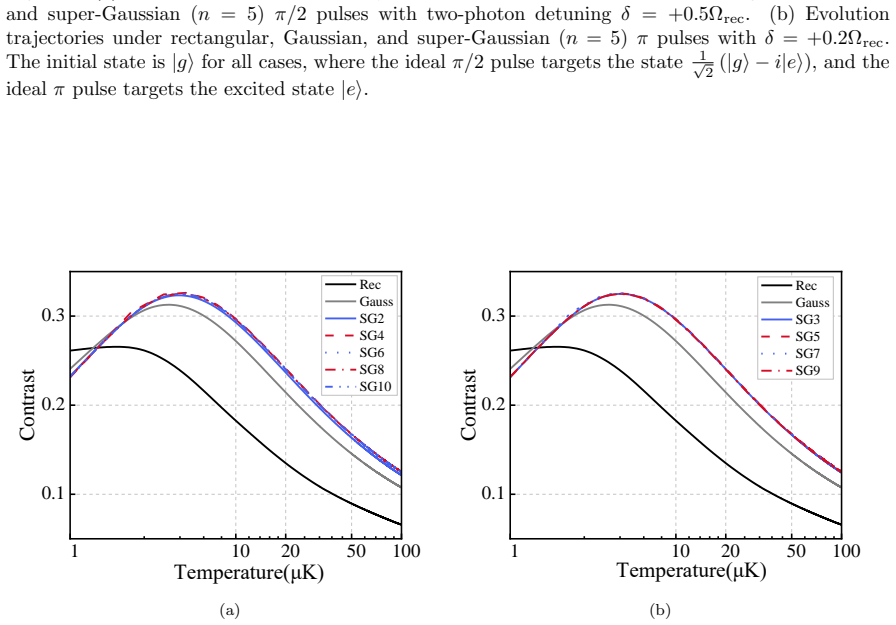
The central discovery is that smooth-edged pulse envelopes outperform both abrupt rectangular pulses and standard Gaussian pulses when atoms see a spread of two-photon detunings. For an $n$th-order super-Gaussian envelope $\exp[-(t^2/2\zeta^2)^n]$, orders $n=2$ to $10$ all give wider detuning tolerances than Gaussian pulses, with $n=4$ maximal: in Table 1, the $\pi$-pulse fidelity stays above 0.5 out to $1.74520\,\delta/\Omega$ and the $\pi/2$ pulse to $3.79894$, versus $0.80691$ and $1.73225$ for rectangular pulses. At 5 $\mu$K without velocity selection, the SG4 Mach-Zehnder sequence produces fringe contrast 0.1709, compared with 0.0895 for rectangular and 0.1523 for Gaussian pulses. The authors attribute the improvement to the suppression of spectral side lobes: smooth temporal edges concentrate pulse energy near resonance, so off-resonant, Doppler-shifted atoms are less perturbed. They also report that the fidelity saturates beyond $n=4$, so higher orders add little.
Load-bearing premise
The simulations use a two-level model of the Raman transition, and the paper acknowledges that the real $^{87}$Rb Raman transition is three-level; if adiabatic elimination of the intermediate state changes the relative robustness of the pulse shapes, the ordering SG4 $>$ Gaussian $>$ rectangular could fail.
Editorial extensions
If this is right
- Atom interferometers could run with thermal clouds at several microkelvin without velocity selection, gaining atomic flux and signal strength while keeping contrast, instead of requiring near-zero temperatures or post-selecting slow atoms.
- An experimental pulse shaper, an arbitrary waveform generator driving an acousto-optic modulator, can implement the super-Gaussian envelope directly, since the simulation's piecewise-constant segments mirror the AWG's discrete output.
- The SG4 pulse gives a high-fidelity operating region about 1.5 times larger than rectangular and 1.1 times larger than Gaussian in the combined detuning-versus-pulse-length error plane, so instruments become more tolerant of laser frequency drift and intensity fluctuations.
- Order $n=4$ is a practical optimum; going to $n=10$ gives essentially no additional contrast, so implementations can target SG4 specifically.
- At very low temperatures, below about 4 $\mu$K, Gaussian pulses are slightly better than super-Gaussian, so the envelope choice can be tailored to the operating temperature.
Reading between the lines
- Editorial extension: the same envelope argument should apply to other interferometer geometries, such as gravimeters, gyroscopes, and equivalence-principle tests, wherever Doppler detuning dominates, because the mechanism is not tied to the specific beam-splitter sequence.
- Editorial extension: a direct experimental test at 5 $\mu$K with an $^{87}$Rb source, comparing fringe contrast for rectangular versus SG4 envelopes, would verify the predicted 90% improvement; a much smaller improvement would point to three-level Raman dynamics that the two-level model omits.
- Editorial extension: the predicted saturation at $n=4$ suggests that further gains could come from jointly shaping the three pulses differently or optimizing pulse shape together with phase, directions the authors flag for future work.
- Editorial extension: the non-monotonic contrast peak near 4 $\mu$K implies a practical operating-temperature sweet spot, and treating the spatial beam profile as a second control parameter could trade intensity inhomogeneity against Doppler robustness.
Signed reviews
Editorial analysis
A structured set of objections, weighed in public.
Referee Report
Summary. The paper numerically compares rectangular, Gaussian, and super-Gaussian (orders 2-10) pulse shapes in a Mach-Zehnder light-pulse atom interferometer, using a two-level model with the Stoner transition-probability formula. The authors study how the fringe contrast degrades with atomic temperature, through a Doppler-shifted detuning distribution, and how the contrast is affected by pulse-length and detuning errors. They report that 4th-order super-Gaussian pulses give a 90.9% contrast improvement over rectangular pulses at 5 µK (0.1709 vs 0.0895) and a 12.2% improvement over Gaussian pulses, and that SG4 has a larger high-fidelity robustness region than rectangular or Gaussian pulses.
Significance. The paper addresses a practical problem in cold-atom interferometry and proposes a simple pulse-shape modification with a clear, systematic comparison over pulse order and temperature. If the numerical results are correct and the parameters are fully specified, the main finding—that moderate-order super-Gaussian pulses outperform both rectangular and Gaussian pulses for thermal clouds—would be useful guidance for experimental design. The explicit acknowledgment of the two-level approximation is commendable, though it leaves the quantitative reliability of the 90% claim open. The study is reproducible in principle, but the manuscript currently omits several details needed for the reader to verify the reported numbers.
major comments (4)
- [§3.3, Eq. (18), Table 2, Fig. 8] The text states that 'the initial temperature T was set to 5 µK, corresponding to an initial velocity of 7 mm/s for Rb atoms.' For 87Rb, the one-dimensional rms thermal velocity is sqrt(k_B T / m) ≈ 22 mm/s at 5 µK; 7 mm/s corresponds to about 0.5 µK. The manuscript does not specify how the velocity distribution in Eq. (21) is related to T, so the reader cannot determine whether the '5 µK' entries in Table 2 and Fig. 8 were computed with σ_v = 7 mm/s or σ_v ≈ 22 mm/s. This is load-bearing because the central 90.9% improvement claim (0.0895 → 0.1709 at '5 µK') depends on that temperature. Please state the exact relation and correct the inconsistency; if the simulation actually used σ_v = 7 mm/s for the '5 µK' points, the claim is not demonstrated at 5 µK.
- [Table 2 and §3.2] Table 2 reports contrast values as 'averages of 50 measurements' but provides no standard deviation or standard error. The simulation includes a finite atomic ensemble (5 × 10^4 atoms) and random sampling, so the reported contrasts carry statistical uncertainty. Without error bars or a convergence test, the headline 90.9% relative improvement could be within noise if the sampling is insufficient. Please add statistical uncertainties or demonstrate that 50 samples suffice for the quoted precision.
- [§3.1 and Fig. 6] The non-monotonic temperature dependence in Fig. 6 (peak near 4 µK) is attributed to competition between thermal Doppler spread and 'spatial intensity inhomogeneity' of the Raman beams, but the spatial model is not specified. The text mentions a beam radius of 10 mm and an initial cloud radius of 1.5 mm but does not define the transverse intensity profile (e.g., Gaussian, with which radius convention), how the cloud's spatial distribution is sampled, or how the local Rabi frequency scales with position. Without this information, the low-temperature branch of Fig. 6 and the claim that Gaussian pulses are slightly better there cannot be reproduced or assessed.
- [§3.1 and Fig. 7] The claim that SG4 'can maintain transition fidelity above 90% in a parameter region that is about 1.5 times larger than that of rectangular pulse sequences and 1.1 times larger than that of Gaussian pulse sequences' is not supported by a precise definition of the region or the fidelity measure. For π/2 pulses, a transition probability of 0.5 does not uniquely define the target superposition fidelity because the relative phase is also relevant. Please specify the exact threshold and the parameter ranges in Fig. 7, and report the actual region areas for Rec, Gaussian, and SG4 so the 1.5× and 1.1× ratios can be checked.
minor comments (4)
- [Throughout] Typos: 'Mach Zender' should be 'Mach-Zehnder' in the caption of Fig. 1; 'Gaussion' in Table 1 should be 'Gaussian'; the abstract contains '4th-order pulses achieving up to a 90% improvement...', which should read 'can achieve up to a 90% improvement'.
- [Eq. (21)] In Eq. (21), the symbol g(v) is not defined; it appears to denote the one-dimensional thermal velocity distribution from Eq. (18), but this should be stated explicitly at the point of use.
- [§3.2] The notation for the hyperfine states is garbled: '|S2S1/2, F=1⟩' should be written as e.g. |5^2S_{1/2}, F=1⟩.
- [Introduction and Conclusion] The two-level approximation is appropriately acknowledged, but the paper does not estimate the magnitude of three-level effects on the specific contrast values. Given the quantitative nature of the headline claim, a brief discussion of why the two-level model is expected to give the correct ordering of pulse shapes would strengthen the paper.
Circularity Check
No circularity: the contrast improvements are forward-simulated outputs, with no fitted parameter later called a prediction; the two-level approximation and the 5 µK/7 mm/s mapping are correctness caveats, not derivation-by-construction.
full rationale
The paper's central claim—that a 4th-order super-Gaussian pulse sequence raises fringe contrast from 0.0895 to 0.1709 at 5 µK (Table 2)—is obtained by forward integration of the two-level Bloch propagator (Eqs. 3–6, 9, 15) over a thermal velocity distribution (Eqs. 18, 21). No parameter is fitted to the target contrast and then reported as a prediction. The pulse shapes (Eq. 13), pulse-area conservation (Eq. 16), 'detuning tolerance' (§3.1), and contrast definition (§3.2) are openly stated metrics, not hidden inputs. The choice n=4 is a transparent scan over n=2..10; Tables 1–2 show all super-Gaussian orders behave nearly identically, so the headline is not an artifact of cherry-picking a fitted order. The only overlapping-author reference, [30] (Wang, Cheng, Liu, Lin), supports a motivational statement about rectangular-pulse Doppler limits alongside external refs [26,29], and the same point is re-derived in Fig. 4, so it is not load-bearing. The explicitly acknowledged two-level/three-level limitation is a modeling caveat, and the §3.3 statement that '5 µK, corresponding to an initial velocity of 7 mm/s for Rb atoms' is a numerical consistency concern (the 1D rms width at 5 µK is about 22 mm/s for 87Rb, while 7 mm/s corresponds to roughly 0.5 µK), but neither of these makes the derivation circular. The comparison is self-contained and externally checkable.
Assumptions & free parameters
free parameters (1)
- Super-Gaussian order n =
4 (selected post hoc)
assumptions (6)
- domain assumption The Raman transition can be described by a two-level model after adiabatic elimination of the intermediate state.
- domain assumption Pulse area is conserved: the integral of the effective Rabi frequency over time equals pi/2 or pi.
- domain assumption The atomic velocity distribution is Gaussian with standard deviation sqrt(k_B T / m) in one dimension, and the full cloud temperature is used without velocity selection.
- domain assumption The Raman laser has a finite transverse profile with 10 mm radius, and the atomic cloud has a 1.5 mm radius with a Gaussian spatial distribution.
- standard math Propagators can be accurately computed with a piecewise-constant approximation using N=128 time steps.
- standard math The Stoner et al. formula (Equation 10) for the Mach-Zehnder sequence transition probability is valid.
Cite this review
Pith. "Pith review of Robust Atom Interferometry with Super-Gaussian Pulses against Thermal Velocity Spread." pith.science (2026). https://pith.science/paper/IDVVVUGO
@misc{pith2026250515552,
  author       = {Pith},
  title        = {Pith review of: Robust Atom Interferometry with Super-Gaussian Pulses against Thermal Velocity Spread},
  year         = {2026},
  howpublished = {\url{https://pith.science/paper/IDVVVUGO}},
  note         = {Machine review of arXiv:2505.15552}
}
read the original abstract
Laser frequency fluctuation and atomic thermal motion can lead to errors in pulse duration and detuning in cold atom interferometry, thereby reducing measurement stability and fringe contrast. To address this issue, we investigate the use of super-Gaussian pulses, which are characterized by smooth temporal profiles and centralized energy distribution, in the beam-splitting and reflection stages of an atom interferometer. Through numerical simulations, we compare the performance of rectangular, Gaussian, and 2nd- to 10th-order super-Gaussian pulses subject to deviations in pulse duration and detuning. Our results show that both Gaussian and super-Gaussian pulses offer a significant advantage over traditional rectangular pulses, particularly under thermal conditions where velocity spread is prominent. We find that 4th-order pulses achieving up to a 90\% improvement in contrast over rectangular pulses under realistic conditions, and while their peak performance at very low temperatures is comparable to that of Gaussian pulses, they demonstrate enhanced robustness against combined detuning and pulse-length errors. These findings demonstrate that super-Gaussian pulse shaping is an effective method for enhancing the robustness of atom interferometers against errors induced by thermal motion.
Figures


Figures from the paper (5 more)




Reference graph
Works this paper leans on
-
[1]
Berman P R 1997Atom interferometry(Academic press)
-
[2]
Baudon J, Mathevet R and Robert J 1999Journal of Physics B: Atomic, Molecular and Optical Physics32R173–R195 ISSN 1361-6455 URLhttp://dx.doi.org/10.1088/0953-4075/32/15/ 201
-
[3]
Giovannetti V, Lloyd S and Maccone L 2004Science3061330–1336 ISSN 1095-9203 URLhttp: //dx.doi.org/10.1126/science.1104149
-
[4]
Rakholia A V, McGuinness H J and Biedermann G W 2014Physical Review Applied2ISSN 2331-7019 URLhttp://dx.doi.org/10.1103/PhysRevApplied.2.054012
-
[5]
Canuel B, Leduc F, Holleville D, Gauguet A, Fils J, Virdis A, Clairon A, Dimarcq N, Bord´ e C J, Landragin A and Bouyer P 2006Physical Review Letters97ISSN 1079-7114 URLhttp: //dx.doi.org/10.1103/PhysRevLett.97.010402
-
[6]
Dutta I, Savoie D, Fang B, Venon B, Garrido Alzar C, Geiger R and Landragin A 2016Physical Re- view Letters116ISSN 1079-7114 URLhttp://dx.doi.org/10.1103/PhysRevLett.116.183003
-
[7]
Gustavson T L, Landragin A and Kasevich M A 2000Classical and Quantum Gravity17 2385–2398 ISSN 1361-6382 URLhttp://dx.doi.org/10.1088/0264-9381/17/12/311
-
[8]
Louchet-Chauvet A, Farah T, Bodart Q, Clairon A, Landragin A, Merlet S and Santos F P D 2011New Journal of Physics13065025 ISSN 1367-2630 URLhttp://dx.doi.org/10.1088/ 1367-2630/13/6/065025
Show all 49 references
-
[9]
McGuirk J M, Foster G T, Fixler J B, Snadden M J and Kasevich M A 2002Physical Review A 65ISSN 1094-1622 URLhttp://dx.doi.org/10.1103/PhysRevA.65.033608
-
[10]
Rosi G, Cacciapuoti L, Sorrentino F, Menchetti M, Prevedelli M and Tino G 2015Physical Review Letters114ISSN 1079-7114 URLhttp://dx.doi.org/10.1103/PhysRevLett.114.013001
-
[11]
Rosi G, Sorrentino F, Cacciapuoti L, Prevedelli M and Tino G M 2014Nature510518–521 ISSN 1476-4687 URLhttp://dx.doi.org/10.1038/nature13433 15
-
[12]
Lamporesi G, Bertoldi A, Cacciapuoti L, Prevedelli M and Tino G M 2008Physical Review Letters 100ISSN 1079-7114 URLhttp://dx.doi.org/10.1103/PhysRevLett.100.050801
-
[13]
Asenbaum P, Overstreet C, Kim M, Curti J and Kasevich M A 2020Physical Review Letters125 ISSN 1079-7114 URLhttp://dx.doi.org/10.1103/PhysRevLett.125.191101
-
[14]
Wu X, Pagel Z, Malek B S, Nguyen T H, Zi F, Scheirer D S and M¨ uller H 2019Science Advances 5ISSN 2375-2548 URLhttp://dx.doi.org/10.1126/sciadv.aax0800
-
[15]
Bidel Y, Carraz O, Charri` ere R, Cadoret M, Zahzam N and Bresson A 2013Applied Physics Letters102ISSN 1077-3118 URLhttp://dx.doi.org/10.1063/1.4801756
-
[16]
org/10.1038/ncomms5009
van Frank S, Negretti A, Berrada T, B¨ ucker R, Montangero S, Schaff J F, Schumm T, Calarco T and Schmiedmayer J 2014Nature Communications5ISSN 2041-1723 URLhttp://dx.doi. org/10.1038/ncomms5009
-
[17]
J¨ ager G, Reich D M, Goerz M H, Koch C P and Hohenester U 2014Physical Review A90ISSN 1094-1622 URLhttp://dx.doi.org/10.1103/PhysRevA.90.033628
-
[18]
Daems D, Ruschhaupt A, Sugny D and Gu´ erin S 2013Physical Review Letters111ISSN 1079- 7114 URLhttp://dx.doi.org/10.1103/PhysRevLett.111.050404
-
[19]
Szigeti S S, Debs J E, Hope J J, Robins N P and Close J D 2012New Journal of Physics14 023009 ISSN 1367-2630 URLhttp://dx.doi.org/10.1088/1367-2630/14/2/023009
-
[20]
doi.org/10.1103/PhysRevA.77.023609
M¨ uller H, Chiow S w and Chu S 2008Physical Review A77ISSN 1094-1622 URLhttp://dx. doi.org/10.1103/PhysRevA.77.023609
-
[21]
Luo Y, Yan S, Hu Q, Jia A, Wei C and Yang J 2016The European Physical Journal D70ISSN 1434-6079 URLhttp://dx.doi.org/10.1140/epjd/e2016-70428-6
-
[22]
Peterson J P, Sarthour R S and Laflamme R 2020Physical Review Applied13ISSN 2331-7019 URLhttp://dx.doi.org/10.1103/PhysRevApplied.13.054060
-
[23]
doi.org/10.1103/PhysRevA.91.032325
Cross A W and Gambetta J M 2015Physical Review A91ISSN 1094-1622 URLhttp://dx. doi.org/10.1103/PhysRevA.91.032325
-
[24]
Vandersypen L M K and Chuang I L 2005Reviews of Modern Physics761037–1069 ISSN 1539- 0756 URLhttp://dx.doi.org/10.1103/RevModPhys.76.1037
-
[25]
Cummins H K, Llewellyn G and Jones J A 2003Physical Review A67ISSN 1094-1622 URL http://dx.doi.org/10.1103/PhysRevA.67.042308
-
[26]
Fang B, Mielec N, Savoie D, Altorio M, Landragin A and Geiger R 2018New Journal of Physics 20023020 ISSN 1367-2630 URLhttp://dx.doi.org/10.1088/1367-2630/aaa37c
-
[27]
Kovachy T, Chiow S w and Kasevich M A 2012Physical Review A86ISSN 1094-1622 URL http://dx.doi.org/10.1103/PhysRevA.86.011606
-
[28]
Cummins H K and Jones J A 2000New Journal of Physics2006 ISSN 1367-2630 URLhttp: //dx.doi.org/10.1088/1367-2630/2/1/006
-
[29]
L´ opez-Monjaraz C, Pe˜ na Vega H, Jim´ enez-Garc ´ ıa K, L´ opez Romero J M and Corzo N V 2024Phys- ica Scripta99125414 ISSN 1402-4896 URLhttp://dx.doi.org/10.1088/1402-4896/ad92b2
-
[30]
Wang Y, Cheng J, Liu Y and Lin T 2024Physical Review A109ISSN 2469-9934 URLhttp: //dx.doi.org/10.1103/PhysRevA.109.053501
-
[31]
Saywell J C, Kuprov I, Goodwin D, Carey M and Freegarde T 2018Physical Review A98ISSN 2469-9934 URLhttp://dx.doi.org/10.1103/PhysRevA.98.023625
-
[32]
Stoner R, Butts D, Kinast J and Timmons B 2011Journal of the Optical Society of America B 282418 ISSN 1520-8540 URLhttp://dx.doi.org/10.1364/JOSAB.28.002418 16
-
[33]
Dunning A, Gregory R, Bateman J, Cooper N, Himsworth M, Jones J A and Freegarde T 2014 Physical Review A90ISSN 1094-1622 URLhttp://dx.doi.org/10.1103/PhysRevA.90.033608
2014 doi
-
[34]
org/10.1103/PhysRevA.99.013402
Torosov B T and Vitanov N V 2019Physical Review A99ISSN 2469-9934 URLhttp://dx.doi. org/10.1103/PhysRevA.99.013402
-
[35]
Shore B W 2011Manipulating quantum structures using laser pulses(Cambridge University Press)
-
[36]
doi.org/10.1038/23655
Peters A, Chung K Y and Chu S 1999Nature400849–852 ISSN 1476-4687 URLhttp://dx. doi.org/10.1038/23655
-
[37]
Butts D L, Kinast J M, Timmons B P and Stoner R E 2011Journal of the Optical Society of America B28416 ISSN 1520-8540 URLhttp://dx.doi.org/10.1364/JOSAB.28.000416
-
[38]
1038/s41467-023-43374-0
Saywell J C, Carey M S, Light P S, Szigeti S S, Milne A R, Gill K S, Goh M L, Perunicic V S, Wilson N M, Macrae C D, Rischka A, Everitt P J, Robins N P, Anderson R P, Hush M R and Biercuk M J 2023Nature Communications14ISSN 2041-1723 URLhttp://dx.doi.org/10. 1038/s41467-023-43374-0
-
[39]
Zhao X, Liu X, Sun J, Xu Z, Hu Z and Yang X 2022The European Physical Journal D76ISSN 1434-6079 URLhttp://dx.doi.org/10.1140/epjd/s10053-022-00368-9
-
[40]
Dedes N, Saywell J, Carey M, Kuprov I and Freegarde T 2023Physical Review A108ISSN 2469-9934 URLhttp://dx.doi.org/10.1103/PhysRevA.108.053319
-
[41]
2019.163072
Karar A S 2019Optik194163072 ISSN 0030-4026 URLhttp://dx.doi.org/10.1016/j.ijleo. 2019.163072
2019
-
[42]
doi.org/10.3390/photonics7020032
Zhao Y, Wang S, Zhuang W and Li T 2020Photonics732 ISSN 2304-6732 URLhttp://dx. doi.org/10.3390/photonics7020032
-
[43]
Beirle S, Lampel J, Lerot C, Sihler H and Wagner T 2017Atmospheric Measurement Techniques 10581–598 ISSN 1867-8548 URLhttp://dx.doi.org/10.5194/amt-10-581-2017
2017 doi
-
[44]
1088/1464-4266/4/1/310
Brzozowski T M, Maczynska M, Zawada M, Zachorowski J and Gawlik W 2002Journal of Optics B: Quantum and Semiclassical Optics462–66 ISSN 1741-3575 URLhttp://dx.doi.org/10. 1088/1464-4266/4/1/310
-
[45]
Gillen-Christandl K, Gillen G D, Piotrowicz M J and Saffman M 2016Applied Physics B122 ISSN 1432-0649 URLhttp://dx.doi.org/10.1007/s00340-016-6407-y
-
[46]
Cheinet P, Canuel B, Pereira Dos Santos F, Gauguet A, Yver-Leduc F and Landragin A 2008 IEEE Transactions on Instrumentation and Measurement571141–1148 URLhttps://doi.org/ 10.1109/TIM.2007.915148
2008
-
[47]
org/10.3390/photonics2010164
Masoudnia L and Bleiner D 2015Photonics2164–183 ISSN 2304-6732 URLhttp://dx.doi. org/10.3390/photonics2010164
-
[48]
Chuang Y H, Zheng L and Meyerhofer D 1993IEEE Journal of Quantum Electronics29270–280 URLhttps://doi.org/10.1109/3.199268
-
[49]
Saywell J, Carey M, Kuprov I and Freegarde T 2020Physical Review A101ISSN 2469-9934 URL http://dx.doi.org/10.1103/PhysRevA.101.063625 17
Reviewed August 7, 2026 · model on record in the stance chip above.
Discussion (0). Continue with ORCID to comment.