Status report towards implementation of a Compton polarimeter at BEPCII
Pith reviewed 2026-05-12 01:55 UTC · model grok-4.3
The pith
The BEPCII Compton polarimeter has detected clear laser-electron scattering signals.
A machine-rendered reading of the paper's core claim, the machinery that carries it, and where it could break.
Core claim
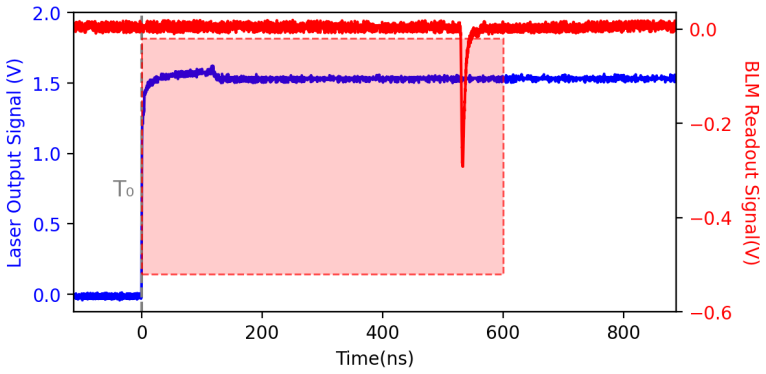
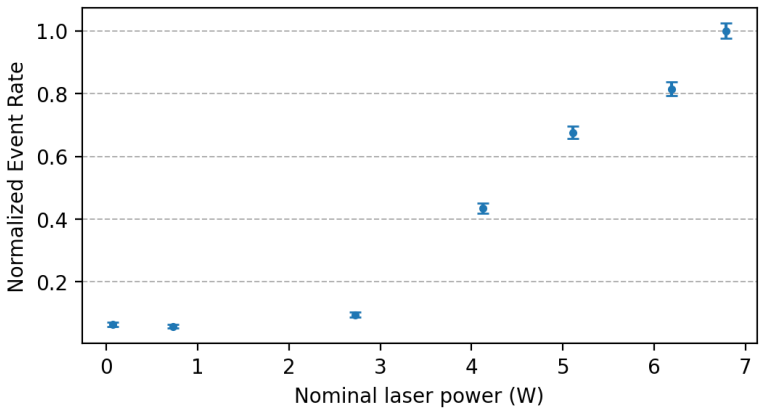
We report unambiguous observation of Compton interaction, discuss current limitations of the experimental setup and draw prospects for improvements and actual measurement of electron beam polarization in the near future.
What carries the argument
The laser-electron Compton scattering detection system, which uses backscattered photons to probe beam polarization.
If this is right
- The observed Compton signals confirm that the basic optical and detector chain functions as designed.
- Hardware upgrades to laser power, detector resolution, and background suppression will be required before polarization can be extracted.
- Once operational, the device will provide a diagnostic for beam polarization that can support BESIII physics analyses.
- The same approach can serve as a template for polarization monitors at other high-energy electron rings.
Where Pith is reading between the lines
- Successful implementation here would allow cross-checks with other polarization techniques used at storage rings.
- The current background environment at BEPCII sets a practical benchmark for what laser intensity and timing precision are needed in similar devices.
Load-bearing premise
The detected signal arises specifically from Compton scattering on the electron beam and not from unrelated backgrounds, and the listed hardware changes will enable polarization extraction.
What would settle it
A controlled test showing that the observed photon rate does not vary with electron beam current or laser intensity in the manner predicted by Compton kinematics would falsify the identification of the signal.
Figures



read the original abstract
Precision beam polarization measurements based on Compton polarimeters are essential for the physics program of future high-energy colliders. In order to prepare for these and to extend the scope of physics measurements of the BESIII experiment at the BEPCII, a diagnostic of electron beam transverse polarization at BEPCII is of interest. The design and status report of the commissioning, until July 2025, of this device is reported in this paper. We report unambiguous observation of Compton interaction, discuss current limitations of the experimental setup and draw prospects for improvements and actual measurement of electron beam polarization in the near future.
Editorial analysis
A structured set of objections, weighed in public.
Referee Report
Summary. The manuscript is a status report on the design and commissioning (through July 2025) of a Compton polarimeter at BEPCII for measuring electron beam transverse polarization in support of the BESIII physics program. It describes the experimental setup, reports an unambiguous observation of Compton interactions, discusses current hardware limitations, and outlines prospects for improvements to enable quantitative polarization measurements.
Significance. If the central observation claim holds with adequate supporting controls, the work provides a useful technical milestone toward implementing a practical beam polarization diagnostic at BEPCII. This would extend the measurement capabilities of BESIII and offer preparatory experience relevant to polarization diagnostics at future high-energy colliders.
major comments (1)
- [Abstract] Abstract: The headline claim of an 'unambiguous observation of Compton interaction' is load-bearing for the paper but is not accompanied by the necessary experimental controls. The status report does not present on/off-laser rate comparisons, count-rate scaling with beam current and laser intensity, or deposited-energy/timing spectra demonstrating consistency with the Compton edge kinematics at the BEPCII beam energy. Without these, the attribution to laser-electron Compton scattering remains open to beam-gas bremsstrahlung, synchrotron radiation, or detector artifacts.
minor comments (1)
- The manuscript would benefit from a dedicated results subsection that tabulates the observed count rates, statistical significance, and any background-subtraction procedure even at the current commissioning stage.
Simulated Author's Rebuttal
We thank the referee for the careful review and constructive comments on our status report. We address the major comment below and will revise the manuscript accordingly to strengthen the presentation of our observations.
read point-by-point responses
-
Referee: [Abstract] Abstract: The headline claim of an 'unambiguous observation of Compton interaction' is load-bearing for the paper but is not accompanied by the necessary experimental controls. The status report does not present on/off-laser rate comparisons, count-rate scaling with beam current and laser intensity, or deposited-energy/timing spectra demonstrating consistency with the Compton edge kinematics at the BEPCII beam energy. Without these, the attribution to laser-electron Compton scattering remains open to beam-gas bremsstrahlung, synchrotron radiation, or detector artifacts.
Authors: We agree that these controls are essential to support the claim of an unambiguous observation. The current manuscript describes the detection of signals during laser-electron interactions at BEPCII but does not explicitly include the requested comparisons, scaling plots, or detailed spectra. In the revised version, we will add on/off-laser rate comparisons, count-rate scaling with beam current and laser intensity, and deposited-energy/timing spectra to demonstrate consistency with the expected Compton edge kinematics. These data from the commissioning period will be presented in an expanded section on the observation to address potential alternative explanations. revision: yes
Circularity Check
No circularity: experimental status report with direct observations only
full rationale
This is a commissioning status report on a Compton polarimeter at BEPCII. It contains no derivations, equations, fitted parameters, predictions, or self-citations that could form a load-bearing chain. The central claim of 'unambiguous observation of Compton interaction' rests on raw experimental data (laser on/off comparisons, count rates, spectra) rather than any reduction to prior inputs by construction. No self-definitional loops, fitted-input predictions, or ansatz smuggling are present. The work is self-contained against external benchmarks and receives the default non-finding.
Axiom & Free-Parameter Ledger
axioms (1)
- standard math Compton scattering cross section depends on the polarization state of the incident electron beam
discussion (0)
Sign in with ORCID, Apple, or X to comment. Anyone can read and Pith papers without signing in.