REVIEW 4 major objections 5 minor 17 references
Improving the Results of De novo Peptide Identification via Tandem Mass Spectrometry Using a Genetic Programming-based Scoring Function for Re-ranking Peptide-Spectrum Matches
T0 review · 4 major / 5 minor · reviewed 2026-08-14 · deepseek-v4-flash
Pith's one-line read A genetic-programming scoring function re-ranks candidate peptide-spectrum matches and raises correct de novo identifications from 67 to 79 spectra out of 120.
desk verdict A modest but real GP-based PSM rescoring paper; the 10% FPR claim needs better statistical backing and an explicit disjointness statement. read the letter →
The pith
A machine-rendered reading of the paper's core claim, the machinery that carries it, and where it could break.
The reading
What carries the argument
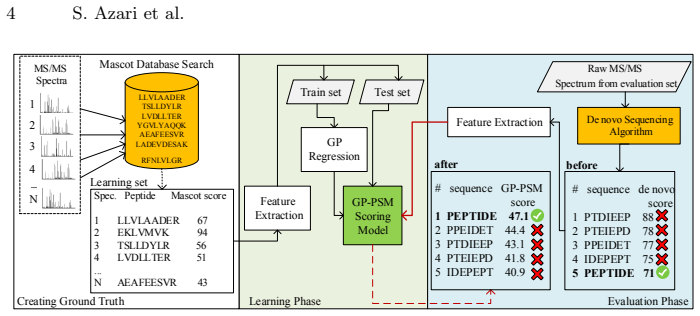
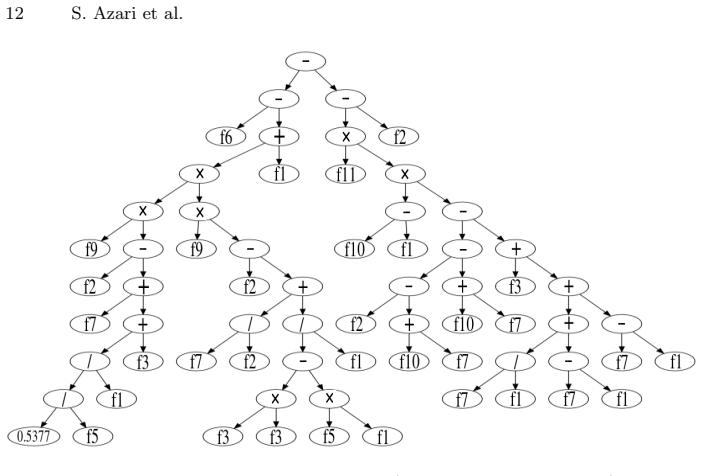
The central object is the GP-evolved scoring function, a tree-structured arithmetic expression over eleven PSM features: matched peak intensity, numbers of matched and unmatched peaks, precursor mass difference, consecutive b-ion and y-ion matches, cosine similarity, Euclidean distance, Hamming distance, and two SEQUEST-style fixed- and variable-length vector scores. The GP runs as symbolic regression: fitness is the relative sum of squared error between the evolved score and the known database-search confidence score, and the terminal set includes the eleven features plus constants, with protected arithmetic as the function set. The evolved tree re-scores each candidate peptide in a spectrum's output list; the highest-scoring candidate is then reported as the identification. Its work is to compress the eleven weak individual similarity signals into one ranking that separates the true peptide from near-synonymous decoys.
What would settle it
Re-apply the learned function to a fresh, independently created set of MS/MS spectra with known peptide identities and count top-ranked correct matches; if the improvement over the original de novo rankings is not around 10 percentage points, the paper's central claim fails.
Extended reading notes
Core claim
The central claim is that a PSM scoring function evolved by genetic programming can serve as a post-processing re-ranker that outperforms the raw confidence scores of a de novo sequencing algorithm and also beats two regression baselines, Random Forest and Support Vector Regression. The learned function combines eleven spectrum-peptide similarity features into a single score, and when each spectrum's five candidate peptides are re-ranked by that score, the correct peptide reaches the top rank more often than it did under the original de novo score. Concretely, on 120 benchmark spectra the method identifies 79 spectra correctly versus 67 before re-ranking, identifies 20 of the 25 correct matches that the original tool had ranked below the top, and reduces the false positive rate from 0.44 to 0.34. The paper presents this as evidence that GP's nonlinear, feature-selecting symbolic expressions are better discriminators for full-length peptide assignments than hand-built or linear scoring functions.
Load-bearing premise
The scoring function is trained on matches produced by a database search and then applied to matches produced by a different de novo sequencing algorithm; if those two kinds of matches score differently on the same features, the learned function will not transfer.
Editorial extensions
If this is right
- De novo peptide identification can be improved in a post-processing step, without altering the sequencing algorithm or acquisition parameters.
- A 10-percentage-point false-positive-rate reduction on 120 spectra implies that re-ranking with a learned scorer can recover correct matches that the original de novo tool had ranked below the top.
- The GP-evolved scoring function can be reused as a fitness function inside other de novo sequencing algorithms, not just as a post-hoc re-ranker.
- The explicit feature selection in the evolved tree identifies which spectral properties matter most, making the scoring function interpretable rather than a black box.
Reading between the lines
- A natural extension is to train the same re-ranker on decoy-based labels from database search, removing the need for a validated ground-truth set and allowing much larger training corpora.
- Because the scorer never uses the original de novo confidence score, the same model could be applied to candidate lists from any de novo tool; testing on other tools would reveal whether the 10% gain is tied to one tool's candidate distributions.
- The fact that most missed correct matches were recovered from lower ranks suggests the bottleneck in de novo identification may be ranking rather than candidate generation, a direction the paper does not explicitly pursue.
Signed reviews
Editorial analysis
A structured set of objections, weighed in public.
Referee Report
Summary. The paper proposes GP-PSM, a genetic-programming symbolic-regression scoring function for re-ranking peptide-spectrum matches. It extracts 11 features per PSM and regresses Mascot confidence scores on a learning set of 10,000 MS/MS spectra from the Wessels et al. benchmark, then applies the evolved function to re-score five candidate peptides per spectrum from PEAKS de novo sequencing on 120 evaluation spectra. The central empirical claim is that GP-PSM raises correct top-1 identifications from 67 to 79 of 120 spectra and lowers FPR from 0.44 to 0.34, outperforming RF and SVR re-ranking. The paper also analyzes the evolved tree for feature selection and interpretability.
Significance. If the reported 10-percentage-point FPR reduction is robust, the contribution is a useful, interpretable nonlinear PSM scoring function and a demonstration that GP-based re-ranking can outperform RF/SVR on a real benchmark. The use of a public benchmark with known ground truth, explicit feature definitions, comparison with two ML baselines, and interpretability analysis are strengths. The main limitations are statistical: the headline improvement rests on 120 spectra and a single GP individual selected from 30 runs, with no confidence intervals or significance tests, and the learning/evaluation split is not shown to be disjoint. These issues are fixable, but until addressed the central empirical claim is not established at the standard expected for a journal paper.
major comments (4)
- [Section 4.1 / Table 2] The learning set (10,000 spectra) and evaluation set (120 spectra) are both selected from the same full factorial benchmark dataset, but the text never states that the two sets are disjoint. Because the GP model is trained to predict the Mascot score of the known peptide for each training spectrum, any evaluation spectrum that also appeared in training would give the model direct access to the correct answer for that spectrum. This makes the abstract's 10% improvement claim potentially an artifact of training/evaluation overlap. Please state the disjointness explicitly and provide spectrum identifiers or a reproducible split so that the separation can be audited.
- [Section 5.2 / Table 5] No confidence intervals or significance tests are reported for the evaluation results. On n=120, the GP/SVR difference is 79 versus 72 correct spectra (FPR 0.34 versus 0.40), a gap well within plausible sampling variability; a paired test such as McNemar's test, or a bootstrap confidence interval on the FPR difference, is needed before 'GP-PSM outperforms RF and SVR' can be supported. In addition, Section 5.1 states that the best GP individual is selected from 30 runs by training RSS, so evaluating that chosen individual on a single 120-spectrum set inherits selection bias; please report the variance of the evaluation metrics across the 30 runs.
- [Section 4.3] The transfer assumption is load-bearing but untested. The scoring function is learned from PSMs produced by Mascot database search and applied to PSMs produced by PEAKS de novo sequencing; Section 4.3 only explains that the two sets differ, without any quantitative evidence that their feature distributions overlap. Please provide diagnostics such as feature-distribution comparisons or a cross-training experiment (e.g., train on PEAKS PSMs from a disjoint subset and evaluate), or temper the generalization claim accordingly.
- [Section 4.2 / Table 5] The evaluation lacks a baseline that re-ranks the same PEAKS candidate lists using a simple linear combination of the same features, or using raw Mascot scores where available. Such a baseline would isolate the contribution of the GP-evolved nonlinear form from the generic benefit of re-scoring with additional intensity features, and it is needed to support the claim that the GP representation itself is responsible for the observed improvement.
minor comments (5)
- [Section 4.2 / Eq. (2)] The sentence preceding Eq. (2) says that FPR is 'the ratio of the number of correct matches to the total number of MS/MS spectra', but the equation defines FPR as FP/N, i.e., the proportion of incorrect top-ranked PSMs. Please correct the sentence so that it matches the equation.
- [Section 3.1] The text refers to 'SeqFix and SeqVar, (f11,f12)', but Table 1 lists f10 as SeqFix and f11 as SeqVar; the numbering and naming should be aligned consistently.
- [Section 3.1] Please specify the bin width for the fixed-length vectorization features f7-f10 and how the 4,000 bins are defined over the m/z range; without this detail the features are not fully reproducible.
- [Section 5.2] There are small typos: 'evolution set' should be 'evaluation set', and 'did not have the change' should be 'did not have the chance'.
- [Table 5] Please state explicitly whether 'FPR reduction after post-processing' is reported in absolute percentage points (e.g., 0.10 for GP-PSM) or as a relative reduction; the current text mixes '10% more spectra' with the absolute FPR change from 0.44 to 0.34.
Circularity Check
No substantive circularity; the FPR improvement is an independent transfer result, with only a non-load-bearing self-citation.
full rationale
GP-PSM learns a symbolic-regression model f(X) mapping eleven PSM features to Mascot scores on a 10,000-spectrum learning set (Section 3, Fig. 1), and the reported FPR reduction is obtained by applying this fixed model to PEAKS candidate lists on a separate 120-spectrum evaluation set (Tables 4-5). The evaluation target is the rank of the known correct peptide; no evaluation PSM enters the regression and no parameter is adjusted to the evaluation FPR, so the 10% improvement is an empirical transfer result, not an identity. The only self-citation, [12], supplies provenance for six input features and is not load-bearing. The absence of an explicit statement that the learning and evaluation spectra are disjoint, and the use of Mascot-derived labels both for training and as ground truth, are correctness or validation concerns; under the stated hard rules, without a quoted identity or a fitted parameter renamed as a prediction, they do not establish circularity.
Assumptions & free parameters
free parameters (7)
- GP population size =
300
- GP maximum generations =
100
- Crossover rate =
0.9
- Mutation rate =
0.1
- Tournament size =
5
- Fragment ion tolerance for variable-length vectorization =
0.5 Da
- Fixed vector length for features f7 to f10 =
4000 bins
assumptions (5)
- domain assumption Mascot database search identifications with q-value <= 0.01 are correct ground truth.
- domain assumption A scoring function trained on Mascot-generated PSMs transfers to PEAKS de novo candidate PSMs.
- domain assumption The 11 features in Table 1 are sufficient to discriminate correct from incorrect PSMs.
- domain assumption The selected spectrum population (doubly charged, precursor mass <=1150 Da, peptide length 7-12, no modifications) is the intended scope.
- domain assumption Arithmetic operators with protected division are sufficient to express a good scoring function.
Cite this review
Pith. "Pith review of Improving the Results of De novo Peptide Identification via Tandem Mass Spectrometry Using a Genetic Programming-based Scoring Function for Re-ranking Peptide-Spectrum Matches." pith.science (2026). https://pith.science/paper/IFD7IYW6
@misc{pith2026190808010,
  author       = {Pith},
  title        = {Pith review of: Improving the Results of De novo Peptide Identification via Tandem Mass Spectrometry Using a Genetic Programming-based Scoring Function for Re-ranking Peptide-Spectrum Matches},
  year         = {2026},
  howpublished = {\url{https://pith.science/paper/IFD7IYW6}},
  note         = {Machine review of arXiv:1908.08010}
}
read the original abstract
De novo peptide sequencing algorithms have been widely used in proteomics to analyse tandem mass spectra (MS/MS) and assign them to peptides, but quality-control methods to evaluate the confidence of de novo peptide sequencing are lagging behind. A fundamental part of a quality-control method is the scoring function used to evaluate the quality of peptide-spectrum matches (PSMs). Here, we propose a genetic programming (GP) based method, called GP-PSM, to learn a PSM scoring function for improving the rate of confident peptide identification from MS/MS data. The GP method learns from thousands of MS/MS spectra. Important characteristics about goodness of the matches are extracted from the learning set and incorporated into the GP scoring functions. We compare GP-PSM with two methods including Support Vector Regression (SVR) and Random Forest (RF). The GP method along with RF and SVR, each is used for post-processing the results of peptide identification by PEAKS, a commonly used de novo sequencing method. The results show that GP-PSM outperforms RF and SVR and discriminates accurately between correct and incorrect PSMs. It correctly assigns peptides to 10% more spectra on an evaluation dataset containing 120 MS/MS spectra and decreases the false positive rate (FPR) of peptide identification.
Figures
Reference graph
Works this paper leans on
-
[1]
Hao Yang, Hao Chi, Wen-Jing Zhou, Wen-Feng Zeng, Chao Liu, Rui-Min Wang, Zhao-Wei Wang, Xiu-Nan Niu, Zhen-Lin Chen, and Si-Min He. psite: Amino acid confidence evaluation for quality control of de novo peptide sequencing and modification site localization. Journal of proteome research , 17(1):119–128, 2017
work page 2017
-
[2]
Introduction to computational proteomics
Jacques Colinge and Keiryn L Bennett. Introduction to computational proteomics. PLoS Comput Biol , 3(7):e114, 2007. Genetic Programming for Scoring Peptide-Spectrum Matches 13
work page 2007
-
[3]
David Feny¨ o and Ronald C Beavis. A method for assessing the statistical sig- nificance of mass spectrometry-based protein identifications using general scoring schemes. Analytical chemistry, 75(4):768–774, 2003
work page 2003
-
[4]
Andrew Keller, Alexey I Nesvizhskii, Eugene Kolker, and Ruedi Aebersold. Em- pirical statistical model to estimate the accuracy of peptide identifications made by MS/MS and database search. Analytical chemistry, 74(20):5383–5392, 2002
work page 2002
-
[5]
Genetic programming as a model induction engine
Vladan Babovic and Maarten Keijzer. Genetic programming as a model induction engine. Journal of Hydroinformatics , 2(1):35–60, 2000
work page 2000
-
[6]
Pareto-front exploitation in symbolic regres- sion
Guido Smits and Mark Kotanchek. Pareto-front exploitation in symbolic regres- sion. Genetic programming theory and practice II , pages 283–299, 2005
work page 2005
-
[7]
Building credit scoring models using genetic programming
Chorng-Shyong Ong, Jih-Jeng Huang, and Gwo-Hshiung Tzeng. Building credit scoring models using genetic programming. Expert Systems with Applications , 29(1):41–47, 2005
work page 2005
-
[8]
Forecasting energy consumption using a grey model improved by incorporating genetic programming
Yi-Shian Lee and Lee-Ing Tong. Forecasting energy consumption using a grey model improved by incorporating genetic programming. Energy Conversion and Management, 52(1):147–152, 2011
work page 2011
Show all 17 references
-
[9]
Search based software engineering for software product line engineering: a survey and directions for future work
Mark Harman, Yue Jia, Jens Krinke, William B Langdon, Justyna Petke, and Yuanyuan Zhang. Search based software engineering for software product line engineering: a survey and directions for future work. In Proceedings of the 18th International Software Product Line Conference-...
2014
-
[10]
Genetic programming: An introduction and tutorial, with a survey of techniques and appli- cations
William B Langdon, Riccardo Poli, Nicholas F McPhee, and John R Koza. Genetic programming: An introduction and tutorial, with a survey of techniques and appli- cations. In Computational intelligence: A compendium , pages 927–1028. Springer, 2008
2008
-
[11]
Peptide fragmentation overview
Richard L Beardsley Herrmann and Amye Hilderbrand. Peptide fragmentation overview. Principles of Mass Spectrometry Applied to Biomolecules , 10:279, 2006
2006
-
[12]
GA-Novo: De novo peptide sequencing via tandem mass spectrometry using genetic algorithm
Samaneh Azari, Bing Xue, Mengjie Zhang, and Lifeng Peng. GA-Novo: De novo peptide sequencing via tandem mass spectrometry using genetic algorithm. In Applications of Evolutionary Computation , pages 72–89, Cham, 2019
2019
-
[13]
An approach to correlate tandem mass spectral data of peptides with amino acid sequences in a protein database
Jimmy K Eng, Ashley L McCormack, and John R Yates. An approach to correlate tandem mass spectral data of peptides with amino acid sequences in a protein database. Journal of the American Society for Mass Spectrometry , 5(11):976–989, 1994
1994
-
[14]
DEAP: Evolutionary algorithms made easy.Jour- nal of Machine Learning Research , 13:2171–2175, 2012
F´ elix-Antoine Fortin, Fran¸ cois-Michel De Rainville, Marc-Andr´ e Gardner, Marc Parizeau, and Christian Gagn´ e. DEAP: Evolutionary algorithms made easy.Jour- nal of Machine Learning Research , 13:2171–2175, 2012
2012
-
[15]
A comprehensive full factorial lc-ms/ms proteomics benchmark data set
Hans JCT Wessels, Tom G Bloemberg, Maurice van Dael, Ron Wehrens, Lutgarde Buydens, Lambert P van den Heuvel, and Jolein Gloerich. A comprehensive full factorial lc-ms/ms proteomics benchmark data set. Proteomics, 12(14):2276–2281, 2012
2012
-
[16]
Probability-based protein identification by search- ing sequence databases using mass spectrometry data.electrophoresis, 20(18):3551– 3567, 1999
John S Cottrell and U London. Probability-based protein identification by search- ing sequence databases using mass spectrometry data.electrophoresis, 20(18):3551– 3567, 1999
1999
-
[17]
Peaks: powerful software for peptide de novo sequencing by tandem mass spectrometry
Bin Ma, Kaizhong Zhang, Christopher Hendrie, Chengzhi Liang, Ming Li, Amanda Doherty-Kirby, and Gilles Lajoie. Peaks: powerful software for peptide de novo sequencing by tandem mass spectrometry. Rapid communications in mass spec- trometry, 17(20):2337–2342, 2003
2003
Reviewed August 14, 2026 · model on record in the stance chip above.
Discussion (0). Continue with ORCID to comment.