REVIEW 4 major objections 4 minor 126 references
A Multi-Data Approach to Open Clusters: Roslund 3 and Ruprecht 174 in CCD UBV and Gaia DR3 Context
T0 review · 4 major / 4 minor · reviewed 2026-08-06 · deepseek-v4-flash
Pith's one-line read Two independent methods agree on the ages, distances, and reddening of open clusters Roslund 3 and Ruprecht 174.
desk verdict Two more clusters added to the census with fresh UBV photometry, but the two-method agreement is less independent than claimed. read the letter →
The pith
A machine-rendered reading of the paper's core claim, the machinery that carries it, and where it could break.
The reading
What carries the argument
The argument runs on two parallel parameter-estimation pipelines that share the same PARSEC stellar models and the same Gaia-based membership list. The classical pipeline first fits a zero-age main sequence to the $U-B$ versus $B-V$ two-color diagram using the empirical relation $E(U-B)/E(B-V)=0.72+0.05\,E(B-V)$, then derives photometric metallicities from the UV-excess of a handful of F-G main-sequence stars via the calibration of Karaali et al., and finally fits PARSEC isochrones to the color-magnitude diagrams with reddening and metallicity held fixed. The MCMC pipeline instead assigns one walker per member star and samples a global distance, extinction, age, and metallicity jointly, using a Delaunay-interpolated PARSEC isochrone grid. Agreement between these two otherwise independent routes is the paper's evidence that the derived parameters are reliable.
What would settle it
Take high-resolution spectra of roughly twenty member stars in each cluster, measure [Fe/H] directly, and re-fit the color-magnitude diagrams with the spectroscopic metallicity held fixed; if the resulting ages or distances move by more than the quoted uncertainties, the assumed metallicity and reddening are biased.
Extended reading notes
Core claim
The central claim is that two previously poorly characterized open clusters now have well-defined astrophysical parameters, and that a classical two-step photometric analysis and a simultaneous MCMC analysis return consistent answers. Roslund 3 is a young cluster at about 60 Myr, while Ruprecht 174 is a middle-aged cluster at about 520 Myr, both at roughly 1.7 and 2.4 kpc, respectively, with near-solar metallicities and moderate reddening. The paper further claims that both clusters are dynamically relaxed and mass-segregated, with present-day mass function slopes consistent with the canonical Salpeter value, and that their orbits place them in the thin disk within the Solar circle.
Load-bearing premise
The classical distance and age solution treats reddening and metallicity as known constants, with metallicity coming from only 9 to 10 F-G stars and reddening from an empirical relation, so a bias in either would shift the ages and distances systematically.
Editorial extensions
If this is right
- Roslund 3 and Ruprecht 174 can now serve as benchmark clusters for studies of young versus middle-aged open cluster evolution, with distances and reddening consistent with Gaia parallax-based estimates.
- The classical UBV method, which does not require spectroscopy, is shown to yield parameters consistent with a full MCMC fit, supporting its continued use for large samples of poorly studied clusters.
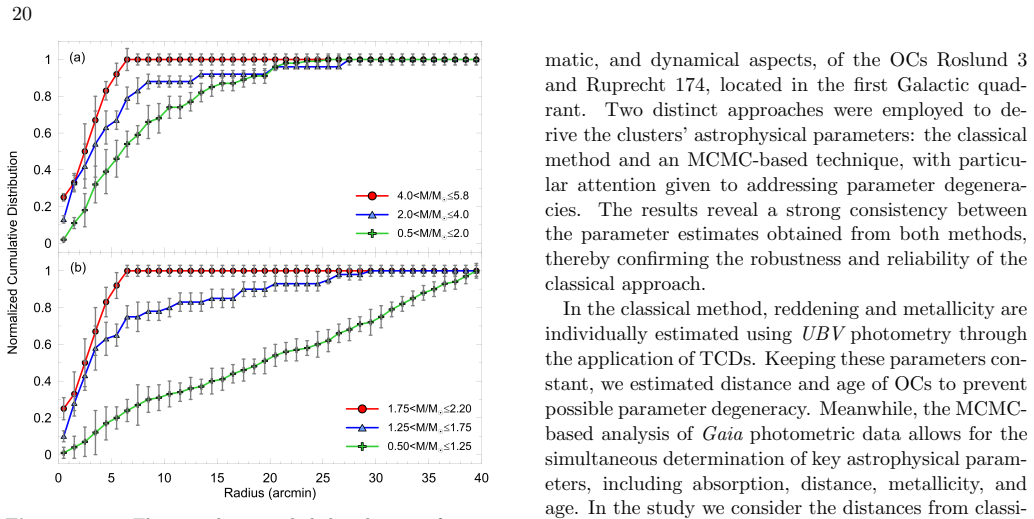
- Both clusters are claimed to be dynamically relaxed and mass-segregated, meaning their current stellar distributions already reflect internal dynamical evolution rather than only their initial conditions.
- The near-solar metallicities and thin-disk orbits place both clusters in the local disk population, making them suitable anchors for Galactic metallicity-gradient and orbital studies.
Reading between the lines
- If the classical method is as reliable as this agreement suggests, it could be applied cheaply to many dozens of sparse clusters that lack spectroscopic data, producing a homogeneous parameter catalog.
- Because the MCMC and classical analyses share the PARSEC models and the same membership list, their agreement does not fully break model-dependent degeneracies; an independent spectroscopic metallicity measurement for more member stars would be a stronger test.
- The claimed mass segregation rests on 198 and 397 member stars with moderate Kolmogorov-Smirnov confidence levels, so deeper photometry that recovers more low-mass stars could either strengthen or weaken the conclusion.
- The traceback orbital radii suggest both clusters formed inside the Solar circle; checking whether their birth radii match local spiral-arm structure could link these two clusters to specific star-forming regions.
Editorial analysis
A structured set of objections, weighed in public.
Referee Report
Summary. The paper presents a multi-wavelength, multi-method study of two Galactic open clusters, Roslund 3 and Ruprecht 174, using new CCD UBV photometry from the TUG T100 telescope together with Gaia DR3 astrometry and photometry. Membership probabilities are assigned with UPMASK, and cluster parameters are derived by two routes: a 'classical' approach in which reddening and metallicity are fixed from UBV two-color diagrams and then PARSEC isochrones are fitted to the CMD, and an MCMC approach that simultaneously fits distance, G-band extinction, age, and metallicity to Gaia photometry. The paper reports E(B-V)=0.410±0.046 mag, d=1687±121 pc, age 60±6 Myr, and [Fe/H]=0.030±0.065 dex for Roslund 3, and E(B-V)=0.615±0.042 mag, d=2385±163 pc, age 520±50 Myr, and [Fe/H]=0.041±0.064 dex for Ruprecht 174. It also derives radial velocities, Galactic orbits, present-day mass functions, relaxation times, and mass segregation diagnostics, concluding that both clusters are relaxed, mass-segregated, thin-disk members within the Solar circle. The headline claim is that agreement between the classical and MCMC parameter estimates confirms the reliability of both approaches.
Significance. If the results hold, the paper provides a useful homogeneous parameter set for two relatively under-studied open clusters and demonstrates a workable strategy for combining UBV photometry with Gaia DR3. The strengths are the new ground-based UBV dataset, use of UPMASK for membership, explicit comparison of classical and MCMC parameter estimation, and the incorporation of orbital and dynamical analyses. The headline distances and ages are broadly consistent with recent Gaia-based literature values, which gives external plausibility to the measurements. However, the paper's central epistemological claim that the two methods are independent and therefore confirm each other is not justified, because both methods share the same PARSEC isochrone grid and the same membership-filtered sample. The mass-segregation statistics appear to be reported with inverted significance, and the astrometric distances ignore the Gaia parallax zero-point. These issues do not necessarily invalidate the headline parameters, but they need to be fixed before the conclusions can be accepted as stated.
major comments (4)
- [Abstract; Sections 3.3, 4.3, 4.4.1, and 7] The central robustness claim that agreement between the classical and MCMC methods 'confirms their reliability' is not supported as stated, because both channels share the PARSEC isochrone grid and the same Gaia-based membership list. Section 3.3 pre-filters members using a PARSEC ZAMS, Section 4.3 fits PARSEC isochrones to the UBV CMD, and Section 4.4.1 samples PARSEC CMD 3.8 models in the MCMC; a common systematic in PARSEC colors, bolometric corrections, or the age scale would therefore produce agreement without validating the absolute calibration. The apparent consistency in metallicity is weak: Table 7 gives Z = 0.0159^{+0.0045}_{-0.0165} for Roslund 3 and Z = 0.0166^{+0.0039}_{-0.0208} for Ruprecht 174, so the Z posteriors are nearly unconstrained. I recommend rephrasing the conclusion as a consistency check rather than an independent validation, and adding an explicit discussion of the shared model dependence.
- [Section 6.3] The K-S test results are reported in a way that appears to invert their meaning. The text states confidence levels of 71%, 84%, and 75% for Roslund 3 and 70%, 85%, and 74% for Ruprecht 174, and then says the null hypothesis 'can be rejected with moderate statistical confidence' at P<0.05. If these numbers are p-values, values above 0.05 mean the null hypothesis cannot be rejected; if they are confidence levels, the corresponding p-values are not given. In either case, the reported statistics do not support the claim of 'clear signs of mass segregation' at the 95% level, and the cumulative distributions in Figure 15 alone are insufficient. Please report the actual K-S D statistics and p-values and redraw the conclusion accordingly.
- [Section 3.3 and Table 9] The astrometric distances d_pi = 1745 ± 12 pc and 2427 ± 18 pc are quoted to high precision from the parallax histograms without any correction for the Gaia DR3 parallax zero-point. The zero-point offset, typically around -0.02 to -0.05 mas for stars in these magnitude and color ranges, is several times larger than the quoted statistical errors and would shift the distances by tens to over a hundred parsecs. Since these distances are presented as an independent check on the isochrone distances in Section 7, item 5, the zero-point should be applied or the comparison should explicitly acknowledge this systematic.
- [Sections 4.1-4.3] The classical method is described as determining parameters independently, but the reddening derived in Section 4.1 is reused in Section 4.2 to deredden the F-G stars before computing [Fe/H] and in Section 4.3 to set A_V for the distance modulus. A systematic error in the TCD fit, for example in the adopted solar-abundance ZAMS or in the empirical slope E(U-B)/E(B-V)=0.72+0.05E(B-V), therefore propagates coherently into [Fe/H] and into the distance/age solution. The metallicity calibration also rests on only nine F-G stars for Roslund 3 and ten for Ruprecht 174. I request an explicit propagation of this systematic and a sensitivity test, such as repeating the classical fit with E(B-V) shifted by ±0.05 mag, rather than treating the classical and MCMC results as fully independent.
minor comments (4)
- [Abstract and Section 1] The abstract contains the typo 'Ruprecht1 74' and Section 1 contains 'nomeclature'; both should be corrected to 'Ruprecht 174' and 'nomenclature'.
- [Section 6.3] The text refers to 'Ruprecht 147' when reporting the second cluster's K-S confidence levels; this should be 'Ruprecht 174'.
- [Section 4.2] The sentence 'these stars ... identified nine F-G main-sequence stars in total in Roslund 3 and Ruprecht 174' is ambiguous; the text subsequently lists nine stars for Roslund 3 and ten for Ruprecht 174, so the wording should specify the per-cluster counts.
- [Section 4.3] The age uncertainties are described as coming from fitting low- and high-age isochrones to the observed scatter; this visual procedure should be stated more explicitly, and the corresponding isochrone curves in Figure 10 should be identified in the figure caption.
Circularity Check
No circularity: the classical and MCMC parameter estimates are independent fits to distinct data sets, and the distances are externally validated by Gaia parallaxes.
full rationale
The paper's claimed derivation chain does not reduce any fitted quantity to its own input. Membership probabilities are computed by UPMASK from Gaia astrometry (positions, parallaxes, proper motions), independently of the photometric isochrone fits. In the classical channel, E(B−V) is obtained by fitting the Sung et al. (2013) empirical solar-metallicity ZAMS to the UBV two-color diagram; [Fe/H] then comes from the Karaali et al. (2011) UV-excess calibration applied to dereddened F-G stars; only after these are fixed are PARSEC isochrones used to read distance and age from the CMD. In the MCMC channel, AG, distance, Z, and age are jointly sampled against Gaia (GBP−GRP) photometry with a PARSEC CMD 3.8 grid, with no classical values imposed as priors. The two channels therefore share the PARSEC stellar model family and the UPMASK membership list, but they do not feed each other's fitted parameters; a shared-model systematic would bias both in the same direction, weakening the paper's 'agreement confirms reliability' wording, yet that is a limitation rather than a circular reduction. The distance estimates are also checked against an external, non-fitted benchmark: the Gaia trigonometric parallax distances (1745±12 pc and 2427±18 pc) agree within uncertainties with the isochrone distances (1687±121 pc and 2385±163 pc). No equation in Sections 4.1–4.4.1 defines a target parameter in terms of itself, and no fitted value is relabeled as a prediction. The many citations to the authors' earlier cluster papers are methodological references, and the metallicity calibration, although co-authored by some of the present authors, is an externally published empirical relation not calibrated on these clusters. Thus no significant circularity is present.
Assumptions & free parameters
free parameters (12)
- E(B-V), Roslund 3 =
0.410 ± 0.046 mag
- E(B-V), Ruprecht 174 =
0.615 ± 0.042 mag
- E(U-B), Roslund 3 =
0.304 ± 0.033 mag
- E(U-B), Ruprecht 174 =
0.462 ± 0.030 mag
- [Fe/H], Roslund 3 =
0.030 ± 0.065 dex
- [Fe/H], Ruprecht 174 =
0.041 ± 0.064 dex
- Distance, Roslund 3 (classical) =
1687 ± 121 pc
- Distance, Ruprecht 174 (classical) =
2385 ± 163 pc
- Age, Roslund 3 =
60 ± 6 Myr
- Age, Ruprecht 174 =
520 ± 50 Myr
- PDMF slope, Roslund 3 =
1.18 ± 0.13
- PDMF slope, Ruprecht 174 =
1.53 ± 0.30
assumptions (8)
- domain assumption The empirical reddening ratio E(U-B)/E(B-V) = 0.72 + 0.05 E(B-V) from Garcia et al. (1988) applies to both cluster sightlines.
- domain assumption PARSEC isochrones (Bressan et al. 2012) accurately reproduce the CMDs of these clusters at the fitted Z and age.
- domain assumption The UPMASK membership cut at P>=0.5 plus visually defined ZAMS boundaries yields a clean and representative member sample.
- domain assumption A single foreground extinction law with R_V=3.1 and G-band R=1.8626 applies uniformly across each cluster.
- domain assumption The Gaia DR3 parallax zero point is negligible for the mean cluster parallaxes.
- domain assumption The Karaali et al. (2011) UV-excess calibration converts measured delta_0.6 to [Fe/H] correctly for these F-G stars.
- domain assumption MWPotential2014 with R0=8 kpc and Vrot=220 km/s is an adequate model for cluster orbit integration.
- domain assumption Both clusters are single stellar populations with negligible residual field-star and binary contamination after membership selection.
Cite this review
Pith. "Pith review of A Multi-Data Approach to Open Clusters: Roslund 3 and Ruprecht 174 in CCD UBV and Gaia DR3 Context." pith.science (2026). https://pith.science/paper/IFECZS7D
@misc{pith2026250703070,
  author       = {Pith},
  title        = {Pith review of: A Multi-Data Approach to Open Clusters: Roslund 3 and Ruprecht 174 in CCD UBV and Gaia DR3 Context},
  year         = {2026},
  howpublished = {\url{https://pith.science/paper/IFECZS7D}},
  note         = {Machine review of arXiv:2507.03070}
}
abstract
A detailed analysis of the structural, astrophysical, kinematic, and dynamical properties of the open clusters Roslund 3 and Ruprecht1 74 is carried out using CCD UBV photometry in conjunction with astrometric and photometric data from Gaia DR3. Membership probabilities were computed via the UPMASK algorithm applied to Gaia proper motions and trigonometric parallaxes, leading to the identification of 198 likely members for Roslund 3 and 397 for Ruprecht 174. Astrophysical parameters were derived using both the classical approach, where parameters are independently determined, and a MCMC technique, which estimates them simultaneously. The agreement between the results from both methods confirms their reliability and highlights the robustness of the classical method. The reddening values were determined as $E(B-V)=0.410\pm 0.046$ mag for Roslund 3 and $E(B-V)=0.615\pm 0.042$ mag for Ruprecht 174. The estimated distances are $d=1687 \pm 121$ pc for Roslund 3 and $d=2385 \pm 163$ pc for Ruprecht 174. Both clusters exhibit metallicities close to the solar value, with [Fe/H] = $0.030 \pm 0.065$ dex for Roslund 3 and [Fe/H] = $0.041 \pm 0.064$ dex for Ruprecht 174. The corresponding ages were found to be $\tau=60\pm 6$ and $\tau=520\pm 50$ Myr, respectively. The present day mass function slopes were found to be $1.18 \pm 0.13$ for Roslund 3 and $1.53 \pm 0.30$ for Ruprecht 174, consistent with the canonical Salpeter value within uncertainties. Galactic orbital analyses indicate that both clusters are thin-disk members confined within the Solar circle. Additionally, relaxation times and spatial distributions of stars suggest that both clusters have reached dynamical relaxation and exhibit clear signs of mass segregation.
Figures


Figures from the paper (11 more)


Reference graph
Works this paper leans on
-
[1]
, " * write output.state after.block = add.period write newline
ENTRY address archivePrefix author booktitle chapter doi edition editor eprint howpublished institution journal key month number organization pages publisher school series title misctitle type volume year version url label extra.label sort.label short.list INTEGERS output.state before.all mid.sentence after.sentence after.block FUNCTION init.state.consts ...
-
[2]
write newline
" write newline "" before.all 'output.state := FUNCTION format.url url empty "" new.block "" url * "" * if FUNCTION format.eprint eprint empty "" archivePrefix empty "" archivePrefix "arXiv" = new.block " " eprint * " " * new.block " " eprint * " " * if if if FUNCTION format.doi doi empty "" " " doi * " " * if FUNCTION format.pid doi empty eprint empty ur...
-
[3]
adobe:ns:meta/
thebibliography [1] 20pt to REFERENCES 6pt =0pt 10pt plus 3pt =0pt =0pt =1pt plus 1pt =0pt =0pt -12pt =13pt plus 1pt =20pt =13pt plus 1pt \@M =10000 =-1.0em =0pt =0pt 0pt =0pt =1.0em @enumiv\@empty 10000 10000 `\.\@m \@noitemerr \@latex@warning Empty `thebibliography' environment \@ifnextchar \@reference \@latexerr Missing key on reference command Each re...
2019
-
[4]
Ak , T., Bostanc , Z. F., Yontan , T., et al. 2016, title CCD <inline-formula id=``IEq1''><mml:math><mml:mi mathvariant=``italic''>UBV</mml:mi></mml:math></inline-formula> photometry of the open cluster NGC 6819 , , 361, 126, 10.1007/s10509-016-2707-2
-
[5]
Ak , T., Canbay , R., & Yontan , T. 2024, title Transformation Relations for UBV Photometric System of 1m Telescope at the T \"U B \.I TAK National Observatory , Physics and Astronomy Reports, 2, 58, 10.26650/PAR.2024.00006
arXiv 2024
-
[6]
Akbaba , F., Ak , T., Bilir , S., et al. 2024, title Radial Metallicity Gradients for the Chemically Selected Galactic Thin Disc Main-Sequence Stars , Astronomische Nachrichten, 345, e20240052, 10.1002/asna.20240052
-
[7]
Akbulut, B., Ak, S., Yontan, T., et al. 2021, title A study of the C zernik 2 and NGC 7654 open clusters using CCD UBV photometric and G aia EDR3 data, Astrophysics and Space Science, 366, 68, 10.1007/s10509-021-03975-x
-
[8]
Allison , R. J., Goodwin , S. P., Parker , R. J., et al. 2009, title Dynamical Mass Segregation on a Very Short Timescale , , 700, L99, 10.1088/0004-637X/700/2/L99
Show all 126 references
-
[9]
Almeida , A., Monteiro , H., & Dias , W. S. 2023, title Revisiting the mass of open clusters with Gaia data , , 525, 2315, 10.1093/mnras/stad2291
2023 doi
-
[10]
S., Corradi , W
Angelo , M. S., Corradi , W. J. B., Santos , Jr., J. F. C., Maia , F. F. S., & Ferreira , F. A. 2021, title Characterizing dynamical states of Galactic open clusters with Gaia DR2 , , 500, 4338, 10.1093/mnras/staa3192
2021 doi
-
[11]
A., Tadross , A
Badawy , W. A., Tadross , A. L., Hendy , Y. H. M., Ismail , M. N., & Mouner , A. 2024, title Gaia (DR3)-based astronomical analysis of the seven unstudied open star clusters , , 109, 102196, 10.1016/j.newast.2024.102196
2024
-
[12]
2020, title Vilnius photometry and Gaia astrometry of Melotte 105 , Journal of Astrophysics and Astronomy, 41, 6, 10.1007/s12036-020-9621-2
Banks , T., Yontan , T., Bilir , S., & Canbay , R. 2020, title Vilnius photometry and Gaia astrometry of Melotte 105 , Journal of Astrophysics and Astronomy, 41, 6, 10.1007/s12036-020-9621-2
2020 doi
-
[13]
2018, title Multiple Stellar Populations in Globular Clusters , , 56, 83, 10.1146/annurev-astro-081817-051839
Bastian , N., & Lardo , C. 2018, title Multiple Stellar Populations in Globular Clusters , , 56, 83, 10.1146/annurev-astro-081817-051839
2018 doi
-
[15]
1996, title SExtractor: Software for source extraction
Bertin , E., & Arnouts , S. 1996, title SExtractor: Software for source extraction. , , 117, 393, 10.1051/aas:1996164
1996 doi
-
[16]
2006, title Separation of dwarf and giant stars with ROTSE-III d, Astronomische Nachrichten, 327, 693, 10.1002/asna.200510614
Bilir , S., G \"u ver , T., & Aslan , M. 2006, title Separation of dwarf and giant stars with ROTSE-III d, Astronomische Nachrichten, 327, 693, 10.1002/asna.200510614
2006 doi
-
[17]
2010, title CCD BV and 2MASS photometric study of the open cluster NGC 1513 , , 326, 139, 10.1007/s10509-009-0233-1
Bilir , S., G \"u ver , T., Khamitov , I., et al. 2010, title CCD BV and 2MASS photometric study of the open cluster NGC 1513 , , 326, 139, 10.1007/s10509-009-0233-1
2010 doi
-
[18]
F., Yontan , T., et al
Bilir , S., Bostanc , Z. F., Yontan , T., et al. 2016, title CCD UBV photometry and kinematics of the open cluster NGC 225 , Advances in Space Research, 58, 1900, 10.1016/j.asr.2016.06.039
2016 doi
-
[19]
Bisht , D., Zhu , Q., Yadav , R. K. S., Durgapal , A., & Rangwal , G. 2020, title A comprehensive study of open clusters Czernik 14, Haffner 14, Haffner 17 and King 10 using multicolour photometry and Gaia DR2 astrometry , , 494, 607, 10.1093/mnras/staa656
2020 doi
-
[21]
2019, title Age determination for 269 Gaia DR2 open clusters , Astronomy and Astrophysics, 623, A108, 10.1051/0004-6361/201834693
Bossini , D., Vallenari , A., Bragaglia , A., et al. 2019, title Age determination for 269 Gaia DR2 open clusters , Astronomy and Astrophysics, 623, A108, 10.1051/0004-6361/201834693
2019 doi
-
[22]
F., Ak , T., Yontan , T., et al
Bostanc , Z. F., Ak , T., Yontan , T., et al. 2015, title A comprehensive study of the open cluster NGC 6866 , , 453, 1095, 10.1093/mnras/stv1665
2015 doi
-
[23]
F., Yontan , T., Bilir , S., et al
Bostanc , Z. F., Yontan , T., Bilir , S., et al. 2018, title CCD UBV photometric study of five open clusters Dolidze 36, NGC 6728, NGC 6800, NGC 7209, and Platais 1 , , 363, 143, 10.1007/s10509-018-3364-4
2018 doi
-
[24]
2015, title galpy: A p ython Library for G alactic Dynamics, The Astrophysical Journal Supplement Series, 216, 29, 10.1088/0067-0049/216/2/29
Bovy, J. 2015, title galpy: A p ython Library for G alactic Dynamics, The Astrophysical Journal Supplement Series, 216, 29, 10.1088/0067-0049/216/2/29
2015 doi
-
[25]
2012, title On the Local Dark Matter Density, The Astrophysical Journal, 756, 89, 10.1088/0004-637X/756/1/89
Bovy, J., & Tremaine, S. 2012, title On the Local Dark Matter Density, The Astrophysical Journal, 756, 89, 10.1088/0004-637X/756/1/89
2012 doi
-
[26]
Bressan, A., Marigo, P., Girardi, L., et al. 2012, title PARSEC : stellar tracks and isochrones with the PA dova and TR ieste S tellar E volution C ode, Monthly Notices of the Royal Astronomical Society, 427, 127, 10.1111/j.1365-2966.2012.21948.x
2012
-
[27]
2020, title Clusters and mirages: cataloguing stellar aggregates in the Milky Way , , 633, A99, 10.1051/0004-6361/201936691
Cantat-Gaudin , T., & Anders , F. 2020, title Clusters and mirages: cataloguing stellar aggregates in the Milky Way , , 633, A99, 10.1051/0004-6361/201936691
2020 doi
-
[28]
2018, title A G aia DR2 view of the open cluster population in the M ilky W ay , Astronomy and Astrophysics, 618, A93, 10.1051/0004-6361/201833476
Cantat-Gaudin, T., Jordi, C., Vallenari, A., et al. 2018, title A G aia DR2 view of the open cluster population in the M ilky W ay , Astronomy and Astrophysics, 618, A93, 10.1051/0004-6361/201833476
2018 doi
-
[29]
2020, title Painting a portrait of the Galactic disc with its stellar clusters, Astronomy and Astrophysics, 640, A1, 10.1051/0004-6361/202038192
Cantat-Gaudin, T., Anders, F., Castro-Ginard, A., et al. 2020, title Painting a portrait of the Galactic disc with its stellar clusters, Astronomy and Astrophysics, 640, A1, 10.1051/0004-6361/202038192
2020 doi
-
[30]
A., Clayton , G
Cardelli , J. A., Clayton , G. C., & Mathis , J. S. 1989, title The Relationship between Infrared, Optical, and Ultraviolet Extinction , , 345, 245, 10.1086/167900
1989 doi
-
[31]
V., Moni Bidin , C., & Vazquez , R
Carraro , G., Sales Silva , J. V., Moni Bidin , C., & Vazquez , R. A. 2017, title Galactic Structure in the Outer Disk: The Field in the Line of Sight to the Intermediate-age Open Cluster Tombaugh 1 , The Astronomical Journal, 153, 99, 10.3847/1538-3881/153/3/99
2017 doi
-
[32]
J., Luri , X., et al
Castro-Ginard , A., McMillan , P. J., Luri , X., et al. 2021, title Milky Way spiral arms from open clusters in Gaia EDR3 , , 652, A162, 10.1051/0004-6361/202039751
2021 doi
-
[33]
2024, title Photometric and Kinematic Studies of Open Clusters Ruprecht 1 and Ruprecht 171 , Astronomische Nachrichten, 345, e20240054, 10.1002/asna.20240054
C akmak , H., Yontan , T., Bilir , S., et al. 2024, title Photometric and Kinematic Studies of Open Clusters Ruprecht 1 and Ruprecht 171 , Astronomische Nachrichten, 345, e20240054, 10.1002/asna.20240054
2024 doi
-
[34]
C., Bilir , S., S ahin , T., & Plevne , O
C nar , D. C., Bilir , S., S ahin , T., & Plevne , O. 2025, title Tracing the Galactic Origins of Selected Four G-type Stars in the Solar Neighborhood , , 170, 13, 10.3847/1538-3881/add343
2025 doi
-
[35]
C., Ta s demir , S., Ko c , S., & Iyer , S
C nar , D. C., Ta s demir , S., Ko c , S., & Iyer , S. 2024, title SED Analysis of the Old Open Cluster NGC 188 , Physics and Astronomy Reports, 2, 1, 10.26650/PAR.2024.00002
2024
-
[36]
Q., Nissen , P
Chen , Y. Q., Nissen , P. E., Zhao , G., Zhang , H. W., & Benoni , T. 2000, title Chemical composition of 90 F and G disk dwarfs , , 141, 491, 10.1051/aas:2000124
2000 doi
-
[38]
S., Assafin , M., Fl \'o rio , V., Alessi , B
Dias , W. S., Assafin , M., Fl \'o rio , V., Alessi , B. S., & L \' bero , V. 2006, title Proper motion determination of open clusters based on the UCAC2 catalogue , , 446, 949, 10.1051/0004-6361:20052741
2006 doi
-
[39]
S., Monteir, H., Moitinho, A., et al
Dias, W. S., Monteir, H., Moitinho, A., et al. 2021, title Updated parameters of 1743 open clusters based on G aia DR2 , Monthly Notices of the Royal Astronomical Society, 504, 356, 10.1093/mnras/stab770
2021 doi
-
[40]
S., Monteiro , H., & Assafin , M
Dias , W. S., Monteiro , H., & Assafin , M. 2018, title Update of membership and mean proper motion of open clusters from UCAC5 catalogue , , 478, 5184, 10.1093/mnras/sty1456
2018 doi
-
[41]
S., Monteiro, H., Caetano, T
Dias, W. S., Monteiro, H., Caetano, T. C., et al. 2014, title Proper motions of the optically visible open clusters based on the UCAC4 catalog, Astronomy and Astrophysics, 564, A79, 10.1051/0004-6361/201323226
2014 doi
-
[42]
Dib , S., & Henning , T. 2019, title Star formation activity and the spatial distribution and mass segregation of dense cores in the early phases of star formation , , 629, A135, 10.1051/0004-6361/201834080
2019 doi
-
[43]
2025, title Fundamentals of Stars II: Revisiting Bolometric Corrections , Physics and Astronomy Reports, 3, 43, :10.26650/PAR.2025.00005
Eker , Z., & Bak s , V. 2025, title Fundamentals of Stars II: Revisiting Bolometric Corrections , Physics and Astronomy Reports, 3, 43, :10.26650/PAR.2025.00005
2025
-
[44]
2024, title Fundamentals of Stars: A Critical Look at Mass-Luminosity Relations and Beyond , Physics and Astronomy Reports, 2, 41, 10.26650/PAR.2024.00001
Eker , Z., Soydugan , F., & Bilir , S. 2024, title Fundamentals of Stars: A Critical Look at Mass-Luminosity Relations and Beyond , Physics and Astronomy Reports, 2, 41, 10.26650/PAR.2024.00001
2024
-
[45]
Eker, Z., Soydugan, F., Bilir, S., et al. 2020, title Empirical bolometric correction coefficients for nearby main-sequence stars in the G aia era, Monthly Notices of the Royal Astronomical Society, 496, 3887, 10.1093/mnras/staa1659
2020 doi
-
[46]
Eker, Z., Bak s , V., Bilir, S., et al. 2018, title Interrelated main-sequence mass-luminosity, mass-radius, and mass-effective temperature relations, Monthly Notices of the Royal Astronomical Society, 479, 5491, 10.1093/mnras/sty1834
2018 doi
-
[47]
1987, title Dynamical evolution of globular clusters
Elson , R., Hut , P., & Inagaki , S. 1987, title Dynamical evolution of globular clusters. , , 25, 565, 10.1146/annurev.aa.25.090187.003025
1987
-
[48]
1998, title Mass Segregation in Young Large Magellanic Cloud Clusters
Fischer , P., Pryor , C., Murray , S., Mateo , M., & Richtler , T. 1998, title Mass Segregation in Young Large Magellanic Cloud Clusters. I. NGC 2157 , , 115, 592, 10.1086/300212
1998 doi
-
[49]
W., Lang , D., & Goodman , J
Foreman-Mackey , D., Hogg , D. W., Lang , D., & Goodman , J. 2013, title emcee: The MCMC Hammer , , 125, 306, 10.1086/670067
2013 doi
-
[50]
Gaia Collaboration , Prusti , T., de Bruijne , J. H. J., et al. 2016, title The Gaia mission , , 595, A1, 10.1051/0004-6361/201629272
2016 doi
-
[51]
Gaia Collaboration , Vallenari , A., Brown , A. G. A., et al. 2023, title Gaia Data Release 3. Summary of the content and survey properties , , 674, A1, 10.1051/0004-6361/202243940
2023 doi
-
[52]
J., & Levato , H
Garcia , B., Claria , J. J., & Levato , H. 1988, title The Ratio of Total to Selective Absorption in the CARINA-OB2 Association , , 143, 317, 10.1007/BF00637143
1988 doi
- [53]
-
[54]
2023, title CCD UBV and Gaia DR3 Analyses of the Open Clusters King 6 and NGC 1605 , , 166, 263, 10.3847/1538-3881/ad08b0
Gokmen , S., Eker , Z., Yontan , T., et al. 2023, title CCD UBV and Gaia DR3 Analyses of the Open Clusters King 6 and NGC 1605 , , 166, 263, 10.3847/1538-3881/ad08b0
2023 doi
-
[55]
J., Xu , Y., Hou , L
Hao , C. J., Xu , Y., Hou , L. G., et al. 2021, title Evolution of the local spiral structure of the Milky Way revealed by open clusters , , 652, A102, 10.1051/0004-6361/202140608
2021 doi
-
[56]
A., Elsanhoury , W
Haroon , A. A., Elsanhoury , W. H., Elkholy , E. A., Saad , A. S., & C nar , D. C. 2025, title Study of open star clusters using the gaia DR3: I-poorly studied king 2 and king 5 , , 100, 055006, 10.1088/1402-4896/adbf71
2025 doi
-
[57]
Heggie, D. C. 1979, title A theory of core collapse in clusters, Monthly Notices of the Royal Astronomical Society, 188, 525, 10.1093/mnras/188.3.525
1979 doi
-
[58]
I., Aprilia , & Hakim , M
Hidayat , W., Arifyanto , M. I., Aprilia , & Hakim , M. I. 2019, in Journal of Physics Conference Series, Vol. 1231, Journal of Physics Conference Series (IOP), 012032, 10.1088/1742-6596/1231/1/012032
2019 doi
-
[59]
A., & Hartmann , L
Hillenbrand , L. A., & Hartmann , L. W. 1998, title A Preliminary Study of the Orion Nebula Cluster Structure and Dynamics , , 492, 540, 10.1086/305076
1998 doi
-
[60]
V., et al
H g , E., Fabricius , C., Makarov , V. V., et al. 2000, title The Tycho-2 catalogue of the 2.5 million brightest stars , , 355, L27
2000
-
[61]
L., & Reffert , S
Hunt , E. L., & Reffert , S. 2023, title Improving the open cluster census. II. An all-sky cluster catalogue with Gaia DR3 , , 673, A114, 10.1051/0004-6361/202346285
2023 doi
-
[62]
A., & Hoq , S
Janes , K. A., & Hoq , S. 2011, title A Quantitative Analysis of Distant Open Clusters , , 141, 92, 10.1088/0004-6256/141/3/92
2011 doi
-
[63]
C., Deepak , & Malhotra , S
Joshi , Y. C., Deepak , & Malhotra , S. 2024, title A study on the metallicity gradients in the galactic disk using open clusters , Frontiers in Astronomy and Space Sciences, 11, 1348321, 10.3389/fspas.2024.1348321
2024
-
[64]
G., Bilir, S., Karata s , Y., & Gilmore, G
Karaali, S., Ak, S. G., Bilir, S., Karata s , Y., & Gilmore, G. 2003 a , title A charge-coupled device study of high-latitude G alactic structure: testing the model parameters, Monthly Notices of the Royal Astronomical Society, 343, 1013, 10.1046/j.1365-8711.2003.06743.x
2003
-
[65]
2011, title An Improved Metallicity Calibration with UBV Photometry, Publications of the Astronomical Society of Australia, 28, 95, 10.1071/AS10026
Karaali, S., Bilir, S., Ak, S., Yaz, E., & Co s kuno g lu, B. 2011, title An Improved Metallicity Calibration with UBV Photometry, Publications of the Astronomical Society of Australia, 28, 95, 10.1071/AS10026
2011 doi
-
[66]
Karaali, S., Bilir, S., Karata s , Y., & Ak, S. G. 2003 b , title New Metallicity Calibration Down to [Fe/H] = -2.75 dex, Publications of the Astronomical Society of Australia, 20, 165, 10.1071/AS02028
2003 doi
-
[67]
V., Piskunov, A
Kharchenko, N. V., Piskunov, A. E., R \"o ser, S., Schilbach, E., & Scholz, R. D. 2005, title Astrophysical parameters of G alactic open clusters, Astronomy and Astrophysics, 438, 1163, 10.1051/0004-6361:20042523
2005 doi
-
[68]
V., Piskunov , A
Kharchenko , N. V., Piskunov , A. E., R \"o ser , S., et al. 2009, title Integrated BVJHK\ s\ parameters and luminosity functions of 650 Galactic open clusters , , 504, 681, 10.1051/0004-6361/200911979
2009 doi
-
[69]
V., Piskunov, A
Kharchenko, N. V., Piskunov, A. E., Schilbach, E., R \"o ser, S., & Scholz, R. D. 2013, title Global survey of star clusters in the M ilky W ay. II. The catalogue of basic parameters, Astronomy and Astrophysics, 558, A53, 10.1051/0004-6361/201322302
2013 doi
-
[70]
1962, title The structure of star clusters
King, I. 1962, title The structure of star clusters. I. an empirical density law, Astronomical Journal, 67, 471, 10.1086/108756
1962 doi
-
[71]
2022, title A Photometric and Astrometric Study of the Open Clusters NGC 1664 and NGC 6939 , The Astronomical Journal, 163, 191, 10.3847/1538-3881/ac58a0
Ko c , S., Yontan , T., Bilir , S., et al. 2022, title A Photometric and Astrometric Study of the Open Clusters NGC 1664 and NGC 6939 , The Astronomical Journal, 163, 191, 10.3847/1538-3881/ac58a0
2022 doi
-
[72]
2014, title UPMASK : unsupervised photometric membership assignment in stellar clusters, Astronomy and Astrophysics, 561, A57, 10.1051/0004-6361/201321143
Krone-Martins, A., & Moitinho, A. 2014, title UPMASK : unsupervised photometric membership assignment in stellar clusters, Astronomy and Astrophysics, 561, A57, 10.1051/0004-6361/201321143
2014 doi
-
[73]
Kruijssen , J. M. D., Maschberger , T., Moeckel , N., et al. 2012, title The dynamical state of stellar structure in star-forming regions , , 419, 841, 10.1111/j.1365-2966.2011.19748.x
2012
-
[74]
J., & Lada , E
Lada , C. J., & Lada , E. A. 2003, title Embedded Clusters in Molecular Clouds , , 41, 57, 10.1146/annurev.astro.41.011802.094844
2003 arXiv
-
[75]
Landolt, A. U. 2009, title UBVRI Photometric Standard Stars Around the Celestial Equator: Updates and Additions, The Astronomical Journal, 137, 4186, 10.1088/0004-6256/137/5/4186
2009 doi
-
[76]
W., Mierle , K., Blanton , M., & Roweis , S
Lang , D., Hogg , D. W., Mierle , K., Blanton , M., & Roweis , S. 2010, title Astrometry.net: Blind Astrometric Calibration of Arbitrary Astronomical Images , , 139, 1782, 10.1088/0004-6256/139/5/1782
2010 doi
-
[77]
2019, title A Catalog of Newly Identified Star Clusters in G aia DR 2 , The Astrophysical Journal Supplement Series, 245, 32, 10.3847/1538-4365/ab530a
Liu, L., & Pang, X. 2019, title A Catalog of Newly Identified Star Clusters in G aia DR 2 , The Astrophysical Journal Supplement Series, 245, 32, 10.3847/1538-4365/ab530a
2019 doi
-
[78]
V., & Beshenov , G
Loktin , A. V., & Beshenov , G. V. 2003, title Proper Motions of Open Star Clusters and the Rotation Rate of the Galaxy , Astronomy Reports, 47, 6, 10.1134/1.1538491
2003 doi
-
[79]
V., & Popova, M
Loktin, A. V., & Popova, M. E. 2017, title Updated version of the `homogeneous catalog of open cluster parameters, Astrophysical Bulletin, 72, 257, 10.1134/S1990341317030154
2017 doi
-
[80]
Majewski , S. R. 1993, title Galactic structure surveys and the evolution of the Milky Way. , , 31, 575, 10.1146/annurev.aa.31.090193.003043
1993
-
[81]
Maurya , J., & Joshi , Y. C. 2020, title Photometric and kinematic study of the three intermediate age open clusters NGC 381, NGC 2360, and Berkeley 68 , , 494, 4713, 10.1093/mnras/staa893
2020 doi
-
[82]
F., & Ostriker , E
McKee , C. F., & Ostriker , E. C. 2007, title Theory of Star Formation , , 45, 565, 10.1146/annurev.astro.45.051806.110602
2007 arXiv
-
[83]
O'Donnell , J. E. 1994, title R v-dependent Optical and Near-Ultraviolet Extinction , , 422, 158, 10.1086/173713
1994 doi
-
[84]
2022, title Mass segregation and dynamics of primordial binaries in star clusters with a radially anisotropic velocity distribution , , 515, 1830, 10.1093/mnras/stac1776
Pavl \' k , V., & Vesperini , E. 2022, title Mass segregation and dynamics of primordial binaries in star clusters with a radially anisotropic velocity distribution , , 515, 1830, 10.1093/mnras/stac1776
2022 doi
-
[85]
E., Kharchenko , N
Piskunov , A. E., Kharchenko , N. V., R \"o ser , S., Schilbach , E., & Scholz , R. D. 2006, title Revisiting the population of Galactic open clusters , , 445, 545, 10.1051/0004-6361:20053764
2006 doi
-
[86]
2015, title Local Stellar Kinematics from RAVE Data - VI
Plevne , O., Ak , T., Karaali , S., et al. 2015, title Local Stellar Kinematics from RAVE Data - VI. Metallicity Gradients Based on the F-G Main-Sequence Stars , , 32, e043, 10.1017/pasa.2015.44
2015 doi
-
[87]
F., McMillan , S
Portegies Zwart , S. F., McMillan , S. L. W., & Gieles , M. 2010, title Young Massive Star Clusters , , 48, 431, 10.1146/annurev-astro-081309-130834
2010 doi
- [88]
- [89]
-
[90]
O., & Tremaine , S
Richstone , D. O., & Tremaine , S. 1986, title Measuring mass-to-light ratios of spherical stellar systems by core fitting. , , 92, 72, 10.1086/114135
1986 doi
-
[91]
2010, title The PPMXL Catalog of Positions and Proper Motions on the ICRS
Roeser , S., Demleitner , M., & Schilbach , E. 2010, title The PPMXL Catalog of Positions and Proper Motions on the ICRS. Combining USNO-B1.0 and the Two Micron All Sky Survey (2MASS) , , 139, 2440, 10.1088/0004-6256/139/6/2440
2010 doi
-
[92]
1960, title REMARKS ON SOME NEW AND SOME KNOWN GALACTIC CLUSTERS, Publications of the Astronomical Society of the Pacific, 72, 205, 10.1086/127512
Roslund, C. 1960, title REMARKS ON SOME NEW AND SOME KNOWN GALACTIC CLUSTERS, Publications of the Astronomical Society of the Pacific, 72, 205, 10.1086/127512
1960 doi
-
[93]
1966, title Classification of open star clusters , Bulletin of the Astronomical Institutes of Czechoslovakia, 17, 33
Ruprecht , J. 1966, title Classification of open star clusters , Bulletin of the Astronomical Institutes of Czechoslovakia, 17, 33
1966
-
[94]
I., Piskunov , A
Sagar , R., Miakutin , V. I., Piskunov , A. E., & Dluzhnevskaia , O. B. 1988, title A study of the spatial stellar mass distribution in some young open clusters. , , 234, 831, 10.1093/mnras/234.4.831
1988 doi
-
[95]
Salpeter , E. E. 1955, title The Luminosity Function and Stellar Evolution. , , 121, 161, 10.1086/145971
1955 doi
-
[96]
1969, title New subdwarfs
Sandage, A. 1969, title New subdwarfs. II. Radial velocities, photometry, and preliminary space motions for 112 stars with large proper motion, Astrophysical Journal, Vol. 158, p. 1115, 158, 1115
1969
-
[97]
J., Moreno , E., Nissen , P
Schuster , W. J., Moreno , E., Nissen , P. E., & Pichardo , B. 2012, title Two distinct halo populations in the solar neighborhood. III. Evidence from stellar ages and orbital parameters , , 538, A21, 10.1051/0004-6361/201118035
2012 doi
-
[98]
2012, title PyRAF: Python alternative for IRAF , , Astrophysics Source Code Library, record ascl:1207.011
Science Software Branch at STScI . 2012, title PyRAF: Python alternative for IRAF , , Astrophysics Source Code Library, record ascl:1207.011
2012
-
[99]
F., Cutri , R
Skrutskie , M. F., Cutri , R. M., Stiening , R., et al. 2006, title The Two Micron All Sky Survey (2MASS) , , 131, 1163, 10.1086/498708
2006 doi
-
[100]
2018, title Open cluster kinematics with G aia DR 2, Astronomy and Astrophysics, 619, A155, 10.1051/0004-6361/201834020
Soubiran, C., Cantat-Gaudin, T., Romero-G \'o mez, M., et al. 2018, title Open cluster kinematics with G aia DR 2, Astronomy and Astrophysics, 619, A155, 10.1051/0004-6361/201834020
2018 doi
-
[101]
2022, title Mapping the Galactic Metallicity Gradient with Open Clusters: The State-of-the-Art and Future Challenges , Universe, 8, 87, 10.3390/universe8020087
Spina , L., Magrini , L., & Cunha , K. 2022, title Mapping the Galactic Metallicity Gradient with Open Clusters: The State-of-the-Art and Future Challenges , Universe, 8, 87, 10.3390/universe8020087
2022 doi
-
[102]
Spitzer , Jr., L., & Hart , M. H. 1971, title Random Gravitational Encounters and the Evolution of Spherical Systems. I. Method , , 164, 399, 10.1086/150855
1971 doi
-
[103]
Stetson , P. B. 1987, title DAOPHOT: A Computer Program for Crowded-Field Stellar Photometry , , 99, 191, 10.1086/131977
1987 doi
-
[104]
S., et al
Sung, H., Lim, B., Bessell, M. S., et al. 2013, title Sejong Open Cluster Survey ( SOS ). 0. Target Selection and Data Analysis, Journal of Korean Astronomical Society, 46, 103, 10.5303/JKAS.2013.46.3.103
2013 doi
-
[105]
Ta s demir , S., & C nar , D. C. 2025, title A detailed analysis of close binary OCs , Contributions of the Astronomical Observatory Skalnate Pleso, 55, 506, 10.31577/caosp.2025.55.3.506
2025 doi
-
[106]
C., Canbay , R., et al
Ta s demir , S., C nar , D. C., Canbay , R., et al. 2025, title Comprehensive Analysis of Middle-Aged Open Cluster NGC 6793 in Vulpecula via Gaia DR3 Data , Physics and Astronomy Reports, 3, 1, 10.26650/PAR.2025.00003
2025
-
[107]
2023, title Analysis of the Young Open Cluster Trumpler 2 Using Gaia DR3 Data , Physics and Astronomy Reports, 1, 1, 10.26650/PAR.2023.00001
Ta s demir , S., & Yontan , T. 2023, title Analysis of the Young Open Cluster Trumpler 2 Using Gaia DR3 Data , Physics and Astronomy Reports, 1, 1, 10.26650/PAR.2023.00001
2023
-
[108]
L., & Hendy , Y
Tadross , A. L., & Hendy , Y. H. 2021, title Characteristics of the open star cluster Kronberger 60 using Gaia DR2 , Journal of Astrophysics and Astronomy, 42, 6, 10.1007/s12036-020-09648-5
2021 doi
-
[109]
2021, title 3 D kinematics and age distribution of the open cluster population, Astronomy and Astrophysics, 647, A19, 10.1051/0004-6361/202039388
Tarricq, Y., C., S., Casamiquela, L., et al. 2021, title 3 D kinematics and age distribution of the open cluster population, Astronomy and Astrophysics, 647, A19, 10.1051/0004-6361/202039388
2021 doi
-
[110]
1986, in Society of Photo-Optical Instrumentation Engineers (SPIE) Conference Series, Vol
Tody , D. 1986, in Society of Photo-Optical Instrumentation Engineers (SPIE) Conference Series, Vol. 627, Instrumentation in astronomy VI, ed. D. L. Crawford , 733, 10.1117/12.968154
1986 doi
-
[111]
1993, in Astronomical Society of the Pacific Conference Series, Vol
Tody , D. 1993, in Astronomical Society of the Pacific Conference Series, Vol. 52, Astronomical Data Analysis Software and Systems II, ed. R. J. Hanisch , R. J. V. Brissenden , & J. Barnes , 173
1993
-
[112]
Trumpler , R. J. 1930, title Preliminary results on the distances, dimensions and space distribution of open star clusters , Lick Observatory Bulletin, 420, 154, 10.5479/ADS/bib/1930LicOB.14.154T
1930 doi
-
[113]
2019, title Vertical and radial metallicity gradients in high latitude galactic fields with SDSS , Advances in Space Research, 63, 1360, 10.1016/j.asr.2018.10.041
Tun c el G \"u c tekin , S., Bilir , S., Karaali , S., Plevne , O., & Ak , S. 2019, title Vertical and radial metallicity gradients in high latitude galactic fields with SDSS , Advances in Space Research, 63, 1360, 10.1016/j.asr.2018.10.041
2019 doi
-
[114]
Turner , D. G. 1993, title A detailed study of the sparse open cluster Roslund 3: a case for circumstellar extinction. , , 97, 755
1993
-
[115]
P., Ferreras , I., Mignani , R
Vande Putte , D., Garnier , T. P., Ferreras , I., Mignani , R. P., & Cropper , M. 2010, title A kinematic study of open clusters: implications for their origin , , 407, 2109, 10.1111/j.1365-2966.2010.17025.x
2010
-
[116]
A., Moitinho , A., Carraro , G., & Dias , W
V \'a zquez , R. A., Moitinho , A., Carraro , G., & Dias , W. S. 2010, title Open clusters in the Third Galactic Quadrant III. Alleged binary clusters , , 511, A38, 10.1051/0004-6361/200811583
2010 doi
-
[117]
E., et al
Virtanen, P., Gommers, R., Oliphant, T. E., et al. 2020, title SciPy 1.0: Fundamental Algorithms for Scientific Computing in Python , Nature Methods, 17, 261, 10.1038/s41592-019-0686-2
2020 doi
-
[118]
2009, title The orbits of open clusters in the Galaxy , , 399, 2146, 10.1111/j.1365-2966.2009.15416.x
Wu , Z.-Y., Zhou , X., Ma , J., & Du , C.-H. 2009, title The orbits of open clusters in the Galaxy , , 399, 2146, 10.1111/j.1365-2966.2009.15416.x
2009
-
[119]
2023a, title An Investigation of Open Clusters Berkeley 68 and Stock 20 Using CCD UBV and Gaia DR3 Data , , 165, 79, 10.3847/1538-3881/aca6f0
Yontan , T. 2023a, title An Investigation of Open Clusters Berkeley 68 and Stock 20 Using CCD UBV and Gaia DR3 Data , , 165, 79, 10.3847/1538-3881/aca6f0
-
[120]
2023b, title CCD UBV and Gaia DR3 based analysis of NGC 189, NGC 1758 and NGC 7762 open clusters , Advances in Space Research, 72, 1454, 10.1016/j.asr.2023.04.015
Yontan , T., Bilir , S., C akmak , H., et al. 2023b, title CCD UBV and Gaia DR3 based analysis of NGC 189, NGC 1758 and NGC 7762 open clusters , Advances in Space Research, 72, 1454, 10.1016/j.asr.2023.04.015
2023 doi
-
[121]
2023c, title Comprehensive Analysis of the Open Cluster Collinder 74 , Physics and Astronomy Reports, 1, 65, 10.26650/PAR.2023.00008
Yontan , T., & Canbay , R. 2023c, title Comprehensive Analysis of the Open Cluster Collinder 74 , Physics and Astronomy Reports, 1, 65, 10.26650/PAR.2023.00008
2023
-
[122]
F., et al
Yontan , T., Bilir , S., Bostanc , Z. F., et al. 2015, title CCD UBVRI photometry of NGC 6811 , , 355, 267, 10.1007/s10509-014-2175-5
2015 doi
-
[123]
F., et al
Yontan , T., Bilir , S., Bostanc , Z. F., et al. 2019, title CCD UBV photometric and Gaia astrometric study of eight open clusters ASCC 115, Collinder 421, NGC 6793, NGC 7031, NGC 7039, NGC 7086, Roslund 1 and Stock 21 , , 364, 152, 10.1007/s10509-019-3640-y
2019 doi
-
[124]
2021, title A study of open clusters Frolov 1 and NGC 7510 using CCD UBV photometry and Gaia DR2 astrometry , Astronomische Nachrichten, 342, 538, 10.1002/asna.202113837
Yontan , T., Bilir , S., Ak , T., et al. 2021, title A study of open clusters Frolov 1 and NGC 7510 using CCD UBV photometry and Gaia DR2 astrometry , Astronomische Nachrichten, 342, 538, 10.1002/asna.202113837
2021 doi
-
[125]
2022, title A Study of the NGC 1193 and NGC 1798 Open Clusters Using CCD UBV Photometric and Gaia EDR3 Data , , 58, 333, 10.22201/ia.01851101p.2022.58.02.14
Yontan , T., C akmak , T., Bilir , S., et al. 2022, title A Study of the NGC 1193 and NGC 1798 Open Clusters Using CCD UBV Photometric and Gaia EDR3 Data , , 58, 333, 10.22201/ia.01851101p.2022.58.02.14
2022 doi
- [126]
-
[127]
2025, title Unveiling the Origins and Dynamics of the Hierarchical Triple Star System CN Lyn , , 169, 71, 10.3847/1538-3881/ad9d46
Y \"u cel , G., Bak s , V., Canbay , R., et al. 2025, title Unveiling the Origins and Dynamics of the Hierarchical Triple Star System CN Lyn , , 169, 71, 10.3847/1538-3881/ad9d46
2025 doi
-
[128]
2024, title The Fundamental Parameters and Evolutionary Status of V454 Aurigae , Physics and Astronomy Reports, 2, 18, 10.26650/PAR.2024.00003
Y\"ucel , G., Canbay , R., & Bak s , V. 2024, title The Fundamental Parameters and Evolutionary Status of V454 Aurigae , Physics and Astronomy Reports, 2, 18, 10.26650/PAR.2024.00003
2024
-
[129]
T., Girard , T
Zacharias , N., Finch , C. T., Girard , T. M., et al. 2013, title The Fourth US Naval Observatory CCD Astrograph Catalog (UCAC4) , , 145, 44, 10.1088/0004-6256/145/2/44
2013 doi
Reviewed August 6, 2026 · model on record in the stance chip above.
Discussion (0). Continue with ORCID to comment.