From Consistency to Collaborative Discovery: MFEA-CoD for Multitask Novelty Search
Pith reviewed 2026-07-02 03:23 UTC · model grok-4.3
The pith
MFEA-CoD coordinates multiple novelty search tasks to collaboratively discover diverse novel solutions via repulsion and adaptive transfer.
A machine-rendered reading of the paper's core claim, the machinery that carries it, and where it could break.
Core claim
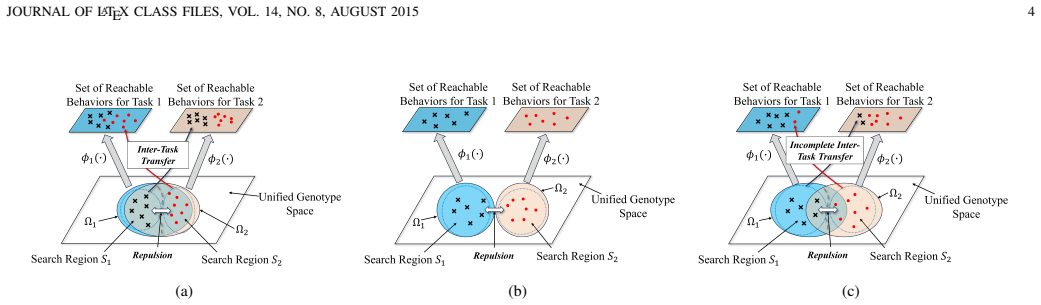
MFEA-CoD coordinates multiple novelty search tasks to collaboratively discover behaviorally novel solutions rather than merely transferring consistent search information for faster convergence. A multitask repulsion operator encourages different tasks to explore distinct regions of the unified search space, thereby reducing redundant behavioral discoveries. An adaptive inter-task transfer mechanism exploits shared discovery opportunities in overlapping novelty-improving regions by adjusting the transfer probability according to the online contribution of transferred information. MFEA-CoD is further extended to multitask novelty-augmented optimization to alleviate premature convergence caused
What carries the argument
The multitask repulsion operator paired with an adaptive inter-task transfer mechanism that together separate exploration while selectively sharing overlapping novelty gains.
If this is right
- Reduces redundant behavioral discoveries across tasks.
- Exploits shared opportunities in overlapping novelty regions through adjusted transfer rates.
- Improves discovery efficiency on basin, maze, policy, and generative problems.
- Alleviates premature convergence when novelty is added to deceptive objective functions.
Where Pith is reading between the lines
- The same repulsion-plus-adaptive-transfer pattern could be tested on other population-based methods that currently waste evaluations on duplicate behaviors.
- If repulsion strength is made task-dependent rather than uniform, the approach might scale to larger numbers of tasks without forcing artificial separation.
- Applying the framework to standard objective optimization without novelty would test whether collaborative discovery ideas transfer when the goal is convergence rather than diversity.
Load-bearing premise
Overlapping novelty-improving regions exist across tasks and the repulsion operator can separate them without destroying useful shared information that the adaptive transfer would otherwise use.
What would settle it
Run the algorithm on a set of tasks whose novelty-improving regions have zero overlap and check whether performance drops below that of independent single-task novelty searches.
Figures
read the original abstract
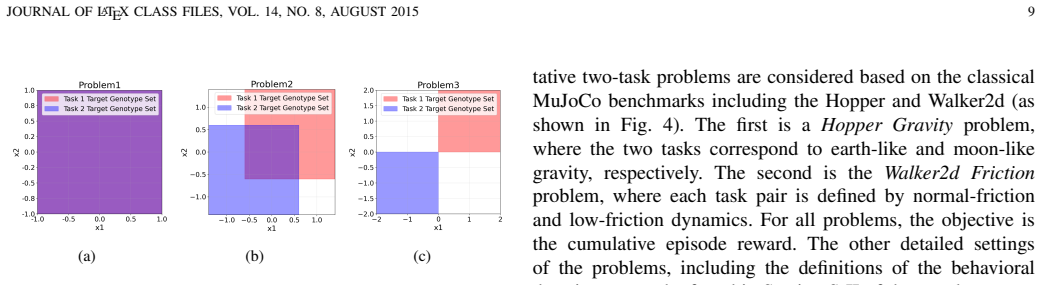
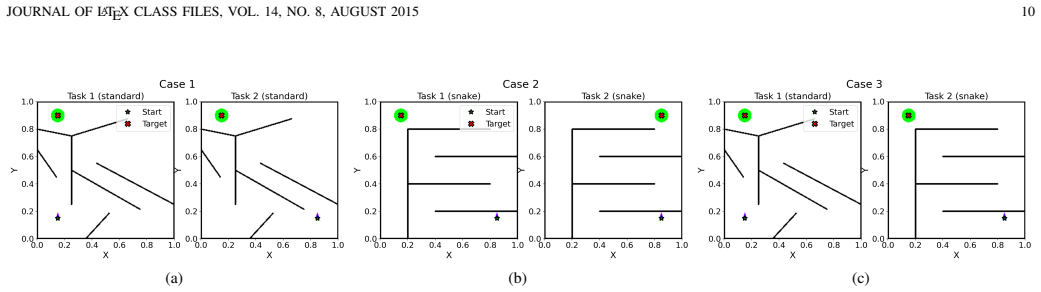
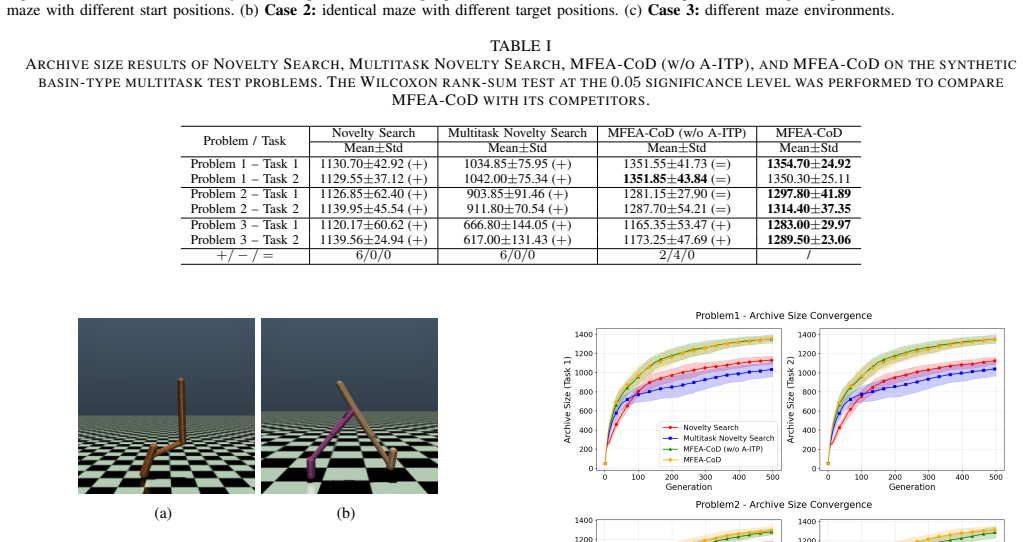
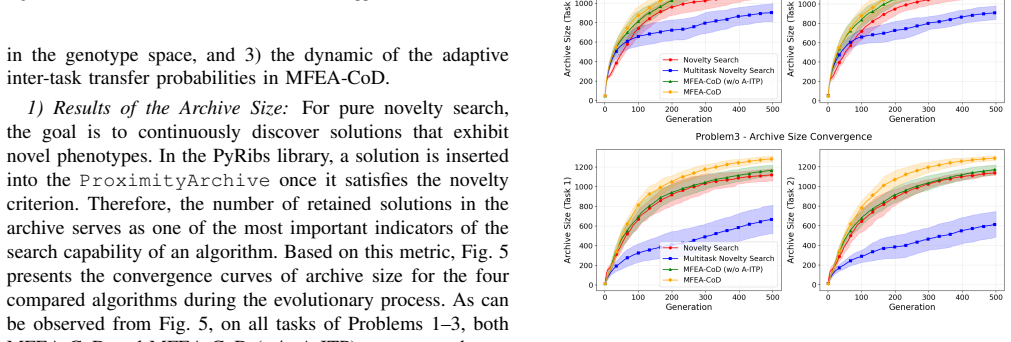
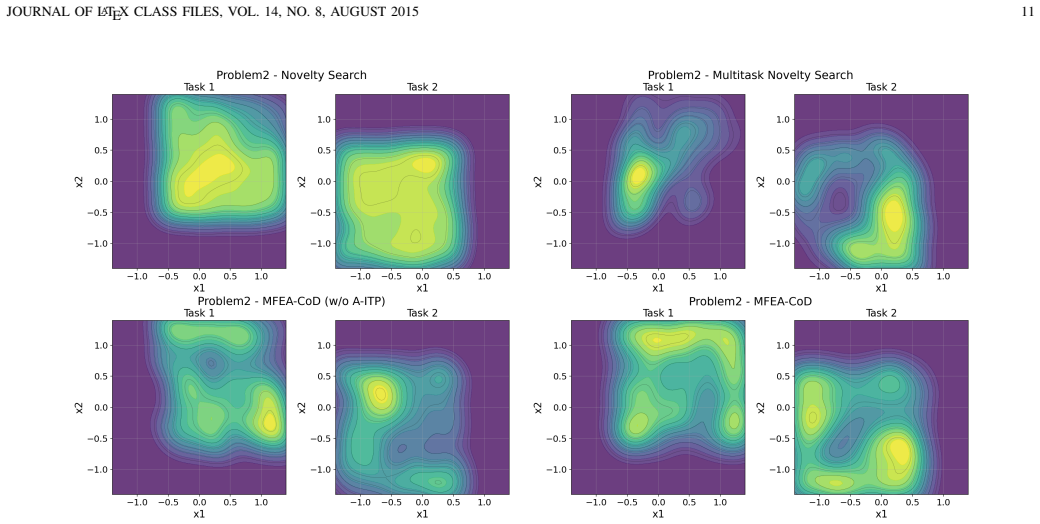
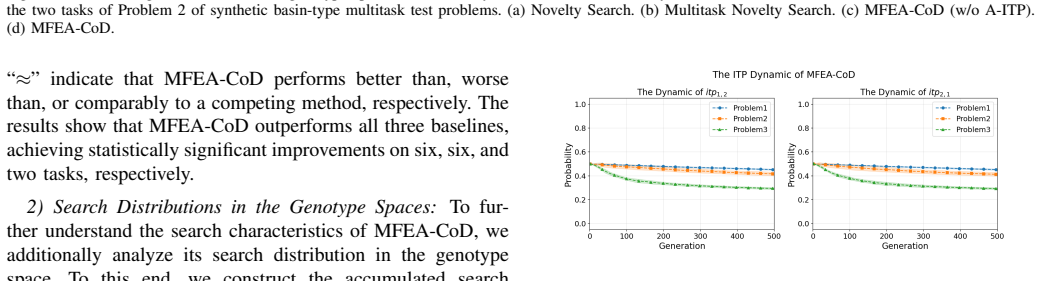
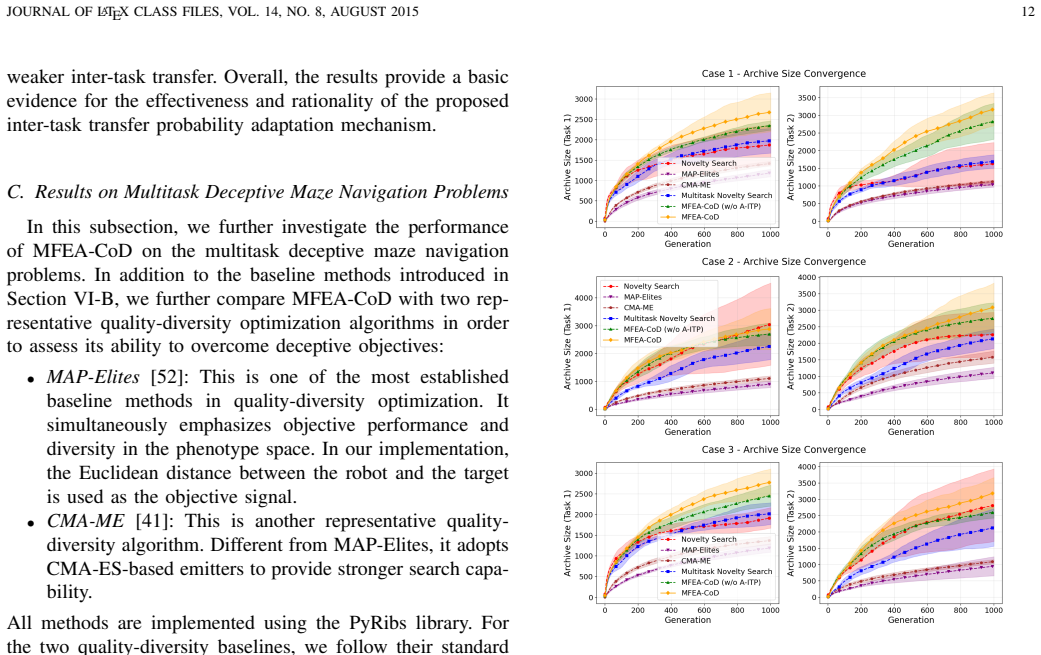
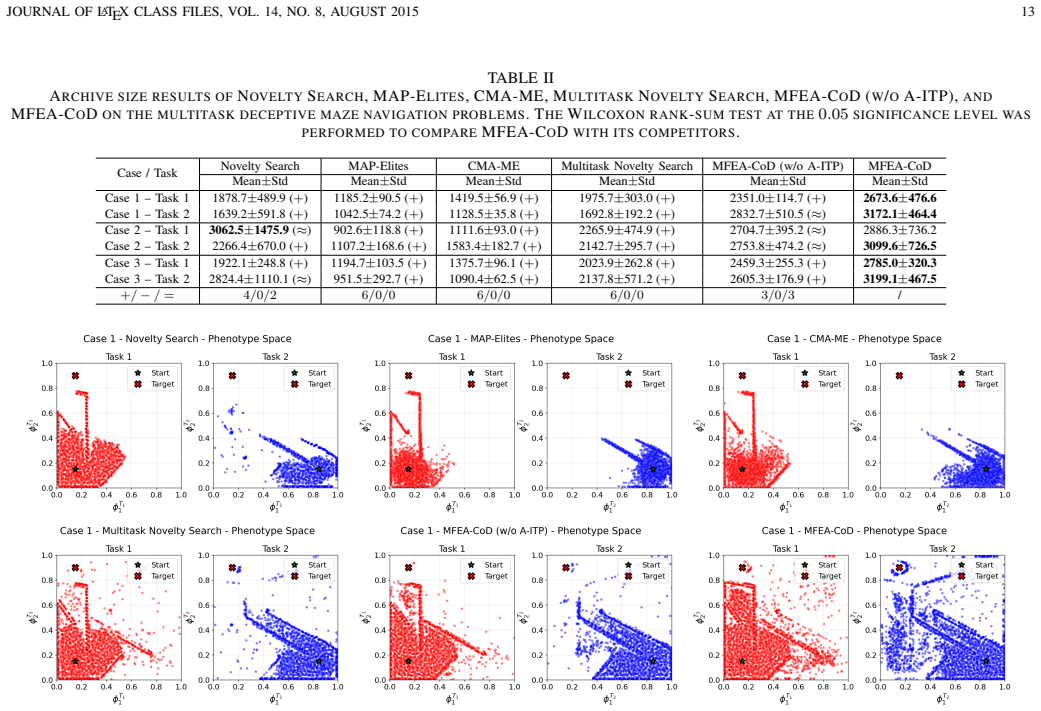
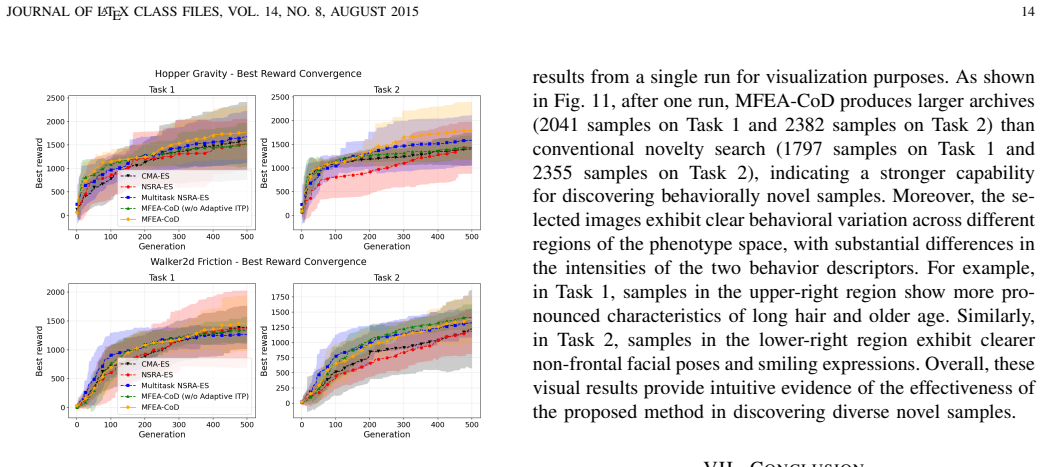
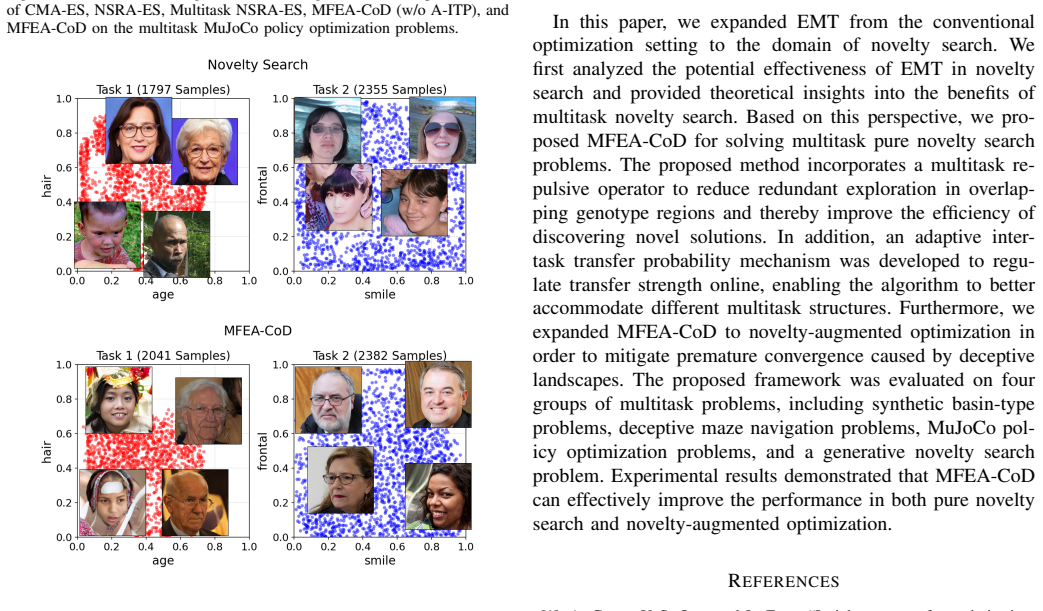
Evolutionary multitasking (EMT) has shown strong capability in solving multiple optimization problems simultaneously by exploiting latent inter-task consistency, such as similarities in promising solutions or search directions. However, most existing EMT studies remain focused on objective-driven optimization, where such consistency is mainly used to accelerate convergence toward predefined optima. In this paper, we move EMT from consistency to collaborative discovery and propose a multifactorial evolutionary algorithm with collaborative discovery (MFEA-CoD) for multitask novelty search. Unlike conventional EMT, MFEA-CoD coordinates multiple novelty search tasks to collaboratively discover behaviorally novel solutions rather than merely transferring consistent search information for faster convergence. Specifically, a multitask repulsion operator encourages different tasks to explore distinct regions of the unified search space, thereby reducing redundant behavioral discoveries. Meanwhile, an adaptive inter-task transfer mechanism exploits shared discovery opportunities in overlapping novelty-improving regions by adjusting the transfer probability according to the online contribution of transferred information. Furthermore, MFEA-CoD is extended to multitask novelty-augmented optimization, where behavioral novelty is jointly considered with objective information to alleviate premature convergence caused by deceptive objectives. Experiments on synthetic basin-type problems, deceptive maze navigation problems, MuJoCo policy optimization problems, and generative novelty search problems demonstrate that MFEA-CoD improves the efficiency of discovering diverse novel solutions and shows clear advantages in deceptive objective landscapes.
Editorial analysis
A structured set of objections, weighed in public.
Referee Report
Summary. The paper proposes MFEA-CoD, a multifactorial evolutionary algorithm for multitask novelty search. It shifts EMT from objective-driven convergence to collaborative discovery by introducing a multitask repulsion operator that encourages tasks to explore distinct regions of the unified search space and an adaptive inter-task transfer mechanism that adjusts transfer probability based on the online contribution of transferred information. The method is extended to novelty-augmented optimization to mitigate premature convergence in deceptive objective landscapes. Experiments on synthetic basin-type problems, deceptive maze navigation, MuJoCo policy optimization, and generative novelty search problems are used to claim improved efficiency in discovering diverse novel solutions and advantages over standard approaches in deceptive settings.
Significance. If the empirical claims hold, the work provides a useful extension of EMT techniques into novelty search, addressing the need for diversity maintenance across tasks rather than pure convergence. The combination of repulsion for reduced redundancy and adaptive transfer for exploiting shared opportunities is a natural fit for collaborative exploration. The application to deceptive problems and the range of test domains (synthetic, maze, MuJoCo, generative) add practical relevance for evolutionary robotics and design tasks where local optima are prevalent.
minor comments (3)
- [Abstract] The abstract states that the adaptive mechanism 'adjusts the transfer probability according to the online contribution of transferred information,' but without the precise definition or pseudocode for this contribution metric it is difficult to assess whether the adaptation is parameter-free or introduces new hyperparameters.
- [Abstract] The description of the repulsion operator as encouraging 'distinct regions' would benefit from an explicit formulation (e.g., how repulsion is computed between tasks and whether it interacts with the standard EMT skill-factor assignment).
- The claim of 'clear advantages in deceptive objective landscapes' is presented without reference to the specific baseline algorithms or statistical tests used; adding these details would strengthen the experimental section.
Simulated Author's Rebuttal
We thank the referee for the constructive summary, positive significance assessment, and recommendation of minor revision. No specific major comments were enumerated in the provided report, so we have no points requiring point-by-point rebuttal or clarification at this stage.
Circularity Check
No significant circularity detected
full rationale
The paper presents MFEA-CoD as an extension of standard multifactorial evolutionary algorithms by adding a multitask repulsion operator and an adaptive inter-task transfer probability. No equations or claims in the provided abstract reduce a reported performance metric or discovery result to a fitted parameter or self-citation by construction. The central method is described through explicit algorithmic components whose behavior is independent of the experimental outcomes, and the derivation chain remains self-contained against external benchmarks.
Axiom & Free-Parameter Ledger
Reference graph
Works this paper leans on
-
[1]
Insights on transfer optimization: Because experience is the best teacher,
A. Gupta, Y .-S. Ong, and L. Feng, “Insights on transfer optimization: Because experience is the best teacher,”IEEE Transactions on Emerging Topics in Computational Intelligence, vol. 2, no. 1, pp. 51–64, 2017
2017
-
[2]
Half a dozen real-world applications of evolutionary multitasking, and more,
A. Gupta, L. Zhou, Y .-S. Ong, Z. Chen, and Y . Hou, “Half a dozen real-world applications of evolutionary multitasking, and more,”IEEE Computational Intelligence Magazine, vol. 17, no. 2, pp. 49–66, 2022
2022
-
[3]
A review on evolution- ary multitask optimization: Trends and challenges,
T. Wei, S. Wang, J. Zhong, D. Liu, and J. Zhang, “A review on evolution- ary multitask optimization: Trends and challenges,”IEEE Transactions on Evolutionary Computation, vol. 26, no. 5, pp. 941–960, 2021
2021
-
[4]
From multitask gradient descent to gradient-free evolutionary multitasking: A proof of faster convergence,
L. Bai, W. Lin, A. Gupta, and Y .-S. Ong, “From multitask gradient descent to gradient-free evolutionary multitasking: A proof of faster convergence,”IEEE Transactions on Cybernetics, vol. 52, no. 8, pp. 8561–8573, 2021
2021
-
[5]
Multifactorial evolutionary algorithm enhanced with cross-task search direction,
J. Yin, A. Zhu, Z. Zhu, Y . Yu, and X. Ma, “Multifactorial evolutionary algorithm enhanced with cross-task search direction,” in2019 IEEE Congress on evolutionary computation (CEC). IEEE, 2019, pp. 2244– 2251
2019
-
[6]
Multifactorial evolution: Toward evolutionary multitasking,
A. Gupta, Y .-S. Ong, and L. Feng, “Multifactorial evolution: Toward evolutionary multitasking,”IEEE Transactions on Evolutionary Compu- tation, vol. 20, no. 3, pp. 343–357, 2015. JOURNAL OF LATEX CLASS FILES, VOL. 14, NO. 8, AUGUST 2015 15
2015
-
[7]
Multifactorial evolu- tionary algorithm with online transfer parameter estimation: Mfea-ii,
K. K. Bali, Y .-S. Ong, A. Gupta, and P. S. Tan, “Multifactorial evolu- tionary algorithm with online transfer parameter estimation: Mfea-ii,” IEEE Transactions on Evolutionary Computation, vol. 24, no. 1, pp. 69–83, 2019
2019
-
[8]
Multiobjective multifac- torial optimization in evolutionary multitasking,
A. Gupta, Y .-S. Ong, L. Feng, and K. C. Tan, “Multiobjective multifac- torial optimization in evolutionary multitasking,”IEEE transactions on cybernetics, vol. 47, no. 7, pp. 1652–1665, 2016
2016
-
[9]
Cognizant multitasking in multiobjective multifactorial evolution: Mo-mfea-ii,
K. K. Bali, A. Gupta, Y .-S. Ong, and P. S. Tan, “Cognizant multitasking in multiobjective multifactorial evolution: Mo-mfea-ii,”IEEE transac- tions on cybernetics, vol. 51, no. 4, pp. 1784–1796, 2020
2020
-
[10]
Evolution- ary competitive multiobjective multitasking: One-pass optimization of heterogeneous pareto solutions,
Y . Li, X. Wu, W. Gong, M. Xu, Y . Wang, and Q. Gu, “Evolution- ary competitive multiobjective multitasking: One-pass optimization of heterogeneous pareto solutions,”IEEE Transactions on Evolutionary Computation, vol. 29, no. 6, pp. 2757–2770, 2025
2025
-
[11]
Explicit evolutionary multitasking for combinatorial optimization: A case study on capacitated vehicle routing problem,
L. Feng, Y . Huang, L. Zhou, J. Zhong, A. Gupta, K. Tang, and K. C. Tan, “Explicit evolutionary multitasking for combinatorial optimization: A case study on capacitated vehicle routing problem,”IEEE transactions on cybernetics, vol. 51, no. 6, pp. 3143–3156, 2020
2020
-
[12]
Solving generalized vehicle routing problem with occasional drivers via evolutionary multitasking,
L. Feng, L. Zhou, A. Gupta, J. Zhong, Z. Zhu, K.-C. Tan, and K. Qin, “Solving generalized vehicle routing problem with occasional drivers via evolutionary multitasking,”IEEE transactions on cybernetics, vol. 51, no. 6, pp. 3171–3184, 2019
2019
-
[13]
Ensemble of domain adaptation-based knowledge transfer for evolutionary multitasking,
W. Lin, Q. Lin, L. Feng, and K. C. Tan, “Ensemble of domain adaptation-based knowledge transfer for evolutionary multitasking,” IEEE Transactions on Evolutionary Computation, vol. 28, no. 2, pp. 388–402, 2023
2023
-
[14]
Evolutionary multitasking for multiobjective optimization with subspace alignment and adaptive differential evolution,
Z. Liang, H. Dong, C. Liu, W. Liang, and Z. Zhu, “Evolutionary multitasking for multiobjective optimization with subspace alignment and adaptive differential evolution,”IEEE Transactions on Cybernetics, vol. 52, no. 4, pp. 2096–2109, 2020
2096
-
[15]
Multiobjective multitask optimization with mul- tiple knowledge types and transfer adaptation,
Y . Li and W. Gong, “Multiobjective multitask optimization with mul- tiple knowledge types and transfer adaptation,”IEEE Transactions on Evolutionary Computation, vol. 29, no. 1, pp. 205–216, 2024
2024
-
[16]
Evolutionary many- task optimization based on multisource knowledge transfer,
Z. Liang, X. Xu, L. Liu, Y . Tu, and Z. Zhu, “Evolutionary many- task optimization based on multisource knowledge transfer,”IEEE Transactions on Evolutionary Computation, vol. 26, no. 2, pp. 319–333, 2021
2021
-
[17]
Knowledge structure preserving-based evolutionary many-task optimization,
Y . Jiang, Z.-H. Zhan, K. C. Tan, S. Kwong, and J. Zhang, “Knowledge structure preserving-based evolutionary many-task optimization,”IEEE transactions on evolutionary computation, vol. 29, no. 2, pp. 287–301, 2024
2024
-
[18]
Multitask evolution strategy with knowledge- guided external sampling,
Y . Li, W. Gong, and S. Li, “Multitask evolution strategy with knowledge- guided external sampling,”IEEE Transactions on Evolutionary Compu- tation, vol. 28, no. 6, pp. 1733–1745, 2023
2023
-
[19]
Jack and masters of all trades: One-pass learning sets of model sets from large pre- trained models,
H. X. Choong, Y .-S. Ong, A. Gupta, C. Chen, and R. Lim, “Jack and masters of all trades: One-pass learning sets of model sets from large pre- trained models,”IEEE Computational Intelligence Magazine, vol. 18, no. 3, pp. 29–40, 2023
2023
-
[20]
Llm2tea: An agen- tic ai designer for discovery with generative evolutionary multitasking,
M. Wong, J. Liu, T. Rios, S. Menzel, and Y .-S. Ong, “Llm2tea: An agen- tic ai designer for discovery with generative evolutionary multitasking,” IEEE Computational Intelligence Magazine, vol. 20, no. 4, pp. 42–55, 2025
2025
-
[21]
Abandoning objectives: Evolution through the search for novelty alone,
J. Lehman and K. O. Stanley, “Abandoning objectives: Evolution through the search for novelty alone,”Evolutionary computation, vol. 19, no. 2, pp. 189–223, 2011
2011
-
[22]
Discovering evolutionary stepping stones through behavior domination,
E. Meyerson and R. Miikkulainen, “Discovering evolutionary stepping stones through behavior domination,” inProceedings of the Genetic and Evolutionary Computation Conference, 2017, pp. 139–146
2017
-
[23]
Improving exploration in evolution strategies for deep reinforcement learning via a population of novelty-seeking agents,
E. Conti, V . Madhavan, F. Petroski Such, J. Lehman, K. Stanley, and J. Clune, “Improving exploration in evolution strategies for deep reinforcement learning via a population of novelty-seeking agents,” Advances in neural information processing systems, vol. 31, 2018
2018
-
[24]
Evolutionary policy optimization,
Z. S. Mustafaoglu, K. Pingali, and R. Miikkulainen, “Evolutionary policy optimization,” inProceedings of the Genetic and Evolutionary Computation Conference Companion, 2025, pp. 735–738
2025
-
[25]
Toward adaptive knowledge transfer in multifactorial evolutionary computation,
L. Zhou, L. Feng, K. C. Tan, J. Zhong, Z. Zhu, K. Liu, and C. Chen, “Toward adaptive knowledge transfer in multifactorial evolutionary computation,”IEEE transactions on cybernetics, vol. 51, no. 5, pp. 2563–2576, 2020
2020
-
[26]
Adaptive multifac- torial evolutionary optimization for multitask reinforcement learning,
A. D. Martinez, J. Del Ser, E. Osaba, and F. Herrera, “Adaptive multifac- torial evolutionary optimization for multitask reinforcement learning,” IEEE Transactions on Evolutionary Computation, vol. 26, no. 2, pp. 233–247, 2021
2021
-
[27]
Multiobjective multitask optimization with mul- tiple knowledge types and transfer adaptation,
Y . Li and W. Gong, “Multiobjective multitask optimization with mul- tiple knowledge types and transfer adaptation,”IEEE Transactions on Evolutionary Computation, vol. 29, no. 1, pp. 205–216, 2025
2025
-
[28]
Affine transformation-enhanced multifactorial optimization for heterogeneous problems,
X. Xue, K. Zhang, K. C. Tan, L. Feng, J. Wang, G. Chen, X. Zhao, L. Zhang, and J. Yao, “Affine transformation-enhanced multifactorial optimization for heterogeneous problems,”IEEE Transactions on Cy- bernetics, vol. 52, no. 7, pp. 6217–6231, 2020
2020
-
[29]
Optimal transport-based distributional pairing in transfer multiobjective optimization,
J. Liu, W. Liu, J. T. W. En, C. Chen, P. S. Tan, and Y .-S. Ong, “Optimal transport-based distributional pairing in transfer multiobjective optimization,”IEEE Transactions on Evolutionary Computation, 2025
2025
-
[30]
Multiobjective multitask optimization with manifold structure-driven knowledge transfer,
T. Zhang, X. Wu, Y . Li, S. Li, and W. Gong, “Multiobjective multitask optimization with manifold structure-driven knowledge transfer,”IEEE Transactions on Systems, Man, and Cybernetics: Systems, 2026
2026
-
[31]
A surrogate-assisted evolutionary framework for expensive multitask optimization problems,
S. Tan, Y . Wang, G. Sun, T. Pang, and K. Tang, “A surrogate-assisted evolutionary framework for expensive multitask optimization problems,” IEEE Transactions on Evolutionary Computation, 2024
2024
-
[32]
Multiproblem surrogates: Transfer evolutionary multiobjective optimization of com- putationally expensive problems,
A. T. W. Min, Y .-S. Ong, A. Gupta, and C.-K. Goh, “Multiproblem surrogates: Transfer evolutionary multiobjective optimization of com- putationally expensive problems,”IEEE Transactions on Evolutionary Computation, vol. 23, no. 1, pp. 15–28, 2017
2017
-
[33]
Extremo: Transfer evolutionary multiobjective optimization with proof of faster convergence,
J. Liu, A. Gupta, C. Ooi, and Y .-S. Ong, “Extremo: Transfer evolutionary multiobjective optimization with proof of faster convergence,”IEEE Transactions on Evolutionary Computation, vol. 29, no. 1, pp. 102–116, 2024
2024
-
[34]
Transfer stacking from low- to high-fidelity: A surrogate-assisted bi-fidelity evolutionary algorithm,
H. Wang, Y . Jin, C. Yang, and L. Jiao, “Transfer stacking from low- to high-fidelity: A surrogate-assisted bi-fidelity evolutionary algorithm,” Applied soft computing, vol. 92, p. 106276, 2020
2020
-
[35]
(θ l,θ u)-parametric multi-task optimization: Joint search in solution and infinite task spaces,
T. Wei, J. Liu, A. Gupta, P. S. Tan, and Y .-S. Ong, “(θ l,θ u)-parametric multi-task optimization: Joint search in solution and infinite task spaces,” IEEE Transactions on Evolutionary Computation, 2025
2025
-
[36]
Parametric pareto set learning for expensive multi-objective optimization,
J. Cheng, B. Xue, and Q. Zhang, “Parametric pareto set learning for expensive multi-objective optimization,” inProceedings of the AAAI Conference on Artificial Intelligence, vol. 40, no. 43, 2026, pp. 36 829– 36 837
2026
-
[37]
Amortized Multi-Objective Optimization Across Tasks with Generative Solution Modeling
T. Wei, J. Liu, A. Gupta, C. C. Ooi, P. S. Tan, and Y .-S. Ong, “Parametric expensive multi-objective optimization via generative solution model- ing,”arXiv preprint arXiv:2511.09598, 2025
work page internal anchor Pith review Pith/arXiv arXiv 2025
-
[38]
Bayesian inverse transfer in evolu- tionary multiobjective optimization,
J. Liu, A. Gupta, and Y .-S. Ong, “Bayesian inverse transfer in evolu- tionary multiobjective optimization,”ACM Transactions on Evolutionary Learning, vol. 4, no. 4, pp. 1–27, 2025
2025
-
[39]
Bayesian forward- inverse transfer for multiobjective optimization,
T. Wei, J. Liu, A. Gupta, P. S. Tan, and Y .-S. Ong, “Bayesian forward- inverse transfer for multiobjective optimization,” inInternational Con- ference on Parallel Problem Solving from Nature. Springer, 2024, pp. 135–152
2024
-
[40]
Critical factors in the performance of novelty search,
S. Kistemaker and S. Whiteson, “Critical factors in the performance of novelty search,” inProceedings of the 13th annual conference on Genetic and evolutionary computation, 2011, pp. 965–972
2011
-
[41]
Covari- ance matrix adaptation for the rapid illumination of behavior space,
M. C. Fontaine, J. Togelius, S. Nikolaidis, and A. K. Hoover, “Covari- ance matrix adaptation for the rapid illumination of behavior space,” inProceedings of the 2020 genetic and evolutionary computation conference, 2020, pp. 94–102
2020
-
[42]
Evolving a diversity of virtual creatures through novelty search and local competition,
J. Lehman and K. O. Stanley, “Evolving a diversity of virtual creatures through novelty search and local competition,” inProceedings of the 13th annual conference on Genetic and evolutionary computation, 2011, pp. 211–218
2011
-
[43]
Simulated binary crossover for continuous search space,
K. Deb, R. B. Agrawalet al., “Simulated binary crossover for continuous search space,”Complex systems, vol. 9, no. 2, pp. 115–148, 1995
1995
-
[44]
pyribs: A bare-bones python library for quality diversity optimization,
B. Tjanaka, M. C. Fontaine, D. H. Lee, Y . Zhang, N. R. Balam, N. Dennler, S. S. Garlanka, N. D. Klapsis, and S. Nikolaidis, “pyribs: A bare-bones python library for quality diversity optimization,” in Proceedings of the Genetic and Evolutionary Computation Conference, 2023, pp. 220–229
2023
-
[45]
Kheperax: a lightweight jax-based robot control environment for benchmarking quality-diversity algorithms,
L. Grillotti and A. Cully, “Kheperax: a lightweight jax-based robot control environment for benchmarking quality-diversity algorithms,” in Proceedings of the Companion Conference on Genetic and Evolutionary Computation, 2023, pp. 2163–2165
2023
-
[46]
Mujoco: A physics engine for model- based control,
E. Todorov, T. Erez, and Y . Tassa, “Mujoco: A physics engine for model- based control,” in2012 IEEE/RSJ international conference on intelligent robots and systems. IEEE, 2012, pp. 5026–5033
2012
-
[47]
Analyzing and improving the image quality of stylegan,
T. Karras, S. Laine, M. Aittala, J. Hellsten, J. Lehtinen, and T. Aila, “Analyzing and improving the image quality of stylegan,” inProceedings of the IEEE/CVF conference on computer vision and pattern recognition, 2020, pp. 8110–8119
2020
-
[48]
Exploring deceptive mazes with novelty search,
B. Tjanaka, “Exploring deceptive mazes with novelty search,” pyribs.org, 2025. [Online]. Available: https://docs.pyribs.org/en/stable/ tutorials/ns maze.html
2025
-
[49]
Gymnasium: A Standard Interface for Reinforcement Learning Environments
M. Towers, A. Kwiatkowski, J. Terry, J. U. Balis, G. De Cola, T. Deleu, M. Goul ˜ao, A. Kallinteris, M. Krimmel, A. KGet al., “Gymnasium: A standard interface for reinforcement learning environments,”arXiv preprint arXiv:2407.17032, 2024. JOURNAL OF LATEX CLASS FILES, VOL. 14, NO. 8, AUGUST 2015 16
work page internal anchor Pith review Pith/arXiv arXiv 2024
-
[50]
Learning transferable visual models from natural language supervision,
A. Radford, J. W. Kim, C. Hallacy, A. Ramesh, G. Goh, S. Agarwal, G. Sastry, A. Askell, P. Mishkin, J. Clarket al., “Learning transferable visual models from natural language supervision,” inInternational conference on machine learning. PmLR, 2021, pp. 8748–8763
2021
-
[51]
Kernel density estimation and its application,
S. Weglarczyk, “Kernel density estimation and its application,” inITM web of conferences, vol. 23. EDP Sciences, 2018, p. 00037
2018
-
[52]
Illuminating search spaces by mapping elites
J.-B. Mouret and J. Clune, “Illuminating search spaces by mapping elites,”arXiv preprint arXiv:1504.04909, 2015
work page internal anchor Pith review Pith/arXiv arXiv 2015
-
[53]
Reducing the time complexity of the derandomized evolution strategy with covariance matrix adaptation (cma-es),
N. Hansen, S. D. M ¨uller, and P. Koumoutsakos, “Reducing the time complexity of the derandomized evolution strategy with covariance matrix adaptation (cma-es),”Evolutionary computation, vol. 11, no. 1, pp. 1–18, 2003. JOURNAL OF LATEX CLASS FILES, VOL. 14, NO. 8, AUGUST 2015 17 Supplementary File of “From Consistency to Collaborative Discovery:MFEA-CoDfo...
2003
-
[54]
The MFEA-CoD settings use novelty weightλ= 0.3, linear decayed repulsion strength from 0.5 to 0, regularization coefficient 0.5, adaptive-ITPlearning rate 0.1, and the initial transfer probability itp 1,2 =itp 2,1 = 0.3
discussion (0)
Sign in with ORCID, Apple, or X to comment. Anyone can read and Pith papers without signing in.