REVIEW 3 major objections 6 minor 126 references
Formation of Transitional cE/UCD Galaxies through Massive/Dwarf Disc Galaxy Mergers
T0 review · 3 major / 6 minor · reviewed 2026-08-11 · deepseek-v4-flash
Pith's one-line read Dwarf galaxies shredded by spiral discs leave compact cE/UCD cores behind
desk verdict A useful and physically plausible parameter study of tidal stripping, but the headline numbers should be read with caution until resolution and radius-definition issues are addressed. read the letter →
The pith
A machine-rendered reading of the paper's core claim, the machinery that carries it, and where it could break.
The reading
What carries the argument
The engine is repeated tidal threshing: the satellite crosses the host disc at every pericentric passage, with initial orbital eccentricity close to unity, and each collision strips the outermost stars while the dense central region survives. The numerical machinery is a direct-summation N-body and SPH code with a gravitational softening of 10 pc, which resolves the $60\text{--}200$ pc cores; the gas component is treated hydrodynamically with cooling and heating, and the satellite models contain stars, gas, and a quasi-isothermal dark halo. The load-bearing seed is the satellite's nuclear star cluster or compact pseudo-bulge, which forms a stellar bar before disruption; the final core is assembled mainly from the bar's central material.
What would settle it
If a transitional cE/UCD is found around a Milky Way-type spiral with a dark-matter fraction above a few percent inside its effective radius, or with a detectable gas reservoir, the stripped-core channel would be ruled out for that object, since the models end with almost no dark matter and negligible gas.
Extended reading notes
Core claim
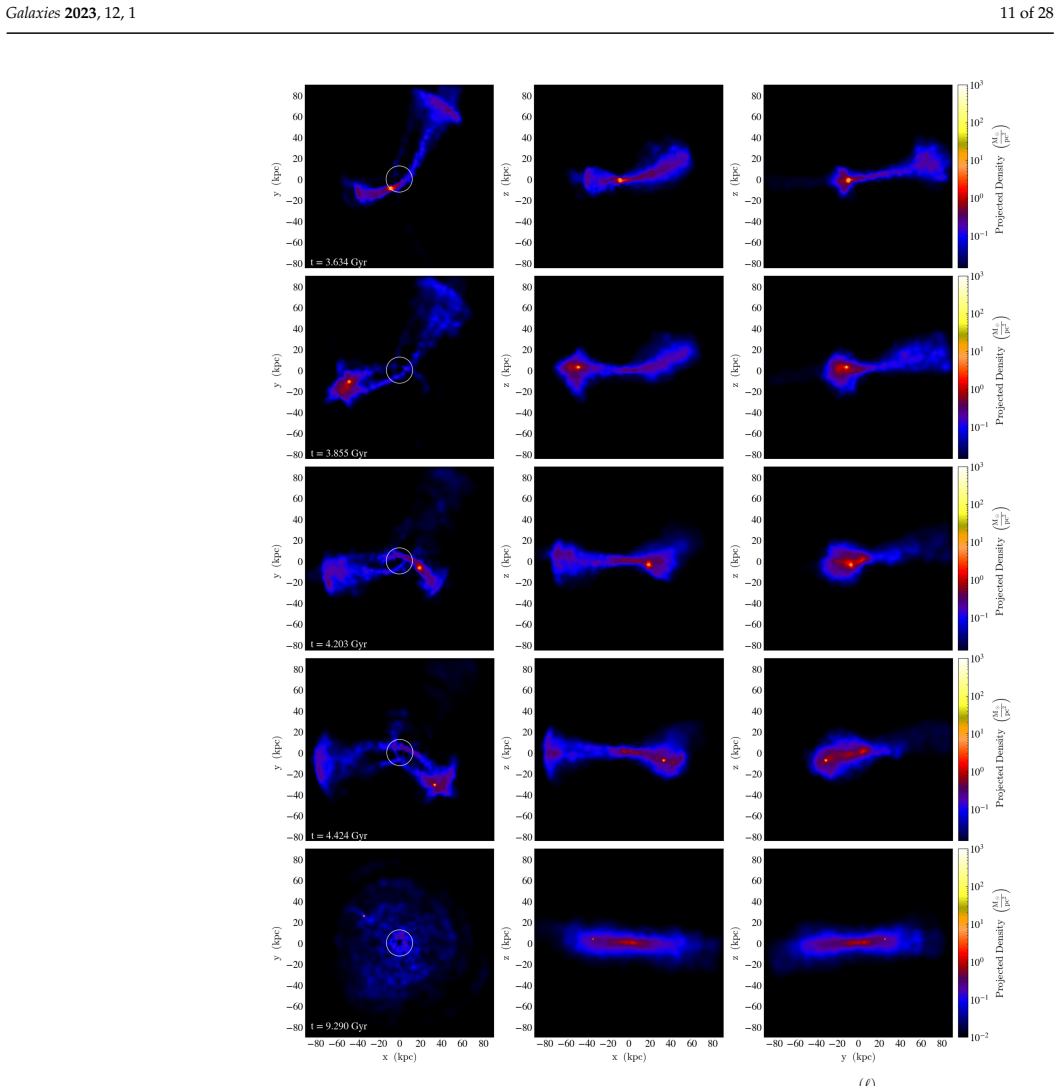
The central discovery is that a dwarf disc galaxy with a concentrated stellar nucleus, falling almost radially into a Milky Way-type galaxy, loses its outer layers through repeated disc crossings and leaves behind a quasi-spherical, slowly rotating stellar core with cE/UCD properties. Roughly $30\text{--}50$ percent of the satellite's initial stellar mass ends up in the core; gas is swept out within a few crossings, dark matter is stripped by more than an order of magnitude, and the core then survives almost unchanged for many orbital periods. Gas in the progenitor acts as an agent of destruction: its loss weakens the dwarf's gravitational well, so stars are stripped more efficiently, producing a smaller, denser, and less rotating remnant than an identical gas-free dwarf. Models whose dwarf lacks an initial central concentration do not produce such objects, so the dense nucleus is the essential seed.
Load-bearing premise
The whole mechanism presupposes that the dwarf disc galaxy starts with a dense central stellar concentration, a nuclear star cluster or compact pseudo-bulge, because satellites without such a seed are stripped to nothing instead of leaving a cE/UCD.
Editorial extensions
If this is right
- If the channel works, cE/UCD galaxies do not require a rich cluster environment; they can appear as satellites of isolated Milky Way-type spirals, and searches near such hosts should find them.
- Formed cores are long-lived: after about $4\text{--}5$ billion years they lose only $1\text{--}2$ percent of their mass per additional disc crossing, so they can persist for cosmological times.
- The initial gas content of the dwarf sets observable remnant properties: gas-rich progenitors yield more compact, nearly non-rotating cores, while gas-free progenitors leave larger, internally rotating cores.
- The absence of a compact cE/UCD remnant in the Milky Way today constrains the Gaia-Sausage-Enceladus progenitor: it probably lacked a massive dense stellar core or bulge.
- A dwarf without a concentrated central nucleus is completely shredded rather than leaving a cE/UCD, so the mechanism predicts which dwarf morphologies can produce such remnants.
Reading between the lines
- The simulations imply a testable dichotomy: rotating cE/UCDs around spirals should trace gas-poor dwarf progenitors, whereas non-rotating, denser ones should trace gas-rich progenitors; current samples of rotating compact ellipticals could be checked against this.
- Because the cores end up nearly free of dark matter, measuring dynamical masses of cE/UCD satellites of spirals offers a direct discriminator: a high dark-matter fraction would argue for a different formation path.
- The same stripping physics should operate with a host's hot gas halo (ram pressure) as an additional gas-removal agent, potentially extending the mechanism to cluster UCDs; the paper mentions this but does not simulate it.
- If nuclear star clusters are common in field dwarf discs, this channel could account for a substantial fraction of the UCD population around spirals; if they are rare, the channel is correspondingly limited.
Editorial analysis
A structured set of objections, weighed in public.
Referee Report
Summary. The paper presents N-body/SPH simulations of a dwarf disc galaxy merging with a Milky Way-type galaxy, focusing on repeated disc crossings over 9.5 Gyr. The authors show that a satellite with an initially concentrated stellar nucleus (NSC or pseudo-bulge) loses its outer layers in discrete events, leaving a compact, slowly rotating stellar core with little gas or dark matter. For their gas-rich models they report core masses (1-5)x10^8 M_sun and effective radii 60-200 pc, which they equate with transitional cE/UCD systems. The gas content of the satellite influences the stripping efficiency, final core size, and internal rotation. They also use their results to constrain the initial properties of the Gaia-Sausage-Enceladus progenitor.
Significance. The proposed mechanism is physically plausible, and the stepwise stripping of the dwarf through repeated disc crossings is clearly demonstrated across a large suite of experiments. Strengths include the use of direct force summation, explicit SPH treatment of gas, and a broad parameter study that shows how gas content affects the remnant. If the quantitative matching is secured, the work offers a viable formation channel for cE/UCDs near massive spiral galaxies and provides a natural explanation for objects like NGC936_UCD. However, the headline numbers are not yet robust to resolution effects and to the choice of radius definition, so the significance of the quantitative claim is currently conditional on additional verification.
major comments (3)
- [Section 2, Eq. (5)] The central quantitative claim rests on effective radii of 60–200 pc, yet no numerical convergence study is presented. The gravitational softening is fixed at ε_c = 10 pc (Eq. 5), so the smallest quoted radii are only ~6ε_c, and the central density profile used to measure r_eff is itself softened. The paper reports total particle numbers of 2^20–2^23 (Section 2) but never gives per-component counts, so it is impossible to estimate the two-body relaxation time of the surviving core; for a core of ~10^5 particles and radius ~100 pc, that time is only a few Gyr, comparable to the 9.5 Gyr integration time. The 'long-lived' claim in Section 5 may therefore be partly a discreteness effect. A resolution test (smaller ε_c and/or higher N) is needed before the values (1–5)×10^8 M_⊙ and 60–200 pc can be taken at face value.
- [Section 3.2] The definition of the effective radius changes within the paper. Section 3.2 states that R_eff^C is computed as a 3D half-mass radius from the bulk density, while Figure 16 quotes r_eff = 97 pc from the surface density profile. The Introduction compares these model radii with observed projected half-light radii (e.g., NGC936_UCD 66.5 pc, VUCD7 96.8 pc, NGC0703-AIMSS1 165 pc). For typical stellar profiles the projected half-light radius is substantially smaller than the 3D half-mass radius, so the claimed match in the abstract (100–200 pc) is optimistic. The paper acknowledges the uncertainty in Section 3.2 but does not quantify the bias or adopt a consistent definition for the observational comparison.
- [Section 4] The formation channel is demonstrated only for dwarf galaxies that initially contain a dense central stellar concentration (NSC or compact pseudo-bulge). Section 2 states that 'the key role is played by the presence or absence of a nuclear star cluster (NSC) in the satellite or a compact pseudo bulge,' and models G100, G49, G50, which lack such a nucleus, either destroy the satellite or produce objects that are too loose to be classed as UCDs (Section 3.2). Section 4 explicitly states the study is limited to satellites with a high central stellar concentration. The abstract and conclusions, however, present the mechanism as a general outcome of 'massive/dwarf disc galaxy mergers.' This overstates the scope of the result; the paper should either qualify the title/abstract or quantify the fraction of dwarf disc galaxies expected to host the required nucleus.
minor comments (6)
- [Section 3.2, page 14] The text '300–900 ps' should read '300–900 pc'.
- [Section 4, pages 20–21] The discussion of PGC 029388 appears twice in Section 4; one occurrence should be removed.
- [Section 3.1] The notation θ(GSE) is used for the satellite's incidence angle, while GSE elsewhere denotes the Gaia-Sausage-Enceladus merger; using the same abbreviation for the model satellite is confusing.
- [Header and citation block] The article is cited as 'Galaxies 2023, 12, 1' while the publication date and DOI indicate 2024; please harmonize the citation details.
- [Section 3.2, Figure 8] The quantity R_C^(3/4) is used without a definition; all radius measures should be defined explicitly on first use.
- [Section 3.2, Figure 16] The surface density profiles in Figure 16 are not overlaid with the observed r_eff–M_* relation of the comparison sample, which makes the claimed match harder to evaluate.
Circularity Check
No circularity: the simulated core masses and sizes emerge from the N-body/SPH evolution, and observed cE/UCD parameters appear only in post hoc comparison.
full rationale
The paper's derivation chain is simulative rather than algebraic: it sets up initial galaxy models (a fixed MW model and dwarf satellite models with varied gas content, orbital parameters, and central stellar concentration), integrates the hydrodynamic and gravitational equations (1)-(5) for up to 9.5 Gyr, and then measures the resulting bound-core mass and effective radius. The headline quantities M_SC = (1-5)x10^8 M_sun and r_eff = 60-200 pc are not inserted as target values, nor is any parameter fitted to the observed NGC936_UCD, VUCD7, or NGC0703-AIMSS1 radii quoted in Section 1; those numbers are used only as a post hoc comparison in the Conclusions. The initial central concentration of the satellite is a physical precondition for the channel, explicitly tested by the non-nucleated models G100, G49, and G50, which fail to produce UCD-like remnants; this is an internal falsifier, not a definition of the outcome. The final core is not identical to the initial nucleus: it is substantially less massive than the initial satellite and its radius evolves in time (e.g., G21's surface-density effective radius decreases from 97 pc to 68 pc between the 4th and 15th crossings). Self-citations to models and numerical methods ([93]-[97], [111]-[112]) are standard setup choices and are not used to force the target result; no uniqueness theorem or ansatz is imported to forbid alternatives. The main quantitative caveats are spatial-resolution and definitional mismatches (10 pc softening vs. r_eff of 60-200 pc, and 3D half-mass vs. projected half-light radii), but these are accuracy/correctness concerns, not circularity. No load-bearing step reduces to its own input by construction.
Assumptions & free parameters
free parameters (5)
- Satellite gas mass M_g(Sat) =
0 to 0.093e10 M_sun (varied)
- Initial orbital geometry (r0, theta, beta, velocities) =
r0=100-128 kpc, theta=0-71 deg, beta=0/90 deg
- Satellite dark halo scale a(Sat) =
0.62 kpc
- Initial stellar central concentration (NSC/pseudo-bulge) =
Present in G20-G31, absent in G49, G50, G100
- Gravitational softening length eps_c =
10 pc
assumptions (5)
- standard math The direct-summation N-body + SPH equations (Eqs. 1-5) accurately model galaxy-scale dynamics.
- domain assumption The initial galaxy models are in equilibrium in the radial and vertical directions.
- domain assumption The satellite forms a stellar bar before the first impact, and the SC is built from bar material.
- domain assumption Radiative cooling and heating are modeled via a simple energy balance without chemical evolution.
- domain assumption The host galaxy's dark halo is treated as spherically symmetric.
Cite this review
Pith. "Pith review of Formation of Transitional cE/UCD Galaxies through Massive/Dwarf Disc Galaxy Mergers." pith.science (2026). https://pith.science/paper/IH5QJ3BG
@misc{pith2026241203100,
  author       = {Pith},
  title        = {Pith review of: Formation of Transitional cE/UCD Galaxies through Massive/Dwarf Disc Galaxy Mergers},
  year         = {2026},
  howpublished = {\url{https://pith.science/paper/IH5QJ3BG}},
  note         = {Machine review of arXiv:2412.03100}
}
read the original abstract
The dynamics of the merger of a dwarf disc galaxy with a massive spiral galaxy of the Milky Way type have been studied in detail. The remnant of such interaction after numerous crossings of the satellite through the disc of the main galaxy is a compact stellar core, the characteristics of which are close to small compact elliptical galaxies (cEs) or large ultra-compact dwarfs (UCDs). Such transitional cE/UCD objects with an effective radius of 100-200 pc arise as a result of stripping the outer layers of the stellar core during the destruction of a disc dwarf galaxy. Numerical models of the satellite before interaction include baryonic matter (stars and gas) and dark mass. We use N-body to describe the dynamics of stars and dark matter and Smoothed-Particle Hydrodynamics to model the gas components of both galaxies. The direct method of calculating the gravitational force between all particles provides a qualitative resolution of spatial structures up to 10 pc. The simulated cE/UCD galaxies contain very little gas and dark matter at the end of their evolution.
Figures


Figures from the paper (13 more)



Reference graph
Works this paper leans on
-
[1]
Stellar dynamics and dark matter in Local Group dwarf galaxies
Battaglia, G.; Nipoti, C. Stellar dynamics and dark matter in Local Group dwarf galaxies. Nature Astronomy 2022, 6, 659–672. https://doi.org/10.1038/s41550-022-01638-7
-
[2]
New Local Volume Dwarf Galaxy Candidates from the DESI Legacy Imaging Surveys
Karachentsev, I.D.; Kaisina, E.I. New Local Volume Dwarf Galaxy Candidates from the DESI Legacy Imaging Surveys. Astrophys- ical Bulletin 2022, 77, 372–387. https://doi.org/10.1134/s1990341322040058
-
[3]
The Exploration of Local VolumE Satellites (ELVES) Survey: A Nearly Volume-limited Sample of Nearby Dwarf Satellite Systems
Carlsten, S.G.; Greene, J.E.; Beaton, R.L.; Danieli, S.; Greco, J.P . The Exploration of Local VolumE Satellites (ELVES) Survey: A Nearly Volume-limited Sample of Nearby Dwarf Satellite Systems. The Astrophysical Journal 2022, 933, 47. https://doi.org/10.384 7/1538-4357/ac6fd7
2022
-
[4]
Karachentsev, I.D.; Makarov, D.I.; Kaisina, E.I. Updated Nearby Galaxy Catalog. The Astronomical Journal 2013, 145, 101. https://doi.org/10.1088/0004-6256/145/4/101
-
[5]
Compact Elliptical
Chilingarian, I.; Cayatte, V .; Chemin, L.; Durret, F.; Laganá, T.F.; Adami, C.; Slezak, E. Discovery of a new M 32-like "Compact Elliptical" galaxy in the halo of the Abell 496 cD galaxy. Astronomy & Astrophysics 2007, 466, L21–L24. https://doi.org/10.1051/ 0004-6361:20077291
2007
-
[6]
Kinematics and stellar populations of the dwarf elliptical galaxy IC 3653
Chilingarian, I.V .; Prugniel, P .; Sil’chenko, O.K.; Afanasiev, V .L. Kinematics and stellar populations of the dwarf elliptical galaxy IC 3653. Monthly Notices of the Royal Astronomical Society 2007, 376, 1033–1046. https://doi.org/10.1111/j.1365-2966.2007.11549.x
arXiv 2007
-
[7]
The Observed Properties of Dwarf Galaxies in and around the Local Group
McConnachie, A.W. The Observed Properties of Dwarf Galaxies in and around the Local Group. The Astronomical Journal 2012, 144, 4. https://doi.org/10.1088/0004-6256/144/1/4
-
[8]
The Interstellar Medium of Dwarf Galaxies
Henkel, C.; Hunt, L.K.; Izotov, Y.I. The Interstellar Medium of Dwarf Galaxies. Galaxies 2022, 10, 11. https://doi.org/10.3390/ galaxies10010011
2022
Show all 126 references
-
[9]
KDG 64: a large dwarf spheroidal or a small ultradiffuse satellite of Messier 81
Afanasiev, A.V .; Chilingarian, I.V .; Grishin, K.A.; Makarov, D.; Makarova, L.; Fabricant, D.; Caldwell, N.; Moran, S. KDG 64: a large dwarf spheroidal or a small ultradiffuse satellite of Messier 81. Monthly Notices of the Royal Astronomical Society 2023, 520, 6312–6321. htt...
2023 doi
-
[10]
Spatial segregation impact on star formation in nearby dwarf spheroidal galaxies
Makarova, L.N.; Makarov, D.I. Spatial segregation impact on star formation in nearby dwarf spheroidal galaxies. Monthly Notices of the Royal Astronomical Society 2021, 502, 1623–1632. https://doi.org/10.1093/mnras/stab143
2021 doi
-
[11]
A New Formation Model for M32: A Threshed Early-Type Spiral Galaxy? The Astrophysical Journal 2001, 557, L39–L42
Bekki, K.; Couch, W.J.; Drinkwater, M.J.; Gregg, M.D. A New Formation Model for M32: A Threshed Early-Type Spiral Galaxy? The Astrophysical Journal 2001, 557, L39–L42. https://doi.org/10.1086/323075
2001 doi
-
[12]
The formation pathways of compact elliptical galaxies
Deeley, S.; Drinkwater, M.J.; Sweet, S.M.; Bekki, K.; Couch, W.J.; Forbes, D.A. The formation pathways of compact elliptical galaxies. Monthly Notices of the Royal Astronomical Society 2023, 525, 1192–1209. https://doi.org/10.1093/mnras/stad2313
2023 doi
-
[13]
A Population of Compact Elliptical Galaxies Detected with the Virtual Observatory
Chilingarian, I.; Cayatte, V .; Revaz, Y.; Dodonov, S.; Durand, D.; Durret, F.; Micol, A.; Slezak, E. A Population of Compact Elliptical Galaxies Detected with the Virtual Observatory. Science 2009, 326, 1379–1382. https://doi.org/10.1126/science.1175930
2009 doi
-
[14]
The Undiscovered Ultradiffuse Galaxies of the Local Group
Newton, O.; Di Cintio, A.; Cardona-Barrero, S.; Libeskind, N.I.; Hoffman, Y.; Knebe, A.; Sorce, J.G.; Steinmetz, M.; Tempel, E. The Undiscovered Ultradiffuse Galaxies of the Local Group. The Astrophysical Journal Letters 2023, 946, L37. https: //doi.org/10.3847/2041-8213/acc2bb
2023 doi
-
[15]
SDSS J150634.27+013331.6: the second compact elliptical galaxy in the NGC 5846 group
Chilingarian, I.V .; Bergond, G. SDSS J150634.27+013331.6: the second compact elliptical galaxy in the NGC 5846 group. Monthly Notices of the Royal Astronomical Society: Letters 2010, 405, L11–L15. https://doi.org/10.1111/j.1745-3933.2010.00849.x. Galaxies 2023, 12, 1 24 of 28
2010
-
[16]
The HST/ACS Coma Cluster Survey – V
Price, J.; Phillipps, S.; Huxor, A.; Trentham, N.; Ferguson, H.C.; Marzke, R.O.; Hornschemeier, A.; Goudfrooij, P .; Hammer, D.; Tully, R.B.; et al. The HST/ACS Coma Cluster Survey – V . Compact stellar systems in the Coma Cluster.Monthly Notices of the Royal Astronomical Soci...
2009
-
[17]
Isolated compact elliptical galaxies: Stellar systems that ran away
Chilingarian, I.; Zolotukhin, I. Isolated compact elliptical galaxies: Stellar systems that ran away. Science 2015, 348, 418–421. https://doi.org/10.1126/science.aaa3344
2015 doi
-
[18]
Internal Properties of Ultracompact Dwarf Galaxies in the Virgo Cluster
Evstigneeva, E.A.; Gregg, M.D.; Drinkwater, M.J.; Hilker, M. Internal Properties of Ultracompact Dwarf Galaxies in the Virgo Cluster. The Astronomical Journal 2007, 133, 1722–1740. https://doi.org/10.1086/511958
2007 doi
-
[19]
Galaxy threshing and the origin of ultra-compact dwarf galaxies in the Fornax cluster
Bekki, K.; Couch, W.J.; Drinkwater, M.J.; Shioya, Y. Galaxy threshing and the origin of ultra-compact dwarf galaxies in the Fornax cluster. Monthly Notices of the Royal Astronomical Society 2003, 344, 399–411. https://doi.org/10.1046/j.1365-8711.2003.06916.x
2003
-
[20]
The AIMSS Project – I
Norris, M.A.; Kannappan, S.J.; Forbes, D.A.; Romanowsky, A.J.; Brodie, J.P .; Faifer, F.R.; Huxor, A.; Maraston, C.; Moffett, A.J.; Penny, S.J.; et al. The AIMSS Project – I. Bridging the star cluster–galaxy divide. Monthly Notices of the Royal Astronomical Society 2014, 443, ...
2014 doi
-
[21]
Radial Velocities of Globular Clusters in the Giant Elliptical Galaxy NGC
Minniti, D.; Kissler-Patig, M.; Goudfrooij, P .; Meylan, G. Radial Velocities of Globular Clusters in the Giant Elliptical Galaxy NGC
-
[22]
The central region of the Fornax cluster - II
Hilker, M.; Infante, L.; Vieira, G.; Kissler-Patig, M.; Richtler, T. The central region of the Fornax cluster - II. Spectroscopy and radial velocities of member and background galaxies. Astronomy and Astrophysics Supplement Series 1999, 134, 75–86. https://doi.org/10.1051/aas:1999434
1999 doi
-
[23]
Drinkwater, M.J.; Jones, J.B.; Gregg, M.D.; Phillipps, S. Compact Stellar Systems in the Fornax Cluster: Super-massive Star Clusters or Extremely Compact Dwarf Galaxies? Publications of the Astronomical Society of Australia 2000, 17, 227–233. https: //doi.org/10.1071/AS00034
-
[24]
Ultracompact Dwarf Galaxies in the Fornax Cluster
Phillipps, S.; Drinkwater, M.J.; Gregg, M.D.; Jones, J.B. Ultracompact Dwarf Galaxies in the Fornax Cluster. The Astrophysical Journal 2001, 560, 201–206. https://doi.org/10.1086/322517
2001 doi
-
[25]
Ultra compact objects in the Fornax cluster of galaxies: Globular clusters or dwarf galaxies? Astronomy & Astrophysics 2002, 383, 823–837
Mieske, S.; Hilker, M.; Infante, L. Ultra compact objects in the Fornax cluster of galaxies: Globular clusters or dwarf galaxies? Astronomy & Astrophysics 2002, 383, 823–837. https://doi.org/10.1051/0004-6361:20011833
2002 doi
-
[26]
A class of compact dwarf galaxies from disruptive processes in galaxy clusters
Drinkwater, M.J.; Gregg, M.D.; Hilker, M.; Bekki, K.; Couch, W.J.; Ferguson, H.C.; Jones, J.B.; Phillipps, S. A class of compact dwarf galaxies from disruptive processes in galaxy clusters. Nature 2003, 423, 519–521. https://doi.org/10.1038/nature01666
2003 doi
-
[27]
The formation of compact dwarf ellipticals through merging star clusters
Zapata, F.U.; Fellhauer, M.; Jara, A.A.G.; Carrillo, D.R.M.; Aravena, C.A. The formation of compact dwarf ellipticals through merging star clusters. Monthly Notices of the Royal Astronomical Society 2019, 489, 2746–2754. https://doi.org/10.1093/mnras/stz3 07
2019 doi
-
[28]
A catalog of extended clusters and ultra-compact dwarf galaxies - An analysis of their parameters in early- and late-type galaxies
Brüns, R.C.; Kroupa, P .A. A catalog of extended clusters and ultra-compact dwarf galaxies - An analysis of their parameters in early- and late-type galaxies. Astronomy & Astrophysics 2012, 547, A65. https://doi.org/10.1051/0004-6361/201219693
2012 doi
-
[29]
M32 Analogs? A Population of Massive Ultra-compact Dwarf and Compact Elliptical Galaxies in Intermediate- redshift Clusters
Zhang, Y.; Bell, E.F. M32 Analogs? A Population of Massive Ultra-compact Dwarf and Compact Elliptical Galaxies in Intermediate- redshift Clusters. The Astrophysical Journal Letters 2017, 835, L2. https://doi.org/10.3847/2041-8213/835/1/L2
2017 doi
-
[30]
The nature of UCDs: Internal dynamics from an expanded sample and homogeneous database
Mieske, S.; Hilker, M.; Jordán, A.; Infante, L.; Kissler-Patig, M.; Rejkuba, M.; Richtler, T.; Côté, P .; Baumgardt, H.; West, M.J.; et al. The nature of UCDs: Internal dynamics from an expanded sample and homogeneous database. Astronomy & Astrophysics 2008, 487, 921–935. http...
2008 doi
-
[31]
The creation of a massive UCD by tidal threshing from NGC 936
Paudel, S.; Duc, P .A.; Lim, S.; Poulain, M.; Marleau, F.R.; Müller, O.; Sánchez-Janssen, R.; Habas, R.; Durrell, P .R.; Heesters, N.; et al. The creation of a massive UCD by tidal threshing from NGC 936. Monthly Notices of the Royal Astronomical Society: Letters 2023, 526, L1...
2023 doi
-
[32]
Ultracompact dwarfs in the Perseus Cluster: UCD formation via tidal stripping
Penny, S.J.; Forbes, D.A.; Strader, J.; Usher, C.; Brodie, J.P .; Romanowsky, A.J. Ultracompact dwarfs in the Perseus Cluster: UCD formation via tidal stripping. Monthly Notices of the Royal Astronomical Society 2014, 439, 3808–3816. https://doi.org/10.1093/ mnras/stu232
2014
-
[33]
Dynamical versus stellar masses of ultracompact dwarf galaxies in the Fornax cluster
Chilingarian, I.V .; Mieske, S.; Hilker, M.; Infante, L. Dynamical versus stellar masses of ultracompact dwarf galaxies in the Fornax cluster. Monthly Notices of the Royal Astronomical Society 2011, 412, 1627–1638. https://doi.org/10.1111/j.1365-2966.2010.18000.x
2011
-
[34]
A Catalog of Neighboring Galaxies.The Astronomical Journal 2004, 127, 2031–2068
Karachentsev, I.D.; Karachentseva, V .E.; Huchtmeier, W.K.; Makarov, D.I. A Catalog of Neighboring Galaxies.The Astronomical Journal 2004, 127, 2031–2068. https://doi.org/10.1086/382905
2004 doi
-
[35]
The Second Nucleus of NGC 7727: Direct Evidence for the Formation and Evolution of an Ultracompact Dwarf Galaxy
Schweizer, F.; Seitzer, P .; Whitmore, B.C.; Kelson, D.D.; Villanueva, E.V . The Second Nucleus of NGC 7727: Direct Evidence for the Formation and Evolution of an Ultracompact Dwarf Galaxy. The Astrophysical Journal 2018, 853, 26. https://doi.org/10.3847/ 1538-4357/aaa424
2018
-
[36]
Stellar population constraints on the dark matter content and origin of ultra-compact dwarf galaxies
Chilingarian, I.V .; Cayatte, V .; Bergond, G. Stellar population constraints on the dark matter content and origin of ultra-compact dwarf galaxies. Monthly Notices of the Royal Astronomical Society 2008, 390, 906–912. https://doi.org/10.1111/j.1365-2966.2008.138 45.x
2008
-
[37]
Testing the tidal stripping scenario of ultracompact dwarf galaxy formation by using internal properties
Mayes, R.J.; Drinkwater, M.J.; Pfeffer, J.; Baumgardt, H.; Liu, C.; Ferrarese, L.; Côté, P .; Peng, E.W. Testing the tidal stripping scenario of ultracompact dwarf galaxy formation by using internal properties. Monthly Notices of the Royal Astronomical Society 2021, 506, 2459–...
2021 doi
-
[38]
A possible formation scenario for the ultramassive cluster W3 in NGC 7252
Fellhauer, M.; Kroupa, P . A possible formation scenario for the ultramassive cluster W3 in NGC 7252. Monthly Notices of the Royal Astronomical Society 2005, 359, 223–227. https://doi.org/10.1111/j.1365-2966.2005.08891.x
2005
-
[39]
The transition between star clusters and dwarf galaxies
Kissler-Patig, M.; Jordán, A.; Bastian, N. The transition between star clusters and dwarf galaxies. Astronomy & Astrophysics 2006, 448, 1031–1035. https://doi.org/10.1051/0004-6361:20054384. Galaxies 2023, 12, 1 25 of 28
2006 doi
-
[40]
Formation of ultra-compact dwarf galaxies from supergiant molecular clouds
Goodman, M.; Bekki, K. Formation of ultra-compact dwarf galaxies from supergiant molecular clouds. Monthly Notices of the Royal Astronomical Society 2018, 478, 3564–3575. https://doi.org/10.1093/mnras/sty1187
2018 doi
-
[41]
Globular cluster formation from gravitational tidal effects of merging and interacting galaxies
Bekki, K.; Forbes, D.A.; Beasley, M.A.; Couch, W.J. Globular cluster formation from gravitational tidal effects of merging and interacting galaxies. Monthly Notices of the Royal Astronomical Society 2002, 335, 1176–1192. https://doi.org/10.1046/j.1365-8711. 2002.05708.x
2002 arXiv
-
[42]
SDSS J124155.33+114003.7 – a missing link between compact elliptical and ultracompact dwarf galaxies
Chilingarian, I.V .; Mamon, G.A. SDSS J124155.33+114003.7 – a missing link between compact elliptical and ultracompact dwarf galaxies. Monthly Notices of the Royal Astronomical Society: Letters 2008, 385, L83–L87. https://doi.org/10.1111/j.1745-3933.2008.0 0438.x
2008
-
[43]
A Nearby Isolated Dwarf: Star Formation and Structure of ESO 006–001
Makarova, L.N.; Tully, R.B.; Anand, G.S.; Lambert, T.S.; Sharina, M.E.; Koribalski, B.S.; Kraan-Korteweg, R.C. A Nearby Isolated Dwarf: Star Formation and Structure of ESO 006–001. The Astrophysical Journal 2023, 943, 139. https://doi.org/10.3847/1538-435 7/acb048
2023 doi
-
[44]
Low-mass compact elliptical galaxies: spatially resolved stellar populations and kinematics with the Keck Cosmic Web Imager
Ferré-Mateu, A.; Durré, M.; Forbes, D.A.; Romanowsky, A.J.; Alabi, A.; Brodie, J.P .; McDermid, R.M. Low-mass compact elliptical galaxies: spatially resolved stellar populations and kinematics with the Keck Cosmic Web Imager. Monthly Notices of the Royal Astronomical Society 2...
2021 doi
-
[45]
A search for active galactic nuclei in low-mass compact galaxies
Ferré-Mateu, A.; Mezcua, M.; Barrows, R.S. A search for active galactic nuclei in low-mass compact galaxies. Monthly Notices of the Royal Astronomical Society 2021, 506, 4702–4714. https://doi.org/10.1093/mnras/stab1915
2021 doi
-
[46]
A supermassive black hole in an ultra-compact dwarf galaxy
Seth, A.C.; van den Bosch, R.; Mieske, S.; Baumgardt, H.; Brok, M.D.; Strader, J.; Neumayer, N.; Chilingarian, I.; Hilker, M.; McDermid, R.; et al. A supermassive black hole in an ultra-compact dwarf galaxy. Nature 2014, 513, 398–400. https: //doi.org/10.1038/nature13762
2014 doi
-
[47]
Detection of Supermassive Black Holes in Two Virgo Ultracompact Dwarf Galaxies
Ahn, C.P .; Seth, A.C.; den Brok, M.; Strader, J.; Baumgardt, H.; van den Bosch, R.; Chilingarian, I.; Frank, M.; Hilker, M.; McDermid, R.; et al. Detection of Supermassive Black Holes in Two Virgo Ultracompact Dwarf Galaxies. The Astrophysical Journal 2017, 839, 72. https://d...
2017 doi
-
[48]
Detection of Enhanced Central Mass-to-light Ratios in Low-mass Early-type Galaxies: Evidence for Black Holes? The Astrophysical Journal 2017, 850, 15
Pechetti, R.; Seth, A.; Cappellari, M.; McDermid, R.; den Brok, M.; Mieske, S.; Strader, J. Detection of Enhanced Central Mass-to-light Ratios in Low-mass Early-type Galaxies: Evidence for Black Holes? The Astrophysical Journal 2017, 850, 15. https://doi.org/10.3847/1538-4357/aa9021
2017 doi
-
[49]
A 3.5 million Solar masses black hole in the centre of the ultracompact dwarf galaxy fornax UCD3
Afanasiev, A.V .; Chilingarian, I.V .; Mieske, S.; Voggel, K.T.; Picotti, A.; Hilker, M.; Seth, A.; Neumayer, N.; Frank, M.; Romanowsky, A.J.; et al. A 3.5 million Solar masses black hole in the centre of the ultracompact dwarf galaxy fornax UCD3. Monthly Notices of the Royal ...
2018 doi
-
[50]
The Black Hole in the Most Massive Ultracompact Dwarf Galaxy M59-UCD3
Ahn, C.P .; Seth, A.C.; Cappellari, M.; Krajnovi´ c, D.; Strader, J.; Voggel, K.T.; Walsh, J.L.; Bahramian, A.; Baumgardt, H.; Brodie, J.; et al. The Black Hole in the Most Massive Ultracompact Dwarf Galaxy M59-UCD3. The Astrophysical Journal 2018, 858, 102. https://doi.org/10...
2018 doi
-
[52]
Supermassive black holes in UCDs formed from the nuclei of disrupted galaxies
Mayes, R.; Drinkwater, M.; Pfeffer, J.; Baumgardt, H. Supermassive black holes in UCDs formed from the nuclei of disrupted galaxies. arXiv e-prints 2023, p. arXiv:2302.08082. https://doi.org/10.48550/arXiv.2302.08082
-
[53]
The Effect of the LMC on the Milky Way System
Vasiliev, E. The Effect of the LMC on the Milky Way System. Galaxies 2023, 11, 59. https://doi.org/10.3390/galaxies11020059
2023 doi
-
[54]
A holistic review of a galactic interaction
Grion Filho, D.; Johnston, K.V .; Poggio, E.; Laporte, C.F.P .; Drimmel, R.; D’Onghia, E. A holistic review of a galactic interaction. Monthly Notices of the Royal Astronomical Society 2021, 507, 2825–2842. https://doi.org/10.1093/mnras/stab2398
2021 doi
-
[55]
Galaxy Cruise: Deep Insights into Interacting Galaxies in the Local Universe
Tanaka, M.; Koike, M.; Naito, S.; Shibata, J.; Usuda-Sato, K.; Yamaoka, H.; Ando, M.; Ito, K.; Kobayashi, U.; Kofuji, Y.; et al. Galaxy Cruise: Deep Insights into Interacting Galaxies in the Local Universe. Publications of the Astronomical Society of Japan 2023, 75, 986–1010. ...
2023 doi
-
[56]
Harnessing the Hubble Space Telescope Archives: A Catalog of 21,926 Interacting Galaxies
O’Ryan, D.; Merín, B.; Simmons, B.D.; Vojteková, A.; Anku, A.; Walmsley, M.; Garland, I.L.; Géron, T.; Keel, W.; Kruk, S.; et al. Harnessing the Hubble Space Telescope Archives: A Catalog of 21,926 Interacting Galaxies. The Astrophysical Journal 2023, 948, 40. https://doi.org/...
2023 doi
-
[57]
Young Star-Forming Complexes in the Ring of the S0 Galaxy NGC 4324.Astronomy Letters 2022, 48, 139–152
Proshina, I.S.; Moiseev, A.V .; Sil’chenko, O.K. Young Star-Forming Complexes in the Ring of the S0 Galaxy NGC 4324.Astronomy Letters 2022, 48, 139–152. https://doi.org/10.1134/S1063773722020049
2022 doi
-
[58]
Hidden depths in the local Universe: The Stellar Stream Legacy Survey
Martínez-Delgado, D.; Cooper, A.P .; Román, J.; Pillepich, A.; Erkal, D.; Pearson, S.; Moustakas, J.; Laporte, C.F.P .; Laine, S.; Akhlaghi, M.; et al. Hidden depths in the local Universe: The Stellar Stream Legacy Survey. Astronomy & Astrophysics 2023, 671, A141. https://doi....
2023 doi
-
[59]
Constraining the Gravitational Potential from the Projected Morphology of Extragalactic Tidal Streams
Nibauer, J.; Bonaca, A.; Johnston, K.V . Constraining the Gravitational Potential from the Projected Morphology of Extragalactic Tidal Streams. The Astrophysical Journal 2023, 954, 195. https://doi.org/10.3847/1538-4357/ace9bc
2023 doi
-
[60]
The Influence of the Galactic Bar on the Dynamics of Globular Clusters
Tkachenko, R.; Korchagin, V .; Jmailova, A.; Carraro, G.; Jmailov, B. The Influence of the Galactic Bar on the Dynamics of Globular Clusters. Galaxies 2023, 11, 26. https://doi.org/10.3390/galaxies11010026
2023 doi
-
[61]
An almost head-on collision as the origin of two off-centre rings in the Andromeda galaxy
Block, D.L.; Bournaud, F.; Combes, F.; Groess, R.; Barmby, P .; Ashby, M.L.N.; Fazio, G.G.; Pahre, M.A.; Willner, S.P . An almost head-on collision as the origin of two off-centre rings in the Andromeda galaxy. Nature 2006, 443, 832–834. https: //doi.org/10.1038/nature05184
2006 doi
-
[62]
Star formation in outer rings of S0 galaxies - IV
Katkov, I.Y.; Kniazev, A.Y.; Sil’chenko, O.K.; Gasymov, D. Star formation in outer rings of S0 galaxies - IV . NGC 254: A double- ringed S0 with gas counter-rotation. Astronomy & Astrophysics 2022, 658, A154. https://doi.org/10.1051/0004-6361/202141934. Galaxies 2023, 12, 1 26 of 28
2022 doi
-
[63]
Dark matter in galaxies.Physics-Uspekhi (Advances in Physical Sciences) 2017, 60, 3–39
Zasov, A.V .; Saburova, A.S.; Khoperskov, A.V .; Khoperskov, S.A. Dark matter in galaxies.Physics-Uspekhi (Advances in Physical Sciences) 2017, 60, 3–39. https://doi.org/10.3367/ufne.2016.03.037751
2017 doi
-
[64]
A Virgo Environmental Survey Tracing Ionised Gas Emission (VESTIGE) - XII
Boselli, A.; Fossati, M.; Longobardi, A.; Kianfar, K.; Dametto, N.Z.; Amram, P .; Anderson, J.P .; Andreani, P .; Boissier, S.; Boquien, M.; et al. A Virgo Environmental Survey Tracing Ionised Gas Emission (VESTIGE) - XII. Ionised gas emission in the inner regions of lenticula...
2022 doi
-
[65]
Remnant of a “Wet” Merger: NGC 34 and Its Young Massive Clusters, Young Stellar Disk, and Strong Gaseous Outflow
Schweizer, F.; Seitzer, P . Remnant of a “Wet” Merger: NGC 34 and Its Young Massive Clusters, Young Stellar Disk, and Strong Gaseous Outflow. The Astronomical Journal 2007, 133, 2132–2155. https://doi.org/10.1086/513317
2007 doi
-
[66]
Luminosity profiles and sizes of massive star clusters in NGC 7252
Bastian, N.; Schweizer, F.; Goudfrooij, P .; Larsen, S.S.; Kissler-Patig, M. Luminosity profiles and sizes of massive star clusters in NGC 7252. Monthly Notices of the Royal Astronomical Society 2013, 431, 1252–1263. https://doi.org/10.1093/mnras/stt253
2013 doi
-
[67]
The 13th Data Release of the Sloan Digital Sky Survey: First Spectroscopic Data from the SDSS-IV Survey Mapping Nearby Galaxies at Apache Point Observatory
Albareti, F.D.; Allende Prieto, C.; Almeida, A.; Anders, F.; Anderson, S.; Andrews, B.H.; Aragón-Salamanca, A.; Argudo- Fernández, M.; Armengaud, E.; Aubourg, E.; et al. The 13th Data Release of the Sloan Digital Sky Survey: First Spectroscopic Data from the SDSS-IV Survey Map...
2017 doi
-
[68]
The Gaia mission
Collaboration, G.; Prusti, T.; de Bruijne, J.H.J.; Brown, A.G.A.; Vallenari, A.; Babusiaux, C.; Bailer-Jones, C.A.L.; Bastian, U.; Biermann, M.; Evans, D.W.; et al. The Gaia mission. Astronomy & Astrophysics 2016, 595, A1. https://doi.org/10.1051/0004-6361/ 201629272
2016 doi
-
[69]
Gaia Data Release 3
Vallenari, A.; Brown, A.G.A.; Prusti, T.; de Bruijne, J.H.J.; Arenou, F.; Babusiaux, C.; Biermann, M.; Creevey, O.L.; Ducourant, C.e.a. Gaia Data Release 3. Astronomy & Astrophysics 2023, 674, A1. https://doi.org/10.1051/0004-6361/202243940
2023 doi
-
[70]
SEGUE: A Spectroscopic Survey of 240,000 Stars with g = 14-20
Yanny, B.; Rockosi, C.; Newberg, H.J.; Knapp, G.R.; Adelman-McCarthy, J.K.; Alcorn, B.; Allam, S.; Allende Prieto, C.; An, D.; Anderson, K.S.J.; et al. SEGUE: A Spectroscopic Survey of 240,000 Stars with g = 14-20. The Astronomical Journal 2009, 137, 4377–4399. https://doi.org...
2009 doi
-
[71]
The Apache Point Observatory Galactic Evolution Experiment (APOGEE)
Majewski, S.R.; Schiavon, R.P .; Frinchaboy, P .M.; Allende Prieto, C.; Barkhouser, R.; Bizyaev, D.; Blank, B.; Brunner, S.; Burton, A.; Carrera, R.; et al. The Apache Point Observatory Galactic Evolution Experiment (APOGEE). The Astronomical Journal 2017, 154, 94. https://doi...
2017 doi
-
[72]
A Tale of Two Disks: Mapping the Milky Way with the Final Data Release of APOGEE
Imig, J.; Price, C.; Holtzman, J.A.; Stone-Martinez, A.; Majewski, S.R.; Weinberg, D.H.; Johnson, J.A.; Prieto, C.A.; Beaton, R.L.; Beers, T.C.; et al. A Tale of Two Disks: Mapping the Milky Way with the Final Data Release of APOGEE. The Astrophysical Journal 2023, 954, 30. ht...
2023 doi
-
[73]
Co-formation of the disc and the stellar halo.Monthly Notices of the Royal Astronomical Society 2018, 478, 611–619
Belokurov, V .; Erkal, D.; Evans, N.W.; Koposov, S.E.; Deason, A.J. Co-formation of the disc and the stellar halo.Monthly Notices of the Royal Astronomical Society 2018, 478, 611–619. https://doi.org/10.1093/mnras/sty982
2018 doi
-
[74]
In Disguise or Out of Reach: First Clues about In Situ and Accreted Stars in the Stellar Halo of the Milky Way from Gaia DR2
Haywood, M.; Di Matteo, P .; Lehnert, M.D.; Snaith, O.; Khoperskov, S.; Gómez, A. In Disguise or Out of Reach: First Clues about In Situ and Accreted Stars in the Stellar Halo of the Milky Way from Gaia DR2. The Astrophysical Journal 2018, 863, 113. https://doi.org/10.3847/153...
2018 doi
-
[75]
How unusual is the Milky Way’s assembly history? Monthly Notices of the Royal Astronomical Society 2020, 497, 4311–4321
Evans, T.A.; Fattahi, A.; Deason, A.J.; Frenk, C.S. How unusual is the Milky Way’s assembly history? Monthly Notices of the Royal Astronomical Society 2020, 497, 4311–4321. https://doi.org/10.1093/mnras/staa2202
2020 doi
-
[76]
The shape of the Galactic halo with Gaia DR2 RR Lyrae
Iorio, G.; Belokurov, V . The shape of the Galactic halo with Gaia DR2 RR Lyrae. Anatomy of an ancient major merger.Monthly Notices of the Royal Astronomical Society 2018, 482, 3868–3879. https://doi.org/10.1093/mnras/sty2806
2018 doi
-
[77]
The merger that led to the formation of the Milky Way’s inner stellar halo and thick disk
Helmi, A.; Babusiaux, C.; Koppelman, H.H.; Massari, D.; Veljanoski, J.; Brown, A.G.A. The merger that led to the formation of the Milky Way’s inner stellar halo and thick disk. Nature 2018, 563, 85–88. https://doi.org/10.1038/s41586-018-0625-x
2018 doi
-
[78]
The stellar mass of the Gaia-Sausage/Enceladus accretion remnant
Lane, J.M.M.; Bovy, J.; Mackereth, J.T. The stellar mass of the Gaia-Sausage/Enceladus accretion remnant. Monthly Notices of the Royal Astronomical Society 2023, 526, 1209–1234. https://doi.org/10.1093/mnras/stad2834
2023 doi
-
[79]
A high fidelity Milky Way simulation with Kraken, Gaia-Enceladus, and Sequoia analogues: clues to their accretion histories
García-Bethencourt, G.; Brook, C.B.; Grand, R.J.J.; Kawata, D. A high fidelity Milky Way simulation with Kraken, Gaia-Enceladus, and Sequoia analogues: clues to their accretion histories. Monthly Notices of the Royal Astronomical Society 2023, 526, 1190–1197. https://doi.org/1...
2023 doi
-
[80]
From dawn till disc: Milky Way’s turbulent youth revealed by the APOGEE+Gaia data
Belokurov, V .; Kravtsov, A. From dawn till disc: Milky Way’s turbulent youth revealed by the APOGEE+Gaia data. Monthly Notices of the Royal Astronomical Society 2022, 514, 689–714. https://doi.org/10.1093/mnras/stac1267
2022 doi
-
[81]
The stellar halo in Local Group Hestia simulations - II
Khoperskov, S.; Minchev, I.; Libeskind, N.; Haywood, M.; Di Matteo, P .; Belokurov, V .; Steinmetz, M.; Gomez, F.A.; Grand, R.J.J.; Hoffman, Y.; et al. The stellar halo in Local Group Hestia simulations - II. The accreted component. Astronomy & Astrophysics 2023, 677, A90. htt...
2023 doi
-
[82]
VINTERGATAN- GM: The cosmological imprints of early mergers on Milky-Way-mass galaxies
Rey, M.P .; Agertz, O.; Starkenburg, T.K.; Renaud, F.; Joshi, G.D.; Pontzen, A.; Martin, N.F.; Feuillet, D.K.; Read, J.I. VINTERGATAN- GM: The cosmological imprints of early mergers on Milky-Way-mass galaxies. Monthly Notices of the Royal Astronomical Society 2023, 521, 995–10...
2023 doi
-
[83]
Silva, L.; Laporte, C.F.P .; Deg, N
Amarante, J.A.S.; Debattista, V .P .; Beraldo E. Silva, L.; Laporte, C.F.P .; Deg, N. Gastro Library. I. The Simulated Chemodynamical Properties of Several Gaia–Sausage–Enceladus-like Stellar Halos. The Astrophysical Journal 2022, 937, 12. https://doi.org/10.384 7/1538-4357/ac8b0d
2022
-
[84]
Stellar halo substructure generated by bar resonances.Monthly Notices of the Royal Astronomical Society 2023, 524, 3596–3608
Dillamore, A.M.; Belokurov, V .; Evans, N.W.; Davies, E.Y. Stellar halo substructure generated by bar resonances.Monthly Notices of the Royal Astronomical Society 2023, 524, 3596–3608. https://doi.org/10.1093/mnras/stad2136
2023 doi
-
[85]
Stellar halo striations from assumptions of axisymmetry
Davies, E.Y.; Dillamore, A.M.; Belokurov, V .; Evans, N.W. Stellar halo striations from assumptions of axisymmetry. Monthly Notices of the Royal Astronomical Society 2023, 524, 3821–3833. https://doi.org/10.1093/mnras/stad2138. Galaxies 2023, 12, 1 27 of 28
2023 doi
-
[86]
Energy wrinkles and phase-space folds of the last major merger
Belokurov, V .; Vasiliev, E.; Deason, A.J.; Koposov, S.E.; Fattahi, A.; Dillamore, A.M.; Davies, E.Y.; Grand, R.J.J. Energy wrinkles and phase-space folds of the last major merger. Monthly Notices of the Royal Astronomical Society 2023, 518, 6200–6215. https: //doi.org/10.1093...
2023 doi
-
[87]
The stellar halo in Local Group Hestia simulations - III
Khoperskov, S.; Minchev, I.; Libeskind, N.; Belokurov, V .; Steinmetz, M.; Gomez, F.A.; Grand, R.J.J.; Hoffman, Y.; Knebe, A.; Sorce, J.G.; et al. The stellar halo in Local Group Hestia simulations - III. Chemical abundance relations for accreted and in situ stars. Astronomy &...
2023 doi
-
[88]
Reconstructing the Last Major Merger of the Milky Way with the H3 Survey
Naidu, R.P .; Conroy, C.; Bonaca, A.; Zaritsky, D.; Weinberger, R.; Ting, Y.S.; Caldwell, N.; Tacchella, S.; Han, J.J.; Speagle, J.S.; et al. Reconstructing the Last Major Merger of the Milky Way with the H3 Survey. The Astrophysical Journal 2021, 923, 92. https://doi.org/10.3...
2021 doi
-
[89]
Reconstructing the Disrupted Dwarf Galaxy Gaia-Sausage/Enceladus Using Its Stars and Globular Clusters
Limberg, G.; Souza, S.O.; Pérez-Villegas, A.; Rossi, S.; Perottoni, H.D.; Santucci, R.M. Reconstructing the Disrupted Dwarf Galaxy Gaia-Sausage/Enceladus Using Its Stars and Globular Clusters. The Astrophysical Journal 2022, 935, 109. https: //doi.org/10.3847/1538-4357/ac8159
2022 doi
-
[90]
The Fall of a Giant
Vincenzo, F.; Spitoni, E.; Calura, F.; Matteucci, F.; Silva Aguirre, V .; Miglio, A.; Cescutti, G. The Fall of a Giant. Chemical evolution of Enceladus, alias the Gaia Sausage. Monthly Notices of the Royal Astronomical Society: Letters 2019, 487, L47–L52. https://doi.org/10.10...
2019 doi
-
[92]
Evidence for two early accretion events that built the Milky Way stellar halo
Myeong, G.C.; Vasiliev, E.; Iorio, G.; Evans, N.W.; Belokurov, V . Evidence for two early accretion events that built the Milky Way stellar halo. Monthly Notices of the Royal Astronomical Society 2019, 488, 1235–1247. https://doi.org/10.1093/mnras/stz1770
2019 doi
-
[93]
Modeling of Spiral Structure in a Multi-Component Milky Way-Like Galaxy.Galaxies 2021, 9, 29
Khrapov, S.; Khoperskov, A.; Korchagin, V . Modeling of Spiral Structure in a Multi-Component Milky Way-Like Galaxy.Galaxies 2021, 9, 29. https://doi.org/10.3390/galaxies9020029
2021 doi
-
[94]
Numerical Modeling of the Collisions of Spheroidal Galaxies: Mass Loss Efficiency by Baryon Components
Titov, A.V .; Khoperskov, A.V . Numerical Modeling of the Collisions of Spheroidal Galaxies: Mass Loss Efficiency by Baryon Components. Vestnik St. Petersburg University, Mathematics 2022, 55, 124–134. https://doi.org/10.1134/S1063454122010149
2022 doi
-
[95]
Numerical Modelling of the Dynamics of the Galactic Halos in the Colliding Galaxies
Khrapov, S.S.; Khoperskov, A.V .; Korchagin, V .I. Numerical Modelling of the Dynamics of the Galactic Halos in the Colliding Galaxies. Bulletin of the South Ural State University Series-Mathematical Modelling Programming & Computer Software 2019, 12, 123–135. https://doi.org/...
2019 doi
-
[96]
Extreme kinematic misalignment in IllustrisTNG galaxies: the origin, structure, and internal dynamics of galaxies with a large-scale counterrotation
Khoperskov, S.; Zinchenko, I.; Avramov, B.; Khrapov, S.; Berczik, P .; Saburova, A.; Ishchenko, M.; Khoperskov, A.; Pulsoni, C.; Venichenko, Y.; et al. Extreme kinematic misalignment in IllustrisTNG galaxies: the origin, structure, and internal dynamics of galaxies with a larg...
2021 doi
-
[97]
Smoothed-particle hydrodynamics models: implementation features on GPUs
Khrapov, S.; Khoperskov, A. Smoothed-particle hydrodynamics models: implementation features on GPUs. Communications in Computer and Information Science 2017, 793, 266–277. https://doi.org/10.1007/978-3-319-71255-0_21
2017 doi
-
[98]
The simulation of molecular clouds formation in the Milky Way
Khoperskov, S.A.; Vasiliev, E.O.; Sobolev, A.M.; Khoperskov, A.V . The simulation of molecular clouds formation in the Milky Way. Monthly Notices of the Royal Astronomical Society 2013, 428, 2311–2320. https://doi.org/10.1093/mnras/sts195
2013 doi
-
[99]
Bimodality of [α Fe]-[Fe/H] distributions is a natural outcome of dissipative collapse and disc growth in Milky Way-type galaxies
Khoperskov, S.; Haywood, M.; Snaith, O.; Di Matteo, P .; Lehnert, M.; Vasiliev, E.; Naroenkov, S.; Berczik, P . Bimodality of [α Fe]-[Fe/H] distributions is a natural outcome of dissipative collapse and disc growth in Milky Way-type galaxies. Monthly Notices of the Royal Astro...
2021 doi
-
[100]
A Simulation of the Collapse and Fragmentation of Cooling Molecular Clouds
Monaghan, J.J.; Lattanzio, J.C. A Simulation of the Collapse and Fragmentation of Cooling Molecular Clouds. The Astrophysical Journal 1991, 375, 177–189. https://doi.org/10.1086/170179
1991 doi
-
[101]
Non-equilibrium ionization states and cooling rates of photoionized enriched gas
Vasiliev, E.O. Non-equilibrium ionization states and cooling rates of photoionized enriched gas. Monthly Notices of the Royal Astronomical Society 2011, 414, 3145–3157. https://doi.org/10.1111/j.1365-2966.2011.18623.x
2011
-
[102]
Hydrodynamical Simulations of the Galaxy Population: Enduring Successes and Outstanding Challenges
Crain, R.A.; van de Voort, F. Hydrodynamical Simulations of the Galaxy Population: Enduring Successes and Outstanding Challenges. Annual Review of Astronomy and Astrophysics 2023, 61, 473–515. https://doi.org/10.1146/annurev-astro-041923-04361 8
2023 doi
-
[103]
Apocenter Pile-up: Origin of the Stellar Halo Density Break
Deason, A.J.; Belokurov, V .; Koposov, S.E.; Lancaster, L. Apocenter Pile-up: Origin of the Stellar Halo Density Break. The Astrophysical Journal Letters 2018, 862, L1. https://doi.org/10.3847/2041-8213/aad0ee
2018 doi
-
[104]
The dual origin of the Galactic thick disc and halo from the gas-rich Gaia-Enceladus Sausage merger
Grand, R.J.J.; Kawata, D.; Belokurov, V .; Deason, A.J.; Fattahi, A.; Fragkoudi, F.; Gómez, F.A.; Marinacci, F.; Pakmor, R. The dual origin of the Galactic thick disc and halo from the gas-rich Gaia-Enceladus Sausage merger. Monthly Notices of the Royal Astronomical Society 20...
2020 doi
-
[105]
One Large Blob and Many Streams Frosting the nearby Stellar Halo in Gaia DR2
Koppelman, H.; Helmi, A.; Veljanoski, J. One Large Blob and Many Streams Frosting the nearby Stellar Halo in Gaia DR2. The Astrophysical Journal Letters 2018, 860, L11. https://doi.org/10.3847/2041-8213/aac882
2018 doi
-
[106]
The Sausage Globular Clusters
Myeong, G.C.; Evans, N.W.; Belokurov, V .; Sanders, J.L.; Koposov, S.E. The Sausage Globular Clusters. The Astrophysical Journal Letters 2018, 863, L28. https://doi.org/10.3847/2041-8213/aad7f7
2018 doi
-
[107]
The formation and assembly history of the Milky Way revealed by its globular cluster population
Kruijssen, J.M.D.; Pfeffer, J.L.; Reina-Campos, M.; Crain, R.A.; Bastian, N. The formation and assembly history of the Milky Way revealed by its globular cluster population. Monthly Notices of the Royal Astronomical Society 2019, 486, 3180–3202. https: //doi.org/10.1093/mnras/...
2019 doi
-
[108]
The hidden giant: discovery of an enormous Galactic dwarf satellite in Gaia DR2
Torrealba, G.; Belokurov, V .; Koposov, S.E.; Li, T.S.; Walker, M.G.; Sanders, J.L.; Geringer-Sameth, A.; Zucker, D.B.; Kuehn, K.; Evans, N.W.; et al. The hidden giant: discovery of an enormous Galactic dwarf satellite in Gaia DR2. Monthly Notices of the Royal Astronomical Soc...
2019 doi
-
[109]
The origin of stars in the inner 500 parsecs in TNG50 galaxies
Boecker, A.; Neumayer, N.; Pillepich, A.; Frankel, N.; Ramesh, R.; Leaman, R.; Hernquist, L. The origin of stars in the inner 500 parsecs in TNG50 galaxies. Monthly Notices of the Royal Astronomical Society 2023, 519, 5202–5235. https://doi.org/10.1093/ mnras/stac3759
2023
-
[110]
Photometric and structural parameters of newly discovered nuclear star clusters in Local Volume galaxies
Hoyer, N.; Neumayer, N.; Seth, A.C.; Georgiev, I.Y.; Greene, J.E. Photometric and structural parameters of newly discovered nuclear star clusters in Local Volume galaxies. Monthly Notices of the Royal Astronomical Society 2023, 520, 4664–4682. https: //doi.org/10.1093/mnras/stad220
2023 doi
-
[111]
A Dynamical Model of the Galaxy.Astronomy Reports 2003, 47, 443–457
Khoperskov, A.V .; Tyurina, N.V . A Dynamical Model of the Galaxy.Astronomy Reports 2003, 47, 443–457. https://doi.org/10.113 4/1.1583771
2003
-
[112]
Numerical modelling of the vertical structure and dark halo parameters in disc galaxies
Khoperskov, A.; Bizyaev, D.; Tiurina, N.; Butenko, M. Numerical modelling of the vertical structure and dark halo parameters in disc galaxies. Astronomische Nachrichten 2010, 331, 731. https://doi.org/10.1002/asna.200911402
2010 doi
-
[113]
Dynamics of gaseous disks in a non- axisymmetric dark halo
Khoperskov, A.V .; Eremin, M.A.; Khoperskov, S.A.; Butenko, M.A.; Morozov, A.G. Dynamics of gaseous disks in a non- axisymmetric dark halo. Astronomy Reports 2012, 56, 16–28. https://doi.org/10.1134/S1063772912010039
2012 doi
-
[114]
Numerical simulation of the galaxies outer spiral structure: the influence of the dark halo non-axisymmetry on the gaseous disk shape
Butenko, M.; Belikova, I.; Kuzmin, N.; Khokhlova, S.; Ivanchenko, G.; Ten, A.; Kudina, I. Numerical simulation of the galaxies outer spiral structure: the influence of the dark halo non-axisymmetry on the gaseous disk shape. Mathematical Physics and Computer Simulation 2022, 2...
2022 doi
-
[115]
Interaction between collisionless galactic discs and non-axisymmetric dark matter haloes
Khoperskov, A.V .; Khoperskov, S.A.; Zasov, A.V .; Bizyaev, D.V .; Khrapov, S.S. Interaction between collisionless galactic discs and non-axisymmetric dark matter haloes. Monthly Notices of the Royal Astronomical Society 2013, 431, 1230–1239. https: //doi.org/10.1093/mnras/stt245
2013 doi
-
[116]
The Structure of Cold Dark Matter Halos
Navarro, J.F.; Frenk, C.S.; White, S.D.M. The Structure of Cold Dark Matter Halos. Astrophysical Journal 1996, 462, 563–575. https://doi.org/10.1086/177173
1996 doi
-
[117]
On the Formation of Spiral Arms in Dwarf Galaxies.Astronomy Reports 2021, 65, 1215–1232
Zasov, A.V .; Khoperskov, A.V .; Zaitseva, N.A.; Khrapov, S.S. On the Formation of Spiral Arms in Dwarf Galaxies.Astronomy Reports 2021, 65, 1215–1232. https://doi.org/10.1134/S106377292112009X
2021 doi
-
[118]
Photo-astrometric distances, extinctions, and astrophysical parameters for Gaia DR2 stars brighter than G = 18
Anders, F.; Khalatyan, A.; Chiappini, C.; Queiroz, A.B.; Santiago, B.X.; Jordi, C.; Girardi, L.; Brown, A.G.A.; Matijevic, G.; Monari, G.; et al. Photo-astrometric distances, extinctions, and astrophysical parameters for Gaia DR2 stars brighter than G = 18. Astronomy & Astroph...
2019 doi
-
[119]
Observations of cold gas and star formation in dwarf S0 galaxies
Ge, X.; Gu, Q.S.; García-Benito, R.; Lu, S.Y.; Lei, C.L.; Ding, N. Observations of cold gas and star formation in dwarf S0 galaxies. Monthly Notices of the Royal Astronomical Society 2021, 507, 4262–4273. https://doi.org/10.1093/mnras/stab2378
2021 doi
-
[120]
Vertical Structure of the Milky Way Disk with Gaia DR3.Galaxies 2023, 11, 77
Vieira, K.; Korchagin, V .; Carraro, G.; Lutsenko, A. Vertical Structure of the Milky Way Disk with Gaia DR3.Galaxies 2023, 11, 77. https://doi.org/10.3390/galaxies11030077
2023 doi
-
[121]
The Field of Streams: Sagittarius and Its Siblings
Belokurov, V .; Zucker, D.B.; Evans, N.W.; Gilmore, G.; Vidrih, S.; Bramich, D.M.; Newberg, H.J.; Wyse, R.F.G.; Irwin, M.J.; Fellhauer, M.; et al. The Field of Streams: Sagittarius and Its Siblings. The Astrophysical Journal 2006, 642, L137–L140. https://doi.org/10.1086/504797
2006 doi
-
[122]
Reading the CARDs: The Imprint of Accretion History in the Chemical Abundances of the Milky Way’s Stellar Halo
Cunningham, E.C.; Sanderson, R.E.; Johnston, K.V .; Panithanpaisal, N.; Ness, M.K.; Wetzel, A.; Loebman, S.R.; Escala, I.; Horta, D.; Faucher-Giguère, C.A. Reading the CARDs: The Imprint of Accretion History in the Chemical Abundances of the Milky Way’s Stellar Halo. The Astro...
2022 doi
-
[123]
The SkyMapper-Gaia RVS view of the Gaia-Enceladus-Sausage - an investigation of the metallicity and mass of the Milky Way’s last major merger
Feuillet, D.K.; Feltzing, S.; Sahlholdt, C.L.; Casagrande, L. The SkyMapper-Gaia RVS view of the Gaia-Enceladus-Sausage - an investigation of the metallicity and mass of the Milky Way’s last major merger. Monthly Notices of the Royal Astronomical Society 2020, 497, 109–124. ht...
2020 doi
-
[124]
Are Globular Clusters the Nuclei of Cannibalized Dwarf Galaxies? Astrophysical Journal 1994, 431, 634–639
Bassino, L.P .; Muzzio, J.C.; Rabolli, M. Are Globular Clusters the Nuclei of Cannibalized Dwarf Galaxies? Astrophysical Journal 1994, 431, 634–639. https://doi.org/10.1086/174514
1994 doi
-
[125]
Quenching Timescales of Dwarf Satellites around Milky Way-mass Hosts
Akins, H.B.; Christensen, C.R.; Brooks, A.M.; Munshi, F.; Applebaum, E.; Engelhardt, A.; Chamberland, L. Quenching Timescales of Dwarf Satellites around Milky Way-mass Hosts. The Astrophysical Journal 2021, 909, 139. https://doi.org/10.3847/1538-4357/ abe2ab
2021 doi
-
[126]
GASP - XVII
Ramatsoku, M.; Serra, P .; Poggianti, B.M.; Moretti, A.; Gullieuszik, M.; Bettoni, D.; Deb, T.; Fritz, J.; van Gorkom, J.H.; Jaffé, Y.L.; et al. GASP - XVII. H I imaging of the jellyfish galaxy JO206: gas stripping and enhanced star formation. Monthly Notices of the Royal Astr...
2019 doi
-
[127]
NGC 90: a hidden jellyfish galaxy? Monthly Notices of the Royal Astronomical Society 2020, 498, 101–109
Zasov, A.V .; Saburova, A.S.; Egorov, O.V .; Moiseev, A.V . NGC 90: a hidden jellyfish galaxy? Monthly Notices of the Royal Astronomical Society 2020, 498, 101–109. https://doi.org/10.1093/mnras/staa2283. Disclaimer/Publisher’s Note: The statements, opinions and data contained...
2020 doi
-
[1399]
https://doi.org/10.1086/300173
The Astronomical Journal 1998, 115, 121–129. https://doi.org/10.1086/300173
1998 doi
Reviewed August 11, 2026 · model on record in the stance chip above.
Discussion (0). Continue with ORCID to comment.