REVIEW 4 minor 17 references
Coarse density of subsets of $M_g$
T0 review · 0 major / 4 minor · reviewed 2026-08-14 · deepseek-v4-flash
Pith's one-line read A proper algebraic subvariety of moduli space is never coarsely dense
desk verdict Clean proof of a folklore-type theorem: proper algebraic subvarieties of M_g are never coarsely dense in either metric; only minor exposition issues in the Thurston lemma. read the letter →
The pith
A machine-rendered reading of the paper's core claim, the machinery that carries it, and where it could break.
The reading
What carries the argument
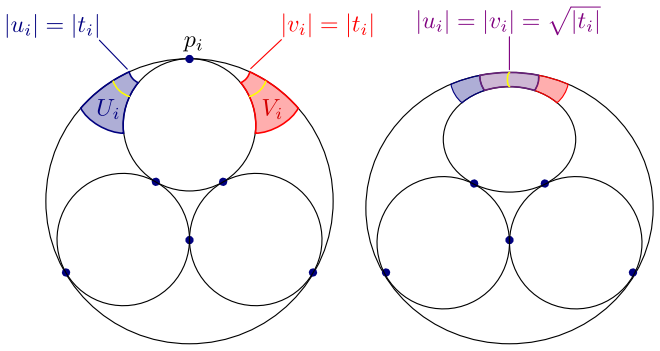
The machinery is plumbing coordinates near a boundary point of the Deligne–Mumford compactification (the compactification of $M_g$ by stable nodal Riemann surfaces) at which all $3g-3$ curves are pinched to nodes, together with a Taylor-series domination lemma. In these coordinates a boundary point is described by parameters $t_1,\ldots,t_{3g-3}$, each $t_i=0$ marking one pinched curve, and a coordinate chart is obtained by gluing punctured disks with the relation $u_i v_i = t_i$. The proof uses Proposition 2.2, which relates the hyperbolic length of the pinched curve $\alpha_i$ to $|t_i|$ roughly as $2\pi^2/\log(1/|t_i|)$, to turn length separation into polynomial-order separation of coordinates. The domination lemma then shows that along any sequence with $|t_j|=o(|t_i|^p)$ for $j>i$ and all $p$, a nonzero analytic function's leading monomial in a lexicographic order eventually outweighs the entire remainder, so the function cannot vanish at every point of the sequence.
What would settle it
Find a proper algebraic subvariety $V \subset M_g$ and a constant $K$ such that every genus-$g$ surface lies within Teichmüller distance $K$ of $V$; the hyperelliptic locus would be a natural candidate. A more local test is to exhibit a proper subvariety containing a sequence of surfaces whose plumbing coordinates satisfy $|t_j(m)| = o(|t_i(m)|^p)$ for all $j>i$ and all positive integers $p$, which the paper's analytic-equation argument says cannot happen.
Extended reading notes
Core claim
The paper's central claim is that an algebraic subvariety $V \subset M_g$ is coarsely dense in the Teichmüller metric if and only if $V = M_g$, and the same equivalence holds for the Thurston metric under either of the two definitions of coarse density. To prove it, the authors suppose $V$ is $K$-coarsely dense and fix a pants decomposition (a maximal set of disjoint simple closed curves). They build a test sequence of surfaces in which the $3g-3$ curve lengths are $1/m, 1/m^2, \ldots, 1/m^{3g-3}$ up to bounded factors. Coarse density supplies surfaces $X_m \in V$ with comparable lengths, and these converge to a boundary point of the Deligne–Mumford compactification where all $3g-3$ curves are pinched to nodes. In plumbing coordinates, the relation between hyperbolic length and plumbing parameters forces the coordinates to satisfy $|t_j(m)| = o(|t_i(m)|^p)$ whenever $j>i$. A proper algebraic subvariety is locally the zero set of a nonzero analytic function in these coordinates, and its Taylor series has a lexicographically minimal nonzero monomial $c_\beta t^\beta$ that dominates every later term along such a sequence; that contradicts $f(t(m))=0$. Therefore the variety cannot be a proper subvariety.
Load-bearing premise
The argument assumes that a proper algebraic subvariety can be represented near the boundary of moduli space by a nonzero analytic equation in the plumbing coordinates, and that hyperbolic lengths of short curves match those coordinates to the stated exponential precision; if either structural fact failed, the Taylor-series domination step would not go through.
Editorial extensions
If this is right
- For any proper algebraic subvariety $V$ of $M_g$ there are points of $M_g$ at arbitrarily large Teichmüller distance from $V$; coarse density is strictly stronger than topological density for these sets.
- For the Thurston metric, the same conclusion holds under both one-sided definitions of coarse density, so the asymmetric nature of the metric does not change the result.
- A stratum $\mathcal{H}(\kappa)$ of abelian differentials projects to a coarsely dense subset of $M_g$ exactly when $\dim \mathbb{P}\mathcal{H}(\kappa) \geq 3g-3$; under that condition the projection is in fact Zariski open and hence topologically dense.
- For any closure $M = \overline{\mathrm{GL}_2(\mathbb{R})(X,\omega)}$ of a $\mathrm{GL}_2(\mathbb{R})$-orbit, $\pi(M)$ is coarsely dense exactly when $\dim \pi(M) \geq 3g-3$, so coarse density and topological density coincide for these projections.
Reading between the lines
- The proof never uses algebraicity beyond local analyticity in plumbing coordinates, so a plausible extension is that every proper complex-analytic subvariety of $M_g$, not only algebraic ones, fails to be coarsely dense; this is my inference, not a claim of the paper.
- The rate-separation criterion suggests a quantitative strengthening: given an analytic equation, the Cauchy estimates should bound how close the vanishing set can come to a rate-separated sequence, potentially producing explicit lower bounds on the distance from a proper subvariety to generic surfaces—something the paper does not compute.
- For Teichmüller dynamics the result sharpens the dichotomy for affine invariant manifolds: an orbit closure whose projection has full dimension must dominate an open set of moduli space, and one whose projection has smaller dimension leaves open coarse-scale holes that persist at every scale.
Signed reviews
Editorial analysis
A structured set of objections, weighed in public.
Referee Report
Summary. The paper proves that a proper algebraic subvariety of the moduli space M_g of genus g Riemann surfaces cannot be coarsely dense in the Teichmüller metric; coarse density holds exactly for V = M_g. The same characterization is established for the Thurston metric under both natural definitions of coarse density. The proof uses plumbing coordinates near a maximally degenerate point of the Deligne-Mumford compactification, the asymptotic relation between plumbing parameters and hyperbolic lengths of pinched curves, and a Taylor-series domination argument: a nonzero analytic equation in plumbing coordinates has a lexicographically minimal monomial that dominates all other terms along a sequence with wildly separated pinching rates. The theorems are applied to strata of abelian differentials and to projections of GL(2,R)-orbit closures.
Significance. If correct, the main result is a clean and novel statement about the coarse geometry of moduli space: a proper algebraic subvariety is 'sparse' at the coarse scale, despite the non-compactness and wild geometry of M_g. The proof is elegant and self-contained modulo standard cited results (plumbing coordinates, Wolpert's length estimates, Hubbard-Koch analytic-algebraic compatibility, EMM and Filip for affine manifolds). The applications to strata and orbit closures are immediate and likely to be of interest to the Teichmüller dynamics community. The paper is honest about its dependencies; the one soft spot, the analytic description of algebraic subvarieties at the boundary, is supported by a standard reference.
minor comments (4)
- [Section 3.2] In the estimate for S_i(t), the shift vector in the reindexed coefficient should be (0,\ldots,0,\beta_i+1,\beta_{i+1},\ldots,\beta_n); the current display is ambiguous and appears to show a doubled \beta_{i+1}.
- [Corollary 1.3] The assertion 'coarse density is not affected by taking topological closure' is false for arbitrary subsets; for the constructible set \pi(M) the desired equivalence can be justified because if its Zariski closure V is coarsely dense, then Theorem 1.1 forces V = M_g, and \pi(M) contains a Zariski open subset of M_g whose complement has empty interior, making \pi(M) coarsely dense.
- [Remark 4.1] The displayed inequalities for the second definition of coarse density are garbled; the lower bound should presumably be (1/c)^c e^{-c m^i} (up to a constant), obtained by applying the upper bound in Lemma 4.1 with the roles of X and Y interchanged.
- [Section 3.2] When lifting the sequence X_m to the finite cover U, one should pass to a subsequence contained in a single irreducible component of the preimage of V so that the chosen analytic equation f satisfies f(t(m))=0 for all m.
Circularity Check
No circularity: the main theorem is proved from external standard results with no fitted inputs or self-referential reduction.
full rationale
The paper's central claim is that a proper algebraic subvariety of M_g cannot be coarsely dense. The proof proceeds constructively: coarse density yields a sequence X_m with prescribed short curve lengths; Wolpert's length comparison (Proposition 2.2, cited to [Wol10]) converts these length rates into the plumbing-coordinate rate separation |t_j|=o(|t_i|^p). Properness plus the Hubbard-Koch analytic/algebraic compatibility result gives a nonzero analytic equation f=0 in those coordinates. A lexicographic Taylor-series argument then shows the leading monomial dominates all others along the sequence, contradicting f(t(m))=0. No step in this chain uses the theorem being proved as an input, and no parameter is fitted to data and then renamed a prediction. The only load-bearing external inputs (plumbing-coordinate analyticity, Wolpert's length estimate, and the Hubbard-Koch identification of algebraic and analytic structures) are independent results that do not presuppose coarse density or the theorem. The applications to strata and affine invariant manifolds rely on separate external theorems (EMM, Filip, Gendron, Chen) and do not feed back into the main proof. I find no circular step, whether self-definitional, fitted-input, self-citation, imported uniqueness, ansatz-smuggling, or renaming of a known result.
Assumptions & free parameters
assumptions (7)
- standard math Plumbing coordinates give local analytic coordinates on a finite cover near a maximally degenerate boundary point of the Deligne-Mumford compactification (Proposition 2.1).
- standard math Hyperbolic length of a pinching curve is related to the plumbing parameter by l(alpha_i) = 2*pi^2 / log(1/|t_i|) up to small error (Proposition 2.2).
- standard math Wolpert's lemma: a bounded Teichmüller distance bounds the ratio of hyperbolic lengths of curves (FM12 Lemma 12.5).
- standard math Algebraic subvarieties of M_g are analytic in plumbing coordinates near the boundary, because the algebraic and analytic structures on M_g agree.
- standard math Bers pants decomposition, the Collar Lemma, and the right-angled pentagon formula for hyperbolic geometry.
- standard math Eskin-Mirzakhani-Mohammadi: orbit closures are affine invariant manifolds; Filip: affine invariant manifolds are quasiprojective.
- standard math Gendron and Chen: strata of abelian differentials with dim PH(kappa) >= 3g-3 dominate a Zariski open set in M_g.
Cite this review
Pith. "Pith review of Coarse density of subsets of $M_g$." pith.science (2026). https://pith.science/paper/IHGRWUUJ
@misc{pith2026190804458,
  author       = {Pith},
  title        = {Pith review of: Coarse density of subsets of $M_g$},
  year         = {2026},
  howpublished = {\url{https://pith.science/paper/IHGRWUUJ}},
  note         = {Machine review of arXiv:1908.04458}
}
abstract
Let $\mathcal{M}_g$ be the moduli space of genus $g$ Riemann surfaces. We show that an algebraic subvariety of $\mathcal{M}_g$ is coarsely dense with respect to the Teichm\"uller metric (or Thurston metric) if and only if it is all of $\mathcal{M}_g$. We apply this to projections of $\operatorname{GL}_2(\mathbb{R})$-orbit closures in the space of abelian differentials. Moreover, we determine which strata of abelian differentials have coarsely dense projection to $\mathcal{M}_g$.
Figures
Reference graph
Works this paper leans on
-
[1]
Augmented T eichm\" u ller spaces
William Abikoff. Augmented T eichm\" u ller spaces. Bull. Amer. Math. Soc. , 82(2):333--334, 1976
work page 1976
-
[2]
Degenerating families of R iemann surfaces
William Abikoff. Degenerating families of R iemann surfaces. Ann. of Math. (2) , 105(1):29--44, 1977
work page 1977
-
[3]
Spaces of degenerating R iemann surfaces
Lipman Bers. Spaces of degenerating R iemann surfaces. pages 43--55. Ann. of Math. Studies, No. 79, 1974
work page 1974
-
[4]
Covers of elliptic curves and the moduli space of stable curves
Dawei Chen. Covers of elliptic curves and the moduli space of stable curves. J. Reine Angew. Math. , 649:167--205, 2010
work page 2010
-
[5]
P. Deligne and D. Mumford. The irreducibility of the space of curves of given genus. Inst. Hautes \' E tudes Sci. Publ. Math. , (36):75--109, 1969
work page 1969
-
[6]
Clifford J. Earle and Albert Marden. Holomorphic plumbing coordinates. In Quasiconformal mappings, R iemann surfaces, and T eichm\" u ller spaces , volume 575 of Contemp. Math. , pages 41--52. Amer. Math. Soc., Providence, RI, 2012
work page 2012
-
[7]
Isolation, equidistribution, and orbit closures for the SL (2, R ) action on moduli space
Alex Eskin, Maryam Mirzakhani, and Amir Mohammadi. Isolation, equidistribution, and orbit closures for the SL (2, R ) action on moduli space. Ann. of Math. (2) , 182(2):673--721, 2015
work page 2015
-
[8]
John D. Fay. Theta functions on R iemann surfaces . Lecture Notes in Mathematics, Vol. 352. Springer-Verlag, Berlin-New York, 1973
1973
Show all 17 references
-
[9]
Splitting mixed H odge structures over affine invariant manifolds
Simion Filip. Splitting mixed H odge structures over affine invariant manifolds. Ann. of Math. (2) , 183(2):681--713, 2016
2016
-
[10]
A primer on mapping class groups , volume 49 of Princeton Mathematical Series
Benson Farb and Dan Margalit. A primer on mapping class groups , volume 49 of Princeton Mathematical Series . Princeton University Press, Princeton, NJ, 2012
2012
-
[11]
The D eligne- M umford and the incidence variety compactifications of the strata of M _g
Quentin Gendron. The D eligne- M umford and the incidence variety compactifications of the strata of M _g . Ann. Inst. Fourier (Grenoble) , 68(3):1169--1240, 2018
2018
-
[12]
Hubbard and Sarah Koch
John H. Hubbard and Sarah Koch. An analytic construction of the D eligne- M umford compactification of the moduli space of curves. J. Differential Geom. , 98(2):261--313, 2014
2014
-
[13]
Horocyclic coordinates for R iemann surfaces and moduli spaces
Irwin Kra. Horocyclic coordinates for R iemann surfaces and moduli spaces. I . T eichm\" u ller and R iemann spaces of K leinian groups. J. Amer. Math. Soc. , 3(3):499--578, 1990
1990
-
[14]
Geometric complex coordinates for T eichm\" u ller space
Albert Marden. Geometric complex coordinates for T eichm\" u ller space. In Mathematical aspects of string theory ( S an D iego, C alif., 1986) , volume 1 of Adv. Ser. Math. Phys. , pages 341--354. World Sci. Publishing, Singapore, 1987
1986
-
[15]
J.L. Taylor. Several Complex Variables with Connections to Algebraic Geometry and Lie Groups . Graduate studies in mathematics. American Mathematical Society, 2002
2002
-
[16]
Thurston
William P. Thurston . Minimal stretch maps between hyperbolic surfaces . arXiv Mathematics e-prints , page math/9801039, Jan 1998
1998 arXiv
-
[17]
Scott A. Wolpert. Families of R iemann surfaces and W eil- P etersson geometry , volume 113 of CBMS Regional Conference Series in Mathematics . Published for the Conference Board of the Mathematical Sciences, Washington, DC; by the American Mathematical Society, Providence, RI, 2010
2010
Reviewed August 14, 2026 · model on record in the stance chip above.
Discussion (0). Continue with ORCID to comment.