REVIEW 1 major objections 6 minor 38 references
The Ultimate I-band Calibration of the TRGB Standard Candle
T0 review · 1 major / 6 minor · reviewed 2026-08-06 · deepseek-v4-flash
Pith's one-line read The paper pins the I-band absolute magnitude of the TRGB at −4.022 mag with total uncertainty near 1%, using ~140,000 red giants in the clean outer disk of the Large Magellanic Cloud.
desk verdict A genuinely improved TRGB zero point from the outer LMC, but the 'ultimate' precision claim needs a warp-model test before it holds up. read the letter →
The pith
A machine-rendered reading of the paper's core claim, the machinery that carries it, and where it could break.
The reading
What carries the argument
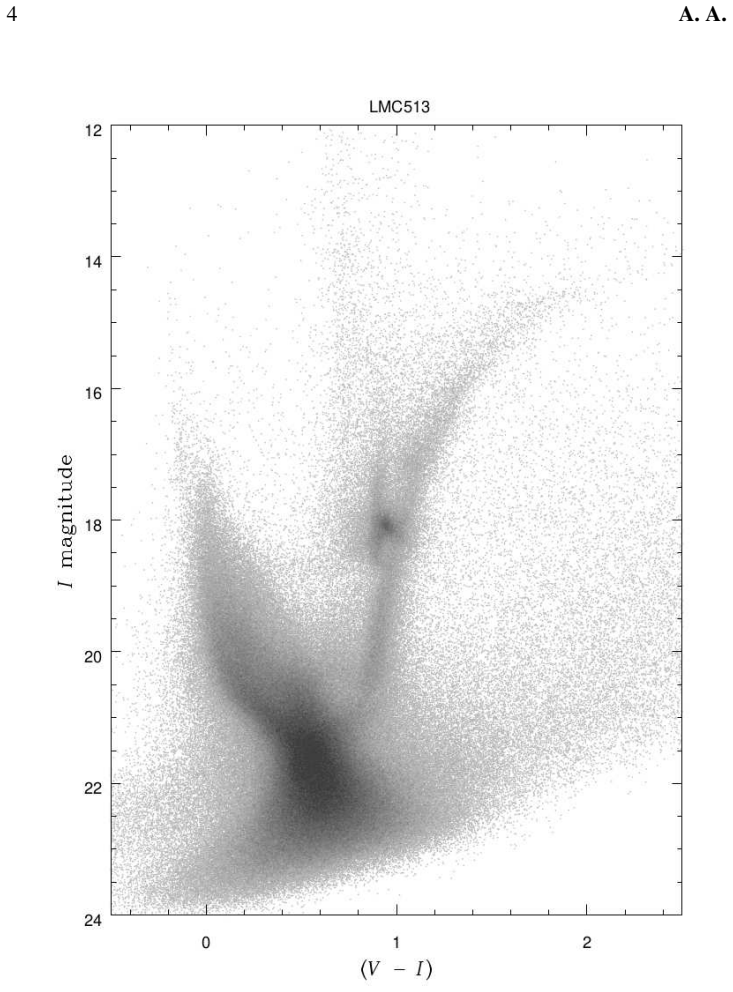
The key machinery is the pairing of a large, homogeneous photometric catalog with an individual distance correction for every star. Each red giant is dereddened along its own line of sight using the red-clump-based reddening maps of Skowron et al. (2021), then its magnitude is rectified to a common distance using a flat-disk model of the outer LMC with inclination $i$ and position angle $\mathrm{PA}$ chosen to minimize the scatter of the tip magnitude across 12 sectors of the disk. The tip itself is located by binning roughly 140,000 upper RGB stars into a luminosity function, smoothing it with the GLOESS filter at $\sigma_s = 0.125$, and applying an extended Sobel-like edge-detection kernel $[-1,-1,-1,0,0,0,+1,+1,+1]$ whose maximum marks the tip.
What would settle it
Measure the geometric distance to a set of stars (for example, eclipsing binaries) in the outer LMC disk at radii between 3 and 6 degrees and compare their distance moduli to the flat-disk prediction; a systematic deviation larger than the quoted statistical uncertainty would falsify the calibration. An independent 1%-accurate geometric distance to another nearby galaxy whose TRGB apparent magnitude then gave an absolute magnitude outside the stated systematic error would also refute the result.
Extended reading notes
Core claim
The central claim is that the absolute I-band magnitude of the tip of the red giant branch is $M_{I,\mathrm{TRGB}} = -4.022 \pm 0.006 \mathrm{(stat.)} \pm 0.033 \mathrm{(syst.)}$ mag, established from OGLE-IV photometry of the outer Large Magellanic Cloud between 2.75 and 6.5 degrees from the center. The paper argues that previous attempts using central LMC fields were hampered by crowding, non-uniform extinction, and complex three-dimensional structure, while the outer disk is well described as a flat inclined plane, allowing each star's apparent magnitude to be corrected for its individual line-of-sight distance. The apparent tip magnitude, $I_{\mathrm{TRGB}}^0 = 14.4519 \pm 0.0004$ mag, is converted to an absolute magnitude using the geometric distance to the LMC, and the resulting zero point is validated against TRGB measurements in the SMC and NGC 4258.
Load-bearing premise
The outer LMC disk is assumed to be a single flat plane over the whole 2.75 to 6.5 degree radial range, so if the galaxy's true structure bends or warps within this range, the distance-corrected tip magnitudes would be biased by more than the quoted statistical error.
Editorial extensions
If this is right
- If the calibration is correct, the TRGB zero point is anchored to a 1% geometric distance, making the TRGB a fully competitive distance ladder step for measuring the Hubble constant.
- The paper's menu of calibrations (no-bias, SNR-weighted, Poisson-weighted, and F814W) lets future surveys correct their tip measurements for edge-detector weighting biases of tens of millimagnitudes.
- Applying the new zero point shifts the CCHP Hubble constant by about −0.3 km/s/Mpc and the Anand et al. (2022) value by about −1.8 km/s/Mpc, bringing that determination closer to the CCHP value.
- The success of the outer-disk approach suggests that future standard-candle calibrations in the LMC should avoid central fields entirely and use low-reddening outer regions with simple geometry.
Reading between the lines
- Because the dominant error is the LMC distance itself, further improving this calibration will require a more accurate geometric distance to the LMC rather than more photometry.
- The flat-disk assumption, which appears safe for the LMC's outer disk, may need to be replaced by a warped-disk model if the same method is applied to galaxies with stronger tidal interactions.
- The close agreement among the LMC, SMC, and NGC 4258 zero points suggests the intrinsic I-band TRGB luminosity is uniform at the few-millimagnitude level, which is a testable prediction for future JWST-based TRGB measurements.
- The paper's comparison implies that published TRGB Hubble constants based on weighted edge detectors carry a weighting-dependent offset, and re-deriving H0 with unweighted tips is a straightforward check the community can perform.
Signed reviews
Editorial analysis
A structured set of objections, weighed in public.
Referee Report
Summary. The paper calibrates the I-band absolute magnitude of the tip of the red giant branch (TRGB) using OGLE-IV deep photometry of the outer LMC disk (2.75° < r < 6.5°). Individual stars are dereddened with the Skowron et al. (2021) maps and rectified to a common distance using a flat-disk model with parameters determined from a sector-scatter minimization. The resulting apparent TRGB magnitude is combined with the Pietrzyński et al. (2019) geometric LMC distance to obtain M_I,TRGB = −4.022 ± 0.006 (stat.) ± 0.033 (syst.) mag. The calibration is cross-checked against the SMC (Graczyk et al. 2020) and NGC 4258 (Jang et al. 2021; Scolnic et al. 2023) and used to re-evaluate recent TRGB-based H0 determinations.
Significance. The paper provides the most precise LMC-based TRGB zero point to date, with a careful error budget that includes binning, smoothing, edge-detection, extinction ratio, zero point, LMC center, and metallicity. The use of the outer LMC avoids the crowding and non-uniform reddening of the central bar. The authors provide calibrations for several edge-detection weighting schemes, making the results directly applicable to different TRGB pipelines. The agreement with the geometric SMC distance and with the NGC 4258 maser distance is a considerable strength. However, the flat-disk rectification of the outer LMC and the omission of a warp term in the error budget leave a plausible source of systematic bias at the level of ~0.01–0.02 mag, which must be addressed before the 'ultimate' precision claim is fully established.
major comments (1)
- [§4.2, §4.4] The flat-disk rectification does not include the documented LMC warp toward the SMC, and the error budget in Section 4.4 has no corresponding systematic term. Section 4.1 states that the warp 'becomes noticeable at about 5–6 kpc' from the LMC center, which is inside ring B used here (4.25°–6.5°, i.e., ≈4.8–5.7 kpc). The sector-scatter minimization in Section 4.2 uses only 12 wide sectors and is insensitive to a radially coherent depth trend: a warp that changes the disk tilt with radius would shift the distance corrections for the outer regions without inflating the sector-to-sector rms. The SMC and NGC 4258 checks do not isolate this assumption because they share the same photometric and reddening system and do not test the LMC's internal geometry. I request that the authors (i) recompute the rectification with a published warped-disk model, e.g., Choi et al. (2018) or Saroon & Subramanian (2022), and report the resulting change in M_I,TRGB, or (ii) restrict the sample to radii where the warp is negligible and demonstrate stability of the calibration. The resulting systematic uncertainty should be added to the error budget.
minor comments (6)
- [Abstract] The phrase 'making it possible to determine of the tip magnitude' is ungrammatical and should read 'making it possible to determine the tip magnitude' or 'determination of the tip magnitude'.
- [Table 2] The preferred value in Table 2 is printed as '14.4519±±± 0.0004' with three plus/minus signs; this is a typographical error and should be a single '±'.
- [Table 3] The preferred value in Table 3 appears as '−−−4.022' with three minus signs; it should be '−4.022'.
- [Section 5.2] The SMC-based absolute magnitude is quoted as '−4.024 ± 0.22 (stat.) ± 0.26 (syst.) mag'; the uncertainties appear to be missing leading zeros and should likely be ±0.022 and ±0.026 (or the appropriate combination). Please verify and correct.
- [Section 4.4] The contrast ratio R = N+/N− is used without defining N+ and N−; please define these quantities where the ratio is introduced.
- [Figure 3 caption] The caption contains 'top pf the panel'; this should read 'top of the panel'.
Circularity Check
No significant circularity: the TRGB zero point is anchored to the independent Pietrzyński et al. (2019) eclipsing-binary distance, and the apparent TRGB magnitude is measured rather than predicted.
full rationale
The derivation chain is self-contained against external anchors. The absolute calibration is M_I,TRGB = I_TRGB0 - (m-M)_LMC, where I_TRGB0 is a measured apparent magnitude from OGLE-IV photometry after reddening corrections from Skowron et al. (2021) red-clump maps and flat-disk rectification, and (m-M)_LMC = 18.477 mag comes from Pietrzyński et al. (2019) eclipsing binaries. None of these inputs is defined in terms of the TRGB absolute magnitude; the red-clump maps are calibrated on intrinsic red-clump color, not on the TRGB. The disk parameters (i, PA) are fitted to minimize sector scatter, but the paper shows the final I_TRGB0 changes by less than 1 mmag between using the 25 and 250 best parameter sets, so the mean is not statistically forced by the fit. The SMC and NGC 4258 checks compare against independent geometric distances (Graczyk et al. 2020; Reid, Pesce and Riess 2019), and although the SMC test shares the OGLE photometric and reddening system with the LMC calibration, that shared zero point cancels in the derived distance modulus and does not reduce the comparison to a tautology. The acknowledged LMC warp (Section 4.1) is a potential systematic affecting the geometric rectification, but it is a correctness risk omitted from the error budget rather than a circular step. Self-citations to OGLE pipeline papers and to the Skowron et al. (2021) maps are inputs with independent derivations from red clump stars and do not contain the target result. No equation in the paper is equivalent to another by construction, and no fitted parameter is renamed as a prediction. Therefore the calibration is not circular. The main caveat is the flat-disk/warp assumption, which is a modeling uncertainty, not a circularity.
Assumptions & free parameters
free parameters (6)
- R_I (I-band extinction ratio) =
1.34 default; 1.24 and 1.44 used for testing
- LMC center coordinates =
(81.465, -69.515) default; alternatives (79.88, -69.6) and (82.25, -69.5)
- LMC disk inclination and position angle (i, PA) =
Best-fit from grid: i in 17-22 deg, PA in 140-150 deg; exact values not listed
- GLOESS smoothing parameter sigma_s =
0.125
- Color and magnitude selection limits =
I0 < 16, (V-I)0 strip 0.9-1.6 with slope -3.3333
- Edge detection kernel =
Extended kernel [-1,-1,-1,0,0,0,+1,+1,+1]
assumptions (6)
- domain assumption The outer LMC disk can be accurately modeled as a flat plane over 2.75 < r < 6.5 deg, with the warp toward the SMC negligible.
- domain assumption The reddening maps of Skowron et al. (2021) give accurate E(V-I) toward each star in the outer LMC and central SMC.
- domain assumption The I-band TRGB absolute magnitude is independent of metallicity and stellar population over the sampled color range.
- domain assumption The geometric distance to the LMC from Pietrzynski et al. (2019), adjusted for the adopted LMC center, is accurate to 1%.
- domain assumption The GLOESS smoothing and unweighted Sobel edge detection provide an unbiased estimate of the TRGB magnitude.
- domain assumption The transformation from HST F814W to I-band (Freedman et al. 2020) is accurate.
Cite this review
Pith. "Pith review of The Ultimate I-band Calibration of the TRGB Standard Candle." pith.science (2026). https://pith.science/paper/IHNFYI3X
@misc{pith2026250620766,
  author       = {Pith},
  title        = {Pith review of: The Ultimate I-band Calibration of the TRGB Standard Candle},
  year         = {2026},
  howpublished = {\url{https://pith.science/paper/IHNFYI3X}},
  note         = {Machine review of arXiv:2506.20766}
}
read the original abstract
We present the ultimate I-band calibration of the tip of the red giant branch (TRGB) standard candle. Our calibration is based on photometry from the outer parts of the Large Magellanic Cloud, 2.75<r<6.5 degs from the center, collected during the OGLE-IV phase of the Optical Gravitational Lensing Experiment. Outer regions of the LMC have large advantages compared to the previous attempts of the TRGB calibrations using the red giants from the central parts of this galaxy. The interstellar reddening in these regions is much lower and more uniform, stellar crowding is lower and the outer parts of the LMC can be accurately described as a flat disk within the reasonable distance from the LMC center. The number of red giants in the upper part of the red giant branch in our LMC region is large, ~140 000, making it possible to determine of the tip magnitude with high accuracy. Our ultimate I-band calibration of the TRGB is: M_{I,TRGB}=-4.022 +- 0.006 (stat.) +- 0.033 (syst.) mag. We also provide its values for different techniques of the determination of the tip magnitude. The accuracy of our calibration is mostly limited by the accuracy of the distance to the LMC (~1%) and can be improved in the future. We test our calibration by comparing it with the TRGB in the Small Magellanic Cloud and NGC 4258, i.e., the galaxies with precise geometric distance determination, and find excellent agreement. Finally, we refine the main determinations of the Hubble constant, H_0, with the TRGB using our new calibration of the I-band TRGB brightness.
Figures


Figures from the paper (1 more)

Reference graph
Works this paper leans on
-
[1]
Anand, G.S., Tully, R.B., Rizzi, L., Riess, A.G., and Y uan, W. 2022, ApJ, 932,
work page 2022
- [13]
- [15]
-
[16]
75 25 Freedman, W.L., Madore, B.F., Hoyt, T.J., Jang, I.S., Lee, A .J., and Owens, K.A
V ol. 75 25 Freedman, W.L., Madore, B.F., Hoyt, T.J., Jang, I.S., Lee, A .J., and Owens, K.A. 2025, ApJ, 985,
work page 2025
- [23]
-
[28]
Jang, I.S., Hoyt, T.J., Beaton, R.L. et al. 2021, ApJ, 906,
work page 2021
-
[32]
Li, S., and Beaton, R.L. 2024, in "Hubble Constant Tension", Eds. E. Di V alentino and D. Brout, Springer Singapore, arXiv:2403.17048. Li, S., Anand, G.S., Riess, A.G. et al. 2024, ApJ, 976,
arXiv 2024
-
[34]
Freedman, W.L., Madore, B.F., Hoyt, T. et al. 2020, ApJ, 891,
work page 2020
Show all 38 references
-
[35]
2019, ApJ, 886,
Y uan, W., Riess, A.G., Macri, L.M., Casertano, S., and Scolnic, D.M. 2019, ApJ, 886,
2019
-
[43]
2025, Science, 387, 1209
Zhang, X., and Green, G. 2025, Science, 387, 1209
2025
-
[57]
2021, ApJ, 919,
Freedman, W.L. 2021, ApJ, 919,
2021
-
[61]
2001, AJ, 122,
van der Marel, R.P ., and Cioni M.-R. 2001, AJ, 122,
2001
-
[89]
2024, ApJ, 963, L43
Anderson, R.I., Koblischke, N.W, and Eyer, L. 2024, ApJ, 963, L43. Choi, Y ., Nidever, D.L., Olsen, K.et al. 2018, ApJ, 866,
2024
-
[90]
2009, A&A, 506,
Cioni M.-R. 2009, A&A, 506,
2009
-
[104]
1993, ApJ, 417,
Lee, M.G, Freedman, W.L., and Madore, B.F. 1993, ApJ, 417,
1993
-
[121]
2023, ApJ, 946,
Wang, S., and Chen, X. 2023, ApJ, 946,
2023
-
[125]
2019, A&A, 628, A51
Joshi, Y .C., and Panchal, A. 2019, A&A, 628, A51. Kim, Y .J., Kang, J., Lee, M.G., and Jang I.S. 2020, ApJ, 905,
2019
-
[149]
2017, ApJ, 835,
Jang, I.S, and Lee, M.G. 2017, ApJ, 835,
2017
-
[158]
2023, Nature Astronomy, 7,
Hoyt, T.J. 2023, Nature Astronomy, 7,
2023
-
[176]
Jacyszyn-Dobrzeniecka, A.M., Skowron, D.M., Mróz, P . et al. 2016, Acta Astron., 66,
2016
-
[177]
2009,ApJ, 690,
Madore, B.F., Mager, V ., and Freedman, W.L. 2009,ApJ, 690,
2009
-
[179]
Graczyk, D., Pietrzy ´nski, G., Thompson, I.B. et al. 2020, ApJ, 904,
2020
-
[200]
Planck collaboration, Aghanim, N, Akrami, Y . et al. 2020, A&A, 641, A6. Reid, M.J., Pesce, D.W., and Riess, A.G. 2019, ApJ, 886, L27. Riess, A.G., Y uan, W., Macri, L.M.et al. 2022, ApJ, 934, L7. Saroon, S., and Subramanian, S. 2022, A&A, 666, A103. Schechter, P .L., Mateo, M...
2020
-
[203]
Gaia Collaboration, Luri, X., Chemin, L. et al. 2021, A&A, 649, A7. Górski, M., Zgirski, B., Pietrzy ´nski, G. et al. 2020, ApJ, 889,
2021
-
[269]
Skowron, D.M., Skowron, J., Udalski, A. et al. 2021, ApJS, 252,
2021
-
[284]
2015, Acta Astron., 65,
Udalski, A., Szyma ´nski, M.K., and Szyma ´nski, G. 2015, Acta Astron., 65,
2015
-
[296]
2011, AJ, 141,
Haschke, R., Grebel, E., and Duffau, S. 2011, AJ, 141,
2011
-
[389]
2008,ApJ, 689,
Mager, V ., Madore, B.F., and Freedman, W.L. 2008,ApJ, 689,
2008
-
[421]
Th., Cioni, M.-R
Tatton, B.L., van Loon, J. Th., Cioni, M.-R. et al. 2013, A&A, 554, A33. Udalski. A. 2000, Acta Astron., 50,
2013
-
[553]
Li, S., Riess, A.G., Scolnic, D. et al. 2023, ApJ, 956,
2023
-
[590]
2025, arXiv:2503.11769
Hoyt, T.J., Jang, I.S., Freedman, W.L., Madorre, B.F., Owen s, K.A., and Lee, A.J. 2025, arXiv:2503.11769. Inno, L., Bono, G., Matsunaga, N. et al. 2016, ApJ, 832,
2025 arXiv
-
[721]
2006, AJ, 123,
Makarov, D., Makarova, L., Rizzi, L., Tully, B.R., Dolphin, A.E., Sakai, S., and Shaya, E.J. 2006, AJ, 123,
2006
-
[1137]
Freedman, W.L., Madore, B.F., Hatt, D. et al. 2019, ApJ, 882,
2019
-
[1342]
Scolnic, D., Riess, A.G., Wu, J. et al. 2023, ApJ, 954, L31. Skowron, D.M., Soszy ´nski, I., Udalski, A. et al. 2016, Acta Astron., 66,
2023
-
[1730]
2004, AJ, 128,
Persson, S.E., Madore, B.F., Krzemi ´nski, W., Freedman, W.L., Roth, M., and Murphy, D.C. 2004, AJ, 128,
2004
-
[1807]
2014, ApJ, 781,
van der Marel, R.P ., and Kallivayalil, N. 2014, ApJ, 781,
2014
-
[2239]
Pietrzy´nski, G., Graczyk, D., Gallenne, A. et al. 2019, Nature, 567,
2019
-
[2729]
Pejcha, O., and Stanek. K.Z. 2009, ApJ, 704,
2009
Reviewed August 6, 2026 · model on record in the stance chip above.
Discussion (0). Continue with ORCID to comment.