REVIEW 4 major objections 5 minor 66 references
One task to rule them all: A closer look at traffic classification generalizability
T0 review · 4 major / 5 minor · reviewed 2026-08-06 · deepseek-v4-flash
Pith's one-line read The paper shows that traffic classifiers trained on one real network's TLS traffic transfer poorly to another network's traffic on the identical 25-way service-identification task, with the best model reaching only 35% accuracy while a…
desk verdict A genuinely useful cross-network transfer study whose qualitative conclusion holds even though the headline 30-40% number is conditional on a curated 25-class task. read the letter →
The pith
A machine-rendered reading of the paper's core claim, the machinery that carries it, and where it could break.
The reading
What carries the argument
The evaluation framework is the load-bearing object. It consists of two contemporaneous real-world TLS datasets, collected from large-scale networks in different countries (named CESNET and Orange in the paper), aligned to the identical 25-class service-identification task with matching input representations: inter-arrival times, payload sizes, and directions for the first 30 non-empty packets per flow, normalized so that the same preprocessing applies to both. Transfer is measured as the accuracy of a model trained on one network and evaluated on the other, with a same-dataset split as the reference point, and the framework controls for concept drift by using collections from the same time window. The surrounding analysis is carried by three mechanisms: the method-versus-model distinction (a 'method' is a recipe, a 'model' a trained artifact), a sweep of transformer architectures and learning-rate schedules, and a comparison of transferred versus same-dataset performance across multiple runs to separate model choice from training-process choice.
What would settle it
Collect a third TLS traffic dataset from a different large network covering the same 25 services in the same period, train on CESNET, and transfer: if the best transferred accuracy exceeds roughly 50%, well above the 30–40% band, the reported collapse would not be the general rule. Alternatively, measure real Encrypted-Client-Hello (ECH) traffic and compare flow timeseries features with non-ECH traffic; if ESNI/ECH changes handshake sizes, retransmissions, or packet timing, the framework's simulated safe area is not the deployment scenario it claims to model.
Extended reading notes
Core claim
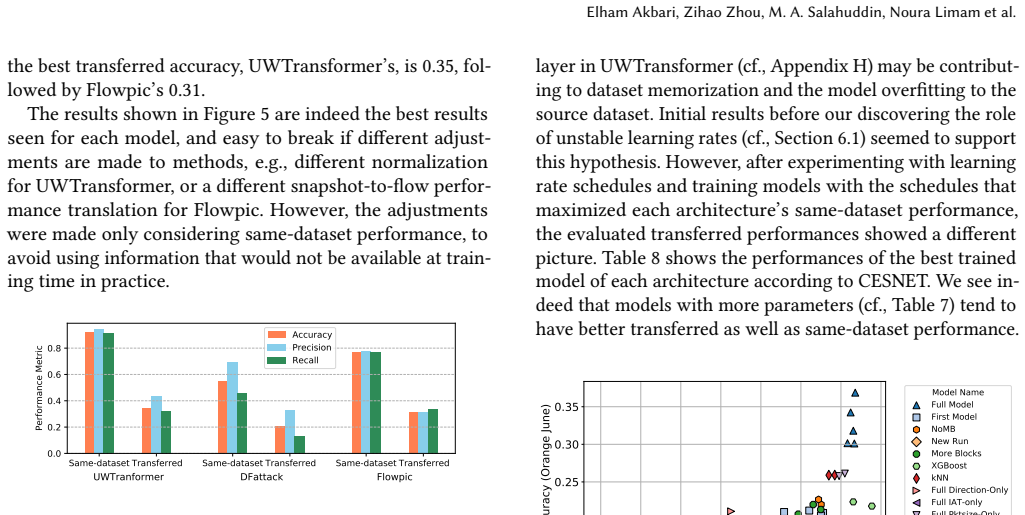
On aligned real-world traffic from two independent networks, trained classifiers generalize poorly: UWTransformer's best transferred accuracy from one network's traffic to the other is 0.35, Flowpic's is 0.31, and DFattack's is below that, while the same models reach roughly 0.85–0.91 when tested on a held-out split of the training network's traffic. Because both traffic collections were made in the same period, the framework excludes concept drift, so the gap is attributed to distribution shift between networks. The paper also finds that larger, over-parameterized transformers transfer somewhat better than smaller ones and that the best deep model only slightly beats classical baselines (XGBoost and 1-NN), while the spread of results caused by different learning-rate schedules and normalization choices exceeds the spread between architectures. These results support the paper's central claim: high same-dataset performances in the literature are inflated by dataset-specific and model-specific properties, and a fair representation of a traffic classifier requires average-case, cross-dataset evaluation.
Load-bearing premise
The framework's realism rests on the assumption that the privacy difference between the two simulated areas, one with encrypted SNI and one without, would not change flow timeseries features such as TCP payload sizes, packet sequence, or timing, an assumption the paper does not test against real ESNI/ECH traffic.
Editorial extensions
If this is right
- Published near-perfect accuracies on a single dataset do not predict performance in another real network, so a cross-network transfer test should precede any practical deployment of a traffic classifier.
- Distribution shift alone, without concept drift, can cut accuracy by more than half, meaning retraining on newer data is not enough; the training distribution itself needs to match the deployment context.
- Classical baselines such as 1-NN and XGBoost should be reported alongside deep models, because the best transformer in this study only slightly outranks them under distribution shift.
- Performance differences between training processes (learning-rate schedules, normalization) exceed differences between architectures, so single-run accuracy numbers should be replaced by the full range of observed performances.
- Larger over-parameterized models transfer slightly better, but the gain is small relative to the transfer gap, so architecture search is secondary to evaluation design.
Reading between the lines
- If Encrypted SNI is widely deployed, a classifier trained on today's clear-SNI traffic from one region may be nearly useless on another region's encrypted traffic, implying that ISPs would need per-network labeled calibration or adaptation, not just a better model.
- The framework can be extended into a transfer benchmark: adding a third independently collected TLS dataset and reporting both pairwise transfer directions would let the field rank methods by average transfer accuracy instead of single-dataset accuracy.
- Since training-process variance exceeds model variance, many published comparisons may be unrepeatable even with the same datasets; reporting learning curves and pinned learning-rate schedules would sharpen future comparisons.
- A testable extension is whether a small amount of labeled target-network traffic restores accuracy through fine-tuning; if it does, the practical prescription is adaptation strategies rather than new architectures.
Editorial analysis
A structured set of objections, weighed in public.
Referee Report
Summary. The paper studies whether traffic classification models generalize across independently collected networks when the task is identical and concept drift is absent. It first revisits three published time-series classifiers (DFattack, Flowpic, UWTransformer) on each other's datasets, finding that each performs best on its original evaluation dataset. It then constructs a transfer-learning benchmark from two real-world TLS datasets (CESNET and Orange, June and October 2021), aligning labels by applying CESNET's labeling function to Orange SNIs and selecting 25 shared classes, and aligning inputs to the first 30 non-empty packets per flow. On this benchmark, the best transferred accuracy is roughly 30-40%, with a 1-NN baseline close behind. The paper further examines the effect of architecture size, learning-rate schedules, and class-grouping on transfer performance.
Significance. If the findings are robust, the paper provides a valuable counterpoint to the high same-dataset accuracies in the traffic-classification literature and a reusable evaluation framework for distribution-shift studies. Strengths include the use of two large-scale real-world datasets collected at overlapping times, explicit alignment of labels and input features, a wide range of compared models including classical baselines, and released artifacts. The result that a simple 1-NN is competitive with trained deep models is a stark and useful observation. However, the headline numbers depend on several post hoc choices whose influence is not fully quantified.
major comments (4)
- [Section 5.2.3 / Section 5.1 Assumption 2] The 25-class label set is selected as the classes most frequent in both CESNET and Orange; because the selection is made after looking at the target dataset, the measured transfer accuracy is conditional on a curated classification problem that may not reflect the full label distribution an operator faces. The paper's Assumption 2 in Section 5.1 asserts that the class count is constrained to 25 in the intended deployment scenario, but no evidence is given from either dataset or from the cited IP-based constraint literature. Please report results on the full label set (e.g., the 103 classes observed in Orange under CESNET labels) or at least on a label set selected using only source information, and include per-class accuracy for rare classes. Without this, the 30-40% headline cannot be read as a statement about practical ESNI identification.
- [Section 6.2.1 / Figure 5 / Table 8] The reported best transferred accuracy is inconsistent across the paper. Section 6.2.1 states that UWTransformer's best transferred accuracy is 0.35 on Orange October, and Figure 5 shows this value, while Table 8 reports 0.2767 for the Full Model (UWTransformer) on the same target under the MinMax normalization used for all models in that table. The text explains that Figure 5 uses a Box-Cox IAT normalization selected on source validation, but the abstract's 'between 30% and 40%' is not clearly tied to either evaluation. Please unify the reported numbers, state which configuration the headline refers to, and discuss the effect of normalization on the headline range.
- [Section 6.2 / Figure 5 / Table 8] Transferred accuracies in Figure 5 are computed from only two training runs ('Each model was trained twice'), and Table 8 lists single point estimates without error bars. Given the paper's own demonstration that learning-rate schedules can change validation accuracy from 0.44 to 0.85 (Section 6.1.2, Figure 4), run-to-run variability is a plausible confound for the small differences between models (e.g., 0.35 vs 0.31). Please provide means and standard deviations (or individual runs) for at least the headline results, and for the Table 8 entries.
- [Section 5.1 Assumption 1] Assumption 1 states that ESNI/ECH adoption does not change flow time-series features such as TCP payload sizes and packet ordering; this is essential for the simulation's realism but is not validated against any ESNI/ECH traffic. Since ESNI changes the ClientHello size and may alter retransmission or timing behaviour, please provide evidence or a sensitivity analysis, or clearly present the result as a lower-bound simulation that abstracts away protocol-level changes.
minor comments (5)
- [Figure 5] The model name 'UWTranformer' is misspelled, and the bars do not include numeric values, making it hard to reconcile the figure with Table 8.
- [Section 4.2.3] 'Incidently' should be 'Incidentally'.
- [Section 5.2.3] The phrase 'the 25 classes that happened to be the most frequent in both datasets' should specify the exact criterion (e.g., minimum number of flows per class) and report how many classes were excluded because of low support.
- [Section 6.1.2] The footnote about CESNET time-series durations not reflecting entire flow durations is confusing; please state the timeout value and how truncated flows are handled in the feature extraction.
- [Table 2] The CESNET-25 size is listed as '1 million' but Table 6 reports 1.2 million selected flows; please reconcile these numbers.
Circularity Check
No derivation-level circularity: transfer accuracy is measured on held-out Orange data with source-only model selection; class-selection and ESNI-assumption concerns are validity risks, not circular reductions.
full rationale
The paper's central claim (best transferred accuracy of 30-40% from CESNET to Orange) is a direct measurement on a target dataset that was never used for model selection. Section 6.2.1 explicitly states that the reported results are "the best results seen for each model" and that "the adjustments were made only considering same-dataset performance, to avoid using information that would not be available at training time in practice." No parameter is fitted to the Orange target and then renamed as a prediction; learning-rate schedules, normalizations, window sizes, and architectures were all chosen using CESNET validation only (Sections 6.1, 6.2.1, Table 8, Figure 6). The reliance on the authors' own UWTransformer [4] is not load-bearing: the low transfer range holds for DFattack (0.31), Flowpic, XGBoost (0.22-0.23), and 1-NN (0.25), so the headline does not reduce to a self-citation chain. Two reviewer concerns are validity risks, not circularities. First, Section 5.2.3's selection of "the 25 classes that happened to be the most frequent in both datasets" conditions the reported 0.35 on a label set chosen post hoc on the target distribution; this could bias the headline in either direction, but the measured performance is still computed on held-out Orange flows under the paper's declared Assumption 2 (25-constrained task), so it is not a self-definitional reduction. Second, Assumptions 1 and 2 of Section 5.1 (ESNI/ECH does not alter timeseries features; 25 classes suffice) are asserted, not validated against real ESNI traffic, which limits realism but does not make the derivation equivalent to its inputs. No equation in the paper equates its output to its input, so no circular step can be exhibited; the correct finding is a near-zero circularity score with a minor, non-load-bearing self-citation.
Assumptions & free parameters
free parameters (5)
- IAT upper bound =
5 seconds
- Flowpic window_size =
500 ms for transfer experiments; 60 s and 240 s for other evaluations
- Box-Cox IAT normalization transform =
Lambda fitted on CESNET
- Selected 25 most frequent classes =
25 SNI classes
- Learning rate schedules =
Custom sequences, e.g., [10^-3, 10^-4, 10^-5, 10^-6, 10^-7]
assumptions (4)
- domain assumption ESNI/ECH deployment does not alter flow time-series features such as packet sizes, sequences, and timing
- domain assumption The two datasets, after alignment, represent the same classification task
- ad hoc to paper Only time-series features are available in the safe area; labels come from unsafe area
- domain assumption Concept drift is absent because CESNET and Orange October were collected around the same time
Cite this review
Pith. "Pith review of One task to rule them all: A closer look at traffic classification generalizability." pith.science (2026). https://pith.science/paper/IHVYW7OT
@misc{pith2026250706430,
  author       = {Pith},
  title        = {Pith review of: One task to rule them all: A closer look at traffic classification generalizability},
  year         = {2026},
  howpublished = {\url{https://pith.science/paper/IHVYW7OT}},
  note         = {Machine review of arXiv:2507.06430}
}
read the original abstract
Existing website fingerprinting and traffic classification solutions do not work well when the evaluation context changes, as their performances often heavily rely on context-specific assumptions. To clarify this problem, we take three prior solutions presented for different but similar traffic classification and website fingerprinting tasks, and apply each solution's model to another solution's dataset. We pinpoint dataset-specific and model-specific properties that lead each of them to overperform in their specific evaluation context. As a realistic evaluation context that takes practical labeling constraints into account, we design an evaluation framework using two recent real-world TLS traffic datasets from large-scale networks. The framework simulates a futuristic scenario in which SNIs are hidden in some networks but not in others, and the classifier's goal is to predict destination services in one network's traffic, having been trained on a labelled dataset collected from a different network. Our framework has the distinction of including real-world distribution shift, while excluding concept drift. We show that, even when abundant labeled data is available, the best solutions' performances under distribution shift are between 30% and 40%, and a simple 1-Nearest Neighbor classifier's performance is not far behind. We depict all performances measured on different models, not just the best ones, for a fair representation of traffic models in practice.
Figures


Figures from the paper (3 more)


Reference graph
Works this paper leans on
-
[1]
Giuseppe Aceto, Domenico Ciuonzo, et al. 2019. Mobile encrypted traffic classification using deep learning: Experimental evaluation, lessons learned, and challenges. IEEE Transactions on Network and Service Management 16, 2 (2019), 445–458
work page 2019
-
[2]
Giuseppe Aceto, Domenico Ciuonzo, Antonio Montieri, and Antonio Pescapè. 2019. MIMETIC: Mobile encrypted traffic classification using multimodal deep learning. In Computer networks, Vol. 165. Elsevier, 106944
work page 2019
-
[3]
Giuseppe Aceto, Domenico Ciuonzo, Antonio Montieri, and Antonio Pescapé. 2020. Toward effective mobile encrypted traffic classification through deep learning. Neurocomputing 409 (2020), 306–315
work page 2020
-
[4]
Tahmid, Navid Malekghaeini, M.A
Elham Akbari, Sheikh A. Tahmid, Navid Malekghaeini, M.A. Salahud- din, Noura Limam, Raouf Boutaba, et al . 2023. A Critical Study of Few-shot Learning for Encrypted Traffic Classification. In Proceedings of 19th International Conference on Service and Network Management
work page 2023
-
[5]
Iman Akbari, Mohammad A Salahuddin, Leni Ven, Noura Limam, Raouf Boutaba, Bertrand Mathieu, Stephanie Moteau, and Stephane Tuffin. 2021. A look behind the curtain: traffic classification in an increasingly encrypted web. Proceedings of the ACM on Measurement and Analysis of Computing Systems 5, 1 (2021), 1–26
work page 2021
-
[6]
Blake Anderson and David McGrew. 2017. Machine learning for en- crypted malware traffic classification: accounting for noisy labels and non-stationarity. In Proceedings of the 23rd ACM SIGKDD International Conference on knowledge discovery and data mining . 1723–1732
work page 2017
-
[7]
Martin Arjovsky, Léon Bottou, Ishaan Gulrajani, and David Lopez-Paz
-
[8]
Daniel Arp, Erwin Quiring, Feargus Pendlebury, Alexander Warnecke, Fabio Pierazzi, Christian Wressnegger, Lorenzo Cavallaro, and Konrad Rieck. 2022. Dos and don’ts of machine learning in computer security. In 31st USENIX Security Symposium (USENIX Security 22) . 3971–3988
2022
Show all 66 references
-
[9]
Roman Beltiukov, Wenbo Guo, Arpit Gupta, and Walter Willinger
-
[10]
Francesco Bronzino, Paul Schmitt, Sara Ayoubi, Guilherme Martins, Renata Teixeira, and Nick Feamster. 2019. Inferring streaming video quality from encrypted traffic: Practical models and deployment ex- perience. Proceedings of the ACM on Measurement and Analysis of Computing S...
2019
-
[11]
Tianqi Chen and Carlos Guestrin. 2016. Xgboost: A scalable tree boosting system. (2016), 785–794
2016
-
[12]
Alexander D’Amour, Katherine Heller, Dan Moldovan, Ben Adlam, Babak Alipanahi, Alex Beutel, Christina Chen, Jonathan Deaton, Ja- cob Eisenstein, Matthew D Hoffman, et al. 2022. Underspecification presents challenges for credibility in modern machine learning. The Journal of Ma...
2022
-
[13]
Shai Ben David, Tyler Lu, Teresa Luu, and Dávid Pál. 2010. Impossibil- ity theorems for domain adaptation. In Proceedings of the Thirteenth International Conference on Artificial Intelligence and Statistics . JMLR Workshop and Conference Proceedings, 129–136
2010
-
[14]
Xinhao Deng, Qilei Yin, Zhuotao Liu, Xiyuan Zhao, Qi Li, Mingwei Xu, Ke Xu, and Jianping Wu. 2023. Robust Multi-tab Website Finger- printing Attacks in the Wild. In 2023 IEEE Symposium on Security and Privacy (SP). 1005–1022. doi:10.1109/SP46215.2023.10179464
2023
-
[15]
Gerard Draper-Gil, Arash Habibi Lashkari, Mohammad Saiful Islam Mamun, and Ali A Ghorbani. 2016. Characterization of encrypted and vpn traffic using time-related. In Proceedings of the 2nd international 14 One Task to Rule Them All: A Closer Look at Traffic Classification Gene...
2016
-
[16]
Tongtong Fang, Nan Lu, Gang Niu, and Masashi Sugiyama. 2020. Rethinking importance weighting for deep learning under distribution shift. Advances in neural information processing systems 33 (2020), 11996–12007
2020
-
[17]
Alessandro Finamore, Chao Wang, Jonatan Krolikowski, Jose M Navarro, Fuxing Chen, and Dario Rossi. 2023. Replication: Contrastive learning and data augmentation in traffic classification using a Flow- pic input representation. In Proceedings of the 2023 ACM on internet measure...
2023
-
[18]
Pierre Foret, Ariel Kleiner, Hossein Mobahi, and Behnam Neyshabur
-
[19]
Saurabh Garg, Sivaraman Balakrishnan, Zachary C Lipton, Behnam Neyshabur, and Hanie Sedghi. 2022. Leveraging unlabeled data to pre- dict out-of-distribution performance. arXiv preprint arXiv:2201.04234 (2022)
2022 arXiv
-
[20]
Robert Geirhos, Jörn-Henrik Jacobsen, Claudio Michaelis, Richard Zemel, Wieland Brendel, Matthias Bethge, and Felix A Wichmann
-
[21]
Jingyu Guo et al. 2022. Global-Aware Prototypical Network for Few- Shot Encrypted Traffic Classification. In 2022 IFIP Networking Confer- ence (IFIP Networking). IEEE, 1–9
2022
-
[22]
Satyandra Guthula, Navya Battula, Roman Beltiukov, Wenbo Guo, and Arpit Gupta. 2023. netFound: Foundation Model for Network Security. arXiv preprint arXiv:2310.17025 (2023)
2023 arXiv
-
[23]
Dominik Herrmann, Rolf Wendolsky, and Hannes Federrath. 2009. Website fingerprinting: attacking popular privacy enhancing tech- nologies with the multinomial naïve-bayes classifier. In Proceedings of the 2009 ACM workshop on Cloud computing security
2009
-
[24]
Nature Machine Intelligence 2, 11 (2020), 665–673
Shortcut learning in deep neural networks. Nature Machine Intelligence 2, 11 (2020), 665–673
2020
-
[25]
Jordan Holland, Paul Schmitt, Nick Feamster, and Prateek Mittal. 2021. New directions in automated traffic analysis. InProceedings of the 2021 ACM SIGSAC Conference on Computer and Communications Security . 3366–3383
2021
-
[26]
Eyal Horowicz, Tal Shapira, and Yuval Shavitt. 2022. A few shots traffic classification with mini-FlowPic augmentations. In Proceedings of the 22nd ACM Internet Measurement Conference . 647–654
2022
-
[27]
Ting-Li Huoh, Yan Luo, Peilong Li, and Tong Zhang. 2023. Flow- Based Encrypted Network Traffic Classification With Graph Neural Networks. IEEE Transactions on Network and Service Management 20, 2 (2023), 1224–1237. doi:10.1109/TNSM.2022.3227500
2023
-
[28]
Nguyen Phong Hoang, Arian Akhavan Niaki, Nikita Borisov, Phillipa Gill, and Michalis Polychronakis. 2020. Assessing the privacy benefits of domain name encryption. In Proceedings of the 15th ACM Asia Conference on Computer and Communications Security . 290–304
2020
-
[29]
2010.{YAF}: Yet Another Flowmeter
Christopher M Inacio and Brian Trammell. 2010.{YAF}: Yet Another Flowmeter. In24th Large Installation System Administration Conference (LISA 10)
2010
-
[30]
Arthur S Jacobs, Roman Beltiukov, Walter Willinger, Ronaldo A Fer- reira, Arpit Gupta, and Lisandro Z Granville. 2022. Ai/ml for network security: The emperor has no clothes. In Proceedings of the 2022 ACM SIGSAC Conference on Computer and Communications Security . 1537– 1551
2022
-
[31]
Yiding Jiang, Behnam Neyshabur, Hossein Mobahi, Dilip Krishnan, and Samy Bengio. 2019. Fantastic generalization measures and where to find them. arXiv preprint arXiv:1912.02178 (2019)
2019 arXiv
-
[32]
Romain Ilbert, Ambroise Odonnat, Vasilii Feofanov, Aladin Virmaux, Giuseppe Paolo, Themis Palpanas, and Ievgen Redko. 2024. SAM- former: unlocking the potential of transformers in time series forecast- ing with sharpness-aware minimization and channel-wise attention. , Article...
2024
-
[33]
Diederik P Kingma and Jimmy Ba. 2014. Adam: A method for stochastic optimization. arXiv preprint arXiv:1412.6980 (2014)
2014 arXiv
-
[34]
Pang Wei Koh, Shiori Sagawa, Henrik Marklund, Sang Michael Xie, Marvin Zhang, Akshay Balsubramani, Weihua Hu, Michihiro Ya- sunaga, Richard Lanas Phillips, Irena Gao, et al. 2021. Wilds: A bench- mark of in-the-wild distribution shifts. In International conference on machine l...
2021
-
[35]
Atli Kosson, Bettina Messmer, and Martin Jaggi. 2024. Rotational equi- librium: how weight decay balances learning across neural networks. , Article 1015 (2024), 37 pages
2024
-
[36]
Marc Juarez, Sadia Afroz, Gunes Acar, Claudia Diaz, and Rachel Green- stadt. 2014. A critical evaluation of website fingerprinting attacks. In Proceedings of the 2014 ACM SIGSAC Conference on Computer and Communications Security. 263–274
2014
-
[37]
2022.{FOAP}:{Fine-Grained}{ Open-World} android app fingerprinting
Jianfeng Li, Hao Zhou, Shuohan Wu, Xiapu Luo, Ting Wang, Xian Zhan, and Xiaobo Ma. 2022.{FOAP}:{Fine-Grained}{ Open-World} android app fingerprinting. In 31st USENIX Security Symposium (USENIX Security 22). 1579–1596
2022
-
[38]
Xinjie Lin et al. 2022. Et-bert: A contextualized datagram representa- tion with pre-training transformers for encrypted traffic classification. In Proceedings of the ACM Web Conference 2022 . 633–642
2022
-
[39]
Liyuan Liu, Xiaodong Liu, Jianfeng Gao, Weizhu Chen, and Jiawei Han
-
[40]
Arash Habibi Lashkari, Gerard Draper Gil, Mohammad Saiful Islam Mamun, and Ali A Ghorbani. 2017. Characterization of tor traffic using time based features. In International Conference on Information Systems Security and Privacy , Vol. 2. SciTePress, 253–262
2017
-
[41]
Navid Malekghaini, Elham Akbari, Mohammad A Salahuddin, Noura Limam, Raouf Boutaba, Bertrand Mathieu, Stephanie Moteau, and Stephane Tuffin. 2022. Data Drift in DL: Lessons Learned from En- crypted Traffic Classification. In 2022 IFIP Networking Conference (IFIP Networking). IEEE, 1–9
2022
-
[42]
Alfredo Nascita, Antonio Montieri, Giuseppe Aceto, Domenico Ciuonzo, Valerio Persico, and Antonio Pescapé. 2021. XAI meets mo- bile traffic classification: Understanding and improving multimodal deep learning architectures. IEEE Transactions on Network and Service Management 1...
2021
-
[43]
Behnam Neyshabur, Hanie Sedghi, and Chiyuan Zhang. 2020. What is being transferred in transfer learning? Advances in neural information processing systems 33 (2020), 512–523
2020
-
[44]
arXiv preprint arXiv:2004.08249 (2020)
Understanding the difficulty of training transformers. arXiv preprint arXiv:2004.08249 (2020)
2020 arXiv
-
[45]
Jan Luxemburk and Tomáš Čejka. 2023. Fine-grained TLS services classification with reject option.Computer Networks 220 (2023), 109467. doi:10.1016/j.comnet.2022.109467
2023
-
[46]
Mohammad Saidur Rahman, Payap Sirinam, Nate Mathews, Kan- tha Girish Gangadhara, and Matthew Wright. 2019. Tik-tok: The utility of packet timing in website fingerprinting attacks.arXiv preprint arXiv:1902.06421 (2019)
2019 arXiv
-
[47]
Tal Shapira and Yuval Shavitt. 2019. Flowpic: Encrypted internet traffic classification is as easy as image recognition. In IEEE INFOCOM 2019- IEEE Conference on Computer Communications Workshops (INFOCOM WKSHPS). IEEE, 680–687. 15 Elham Akbari, Zihao Zhou, M. A. Salahuddin, N...
2019
-
[48]
Payap Sirinam et al. 2019. Triplet fingerprinting: More practical and portable website fingerprinting with n-shot learning. In Proceedings of the 2019 ACM SIGSAC Conference on Computer and Communications Security. 1131–1148
2019
-
[49]
Yuqi Nie, Nam H Nguyen, Phanwadee Sinthong, and Jayant Kalagnanam. 2023. A Time Series is Worth 64 Words: Long-term Forecasting with Transformers. In The Eleventh International Confer- ence on Learning Representations . https://openreview.net/forum?id= Jbdc0vTOcol
2023
-
[50]
Julien Piet, Dubem Nwoji, and Vern Paxson. 2023. GGFAST: Automat- ing Generation of Flexible Network Traffic Classifiers. In Proceedings of the ACM SIGCOMM 2023 Conference . 850–866
2023
-
[51]
Vincent F Taylor, Riccardo Spolaor, Mauro Conti, and Ivan Martinovic
-
[52]
Thijs Van Ede, Riccardo Bortolameotti, Andrea Continella, Jingjing Ren, Daniel J Dubois, Martina Lindorfer, David Choffnes, Maarten van Steen, and Andreas Peter. 2020. Flowprint: Semi-supervised mobile- app fingerprinting on encrypted network traffic. In Network and dis- tribu...
2020
-
[53]
Tao Wang and Ian Goldberg. 2016. On Realistically Attacking Tor with Website Fingerprinting. Proc. Priv. Enhancing Technol. 2016, 4 (2016), 21–36
2016
-
[54]
Payap Sirinam, Mohsen Imani, Marc Juarez, and Matthew Wright. 2018. Deep fingerprinting: Undermining website fingerprinting defenses with deep learning. In Proceedings of the 2018 ACM SIGSAC conference on computer and communications security . 1928–1943
2018
-
[55]
Leslie N. Smith. 2017. Cyclical Learning Rates for Training Neural Networks. In 2017 IEEE Winter Conference on Applications of Computer Vision (W ACV). 464–472. doi:10.1109/WACV.2017.58
2017 doi
-
[56]
Ailing Zeng, Muxi Chen, Lei Zhang, and Qiang Xu. 2023. Are trans- formers effective for time series forecasting?. In Proceedings of the AAAI conference on artificial intelligence , Vol. 37. 11121–11128
2023
-
[57]
Ruijie Zhao, Xianwen Deng, Zhicong Yan, Jun Ma, Zhi Xue, and Yijun Wang. 2022. Mt-flowformer: A semi-supervised flow transformer for encrypted traffic classification. InProceedings of the 28th ACM SIGKDD Conference on Knowledge Discovery and Data Mining . 2576–2584
2022
-
[58]
Personal Data Pro- tection
Guangmeng Zhou, Xiongwen Guo, Zhuotao Liu, Tong Li, Qi Li, and Ke Xu. 2024. Trafficformer: an efficient pre-trained model for traffic data. In 2025 IEEE Symposium on Security and Privacy (SP) . IEEE Computer Society, 102–102. A Ethics The datasets used in this work were all pu...
2024
-
[60]
Wei Wang, Ming Zhu, Jinlin Wang, Xuewen Zeng, and Zhongzhen Yang. 2017. End-to-end encrypted traffic classification with one- dimensional convolution neural networks. In 2017 IEEE international conference on intelligence and security informatics (ISI) . IEEE, 43–48
2017
-
[61]
Lixuan Yang, Alessandro Finamore, Feng Jun, and Dario Rossi. 2021. Deep learning and zero-day traffic classification: Lessons learned from a commercial-grade dataset. In IEEE Transactions on Network and Service Management, Vol. 18. IEEE, 4103–4118
2021
-
[65]
All the snapshots have the same duration, e.g., 60 seconds, and may overlap depending on a step size, e.g., 15 seconds
proposes a data augmentation method to increase the size of the small original dataset by moving a window over each flow and taking snapshots of the flow. All the snapshots have the same duration, e.g., 60 seconds, and may overlap depending on a step size, e.g., 15 seconds. Th...
2021
-
[66]
correctly
according to [5], which resulted in 320K flows in total. The dataset is labeled by SNIs, which can be mapped to 8 service classes using a method described by [5], resulting in 51K labeled flows. Each data item in the dataset is a bidirec- tional flow, which is the same as the ...
2017
-
[2016]
In 2016 IEEE European Symposium on Security and Privacy (EuroS&P)
Appscanner: Automatic fingerprinting of smartphone apps from encrypted network traffic. In 2016 IEEE European Symposium on Security and Privacy (EuroS&P) . IEEE, 439–454
2016
-
[2019]
arXiv preprint arXiv:1907.02893 (2019)
Invariant risk minimization. arXiv preprint arXiv:1907.02893 (2019)
2019 arXiv
-
[2020]
arXiv preprint arXiv:2010.01412 (2020)
Sharpness-aware minimization for efficiently improving gener- alization. arXiv preprint arXiv:2010.01412 (2020)
2020 arXiv
-
[2023]
In Proceedings of the 2023 ACM SIGSAC Conference on Computer and Communications Security
In Search of netUnicorn: A Data-Collection Platform to De- velop Generalizable ML Models for Network Security Problems. In Proceedings of the 2023 ACM SIGSAC Conference on Computer and Communications Security. 2217–2231
2023
Reviewed August 6, 2026 · model on record in the stance chip above.
Discussion (0). Sign in to comment.