REVIEW 3 major objections 5 minor 1 cited by
Trustworthy Provenance for Big Data Science: a Modular Architecture Leveraging Blockchain in Federated Settings
T0 review · 3 major / 5 minor · reviewed 2026-08-07 · deepseek-v4-flash
Pith's one-line read The paper proposes a modular architecture that records scientific provenance on a permissioned blockchain, giving federated collaborations a tamper-evident and independently verifiable audit trail.
desk verdict Plausible design proposal for federated provenance tracking, but the abstract overclaims what permissioned blockchain can guarantee without a prototype or threat model. read the letter →
The pith
A machine-rendered reading of the paper's core claim, the machinery that carries it, and where it could break.
The reading
What carries the argument
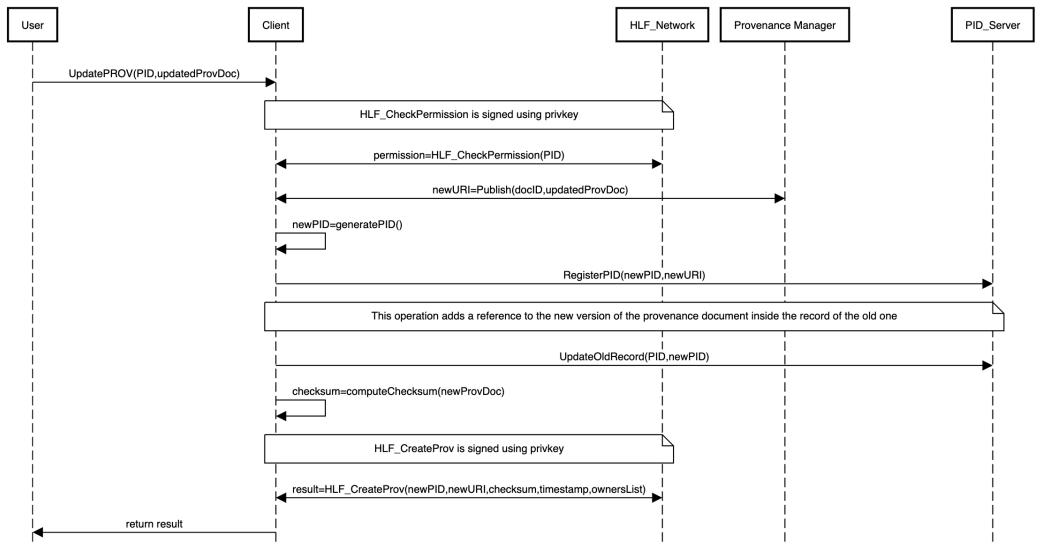
The central mechanism is the blockchain-anchored provenance document with PID-based versioning. A provenance document is published with a persistent identifier; when a new version is created, the PID record of the previous version is updated to reference the new one, and the publication is logged on the permissioned ledger via a chaincode function (a blockchain smart contract) that checks authorization, bumps the version counter, and stores the new URI and checksum. The append-only ledger provides tamper-evidence and time-stamping, while the PID record provides stable, resolvable linkage across experiments and versions. A client library that submits transactions directly to the network, without an intermediary, is what keeps trust anchored in the ledger rather than in any single server.
What would settle it
A direct test would be to run a small permissioned network with a colluding subset of peers and an attacker-controlled ordering service, then attempt to rewrite a provenance record after commit and check whether any client or auditor can detect the change; if the ledger accepts the altered history, the tamper-evidence claim fails. A second test: measure end-to-end update latency as the number of participating organizations grows, and see whether it stays within the bounds scientific workflows can tolerate.
Extended reading notes
Core claim
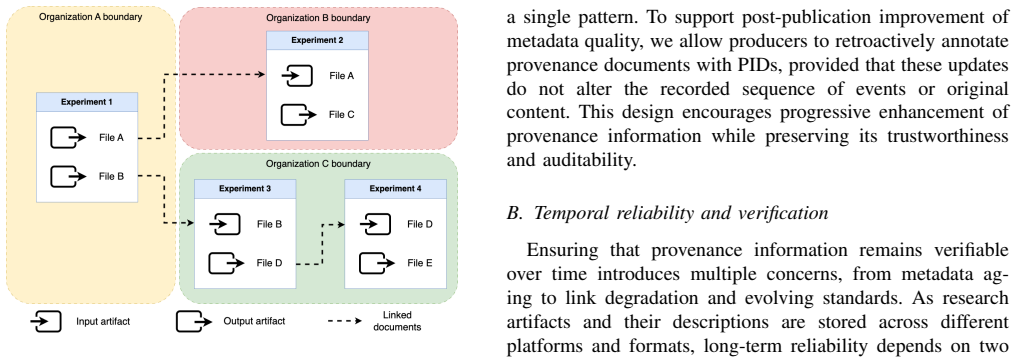
The paper's central claim is that trustworthy provenance in federated science can be achieved by making the provenance record itself live on an append-only permissioned ledger, specifically Hyperledger Fabric, while using persistent identifiers (PID records) as the stable reference that links artifact versions. Each provenance publication or update is a blockchain transaction authenticated by the client's certificate; updates are only allowed to append a new version, never to overwrite or delete, and even artifact deletion is implemented as invalidation to preserve the audit trail. Because clients talk directly to the ledger rather than through a proxy, there is no central point of failure that could filter or falsify records, and a read-only organization lets external consumers verify queries without write access. The authors present this as a response to six concrete challenges, including cross-experiment artifact tracking, long-term temporal reliability, version linkage, correction propagation, accountability, and the vulnerabilities of centralized mutable provenance stores.
Load-bearing premise
The whole design assumes the group running the blockchain is trustworthy enough not to collude in rewriting records, and that the identifier service stays reliable and authoritative.
Editorial extensions
If this is right
- If a published dataset is retracted, downstream artifacts that used it can be automatically flagged as affected, because the provenance graph records every derivation.
- A reader of a publication can trace a result image back to its training model, training dataset, and raw measurements using the persistent identifiers, enabling full reproducibility checks.
- Provenance records cannot be silently altered or deleted: every update creates a new version and logs the operation, so old records remain available for dispute or auditing.
- Because no proxy mediates blockchain access, the system remains usable for verification even if an individual data server goes offline, and records remain attributable to their signing users.
Reading between the lines
- The same architecture could be extended to enforce data-usage policies by encoding license terms in provenance records and checking them at query time, which would go beyond the paper's focus on integrity and auditability.
- Since version linkage lives in the PID record, the system's long-term guarantees depend on the PID provider staying authoritative; a natural hardening step, not discussed in the paper, would be to log every PID update itself as a blockchain transaction.
- The permissioned design means 'immutable' is a governance property: a colluding set of the consortium's own peers could potentially rewrite the ledger, so the guarantee should be understood as protection against outsider tampering rather than against insider collusion.
- A testable prediction of the architecture is that its update latency will be dominated by the endorsement and ordering phases of the permissioned ledger, so performance studies across federation sizes would reveal whether the design scales to the big-data workloads it targets.
Editorial analysis
A structured set of objections, weighed in public.
Referee Report
Summary. The manuscript proposes a modular architecture for tracking provenance of scientific artifacts across federated organizations. It combines a Hyperledger Fabric permissioned blockchain with persistent identifiers (PIDs) from the Handle/ePIC infrastructure, a client library, data and provenance servers, hashing software, and a versioning model in which PID records are updated to point to new versions of provenance documents. Five scientific use cases are described, covering climate data and AI forecasting, retraction propagation, iterative model development, post-publication artifact linking, and retrospective activity decomposition. The authors state explicitly that implementation details and performance benchmarks are deferred to future work. The central claim is that the architecture 'guarantees integrity, immutability, and auditability' and that 'tampering with historical data becomes computationally infeasible' (Section III-B).
Significance. If the claimed guarantees were established, the architecture would address a real need: long-term, cross-organizational provenance verification for data-intensive science, aligned with FAIR and TRUST principles. The design has sensible components, including direct client-to-ledger interaction that avoids a proxy bottleneck, invalidation rather than physical deletion of artifacts, and version chaining through PIDs that preserves history. The paper, however, provides no implementation, no machine-checked proofs, no formal adversary model, and no performance evaluation; the security and scalability properties are currently design hypotheses rather than demonstrated results. The modular decomposition and use-case framing may still serve as a useful blueprint for future systems work, provided the security claims are re-scoped and validated, and the authors deserve credit for making the deferred-validation status explicit in the text.
major comments (3)
- [III-B, first paragraph] The statement that 'tampering with historical data becomes computationally infeasible' is not an accurate characterization of a permissioned Hyperledger Fabric deployment. With the default Raft ordering service, which is crash-fault tolerant rather than Byzantine-fault tolerant, a compromised ordering service can reorder or fork the chain, and a compromised certificate authority can mint valid identities. The hash chain makes tampering evident to honest peers, not computationally impossible. The paper does not specify the consensus algorithm, endorsement thresholds, or an adversary model, and the adjacent claim that robustness improves as more organizations join is only true if the endorsement policy and quorum are configured to scale accordingly. These qualifications should be incorporated into the abstract and Section III-B, replacing the unconditional 'guarantee' language with a governance-dependent tamper-evidence property.
- [III-C, versioning and Algorithm 1] The provenance versioning mechanism relies on updating the external PID record to point to the new version, while the Fabric chaincode only logs that an update operation occurred. If the Handle/ePIC resolver is compromised or unavailable, the version chain breaks, which also conflicts with the conclusion's claim that the system operates 'without introducing centralized points of failure.' Algorithm 1 checks authorization and increments the version but does not verify the new checksum against the new URI, does not check the integrity of the previous record, and does not specify what exactly the Fabric endorsement attests regarding the PID record update. The paper needs an explicit threat model for the PID service and a precise definition of the on-chain transaction's scope of proof.
- [IV, first paragraph] The paper introduces five use cases but immediately states that implementation details and experimental benchmarks 'are not covered in this paper and will be discussed in detail in a future work.' The use cases are described as 'under development' and 'preliminarily demonstrated,' yet no demonstration results are reported. Without a prototype, performance measurements, or a formal analysis of failure modes, the abstract's claim to 'guarantee integrity, immutability, and auditability' is not supported. The authors should either add a preliminary evaluation or explicitly label these properties as design goals rather than established guarantees.
minor comments (5)
- [III-C, preconditions for Figure 3] In the preconditions preceding Figure 3, 'HFL network' should be 'HLF network'.
- [Figure 2 caption] Figure 2's caption mentions a 'security infrastructure (green background)' but the text does not provide a legend or explanation of the color coding.
- [II, blockchain-based provenance paragraph] Reference [15] (Greenspan, 'Do you really need a blockchain for that?') is cited among works presenting blockchain-based provenance solutions, but that essay critiques unnecessary blockchain use; please check the citation placement.
- [IV, introductory paragraph] Section IV says the use cases were 'preliminarily demonstrated in a distributed setting' and also states that implementation details are not covered; please clarify what was actually demonstrated.
- [Algorithm 1] In Algorithm 1, the variable 'permission' used by 'checkAuth' is not defined, and the unconditional 'newVersion <- version + 1' has no concurrency protection despite the sequence diagram implying an atomic update.
Circularity Check
No circularity found: the paper is a design description with no fitted parameters, no predicted quantities, and no derivation chain that reduces to its own inputs.
full rationale
The paper presents a modular architecture for provenance tracking in federated settings using a permissioned blockchain. It contains no mathematical derivation, no fitted parameters, no empirical predictions, and no quantities that are defined in terms of the outcome they are supposed to establish. The central claims, such as 'tampering with historical data becomes computationally infeasible' (Section III-B), are qualitative design assertions about Hyperledger Fabric, not results derived from the paper's own inputs. The only self-citations are background references to ESGF [7] and the CMIP6 ESGF Errata Service [31], which are used as illustrative use-case context, not as load-bearing evidence for the architecture's correctness. The paper explicitly states that implementation details and experimental benchmarks are not covered and will be discussed in future work, so there is no hidden fit masquerading as validation. Concerns about whether Hyperledger Fabric truly provides the claimed tamper-resistance under a permissioned governance model are legitimate correctness/security questions, but they are not circularity: the claim is not equivalent to its own assumption by construction. Overall, the derivation chain, such as it is, is self-contained as a design proposal, and no circular step can be identified from the text.
Assumptions & free parameters
assumptions (4)
- domain assumption Hyperledger Fabric's block-linked append-only ledger makes tampering computationally infeasible.
- domain assumption Permissioned participants and certificate authorities are trusted not to collude or abuse their endorsement authority.
- domain assumption The PID/Handle service remains durably available and authoritative over long time horizons.
- domain assumption The provenance manager is a trusted component that performs atomic updates.
invented entities (1)
-
Read-only consumer organization
Cite this review
Pith. "Pith review of Trustworthy Provenance for Big Data Science: a Modular Architecture Leveraging Blockchain in Federated Settings." pith.science (2026). https://pith.science/paper/IIOZJHRS
@misc{pith2026250524675,
  author       = {Pith},
  title        = {Pith review of: Trustworthy Provenance for Big Data Science: a Modular Architecture Leveraging Blockchain in Federated Settings},
  year         = {2026},
  howpublished = {\url{https://pith.science/paper/IIOZJHRS}},
  note         = {Machine review of arXiv:2505.24675}
}
read the original abstract
Ensuring the trustworthiness and long-term verifiability of scientific data is a foundational challenge in the era of data-intensive, collaborative research. Provenance metadata plays a key role in this context, capturing the origin, transformation, and usage of research artifacts. However, existing solutions often fall short when applied to distributed, multi-institutional settings. This paper introduces a modular, domain-agnostic architecture for provenance tracking in federated environments, leveraging permissioned blockchain infrastructure to guarantee integrity, immutability, and auditability. The system supports decentralized interaction, persistent identifiers for artifact traceability, and a provenance versioning model that preserves the history of updates. Designed to interoperate with diverse scientific domains, the architecture promotes transparency, accountability, and reproducibility across organizational boundaries. Ongoing work focuses on validating the system through a distributed prototype and exploring its performance in collaborative settings.
Figures

Forward citations
Cited by 1 Pith paper
-
Provenance Tracking in Large-Scale Machine Learning Systems
yProv4ML is a new provenance-tracking library for ML workflows that logs experiments as W3C PROV-compliant provenance graphs and demonstrates its use in large-scale distributed training studies.
Reference graph
Works this paper leans on
-
[1]
Al-Khalifa, and Abdel Magid Hamouda
Abdulaziz Aldoseri, Khalifa N. Al-Khalifa, and Abdel Magid Hamouda. Re-thinking data strategy and integration for artificial intelligence: Concepts, opportunities, and challenges. Applied Sciences, 13(12), 2023
work page 2023
-
[2]
C. Glenn Begley and John P.A. Ioannidis. Reproducibility in science. Circulation Research, 116(1):116–126, 2015
work page 2015
-
[3]
Open data initiatives in brazil
Cinthya Bittencourt, Jacinto Estima, and Gabriel Pestana. Open data initiatives in brazil. In 14th Iberian Conference on Information Systems and Technologies, pages 1–4. IEEE Computer Society, 2019
work page 2019
-
[4]
Why and where: A characterization of data provenance
Peter Buneman, Sanjeev Khanna, and Wang-Chiew Tan. Why and where: A characterization of data provenance. In Database Theory — ICDT 2001, Lecture Notes in Computer Science, pages 316–330, United Kingdom, 2001. Springer
work page 2001
-
[5]
Practical Byzantine fault tolerance
Miguel Castro and Barbara Liskov. Practical Byzantine fault tolerance. In 3rd Symposium on Operating System Design and Implementation , number 1999 in OSDI ’99, pages 173–186, 1999
work page 1999
-
[6]
Provenance in databases: Why, how, and where
James Cheney, Laura Chiticariu, and Wang-Chiew Tan. Provenance in databases: Why, how, and where. Foundations and Trends in Databases, 1(4):379–474, 2009
work page 2009
-
[7]
Luca Cinquini, Daniel Crichton, Chris Mattmann, John Harney, Galen Shipman, Feiyi Wang, Rachana Ananthakrishnan, Neill Miller, Sebastian Denvil, Mark Morgan, Zed Pobre, Gavin M. Bell, Charles Doutriaux, Robert Drach, Dean Williams, Philip Kershaw, Stephen Pascoe, Es- tanislao Gonzalez, Sandro Fiore, and Roland Schweitzer. The earth system grid federation:...
-
[8]
Building a spatial data infrastructure
David J Coleman, JD McLaughlin, and S Nichols. Building a spatial data infrastructure. In 64th Permanent Congress Meeting of the F ´ed´eration Internationale des G ´eometres, pages 89–104, 1997
work page 1997
Show all 41 references
-
[9]
Provenance metadata management in distributed storages using the hyperledger blockchain platform
Andrey Demichev, Julia Dubenskaya, Elena Fedotova, Alexander Kryukov, Stanislav Polyakov, and Nikolay Prikhod’ko. Provenance metadata management in distributed storages using the hyperledger blockchain platform. In CEUR Workshop Proceedings , pages 35–42. IEEE Computer Society, 2019
2019
-
[10]
Graphtrail: analyzing large multivariate, het- erogeneous networks while supporting exploration history
Cody Dunne, Nathalie Henry Riche, Bongshin Lee, Ronald Metoyer, and George Robertson. Graphtrail: analyzing large multivariate, het- erogeneous networks while supporting exploration history. In SIGCHI Conference on Human Factors in Computing Systems , CHI ’12, page 1663–1672, ...
2012
-
[11]
Towards the development of a test corpus of digital objects for the evaluation of file format identification tools and signatures
Andrew Fetherston and Tim Gollins. Towards the development of a test corpus of digital objects for the evaluation of file format identification tools and signatures. International Journal of Digital Curation, 7(1):16– 26, March 2012
2012
-
[12]
Blockchain-based database to ensure data integrity in cloud computing environments
Edoardo Gaetani, Leonardo Aniello, Roberto Baldoni, Federico Lom- bardi, Andrea Margheri, and Vladimiro Sassone. Blockchain-based database to ensure data integrity in cloud computing environments. In 1st Italian Conference on Cybersecurity , Venice, Italy, 2017. IEEE Computer Society
2017
-
[13]
Provenance information for biomedical data and workflows: Scoping review
Kerstin Gierend, Frank Kr ¨uger, Sascha Genehr, Francisca Hart- mann, Fabian Siegel, Dagmar Waltemath, Thomas Ganslandt, and Atinkut Alamirrew Zeleke. Provenance information for biomedical data and workflows: Scoping review. J Med Internet Res , 26:e51297, Aug 2024
2024
-
[14]
Link decay in leading information science journals
Dion Hoe-Lian Goh and Peng Kin Ng. Link decay in leading information science journals. Journal of the American Society for Information Science and Technology, 58(1):15–24, 2007
2007
-
[15]
Do you really need a blockchain for that? Coin- Center (online)
Gideon Greenspan. Do you really need a blockchain for that? Coin- Center (online). July , 26, 2017
2017
-
[16]
The unreasonable effectiveness of data
Alon Halevy, Peter Norvig, and Fernando Pereira. The unreasonable effectiveness of data. IEEE Intelligent Systems , 24(2):8–12, 2009
2009
-
[17]
Ibrahim Khan, Fahad Faisal, Sami Azam, Asif Karim, Bharanid- haran Shanmugam, and Friso De Boer
MD. Ibrahim Khan, Fahad Faisal, Sami Azam, Asif Karim, Bharanid- haran Shanmugam, and Friso De Boer. Using blockchain technology for file synchronization. In IOP Conference Series: Materials Science and Engineering, volume 561, page 012117, Coimbatore, Tamil Nadu, India, April...
2019
-
[18]
An analysis of crypto gas wars in ethereum
Kyungchan Ko, Taeyeol Jeong, Jongsoo Woo, and James Won-Ki Hong. An analysis of crypto gas wars in ethereum. In 2022 23rd Asia-Pacific Network Operations and Management Symposium (APNOMS) , pages 1–6, 2022
2022
-
[19]
Link-rot in web- sourced multimedia datasets
Viktor Lakic, Luca Rossetto, and Abraham Bernstein. Link-rot in web- sourced multimedia datasets. In MultiMedia Modeling, pages 476–488, Cham, 2023. Springer International Publishing
2023
-
[20]
Geospatial big data: Challenges and opportunities
Jae-Gil Lee and Minseo Kang. Geospatial big data: Challenges and opportunities. Big Data Research , 2(2):74–81, 2015. Visions on Big Data
2015
-
[21]
Provchain: A blockchain-based data prove- nance architecture in cloud environment with enhanced privacy and availability
Xueping Liang, Sachin Shetty, Deepak Tosh, Charles Kamhoua, Kevin Kwiat, and Laurent Njilla. Provchain: A blockchain-based data prove- nance architecture in cloud environment with enhanced privacy and availability. In 2017 17th IEEE/ACM International Symposium on Cluster, Clou...
2017
-
[22]
Proof of work vs
Shijie Lin. Proof of work vs. proof of stake in cryptocurrency. Highlights in Science, Engineering and Technology , 39:953–961, 04 2023
2023
-
[23]
A scalable version control layer in p2p file system
Xin Lin, Shanping Li, Wei Shi, and Jie Teng. A scalable version control layer in p2p file system. In Grid and Cooperative Computing - GCC 2005, pages 996–1001, Berlin, Heidelberg, 2005. Springer Berlin Heidelberg
2005
-
[24]
Dillo I. et al. Lin D., Crabtree J. The trust principles for digital repositories. Scientific Nature Data , May 2020
2020
-
[25]
Performance evaluation of permissioned blockchain platforms
Ahmed Afif Monrat, Olov Schel ´en, and Karl Andersson. Performance evaluation of permissioned blockchain platforms. In 2020 IEEE Asia- Pacific Conference on Computer Science and Data Engineering (CSDE), pages 1–8, 2020
2020
-
[26]
The open provenance model core specification (v1.1)
Luc Moreau, Ben Clifford, Juliana Freire, Joe Futrelle, Yolanda Gil, Paul Groth, Natalia Kwasnikowska, Simon Miles, Paolo Missier, Jim Myers, Beth Plale, Yogesh Simmhan, Eric Stephan, and Jan Van den Bussche. The open provenance model core specification (v1.1). Future Generati...
2011
-
[27]
PROV-Overview: An Overview of the PROV Family of Documents
Luc Moreau, Paul Groth, et al. PROV-Overview: An Overview of the PROV Family of Documents. https://www.w3.org/TR/prov-overview/, 2013
2013
-
[28]
Open data in science
Peter Murray-Rust. Open data in science. Nature Precedings, Jan 2008
2008
-
[29]
Nguyen, Kai Xu, Andy Bardill, Betul Salman, Kate Herd, and B.L
Phong H. Nguyen, Kai Xu, Andy Bardill, Betul Salman, Kate Herd, and B.L. William Wong. Sensemap: Supporting browser-based online sensemaking through analytic provenance. In 2016 IEEE Conference on Visual Analytics Science and Technology (VAST) , pages 91–100, 2016
2016
-
[30]
Understanding Metadata: What is Metadata, and What is it For? National Information Standards Organization, Bethesda, MD, 2017
National Information Standards Organization (NISO). Understanding Metadata: What is Metadata, and What is it For? National Information Standards Organization, Bethesda, MD, 2017
2017
-
[31]
Petrie, S
R. Petrie, S. Denvil, S. Ames, G. Levavasseur, S. Fiore, C. Allen, F. Antonio, K. Berger, P.-A. Bretonni `ere, L. Cinquini, E. Dart, P. Dwarakanath, K. Druken, B. Evans, L. Franchist ´eguy, S. Gardoll, E. Gerbier, M. Greenslade, D. Hassell, A. Iwi, M. Juckes, S. Kinder- mann, ...
2021
-
[32]
Righi, B
M. Righi, B. Andela, V . Eyring, A. Lauer, V . Predoi, M. Schlund, J. Vegas-Regidor, L. Bock, B. Br ¨otz, L. de Mora, F. Diblen, L. Dreyer, N. Drost, P. Earnshaw, B. Hassler, N. Koldunov, B. Little, S. Loosveldt Tomas, and K. Zimmermann. Earth system model evalu- ation tool (e...
2020
-
[33]
Fern ´andez, Daniel Garijo, Bj ¨orn Gr ¨uning, Marco La Rosa, Simone Leo, Eoghan ´O Carrag ´ain, Marc Portier, Ana Trisovic, RO-Crate Community, Paul Groth, and Carole Goble
Stian Soiland-Reyes, Peter Sefton, Merc `e Crosas, Leyla Jael Castro, Frederik Coppens, Jos ´e M. Fern ´andez, Daniel Garijo, Bj ¨orn Gr ¨uning, Marco La Rosa, Simone Leo, Eoghan ´O Carrag ´ain, Marc Portier, Ana Trisovic, RO-Crate Community, Paul Groth, and Carole Goble. Pack...
2022
-
[34]
Stallman
Richard M. Stallman. Free Software, Free Society: Selected Essays of Richard M. Stallman . Free Software Foundation, 2002
2002
-
[35]
Using provenance to manage knowledge of in silico experiments
Robert Stevens, Jun Zhao, and Carole Goble. Using provenance to manage knowledge of in silico experiments. Brief. Bioinform., 8(3):183– 194, May 2007
2007
-
[36]
Stodden, F
V . Stodden, F. Leisch, and R. D. Peng. Implementing Reproducible Research. Chapman and Hall/CRC, 1st edition, 2014
2014
-
[37]
Norman, Anthony Etuk, Federico Cerutti, Robin Wentao Ouyang, Mani Srivastava, Nir Oren, Timothy Dropps, John A
Alice Toniolo, Timothy J. Norman, Anthony Etuk, Federico Cerutti, Robin Wentao Ouyang, Mani Srivastava, Nir Oren, Timothy Dropps, John A. Allen, and Paul Sullivan. Supporting reasoning with different types of evidence in intelligence analysis. In International Conference on Au...
2015
-
[38]
Khan, and Phuong Hoai Ha
Petter Tunstad, Amin M. Khan, and Phuong Hoai Ha. Hyperprov: Decentralized resilient data provenance at the edge with blockchains. CoRR, abs/1910.05779, 2019
1910 arXiv
-
[39]
Valenta and S
P. Valenta and S. Martin. Comparison of ethereum, hyperledger fabric and corda. Technical report, The Frankfurt School-Blockchain Center, Frankfurt, 2017
2017
-
[40]
Wilkinson, Michel Dumontier, IJsbrand Jan Aalbersberg, Gabrielle Appleton, Myles Axton, Arie Baak, Niklas Blomberg, Jan- Willem Boiten, Luiz Bonino da Silva Santos, Philip E
Mark D. Wilkinson, Michel Dumontier, IJsbrand Jan Aalbersberg, Gabrielle Appleton, Myles Axton, Arie Baak, Niklas Blomberg, Jan- Willem Boiten, Luiz Bonino da Silva Santos, Philip E. Bourne, Jildau Bouwman, Anthony J. Brookes, Tim Clark, Merc `e Crosas, Ingrid Dillo, Olivier D...
2016
-
[2014]
Special Section: Intelligent Big Data Processing Special Section: Behavior Data Security Issues in Network Information Propagation Special Section: Energy-efficiency in Large Distributed Computing Architectures Special Section: eScience Infrastructure and Applications
Reviewed August 7, 2026 · model on record in the stance chip above.
Discussion (0). Sign in to comment.