REVIEW 1 major objections 4 minor 57 references
Plant coexistence mediated by adaptive foraging preferences of exploiters or mutualists
T0 review · 1 major / 4 minor · reviewed 2026-08-14 · deepseek-v4-flash
Pith's one-line read Adaptive animal preferences determine whether two competing plants coexist, and the direction depends on whether the shared animal is an exploiter or a mutualist.
desk verdict A careful equilibrium classification of adaptive foraging in a two-plant, one-animal module; the local results are solid, but the global-stability claims outrun the proof. read the letter →
The pith
A machine-rendered reading of the paper's core claim, the machinery that carries it, and where it could break.
The reading
What carries the argument
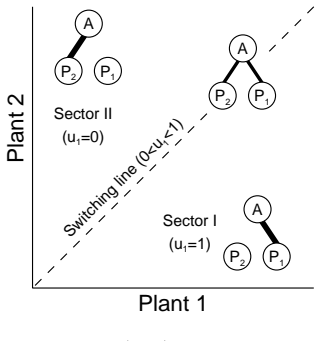
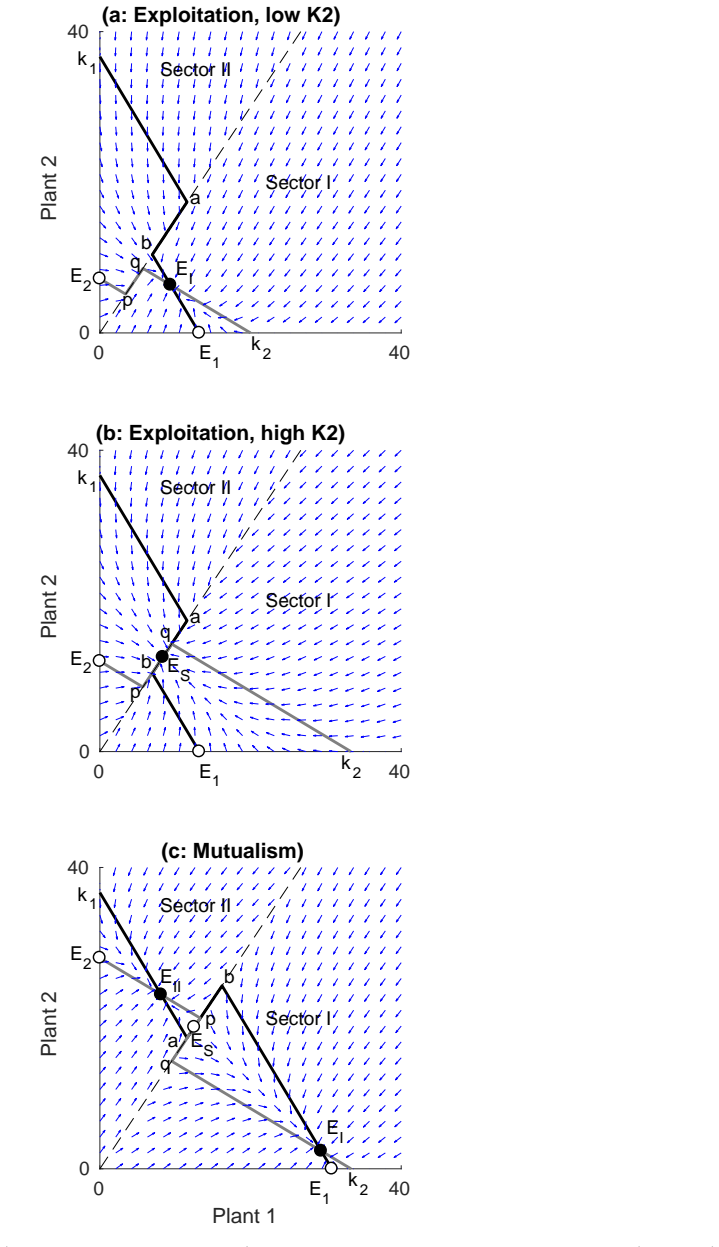
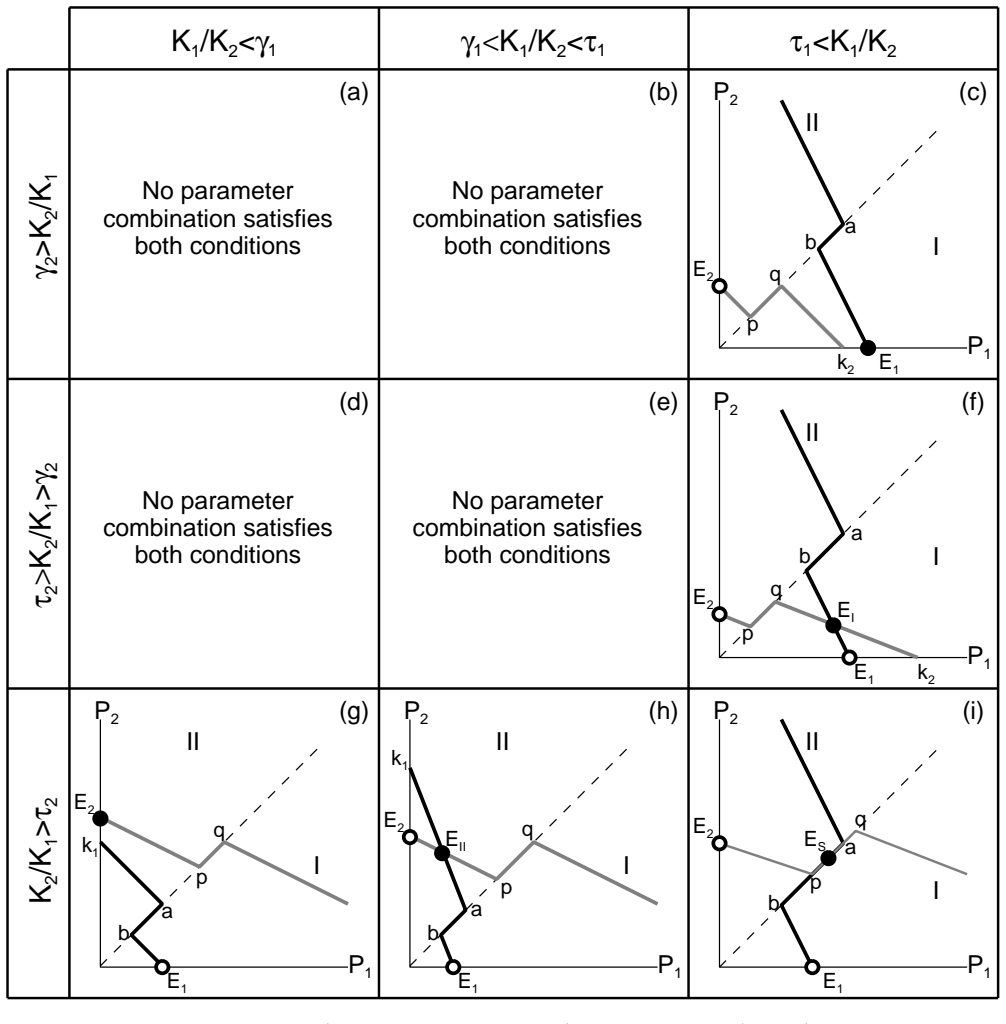
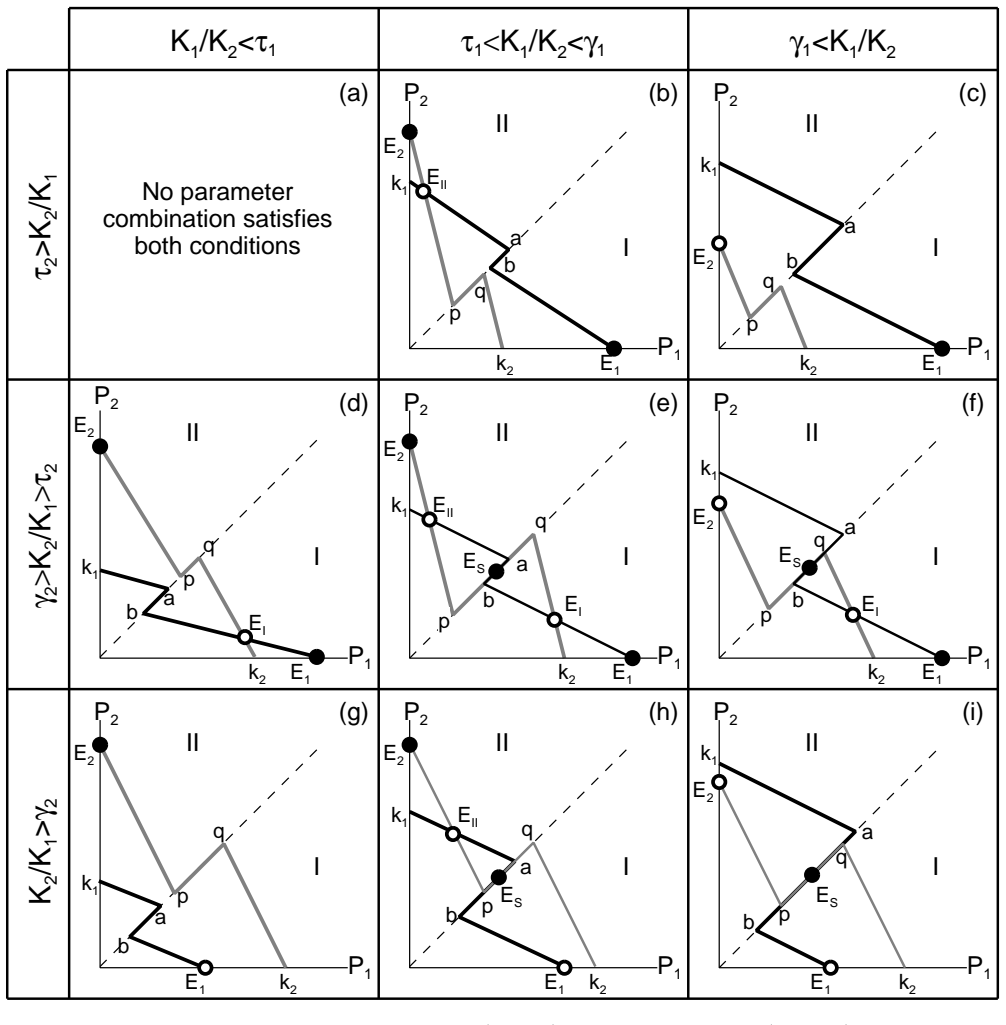
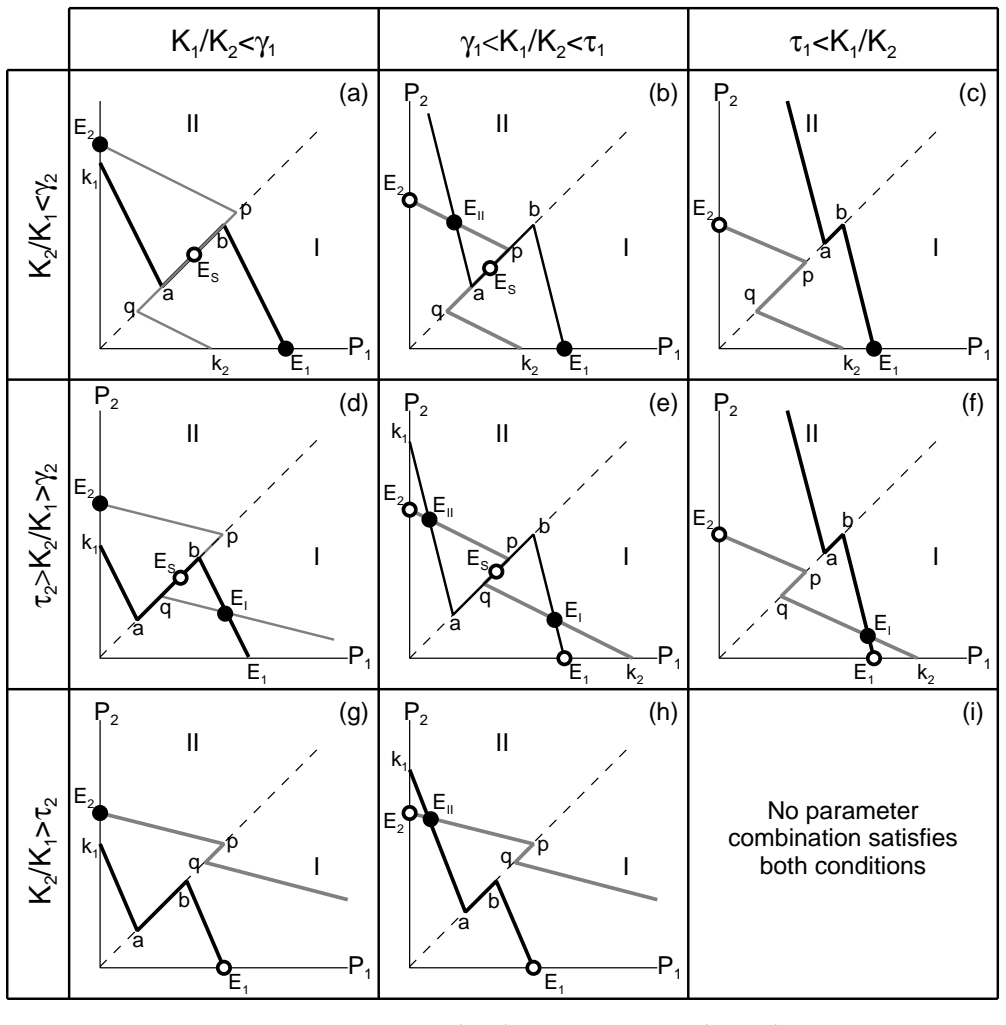
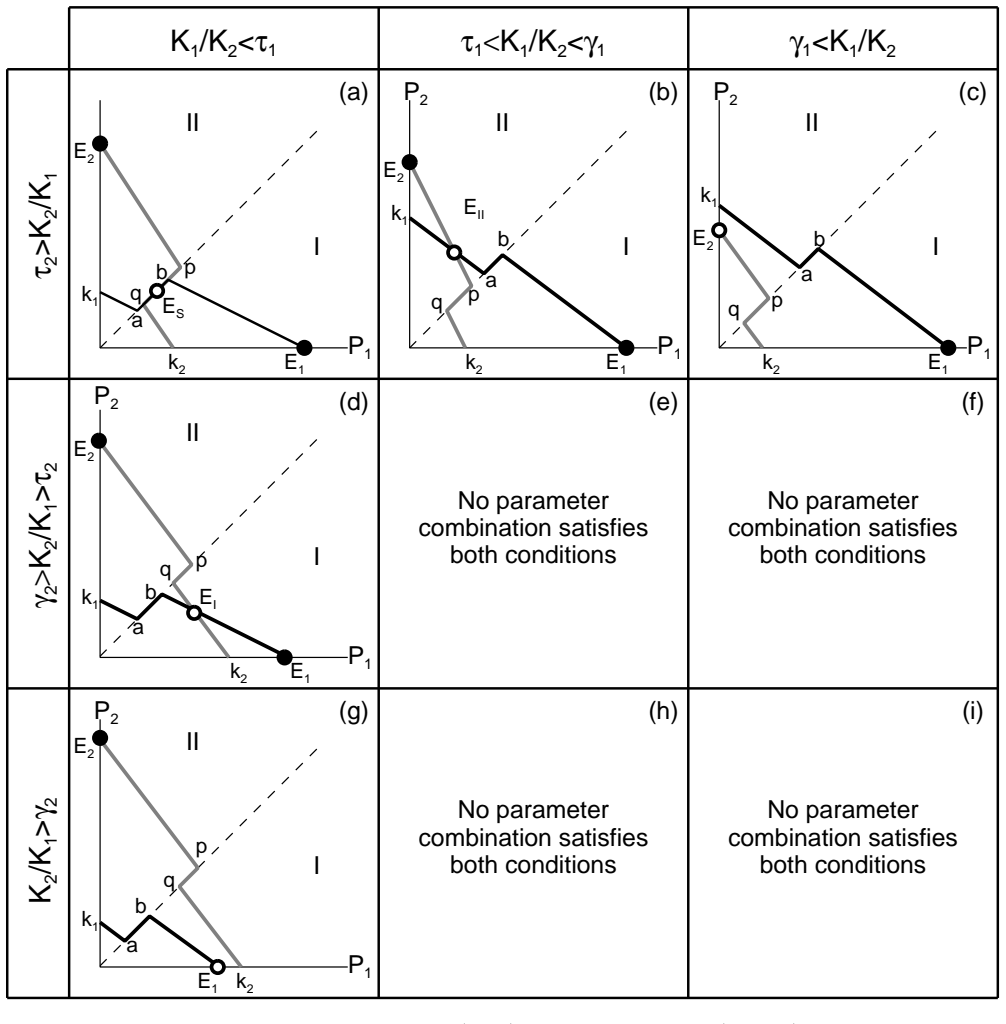
The central object is the generalized isocline, a continuous piecewise-linear curve obtained by taking the classical Lotka–Volterra isoclines inside each preference sector and adding the segment of the switching line $e_1P_1=e_2P_2$ that connects them. Along the switching line the animal's payoff is equal for the two plants and optimal preference is not unique, so the population dynamics form a differential inclusion whose Filippov regularization produces sliding regimes under exploitation and repelling regimes under mutualism. The generalized isoclines are classified by two thresholds each: invasion thresholds $\gamma_i$, which decide whether the missing plant can invade the other's monoculture, and attraction thresholds $\tau_i$, which decide whether the equilibrium $E_S$ on the switching line attracts or repels nearby orbits. Comparing $K_1/K_2$ with $\gamma_1,\tau_1$ and $K_2/K_1$ with $\gamma_2,\tau_2$ yields the complete set of stable equilibria.
What would settle it
Take a system of two plants with measured competition coefficients satisfying $c_1c_2>1$, add a fixed-density herbivore that is observed to forage adaptively, and choose carrying capacities so that both invasion thresholds $\gamma_i$ are met; the paper predicts that the plants converge to a unique coexistence equilibrium $E_S$ at which the herbivore is a generalist, for all initial conditions. A controlled mesocosm, or a simulation with the same parameters, that shows persistent exclusion of one plant or stable coexistence while the herbivore remains a specialist at that parameter set would falsify the claim.
Extended reading notes
Core claim
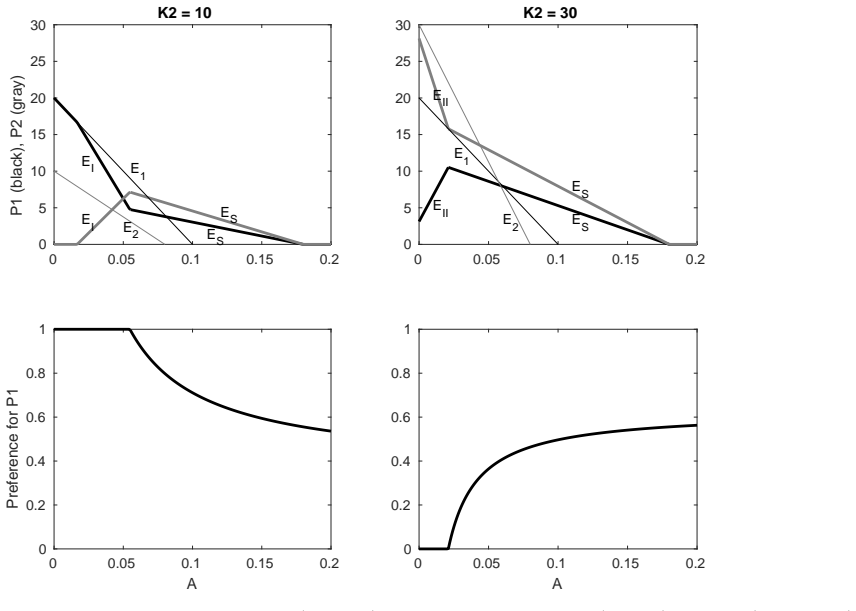
Under the step-like optimal-preference rule, the plant phase plane splits into two sectors in which animals are specialists, separated by the switching line $e_1P_1=e_2P_2$ where both plants are equally profitable and animal preference is not unique. The central discovery is that existence and stability of an interior equilibrium on this switching line, $E_S$, depend on two pairs of thresholds: invasion thresholds $\gamma_i$ and new attraction thresholds $\tau_i$. For exploiters ($s=-1$) and strong plant competition ($c_1c_2>1$), $E_S$ is stable and, when both plants can invade each other's monoculture, globally stable, so adaptive generalist exploiters promote plant coexistence that the Lotka–Volterra model forbids. For mutualists ($s=1$), $E_S$ is always unstable, so any locally stable coexistence has the mutualist as a specialist; with $c_1c_2>1$ no coexistence equilibrium exists at all. These statements rest on a complete enumeration of generic isocline configurations, which reduces all possible outcomes to 56 feasible cases and 11 possible sets of stable equilibria.
Load-bearing premise
The argument rides on the animal being an ideal, costless, instantaneous optimizer: preferences follow the step rule $u_1=1$ when $e_1P_1>e_2P_2$, $u_1=0$ when $e_1P_1<e_2P_2$, and are arbitrary on the switching line $e_1P_1=e_2P_2$, with animal density fixed. If real animals learn slowly, perceive profitability imperfectly, or pay switching costs, the sharp switching line and the sliding and repelling regimes, and with them the specialist and generalist coexistence predictions, need not hold.
Editorial extensions
If this is right
- If adaptive exploiters have fixed density, coexistence of two strongly competing plants is possible without any density-mediated apparent competition; the effect is purely behavioral.
- At exploiter densities above a threshold, the only stable coexistence state has the exploiter as a generalist, and increasing animal density then decreases both plant equilibrium densities together.
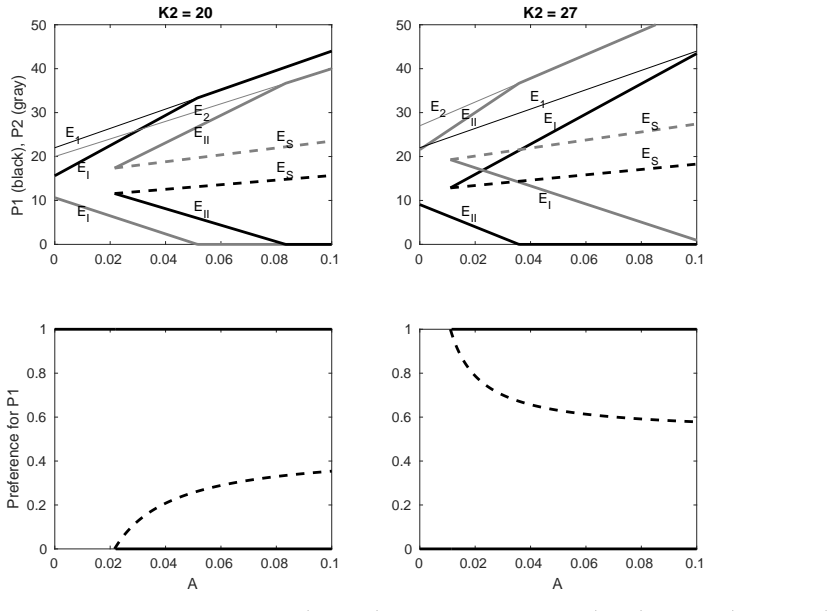
- Under adaptive mutualism, a pollinator that maximizes fitness will not remain a generalist at a stable coexistence equilibrium, so stable coexistence of weakly competing plants occurs as alternative states with the mutualist favoring one plant or the other.
- With strong plant competition, adaptive mutualists cannot rescue coexistence, in sharp contrast to adaptive exploiters; the sign of the interaction determines whether flexible preferences buffer or amplify competitive exclusion.
- The generalized-isocline construction provides a complete classification of all generic outcomes, reducing them to 56 feasible configurations and 11 possible sets of stable equilibria.
Reading between the lines
- Beyond the paper: if animal density were allowed to vary numerically, apparent competition should reappear for exploiters and resource depletion should push mutualists toward generalism, so the predictions here should not be imported into models with numeric responses.
- Beyond the paper: because gradual Hill-function preferences converge to the step-like rule as steepness grows, the listed stable equilibria are the limits of soft-switching models; a testable next step is whether finite switching costs or perceptual error shrink the basin of $E_S$ under strong competition without destroying it.
- Beyond the paper: the classification suggests an empirical asymmetry—at fixed or managed animal densities, herbivores should more often appear as generalists at stable mixed plant stands, while pollinators should appear as specialists even when both plants are present.
- Beyond the paper: adding a second animal species creates two switching lines, three sectors, and five-segment generalized isoclines, so the complete classification will not scale; simulation studies of larger networks could test whether the exploiter-generalist and mutualist-specialist asymmetry persists in multispecies mixtures.
Signed reviews
Editorial analysis
A structured set of objections, weighed in public.
Referee Report
Summary. This paper studies a two-plant, one-animal model in which plant dynamics follow Lotka-Volterra competition, animal density A is fixed, and animal preferences u_i follow the stepwise optimal foraging rule (5), yielding a planar differential inclusion. The authors introduce 'generalized isoclines' by connecting the sector-wise plant isoclines with segments on the switching line e1P1 = e2P2. They derive explicit coexistence equilibria EI, EII, and ES (Eqs. 13, 17, 19), invasion thresholds γ_i and attraction thresholds τ_i (Eqs. 14, 18), and present a classification of stable equilibria for exploitation (s = -1) and mutualism (s = 1) under weak and strong competition (Figures 5-8, Table A.2). The central claims are that adaptive exploiters can stabilize coexistence even when c1c2 > 1, whereas adaptive mutualists always specialize at stable coexistence and preclude coexistence when c1c2 > 1.
Significance. The manuscript is a theory contribution with no free parameters and no fitted constants. Its strengths are the explicit threshold formulas, the fully worked local stability analysis in Appendices A.1-A.2, the classification table, and the new generalized-isocline construction that makes the preference discontinuity analytically tractable. The predictions—exploiter generalism promotes coexistence under strong competition; mutualist specialization leads to alternative stable states under weak competition—are clear, ecologically relevant, and falsifiable in principle. The main caveat is that several headline statements concern global asymptotic behavior, while the proof infrastructure supports local stability plus sector-wise linear dynamics. The significance is therefore high if the global claims can be proven or appropriately qualified.
major comments (1)
- [Sections 3.1-3.2, Appendix A.2, Table A.2] The global-dynamics claims are not backed by a proof. Appendix A.1 establishes local stability of EI and EII from the Lotka-Volterra Jacobian, and Appendix A.2 establishes local attractivity of ES through the sliding-regime logistic equation (A.20), but these are local statements. The text nevertheless asserts global convergence, e.g., 'dynamics globally converge toward the monoculture equilibrium' in Section 3.1, 'ES is globally stable' in Section 3.2 (Figure 6i), and a 'complete classification of model outcomes' in Section 4. The system is a planar Filippov differential inclusion with switching line (6); in each sector the fields (A.1)-(A.2) are linear competition fields, but piecewise-linear Filippov systems can have closed orbits that extend across or slide along the switching line, and the absence of cycles in each linear subsystem does not exclude such orbits. No Dulac/Bendixson argument, Lyapunov function, or explicit cycle-exclusion proof for the full piecewise-smooth system is provided. Therefore the stated global stability and completeness results are, strictly, unproven; the proven content is a classification of locally stable equilibria. This does not affect the local coexistence conditions, but it is load-bearing for the abstract's and discussion's strongest claims.
minor comments (4)
- [Figure 4 caption] The caption says 'as a function of exploiter density' but the panel concerns adaptive mutualism (s = 1); it should read 'mutualist density'.
- [Section 2.1] Equation (5) defines U1 as a set-valued map, but later text uses u1 as if single-valued on the switching line; it would help to state explicitly that on the switching line the relevant u1 is the one selected by the sliding dynamics in Appendix A.2.
- [Table A.1] Entries such as 'ba', 'pq', and 'bq' denote intervals on the switching line but are not defined in the table; please use notation like 'b-a' or define the abbreviated interval names in the caption.
- [Appendix D] The claim that gradual preferences 'well approximate' the step-like case is illustrated with only one Hill exponent (z = 20) and one parameter set; a brief quantitative statement or additional parameter exploration would strengthen the claim.
Circularity Check
Derivation is self-contained: equilibria and thresholds are computed from the stated model equations, not fitted or imported from self-citations.
full rationale
The paper's derivation chain is self-contained. The model is explicitly defined by the plant population equations (1) and the fitness-maximizing preference rule (5). All equilibria—EI, EII, and ES—are solved directly from these equations in Appendices A.1 and A.2, and the invasion thresholds γi and attraction thresholds τi are derived inequalities comparing isocline intersection points; they are not fitted parameters, renamed outputs, or imported conclusions. The generalized-isocline construction is introduced as a bookkeeping device that connects sector-wise classical isoclines with segments of the switching line, and the stability of ES is derived from the differential-inclusion sliding/repelling analysis in Appendix A.2. Self-citations (e.g., Křivan 2003b, Křivan and Vrkoč 2007, Revilla and Křivan 2016) are used to motivate the optimal-foraging rule and to compare related earlier models; they do not carry the load of the present classification, and no uniqueness theorem from the authors' prior work is invoked to force the conclusions. No prediction in the paper reduces to a fitted constant, and no behavioral outcome is assumed by construction beyond the explicit optimal-foraging assumption in equation (5). The only substantive mathematical concern, namely that the claimed global stability of some equilibria in the piecewise-smooth Filippov system is asserted without an explicit proof excluding sliding or periodic orbits, is a proof-completeness or correctness issue, not a circularity.
Assumptions & free parameters
assumptions (5)
- domain assumption Animal population density A is fixed; plants do not affect animal abundance.
- domain assumption Animal preferences instantaneously maximize current fitness W_A = e1u1P1 + e2u2P2 with perfect information, giving the step rule (5).
- domain assumption Plant-animal interactions are linear per-capita terms +/- ui A in the Lotka-Volterra equations (1).
- domain assumption Mutualism is facultative when s=1; plants can persist without the animal.
- standard math Filippov regularization and differential inclusion theory for discontinuous right-hand sides.
Cite this review
Pith. "Pith review of Plant coexistence mediated by adaptive foraging preferences of exploiters or mutualists." pith.science (2026). https://pith.science/paper/IIT2SGGF
@misc{pith2026190802479,
  author       = {Pith},
  title        = {Pith review of: Plant coexistence mediated by adaptive foraging preferences of exploiters or mutualists},
  year         = {2026},
  howpublished = {\url{https://pith.science/paper/IIT2SGGF}},
  note         = {Machine review of arXiv:1908.02479}
}
read the original abstract
Coexistence of plants depends on their competition for common resources and indirect interactions mediated by shared exploiters or mutualists. These interactions are driven either by changes in animal abundance (density-mediated interactions, e.g., apparent competition), or by changes in animal preferences for plants (behaviorally-mediated interactions). This article studies effects of behaviorally-mediated interactions on two plant population dynamics and animal preference dynamics when animal densities are fixed. Animals can be either adaptive exploiters or adaptive mutualists (e.g., herbivores or pollinators) that maximize their fitness. Analysis of the model shows that adaptive animal preferences for plants can lead to multiple outcomes of plant coexistence with different levels of specialization or generalism for the mediator animal species. In particular, exploiter generalism promotes plant coexistence even when inter-specific competition is too strong to make plant coexistence possible without exploiters, and mutualist specialization promotes plant coexistence at alternative stable states when plant inter-specific competition is weak. Introducing a new concept of generalized isoclines allows us to fully analyze the model with respect to the strength of competitive interactions between plants (weak or strong), and the type of interaction between plants and animals (exploitation or mutualism). Keywords: behaviorally-mediated interactions, competition for preference, differential inclusion, generalized isocline, switching, sliding and repelling regimes.
Figures

Figures from the paper (6 more)
Reference graph
Works this paper leans on
-
[1]
Abrams, P. A. and H. Matsuda (1996). P ositive indirect effects between prey species that share predators. E cology\/ 77 , 610--616
work page 1996
-
[2]
Adler, P. B., D. Smull, K. H. Beard, R. T. Choi, T. Furniss, A. Kulmatiski, J. M. Meiners, A. T. Tredennick, and K. E. Veblen (2018). C ompetition and coexistence in plant communities: intraspecific competition is stronger than interspecific competition. E cology L etters\/ 21 , 1319--1329
work page 2018
-
[3]
Aubin, J. P. and A. Cellina (1984). D ifferential I nclusions: S et-valued M aps and V iability T heory . Springer-Verlag
work page 1984
-
[4]
Bastolla, U., M. A. Fortuna, A. Pascual-Garca, A. Ferrera, B. Luque, and J. Bascompte (2009). T he architecture of mutualistic networks minimizes competition and increases biodiversity. N ature\/ 458 , 1018--1020
work page 2009
-
[5]
Berec, L., J. Eisner, and V. Krivan (2010). A daptive foraging does not always lead to more complex food webs. J ournal of T heoretical B iology\/ 266 , 211--218
work page 2010
-
[6]
Bolker, B., M. Holyoak, V. K r ivan, L. Rowe, and O. Schmitz (2003). C onnecting theoretical and empirical studies of trait-mediated interactions. E cology\/ 84 , 1101--1114
work page 2003
-
[7]
Bronstein, J. L. (2015). M utualism . Oxford University Press
work page 2015
-
[8]
Case, T. (2000). A n I llustrated G uide to T heoretical E cology . Oxford University Press
work page 2000
Show all 57 references
-
[9]
Colombo, R. and V. K r ivan (1993). S elective strategies in food webs. IMA J ournal of M athematics A pplied in M edicine and B iology\/ 10 , 281--291
1993
-
[10]
Dieckmann, and M
Egas, M., U. Dieckmann, and M. W. Sabelis (2004). E volution restricts the coexistence of specialists and generalists: the role of trade-off structure. A merican N aturalist\/ 163 , 518--531
2004
-
[11]
Feinsinger, P. (1987). E ffects of plant species on each other's pollination: is community structure influenced? T rends in E cology and E volution\/ 2 , 123--126
1987
-
[12]
Filippov, A. F. (1988). D ifferential equations with discontinuous righthand sides . Academic Publishers
1988
-
[13]
Dajoz, J
Fontaine, C., I. Dajoz, J. Meriguet, and M. Loreau (2005). F unctional diversity of plant--pollinator interaction webs enhances the persistence of plant communities. PL o S B iology\/ 4\/ (1), e1
2005
-
[14]
Th \'e bault, and I
Fontaine, C., E. Th \'e bault, and I. Dajoz (2009). A re insect pollinators more generalist than insect herbivores? P roceedings of the R oyal S ociety B : B iological S ciences\/ 276 , 3027--3033
2009
-
[15]
Gause, G. F. (1934). T he S truggle for E xistence . Baltimore, MD: Williams & Wilkins
1934
-
[16]
Georgelin, E. and N. Loeuille (2014). D ynamics of coupled mutualistic and antagonistic interactions, and their implications for ecosystem management. J ournal of T heoretical B iology\/ 346 , 67--74
2014
-
[17]
Gauzens, M
Geslin, B., B. Gauzens, M. Baude, I. Dajoz, C. Fontaine, M. Henry, L. Ropars, O. Rollin, E. Th \'e bault, and N. Vereecken (2017). M assively I ntroduced M anaged S pecies and T heir C onsequences for P lant-- P ollinator I nteractions. A dvances in E cological R esearch\/ 57 ...
2017
-
[18]
Ghazoul, J. (2006). F loral diversity and the facilitation of pollination. J ournal of E cology\/ 94 , 295--304
2006
-
[19]
Grover, J. P. (1997). R esource C ompetition . Chapman & Hall
1997
-
[20]
Gurevitch, J., L. L. Morrow, A. Wallace, and J. S. Walsh (1992). A meta-analysis of competition in field experiments. A merican N aturalist\/ 140 , 539--572
1992
-
[21]
Hardin, G. (1960). T he competitive exclusion principle. S cience\/ 131 , 1292--1297
1960
-
[22]
Hernandez, M. J. (1998). D ynamics of transitions between population interactions: a nonlinear interaction -function defined. P roceedings of the R oyal S ociety B : B iological S ciences\/ 265 , 1433--1440
1998
-
[23]
Holland, J. N. and D. L. DeAngelis (2010). A consumer-resource approach to the density-dependent population dynamics of mutualism. E cology\/ 91 , 1286--1295
2010
-
[24]
Holt, R. D. (1977). P redation, apparent competition, and the structure of prey communities. T heoretical P opulation B iology\/ 12 , 197--229
1977
-
[25]
Holt, R. D., J. Grover, and D. Tilman (1994). S imple rules for interspecific dominance in systems with exploitative and apparent competition. A merican N aturalist\/ 144 , 741--771
1994
-
[26]
Del Moral (1997)
Inderjit and R. Del Moral (1997). I s separating resource competition from allelopathy realistic? T he B otanical R eview\/ 63 , 221--230
1997
-
[27]
Kisdi, \'E . (2002). D ispersal: risk spreading versus local adaptation. A merican N aturalist\/ 159 , 579--596
2002
-
[28]
Kondoh, M. (2003). F oraging adaptation and the relationship between food-web complexity and stability. S cience\/ 299 , 1388--1391
2003
-
[29]
K r ivan, V. (1996). O ptimal foraging and predator prey dynamics. T heoretical P opulation B iology\/ 49 , 265--290
1996
-
[30]
K r ivan, V. (1997). D ynamic ideal free distribution: effects of optimal patch choice on predator-prey dynamics. A merican N aturalist\/ 149 , 164--178
1997
-
[31]
K r ivan, V. (2003a). C ompetitive co-existence caused by adaptive predators. E volutionary E cology R esearch\/ 5 , 1163--1182
2003
-
[32]
K r ivan, V. (2003b). I deal free distributions when resources undergo population dynamics. T heoretical P opulation B iology\/ 64 , 25--38
2003
-
[33]
K r ivan, V. (2007). T he L otka-- V olterra predator-prey model with foraging--predation risk trade-offs. A merican N aturalist\/ 170 , 771--782
2007
-
[34]
K r ivan, V. (2010). E volutionary stability of optimal foraging: partial preferences in the diet and patch models. J ournal of T heoretical B iology\/ 267 , 486--494
2010
-
[35]
Cressman, and C
K r ivan, V., R. Cressman, and C. Schneider (2008). T he ideal free distribution: a review and synthesis of the game-theoretic perspective. T heoretical P opulation B iology\/ 73 , 403--425
2008
-
[36]
K r ivan, V. and O. J. Schmitz (2004). T rait and density mediated indirect interactions in simple food webs. O ikos\/ 107 , 239--250
2004
-
[37]
K r ivan, V. and E. Sirot (2002). H abitat selection by two competing species in a two-habitat environment. A merican N aturalist\/ 160 , 214--234
2002
-
[38]
K r ivan, V. and I. Vrko c (2007). A L yapunov function for piecewise-independent differential equations: stability of the ideal free distribution in two patch environments. J ournal of M athematical B iology\/ 54 , 465--488
2007
-
[39]
MacArthur, R. H. and R. Levins (1967). T he limiting similarity, convergence, and divergence of coexisting species. A merican N aturalist\/ 101 , 377--385
1967
-
[40]
Melin, C. J., J. Bascompte, P. Jordano, and V. K r ivan (2009). D iversity in a complex ecological network with two interaction types. O ikos\/ 118 , 122--130
2009
-
[41]
Morris, D. W. (2003). T oward an ecological synthesis: a case for habitat selection. O ecologia\/ 136 , 1--13
2003
-
[42]
Mougi, A. and M. Kondoh (2014). A daptation in a hybrid world with multiple interaction types: a new mechanism for species coexistence. E cological R esearch\/ 29 , 113--119
2014
-
[43]
Pimm, S. L. and M. L. Rosenzweig (1981). C ompetitors and habitat use. O ikos\/ 37 , 1--6
1981
-
[44]
Revilla, T. A. and F. Encinas-Viso (2015). D ynamical transitions in a pollination--herbivory interaction: a conflict between mutualism and antagonism. PL o S ONE \/ 10 , e0117964
2015
-
[45]
Revilla, T. A. and V. K r ivan (2016). P ollinator foraging adaptation and the coexistence of competing plants. PL o S ONE \/ 11 , e0160076
2016
-
[46]
Revilla, T. A. and V. K r ivan (2018). C ompetition, trait-mediated facilitation, and the structure of plant-pollinator communities. J ournal of T heoretical B iology\/ 440 , 42--57
2018
-
[47]
Rohr, R. P., S. Saavedra, and J. Bascompte (2014). O n the structural stability of mutualistic systems. S cience\/ 345 , 1253497
2014
-
[48]
Rosenzweig, M. L. (1981). A theory of habitat selection. E cology\/ 62 , 327--335
1981
-
[49]
Rueffler, C., T. J. Van Dooren, and J. A. Metz (2006). T he interplay between behavior and morphology in the evolutionary dynamics of resource specialization. A merican N aturalist\/ 169 , E34--E52
2006
-
[50]
Sauve, A. M. C., C. Fontaine, and E. Th \'e bault (2016). S tability of a diamond-shaped module with multiple interaction types. T heoretical E cology\/ 9 , 27--37
2016
-
[51]
Sheppard, C. S. (2019). R elative performance of co-occurring alien plant invaders depends on traits related to competitive ability more than niche differences. B iological I nvasions\/ 21 , 1101--1114
2019
-
[52]
Tilman, D. (1982). R esource C ompetition and C ommunity S tructure . Princeton: Princeton University Press
1982
-
[53]
Valdovinos, F. S., P. Moisset de Espan \'e s, J. D. Flores, and R. Ramos-Jiliberto (2013). A daptive foraging allows the maintenance of biodiversity of pollination networks. O ikos\/ 122\/ (6), 907--917
2013
-
[54]
Vandermeer, J. and D. H. Boucher (1978). V arieties of mutualistic interaction in population models. J ournal of T heoretical B iology\/ 74 , 549--558
1978
-
[55]
Waser, N. M. and L. A. Real (1979). E ffective mutualism between sequentially flowering plant species. N ature\/ 281 , 670--672
1979
-
[56]
Yan, C. and Z. Zhang (2014). S pecific non-monotonous interactions increase persistence of ecological networks. P roceedings of the R oyal S ociety B : B iological S ciences\/ 281 , 20132797
2014
-
[57]
Zhang, Z., C. Yan, C. J. Krebs, and N. C. Stenseth (2015). E cological non-monotonicity and its effects on complexity and stability of populations, communities and ecosystems. E cological M odelling\/ 312 , 374--384
2015
Reviewed August 14, 2026 · model on record in the stance chip above.
Discussion (0). Continue with ORCID to comment.