Non-Supervised Community Detection and Hierarchical Modularity Estimation in Complex Networks
Pith reviewed 2026-06-28 03:40 UTC · model grok-4.3
The pith
Edge betweenness centrality yields dendrograms that support non-supervised community detection and hierarchical modularity estimation in complex networks.
A machine-rendered reading of the paper's core claim, the machinery that carries it, and where it could break.
Core claim
By estimating edge betweenness centrality in a complex network and constructing a dendrogram from those values with average linkage, the hierarchical cluster detection and modularity estimation procedures can be applied directly to the resulting dendrogram to perform non-supervised community detection and hierarchical modularity estimation.
What carries the argument
The dendrogram constructed from edge betweenness centrality values via average linkage, which serves as the hierarchical representation to which the cluster detection and modularity methods are applied.
If this is right
- Community detection becomes feasible without supervision by transferring the dendrogram methods to networks.
- Hierarchical modularity can be estimated for communities identified at multiple levels in the dendrogram.
- The procedure applies to intrinsically hierarchical modular networks such as fractals.
- The same workflow succeeds on prime partition networks as another class of modular structures.
Where Pith is reading between the lines
- The method could be applied to empirical networks from social or biological domains to recover their community hierarchies.
- Alternative linkage criteria for building the dendrogram might produce different community partitions worth comparing.
- If the assumption holds, the approach offers a route to modularity estimation that avoids direct optimization over the full network graph.
Load-bearing premise
The dendrogram obtained from edge betweenness centrality with average linkage must accurately encode the hierarchical community organization present in the original network.
What would settle it
Direct comparison on a network with known community partitions where the communities recovered from the dendrogram differ substantially from the known partitions, or where the estimated hierarchical modularity values deviate markedly from those computed by standard methods on the original graph.
Figures


read the original abstract
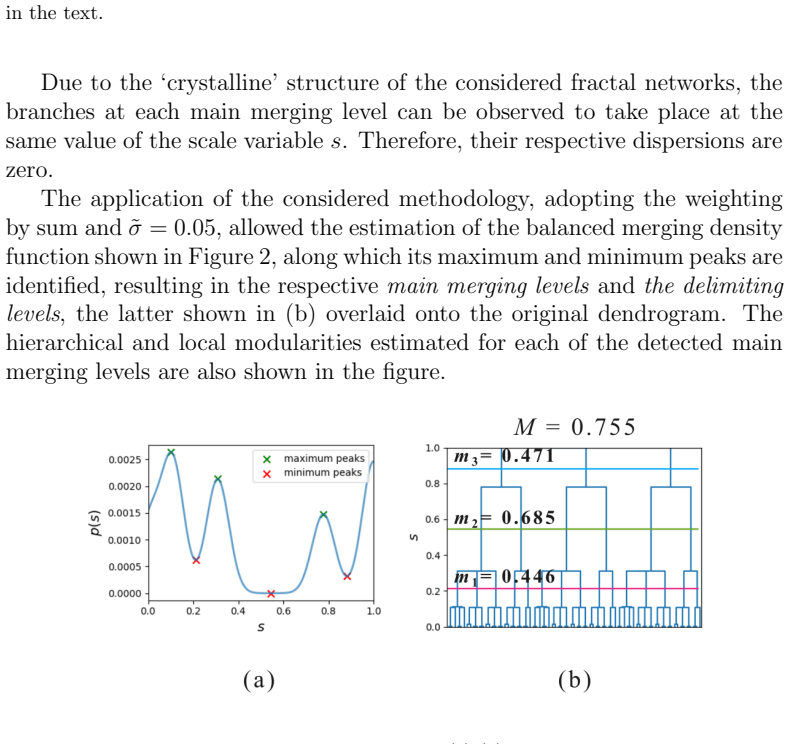
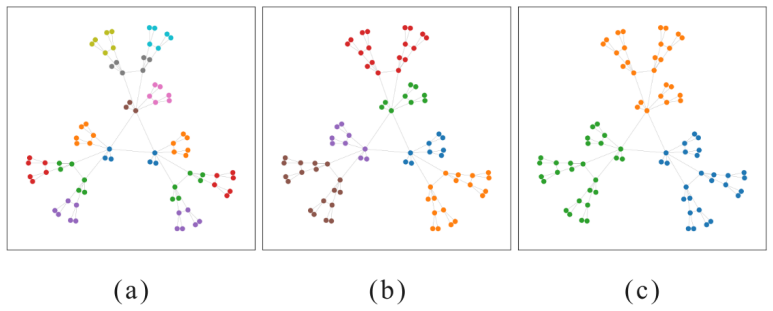
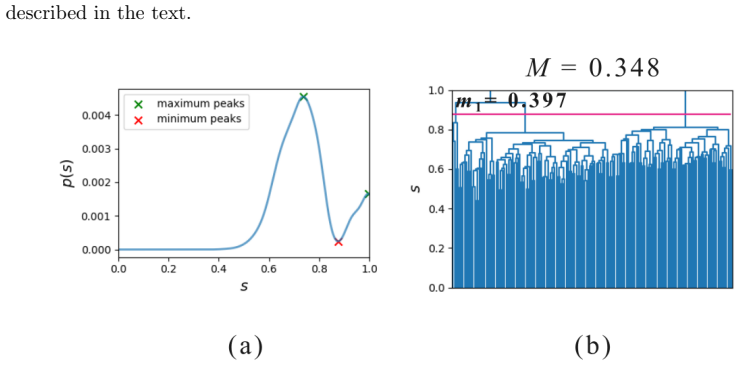
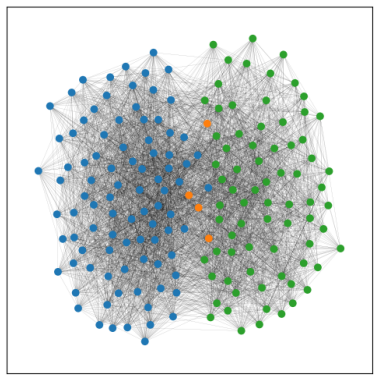
The present work extends to complex networks a recently described methodology (A. Benatti and L. da F Costa, Detecting Hierarchical Clusters and Estimating their Modularity Directly from Dendrograms, May 2026) for non-supervised hierarchical cluster detection and hierarchical modularity estimation. First, the edge betweenness centrality of a given complex network (or graph) is estimated, and a dendrogram is obtained from these values by using some linkage criterion (average linkage is considered in the present work). The mentioned concepts and methods can then be applied to the obtained dendrogram associated with the hierarchical structure of the nodes interrelationship, paving the way to community detection and hierarchical modularity estimation. Promising results are presented and discussed respectively to two types of modular networks, namely fractal networks (which are intrinsically hierarchical) and prime partition networks.
Editorial analysis
A structured set of objections, weighed in public.
Referee Report
Summary. The paper extends a prior dendrogram-based methodology for non-supervised hierarchical cluster detection and modularity estimation (Benatti and da F. Costa, May 2026) to complex networks. Edge betweenness centrality is computed for a given network, a dendrogram is constructed via average linkage, and the prior method is applied to this dendrogram to perform community detection and hierarchical modularity estimation. Promising results are reported for fractal networks and prime partition networks.
Significance. If the transfer of the dendrogram-based modularity procedure remains valid under the new input representation, the work would supply a non-supervised route to hierarchical community detection that avoids direct optimization on the original graph. The approach is conceptually straightforward and could be useful for intrinsically hierarchical networks, but its significance hinges on whether the betweenness-derived hierarchy preserves the node-interrelationship properties assumed by the earlier method.
major comments (2)
- The manuscript provides no derivation or test establishing that the modularity functional evaluated on a dendrogram constructed from edge betweenness centrality (with average linkage) equals or bounds the modularity obtained from the network's actual communities. This equivalence is load-bearing for the central claim that the prior methodology can be transferred without modification.
- [Abstract] Abstract and results sections supply no quantitative metrics (e.g., normalized mutual information, modularity values, or error bars), no comparison to standard community-detection baselines, and no ablation on the choice of linkage criterion, preventing assessment of whether the reported results are robust or merely consistent with the construction.
minor comments (1)
- [Abstract] The phrasing 'respectively to two types of modular networks' is awkward and should be revised for clarity.
Simulated Author's Rebuttal
We thank the referee for the constructive comments on our extension of the dendrogram-based hierarchical modularity method to complex networks. We address each major comment below and will revise the manuscript to strengthen the presentation.
read point-by-point responses
-
Referee: The manuscript provides no derivation or test establishing that the modularity functional evaluated on a dendrogram constructed from edge betweenness centrality (with average linkage) equals or bounds the modularity obtained from the network's actual communities. This equivalence is load-bearing for the central claim that the prior methodology can be transferred without modification.
Authors: We acknowledge that the current manuscript does not include an explicit derivation or empirical test demonstrating equivalence or bounding between the modularity computed on the betweenness-derived dendrogram and the network's ground-truth communities. The transfer relies on the property that edge betweenness centrality encodes separations between densely connected groups, thereby inducing a dendrogram whose structure is compatible with the assumptions of the original method. To address the concern directly, the revised version will add a dedicated subsection with a short theoretical argument based on betweenness properties and validation experiments on synthetic modular networks with known partitions. revision: yes
-
Referee: Abstract and results sections supply no quantitative metrics (e.g., normalized mutual information, modularity values, or error bars), no comparison to standard community-detection baselines, and no ablation on the choice of linkage criterion, preventing assessment of whether the reported results are robust or merely consistent with the construction.
Authors: The current abstract and results describe outcomes only qualitatively as 'promising.' We agree that the absence of numerical metrics, baseline comparisons, and linkage ablation limits evaluation. The revision will update the abstract and results to report concrete values (modularity scores, normalized mutual information on networks with ground truth), include comparisons against Louvain and Girvan-Newman algorithms, and present an ablation across linkage criteria (average, single, complete) with error bars from repeated runs where stochasticity is present. revision: yes
Axiom & Free-Parameter Ledger
Reference graph
Works this paper leans on
-
[1]
D. B. West.Introduction to graph theory, volume 2. Prentice Hall, Upper Saddle River, N.J., 2nd edition, 2001
2001
-
[2]
Bollob´ as.Modern graph theory, volume 184
B. Bollob´ as.Modern graph theory, volume 184. Springer Science & Business Media, 1998
1998
-
[3]
Barab´ asi
A. Barab´ asi. Network science.Philosophical Transactions of the Royal Society A, 371(1987):20120375, 2013
1987
-
[4]
Newman.Networks
M. Newman.Networks. Oxford University Press, 2018
2018
-
[5]
L. da F. Costa, O. N. Oliveira Jr., G. Travieso, F. A. Rodrigues, P. R. Villas Boas, L. Antiqueira, M. P. Viana, and L. E. Correa Rocha. An- alyzing and modeling real-world phenomena with complex networks: a survey of applications.Advances in Physics, 60(3):329–412, 2011
2011
-
[6]
Girvan and M
M. Girvan and M. E. J. Newman. Community structure in social and biological networks.Proceedings of the National Academy of Sciences, 99(12):7821–7826, 2002
2002
-
[7]
M. E. J. Newman and M. Girvan. Finding and evaluating community structure in networks.Physical Review E, 69(2):026113, 2004
2004
-
[8]
R. O. Duda, P. E. Hart, and D. G. Stork.Pattern Classification. Wiley- Interscience New York, 2nd edition, 2000
2000
-
[9]
Theodoridis and K
S. Theodoridis and K. Koutroumbas.Pattern Recognition. Elsevier, 2006
2006
-
[10]
Benatti and L
A. Benatti and L. da F. Costa. Detecting hierarchical clusters and estimating their modularity directly from dendrograms. Research Gate, 2026
2026
-
[11]
Benatti and L
A. Benatti and L. da F. Costa. On the transient and equilibrium fea- tures of growing fractal complex networks.Chaos, Solitons & Fractals, 183:114904, 2024
2024
-
[12]
Benatti and L
A. Benatti and L. da F. Costa. Expressing primes in terms of primes: Are prime numbers modularly or hierarchically organized? Research Gate, 2025
2025
-
[13]
T. M. J. Fruchterman and E. M. Reingold. Graph drawing by force- directed placement.Software: Practice and Experience, 21(11):1129– 1164, 1991
1991
-
[14]
L. C. Freeman. Centrality in social networks conceptual clarification. Social Networks, 1(3):215–239, 1978
1978
-
[15]
R. S. Hill. A stopping rule for partitioning dendrograms.Botanical Gazette, 141(3):321–324, 1980. 10
1980
-
[16]
de Ridder, J
D. de Ridder, J. de Ridder, and M. J. T. Reinders. Pattern recognition in bioinformatics.Briefings in Bioinformatics, 14(5):633–647, 2013
2013
-
[17]
Perona, T
P. Perona, T. Shiota, and J. Malik. Anisotropic diffusion. InGeometry- Driven Diffusion in Computer Vision, pages 73–92. Springer, 1994
1994
-
[18]
M. J. Black, G. Sapiro, D. H. Marimont, and D. Heeger. Robust anisotropic diffusion.IEEE Transactions on Image Processing, 7(3):421– 432, 1998
1998
-
[19]
Weickert.Anisotropic Diffusion in Image Processing
J. Weickert.Anisotropic Diffusion in Image Processing. Teubner, 1998
1998
-
[20]
C. Song, S. Havlin, and H. Makse. Self-similarity of complex networks. Nature, 433(7024):392–395, 2005
2005
-
[21]
Barab´ asi, E
A. Barab´ asi, E. Ravasz, and T. Vicsek. Deterministic scale-free net- works.Physica A: Statistical Mechanics and its Applications, 299(3- 4):559–564, 2001
2001
-
[22]
S. N. Dorogovtsev, A. V. Goltsev, and J. F. F. Mendes. Pseudofractal scale-free web.Physical Review E, 65(6):066122, 2002
2002
-
[23]
Wang.Goldbach conjecture, volume 4
Y. Wang.Goldbach conjecture, volume 4. World scientific, 2002
2002
-
[24]
Goldbach’s weak conjecture — Wikipedia, the free encyclopedia, 2026
Wikipedia contributors. Goldbach’s weak conjecture — Wikipedia, the free encyclopedia, 2026. Accessed: 2026-05-29. 11
2026
discussion (0)
Sign in with ORCID, Apple, or X to comment. Anyone can read and Pith papers without signing in.