Constraining the Physical Properties of Quadruply Lensed Quasars using Optical-to-X-Ray Data
Pith reviewed 2026-06-25 23:31 UTC · model grok-4.3
The pith
X-ray bolometric corrections predict AGN luminosity to within 0.5 dex scatter for lensed quasars.
A machine-rendered reading of the paper's core claim, the machinery that carries it, and where it could break.
Core claim
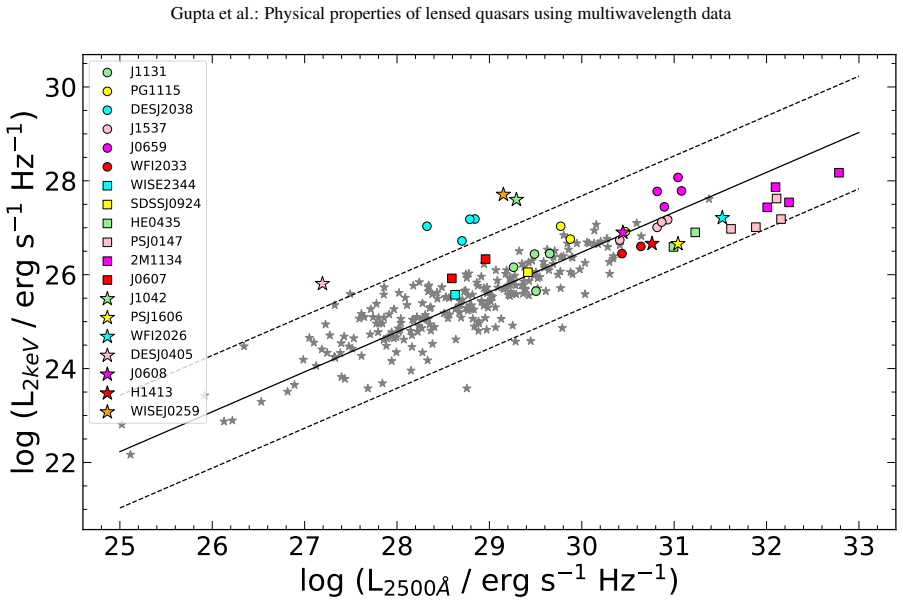
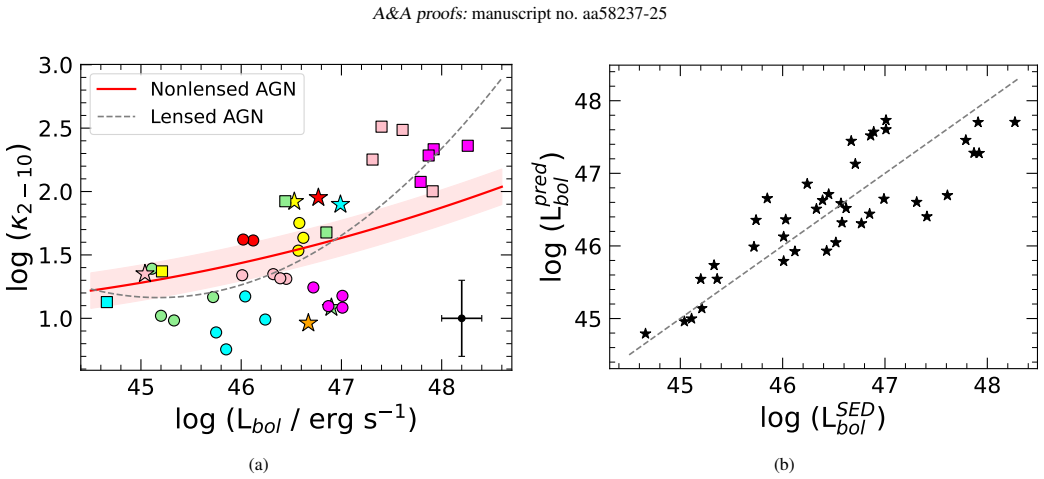
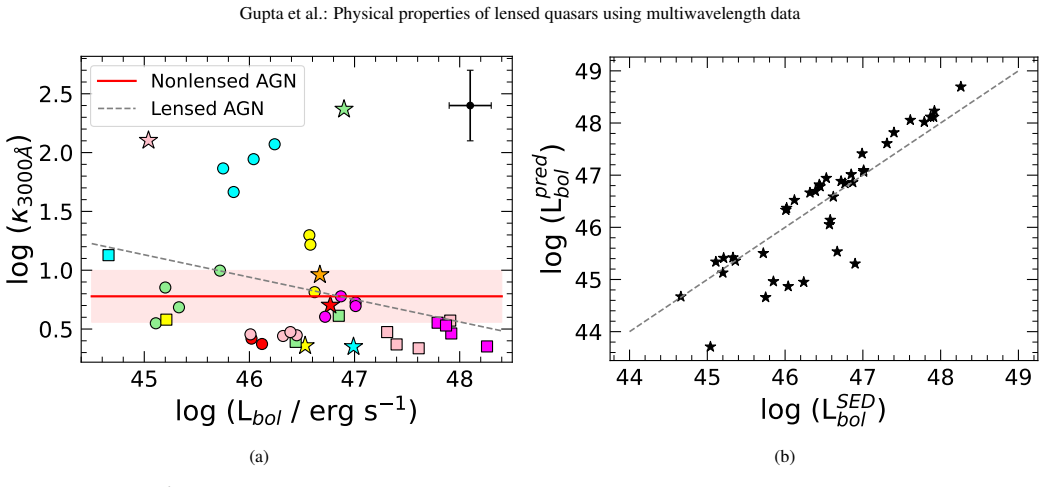
By analyzing multiwavelength data on 27 quadruply lensed AGN, the authors show that luminosity-dependent 2-10 keV X-ray bolometric corrections provide unbiased and reliable predictions of bolometric luminosity with a maximum scatter of ∼0.5 dex. They further establish that the well-known UV-X-ray luminosity relation for AGN offers a novel method to determine uncertainty in the magnifications of lensed AGN induced by micro- and/or millilensing.
What carries the argument
Broadband spectral energy distribution fitting with phenomenological models together with the UV-X-ray luminosity relation applied to quadruply lensed AGN.
If this is right
- X-ray data alone suffice to estimate bolometric luminosities of lensed AGN with quantified scatter.
- The UV-X-ray luminosity relation supplies a practical check on magnification uncertainties from microlensing.
- Black hole masses and Eddington ratios for high-redshift lensed AGN can be derived consistently via the virial method.
- Optical bolometric corrections require explicit microlensing adjustments to achieve lower scatter.
Where Pith is reading between the lines
- The same X-ray correction approach could be tested on non-lensed AGN samples to check whether the 0.5 dex scatter is general.
- Future surveys might combine this relation with lens modeling to separate intrinsic source properties from lensing effects more cleanly.
- Extending the sample to include more systems at the highest redshifts could reveal whether the corrections remain stable with cosmic time.
Load-bearing premise
The phenomenological SED models accurately represent the intrinsic AGN emission without major biases from microlensing, host-galaxy contamination, or differential magnification across wavelengths.
What would settle it
Independent bolometric luminosity measurements, for example from full infrared integration on a comparable sample of lensed AGN, that show systematic offsets exceeding 0.5 dex from the X-ray-based predictions would falsify the claim of unbiased reliability.
Figures
read the original abstract
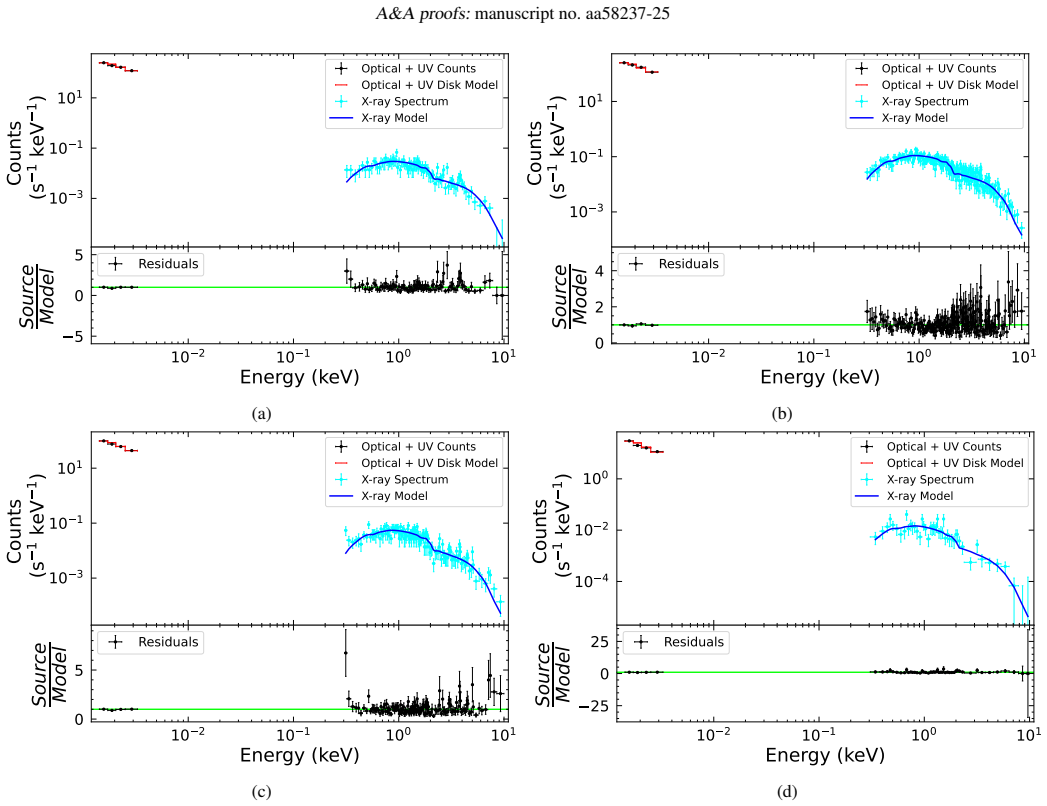
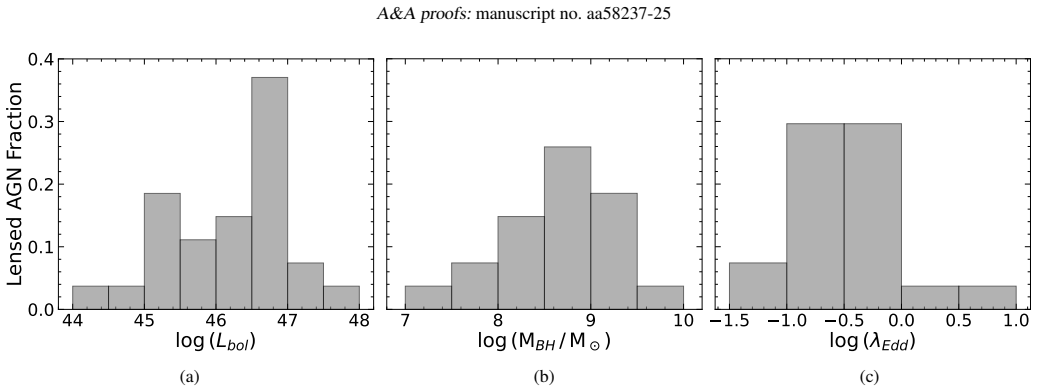
Gravitational lensing of luminous active galactic nuclei (AGN; or quasars) can be used as a natural telescope to zoom in on their inner structures. With more and more lensed AGN being discovered, it is extremely important to have a homogeneous study focused on constraining their key physical properties, especially the bolometric luminosity. The primary limitation for such a study is the availability of observations for a representative sample of lensed AGN in at least the optical, ultraviolet (UV), and X-ray bands, where most of the AGN emission is concentrated. In this paper, we present one of the largest multiwavelength studies of lensed AGN with the aim of accurately measuring some of the fundamental quantities, such as their bolometric luminosities, black hole masses, and Eddington ratios. We compiled photometric and spectroscopic data in optical/UV and X-rays, for 27 quadruply lensed AGN ($0.6 < z < 3.1$) and calculated their bolometric luminosities by fitting their broadband spectral energy distributions (SEDs) with phenomenological models. We also performed spectral emission line fitting to estimate their black hole masses using the virial method. Additionally, we compared different prescriptions to calculate the bolometric luminosities of AGN from limited data, and our results show that the luminosity-dependent 2-10 keV X-ray bolometric corrections provide unbiased and reliable predictions of the bolometric luminosity, with a maximum scatter of $\sim 0.5$ dex. The predictions from optical bolometric corrections are generally overestimated but show a lower scatter once microlensing effects are taken into account. Thanks to the compiled optical/UV and X-ray data for our lensed AGN sample, we also present the well-known UV-X-ray luminosity relation for AGN as a novel way to determine uncertainty in the magnifications of lensed AGN induced by micro- and/or millilensing.
Editorial analysis
A structured set of objections, weighed in public.
Referee Report
Summary. The manuscript compiles optical/UV and X-ray data for 27 quadruply lensed AGN (0.6 < z < 3.1), derives bolometric luminosities from phenomenological SED fits, estimates black hole masses via the virial method, and compares bolometric correction prescriptions. It concludes that luminosity-dependent 2-10 keV X-ray corrections are unbiased with maximum scatter ∼0.5 dex, that optical corrections improve after microlensing accounting, and that the UV-X-ray luminosity relation provides a novel probe of micro/millilensing-induced magnification uncertainties.
Significance. If the central results hold, the work supplies one of the larger homogeneous multiwavelength datasets for lensed quasars and supplies practical guidance on X-ray-based bolometric luminosity estimates. The data compilation itself is a clear asset for the field.
major comments (2)
- [Abstract; results on bolometric correction comparisons] The claim that luminosity-dependent 2-10 keV X-ray bolometric corrections are unbiased (maximum scatter ∼0.5 dex) rests on direct comparison to bolometric luminosities obtained from the phenomenological SED fits. The manuscript notes that optical corrections improve once microlensing is accounted for, but does not demonstrate that the benchmark SED luminosities themselves have been corrected for wavelength-dependent microlensing, millilensing, or host-galaxy dilution across the full sample. If those effects systematically alter the fitted SED shape or normalization, the apparent lack of bias in the X-ray prescription is not independently verified.
- [Discussion of UV-X-ray relation application] The proposal to repurpose the well-known UV-X-ray luminosity relation to constrain magnification uncertainties induced by micro- and/or millilensing assumes that any excess scatter relative to the non-lensed calibration is dominated by lensing rather than by residual differential magnification or sample selection effects; this assumption is load-bearing for the novelty claim but receives limited quantitative support.
minor comments (2)
- The criteria used to assemble the final sample of 27 systems from the known population of quadruply lensed AGN are not stated explicitly; adding a short description of selection cuts would improve reproducibility.
- Notation for the various bolometric corrections (e.g., the precise functional form of the luminosity-dependent 2-10 keV prescription) should be defined once in a dedicated subsection or table for clarity.
Simulated Author's Rebuttal
We thank the referee for their constructive and detailed report. We address each major comment below and outline the revisions we will make to strengthen the manuscript.
read point-by-point responses
-
Referee: [Abstract; results on bolometric correction comparisons] The claim that luminosity-dependent 2-10 keV X-ray bolometric corrections are unbiased (maximum scatter ∼0.5 dex) rests on direct comparison to bolometric luminosities obtained from the phenomenological SED fits. The manuscript notes that optical corrections improve once microlensing is accounted for, but does not demonstrate that the benchmark SED luminosities themselves have been corrected for wavelength-dependent microlensing, millilensing, or host-galaxy dilution across the full sample. If those effects systematically alter the fitted SED shape or normalization, the apparent lack of bias in the X-ray prescription is not independently verified.
Authors: We agree that the SED-derived bolometric luminosities serve as the benchmark and are constructed from observed (magnified) fluxes without explicit wavelength-dependent microlensing or host-dilution corrections applied to the full sample. The optical corrections are adjusted after the fact, but the SED fits themselves are not. This means the X-ray comparison is performed against the observed SED normalizations rather than fully de-lensed values, limiting the independence of the bias test. In the revised manuscript we will add a new subsection in the discussion that quantifies the possible impact of microlensing and host contamination on the SED shapes and normalizations, and we will qualify the 'unbiased' statement to reflect this limitation. We will also note any available constraints on differential magnification from the literature for individual systems. revision: yes
-
Referee: [Discussion of UV-X-ray relation application] The proposal to repurpose the well-known UV-X-ray luminosity relation to constrain magnification uncertainties induced by micro- and/or millilensing assumes that any excess scatter relative to the non-lensed calibration is dominated by lensing rather than by residual differential magnification or sample selection effects; this assumption is load-bearing for the novelty claim but receives limited quantitative support.
Authors: The referee correctly identifies that the novelty of using the UV–X-ray relation as a lensing diagnostic rests on the assumption that excess scatter is primarily lensing-induced. The current manuscript presents the relation but does not provide a quantitative decomposition of the scatter sources. In the revision we will add a quantitative comparison: we will estimate the expected scatter contribution from residual differential magnification (using published microlensing models for a subset of systems) and from selection effects, and show that these are smaller than the observed excess relative to the non-lensed calibration. This will strengthen the supporting evidence for the proposed application. revision: yes
Circularity Check
No significant circularity detected
full rationale
Bolometric luminosities are obtained directly from phenomenological SED fits to the compiled multi-band photometry; X-ray correction prescriptions are then tested against these independent SED values for scatter and bias. The UV-X-ray relation is invoked as an external empirical pattern and repurposed for lensing magnification uncertainty, without any central result reducing to a fitted input, self-definition, or self-citation chain by construction. The derivation chain remains self-contained against the external data.
Axiom & Free-Parameter Ledger
axioms (2)
- domain assumption Virial theorem applies to broad emission lines for estimating black hole masses in AGN
- domain assumption Phenomenological models can be fitted to broadband SEDs to recover accurate bolometric luminosities
Reference graph
Works this paper leans on
-
[1]
2018, MNRAS, 479, 4345
Agnello, A., Lin, H., Kuropatkin, N., et al. 2018, MNRAS, 479, 4345
2018
-
[2]
L., Kuropatkin, N., et al
Anguita, T., Schechter, P. L., Kuropatkin, N., et al. 2018, MNRAS, 480, 5017
2018
-
[3]
Arnaud, K. A. 1996, Astronomical Society of the Pacific Conference Series, V ol. 101, XSPEC: The First Ten Years, ed. G. H. Jacoby & J. Barnes, 17
1996
-
[4]
& Tananbaum, H
Avni, Y . & Tananbaum, H. 1986, ApJ, 305, 83
1986
-
[5]
Beloborodov, A. M. 1999, in Astronomical Society of the Pacific Conference Se- ries, V ol. 161, High Energy Processes in Accreting Black Holes, ed. J. Pouta- nen & R. Svensson, 295
1999
-
[6]
T., Nelson, G
Berghea, C. T., Nelson, G. J., Rusu, C. E., Keeton, C. R., & Dudik, R. P. 2017, ApJ, 844, 90
2017
-
[7]
Boroson, T. A. & Green, R. F. 1992, ApJS, 80, 109
1992
-
[8]
M., Netzer, H., Lira, P., Trakhtenbrot, B., & Mejía-Restrepo, J
Capellupo, D. M., Netzer, H., Lira, P., Trakhtenbrot, B., & Mejía-Restrepo, J. 2015, MNRAS, 446, 3427
2015
-
[9]
M., Netzer, H., Lira, P., Trakhtenbrot, B., & Mejía-Restrepo, J
Capellupo, D. M., Netzer, H., Lira, P., Trakhtenbrot, B., & Mejía-Restrepo, J. 2016, MNRAS, 460, 212
2016
-
[10]
S., Chartas, G., et al
Dai, X., Kochanek, C. S., Chartas, G., et al. 2010, ApJ, 709, 278
2010
-
[11]
2018, A&A, 618, A56
Ducourant, C., Wertz, O., Krone-Martins, A., et al. 2018, A&A, 618, A56
2018
-
[12]
2020, A&A, 636, A73
Duras, F., Bongiorno, A., Ricci, F., et al. 2020, A&A, 636, A73
2020
-
[13]
Floyd, D. J. E., Bate, N. F., & Webster, R. L. 2009, MNRAS, 398, 233
2009
-
[14]
C., Allen, G
Fruscione, A., McDowell, J. C., Allen, G. E., et al. 2006, in Society of Photo- Optical Instrumentation Engineers (SPIE) Conference Series, V ol. 6270, Ob- servatory Operations: Strategies, Processes, and Systems, ed. D. R. Silva & R. E. Doxsey, 62701V
2006
-
[15]
P., Bautz, M
Garmire, G. P., Bautz, M. W., Ford, P. G., Nousek, J. A., & Ricker, Jr., G. R. 2003, in Society of Photo-Optical Instrumentation Engineers (SPIE) Confer- ence Series, V ol. 4851, X-Ray and Gamma-Ray Telescopes and Instruments for Astronomy., ed. J. E. Truemper & H. D. Tananbaum, 28–44
2003
-
[16]
Gilman, D., Nierenberg, A. M., Treu, T., et al. 2025, arXiv e-prints, arXiv:2511.07513
Pith/arXiv arXiv 2025
-
[17]
& Mirocha, J
Ginsburg, A. & Mirocha, J. 2011, PySpecKit: Python Spectroscopic Toolkit, As- trophysics Source Code Library, record ascl:1109.001
2011
-
[18]
2022, AJ, 163, 291
Ginsburg, A., Sokolov, V ., de Val-Borro, M., et al. 2022, AJ, 163, 291
2022
-
[19]
E., Peng, C
Greene, J. E., Peng, C. Y ., & Ludwig, R. R. 2010, ApJ, 709, 937
2010
-
[20]
1988, A&A, 194, 54
Grieger, B., Kayser, R., & Refsdal, S. 1988, A&A, 194, 54
1988
-
[21]
K., Ricci, C., Temple, M
Gupta, K. K., Ricci, C., Temple, M. J., et al. 2024, A&A, 691, A203
2024
-
[22]
K., Ricci, C., Tortosa, A., et al
Gupta, K. K., Ricci, C., Tortosa, A., et al. 2025, ApJ, 990, 86
2025
-
[23]
& Maraschi, L
Haardt, F. & Maraschi, L. 1991, ApJ, 380, L51 HI4PI Collaboration, Ben Bekhti, N., Flöer, L., et al. 2016, A&A, 594, A116
1991
-
[24]
E., Nierenberg, A
Keeley, R. E., Nierenberg, A. M., Gilman, D., et al. 2024, MNRAS, 535, 1652
2024
-
[25]
Keeley, R. E., Nierenberg, A. M., Gilman, D., et al. 2025, arXiv e-prints, arXiv:2511.07765
arXiv 2025
-
[26]
S., Morgan, N
Kochanek, C. S., Morgan, N. D., Falco, E. E., et al. 2006, ApJ, 640, 47
2006
-
[27]
W., et al
Lemon, C., Anguita, T., Auger-Williams, M. W., et al. 2023, MNRAS, 520, 3305
2023
-
[28]
A., Auger, M
Lemon, C. A., Auger, M. W., & McMahon, R. G. 2019, MNRAS, 483, 4242
2019
-
[29]
A., Auger, M
Lemon, C. A., Auger, M. W., McMahon, R. G., & Ostrovski, F. 2018, MNRAS, 479, 5060
2018
-
[30]
D., et al
Lusso, E., Comastri, A., Simmons, B. D., et al. 2012, MNRAS, 425, 623
2012
-
[31]
2010, A&A, 512, A34
Lusso, E., Comastri, A., Vignali, C., et al. 2010, A&A, 512, A34
2010
-
[32]
& Risaliti, G
Lusso, E. & Risaliti, G. 2017, A&A, 602, A79
2017
-
[33]
1986, ApJ, 308, 635
Makishima, K., Maejima, Y ., Mitsuda, K., et al. 1986, ApJ, 308, 635
1986
-
[34]
Markwardt, C. B. 2009, in Astronomical Society of the Pacific Conference Se- ries, V ol. 411, Astronomical Data Analysis Software and Systems XVIII, ed. D. A. Bohlender, D. Durand, & P. Dowler, 251 Mejía-Restrepo, J. E., Trakhtenbrot, B., Lira, P., Netzer, H., & Capellupo, D. M. 2016, MNRAS, 460, 187
2009
-
[35]
2021, A&A, 656, A108
Melo, A., Motta, V ., Godoy, N., et al. 2021, A&A, 656, A108
2021
-
[36]
2023, A&A, 680, A51
Melo, A., Motta, V ., Mejía-Restrepo, J., et al. 2023, A&A, 680, A51
2023
-
[37]
1984, PASJ, 36, 741
Mitsuda, K., Inoue, H., Koyama, K., et al. 1984, PASJ, 36, 741
1984
-
[38]
W., Kochanek, C
Morgan, C. W., Kochanek, C. S., Dai, X., Morgan, N. D., & Falco, E. E. 2008, ApJ, 689, 755
2008
-
[39]
D., Caldwell, J
Morgan, N. D., Caldwell, J. A. R., Schechter, P. L., et al. 2004, AJ, 127, 2617 Muñoz, J. A., Mediavilla, E., Kochanek, C. S., Falco, E. E., & Mosquera, A. M. 2011, ApJ, 742, 67
2004
-
[40]
2013, The Physics and Evolution of Active Galactic Nuclei
Netzer, H. 2013, The Physics and Evolution of Active Galactic Nuclei
2013
-
[41]
M., Keeley, R
Nierenberg, A. M., Keeley, R. E., Sluse, D., et al. 2024, MNRAS, 530, 2960
2024
-
[42]
Pei, Y . C. 1992, ApJ, 395, 130
1992
-
[43]
A., Rappaport, S., & Schechter, P
Pooley, D., Blackburne, J. A., Rappaport, S., & Schechter, P. L. 2007, ApJ, 661, 19
2007
-
[44]
& Lusso, E
Risaliti, G. & Lusso, E. 2015, ApJ, 815, 33
2015
-
[45]
& Lusso, E
Risaliti, G. & Lusso, E. 2019, Nature Astronomy, 3, 272
2019
-
[46]
2025, ApJ, 987, 75
Rogers, A., Schwartz, D., Spingola, C., & Barnacka, A. 2025, ApJ, 987, 75
2025
-
[47]
E., Berghea, C
Rusu, C. E., Berghea, C. T., Fassnacht, C. D., et al. 2019, MNRAS, 486, 4987
2019
-
[48]
J., Finkbeiner, D
Schlegel, D. J., Finkbeiner, D. P., & Davis, M. 1998, ApJ, 500, 525
1998
-
[49]
2023, MNRAS, 518, 1260
Schmidt, T., Treu, T., Birrer, S., et al. 2023, MNRAS, 518, 1260
2023
-
[50]
Shakura, N. I. & Sunyaev, R. A. 1973, A&A, 500, 33
1973
-
[51]
N., Goicoechea, L
Shalyapin, V . N., Goicoechea, L. J., Dyrland, K., & Dahle, H. 2023, ApJ, 955, 140
2023
-
[52]
E., Strauss, M
Shen, Y ., Greene, J. E., Strauss, M. A., Richards, G. T., & Schneider, D. P. 2008, ApJ, 680, 169
2008
-
[53]
2006, A&A, 449, 539
Sluse, D., Claeskens, J.-F., Altieri, B., et al. 2006, A&A, 449, 539
2006
-
[54]
2012, A&A, 544, A62
Sluse, D., Hutsemékers, D., Courbin, F., Meylan, G., & Wambsganss, J. 2012, A&A, 544, A62
2012
-
[55]
2022, ApJ, 931, 68
Spingola, C., Schwartz, D., & Barnacka, A. 2022, ApJ, 931, 68
2022
-
[56]
T., Strateva, I., Brandt, W
Steffen, A. T., Strateva, I., Brandt, W. N., et al. 2006, AJ, 131, 2826
2006
-
[57]
Ulrich, M.-H., Maraschi, L., & Urry, C. M. 1997, ARA&A, 35, 445
1997
-
[58]
Urry, C. M. & Padovani, P. 1995, PASP, 107, 803
1995
-
[59]
Vasudevan, R. V . & Fabian, A. C. 2009, MNRAS, 392, 1124
2009
-
[60]
& Wilkes, B
Vestergaard, M. & Wilkes, B. J. 2001, ApJS, 134, 1
2001
-
[61]
E., et al
Virtanen, P., Gommers, R., Oliphant, T. E., et al. 2020, Nature Methods, 17, 261
2020
-
[62]
J., Tananbaum, H., Worrall, D
Wilkes, B. J., Tananbaum, H., Worrall, D. M., et al. 1994, ApJS, 92, 53 Article number, page 12 of 16 Gupta et al.: Physical properties of lensed quasars using multiwavelength data Appendix A:κ 2−10 vsL bol for lensed AGN As expected, the 2–10 keV X-ray bolometric corrections for the lensed AGN show an increasing trend with the bolometric lumi- nosity (Fi...
1994
discussion (0)
Sign in with ORCID, Apple, or X to comment. Anyone can read and Pith papers without signing in.