REVIEW 2 major objections 5 minor 37 references
Functional Laplace Transform of a Multivariate Hawkes Process, Subsequent Characteristics, and Numerical Approximations
T0 review · 2 major / 5 minor · reviewed 2026-08-06 · deepseek-v4-flash
Pith's one-line read A general multivariate Hawkes process with time-dependent baseline and non-Markovian excitation has a closed-form multi-temporal Laplace transform, from which exact two-time covariances and count probabilities follow.
desk verdict Solid multi-time Laplace transform results, but the advertised covariance Lebesgue decomposition is misclassified and needs a real fix. read the letter →
The pith
A machine-rendered reading of the paper's core claim, the machinery that carries it, and where it could break.
The reading
What carries the argument
The machinery is the immigrant-birth (cluster) representation of a linear Hawkes process: an ancestor Poisson process with intensity $\lambda_0$ generates first-generation events, and each such event independently generates its own full Hawkes process with kernel given by the corresponding row of $\phi$. Together with infinite divisibility, this turns the Laplace transform into a product of exponentials and yields the Volterra-like system (7). For moments, the workhorse is the resolvent-style fundamental series $\sum_{r\ge0}\phi^{(*r)}$, whose diagonal-supported bivariate extension $\widehat{\phi}(du,dv)=\phi(u)\delta_u(dv)du$ carries the two-time covariance solution (43). A log-Laplace coefficient recursion from Proposition 3.1 converts these transforms into equations for the count probabilities (Proposition 3.5).
What would settle it
Take $d=1$ with $\lambda_0(t)=1+\sin t$ and $\phi(t)=\alpha e^{-\beta t}$, simulate many independent paths, and compare the empirical covariance density off the diagonal with the absolutely continuous part predicted by Proposition 4.6; a systematic mismatch beyond Monte Carlo error would refute the covariance formula. The diagonal mass $\delta_{k=l}m^{(1)}_k + m^{(1)}_l * m^{(1)}_k$ predicted by the singular part can be checked in the same simulation.
Extended reading notes
Core claim
On the paper's own terms, the discovery is that the $n$-time Laplace transform of a $d$-dimensional non-stationary Hawkes process driven by (2) satisfies the recursive system (7), in which the transform at later times is expressed through the $d$ basic single-type transforms under the excitation kernel. Because each time slice contributes an independent Poisson ancestor layer, the finite-dimensional distributions are fully determined by this system. The paper then solves the corresponding second-order equations in closed series form: the two-time covariance is given by Equation (43) as a convolution of the diagonal-supported measure $\widehat{\phi}$ with the resolvent series $\sum_{r\ge1}\phi^{(*r)}$, and Proposition 4.6 splits that covariance measure into a singular part supported on the diagonal and an absolutely continuous part with explicit densities. This extends known single-time and stationary multivariate formulas to a general non-Markovian, time-dependent-baseline setting.
Load-bearing premise
The formulas assume the linear cluster representation of Hawkes processes, in which the process decomposes into an ancestor Poisson process and independent Hawkes subprocesses generated by each ancestor event, and the paper relies on this representation without re-proving it in full non-stationary, multivariate generality; if the excitation matrix is not integrable or the intensity is nonlinear, the integral equations no longer apply.
Editorial extensions
If this is right
- The multi-temporal Laplace transform in Equation (7) gives a recursive way to compute finite-dimensional distributions of non-stationary multivariate Hawkes processes, not just single-time marginals.
- Means and the two-time covariance can be evaluated through convergent series based on $\sum_{r\ge0}\phi^{(*r)}$, so neither Markovian nor stationary assumptions are needed for these characteristics.
- The covariance measure of each component pair splits into a diagonal singular part and an absolutely continuous part with explicit densities, enabling variance and cross-correlation computations at arbitrary time pairs.
- The grid-based convolution scheme approximates Laplace transforms and moments, providing numerical building blocks that can be used for estimation and calibration of epidemic models.
- Because $\lambda_0$ is allowed to be time-dependent, seasonal or multi-introduction epidemic models fall directly within the scope of the formulas.
Reading between the lines
- The explicit two-time covariance could support minimum-contrast estimators for baseline and excitation parameters without forcing the process into a Markovian state representation; this is an estimation route the paper mentions but does not develop.
- The covariance decomposition suggests that diagonal fluctuations are governed by first-order mean intensities, while off-diagonal dependence is carried by the absolutely continuous part; this distinction could simplify asymptotic variance calculations for non-stationary Hawkes processes.
- The same log-Laplace recursion used for count probabilities should extend to higher-order multi-time cumulants, yielding exact skewness and kurtosis under the model rather than only mean and covariance.
- A direct consistency check is available by taking a constant baseline and translation-invariant excitation, where the new series should reproduce the stationary cumulant formulas from earlier work.
Editorial analysis
A structured set of objections, weighed in public.
Referee Report
Summary. The paper studies a general class of multivariate Hawkes processes with time-dependent baseline intensity and general excitation kernels, in view of applications to spatio-temporal epidemic modeling. The main results are: (i) a system of Volterra-like integral equations for the multi-temporal Laplace transform (Theorem 2.2) and a functional Laplace transform (Theorem 2.3), both derived from the immigrant-birth cluster representation; (ii) an infinite-divisibility-based derivation of equations for the probability distribution of counts at a single time (Proposition 3.5); (iii) integral equations and explicit series solutions for the first two moments, including a two-time covariance formula (Propositions 4.1-4.5); and (iv) a claimed Lebesgue decomposition of the covariance measure into singular and absolutely continuous parts (Proposition 4.6). The paper also contains numerical discretization schemes, illustrations of the moment equations, and simulated trajectories for a two- and four-dimensional Hawkes model.
Significance. If the main formulas are correct, the paper provides a substantial extension of known Laplace-transform and moment results for Hawkes processes from stationary/single-time settings to non-stationary, multivariate, multi-temporal settings. The derivations are self-contained and based on the standard cluster representation, and several formulas reduce to classical special cases, which is a genuine strength. The explicit Volterra-like systems and series solutions for the mean and covariance could serve as a basis for moment-based inference in epidemic applications. However, the advertised Lebesgue decomposition of the covariance measure (Proposition 4.6) is incorrect, and a stated lemma on one-event probabilities (Lemma 2.1) is false; these issues affect the reliability of parts of the manuscript as it stands.
major comments (2)
- [Lemma 2.1, Eq. (6)] The asserted formula P(Ñ^{j'}(t)=e_i) = (∫_0^t φ^{j'}_i(s)ds) exp(−Σ_j ∫_0^t φ^{j'}_j(s)ds) is false for j'=0:d. The event that the total Hawkes count equals one requires not only exactly one ancestor event but also that the Hawkes process ignited by that ancestor has zero events up to the time horizon. The proof's statement that {Ñ^{j'}(t)=e_i} corresponds exactly to the Poisson event {N^0_i(t)=1} is therefore incorrect. The correct one-event probability is p̃^{j'}_{e_i}(t) = p̃^{j'}_0(t) ∫_0^t p̃^i_0(t−u) φ^{j'}_i(u) du (obtainable from Eq. (15) with l=e_i), which reduces to the displayed formula only when the excitation φ is zero. The same erroneous expression is used in the example following Proposition 3.5, where p̃^{j'}_1(t)=e^{−Φ_{j'}(t)}Φ_{j'}(t) is claimed. This must be corrected; although Theorem 2.2 itself does not appear to rely on Eq. (6), the lemma is stated as a result and the error propagates to the illustrations.
- [Proposition 4.6, Section 4.3] The claimed Lebesgue decomposition of the two-time covariance measure is not the correct decomposition. In the proof, the term (h̃^{j'}_j ∗ [M̃^{l,(1)}_k(·)1(·)])(t1,t2) equals ∫_0^{t1} h(u) M(t1−u) du for t1<t2, and the authors conclude that it is supported on the diagonal because it depends only on t1. However, the mixed derivative of this function on the open lower triangle {t2<t1} is the absolutely continuous density h(t2) m(t1−t2) (with m=M'), not a diagonal mass; the diagonal contribution from this term is proportional to M(0), which is zero for the cumulative mean functions considered here. Consequently, the absolutely continuous part stated in Proposition 4.6 contains the term m̃^{j',(1)}_k(u) m̃^{k,(1)}_l(v−u) for v>u but lacks its symmetric counterpart m̃^{j',(1)}_l(v) m̃^{l,(1)}_k(u−v) for u>v, and the singular part incorrectly includes the convolution term m̃^{j',(1)}_l ∗ m̃^{l,(1)}_k(u) δ_u(dv)du. The resulting covariance measure is not symmetric and does not match the known second-order structure of linear Hawkes processes (e.g., in the univariate stationary case the off-diagonal density should contain both μ h(v−u) and μ h(u−v)). Since Proposition 4.6 is advertised as a central contribution, this error requires a corrected derivation of the decomposition.
minor comments (5)
- [Eq. (45)] In the exponent of the discrete Laplace transform approximation, the term e^{a_j} should be e^{−a_j} to match the continuous-time formula and the preceding cases for m=1 and m=2.
- [Proof of Theorem 2.2] There are typographical issues in the proof: 'Λ0(tk) − Λ(tk−1)' is missing a subscript on the second term, and 'e^{−a[k,n] j } L̃^{j,(n+1−k), (t − u)[k,n]}' contains a misplaced comma that should be removed.
- [Abstract and Introduction] The abstract contains the sentence 'We also provides illustrative simulations', which should be 'We also provide...'.
- [Section 4.2.4] The definition of R̃^j_{k,l}(u,v) uses '(Id + M̃^{(1)}(u))' while the notation elsewhere is e_j + M̃^{j,(1)}(u); the matrix notation should be made consistent.
- [Section 5] The numerical scheme is presented without a convergence or error analysis; a brief statement on the order of approximation or a reference to a fixed-point convergence argument would be useful.
Circularity Check
No significant circularity: the derivation is self-contained and no fitted quantity is relabeled as a prediction.
full rationale
The paper's central results are derived from the immigrant-birth cluster representation of linear Hawkes processes (Eq. (4)), inherited from the external references Hawkes and Oakes (1974) and Karabash and Zhu (2015), together with Poisson-process thinning and the Lévy-Khinchine representation. Theorem 2.2 is obtained by conditioning on the ancestor Poisson points and using the i.i.d. structure of the triggered Hawkes processes; Theorem 2.3 follows by the same mechanism. The moment equations in Propositions 4.1, 4.3, 4.4 and 4.5 are obtained by differentiating the Laplace transforms, and Proposition 4.6 decomposes the resulting covariance measure into absolutely continuous and singular components. No parameter is fitted to data, no fitted quantity is renamed as a prediction, and no load-bearing claim rests on a self-citation. The authors' own prior work appears only in the concluding applications paragraph (e.g., [1], [2], [3]) and does not support the mathematical derivation. A possible mathematical objection to Proposition 4.6's classification of the covariance measure would concern correctness, not circularity, and is therefore outside the scope of this pass.
Assumptions & free parameters
assumptions (5)
- domain assumption The probability law of a multivariate point process is uniquely characterized by its predictable compensator (conditional intensity).
- domain assumption Every linear Hawkes process admits the immigrant-birth (cluster) representation: N(t) = N^0(t) + Σ_j Σ_{l≤N^0_j(t)} Ñ^{j,(l)}(t - T^{0,j}_l), where N^0 is a Poisson process and the Ñ^{j,(l)} are independent Hawkes processes.
- standard math Infinitely divisible Rd+-valued distributions have the Lévy-Khinchine representation (Theorem 3.3) and its discrete version (Theorem 3.4).
- standard math Faà di Bruno formula for taking partial derivatives of the composite Laplace transform expression exp(θ(a,t)).
- standard math Convolution powers and Young's inequality for L1 functions justify the convergence of the Neumann series for the mean.
Cite this review
Pith. "Pith review of Functional Laplace Transform of a Multivariate Hawkes Process, Subsequent Characteristics, and Numerical Approximations." pith.science (2026). https://pith.science/paper/IKGJEP6E
@misc{pith2026250715370,
  author       = {Pith},
  title        = {Pith review of: Functional Laplace Transform of a Multivariate Hawkes Process, Subsequent Characteristics, and Numerical Approximations},
  year         = {2026},
  howpublished = {\url{https://pith.science/paper/IKGJEP6E}},
  note         = {Machine review of arXiv:2507.15370}
}
read the original abstract
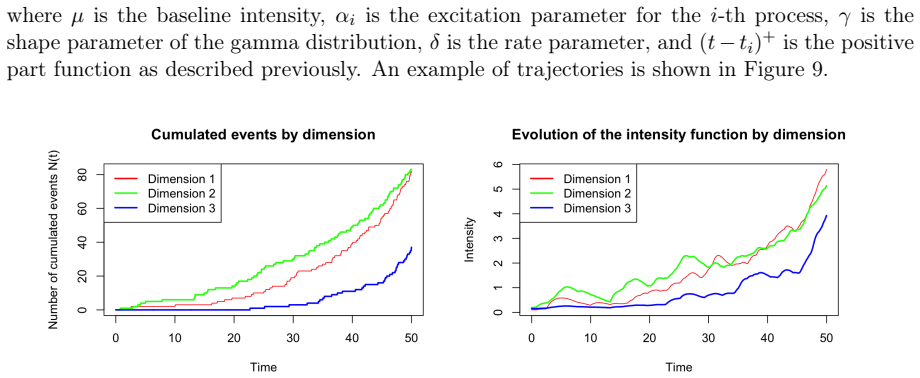
Numerous studies grounded on Hawkes processes have been carried out in many fields including finance, biology and social network. Hawkes processes form a class of selfexciting simple point processes. In this article, we consider a general class of multivariate Hawkes processes envisioned to model dynamics of spatio-temporal epidemics. For this class, the igniting baseline intensity is time dependent and the exciting matrix function is a general one, making the model non-Markovian in most of the cases. In this article, we first provide the closed-form expression of the multivariate multi-temporal characteristic function of these Hawkes processes, extending in a natural way the classical single-time formula found in the Hawkes literature. Then, we use the infinitely divisible property of the Hawkes process to derive the equation system related to the probability distribution of counts at each single time, adapted to the general formulation of the Hawkes model considered in this article. Next, we provide closed-form formulas for the temporal structure of the two first moments of the process, which allows us to deduce an original expression of the multivariate covariance function at two distinct times, thereby extending existing results established for more restricted classes of Hawkes processes. Based on this expression, we analytically decompose the covariance at two distinct times into singular and continuous parts. We finish with brief numerical elements: We present a simple scheme for numerical approximations of the Laplace transform and the first two moments, and give examples of solutions of the different related integral equations. We also provides illustrative simulations of the multivariate Hawkes process for different model specifications.
Figures


Figures from the paper (9 more)




Reference graph
Works this paper leans on
-
[1]
Candy Abboud, Olivier Bonnefon, Eric Parent, and Samuel Soubeyrand,Dating and local- izing an invasion from post-introduction data and a coupled reaction–diffusion–absorption model, Journal of Mathematical Biology79 (2019), 765–789
work page 2019
-
[2]
Candy Abboud, Eric Parent, Olivier Bonnefon, and Samuel Soubeyrand, Forecasting pathogen dynamics with Bayesian model-averaging: Application to Xylella fastidiosa, Bul- letin of Mathematical Biology85 (2023), 67
work page 2023
-
[3]
Candy Abboud, Rachid Senoussi, and Samuel Soubeyrand,Piecewise-deterministic Markov processes for spatio-temporal population dynamics, Statistical Inference for Piecewise- deterministic Markov Processes, 2018, pp. 209–255. 37
work page 2018
-
[4]
Emmanuel Bacry, Iacopo Mastromatteo, and Jean-François Muzy,Hawkes processes in fi- nance, Market Microstructure and Liquidity1 (2015), 1550005
work page 2015
-
[5]
Loubna Ben Allal, Antoine Lejay, and Radu Stefan Stoica,Hawkes point processes based inference applied to seismic data analysis, 2020 RING Meeting, ASGA, hal-02928408, 2020
work page 2020
-
[6]
M Charras-Garrido, Lamiae Azizi, Florence Forbes, Senan Doyle, Nathalie Peyrard, and David Abrial, On the difficulty to delimit disease risk hot spots, International Journal of Applied Earth Observation and Geoinformation22 (2013), 99–105
work page 2013
-
[7]
Maria Choufany, Davide Martinetti, Rachid Senoussi, Cindy E Morris, and Samuel Soubeyrand, Spatiotemporal large-scale networks shaped by air mass movements, Frontiers in Applied Mathematics and Statistics6 (2021), 602621
work page 2021
-
[8]
D. Dacunha-Castelle and M. Duflo,Probabilités et Statistiques: Problèmes à Temps Mobile, vol. 2, Masson, Paris, 1982
work page 1982
Show all 37 references
-
[9]
Daryl J Daley, David Vere-Jones, et al.,An Introduction to the Theory of Point Processes, Volume I: Elementary Theory and Methods, Springer, New York, 2003
2003
-
[10]
David and H.N
H.A. David and H.N. Nagaraja,Order statistics, Wiley, Hoboken, 2004
2004
-
[11]
OmarElEuchandMathieuRosenbaum, The characteristic function of rough Heston models, Mathematical Finance29 (2019), 3–38
2019
-
[12]
Eymen Errais, Kay Giesecke, and Lisa R Goldberg, Affine point processes and portfolio credit risk, SIAM Journal on Financial Mathematics1 (2010), 642–665
2010
-
[13]
Xuefeng Gao, Xiang Zhou, and Lingjiong Zhu,Transform analysis for Hawkes processes with applications in dark pool trading, Quantitative Finance18 (2018), 265–282
2018
-
[14]
Xuefeng Gao and Lingjiong Zhu,Functional central limit theorems for stationary Hawkes processes and application to infinite-server queues, Queueing Systems90 (2018), 161–206
2018
-
[15]
László Gerencsér, György Perczel, Loránd Eross, Dániel Fabó, and Zsuzsanna Vágó,Hawkes processes: Some key ideas, links to neuroscience and system identification, Communications in Information and Systems21 (2021), 385–413
2021
-
[16]
Alan G Hawkes, Spectra of some self-exciting and mutually exciting point processes , Biometrika58 (1971), 83–90
1971
-
[17]
, Hawkes processes and their applications to finance: A review, Quantitative Finance 18 (2018), 193–198
2018
-
[18]
Alan G Hawkes and David Oakes,A cluster process representation of a self-exciting process, Journal of Applied Probability11 (1974), 493–503
1974
-
[19]
Caroline Hillairet, Thomas Peyrat, and Anthony Réveillac,Multivariate self-exciting pro- cesses with dependencies, arXiv preprint arXiv:2503.15958 (2025)
2025 arXiv
-
[20]
Caroline Hillairet and Anthony Réveillac,Explicit correlations for the Hawkes processes, arXiv preprint arXiv:2304.02376 (2023)
2023 arXiv
-
[21]
Jean Jacod, Multivariate Point Processes: Predictable projection, Radon-Nycodym deriva- tives, representation of martingales, Zeitschrift fur Wahrscheinlichkeitstheorie und ver- wandte Gebiete31 (1975), 235–253. 38
1975
-
[22]
Thibault Jaisson and Mathieu Rosenbaum,Limit theorems for nearly unstable Hawkes pro- cesses: Version with technical appendix, 2014
2014
-
[23]
, Limit theorems for nearly unstable Hawkes processes, The Annals of Applied Prob- ability 25 (2015), 600–631
2015
-
[24]
Stojan Jovanović, John Hertz, and Stefan Rotter,Cumulants of Hawkes point processes, Physical Review E91 (2015), 042802
2015
-
[25]
Dmytro Karabash and Lingjiong Zhu,Limit theorems for marked Hawkes processes with application to a risk model, Stochastic Models31 (2015), 433–451
2015
-
[26]
Raviar Karim, Roger J A Laeven, and Michel Mandjes, Exact and asymptotic analysis of general multivariate hawkes processes and induced population processes, arXiv preprint arXiv:2106.03560 (2021)
2021 arXiv
-
[27]
Régis C Lambert, Christine Tuleau-Malot, Thomas Bessaih, Vincent Rivoirard, Yann Bouret, Nathalie Leresche, and Patricia Reynaud-Bouret,Reconstructing the functional con- nectivity of multiple spike trains using Hawkes models, Journal of Neuroscience Methods297 (2018), 9–21
2018
-
[28]
Michel Loève,Elementary probability theory, Springer, 1977
1977
-
[29]
Davide Martinetti and Samuel Soubeyrand,Identifying lookouts for epidemio-surveillance: Application to the emergence of Xylella fastidiosa in France, Phytopathology109 (2019), 265–276
2019
-
[30]
David Oakes,The Markovian self-exciting process, Journal of Applied Probability12 (1975), 69–77
1975
-
[31]
Nicolas Privault,Recursive computation of the Hawkes cumulants, Statistics & Probability Letters 177 (2021), 109161
2021
-
[32]
Patricia Reynaud-Bouret and Sophie Schbath,Adaptive estimation for Hawkes processes: Application to genome analysis, The Annals of Statistics38 (2010), 2781–2822
2010
-
[33]
Hervé Richard, Davide Martinetti, Daphné Lercier, Yann Fouillat, Buyung Hadi, Maged Elkahky, Jianqi Ding, Lucie Michel, Cindy E Morris, Karine Berthier, et al.,Computing ge- ographical networks generated by air-mass movement, GeoHealth7 (2023), e2023GH000885
2023
-
[34]
Marian-Andrei Rizoiu, Swapnil Mishra, Quyu Kong, Mark Carman, and Lexing Xie,SIR- Hawkes: linking epidemic models and Hawkes processes to model diffusions in finite popula- tions, Proceedings of the 2018 World Wide Web Conference, 2018, pp. 419–428
2018
-
[35]
Youngsoo Seol,Limit theorems for an inverse Markovian Hawkes process, Statistics & Prob- ability Letters155 (2019), 108580
2019
-
[36]
5, 466–477
Samuel Soubeyrand, Florence Carpentier, Nicolas Desassis, and Joël Chadœuf,Inference with a contrast-based posterior distribution and application in spatial statistics, Statistical Methodology 6 (2009), no. 5, 466–477
2009
-
[37]
Anatoliy Swishchuk, Rudi Zagst, and Gabriela Zeller,Hawkes processes in insurance: Risk model, application to empirical data and optimal investment, Insurance: Mathematics and Economics 101 (2021), 107–124. 39
2021
Reviewed August 6, 2026 · model on record in the stance chip above.
Discussion (0). Continue with ORCID to comment.