REVIEW 3 major objections 5 minor 100 references
A novel compact scheme for second-order fluxes applied to the Spectral Difference method
T0 review · 3 major / 5 minor · reviewed 2026-08-11 · deepseek-v4-flash
Pith's one-line read The paper proposes a compact, fully centered reformulation of second-order fluxes for the Spectral Difference method that shrinks the viscous stencil from five to three elements and restores nominal convergence order at even approximation…
desk verdict A solid 1D compact viscous-flux construction for SD that fixes BR1's even-order convergence and adds high-wavenumber damping; the multidimensional extension is asserted, not demonstrated. read the letter →
The pith
A machine-rendered reading of the paper's core claim, the machinery that carries it, and where it could break.
The reading
What carries the argument
The load-bearing object is the pair of one-sided continuous flux reconstructions $H^{C,L}_e$ and $H^{C,R}_e$ (equivalently, the corrected gradient states $v^{S,L}_e$ and $v^{S,R}_e$) built from the correction vectors $\hat{c}_L$ and $\hat{c}_R$ at each element's interfaces. Unlike the standard BR1 construction, which first forms a globally continuous flux and then differentiates it, the compact construction applies each interface correction only on the side that shares that interface, so the auxiliary gradient at an interface depends only on the two adjacent elements. The interface gradient is then the average of these one-sided contributions. This is what cuts the viscous stencil from five to three elements and what the eigenanalysis shows to add dissipation in the medium- to high-wavenumber range.
What would settle it
Run a two-dimensional manufactured-solution convergence study for the compact scheme on hexahedral elements, measuring L2 error for polynomial degrees p=1, 2, 3, and 4; the central claim would be refuted if any even approximation order (p+1 even, i.e., p odd) shows a convergence rate one order below nominal.
Extended reading notes
Core claim
The central claim is that the compact, fully-centered formulation is an effective drop-in alternative to BR1 within the Spectral Difference method, achieving nominal convergence order for every polynomial degree tested and proving more robust in under-resolved and nonlinear regimes. The mechanism is the reconstruction of the auxiliary gradient from element-local one-sided continuous fluxes, with interface values obtained by averaging contributions from the two neighbors only. This preserves the centered, parameter-free character of BR1 while formally reducing the one-dimensional stencil from five to three elements and improving damping of high-wavenumber numerical modes. The paper supports this claim with a temporal eigenanalysis of the dissipation curves and with convergence studies, under-resolved diffusion tests, and implicit large-eddy simulations of the Taylor-Green vortex at Reynolds numbers 1600 and 5000.
Load-bearing premise
The multidimensional accuracy claim rests on assuming that applying the compact corrections direction by direction on tensor-product hexahedral elements preserves enough accuracy, and the paper does not include a 2D or 3D convergence test to verify this.
Editorial extensions
If this is right
- For the linear diffusion equation, the compact scheme reaches convergence rates of 2.60, 3.01, 4.19, 5.04, and 6.37 for polynomial degrees p=1 through p=5, whereas standard BR1 drops to about 1.00, 3.00, 3.00, 5.05, and 4.99, so the even-order deficit at p=1, 3, and 5 is removed.
- In under-resolved tests (Dirac delta diffusion and the porous medium equation), the compact scheme produces smaller L2 errors and markedly fewer spurious high-wavenumber oscillations than the standard flux, with the Fourier-space oscillation peaks matching the eigenanalysis predictions.
- In implicit large-eddy simulations of the Taylor-Green vortex at Re=1600 and Re=5000, the compact scheme stays stable in configurations where the standard flux diverges, such as the 16^3 p7 case at Re=1600 and the 12^3 p6 case at Re=5000, and in stable runs it yields lower spurious enstrophy.
- The reduced five-to-three-element stencil lowers the memory and data-exchange footprint of the viscous operator, which is a direct benefit for implicit time integration, adjoint-based optimization, and large-scale parallel implementations.
Reading between the lines
- The paper leaves implicit that the multidimensional accuracy gain is the main untested part of the scheme; a 2D or 3D manufactured-solution convergence study on hexahedral meshes would directly test the tensor-product extension, and none is reported.
- The eigenanalysis shows that the compact flux adds dissipation mainly at medium and high wavenumbers, so one could quantify this as an effective implicit subgrid-scale viscosity by measuring spectral energy transfer in the Taylor-Green vortex, a diagnostic the paper does not compute.
- The same one-sided, interface-averaged reconstruction idea could be transferred to other discontinuous spectral element formulations that inherit BR1's wide stencil, although the paper demonstrates it only within the Spectral Difference framework.
- At higher resolution, the interior penalty term can degrade the compact scheme (as observed for the porous medium equation on 200 elements), suggesting that the compact flux may already supply enough dissipation and that penalty should be tuned lower when the two are combined.
Editorial analysis
A structured set of objections, weighed in public.
Referee Report
Summary. The manuscript proposes a compact, fully-centered viscous-flux formulation for the Spectral Difference (SD) method, inspired by Huynh's Flux Reconstruction approach. In one dimension it modifies the reconstruction of the auxiliary gradient so that the stencil shrinks from five to three elements while preserving the parameter-free, centered character of BR1. The authors give the 1D construction, a direction-by-direction extension to tensor-product hexahedral elements, a temporal eigenanalysis with and without interior penalty terms, and a series of tests: 1D Gaussian diffusion convergence, under-resolved Dirac-delta diffusion, the porous medium equation, and three-dimensional Taylor-Green vortex ILES. The 1D derivation and eigenanalysis are algebraically coherent, and the compact scheme's 1D convergence behavior is demonstrated for p=1 through p=5. The multidimensional accuracy claim, however, is asserted by analogy and is not supported by any 2D or 3D convergence test.
Significance. If the claims hold, this is a practically useful, parameter-free alternative to BR1 for the SD discretization of second-order fluxes, with particular relevance to implicit LES on hexahedral meshes. The manuscript has clear strengths: the compact scheme is parameter-free, the eigenanalysis is derived from the scheme's own operators, the 1D convergence rates are measured against exact solutions, and the TGV stability tables provide falsifiable comparisons. The current significance is limited by an internal contradiction in the parity of the suboptimal BR1 orders (the paper's own data show odd p, not even p, are suboptimal) and by the absence of any multidimensional accuracy validation, which leaves the headline 'all polynomial degrees' claim supported only in one dimension.
major comments (3)
- [§4.1, Table 2 and surrounding text] The text in §4.1 states that the standard scheme 'provides a much more degraded convergence rate' at even orders, listing p=2 and p=4 as even; however, Table 2 shows the opposite: the standard scheme's convergence rates are 0.998, 2.996, and 4.990 for p=1, p=3, and p=5 (all odd), while for p=2 and p=4 the rates are 3.001 and 5.050, which match the nominal orders. The same misstatement appears in the Abstract ('including even orders for which the standard BR1 scheme underperforms'). This is a load-bearing error in the central accuracy claim and must be corrected, and the abstract's 'even orders' must be revised to reflect the paper's own data.
- [§2.3 and Abstract] The multidimensional extension is presented by applying the one-sided compact corrections direction by direction (Eqs. (41)-(44)), but no 2D or 3D convergence study is reported anywhere in the manuscript. The Taylor-Green vortex tests demonstrate stability, not formal accuracy, and the text itself notes that in multiple dimensions the global stencil spans five elements. Consequently, the abstract's statement that the compact scheme 'restores the expected convergence order for all polynomial degrees' is only verified in one dimension. The authors should either supply multidimensional convergence evidence (e.g., a manufactured 2D or 3D diffusion problem with cross-derivative terms and non-affine metrics) or explicitly restrict the accuracy claim to the 1D case.
- [§4.1, Table 2] The convergence-rate claims are based on a single smooth test problem (well-resolved Gaussian diffusion) with no error estimates or multiple test cases. While this is not by itself a fatal flaw, it is the only evidence for the central accuracy claim; adding a second 1D problem with a known exact solution, or fitting the rates with linear-regression standard errors, would strengthen the conclusion that the compact scheme 'consistently achieves the expected order of accuracy for all polynomial degrees.'
minor comments (5)
- [§4.1] The sentence beginning 'For even orders of approximation, p=1 p=2 p=3 p=4 p=5 compact 2.599...' is a fragment and mislabels the parity of the tabulated polynomial degrees; p=1,3,5 are odd and p=2,4 are even.
- [Abstract and §2.3] The abstract's 'reducing the stencil from five to three elements' is a 1D statement; in §2.3, step 3, the text correctly notes that the global multidimensional stencil spans five elements. The abstract should qualify the stencil reduction as applying to the one-dimensional case to avoid overstatement.
- [§3] The eigenanalysis section states that both schemes satisfy Re(e\omega)=0 and then presents only dissipation curves; it would be clearer to state explicitly that the dispersion is identically zero for these centered schemes, so the imaginary part of the numerical frequency fully characterizes the scheme.
- [§4.2, Eq. (73)] The Fourier coefficient is computed using only the cosine transform; this is justified for the symmetric initial data used here, but the text should mention this restriction rather than presenting it as a general Fourier-space analysis.
- [References] Reference [7] has a formatting inconsistency: the title and subtitle are run together, and the doi is duplicated; this should be normalized.
Circularity Check
No significant circularity: the compact scheme is analyzed from its own operators and validated against exact solutions, with no fitted inputs or load-bearing self-citations.
full rationale
The paper's derivation chain is self-contained and non-circular. The compact flux is constructed explicitly in Section 2.2 through equations (21)-(26) as a modification of the standard SD/BR1 discretization, and its properties are then assessed independently. No parameter is fitted to produce the claimed convergence results: the convergence rates in Table 2 are measured against the analytic Gaussian diffusion solution, and the stencil reduction from five to three elements follows directly from the algebraic definitions of the one-sided continuous fluxes. The temporal eigenanalysis in Section 3 uses the scheme's own discrete operators to assemble the matrix B(θ) and solve the eigenvalue problem, so the dissipation curves are derived rather than imposed; the comparison with Fourier peaks in the Dirac-delta test is a consistency check, not a fit. The self-citations in the paper concern the SD solver and prior LES methodology (e.g., refs. [18], [20], [54], [57], [85], [86], [87]) and are not invoked as proof of the compact scheme's accuracy or stability. The central claims of order recovery, reduced oscillations, and improved stability are supported by in-paper numerical experiments against exact or established solutions. The multidimensional extension in Section 2.3 is presented by analogy and is not backed by 2D/3D convergence tests, but this is an evidentiary gap regarding generality, not a circular reduction of the claimed result to its inputs. No instance of self-definitional reasoning, fitted-input-as-prediction, or uniqueness-imported-from-authors appears in the paper.
Assumptions & free parameters
assumptions (4)
- standard math The standard SD interpolation and differentiation operators, based on Gauss-Legendre solution points and Gauss-Lobatto flux points, are stable and accurate as described by Kopriva and Jameson.
- domain assumption Tensor-product hexahedral elements allow the compact corrections to be applied direction by direction in multiple dimensions.
- domain assumption Temporal eigenanalysis of the one-dimensional linear diffusion equation with Bloch-periodic solutions is representative of the nonlinear three-dimensional ILES behavior.
- domain assumption Centered averaging of one-sided continuous gradients at interfaces is consistent for nonlinear diffusion fluxes such as the porous medium equation.
Cite this review
Pith. "Pith review of A novel compact scheme for second-order fluxes applied to the Spectral Difference method." pith.science (2026). https://pith.science/paper/IL4J3BDS
@misc{pith2026260809615,
  author       = {Pith},
  title        = {Pith review of: A novel compact scheme for second-order fluxes applied to the Spectral Difference method},
  year         = {2026},
  howpublished = {\url{https://pith.science/paper/IL4J3BDS}},
  note         = {Machine review of arXiv:2608.09615}
}
abstract
The discretization of second-order (viscous) terms in Discontinuous Spectral Element Methods (DSEMs) typically relies on an auxiliary gradient variable, whose treatment at element interfaces affects the accuracy and stability of the scheme. The Bassi-Rebay (BR1) formulation is attractive for its simplicity and parameter-free character, but suffers from sub-optimal convergence at even polynomial orders and requires an extended five-element stencil. Inspired by Huynh's Flux Reconstruction formulation, we develop a compact, fully-centered scheme for second-order fluxes within the Spectral Difference (SD) method. The proposed approach modifies the reconstruction of the auxiliary gradient using interface-dependent, one-sided continuous fluxes, reducing the stencil from five to three elements while preserving the centered and parameter-free nature of BR1. The formulation is developed in one dimension and extended to multiple dimensions. Temporal eigenanalysis is used to characterize its dissipation and dispersion properties, including the effects of interior penalty terms. Numerical tests consider the linear diffusion equation, an under-resolved localized Dirac's delta, the nonlinear porous medium equation, and implicit large-eddy simulations of the three-dimensional Taylor-Green vortex at $\mathrm{Re}=1600$ and $5000$. The compact scheme restores the expected convergence order for all polynomial degrees, including even orders, and reduces spurious oscillations in under-resolved and nonlinear regimes. It also remains stable in turbulent cases where the standard formulation fails, owing to improved damping of high-wavenumber numerical modes. The proposed approach provides an attractive compact alternative to BR1 for second-order fluxes in the SD method.
Figures


Figures from the paper (15 more)


Reference graph
Works this paper leans on
-
[1]
Alhawwary, M. and Z. Wang (2020). A combined-mode Fourier analysis of DG methods for linear parabolic problems.SIAM J. Sci. Comput.,vol. 42(6): pp. A3825–A3858
2020
-
[2]
Alhawwary, M. and Z. J. Wang (2018). Fourier analysis and evaluation of dg, fd and compact difference methods for conservation laws.J. Comput. Phys.,vol. 373: pp. 835–862
2018
-
[3]
Alhawwary, M. A. and Z. J. Wang (2019). A study of DG methods for diffusion using the combined- mode analysis.AIAA P.,vol. 2019-1157: pp. 1–22. AIAA Scitech 2019 Forum, San Diego, CA, Jan. 7–11, 2019
2019
-
[4]
Arnold, D. N. (1982). An interior penalty finite element method with discontinuous elements. SIAM J. Numer. Anal.,vol. 19(4): pp. 742–760
1982
-
[5]
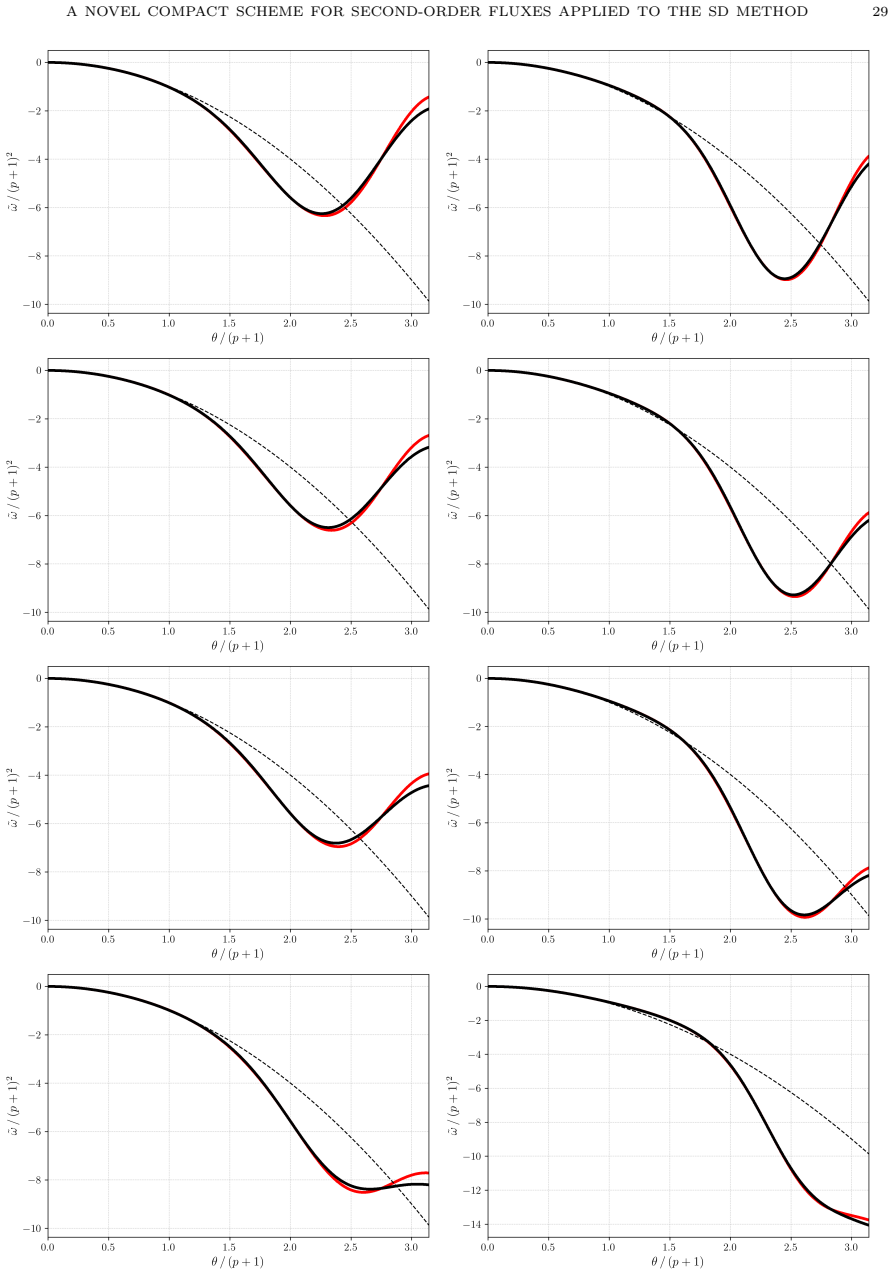
Arnold, D. N., F. Brezzi, B. Cockburn, and L. D. Marini (2002). Unified analysis of discontinuous Galerkin methods for elliptic problems.SIAM J. Numer. Anal.,vol. 39(5): pp. 1749–1779. 28 A NOVEL COMPACT SCHEME FOR SECOND-ORDER FLUXES APPLIED TO THE SD METHOD Figure 17.Combined-mode dissipation curves for the SD method for different order of approximation...
2002
-
[6]
Barenblatt, G. I. (1952). On some unsteady motions of a fluid and a gas in a porous medium. Prikl. Mat. Mekh.,vol. 16: pp. 67–78
1952
-
[7]
Barenblatt, G. I.,Scaling, Self-similarity, and Intermediate Asymptotics: Dimensional Analysis and Intermediate Asymptotics. Cambridge Texts in Applied Mathematics (Cambridge University Press, 1996). ISBN 978-1-107-05024-2. doi:10.1017/CBO9781107050242
-
[8]
Onthedevelopment of an implicit high-order discontinuous galerkin method for dns and implicit les of turbulent flows
Bassi, F., L.Botti, A.Colombo, A.Crivellini, A.Ghidoni, andF.Massa(2016). Onthedevelopment of an implicit high-order discontinuous galerkin method for dns and implicit les of turbulent flows. Eur. J. Mech. B-Fluid,vol. 55: pp. 367–379
2016
Show all 100 references
-
[9]
Bassi, F. and S. Rebay (1997). A high-order accurate discontinuous finite element method for the numerical solution of the compressible Navier-Stokes equations.J. Comput. Phys.,vol. 131(2): pp. 267–279
1997
-
[10]
Bassi, F. and S. Rebay, GMRES discontinuous Galerkin solution of the compressible Navier-Stokes equations. In Cockburn, B., G. E. Karniadakis, and C.-W. Shu (Eds.),Discontinuous Galerkin Methods, (pp. 197–208) (Springer Berlin Heidelberg, Berlin, Heidelberg, 2000). ISBN 978-3-...
-
[11]
Rebay, G
Bassi, F., S. Rebay, G. Mariotti, S. Pedinotti, M. Savini,et al., A high-order accurate discontinuous finite element method for inviscid and viscous turbomachinery flows. In2nd European Conference on Turbomachinery Fluid Dynamics and Thermodynamics, (pp. 99–108) (Technologisch...
1997
-
[12]
Bogey, C. and C. Bailly (2004). A family of low dispersive and low dissipative explicit schemes for flow and noise computations.J. Comput. Phys.,vol. 194(1): pp. 194–214
2004
-
[13]
Bosnyakov, I., S. V. Lyapunov, A. Troshin, V. V. Vlasenko, A. V. Wolkov, and C. Hirsch (2014). A high-order Discontinuous Galerkin method for external aerodynamics.AIAA P.,vol. 2014-2981. 32nd AIAA Applied Aerodynamics Conference, Atlanta, GA, Jun. 16–20, 2014
2014
-
[14]
Meiron, S
Brachet, M., D. Meiron, S. Orszag, B. Nickel, R. Morf, and U. Frisch (1983). Small-scale structure of the Taylor-Green vortex.J. Fluid Mech.,vol. 130(41): pp. 411–452. A NOVEL COMPACT SCHEME FOR SECOND-ORDER FLUXES APPLIED TO THE SD METHOD 29 Figure 18.Combined-mode dissipatio...
1983
-
[15]
Buresti, G. (2015). A note on Stokes’ hypothesis.ACTA Mech.,vol. 226(10): pp. 3555–3559
2015
-
[16]
Okrasińska-Płociniczak, Ł
Caballero, J., H. Okrasińska-Płociniczak, Ł. Płociniczak, and K. Sadarangani (2026). Baren- blatt solutions for the time-fractional porous medium equation: approach via integral equations. Fract. Calc. Appl. Anal.,vol. 29(3): pp. 1516–1546
2026
-
[17]
De La Llave Plata, F
Chapelier, J.-B., M. De La Llave Plata, F. Renac, and E. Lamballais (2014). Evaluation of a high-order discontinuous galerkin method for the dns of turbulent flows.Comput. Fluids,vol. 95: pp. 210–226
2014
-
[18]
Chapelier, J.-B. and G. Lodato (2016). A spectral-element dynamic model for the large-eddy simulation of turbulent flows.J. Comput. Phys.,vol. 321: pp. 279–302. doi:10.1016/j.jcp.2016. 05.051
2016 doi
-
[19]
Chapelier, J.-B. and G. Lodato (2017). Study of the Spectral Difference numerical dissipation for turbulent flows using unstructured grids.Flow Turbul. Combust.,vol. 99(3): pp. 643–664. doi:10.1007/s10494-017-9847-5
2017 doi
-
[20]
Lodato, and A
Chapelier, J.-B., G. Lodato, and A. Jameson (2016). A study on the numerical dissipation of the spectral difference method for freely decaying and wall-bounded turbulence.Comput. Fluids,vol. 139: pp. 261–280. doi:10.1016/j.compfluid.2016.03.006
2016 doi
-
[21]
Ching, E. J., R. F. Johnson, S. Burrows, J. Higgs, and A. D. Kercher (2025). Positivity-preserving and entropy-bounded discontinuous galerkin method for the chemically reacting, compressible navier-stokes equations.J. Comput. Phys.,vol. 525: p. 113746
2025
-
[22]
Tonicello, P
Clinco, N., N. Tonicello, P. Cinnella, and G. Rozza (2026). End-to-end optimization of subgrid scale models for discontinuous spectral element schemes based on the discrete adjoint method. arXiv preprint arXiv:2606.01150
2026 arXiv
-
[23]
Cockburn, B. and C. Shu (1998). The local discontinuous Galerkin finite element method for convection-diffusion systems.SIAM J. Numer. Anal.,vol. 35: pp. 2440–2463
1998
-
[24]
Cockburn, B. and C. Shu (1998). The Runge-Kutta discontinuous Galerkin finite element method for conservation laws V: Multidimensional systems.J. Comput. Phys.,vol. 141: pp. 199–224
1998
-
[25]
and C.-W
Cockburn, B. and C.-W. Shu (1998). The local discontinuous galerkin method for time-dependent convection-diffusion systems.SIAM J. Numer. Anal.,vol. 35(6): pp. 2440–2463
1998
-
[26]
Couaillier, and M.-C
de la Llave Plata, M., V. Couaillier, and M.-C. Le Pape (2018). On the use of a high-order discontinuous galerkin method for dns and les of wall-bounded turbulence.Comput. Fluids,vol. 176: pp. 320–337
2018
-
[27]
Lamballais, and F
de la Llave Plata, M., E. Lamballais, and F. Naddei (2019). On the performance of a high-order multiscale dg approach to les at increasing reynolds number.Comput. Fluids,vol. 194: p. 104306
2019
-
[28]
Münsch, N
Du, S., M. Münsch, N. Jansson, and P. Schlatter (2026). Assessment of the gradient jump penali- sation in large-eddy simulations of turbulence.ACTA Mech., (pp. 1–22)
2026
-
[29]
Dzanic, T. and F. D. Witherden (2022). Positivity-preserving entropy-based adaptive filtering for Discontinuous spectral element methods.J. Comput. Phys.,vol. 468: p. 111501
2022
-
[30]
Fehn, N., W. A. Wall, and M. Kronbichler (2018). Efficiency of high-performance discontinuous galerkin spectral element methods for under-resolved turbulent incompressible flows.Int. J. Nu- mer. Meth. Fl.,vol. 88(1): pp. 32–54
2018
-
[31]
Fernandez, P., R. C. Moura, G. Mengaldo, and J. Peraire (2019). Non-modal analysis of spectral element methods: Towards accurate and robust large-eddy simulations.Com- put. Meth. Appl. Mech. Eng.,vol. 346: p. 43–62. ISSN 0045-7825. doi:10.1016/j.cma.2018.11.027
2019 doi
-
[32]
Nguyen, and J
Fernandez, P., N.-C. Nguyen, and J. Peraire (2018). On the ability of discontinuous Galerkin methods to simulate under-resolved turbulent flows.arXiv preprint arXiv:1810.09435
2018 arXiv
-
[33]
Aninteriorpenaltystabilisedincompressiblediscontinuousgalerkin–fouriersolver for implicit large eddy simulations.J
Ferrer, E.(2017). Aninteriorpenaltystabilisedincompressiblediscontinuousgalerkin–fouriersolver for implicit large eddy simulations.J. Comput. Phys.,vol. 348: pp. 754–775
2017
-
[34]
Rubio, G
Ferrer, E., G. Rubio, G. Ntoukas, W. Laskowski, O. Mariño, S. Colombo, A. Mateo-Gabín, H. Mar- bona, F. M. de Lara, D. Huergo,et al.(2023). HORSE3D: A high-order Discontinuous Galerkin solver for flow simulations and multi-physics applications.Comput. Phys. Commun.,vol. 287: p. 108700
2023
-
[35]
Spiga, and O
Gasparino, L., F. Spiga, and O. Lehmkuhl (2024). Sod2d: A gpu-enabled spectral finite ele- ments method for compressible scale-resolving simulations.Comput. Phys. Commun.,vol. 297: p. 109067
2024
-
[36]
Harten, A. (1983). High resolution schemes for hyperbolic conservation laws.J. Comput. Phys., vol. 49(3): pp. 357–393
1983
-
[37]
Hartmann, R. and P. Houston (2008). An optimal order interior penalty discontinuous galerkin discretization of the compressible navier–stokes equations.J. Comput. Phys.,vol. 227(22): pp. A NOVEL COMPACT SCHEME FOR SECOND-ORDER FLUXES APPLIED TO THE SD METHOD 31 9670–9685
2008
-
[38]
Hesthaven, J. S. and T. Warburton,Nodal discontinuous Galerkin methods: algorithms, analysis, and applications(Springer Science & Business Media, 2007)
2007
-
[39]
Hesthaven, J. S. and T. Warburton,Nodal Discontinuous Galerkin Methods: Algorithms, Analysis, and Applications(Springer Science+Business Media, LLC, 2008). ISBN 978-0-387-72065-4
2008
-
[40]
Hu, F. Q. and H. L. Atkins (2002). Eigensolution analysis of the discontinuous Galerkin method with nonuniform grids: I. one space dimension.J. Comput. Phys.,vol. 182(2): pp. 516–545
2002
-
[41]
Hu, F. Q., M. Y. Hussaini, and P. Rasetarinera (1999). An analysis of the discontinuous galerkin method for wave propagation problems.J. Comput. Phys.,vol. 151(2): pp. 921–946
1999
-
[42]
Huynh, H. (2007). A flux reconstruction approach to high-order schemes including discontinu- ous Galerkin methods.AIAA P.,vol. 2007-4079: pp. 1–42. 18th AIAA Computational Fluid Dynamics Conference, Miami, FL, Jun. 25–28, 2007
2007
-
[43]
Huynh, H. (2009). A reconstruction approach to high-order schemes including discontinuous Galerkin for diffusion.AIAA P.,vol. 2009-403: pp. 1–34. 47th AIAA Aerospace Sciences Meeting, Orlando, FL, Jan. 5–8, 2009
2009
-
[44]
Jameson, A. (2010). A proof of the stability of the spectral difference method for all orders of accuracy.J. Sci. Comput.,vol. 45(1): pp. 348–358
2010
-
[45]
Jameson, A. and G. Lodato (2014). A note on the numerical dissipation from high-order discon- tinuous finite element schemes.Comput. Fluids,vol. 98: pp. 186–195. doi:10.1016/j.compfluid. 2014.01.016. 12th USNCCM mini-symposium of High-Order Methods for Computational Fluid Dyna...
2014 doi
-
[46]
Vincent, and P
Jameson, A., P. Vincent, and P. Castonguay (2012). On the non-linear stability of flux reconstruc- tion schemes.J. Sci. Comput.,vol. 50(2): pp. 434–445
2012
-
[47]
Kopriva, D. (1998). A staggered-grid multidomain spectral method for the compressible Navier- Stokes equations.J. Comput. Phys.,vol. 143(1): pp. 125–158
1998
-
[48]
Kopriva, D. and J. Kolias (1996). A conservative staggered-grid Chebyshev multidomain method for compressible flows.J. Comput. Phys.,vol. 125(1): pp. 244–261
1996
-
[49]
Kou, J., O. A. Marino, and E. Ferrer (2023). Jump penalty stabilization techniques for under- resolved turbulence in discontinuous galerkin schemes.J. Comput. Phys.,vol. 491: p. 112399
2023
-
[50]
Kronbichler, and W
Krank, B., M. Kronbichler, and W. A. Wall (2018). Direct numerical simulation of flow over periodic hills up toReH = 10,595.Flow Turbul. Combust.,vol. 101(2): pp. 521–551
2018
-
[51]
Kempf, M
Kurz, M., D. Kempf, M. P. Blind, P. Kopper, P. Offenhäuser, A. Schwarz, S. Starr, J. Keim, and A. Beck (2025). Galæxi: Solving complex compressible flows with high-order discontinuous galerkin methods on accelerator-based systems.Comput. Phys. Commun.,vol. 306: p. 109388
2025
-
[52]
Lele, S. K. (1992). Compact finite difference schemes with spectral-like resolution.J. Com- put. Phys.,vol. 103(1): pp. 16–42
1992
-
[53]
Vinokur, and Z
Liu, Y., M. Vinokur, and Z. Wang (2006). Spectral difference method for unstructured grids I: basic formulation.J. Comput. Phys.,vol. 216(2): pp. 780–801
2006
-
[54]
Lodato, G. (2019). Characteristic modal shock detection for discontinuous finite element methods. Comput. Fluids,vol. 179: pp. 309–333. doi:10.1016/j.compfluid.2018.11.008
2019 doi
-
[55]
Characteristic modal shock detection for discon- tinuous finite element methods
Lodato, G. (2019). Corrigendum to the article “Characteristic modal shock detection for discon- tinuous finite element methods”.Comput. Fluids,vol. 193: p. 104245. doi:10.1016/j.compfluid. 2019.104245
2019
-
[56]
Tonicello, and B
Lodato, G., N. Tonicello, and B. Pinto (2021). Large-eddy simulation of bypass transition on a zero-pressure-gradient flat plate using the spectral-element dynamic model.Flow Turbul. Combust., (pp. 1–30)
2021
-
[57]
Vervisch, and J.-B
Lodato, G., L. Vervisch, and J.-B. Chapelier (2022). Mitigation of post-shock oscillations induced by artificial viscosity in discontinuous finite element methods.Comput. Fluids,vol. 241: p. 105491. doi:10.1016/j.compfluid.2022.105491
2022
-
[58]
Vervisch, and P
Lodato, G., L. Vervisch, and P. Clavin (2016). Direct numerical simulation of shock wavy-wall interaction: analysis of cellular shock structures and flow patterns.J. Fluid Mech.,vol. 789: pp. 221–258. doi:10.1017/jfm.2015.731
2016 doi
-
[59]
Vervisch, and P
Lodato, G., L. Vervisch, and P. Clavin (2017). Numerical study of smoothly perturbed shocks in the Newtonian limit.Flow Turbul. Combust.,vol. 99(3): pp. 887–908. doi:10.1007/s10494-017-9830-1
2017 doi
-
[60]
Lv, Y. and M. Ihme (2014). Discontinuous galerkin method for multicomponent chemically reacting flows and combustion.J. Comput. Phys.,vol. 270: pp. 105–137
2014
-
[61]
Lv, Y., X. I. Yang, G. I. Park, and M. Ihme (2021). A Discontinuous Galerkin method for wall- modeled large-eddy simulations.Comput. Fluids,vol. 222: p. 104933. 32 A NOVEL COMPACT SCHEME FOR SECOND-ORDER FLUXES APPLIED TO THE SD METHOD
2021
-
[62]
Rubio, D
Manzanero, J., G. Rubio, D. A. Kopriva, E. Ferrer, and E. Valero (2020). Entropy–stable Discon- tinuous Galerkin approximation with summation–by–parts property for the incompressible Navier– Stokes/Cahn–Hilliard system.J. Comput. Phys.,vol. 408: p. 109363
2020
-
[63]
Manzanero, J., A. M. Rueda-Ramírez, G. Rubio, and E. Ferrer (2018). The Bassi Rebay 1 scheme is a special case of the symmetric interior penalty formulation for discontinuous Galerkin discreti- sations with Gauss–Lobatto points.J. Comput. Phys.,vol. 363: pp. 1–10
2018
-
[64]
Deniau, J.-F
Marchal, T., H. Deniau, J.-F. Boussuge, B. Cuenot, and R. Mercier (2023). Extension of the spectral difference method to premixed laminar and turbulent combustion.Flow Turbul. Combust., vol. 111(1): pp. 141–176
2023
-
[65]
De Grazia, R
Mengaldo, G., D. De Grazia, R. C. Moura, and S. J. Sherwin (2018). Spatial eigensolution analysis of energy-stable flux reconstruction schemes and influence of the numerical flux on accuracy and robustness.J. Comput. Phys.,vol. 358: pp. 1–20
2018
-
[66]
Moura, B
Mengaldo, G., R. Moura, B. Giralda, J. Peiró, and S. Sherwin (2018). Spatial eigensolution analysis of discontinuous Galerkin schemes with practical insights for under-resolved computations and implicit LES.Comput. Fluids,vol. 169: pp. 349–364
2018
-
[67]
Moxey, M
Mengaldo, G., D. Moxey, M. Turner, R. C. Moura, A. Jassim, M. Taylor, J. Peiró, and S. Sher- win (2021). Industry-relevant implicit large-eddy simulation of a high-performance road car via spectral/hp element methods.SIAM Rev.,vol. 63: pp. 723–755
2021
-
[68]
Moura, R. C., M. Aman, J. Peiró, and S. J. Sherwin (2020). Spatial eigenanalysis of spectral/hp continuous Galerkin schemes and their stabilisation via DG-mimicking spectral vanishing viscosity for high Reynolds number flows.J. Comput. Phys.,vol. 406: p. 109112
2020
-
[69]
Moura, R. C., L. D. Fernandes, A. Da Silva, and S. J. Sherwin (2024). Joint-mode diffusion analysis of discontinuous galerkin methods: Towards superior dissipation estimates for nonlinear problems and implicit les.J. Comput. Phys.,vol. 505: p. 112912
2024
-
[70]
Moura, R. C., G. Mengaldo, J. Peiró, and S. J. Sherwin (2017). On the eddy-resolving capability of high-order discontinuous Galerkin approaches to implicit LES/under-resolved DNS of Euler turbulence.J. Comput. Phys.,vol. 330: pp. 615–623
2017
-
[71]
Moura, R. C., S. J. Sherwin, and J. Peiró (2015). Linear dispersion–diffusion analysis and its appli- cation to under-resolved turbulence simulations using discontinuous Galerkin spectral/hp methods. J. Comput. Phys.,vol. 298: pp. 695–710
2015
-
[72]
Moxey, D., C. D. Cantwell, Y. Bao, A. Cassinelli, G. Castiglioni, S. Chun, E. Juda, E. Kazemi, K. Lackhove, J. Marcon,et al.(2020). Nektar++: Enhancing the capability and application of high-fidelity spectral/hp element methods.Comput. Phys. Commun.,vol. 249: p. 107110
2020
-
[73]
Manzanero, G
Ntoukas, G., J. Manzanero, G. Rubio, E. Valero, and E. Ferrer (2022). An entropy–stable p–adaptive nodal Discontinuous Galerkin for the coupled Navier–Stokes/Cahn–Hilliard system. J. Comput. Phys.,vol. 458: p. 111093
2022
-
[74]
Orlando, G. (2024). An implicit dg solver for incompressible two-phase flows with an artificial compressibility formulation.Int. J. Numer. Meth. Fl.,vol. 96(12): pp. 1932–1959
2024
-
[75]
Ortleb, S. (2020). A comparative Fourier analysis of discontinuous Galerkin schemes for advection– diffusion with respect to BR1, BR2, and local discontinuous Galerkin diffusion discretization. Math. Method. Appl. Sci.,vol. 43(13): pp. 7841–7863
2020
-
[76]
Ou, K. and A. Jameson (2011). Unsteady adjoint method for the optimal control of advection and Burger’s equations using high-order spectral difference method.AIAA P.,vol. 2011-24: pp. 1–18. 49th AIAA Aerospace Sciences Meeting including the New Horizons Forum and Aerospace Exp...
2011
-
[77]
Stokes assumption
Rajagopal, K. (2013). A new development and interpretation of the Navier-Stokes fluid which reveals why the “Stokes assumption” is inapt.Int. J. NonLin. Mech.,vol. 50: pp. 141–151
2013
-
[78]
Marmignon, and F
Renac, F., C. Marmignon, and F. Coquel (2012). Time implicit high-order discontinuous Galerkin method with reduced evaluation cost.SIAM J. Sci. Comput.,vol. 34(1): pp. A370–A394
2012
-
[79]
Rising, C. J., E. J. Ching, and R. F. Johnson (2026). Simulation of non-premixed, supersonic combustion using the discontinuous galerkin method on fully unstructured grids.Phys. Rev. Fluids, vol. 11(1): p. 013203
2026
-
[80]
Roe, P. (1981). Approximate Riemann solvers, parameter vectors, and difference schemes.J. Com- put. Phys.,vol. 43: pp. 357–372
1981
-
[81]
Shahbazi, K. (2005). An explicit expression for the penalty parameter of the interior penalty method.J. Comput. Phys.,vol. 205(2): pp. 401–407
2005
-
[82]
Spiteri, R. and S. Ruuth (2002). A new class of optimal high-order strong-stability-preserving time discretization methods.SIAM J. Numer. Anal.,vol. 40(2): pp. 469–491. A NOVEL COMPACT SCHEME FOR SECOND-ORDER FLUXES APPLIED TO THE SD METHOD 33
2002
-
[83]
Wang, and Y
Sun, Y., Z. Wang, and Y. Liu (2007). High-order multidomain spectral difference method for the Navier-Stokes equations on unstructured hexahedral grids.Commun. Comput. Phys.,vol. 2(2): pp. 310–333
2007
-
[84]
Tonicello, N. and M. Ihme (2024). A high-order diffused-interface approach for two-phase com- pressible flow simulations using a discontinuous galerkin framework.J. Comput. Phys.,vol. 508: p. 112983
2024
-
[85]
Lodato, and M
Tonicello, N., G. Lodato, and M. Ihme (2025). Extension of a spectral difference method for the diffused-interface five-equation model.Comput. Fluids, (p. 106880)
2025
-
[86]
Lodato, and L
Tonicello, N., G. Lodato, and L. Vervisch (2021). Analysis of high-order explicit les dynamic modeling applied to airfoil flows.Flow Turbul. Combust., (pp. 1–28)
2021
-
[87]
Lodato, and L
Tonicello, N., G. Lodato, and L. Vervisch (2021). A comparative study from spectral analyses of high-order methods with non-constant advection velocities.J. Sci. Comput.,vol. 87(3): pp. 1–38
2021
-
[88]
Lodato, and L
Tonicello, N., G. Lodato, and L. Vervisch (2022). Analysis of high-order explicit LES dynamic modeling applied to airfoil flows.Flow Turbul. Combust.,vol. 108: pp. 77–104
2022
-
[89]
Lodato, and L
Tonicello, N., G. Lodato, and L. Vervisch (2022). Turbulence kinetic energy transfers in direct nu- merical simulation of shock-wave–turbulence interaction in a compression/expansion ramp.J. Fluid Mech.,vol. 935: p. A31
2022
-
[90]
Broeckhoven, and C
Van den Abeele, K., T. Broeckhoven, and C. Lacor (2007). Dispersion and dissipation properties of the 1d spectral volume method and application to a p-multigrid algorithm.J. Comput. Phys., vol. 224(2): pp. 616–636
2007
-
[91]
Lacor, and Z
Van den Abeele, K., C. Lacor, and Z. J. Wang (2008). On the stability and accuracy of the spectral difference method.J. Sci. Comput.,vol. 37(2): pp. 162–188
2008
-
[92]
Puigt, X
Vanharen, J., G. Puigt, X. Vasseur, J.-F. Boussuge, and P. Sagaut (2017). Revisiting the spectral analysis for high-order spectral discontinuous methods.J. Comput. Phys.,vol. 337: pp. 379–402
2017
-
[93]
L.,The Porous Medium Equation: Mathematical Theory
Vázquez, J. L.,The Porous Medium Equation: Mathematical Theory. Oxford Mathematical Mono- graphs (Oxford University Press, 2006). ISBN 978-0-198-56903-9
2006
-
[94]
Vincent, P. E., P. Castonguay, and A. Jameson (2011). Insights from von neumann analysis of high-order flux reconstruction schemes.J. Comput. Phys.,vol. 230(22): pp. 8134–8154
2011
-
[95]
Vincent, P. E., P. Castonguay, and A. Jameson (2011). A new class of high-order energy stable flux reconstruction schemes.J. Sci. Comput.,vol. 47(1): pp. 50–72
2011
-
[96]
Facilitatingtheadoptionofunstructuredhigh-ordermethods amongst a wider community of fluid dynamicists.Math
Vincent, P.E.andA.Jameson(2011). Facilitatingtheadoptionofunstructuredhigh-ordermethods amongst a wider community of fluid dynamicists.Math. Model. Nat. Phenom.,vol. 6(3): pp. 97– 140
2011
-
[97]
Wang, Z., Y. Liu, G. May, and A. Jameson (2007). Spectral difference method for unstructured grids II: Extension to the Euler equations.J. Sci. Comput.,vol. 32(1): pp. 45–71
2007
-
[98]
Asthana, and A
Watkins, J., K. Asthana, and A. Jameson (2016). A numerical analysis of the nodal discontinuous galerkin scheme via flux reconstruction for the advection-diffusion equation.Comput. Fluids,vol. 139: pp. 233–247
2016
-
[99]
Watkins, J. E., J. Romero, and A. Jameson (2016). Multi-GPU, implicit time stepping for high- order methods on unstructured grids.AIAA P.,vol. 2016-3965: pp. 1–33. 46th AIAA Fluid Dynamics Conference, Washington, D.C., Jun. 13–17, 2016
2016
-
[100]
Zel’dovich, Y. B. and A. Kompaneets,Towards a theory of heat conduction with thermal conduc- tivity depending on the temperature(Izdatel’stvo Akademii Nauk SSSR, Moscow, 1950). Collection of Papers Dedicated to 70th Anniversary of A.F. Ioffe
1950
Reviewed August 11, 2026 · model on record in the stance chip above.
Discussion (0). Continue with ORCID to comment.