Deterministic Volume Estimation of Truncated Hypercubes
Pith reviewed 2026-05-20 02:09 UTC · model grok-4.3
The pith
A fixed number of convex constraints allows a deterministic polynomial-time approximation of the truncated hypercube volume.
A machine-rendered reading of the paper's core claim, the machinery that carries it, and where it could break.
Core claim
For any fixed k, given k constraints of the specified form in dimension n with total input length L bits and output length L_o bits, and error parameter ε > 0, there exists a deterministic algorithm that computes a (1 + ε)-multiplicative approximation to the volume of the intersection with [0,1]^n in time polynomial in n, 1/ε, L, and L_o.
What carries the argument
The deterministic approximation algorithm that exploits the univariate convex monotone structure of the constraints to estimate the truncated volume.
If this is right
- The volume of the unit hypercube truncated by a fixed number of knapsack constraints becomes approximable in polynomial time.
- Intersections with norm balls admit deterministic (1+ε) volume estimates under the same conditions.
- The running time scales polynomially with dimension n and with the desired precision 1/ε.
- Problems reducible to counting or measuring such truncated regions gain deterministic tractability for small k.
Where Pith is reading between the lines
- The method could support deterministic volume-based techniques in sampling or integration tasks over similar convex sets.
- Extending the approach to count lattice points inside these truncated regions would be a natural next computational step.
- Instances with slowly growing k could be tested to map the boundary between polynomial and superpolynomial behavior.
Load-bearing premise
The number of constraints k is a fixed constant independent of the dimension, and the constraints have the specific form of sums of univariate nonnegative monotone convex functions.
What would settle it
An explicit instance with k=2 constraints in dimension n=200 where the algorithm's output volume differs from the independently computed true volume by more than a (1+ε) factor for ε=0.01.
Figures


read the original abstract
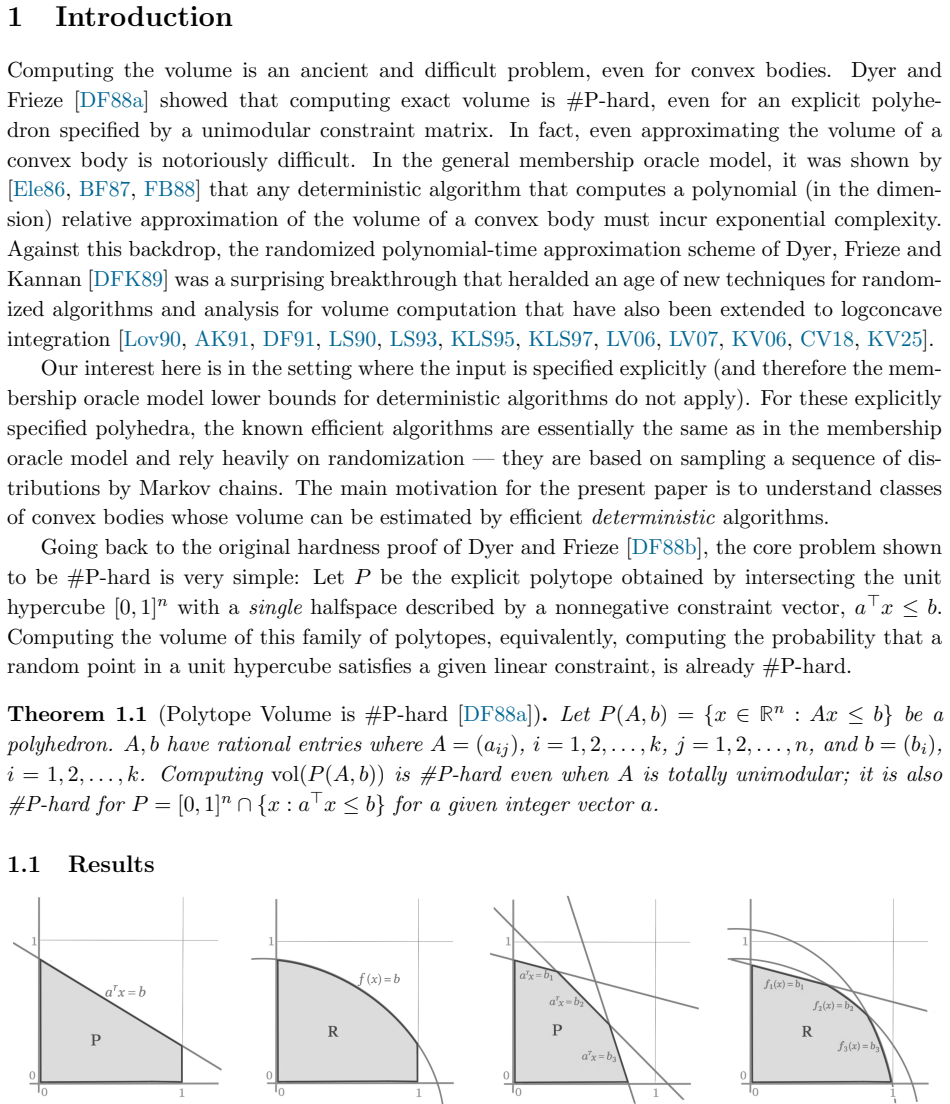
We present a deterministic polynomial-time algorithm for estimating the volume of a hypercube intersected by a fixed number of constraints of the type $f(x) \leq b$, where $f$ is the sum of univariate functions that are each nonnegative, monotone, and convex. Such constraints include knapsack and norm-ball constraints. The case of the unit hypercube truncated by a single linear constraint (halfspace) is already #P-hard. Given $k$ such constraints in dimension $n$, with total input length of at most $L$ bits, total output length of at most $L_o$ bits, and an error parameter $\varepsilon > 0$, our algorithm computes a $(1 + \varepsilon)$-multiplicative approximation of the volume of their intersection with the unit hypercube $[0,1]^n$ in time poly$_k(n, 1/\varepsilon, L,L_o)$.
Editorial analysis
A structured set of objections, weighed in public.
Referee Report
Summary. The manuscript presents a deterministic polynomial-time algorithm for (1+ε)-approximating the volume of the unit hypercube [0,1]^n truncated by k fixed constraints, each being f(x) ≤ b with f a sum of univariate nonnegative, monotone, convex functions. The running time is poly_k(n, 1/ε, L, L_o) where L is the total input bit length.
Significance. If the central claim holds, the result would be a significant contribution to deterministic volume estimation for structured truncations of the hypercube. It provides an explicit algorithmic construction with polynomial time bounds (for fixed k) that handles important special cases such as knapsack and norm-ball constraints, where even the single linear halfspace case is #P-hard. The paper's strength lies in its explicit time bounds and focus on a separable convex structure that enables the claimed efficiency.
major comments (2)
- [algorithm description (post-Section 2)] The discretization of the k-dimensional consumption vector s in the dynamic program (detailed in the algorithm section following the problem definition) must achieve a grid cardinality polynomial in L and 1/ε. With each univariate function taking values up to Θ(2^L) and n steps, the natural range for each coordinate of s is Θ(n · 2^L); the error analysis must show that a non-uniform, logarithmic, or closed-form grid suffices to keep total rounding/interpolation error below ε without incurring exp(Ω(L)) points or time per convolution.
- [main theorem] Theorem 1 (or the main runtime/approximation theorem): the proof that the final volume integral yields a (1+ε) multiplicative guarantee must explicitly bound error accumulation across the n iterative DP steps when using the chosen discretization; without this, the poly(L) claim is not yet load-bearing.
minor comments (2)
- The abstract and introduction should explicitly restate that k is treated as a fixed constant independent of n.
- [preliminaries] Notation for the output bit length L_o is introduced but its precise role in the runtime (e.g., bit precision of the final volume) could be clarified in the preliminaries.
Simulated Author's Rebuttal
We thank the referee for the careful reading and constructive comments on our manuscript. We address the two major comments point by point below and will revise the paper to strengthen the relevant sections.
read point-by-point responses
-
Referee: [algorithm description (post-Section 2)] The discretization of the k-dimensional consumption vector s in the dynamic program (detailed in the algorithm section following the problem definition) must achieve a grid cardinality polynomial in L and 1/ε. With each univariate function taking values up to Θ(2^L) and n steps, the natural range for each coordinate of s is Θ(n · 2^L); the error analysis must show that a non-uniform, logarithmic, or closed-form grid suffices to keep total rounding/interpolation error below ε without incurring exp(Ω(L)) points or time per convolution.
Authors: We agree that an explicit argument for polynomial grid size is necessary to support the claimed runtime. The manuscript already employs a non-uniform grid that exploits monotonicity and convexity to place points with spacing that grows logarithmically in the consumption value; this keeps the per-coordinate cardinality polynomial in L and 1/ε while controlling rounding and linear-interpolation error to O(ε). We will add a dedicated paragraph (or short subsection) immediately after the DP definition that states the grid construction in closed form, proves the cardinality bound, and verifies that each convolution remains polynomial-time under this discretization. revision: yes
-
Referee: [main theorem] Theorem 1 (or the main runtime/approximation theorem): the proof that the final volume integral yields a (1+ε) multiplicative guarantee must explicitly bound error accumulation across the n iterative DP steps when using the chosen discretization; without this, the poly(L) claim is not yet load-bearing.
Authors: The existing proof of Theorem 1 proceeds by induction on the n dimensions and maintains an invariant that the multiplicative error after i steps is at most (1 + ε · i/n). We will expand the error-analysis paragraph that follows the induction to make the per-step additive error contribution explicit (O(ε/n) after accounting for the grid discretization) and to confirm that the accumulated error after n steps remains (1 + ε) while preserving the polynomial dependence on L. This clarification will be inserted directly into the proof of Theorem 1. revision: yes
Circularity Check
No circularity: algorithmic construction with explicit poly-time bounds
full rationale
The paper presents a deterministic algorithm for (1+ε)-approximating the volume of the unit hypercube intersected by k fixed separable convex constraints, with runtime poly_k(n, 1/ε, L, L_o). This is an explicit algorithmic construction rather than a derivation that reduces a claimed result to fitted parameters, self-definitions, or self-citations by construction. No load-bearing step equates the output volume or runtime bound to an input by renaming or circular fitting; the separability and monotonicity/convexity assumptions enable dynamic programming or convolution techniques whose error analysis is claimed to remain polynomial in the input bit length L. The result is therefore self-contained against external benchmarks for algorithmic correctness.
Axiom & Free-Parameter Ledger
Reference graph
Works this paper leans on
-
[1]
Israel Journal of Mathematics , year =
Alexander Barvinok and Mark Rudelson , title =. Israel Journal of Mathematics , year =. doi:10.1007/s11856-024-2615-z , url =
-
[2]
International Mathematics Research Notices , volume =
Narayanan, Hariharan and Srivastava, Piyush , title =. International Mathematics Research Notices , volume =. 2026 , month =. doi:10.1093/imrn/rnag036 , url =
-
[3]
Deterministic approximation for the volume of the truncated fractional matching polytope , author=. 2024 , eprint=
work page 2024
-
[4]
A Deterministic Algorithm of Quasi-Polynomial Complexity for Clipped Cubes Volume Approximation , author=. 2024 , eprint=
work page 2024
-
[5]
D. L. Barrow and P. W. Smith , title =. The American Mathematical Monthly , volume =. 1979 , publisher =. doi:10.1080/00029890.1979.11994730 , URL =
-
[6]
Volume of Hypercubes Clipped by Hyperplanes and Combinatorial Identities , volume =
Cho, Yunhi and Kim, Seonhwa , year =. Volume of Hypercubes Clipped by Hyperplanes and Combinatorial Identities , volume =. The Electronic Journal of Linear Algebra , doi =
-
[7]
Parikshit Gopalan and Adam R. Klivans and Raghu Meka , title =. CoRR , volume =. 2010 , url =. 1008.3187 , timestamp =
work page internal anchor Pith review Pith/arXiv arXiv 2010
-
[9]
A Deterministic Polynomial-time Approximation Scheme for Counting Knapsack Solutions , author=. 2010 , eprint=
work page 2010
-
[10]
Proceedings of the Thirty-Fifth Annual ACM Symposium on Theory of Computing , pages =
Dyer, Martin , title =. Proceedings of the Thirty-Fifth Annual ACM Symposium on Theory of Computing , pages =. 2003 , isbn =. doi:10.1145/780542.780643 , abstract =
-
[11]
Pseudorandom Generators for Polynomial Threshold Functions
Raghu Meka and David Zuckerman , title =. CoRR , volume =. 2009 , url =. 0910.4122 , timestamp =
work page internal anchor Pith review Pith/arXiv arXiv 2009
-
[12]
Proceedings of the Thirty-Eighth Annual ACM Symposium on Theory of Computing , pages =
Kamp, Jesse and Rao, Anup and Vadhan, Salil and Zuckerman, David , title =. Proceedings of the Thirty-Eighth Annual ACM Symposium on Theory of Computing , pages =. 2006 , isbn =. doi:10.1145/1132516.1132613 , abstract =
-
[13]
Ben Cousins and Santosh S. Vempala , title =. 2018 , url =. doi:10.1137/15M1054250 , timestamp =
-
[14]
Lattice packing of spheres in high dimensions using a stochastically evolving ellipsoid , author=. 2025 , eprint=
work page 2025
-
[15]
Geometric and Functional Analysis , volume=
An almost constant lower bound of the isoperimetric coefficient in the KLS conjecture , author=. Geometric and Functional Analysis , volume=. 2021 , publisher=
work page 2021
-
[16]
Mathematical Programming , volume=
Geometric random edge , author=. Mathematical Programming , volume=. 2017 , publisher=
work page 2017
-
[17]
and Oveis, Shayan Gharan and Trevisan, Luca , TITLE =
Anand Louis and Prasad Raghavendra and Prasad Tetali and Santosh Vempala , title =. Proceedings of the 44th Symposium on Theory of Computing Conference,. 2012 , url =. doi:10.1145/2213977.2214079 , timestamp =
-
[18]
The Cutting Plane Method Is Polynomial for Perfect Matchings , booktitle =
Karthekeyan Chandrasekaran and L. The Cutting Plane Method Is Polynomial for Perfect Matchings , booktitle =. 2012 , url =. doi:10.1109/FOCS.2012.35 , timestamp =
-
[19]
Karthekeyan Chandrasekaran and Santosh Vempala , title =. Innovations in Theoretical Computer Science, ITCS'14, Princeton, NJ, USA, January 12-14, 2014 , pages =. 2014 , url =. doi:10.1145/2554797.2554838 , timestamp =
-
[20]
Symposium on Theory of Computing,
Navin Goyal and Santosh Vempala and Ying Xiao , title =. Symposium on Theory of Computing,. 2014 , url =. doi:10.1145/2591796.2591875 , timestamp =
-
[21]
Mathematics of Operations Research , volume=
The cutting plane method is polynomial for perfect matchings , author=. Mathematics of Operations Research , volume=. 2016 , publisher=
work page 2016
-
[22]
Anand Louis and Prasad Raghavendra and Santosh Vempala , title =. 54th Annual. 2013 , url =. doi:10.1109/FOCS.2013.46 , timestamp =
-
[23]
Arriaga and David Rutter and Maya Cakmak and Santosh S
Rosa I. Arriaga and David Rutter and Maya Cakmak and Santosh S. Vempala , title =. Neural Computation , volume =. 2015 , url =. doi:10.1162/NECO_a_00769 , timestamp =
- [24]
-
[25]
Freund and Santosh Vempala , title =
Alexandre Belloni and Robert M. Freund and Santosh Vempala , title =. Math. Oper. Res. , volume =. 2009 , pages =
work page 2009
-
[26]
Journal of the ACM (JACM) , volume=
Solving convex programs by random walks , author=. Journal of the ACM (JACM) , volume=. 2004 , publisher=
work page 2004
-
[27]
arXiv preprint arXiv:2203.15551v2 , year=
Bourgain's slicing problem and KLS isoperimetry up to polylog , author=. arXiv preprint arXiv:2203.15551v2 , year=
-
[28]
Proceedings of the 50th Annual ACM SIGACT Symposium on Theory of Computing , pages=
Convergence rate of Riemannian Hamiltonian Monte Carlo and faster polytope volume computation , author=. Proceedings of the 50th Annual ACM SIGACT Symposium on Theory of Computing , pages=. 2018 , organization=
work page 2018
-
[29]
Chen, Zongchen and Vempala, Santosh S. , title =. Theory of Computing , volume =. 2022 , pages =. doi:10.4086/toc.2022.v018a009 , publisher =
-
[30]
A Slightly Improved Bound for the KLS Constant , author=. 2022 , eprint=
work page 2022
-
[31]
Logarithmic bounds for isoperimetry and slices of convex sets , author=. 2023 , eprint=
work page 2023
-
[32]
Bakry, D. and \'. Diffusions hypercontractives , BOOKTITLE =. 1985 , MRCLASS =. doi:10.1007/BFb0075847 , URL =
- [33]
-
[34]
Kane and Jerry Zheng Li and Ankur Moitra and Alistair Stewart , title =
Ilias Diakonikolas and Gautam Kamath and Daniel M. Kane and Jerry Zheng Li and Ankur Moitra and Alistair Stewart , title =. Proc. of FOCS , year =
-
[35]
Hulda S. Haraldsd. Bioinformatics , volume =. 2017 , url =. doi:10.1093/bioinformatics/btx052 , timestamp =
-
[36]
Ainesh Bakshi and Ilias Diakonikolas and He Jia and Daniel M. Kane and Pravesh K. Kothari and Santosh S. Vempala , editor =. Robustly learning mixtures of. 2022 , url =. doi:10.1145/3519935.3519953 , timestamp =
-
[37]
Log-Sobolev inequalities and sampling from log-concave distributions
Alan Frieze and Ravi Kannan. Log-Sobolev inequalities and sampling from log-concave distributions. Ann. Appl. Probab. 1999. doi:10.1214/aoap/1029962595
-
[38]
P. Diaconis and L. Saloff-Coste. Logarithmic Sobolev inequalities for finite Markov chains. Ann. Appl. Probab. 1996. doi:10.1214/aoap/1034968224
-
[39]
Sampling According to the Multivariate Normal Density , Author =. FOCS , Year =
-
[40]
Simulated Annealing in Convex Bodies and an
L. Simulated Annealing in Convex Bodies and an. FOCS , Year =
- [41]
-
[42]
Fast computation of low-rank matrix approximations , Author =. J. ACM , Year =
-
[43]
On Spectral Learning of Mixtures of Distributions , Author =. Proc. of COLT , Year =
-
[44]
Quantitative estimates of the convergence of the empirical covariance matrix in Log-concave Ensembles , Author =. J. Amer. Math. Soc. , Year =
-
[45]
Global organization of metabolic fluxes in the bacterium Escherichia coli , Author =. Nature , Year =
-
[46]
Aloise, Daniel and Deshpande, Amit and Hansen, Pierre and Popat, Preyas , Journal =. NP-hardness of. 2009 , Number =
work page 2009
- [47]
-
[48]
Proceedings of the 34th Annual ACM Symposium on Theory on Computing , Year =
Random sub-problems of Max-SNP problems , Author =. Proceedings of the 34th Annual ACM Symposium on Theory on Computing , Year =
-
[49]
Random Structures and Algorithms , Year =
Finding a Large Hidden Clique in a Random Graph , Author =. Random Structures and Algorithms , Year =
-
[50]
Deformed Products and Maximal Shadows , Author =. Contemporary Math. , Year =
-
[51]
Sampling and integration of near log-concave functions , Author =. STOC , Year =
-
[52]
S. Arora and R. Kannan , Journal =. Learning mixtures of arbitrary. 2005 , Number =
work page 2005
-
[53]
Proceedings of the 27th Annual ACM Symposium on Theory of Computing , Year =
Polynomial time approximation schemes for dense instances of NP-hard problems , Author =. Proceedings of the 27th Annual ACM Symposium on Theory of Computing , Year =
-
[54]
STOC '04: Proceedings of the thirty-sixth annual ACM symposium on Theory of computing , Year =
Expander flows, geometric embeddings and graph partitioning , Author =. STOC '04: Proceedings of the thirty-sixth annual ACM symposium on Theory of computing , Year =
-
[55]
An algorithmic theory of learning: Robust concepts and random projection , Author =. Mach. Learn. , Year =. doi:10.1007/s10994-006-6265-7 , ISSN =
-
[56]
k-means++: The Advantages of Careful Seeding , Author =. Proc. of SODA , Year =
-
[57]
Discrete Applied Mathematics , Year =
Reverse Search for Enumeration , Author =. Discrete Applied Mathematics , Year =
-
[58]
Spectral analysis of data , Author =. Proc. of STOC , Year =
-
[59]
Computing the volume is difficult , Author =. Discrete Comput. Geom. , Year =. doi:10.1007/BF02187886 , Fjournal =
-
[60]
Nash equilibria in random games , Author =. Random Struct. Algorithms , Year =
-
[61]
Clustering with Interactive Feedback , Author =. Proc. 19th International Conference on Algorithmic Learning Theory (ALT) , Year =
-
[62]
On a Theory of Learning with Similarity Functions , Author =. Proc. International Conference on Machine Learning (ICML) , Year =
-
[63]
Proceedings of the ACM-SIAM Symposium on Discrete Algorithms (SODA) , Year =
Approximate clustering without the approximation , Author =. Proceedings of the ACM-SIAM Symposium on Discrete Algorithms (SODA) , Year =
-
[64]
A discriminative framework for clustering via similarity functions , Author =
-
[65]
Kernels as Features: On Kernels, Margins, and Low-dimensional Mappings , Author =. Machine Learning , Year =
- [66]
-
[67]
Advances in Neural Information Processing Systems (NIPS) , Year =
Co-Training and Expansion: Towards Bridging Theory and Practice , Author =. Advances in Neural Information Processing Systems (NIPS) , Year =
-
[68]
Logarithmically concave functions and sections of convex sets in Rn , Author =. Studia Mathematica , Year =
- [69]
-
[70]
ACM Transactions on Mathematical Software , Year =
The Quickhull algorithm for convex hulls , Author =. ACM Transactions on Mathematical Software , Year =
-
[71]
F. Barthe and A. Naor , Journal =. Hyperplane projections of the unit ball of l _. 2002 , Number =
work page 2002
-
[72]
On learning a union of half spaces , Author =. J. Complexity , Year =
-
[73]
Polynomial Time Algorithms for Learning Neural Nets , Author =. COLT , Year =
-
[74]
Beck, M. and Pixton, D. , Journal =. The. 2003 , Number =. doi:10.1007/s00454-003-2850-8 , Fjournal =
-
[75]
Random Structures Algorithms , Year =
Heat flow and a faster algorithm to compute the surface area of a convex body , Author =. Random Structures Algorithms , Year =. doi:10.1002/rsa.20513 , Fjournal =
-
[76]
An Efficient Rescaled Perceptron Algorithm for Conic Systems , Author =. Math. Oper. Res. , Year =
-
[77]
An Efficient Re-scaled Perceptron Algorithm for Conic Systems , Author =. COLT , Year =
-
[78]
Using linear algebra for intelligent information retrieval , Author =. SIAM Review , Year =
-
[79]
Algorithmic Prediction of Healthcare Costs and Discovery of Medical Knowledge , Author =. Operations Research , Year =
-
[80]
Solving convex programs by random walks , Author =. J. ACM , Year =. doi:10.1145/1008731.1008733 , ISSN =
-
[81]
Matrix Analysis , Author =
discussion (0)
Sign in with ORCID, Apple, or X to comment. Anyone can read and Pith papers without signing in.