REVIEW 3 major objections 5 minor 84 references
Dynamical Models of the Milky Way in Action Space with LAMOST DR8 and GAIA EDR3
T0 review · 3 major / 5 minor · reviewed 2026-08-08 · deepseek-v4-flash
Pith's one-line read This paper constructs self-consistent action-based Milky Way models and shows that the three-dimensional kinematics of 86,109 K giant stars are fit by a galaxy with a virial mass of about 1.3×10^12 M⊙, a local stellar density of 0.0696 M⊙…
desk verdict Solid application of AGAMA action-based modeling to a valuable K-giant sample, but the headline virial mass is model-dependent rather than measured, and the paper's own tables show why. read the letter →
The pith
A machine-rendered reading of the paper's core claim, the machinery that carries it, and where it could break.
The reading
What carries the argument
The central object is a quasi-isothermal action-based distribution function f(J), written in terms of the three action integrals (J_R, J_z, J_φ) that describe radial, vertical, and azimuthal orbital motion in an axisymmetric potential. The argument is carried by the self-consistency loop: start from an initial density-potential pair, compute actions for a sample of orbits, integrate the distribution function to get a new density, solve Poisson's equation for the updated potential, and repeat until convergence. The fitted parameters are the disk surface-density scale lengths, scale heights, and the velocity-dispersion scales σ_r0, σ_z0, and R_σ for the thin and thick disks, plus the dark-matter halo parameters. Model predictions for line-of-sight velocity and both proper-motion components in 30 sky regions are compared with observations through a χ² statistic, and two optional ingredients—a contracted dark-matter halo and a circumgalactic medium—are built into some models.
What would settle it
Measure the local dark matter density independently with the vertical Jeans equation using Gaia RVS stars; if it differs from the paper's value of 0.0115 M⊙ $pc^{-3}$ by more than the quoted uncertainties, the fiducial axisymmetric model is falsified.
Extended reading notes
Core claim
On its own terms, this paper claims that a self-consistent, axisymmetric Milky Way model written as an action-based distribution function can simultaneously match the line-of-sight velocities and Gaia proper motions of K giants in the solar neighborhood, and that this requires a Milky Way with a virial mass of M200 = 1.31×$10^{12}$ M⊙ for the fiducial model (the abstract quotes 1.35×$10^{12}$ M⊙), a local stellar density of 0.0696 M⊙ $pc^{-3}$, and a local dark matter density of 0.0115 M⊙ $pc^{-3}$. The fiducial best-fit model, Mc17a, starts from the McMillan (2017) potential and is selected by the lowest reduced χ² in the inner sky regions. Compared with the earlier Wang et al. (2017) torus model, the fitted thick disk has a larger vertical velocity dispersion and scale length, and the thin disk has a smaller vertical velocity dispersion. The paper also reports that proper-motion data are what exclude the older model, and that all attempted models predict velocity distributions that are narrower than observed in the outer disk, signaling missing ingredients in the axisymmetric equilibrium picture.
Load-bearing premise
The load-bearing premise is that the Milky Way can be treated as an axisymmetric galaxy in a steady state, so that every star's orbit is fully described by three conserved actions in a fixed potential; if the survey volume contains the bar, spiral arms, or phase spirals, the fitted distribution-function parameters and the inferred mass and densities are biased.
Editorial extensions
If this is right
- If the fiducial model is right, the Milky Way's virial mass of about 1.3×10^12 M⊙ and local dark matter density of 0.0115 M⊙ pc^-3 are the values consistent with K-giant kinematics.
- Proper motions are now a required constraint: any viable disk model must reproduce Gaia proper-motion distributions, not just line-of-sight velocities.
- The thick disk is hotter and more extended while the thin disk is cooler, changing expectations for how the two disks formed and evolved.
- The outer disk at 15–20 kpc is hotter than axisymmetric equilibrium models predict, implying missing non-axisymmetric or non-equilibrium components.
- With contracted-halo models that include a circumgalactic medium, the virial mass can be as low as about 0.4×10^12 M⊙, so the outer halo mass remains uncertain even with good local kinematics.
Reading between the lines
- Beyond the paper: The systematic failure in the outer disk means the fiducial mass and densities are effectively calibrated to the inner few kiloparsecs; a model that included the bar and spiral arms could redistribute velocity dispersion and shift the inferred local dark matter density.
- Beyond the paper: The distance-calibration ratios D = D_Carlin/0.86 and D = D_Carlin/0.97 are load-bearing; a change in these scale factors would rescale the stellar densities and velocities and alter the fitted distribution-function parameters.
- Beyond the paper: The spread of virial masses across the paper's models, from about 0.39 to 1.31×10^12 M⊙, shows that K-giant kinematics near the Sun do not by themselves determine the total halo mass; the outer halo mass is fixed by the assumed profile rather than by the data.
- Beyond the paper: A testable extension is to fit the same action-based distribution function to Gaia RVS stars or red-clump stars with independent distances; if the derived local dark matter density changes by more than the quoted uncertainties, the axisymmetric steady-state assumption is the likely cause.
Editorial analysis
A structured set of objections, weighed in public.
Referee Report
Summary. The paper constructs axisymmetric, self-consistent action-based distribution-function models of the Milky Way using the AGAMA code, fitted to the three-dimensional velocity distributions of 86,109 K giants from LAMOST DR8 and Gaia EDR3 in 30 sky regions. The authors vary disk and halo density and distribution-function parameters seeded by several published models (McMillan 2017, Cautun et al. 2020, Wang et al. 2017), iterate the potential to self-consistency, and compare the models by reduced chi-square. They report a best-fit local model with a Milky Way virial mass of 1.35e12 Msun, a local stellar density of 0.0696 Msun/pc3, and a local dark matter density of 0.0115 Msun/pc3, and conclude that the thick disk is hotter and more extended while the thin disk is cooler than in Wang et al. (2017). The paper acknowledges that the fits to the outer regions and the North Galactic Pole are poor, and attributes the discrepancies to missing structures such as spiral arms, the bar, and non-equilibrium features.
Significance. If the local results were robust, the paper would provide a useful update to Wang et al. (2017) by adding Gaia proper motions and a larger LAMOST sample. The use of a public, well-tested modeling code (AGAMA), explicit self-consistency iteration, and comparison against several published potentials are genuine strengths, as is the honest reporting of the poor outer-region fits. However, the headline virial mass is not a stable output of the data: the paper itself shows that models with M200 from 0.39 to 1.31e12 Msun fit comparably, and the fiducial selection is based on local chi-square only. The analysis is therefore more credible as a local dynamical calibration than as a global Milky Way mass measurement, and the abstract overstates the robustness of M200.
major comments (3)
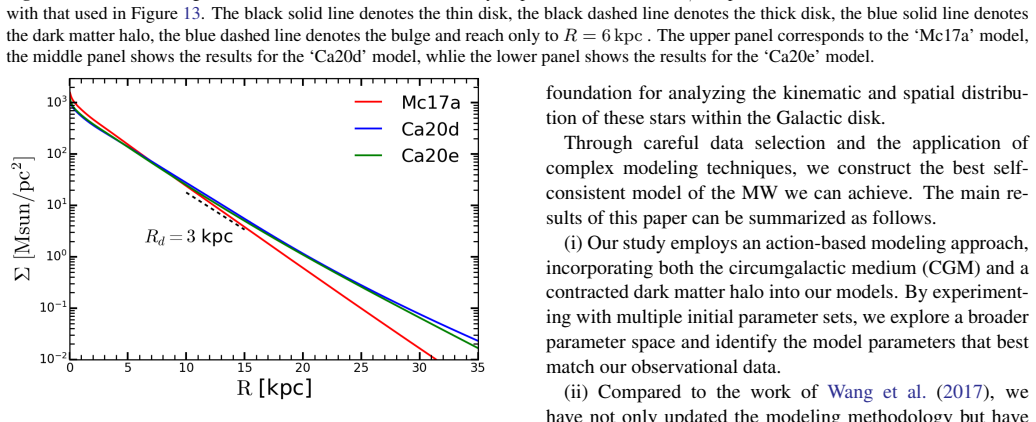
- [Abstract; Section 4.4; Section 4.5; Table 2; Table 3] The reported virial mass is not robustly constrained and is internally inconsistent. The abstract states 1.35e12 Msun, but Table 2 gives M200=1.31e12 for the fiducial 'Mc17a'; the value 1.35e12 corresponds to 'Mc17b'. More importantly, Section 4.4 selects 'Mc17a' solely because it has the smallest chi2_in, while Table 3 shows chi2_tot/dof = 9.97 for Ca20e (best overall), 10.36 for Mc17a, and 12.54 for Ca20d, with M200 values of 0.84, 1.31, and 0.39e12 Msun, respectively. The differences in reduced chi-square among these models are small (0.4-3) and are dwarfed by the overall poor fit (reduced chi-square ~10), so the data do not discriminate among halo models. The virial mass is an extrapolation from local kinematics that depends strongly on the assumed halo profile, baryonic contraction, and CGM treatment (Sections 3.4-3.5 and 4.5). Section 4.2 states that MCMC sampling was performed and that uncertainties are generally below 10%, but no MCMC results, posteriors, or convergence diagnostics are shown. The paper should either provide the MCMC confidence intervals or remove the virial mass from the abstract and present it explicitly as a model-dependent extrapolation.
- [Table 3; Section 4.4; Section 4.6] The global fit quality is poor, so the model cannot support global conclusions. The fiducial model has chi2_tot/dof = 10.36, chi2_out/dof = 27.10 for regions 21-24, and chi2_pole/dof = 21.91 for regions 25-26; even the best global model, Ca20e, has chi2_tot/dof = 9.97. Section 4.6 states that all models fail in the outer regions and that the predicted velocities are narrower than observed, and Section 4.4 notes that proper-motion fits are 2-5 times worse than line-of-sight fits. The statement that 'our model aligns well with observations near the Sun' is defensible only for the 16 local regions (chi2_in = 5.84), but even this value is substantially larger than 1 and indicates unmodeled variance in the local volume. The conclusions about a hotter, more extended thick disk and a cooler thin disk are based on fits that fail to describe a large fraction of the fitted volume; the paper should either restrict these conclusions to the local region or extend the model (e.g., with non-axisymmetric components, flaring, or a warp) and refit before presenting them as main results.
- [Section 3.2; Section 4.6; Section 5] The axisymmetric, steady-state assumption is load-bearing and is explicitly acknowledged to be violated. The model assumes a steady-state axisymmetric system with three conserved actions (Section 3.2), yet Section 4.6 invokes the bar, spiral arms, phase spirals, and the flared/warped outer disk to explain the poor fits. These structures are inside the fitted volume: regions 21-24 reach the Galactic anticenter at 3-12 kpc and cross the Perseus arm, and Section 4.4 notes that regions 02, 03, and 14 include the Local Arm. If non-axisymmetric perturbations bias the inferred distribution-function parameters, then the quoted local densities and masses are also biased. The paper should quantify the impact of this assumption, for example by repeating the fit with regions containing known spiral-arm or bar-affected stars removed, or by explicitly stating that the quoted parameters are conditional on strict axisymmetry and are not intended as unbiased estimates.
minor comments (5)
- [Section 3.1, Eq. (5)] Equation (5) defines pdata_n as the 'observed velocity dispersion', but the text describes fitting binned histograms of vLOS, mu_alpha, and mu_delta; please clarify the notation and define how the degrees of freedom are counted for each region and how the region-averaged reduced chi-square is justified as a global comparison statistic.
- [Section 2.1] The distance corrections D = DCarlin/0.86 in the disk direction and D = DCarlin/0.97 toward the pole are adopted from Ding et al. (2021) with a small change; please state explicitly whether these factors are fixed or fitted, and whether their uncertainties are propagated into the model parameter uncertainties.
- [Table 2] There is a typographical issue in Table 2: the row labeled 'Mv17i' appears to be a typo for 'Mc17i', and there are two rows with similar 'Mc17i' labels but different parameter values; please disambiguate the model names.
- [Table 3] The caption for Table 3 states that chi2_pole is 'estimated from sky regions 25-16', which should presumably read '25 and 26'; please correct this typo.
- [Section 4.2] The sentence 'we employed MCMC sampling to estimate the uncertainties in the fitted parameters' followed by 'specific MCMC results are not included in this paper' is not verifiable; either provide the chains, a corner plot, or a clear statement that these are preliminary and model-dependent, or remove the claim of small (<10%) uncertainties.
Circularity Check
No significant circularity: the mass and density estimates are outputs of a self-consistent fit to LAMOST/Gaia kinematic histograms, not re-scaled inputs; the virial mass is model-dependent but not circularly derived.
full rationale
The paper's derivation chain is a forward-modeling fit, not a tautology. The free parameters (Table 2, columns 2-9 and 11-17) are the density-profile and quasi-isothermal DF parameters, adjusted to match the observed binned velocity distributions (vLOS, mu_alpha, mu_delta) in 30 sky regions via Eq. (5). The reported virial mass, local stellar density, and local dark matter density (Table 4) are computed from the fitted potential and DF through Poisson's equation (Eq. 6) and Eq. (1); they are not supplied as constraints in the chi-squared. Therefore the headline quantities are statistically dependent on the fitted parameters, which is normal for model outputs, not circular. The selection of Mc17a by smallest chi2_in (Section 4.4) is an internal model comparison, and the paper explicitly acknowledges in Section 4.5 that M200 ranges from 0.39 to 1.31e12 Msun across similarly fitting models, so the virial mass is not forced by construction. External rotation-curve comparisons (Figure 17) use independent data (Eilers et al. 2019; Ablimit et al. 2020; Wang et al. 2023). The self-citations (Wang et al. 2017 as an initial/comparison model, Ding et al. 2021 as the data catalog, Sun et al. 2023 for cluster checks) are not load-bearing uniqueness or theorem citations. The paper also flags its own limitations: Section 4.6 admits all models fail in the outer disk, and Section 4.2 omits the MCMC uncertainty results; these are evidentiary gaps and model-dependence caveats, not circular steps. The abstract's 1.35e12 vs Table 2's 1.31e12 is a reporting inconsistency, not a circularity.
Assumptions & free parameters
free parameters (17)
- thin disk central surface density Sigma0,thin =
8.95e8 M_sun/kpc^2
- thin disk scale radius Rd,thin =
2.48 kpc
- thin disk scale height h_thin =
0.30 kpc
- thick disk central surface density Sigma0,thick =
1.87e8 M_sun/kpc^2
- thick disk scale radius Rd,thick =
3.05 kpc
- thick disk scale height h_thick =
0.92 kpc
- dark halo density normalization rho0,halo =
8.52e6 M_sun/kpc^3
- dark halo scale radius r0,halo =
19.25 kpc
- solar distance to Galactic center d_sun =
8.11 kpc
- thin disk radial velocity dispersion at center sigma_r0,thin =
63.99 km/s
- thin disk vertical velocity dispersion at center sigma_z0,thin =
30.22 km/s
- thin disk dispersion scale length R_sigma,thin =
12.52 kpc
- thick disk radial velocity dispersion at center sigma_r0,thick =
82.82 km/s
- thick disk vertical velocity dispersion at center sigma_z0,thick =
132.99 km/s
- thick disk dispersion scale length R_sigma,thick =
18.73 kpc
- photometric distance scale factor in disk direction =
0.86
- photometric distance scale factor toward the pole =
0.97
assumptions (11)
- standard math Poisson equation relates potential to density: Laplace operator on Phi equals 4 pi G rho
- standard math Strong Jeans theorem: equilibrium DF is a function of three isolating integrals, and actions J are such integrals
- domain assumption The Milky Way is axisymmetric and in a steady state
- domain assumption Quasi-isothermal DF describes the stellar disks
- domain assumption Density profiles: exponential disks with sech^2 vertical profile for gas, and power-law spheroids with exponential cutoff for bulge and halo
- domain assumption Dark matter halo contraction model of Cautun et al. (2020) with its quoted parameters
- domain assumption CGM density profile with ACGM = 0.190 and beta_CGM = -1.46
- ad hoc to paper R_sigma,r = R_sigma,z = R_sigma for both disks
- ad hoc to paper sigma_min = 1% of (sigma_r0 + sigma_z0)/2
- domain assumption Systematic LAMOST velocity offset of 5.7 km/s
- domain assumption Solar parameters R_sun = 8.178 kpc, z_sun = 20.8 pc, and solar motion vector from literature
Cite this review
Pith. "Pith review of Dynamical Models of the Milky Way in Action Space with LAMOST DR8 and GAIA EDR3." pith.science (2026). https://pith.science/paper/INS4APQ5
@misc{pith2026250208164,
  author       = {Pith},
  title        = {Pith review of: Dynamical Models of the Milky Way in Action Space with LAMOST DR8 and GAIA EDR3},
  year         = {2026},
  howpublished = {\url{https://pith.science/paper/INS4APQ5}},
  note         = {Machine review of arXiv:2502.08164}
}
abstract
This work explores dynamical models of the Milky Way (MW) by analyzing a sample of 86,109 K giant stars selected through cross-matching the LAMOST DR8 and Gaia EDR3 surveys. Our earlier torus models in Wang et al. (2017) did not include Gaia data, making them incompatible with the new proper motion distributions of samples. Here, we refine the construction of action-based, self-consistent models to constrain the three-dimensional velocity distribution of K giants over a larger parameter space, drawing on a series of existing MW models. This approach produces several new MW models. Our best-fit model for the local kinematics near the Sun indicates a MW virial mass of 1.35 $\times 10^{12} M_\odot$, a local stellar density of 0.0696 $\rm M_\odot pc^{-3}$, and a local dark matter density of 0.0115 $\rm M_\odot pc^{-3}$. Our main conclusion supports a thicker and more extended thick disk, alongside a cooler thin disk, compared to the best-fitting model in Wang et al. (2017). Near the Sun, our model aligns well with observations, but is less satisfactory at distances far from the Galactic center, perhaps implying unidentified structures. Further high-precision observations will be critical for understanding the dynamics in these outer Galactic regions, and will require a more realistic model.
Figures


Figures from the paper (12 more)



Reference graph
Works this paper leans on
-
[1]
Ablimit, I., Zhao, G., Flynn, C., & Bird, S. A. 2020, Astrophysical Journal Letters, 895, L12, doi: 10.3847/2041-8213/ab8d45
-
[2]
Anguiano, B., Majewski, S. R., Allende Prieto, C., et al. 2018, Astronomy and Astrophysics, 620, A76, doi: 10.1051/0004-6361/201833387
-
[3]
Anguiano, B., Majewski, S. R., Hayes, C. R., et al. 2020, The Astronomical Journal, 160, 43, doi: 10.3847/1538-3881/ab9813
-
[4]
Astraatmadja, T. L., & Bailer-Jones, C. A. L. 2016, The Astrophysical Journal, 832, 137, doi: 10.3847/0004-637X/832/2/137 Astropy Collaboration, Robitaille, T. P., Tollerud, E. J., et al. 2013, Astronomy and Astrophysics, 558, A33, doi: 10.1051/0004-6361/201322068 Astropy Collaboration, Price-Whelan, A. M., Sip˝ocz, B. M., et al. 2018, The Astronomical Jo...
-
[5]
2019, Monthly Notices of the Royal Astronomical Society, 482, 1417, doi: 10.1093/mnras/sty2813
Bennett, M., & Bovy, J. 2019, Monthly Notices of the Royal Astronomical Society, 482, 1417, doi: 10.1093/mnras/sty2813
-
[6]
Binney, J. 2010, Monthly Notices of the Royal Astronomical Society, 401, 2318, doi: 10.1111/j.1365-2966.2009.15845.x —. 2012, Monthly Notices of the Royal Astronomical Society, 426, 1328, doi: 10.1111/j.1365-2966.2012.21692.x
arXiv 2010
-
[7]
2018, in Astrometry and Astrophysics in the Gaia Sky, ed
Binney, J. 2018, in Astrometry and Astrophysics in the Gaia Sky, ed. A. Recio-Blanco, P. de Laverny, A. G. A. Brown, & T. Prusti, V ol. 330, 111–118, doi: 10.1017/S1743921317007049 —. 2020, Monthly Notices of the Royal Astronomical Society, 495, 895, doi: 10.1093/mnras/staa1103
-
[8]
1993, Monthly Notices of the Royal Astronomical Society, 261, 584, doi: 10.1093/mnras/261.3.584
Binney, J., & Kumar, S. 1993, Monthly Notices of the Royal Astronomical Society, 261, 584, doi: 10.1093/mnras/261.3.584
Show all 84 references
-
[9]
2011, Monthly Notices of the Royal Astronomical Society, 413, 1889, doi: 10.1111/j.1365-2966.2011.18268.x
Binney, J., & McMillan, P. 2011, Monthly Notices of the Royal Astronomical Society, 413, 1889, doi: 10.1111/j.1365-2966.2011.18268.x
2011
-
[10]
Binney, J., & McMillan, P. J. 2016, Monthly Notices of the Royal Astronomical Society, 456, 1982, doi: 10.1093/mnras/stv2734
2016 doi
-
[11]
Binney, J., & Sanders, J. L. 2014, in Setting the scene for Gaia and LAMOST, ed. S. Feltzing, G. Zhao, N. A. Walton, & P. Whitelock, V ol. 298, 117–129, doi: 10.1017/S1743921313006297
2014 doi
-
[12]
2008, Galactic Dynamics: Second Edition
Binney, J., & Tremaine, S. 2008, Galactic Dynamics: Second Edition
2008
-
[13]
2023, Monthly Notices of the Royal Astronomical Society, 520, 1832, doi: 10.1093/mnras/stad094 —
Binney, J., & Vasiliev, E. 2023, Monthly Notices of the Royal Astronomical Society, 520, 1832, doi: 10.1093/mnras/stad094 —. 2024, Monthly Notices of the Royal Astronomical Society, 527, 1915, doi: 10.1093/mnras/stad3312
2023 doi
-
[14]
Binney, J., & Wong, L. K. 2017, Monthly Notices of the Royal Astronomical Society, 467, 2446, doi: 10.1093/mnras/stx234
2017 doi
-
[15]
A., Xue, X.-X., Liu, C., et al
Bird, S. A., Xue, X.-X., Liu, C., et al. 2022a, Monthly Notices of the Royal Astronomical Society, 516, 731, doi: 10.1093/mnras/stac2036 —. 2022b, Monthly Notices of the Royal Astronomical Society, 516, 731, doi: 10.1093/mnras/stac2036 20
-
[16]
2015, The Astrophysical Journal Supplement Series, 216, 29, doi: 10.1088/0067-0049/216/2/29
Bovy, J. 2015, The Astrophysical Journal Supplement Series, 216, 29, doi: 10.1088/0067-0049/216/2/29
2015 doi
-
[17]
L., Liu, C., Newberg, H
Carlin, J. L., Liu, C., Newberg, H. J., et al. 2015, The Astronomical Journal, 150, 4, doi: 10.1088/0004-6256/150/1/4
2015 doi
-
[18]
J., et al
Cautun, M., Ben´ıtez-Llambay, A., Deason, A. J., et al. 2020, Monthly Notices of the Royal Astronomical Society, 494, 4291, doi: 10.1093/mnras/staa1017
2020 doi
-
[19]
2023, Monthly Notices of the Royal Astronomical Society, 525, 3075, doi: 10.1093/mnras/stad2296
Chen, A., Li, Z., Wang, Y ., et al. 2023, Monthly Notices of the Royal Astronomical Society, 525, 3075, doi: 10.1093/mnras/stad2296
2023 doi
-
[20]
2021, Monthly Notices of the Royal Astronomical Society, 505, 2412, doi: 10.1093/mnras/stab1094
Chiba, R., & Sch¨onrich, R. 2021, Monthly Notices of the Royal Astronomical Society, 505, 2412, doi: 10.1093/mnras/stab1094
2021 doi
-
[21]
Dwarakanath, K. S. 2023, Astrophysical Journal Letters, 946, L8, doi: 10.3847/2041-8213/acc10e
2023 doi
-
[22]
J., Liu, C., et al
Deng, L.-C., Newberg, H. J., Liu, C., et al. 2012, Research in Astronomy and Astrophysics, 12, 735, doi: 10.1088/1674-4527/12/7/003
2012 doi
-
[23]
2021, The Astronomical Journal, 162, 112, doi: 10.3847/1538-3881/ac0892
Ding, P.-J., Xue, X.-X., Yang, C., et al. 2021, The Astronomical Journal, 162, 112, doi: 10.3847/1538-3881/ac0892
2021 doi
-
[24]
A., Macci`o, A
Dutton, A. A., Macci`o, A. V ., Dekel, A., et al. 2016, Monthly Notices of the Royal Astronomical Society, 461, 2658, doi: 10.1093/mnras/stw1537
2016 doi
-
[25]
W., Rix, H.-W., & Ness, M
Eilers, A.-C., Hogg, D. W., Rix, H.-W., & Ness, M. K. 2019, The Astrophysical Journal, 871, 120, doi: 10.3847/1538-4357/aaf648
2019 doi
-
[26]
K., Di Cintio, A., Battaglia, G., Brook, C., & Taibi, S
Fritz, T. K., Di Cintio, A., Battaglia, G., Brook, C., & Taibi, S. 2020, Monthly Notices of the Royal Astronomical Society, 494, 5178, doi: 10.1093/mnras/staa1040
2020 doi
-
[27]
2022, Astronomy and Astrophysics, 668, A4, doi: 10.1051/0004-6361/202243590 Gaia Collaboration, Prusti, T., de Bruijne, J
Fu, X., Bragaglia, A., Liu, C., et al. 2022, Astronomy and Astrophysics, 668, A4, doi: 10.1051/0004-6361/202243590 Gaia Collaboration, Prusti, T., de Bruijne, J. H. J., et al. 2016, Astronomy and Astrophysics, 595, A1, doi: 10.1051/0004-6361/201629272 Gaia Collaboration, Brown...
2022 doi
-
[28]
2024, The Astrophysical Journal, 960, 133, doi: 10.3847/1538-4357/ad037b
Guo, R., Li, Z.-Y ., Shen, J., Mao, S., & Liu, C. 2024, The Astrophysical Journal, 960, 133, doi: 10.3847/1538-4357/ad037b
2024 doi
-
[29]
2020, Monthly Notices of the Royal Astronomical Society, 495, 4828, doi: 10.1093/mnras/staa1483
Guo, R., Liu, C., Mao, S., et al. 2020, Monthly Notices of the Royal Astronomical Society, 495, 4828, doi: 10.1093/mnras/staa1483
2020 doi
-
[30]
2022, The Astrophysical Journal, 936, 103, doi: 10.3847/1538-4357/ac86cd
Guo, R., Shen, J., Li, Z.-Y ., Liu, C., & Mao, S. 2022, The Astrophysical Journal, 936, 103, doi: 10.3847/1538-4357/ac86cd
2022 doi
-
[31]
J., Xu, Y ., Hou, L
Hao, C. J., Xu, Y ., Hou, L. G., et al. 2021, Astronomy and Astrophysics, 652, A102, doi: 10.1051/0004-6361/202140608
2021 doi
-
[32]
2021, Monthly Notices of the Royal Astronomical Society, 508, 5468, doi: 10.1093/mnras/stab2898
Hattori, K., Valluri, M., & Vasiliev, E. 2021, Monthly Notices of the Royal Astronomical Society, 508, 5468, doi: 10.1093/mnras/stab2898
2021 doi
-
[33]
A., Frenk, C
Hellwing, W. A., Frenk, C. S., Cautun, M., et al. 2016, Monthly Notices of the Royal Astronomical Society, 457, 3492, doi: 10.1093/mnras/stw214
2016 doi
-
[34]
Hunt, J. A. S., & Kawata, D. 2013, Monthly Notices of the Royal Astronomical Society, 430, 1928, doi: 10.1093/mnras/stt021
2013 doi
-
[35]
Jeans, J. H. 1915, Monthly Notices of the Royal Astronomical Society, 76, 70, doi: 10.1093/mnras/76.2.70
1915 doi
-
[36]
1994, Monthly Notices of the Royal Astronomical Society, 268, 1033, doi: 10.1093/mnras/268.4.1033
Kaasalainen, M., & Binney, J. 1994, Monthly Notices of the Royal Astronomical Society, 268, 1033, doi: 10.1093/mnras/268.4.1033
1994 doi
-
[37]
R., Sharma, S., Lewis, G
Kafle, P. R., Sharma, S., Lewis, G. F., & Bland-Hawthorn, J. 2014, The Astrophysical Journal, 794, 59, doi: 10.1088/0004-637X/794/1/59
2014 doi
-
[38]
2016, Monthly Notices of the Royal Astronomical Society, 457, 4340, doi: 10.1093/mnras/stw248
Klypin, A., Yepes, G., Gottl¨ober, S., Prada, F., & Heß, S. 2016, Monthly Notices of the Royal Astronomical Society, 457, 4340, doi: 10.1093/mnras/stw248
2016 doi
-
[39]
H., Putney, E., Buckley, M
Lim, S. H., Putney, E., Buckley, M. R., & Shih, D. 2025, Journal of Cosmology and Astroparticle Physics, 2025, 021, doi: 10.1088/1475-7516/2025/01/021
2025 doi
-
[40]
2019, Monthly Notices of the Royal Astronomical Society, 487, 5679, doi: 10.1093/mnras/stz1698
Lin, H.-N., & Li, X. 2019, Monthly Notices of the Royal Astronomical Society, 487, 5679, doi: 10.1093/mnras/stz1698
2019 doi
-
[41]
2021, Astronomy and Astrophysics, 649, A4, doi: 10.1051/0004-6361/202039653
Lindegren, L., Bastian, U., Biermann, M., et al. 2021, Astronomy and Astrophysics, 649, A4, doi: 10.1051/0004-6361/202039653
2021 doi
-
[42]
L., et al
Liu, C., Deng, L.-C., Carlin, J. L., et al. 2014, The Astrophysical Journal, 790, 110, doi: 10.1088/0004-637X/790/2/110
2014 doi
-
[43]
J., Mao, S., Shen, J., & Wang, Y
Long, R. J., Mao, S., Shen, J., & Wang, Y . 2013, Monthly Notices of the Royal Astronomical Society, 428, 3478, doi: 10.1093/mnras/sts285
2013 doi
-
[44]
R., Pillepich, A., Genel, S., et al
Lovell, M. R., Pillepich, A., Genel, S., et al. 2018, Monthly Notices of the Royal Astronomical Society, 481, 1950, doi: 10.1093/mnras/sty2339
2018 doi
-
[45]
Luri, X., Brown, A. G. A., Sarro, L. M., et al. 2018, Astronomy and Astrophysics, 616, A9, doi: 10.1051/0004-6361/201832964
2018 doi
-
[46]
T., Bovy, J., Leung, H
Mackereth, J. T., Bovy, J., Leung, H. W., et al. 2019, Monthly Notices of the Royal Astronomical Society, 489, 176, doi: 10.1093/mnras/stz1521
2019 doi
-
[47]
1990, Monthly Notices of the Royal Astronomical Society, 244, 634
McGill, C., & Binney, J. 1990, Monthly Notices of the Royal Astronomical Society, 244, 634
1990
-
[48]
McMillan, P. J. 2017, Monthly Notices of the Royal Astronomical Society, 465, 76, doi: 10.1093/mnras/stw2759
2017 doi
-
[49]
J., & Binney, J
McMillan, P. J., & Binney, J. J. 2008, Monthly Notices of the Royal Astronomical Society, 390, 429, doi: 10.1111/j.1365-2966.2008.13767.x 21
2008
-
[50]
J., Petersson, J., Tepper-Garcia, T., et al
McMillan, P. J., Petersson, J., Tepper-Garcia, T., et al. 2022, Monthly Notices of the Royal Astronomical Society, 516, 4988, doi: 10.1093/mnras/stac2571
2022 doi
-
[51]
2018, Astronomy and Astrophysics, 616, L9, doi: 10.1051/0004-6361/201833748
Monari, G., Famaey, B., Carrillo, I., et al. 2018, Astronomy and Astrophysics, 616, L9, doi: 10.1051/0004-6361/201833748
2018 doi
-
[52]
G., Schuster, W
Moreno, E., Fern´andez-Trincado, J. G., Schuster, W. J., P´erez-Villegas, A., & Chaves-Velasquez, L. 2021, Monthly Notices of the Royal Astronomical Society, 506, 4687, doi: 10.1093/mnras/stab1908
2021 doi
-
[53]
F., Frenk, C
Navarro, J. F., Frenk, C. S., & White, S. D. M. 1997, The Astrophysical Journal, 490, 493, doi: 10.1086/304888
1997 doi
-
[54]
2022, The Astrophysical Journal, 931, 156, doi: 10.3847/1538-4357/ac674e
Pang, X., Tang, S.-Y ., Li, Y ., et al. 2022, The Astrophysical Journal, 931, 156, doi: 10.3847/1538-4357/ac674e
2022 doi
-
[55]
J., et al
Piffl, T., Binney, J., McMillan, P. J., et al. 2014, Monthly Notices of the Royal Astronomical Society, 445, 3133, doi: 10.1093/mnras/stu1948 Planck Collaboration, Ade, P. A. R., Aghanim, N., et al. 2014, Astronomy and Astrophysics, 571, A1, doi: 10.1051/0004-6361/201321529 Pl...
2014 doi
-
[56]
2021, Astronomy and Astrophysics, 651, A104, doi: 10.1051/0004-6361/202140687
Poggio, E., Drimmel, R., Cantat-Gaudin, T., et al. 2021, Astronomy and Astrophysics, 651, A104, doi: 10.1051/0004-6361/202140687
2021 doi
-
[57]
2017, Monthly Notices of the Royal Astronomical Society, 470, 1233, doi: 10.1093/mnras/stx1293
Portail, M., Wegg, C., Gerhard, O., & Ness, M. 2017, Monthly Notices of the Royal Astronomical Society, 470, 1233, doi: 10.1093/mnras/stx1293
2017 doi
-
[58]
2019, Astronomy and Astrophysics, 621, A56, doi: 10.1051/0004-6361/201833355
Posti, L., & Helmi, A. 2019, Astronomy and Astrophysics, 621, A56, doi: 10.1051/0004-6361/201833355
2019 doi
-
[59]
Price-Whelan, A. M. 2017, The Journal of Open Source Software, 2, 388, doi: 10.21105/joss.00388
2017 doi
-
[60]
C., Bienaym´e, O., Salomon, J
Robin, A. C., Bienaym´e, O., Salomon, J. B., et al. 2022, Astronomy and Astrophysics, 667, A98, doi: 10.1051/0004-6361/202243686
2022 doi
-
[61]
L., & Binney, J
Sanders, J. L., & Binney, J. 2016, Monthly Notices of the Royal Astronomical Society, 457, 2107, doi: 10.1093/mnras/stw106
2016 doi
-
[62]
L., & Das, P
Sanders, J. L., & Das, P. 2018, Monthly Notices of the Royal Astronomical Society, 481, 4093, doi: 10.1093/mnras/sty2490
2018 doi
-
[64]
1979, The Astrophysical Journal, 232, 236, doi: 10.1086/157282 —
Schwarzschild, M. 1979, The Astrophysical Journal, 232, 236, doi: 10.1086/157282 —. 1993, The Astrophysical Journal, 409, 563, doi: 10.1086/172687
1979 doi
-
[65]
2023, Research in Astronomy and Astrophysics, 23, 015013, doi: 10.1088/1674-4527/ac9e91
Sun, G., Wang, Y ., Liu, C., et al. 2023, Research in Astronomy and Astrophysics, 23, 015013, doi: 10.1088/1674-4527/ac9e91
2023 doi
-
[66]
2024, The Astrophysical Journal, 961, 141, doi: 10.3847/1538-4357/ad06ad
Sun, W., Huang, Y ., Shen, H., et al. 2024, The Astrophysical Journal, 961, 141, doi: 10.3847/1538-4357/ad06ad
2024 doi
-
[67]
1996, Monthly Notices of the Royal Astronomical Society, 282, 223, doi: 10.1093/mnras/282.1.223
Syer, D., & Tremaine, S. 1996, Monthly Notices of the Royal Astronomical Society, 282, 223, doi: 10.1093/mnras/282.1.223
1996 doi
-
[68]
2021, Astronomy and Astrophysics, 647, A19, doi: 10.1051/0004-6361/202039388
Tarricq, Y ., Soubiran, C., Casamiquela, L., et al. 2021, Astronomy and Astrophysics, 647, A19, doi: 10.1051/0004-6361/202039388
2021 doi
-
[69]
L., et al
Tian, H.-J., Liu, C., Carlin, J. L., et al. 2015, The Astrophysical Journal, 809, 145, doi: 10.1088/0004-637X/809/2/145
2015 doi
-
[70]
1999, in Astronomical Society of the Pacific Conference Series, V ol
Valluri, M., & Merritt, D. 1999, in Astronomical Society of the Pacific Conference Series, V ol. 182, Galaxy Dynamics - A Rutgers Symposium, ed. D. R. Merritt, M. Valluri, & J. A. Sellwood, 178, doi: 10.48550/arXiv.astro-ph/9906176
-
[71]
2018, arXiv e-prints, arXiv:1802.08255, doi: 10.48550/arXiv.1802.08255 —
Vasiliev, E. 2018, arXiv e-prints, arXiv:1802.08255, doi: 10.48550/arXiv.1802.08255 —. 2019a, Monthly Notices of the Royal Astronomical Society, 482, 1525, doi: 10.1093/mnras/sty2672 —. 2019b, Monthly Notices of the Royal Astronomical Society, 484, 2832, doi: 10.1093/mnras/stz171
-
[72]
2022, The Astrophysical Journal, 932, 28, doi: 10.3847/1538-4357/ac6b9b
Vieira, K., Carraro, G., Korchagin, V ., et al. 2022, The Astrophysical Journal, 932, 28, doi: 10.3847/1538-4357/ac6b9b
2022 doi
-
[73]
2023, The Astrophysical Journal, 942, 12, doi: 10.3847/1538-4357/aca27c
Labini, F. 2023, The Astrophysical Journal, 942, 12, doi: 10.3847/1538-4357/aca27c
2023 doi
-
[74]
Wang, Q., Wang, Y ., Liu, C., Mao, S., & Long, R. J. 2017, Monthly Notices of the Royal Astronomical Society, 470, 2949, doi: 10.1093/mnras/stx1382
2017 doi
-
[75]
Wang, W., Han, J., Cautun, M., Li, Z., & Ishigaki, M. N. 2020, Science China Physics, Mechanics, and Astronomy, 63, 109801, doi: 10.1007/s11433-019-1541-6
2020 doi
-
[76]
J., & Shen, J
Wang, Y ., Mao, S., Long, R. J., & Shen, J. 2013, Monthly Notices of the Royal Astronomical Society, 435, 3437, doi: 10.1093/mnras/stt1537
2013 doi
-
[77]
Wang, Y ., Zhao, H., Mao, S., & Rich, R. M. 2012, Monthly Notices of the Royal Astronomical Society, 427, 1429, doi: 10.1111/j.1365-2966.2012.22063.x
2012
-
[78]
L., Evans, N
Watkins, L. L., Evans, N. W., & An, J. H. 2010, Monthly Notices of the Royal Astronomical Society, 406, 264, doi: 10.1111/j.1365-2966.2010.16708.x
2010
-
[79]
J., Hunt, J
Webb, J. J., Hunt, J. A. S., & Bovy, J. 2023, Monthly Notices of the Royal Astronomical Society, 521, 3898, doi: 10.1093/mnras/stad762
2023 doi
-
[80]
2000, A&AS, 143, 9, doi: 10.1051/aas:2000332
Wenger, M., Ochsenbein, F., Egret, D., et al. 2000, A&AS, 143, 9, doi: 10.1051/aas:2000332
2000 doi
-
[81]
2018, The Astrophysical Journal Supplement Series, 237, 33, doi: 10.3847/1538-4365/aad237
Xiang, M., Shi, J., Liu, X., et al. 2018, The Astrophysical Journal Supplement Series, 237, 33, doi: 10.3847/1538-4365/aad237
2018 doi
-
[82]
2020, The Astrophysical Journal, 905, 6, doi: 10.3847/1538-4357/abc2cb 22
Xu, Y ., Liu, C., Tian, H., et al. 2020, The Astrophysical Journal, 905, 6, doi: 10.3847/1538-4357/abc2cb 22
2020 doi
-
[83]
X., Rix, H
Xue, X. X., Rix, H. W., Zhao, G., et al. 2008, The Astrophysical Journal, 684, 1143, doi: 10.1086/589500
2008 doi
-
[84]
1996, Monthly Notices of the Royal Astronomical Society, 283, 149, doi: 10.1093/mnras/283.1.149
Zhao, H. 1996, Monthly Notices of the Royal Astronomical Society, 283, 149, doi: 10.1093/mnras/283.1.149
1996 doi
-
[85]
J., Mao, S., et al
Zhu, L., Long, R. J., Mao, S., et al. 2014, The Astrophysical Journal, 792, 59, doi: 10.1088/0004-637X/792/1/59 23 APPENDIX A. VELOCITY DISTRIBUTION In this appendix, we show the rest velocity distributions for the regions we consider. 24 Figure A.1. The distribution function ...
2014 doi
Reviewed August 8, 2026 · model on record in the stance chip above.
Discussion (0). Continue with ORCID to comment.