REVIEW 3 major objections 6 minor 2 cited by
Extending near-axis equilibria in DESC
T0 review · 3 major / 6 minor · reviewed 2026-08-07 · deepseek-v4-flash
Pith's one-line read Global stellarator equilibria can keep their near-axis design
desk verdict Solid new bridge between near-axis expansions and global DESC equilibria; abstract's 'guarantee' overstates what the method actually enforces. read the letter →
The pith
A machine-rendered reading of the paper's core claim, the machinery that carries it, and where it could break.
The reading
What carries the argument
The load-bearing object is the linear map between the NAE's Taylor-Fourier coefficients and DESC's Fourier-Zernike coefficients, Eq. (2.13). It converts the requirement 'this flux surface has shape f at order l' into a weighted sum of Zernike modes, with weights that grow like $k^l$ for high radial order $k$; convergence is controlled by a finite truncation. On top of that map, the paper derives a geometric transform (Eqs. (3.6)-(3.7) and (3.12)) that rewrites the axis-frame elliptical and triangular surface shapes in cylindrical coordinates, accounting for the inclination of the axis. These two pieces combine into the concrete linear constraints (3.8) and (3.13) that the solver enforces while minimizing the magnetohydrostatic force residual.
What would settle it
Compute a second-order constrained equilibrium for a configuration with a strongly shaped, high-torsion axis (for example a quasi-isodynamic case), then Fourier-analyze the $R$ and $Z$ cross-sections at small fixed $\rho$ and compare the second-order coefficients to the NAE-predicted lab-frame values; a systematic deviation as torsion grows would indicate that the leading-order angle identification is the cause.
Extended reading notes
Core claim
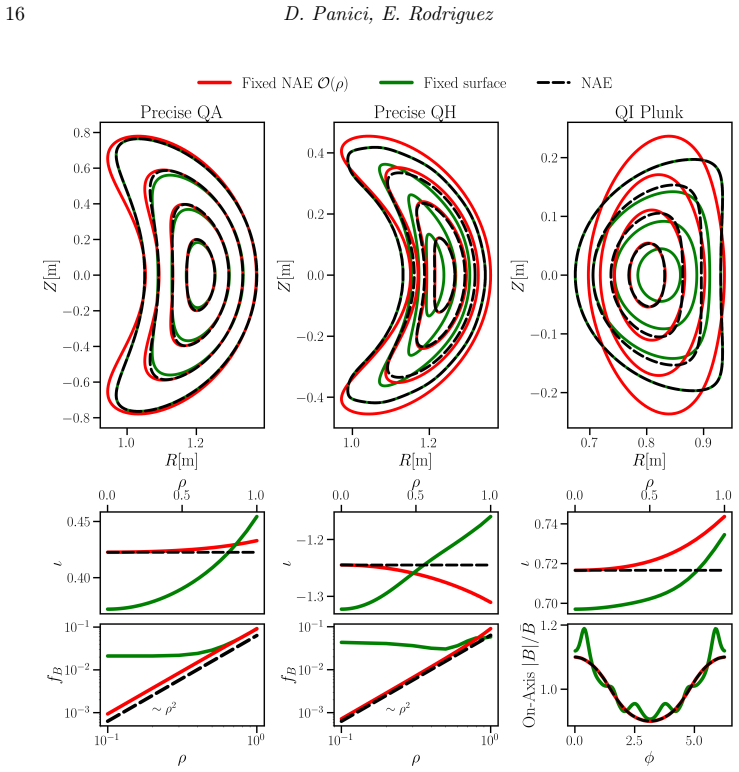
The central claim is that a global ideal-MHD equilibrium in DESC can be forced to have exactly the near-axis behavior of a chosen NAE solution by imposing a handful of linear constraints on the solver's spectral coefficients. The near-axis Taylor-Fourier description of flux surfaces and the Zernike representation used by DESC are connected by an exact linear relation (2.13), and the near-axis surfaces, which are naturally written in the Frenet-Serret frame of the axis and in Boozer coordinates, are mapped to the cylindrical lab frame through the geometric relations (3.6)-(3.7) at first order and (3.12a)-(3.12b) at second order. The resulting constraints fix the axis shape, the elliptical cross-sections, and the second-order shaping (including the Shafranov shift and triangularity as seen in the lab frame) as linear combinations of Fourier-Zernike modes. With these constraints imposed through a feasible-direction method, DESC returns equilibria whose on-axis rotational transform, on-axis |B|, stream function, and magnetic well agree with the NAE to orders of magnitude better than equilibria built from a finite-radius near-axis boundary, and the quasisymmetry error scales as $O(\rho^2)$ (first-order constraints) or $O(\rho^3)$ (second-order constraints).
Load-bearing premise
The derivation assumes the poloidal angle used by DESC can be identified with the near-axis Boozer angle through the simple stream-function relation $\lambda = -\iota\nu$, which is only guaranteed to leading order; if that angle identification fails at higher order, the geometric constraints will not enforce the intended near-axis behavior.
Editorial extensions
If this is right
- Near-axis-optimized properties—rotational transform, on-axis field strength, quasisymmetry error, and magnetic well—survive in a global equilibrium at low aspect ratio, where finite-radius fixed-boundary construction degrades them.
- The NAE-constrained equilibrium provides a much better initial condition for conventional stellarator optimization than a fixed-boundary solve from a large-radius near-axis surface.
- Because the constraints are linear, they can be added to the same constrained-optimization machinery already used for fixed-boundary solves, with modest extra cost.
- Second-order constraints transfer magnetohydrodynamic-stability-linked features such as the magnetic well from the near-axis design into the global solution.
- The method generalizes beyond vacuum fields, since the constraint derivation itself does not require a vacuum or quasisymmetry assumption.
Reading between the lines
- The same linear-constraint approach could be adapted to other spectral equilibrium codes or boundary-based solvers, as long as a radial-poloidal basis with the right near-axis regularity is available.
- The angle-agnostic formulation sketched in Appendix B suggests a testable improvement: letting DESC use a generalized poloidal angle should reduce the toroidal-mode burden for quasi-isodynamic configurations with straight axis sections.
- One could use the freedom left by the near-axis constraints to scan off-axis properties systematically, generating families of global equilibria that share the same core design but differ in boundary shaping, coils, or stability.
- Soft or partial enforcement of the constraints, rather than exact imposition, may be useful during optimization to trade near-axis fidelity against other objectives.
Editorial analysis
A structured set of objections, weighed in public.
Referee Report
Summary. The paper presents a method for constructing global ideal-MHD equilibria in the DESC code that match a prescribed near-axis expansion (NAE) to zeroth, first, or second order in the distance from the magnetic axis. The authors derive linear constraints on DESC's Fourier-Zernike coefficients by (i) relating the NAE Taylor-Fourier basis to the Zernike basis, and (ii) transforming the NAE Frenet-Serret description into the cylindrical-coordinate description used by DESC. They implement the constraints using pyQSC and pyQIC inputs, solve constrained equilibria, and then relax the constraints and re-solve as fixed-boundary equilibria as a final check. Benchmarks for quasi-axisymmetric, quasi-helically symmetric, and quasi-isodynamic configurations show that on-axis quantities such as B0, iota0, and V'' match the NAE values much better than conventional surface-built equilibria, and that the quasisymmetry error scales as expected with the order of the imposed expansion.
Significance. If the results hold, this is a useful methodological advance: it gives a systematic, transparent route from near-axis optimized designs to global equilibria, avoiding the common practice of using the NAE at a finite radius where it is least valid. The theoretical derivations in Sections 3.2-3.3 and Appendices D-E are carefully presented, and the paper ships data and plotting scripts on Princeton Data Commons, which is commendable. The numerical benchmarks show the expected O(rho^2) and O(rho^3) scaling of the quasisymmetry error and large improvements in on-axis rotational transform and magnetic well compared with the fixed-boundary approach. The main caveats are that the abstract's 'guarantees' is stronger than what the implemented workflow actually enforces, and the identification of DESC's poloidal angle with the Boozer angle is not directly verified.
major comments (3)
- [Section 4, paragraph before §4.1; Tables 1-2] The abstract's claim that the construction 'guarantees the correct asymptotic behaviour' is not supported by the implemented workflow, because the near-axis constraints are relaxed after the constrained solve and the equilibrium is re-solved as a fixed-boundary problem. The verification numbers in Tables 1 and 2 therefore describe a solution that is no longer subject to the constraints; for example, Table 1 reports Delta_lambda0 = 5.35e-02 for the QI case and Delta_lambda0 = 2.54e-02 for the QH case. Please either present the constrained solution itself as the deliverable, quantify the drift introduced by the relaxation step, or replace 'guarantees' with language that accurately describes the constrained solve and the subsequent verification step.
- [§2.2, Eq. (2.9); §3.2.1, Eq. (3.10)] The identification of DESC's computational poloidal angle theta with the Boozer angle theta_B through lambda = -iota*nu is an assumption, not an enforced condition. DESC solves for lambda as part of the equilibrium, and at first order only R and Z are constrained; if the computed lambda deviates from -iota*nu at O(rho), then the imposed R/Z constraints no longer correspond to the intended NAE behavior in Boozer coordinates. The nonzero values of Delta_lambda0 in Table 1 show that this deviation is not negligible, especially for QH and QI. Please add a diagnostic that compares the first-order stream function lambda_1 with Eq. (3.10), or impose a constraint on lambda_1 as well, before claiming that the asymptotic behavior is guaranteed.
- [§4.1 and §5] The verification compares quantities such as B0, iota0, V'', and the fB scaling against the same NAE data that were used to construct the constraints. This is a legitimate consistency check of the implementation, but it cannot independently validate that the global equilibrium has the intended near-axis behavior in Boozer coordinates. A more independent test, such as a direct Boozer-coordinate Fourier analysis of the DESC solution or a comparison against a separately generated NAE solution, would substantially strengthen the paper's central claim.
minor comments (6)
- [Section 1] The phrase 'Their benefits stride from the freedom' should be 'Their benefits stem from the freedom'.
- [Figure 4 caption] The word 'meaingful' should be 'meaningful'.
- [Section 5.2] The word 'equilibirum' should be 'equilibrium'.
- [Eq. (2.13) and Appendix C.3] Equation (2.13) is numbered identically in the main text and in Appendix C.3; renumber one of them or reference the equation only once.
- [Eq. (3.16b)] The symbols tau_tilde, kappa'_Z, and kappa_R are used in the equation but defined only in the surrounding prose; a brief definition immediately before the equation would improve readability.
- [References] Several references contain LaTeX artifacts such as 'tex.ids=' and stray 'publisher:' fields (e.g., Boozer 1983, Anderson et al. 1995, Landreman 2022b); these should be cleaned up before publication.
Circularity Check
No significant circularity: the near-axis inputs are external, and the verification diagnostics come from an independent force-balance solve.
full rationale
The derivation chain is self-contained and not circular. The near-axis expansion (NAE) data from pyQSC and pyQIC enter as external inputs into the linear constraints (3.2), (3.8), and (3.13), which map prescribed Taylor-Fourier near-axis coefficients onto DESC Fourier-Zernike degrees of freedom. These constraints fix the magnetic axis, first-order elliptical shaping, and second-order triangular shaping, but they do not prescribe the equilibrium diagnostics used for verification. The global equilibrium is obtained by minimizing the force residual (4.1) under these linear equality constraints, so quantities such as B0, iota0, lambda0, V'', and the fB scaling are outputs of an independent force-balance solve, not fitted parameters relabeled as predictions. Section 4.1 explicitly states that the comparison is made on derived quantities rather than the directly constrained flux-surface shapes: 'To make the comparison as impartial as possible, we do not compare field quantities that correspond to the shape of flux surfaces which we are directly enforcing by the constraint, but rather, derived ones.' The reported nonzero deviations, e.g., Delta-lambda0 = 5.35e-02 for the QI case in Table 1, confirm that the comparisons are not forced by construction. The paper's main limitation, namely that the identification theta = theta_B through lambda = -iota nu (Eq. 2.9) is assumed for the constraints rather than explicitly imposed on lambda, is an acknowledged correctness and scope caveat (Appendix B, Section 6), not a circular step. Self-citations (Panici et al. 2023; Dudt et al. 2023; Rodriguez et al. 2025) provide background and solver context but are not the load-bearing evidence for the central construction, which rests on the external NAE framework and the DESC force-balance solve. Therefore no claimed result reduces to its own input by construction.
Assumptions & free parameters
free parameters (1)
- Fourier-Zernike spectral truncation (L, M, N) =
L=9-15, M=9-10, N=24-25 depending on configuration
assumptions (6)
- domain assumption The magnetic axis is regular enough for the Frenet-Serret frame to be used (no, or only a few isolated, flattening points).
- domain assumption The truncated NAE (to first or second order) is a quantitatively valid approximation of the desired global equilibrium near the axis.
- ad hoc to paper DESC's poloidal coordinate theta can be identified with the Boozer angle at leading order through lambda = -iota*nu, Eq. (2.9).
- ad hoc to paper The Zernike expansion can be truncated without the omitted high-order modes spoiling the low-order NAE coefficients in Eq. (2.13).
- ad hoc to paper Relaxing the NAE constraints and re-solving as a fixed-boundary equilibrium preserves the near-axis behavior.
- standard math The Fourier-Zernike representation and the inverse-coordinate Clebsch form (2.1)-(2.5) faithfully represent smooth equilibria.
Cite this review
Pith. "Pith review of Extending near-axis equilibria in DESC." pith.science (2026). https://pith.science/paper/IOIDJRSA
@misc{pith2026250605170,
  author       = {Pith},
  title        = {Pith review of: Extending near-axis equilibria in DESC},
  year         = {2026},
  howpublished = {\url{https://pith.science/paper/IOIDJRSA}},
  note         = {Machine review of arXiv:2506.05170}
}
read the original abstract
The near-axis description of optimised stellarator fields has proven to be a powerful tool both for design and understanding of this magnetic confinement concept. The description consists of an asymptotic model of the equilibrium in the distance from its centermost axis, and is thus only approximate. Any practical application therefore requires the eventual construction of a global equilibrium. This paper presents a novel way of constructing global equilibria using the \texttt{DESC} code that guarantees the correct asymptotic behaviour imposed by a given near-axis construction. The theoretical underpinnings of this construction are carefully presented, and benchmarking examples provided. This opens the door to an efficient coupling of the near-axis framework and that of global equilibria for future optimisation efforts.
Figures


Figures from the paper (4 more)


Forward citations
Cited by 2 Pith papers
-
Near-axis quasi-isodynamic database
A public database of over 800,000 near-axis quasi-isodynamic stellarator configurations with computed stability, transport, and coil-complexity proxies, plus statistical heuristics for design.
-
Numerical asymptotics of near-axis expansions of quasisymmetric magnetohydrostatic equilibria with anisotropic pressure
The pyAQSC code builds near-axis expansions of anisotropic-pressure quasisymmetric equilibria to arbitrary order and demonstrates a 6th-order quasi-axisymmetric equilibrium.
Reference graph
Works this paper leans on
-
[1]
, " * write output.state after.block = add.period write newline
ENTRY address author booktitle chapter edition editor howpublished institution journal key month note number organization pages publisher school series title type volume year eprint label extra.label sort.label short.list INTEGERS output.state before.all mid.sentence after.sentence after.block FUNCTION init.state.consts #0 'before.all := #1 'mid.sentence ...
-
[2]
write newline
" write newline "" before.all 'output.state := FUNCTION n.dashify 't := "" t empty not t #1 #1 substring "-" = t #1 #2 substring "--" = not "--" * t #2 global.max substring 't := t #1 #1 substring "-" = "-" * t #2 global.max substring 't := while if t #1 #1 substring * t #2 global.max substring 't := if while FUNCTION word.in bbl.in capitalize " " * FUNCT...
-
[3]
Anderson, F. Simon B. , Almagri, Abdulgader F. , Anderson, David T. , Matthews, Peter G. , Talmadge, Joseph N. & Shohet, J. Leon 1995 The Helically Symmetric Experiment , ( HSX ) Goals , Design and Status . Fusion Technology 27 (3T), 273--277 , publisher: Taylor & Francis \_eprint: https://doi.org/10.13182/FST95-A11947086
- [4]
-
[5]
Berlin, Heidelberg: Springer Berlin Heidelberg
Bauer, Frances , Betancourt, Octavio & Garabedian, Paul 1978 A Computational Method in Plasma Physics \/ . Berlin, Heidelberg: Springer Berlin Heidelberg
work page 1978
-
[6]
Bernardin, M. P. , Moses, R. W. & Tataronis, J. A. 1986 Isodynamical (omnigenous) equilibrium in symmetrically confined plasma configurations . The Physics of Fluids 29 (8), 2605--2611
work page 1986
-
[7]
1981 Plasma equilibrium with rational magnetic surfaces
Boozer, Allen H. 1981 Plasma equilibrium with rational magnetic surfaces . The Physics of Fluids 24 (11), 1999--2003 , publisher: American Institute of Physics
work page 1981
-
[8]
5 , tex.ids= boozer\_transport\_1983-1
Boozer, Allen H 1983 Transport and isomorphic equilibria p. 5 , tex.ids= boozer\_transport\_1983-1
work page 1983
Show all 61 references
-
[9]
Nuclear Fusion 61 (9), 096024
Boozer, Allen H 2021 Stellarators as a fast path to fusion . Nuclear Fusion 61 (9), 096024
2021
-
[10]
& Plunk, G
Camacho Mata, K. & Plunk, G. G. 2023 Helicity of the magnetic axes of quasi-isodynamic stellarators . Journal of Plasma Physics 89 (6), 905890609
2023
-
[11]
arXiv preprint arXiv:1311.5857
Carroll, Daniel , K \"o se, Emek & Sterling, Ivan 2013 Improving frenet's frame using bishop's frame . arXiv preprint arXiv:1311.5857
2013 arXiv
-
[12]
Cary, J. R. & Shasharina, S. G. 1997 Omnigenity and quasihelicity in helical plasma confinement systems . Physics of Plasmas 4 (9), 3323--3333 , arXiv:arXiv: https://pubs.aip.org/aip/pop/article-pdf/4/9/3323/12664528/3323\_1\_online.pdf
1997
-
[13]
, Panici, Dario & Kolemen, Egemen 2024 Stellarator Optimization with Constraints
Conlin, Rory , Kim, Patrick , Dudt, Daniel W. , Panici, Dario & Kolemen, Egemen 2024 Stellarator Optimization with Constraints . ArXiv:2403.11033 [physics]
2024 arXiv
-
[14]
Dewar, R. L. & Hudson, S. R. 1998 Stellarator symmetry . Physica D: Nonlinear Phenomena 112 (1), 275--280 , tex.ids= dewar\_stellarator\_1998-1
1998
-
[15]
D'haeseleer, W. D. , Hitchon, W. N. G. , Callen, J. D. & Shohet, J. L. 2012 Flux coordinates and magnetic field structure: a guide to a fundamental tool of plasma theory\/ . Springer Science & Business Media
2012
-
[16]
Dudt, D. W. , Conlin, R. , Panici, D. & Kolemen, E. 2023 The DESC stellarator code suite Part 3: Quasi -symmetry optimization . Journal of Plasma Physics 89 (2), 955890201 , publisher: Cambridge University Press
2023
-
[17]
, Goodman, Alan G
Dudt, Daniel W. , Goodman, Alan G. , Conlin, Rory , Panici, Dario & Kolemen, Egemen 2024 Magnetic fields with general omnigenity . Journal of Plasma Physics 90 (1), 905900120
2024
-
[18]
Dudt, D. W. , W., Conlin , D., Panici , Unalmis, K. , Kim, P. & Kolemen, E. 2022 Desc. https://github.com/PlasmaControl/DESC
2022
-
[19]
Journal de math \'e matiques pures et appliqu \'e es 17 , 437--447
Frenet, F 1852 Sur les courbes \`a double courbure . Journal de math \'e matiques pures et appliqu \'e es 17 , 437--447
-
[20]
Garren, D. A. & Boozer, A. H. 1991 a\/ Existence of quasihelically symmetric stellarators . Physics of Fluids B: Plasma Physics 3 (10), 2822--2834 , publisher: American Institute of Physics
1991
-
[21]
Garren, D. A. & Boozer, A. H. 1991 b\/ Magnetic field strength of toroidal plasma equilibria . Physics of Fluids B: Plasma Physics 3 (10), 2805--2821 , publisher: American Institute of Physics
1991
-
[22]
Garren, D. A. & Boozer, A. H. 1991 c\/ Magnetic field strength of toroidal plasma equilibria . Physics of Fluids B: Plasma Physics 3 (10), 2805--2821
1991
-
[23]
arXiv preprint arXiv:2409.04826
Giuliani, Andrew , Rodr \' guez, Eduardo & Spivak, Marina 2024 A comprehensive exploration of quasisymmetric stellarators and their coil sets . arXiv preprint arXiv:2409.04826
2024 arXiv
-
[24]
In Theory of Fusion Plasmas-Proceedings of the Joint Varenna-Laussane International Workshop\/ , pp
Gori, S , Lotz, W & N \"u hrenberg, J 1997 Quasi-isodynamic stellarators. In Theory of Fusion Plasmas-Proceedings of the Joint Varenna-Laussane International Workshop\/ , pp. 335--342
1997
-
[25]
Greene, J M 1998 A BRIEF REVIEW OF MAGNETIC WELLS p. 15
1998
-
[26]
& McNamara, Brendan 1975 Three‐dimensional equilibrium of the anisotropic, finite‐pressure guiding‐center plasma: Theory of the magnetic plasma
Hall, Laurence S. & McNamara, Brendan 1975 Three‐dimensional equilibrium of the anisotropic, finite‐pressure guiding‐center plasma: Theory of the magnetic plasma . The Physics of Fluids 18 (5), 552--565
1975
-
[27]
In Joint Varenna-Lausanne International Workshop on Theory of Fusion Plasmas\/
Hindenlang, F , Plunk, G & Maj, O 2024 A generalized frenet frame for computing mhd equilibria. In Joint Varenna-Lausanne International Workshop on Theory of Fusion Plasmas\/
2024
-
[28]
Plasma Physics and Controlled Fusion 67 (4), 045002 , publisher: IOP Publishing
Hindenlang, Florian , Plunk, Gabriel G & Maj, Omar 2025 Computing MHD equilibria of stellarators with a flexible coordinate frame . Plasma Physics and Controlled Fusion 67 (4), 045002 , publisher: IOP Publishing
2025
-
[29]
Hirshman, S. P. & Whitson, J. C. 1983 Steepest‐descent moment method for three‐dimensional magnetohydrodynamic equilibria . The Physics of Fluids 26 (12), 3553--3568 , publisher: American Institute of Physics
1983
-
[30]
, Agostinho, B
Jorge, R. , Agostinho, B. & Rodr\' i guez, E. 2023 rogeriojorge/pyqic: Version 0.2 of pyqic
2023
-
[31]
Ku, L. P. & Boozer, A. H. 2010 New classes of quasi-helically symmetric stellarators . Nuclear Fusion 51 (1), 013004
2010
-
[32]
Journal of Computational Physics 73 (1), 107--124
Kuo-Petravic, G & Boozer, Allen H 1987 Numerical determination of the magnetic field line hamiltonian . Journal of Computational Physics 73 (1), 107--124
1987
-
[33]
Plasma Physics and Controlled Fusion 61 (7), 075001 , tex.ids= landreman\_optimized\_2019-1 arXiv: 1902.01672 [physics] publisher: IOP Publishing
Landreman, Matt 2019 Optimized quasisymmetric stellarators are consistent with the Garren - Boozer construction . Plasma Physics and Controlled Fusion 61 (7), 075001 , tex.ids= landreman\_optimized\_2019-1 arXiv: 1902.01672 [physics] publisher: IOP Publishing
2019 arXiv
-
[34]
Journal of Plasma Physics 87 (1), 905870112 , tex.ids= landreman\_figures\_2021
Landreman, Matt 2021 Figures of merit for stellarators near the magnetic axis . Journal of Plasma Physics 87 (1), 905870112 , tex.ids= landreman\_figures\_2021
2021
-
[35]
ArXiv:2209.11849 [physics]
Landreman, Matt 2022 a\/ Mapping the space of quasisymmetric stellarators using optimized near-axis expansion. ArXiv:2209.11849 [physics]
2022 arXiv
-
[36]
2022 b\/ pyqsc
Landreman, M. 2022 b\/ pyqsc. https://github.com/landreman/pyQSC
2022
-
[37]
2012 Omnigenity as generalized quasisymmetry
Landreman, Matt & Catto, Peter J. 2012 Omnigenity as generalized quasisymmetry . Physics of Plasmas 19 (5), 056103
2012
-
[38]
Journal of Plasma Physics 86 (5), 905860510
Landreman, Matt & Jorge, Rogerio 2020 Magnetic well and Mercier stability of stellarators near the magnetic axis . Journal of Plasma Physics 86 (5), 905860510
2020
-
[39]
Physical Review Letters 128 (3), 035001
Landreman, Matt & Paul, Elizabeth 2022 Magnetic Fields with Precise Quasisymmetry for Plasma Confinement . Physical Review Letters 128 (3), 035001
2022
-
[40]
Landreman, Matt & Sengupta, Wrick 2018 Direct construction of optimized stellarator shapes. Part 1. Theory in cylindrical coordinates . Journal of Plasma Physics 84 (6), 905840616
2018
-
[41]
Journal of Plasma Physics 85 (6), 815850601 , arXiv:1908.10253 [physics]
Landreman, Matt & Sengupta, Wrick 2019 Constructing stellarators with quasisymmetry to high order . Journal of Plasma Physics 85 (6), 815850601 , arXiv:1908.10253 [physics]
2019 arXiv
-
[42]
2019 Direct construction of optimized stellarator shapes
Landreman, Matt , Sengupta, Wrick & Plunk, Gabriel G. 2019 Direct construction of optimized stellarator shapes. Part 2. Numerical quasisymmetric solutions . Journal of Plasma Physics 85 (1), publisher: Cambridge University Press
2019
-
[43]
u hrenberg, J 1976 Equilibrium and stability of a three-dimensional toroidal mhd configuration near its magnetic axis . Zeitschrift f \
Lortz, D & N \"u hrenberg, J 1976 Equilibrium and stability of a three-dimensional toroidal mhd configuration near its magnetic axis . Zeitschrift f \"u r Naturforschung A 31 (11), 1277--1288
1976
-
[44]
Nuclear Fusion 4 (3), 213--226
Mercier, Claude 1964 Equilibrium and stability of a toroidal magnetohydrodynamic system in the neighbourhood of a magnetic axis . Nuclear Fusion 4 (3), 213--226
1964
-
[45]
Springer
Nocedal, Jorge & Wright, Stephen J 1999 Numerical optimization\/ . Springer
1999
-
[46]
& Zille, R
Nührenberg, J. & Zille, R. 1988 Quasi-helically symmetric toroidal stellarators . Physics Letters A 129 (2), 113--117 , number: 2
1988
-
[47]
, Conlin, R
Panici, D. , Conlin, R. , Dudt, D.W. , Unalmis, K. & Kolemen, E. 2023 The DESC stellarator code suite. Part 1. Quick and accurate equilibria computations . Journal of Plasma Physics 89 (3), 955890303
2023
-
[48]
Panici, Dario & Rodriguez Urretavizcaya, Eduardo 2025 Inputs, Outputs and Plotting Scripts for paper Extending near-axis equilibria in DESC
2025
-
[49]
, Landreman, Matt & Helander, Per 2019 Direct construction of optimized stellarator shapes
Plunk, Gabriel G. , Landreman, Matt & Helander, Per 2019 Direct construction of optimized stellarator shapes. Part 3. Omnigenity near the magnetic axis . Journal of Plasma Physics 85 (6), publisher: Cambridge University Press
2019
-
[50]
Journal of Plasma Physics 90 (1), 945900102
Rodr \' guez, Eduardo 2024 Magnetohydrodynami stability and the effects of shaping: a near-axis view for tokamaks and quasisymmetric stellarators--erratum . Journal of Plasma Physics 90 (1), 945900102
2024
-
[51]
Physics of Plasmas 27 (6)
Rodriguez, Eduardo , Helander, Per & Bhattacharjee, Amitava 2020 Necessary and sufficient conditions for quasisymmetry . Physics of Plasmas 27 (6)
2020
-
[52]
ArXiv:2204.10234 [physics]
Rodriguez, Eduardo , Sengupta, Wrick & Bhattacharjee, Amitava 2023 Constructing the space of quasisymmetric stellarators. ArXiv:2204.10234 [physics]
2023 arXiv
-
[53]
Journal of Plasma Physics 89 (2), 905890211 , publisher: Cambridge University Press
Rodríguez, Eduardo 2023 Magnetohydrodynamic stability and the effects of shaping: a near-axis view for tokamaks and quasisymmetric stellarators . Journal of Plasma Physics 89 (2), 905890211 , publisher: Cambridge University Press
2023
-
[54]
, Paul, E
Rodríguez, E. , Paul, E. J. & Bhattacharjee, A. 2022 a\/ Measures of quasisymmetry for stellarators . Journal of Plasma Physics 88 (1), 905880109 , publisher: Cambridge University Press
2022
-
[55]
, Plunk, G.G
Rodríguez, E. , Plunk, G.G. & Jorge, R. 2025 Near-axis description of stellarator-symmetric quasi-isodynamic stellarators to second order . Journal of Plasma Physics 91 (2), E44
2025
-
[56]
Rodríguez, E , Plunk, G G & Jorge, R 2024 Near-axis description of stellarator-symmetric quasi-isodynamic stellarators to second order
2024
-
[57]
Plasma Physics and Controlled Fusion 64 (10), 105006 , tex.ids= rodriguez\_phases\_2022 arXiv: 2202.01194
Rodríguez, E , Sengupta, W & Bhattacharjee, A 2022 b\/ Phases and phase-transitions in quasisymmetric configuration space . Plasma Physics and Controlled Fusion 64 (10), 105006 , tex.ids= rodriguez\_phases\_2022 arXiv: 2202.01194
2022 arXiv
-
[58]
Solov'ev, L. S. & Shafranov, V. D. 1970 Reviews of Plasma Physics 5 \/ . New York - London: Consultants Bureau
1970
-
[59]
Stein, Elias M & Shakarchi, Rami 2011 Fourier analysis: an introduction\/ , , vol. 1 . Princeton University Press
2011
-
[60]
Wesson, John & Campbell, David J 2011 Tokamaks\/ , , vol. 149 . Oxford university press
2011
-
[61]
Zarnstorff, M. C. , Berry, L. A. , Brooks, A. , Fredrickson, E. , Fu, G.-Y. , Hirshman, S. , Hudson, S. , Ku, L.-P. , Lazarus, E. , Mikkelsen, D. , Monticello, D. , Neilson, G. H. , Pomphrey, N. , Reiman, A. , Spong, D. , Strickler, D. , Boozer, A. , Cooper, W. A. , Goldston, ...
2001
Reviewed August 7, 2026 · model on record in the stance chip above.
Discussion (0). Continue with ORCID to comment.