REVIEW 5 major objections 5 minor 37 references
Genesis: A Spiking Neuromorphic Accelerator With On-chip Continual Learning
T0 review · 5 major / 5 minor · reviewed 2026-08-15 · deepseek-v4-flash
Pith's one-line read Genesis is a spiking accelerator that claims on-chip continual learning at 17 mW, with activity-dependent metaplasticity as the core mechanism to mitigate catastrophic forgetting.
desk verdict A real 65nm spiking CL ASIC with thoughtful architecture, but the headline accuracy and power are pre-silicon estimates; needs chip measurements or a clear pre-silicon label. read the letter →
The pith
A machine-rendered reading of the paper's core claim, the machinery that carries it, and where it could break.
The reading
What carries the argument
The load-bearing mechanism is the bilinear metaplasticity function $f(w,m)=1-|m\cdot w|/(2d)$, which scales the learning rate for each synapse so that synapses with either a large weight magnitude or a large metaplasticity parameter are consolidated and resist change; the metaplasticity parameter $m$ is updated from neuron activity traces. This is paired with a memory-mapping technique that stores a metaplasticity parameter and a synaptic weight in the same 32-bit address (16 bits each), halving memory accesses during the update phase, and an address-event representation that transfers only the weights of active neurons rather than streaming all inputs and weights.
What would settle it
Expose the fabricated Genesis chip to the same task-agnostic domain-incremental Split-MNIST benchmark (10,000 training samples, 2,500 test samples, 200 hidden neurons) and compare the measured mean accuracy to the 74.46% reported from simulation; a divergence larger than a few percentage points would falsify the claim that the accelerator achieves this continual learning performance in hardware.
Extended reading notes
Core claim
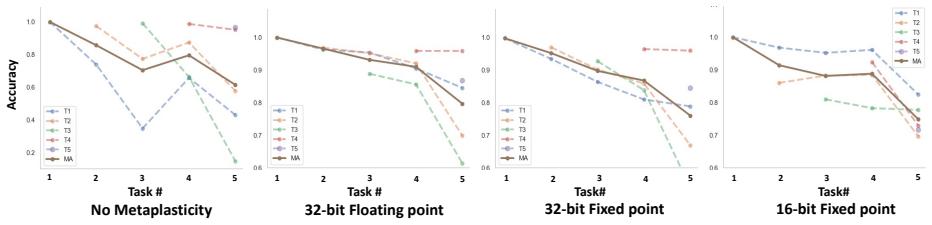
The central claim is that a spiking accelerator, Genesis, can perform online continual learning using surrogate-gradient training regularized by activity-dependent metaplasticity. The chip quantizes all training parameters to 16-bit fixed point, co-locates each synaptic weight with its metaplasticity parameter in a single memory word, and uses an address-encoded dataflow that moves only the weights of active neurons. On the Split-MNIST domain-incremental task, the model achieves 74.46% mean accuracy across five sequential tasks, with a per-image training latency of 10 ms and 640 MOPS throughput at 17.08 mW. The paper positions this as the first spiking continual learning accelerator to combine these mechanisms, and it reports beating regularization baselines such as online EWC and LwF while using less memory than TACOS or Stochastic Synapses.
Load-bearing premise
The reported accuracy comes from a Python simulation that emulates the hardware's 16-bit fixed-point rounding, dyadic scaling, and bilinear metaplasticity function, not from measurements on the fabricated chip; if the chip's real behavior diverges from the simulator, the headline 74.46% accuracy and the claimed forgetting mitigation may not hold on silicon.
Editorial extensions
If this is right
- If the simulated behavior holds on silicon, edge devices operating under a 20 mW budget could learn new classes or domains without a replay buffer or a server connection.
- The 16-bit fixed-point result suggests that continual learning with metaplasticity does not require high-precision gradients, opening the door to memory-doubling-free on-chip training.
- Co-locating weights and metaplasticity parameters cuts update-phase memory traffic roughly in half, reducing training latency by about 20% and making the approach more competitive for real-time adaptation.
- The domain-incremental Split-MNIST result provides a concrete power-accuracy point that other neuromorphic continual learning accelerators can be compared against.
Reading between the lines
- The paper reports accuracy from a Python simulation that emulates hardware constraints rather than from measurements of the fabricated chip; the headline 74.46% is therefore best read as the simulator's prediction until silicon measurements appear.
- A natural extension would be to run Genesis on more complex continual learning benchmarks with larger images or more tasks, to test whether the forgetting mitigation and power envelope scale beyond the small Split-MNIST setting.
- Combining the metaplasticity regularizer with a small replay buffer could close the accuracy gap to TACOS and Stochastic Synapses, while still exploiting Genesis's memory and power optimizations.
Signed reviews
Editorial analysis
A structured set of objections, weighed in public.
Referee Report
Summary. The manuscript describes Genesis, a 65 nm ASIC design for on-chip continual learning in spiking neural networks. It combines a spiking network with activity-dependent metaplasticity, 16-bit fixed-point quantization of weights and metaplasticity parameters, an address-event dataflow that moves only weights associated with active neurons, and interleaved memory banks that co-locate weights with metaplasticity parameters. The authors report 74.46% mean accuracy on task-agnostic domain-incremental Split-MNIST, 17.08 mW power from Synopsys DC synthesis, 640 MOPS peak throughput, and 10 ms per-image training latency. They compare Genesis with regularization-based continual learning methods and with prior continual learning accelerators.
Significance. If the reported numbers can be taken at face value, the paper is a useful engineering data point: it shows that a small spiking accelerator can run a metaplasticity-based regularizer with 16-bit parameters at low power, and the co-location of weights with metaplasticity states is a sensible memory optimization. The paper also gives a clear component-level power and area breakdown, and Table I provides a useful comparison with existing CL accelerators. However, the central accuracy claim is not measured on the fabricated chip but comes from a Python simulation, and the comparisons in Table II are not controlled for dataset subset and memory-footprint semantics. These issues must be resolved before the results can be considered established.
major comments (5)
- [Abstract and Section V.A] The headline 74.46% mean accuracy is obtained from "network-level simulations in python while considering the hardware constraints," not from measurements of the fabricated chip shown in Fig. 5. No chip-in-the-loop results, simulation-to-silicon calibration, or variance across seeds are provided. Since the central continual-learning claim depends on the simulator faithfully capturing 16-bit rounding, dyadic constants, and the bilinear metaplasticity rule under real hardware timing, the abstract and conclusions should either report measured silicon accuracy or explicitly state that 74.46% is simulated accuracy under hardware constraints. Please also report the standard deviation across runs.
- [Section V.A and Table II] The manuscript trains Genesis on a reduced subset of the MNIST dataset, consisting of 10,000 training samples and 2,500 testing samples, but Table II compares the resulting 74.46% accuracy against numbers for LwF, BGD, TACOS, SS, and Online EWC without stating whether those baselines were run on the same reduced subset or on full Split-MNIST. If the baselines are taken from the literature on the full dataset, the comparison is not apples-to-apples and the claim of competitive performance is not supported. Please rerun all methods on the same data subset or clearly label the baselines as full-dataset references.
- [Introduction and Contributions] The statement that "we introduce Genesis, the first spiking continual learning accelerator" is contradicted by SCOLAR [30], cited later in the manuscript, which is described as a spiking digital accelerator with continual learning. Please revise the novelty claim so that it is relative to a precisely defined class, for example a fabricated ASIC with on-chip task-agnostic learning with metaplasticity, and cite SCOLAR in the introduction where the novelty claim is made.
- [Section V.B and Table I] The power (17.08 mW), area, and latency figures are presented alongside a chip photograph, but the text states that power and area come from Synopsys DC synthesis and that latency is evaluated with the SCALEsim cycle simulator. Since Fig. 5 shows a fabricated chip, the manuscript should state explicitly which numbers are post-synthesis estimates, which are cycle-simulator estimates, and which, if any, are measured from silicon. Table I should be annotated accordingly to avoid presenting estimates as measured chip results.
- [Table II and Section IV.A] Table II reports the same 628 kB memory footprint for "Baseline" and for Genesis, even though the contribution list claims that metaplasticity parameters are co-located with weights and that quantization halves memory. Please specify what the memory-size column includes (weights only, weights plus metaplasticity parameters, traces, or all on-chip memory) and explain why adding a metaplasticity parameter per synapse does not increase the reported memory size relative to the baseline. Without this explanation, the "halving memory overhead" claim cannot be verified.
minor comments (5)
- [Section IV.A] The paragraph on quantization reports an approximately 5% degradation for 16-bit fixed point and 3% for 32-bit fixed point, but later says "minimal degradation (2%) of accuracy is noticed"; these numbers should be made consistent.
- [Section IV.B] The text refers to "Figure 2(c)" but Figure 2 appears to have parts (a) and (b) only; fix the figure reference.
- [Section V.B] The sentence attributing the 10 ms training latency to "4(b)" is unclear; reference the correct figure panel and describe the configuration used to obtain that number.
- [Throughout] There are several typographical errors: "low-preicsion" in Section V.A, "quntization" in the introduction, "I.I.D. ." in Section I, "Bit-preicion" in Table I, and inconsistent spelling of "bilinear" versus "bi-linear."
- [Table I] In the Genesis row, "0.516-bit FXP" is likely a formatting error for "0.5 MB, 16-bit FXP"; please correct the table.
Circularity Check
No circular derivation found: the accuracy and power numbers come from simulation/synthesis, not from fitted targets or self-citation chains.
full rationale
No circularity found. The headline accuracy is produced by a network-level Python simulation that incorporates hardware constraints (Section V.A: 'We conduct network-level simulations in python while considering the hardware constraints, such as low-precision quantized weights, dyadic constants, and bilinear metaplasticity functions'), and the power/area numbers come from Synopsys DC synthesis on IBM 65nm (Section V.B). These are independent evaluations of the designed system, not derivations from the claimed results. The learning rule is restated explicitly in Eqs. (1)-(5) and originates from prior work TACOS [13] by overlapping authors, but the paper does not invoke TACOS as a theorem or as the justification for its accuracy; its own simulation reports 74.46%, which is lower than TACOS's 82.56% in Table II, so the number is not fitted to a target. The SCOLAR [30] reference for dual fixed-point quantization and dyadic scaling is an engineering adoption, not a load-bearing self-citation chain, and no uniqueness claim is imported from the authors' prior work. The main weakness is evidential, not circular: Section V.A states the accuracy is not measured from the fabricated chip, and Section V.B reports synthesis/simulation estimates rather than silicon measurements. That is a validation gap that should be addressed with chip measurements or simulation-to-silicon calibration, but it does not make the derivation equivalent to its inputs by construction.
Assumptions & free parameters
free parameters (4)
- LIF constants a, b, c
- Metaplasticity AUC parameter d
- Learning rate eta
- Boxcar limits Imin, Imax
assumptions (3)
- domain assumption Python simulation with hardware constraints faithfully represents the fabricated chip
- domain assumption Synopsys DC synthesis power at 10 MHz predicts silicon power consumption
- ad hoc to paper Reduced 10,000-sample training subset preserves the ranking of continual learning methods
Cite this review
Pith. "Pith review of Genesis: A Spiking Neuromorphic Accelerator With On-chip Continual Learning." pith.science (2026). https://pith.science/paper/IOTPL7YL
@misc{pith2026250905858,
  author       = {Pith},
  title        = {Pith review of: Genesis: A Spiking Neuromorphic Accelerator With On-chip Continual Learning},
  year         = {2026},
  howpublished = {\url{https://pith.science/paper/IOTPL7YL}},
  note         = {Machine review of arXiv:2509.05858}
}
read the original abstract
Continual learning, the ability to acquire and transfer knowledge through a models lifetime, is critical for artificial agents that interact in real-world environments. Biological brains inherently demonstrate these capabilities while operating within limited energy and resource budgets. Achieving continual learning capability in artificial systems considerably increases memory and computational demands, and even more so when deploying on platforms with limited resources. In this work, Genesis, a spiking continual learning accelerator, is proposed to address this gap. The architecture supports neurally inspired mechanisms, such as activity-dependent metaplasticity, to alleviate catastrophic forgetting. It integrates low-precision continual learning parametersand employs a custom data movement strategy to accommodate the sparsely distributed spikes. Furthermore, the architecture features a memory mapping technique that places metaplasticity parameters and synaptic weights in a single address location for faster memory access. Results show that the mean classification accuracy for Genesis is 74.6% on a task-agnostic split-MNIST benchmark with power consumption of 17.08mW in a 65nm technology node.
Figures


Figures from the paper (2 more)


Reference graph
Works this paper leans on
-
[30]
Scolar: A spiking digital accelerator with dual fixed point for continual learning,
V . Karia, F. T. Zohora, N. Soures, and D. Kudithipudi, “Scolar: A spiking digital accelerator with dual fixed point for continual learning,” in2022 IEEE International Symposium on Circuits and Systems (ISCAS). IEEE, 2022, pp. 1372–1376
work page 2022
-
[1]
Catastrophic forgetting in connectionist networks,
R. M. French, “Catastrophic forgetting in connectionist networks,” Trends in cognitive sciences, vol. 3, no. 4, pp. 128–135, 1999
1999
-
[2]
Embracing change: Continual learning in deep neural networks,
R. Hadsell, D. Rao, A. A. Rusu, and R. Pascanu, “Embracing change: Continual learning in deep neural networks,”Trends in cognitive sci- ences, 2020
work page 2020
-
[3]
Continual lifelong learning with neural networks: A review,
G. I. Parisi, R. Kemker, J. L. Part, C. Kanan, and S. Wermter, “Continual lifelong learning with neural networks: A review,”Neural networks, vol. 113, pp. 54–71, 2019
2019
-
[4]
A continual learning survey: Defying forgetting in classification tasks,
M. De Lange, R. Aljundi, M. Masana, S. Parisot, X. Jia, A. Leonardis, G. Slabaugh, and T. Tuytelaars, “A continual learning survey: Defying forgetting in classification tasks,”IEEE transactions on pattern analysis and machine intelligence, vol. 44, no. 7, pp. 3366–3385, 2021
2021
-
[5]
A comprehensive survey of continual learning: theory, method and application,
L. Wang, X. Zhang, H. Su, and J. Zhu, “A comprehensive survey of continual learning: theory, method and application,”IEEE Transactions on Pattern Analysis and Machine Intelligence, 2024
work page 2024
-
[6]
Biological underpinnings for lifelong learning machines,
D. Kudithipudi, M. Aguilar-Simon, J. Babb, M. Bazhenov, D. Black- iston, J. Bongard, A. P. Brna, S. Chakravarthi Raja, N. Cheney, J. Clune et al., “Biological underpinnings for lifelong learning machines,”Nature Machine Intelligence, vol. 4, no. 3, pp. 196–210, 2022
work page 2022
-
[7]
S. B. Furber, “Brain-inspired computing,”IET Computers & Digital Techniques, vol. 10, no. 6, pp. 299–305, 2016
work page 2016
Show all 37 references
-
[8]
Building brain-inspired computing,
D. Strukov, G. Indiveri, J. Grollier, and S. Fusi, “Building brain-inspired computing,”Nature Communications, no. 10, pp. 4838–2019, 2019
2019
-
[9]
Brain- inspired computing: A systematic survey and future trends,
G. Li, L. Deng, H. Tang, G. Pan, Y . Tian, K. Roy, and W. Maass, “Brain- inspired computing: A systematic survey and future trends,”Proceedings of the IEEE, 2024
2024
-
[10]
A survey and perspective on neuromorphic continual learning systems,
R. Mishra and M. Suri, “A survey and perspective on neuromorphic continual learning systems,”Frontiers in Neuroscience, vol. 17, 2023. [Online]. Available: https://www.frontiersin.org/journals/neuroscience/ articles/10.3389/fnins.2023.1149410
2023
-
[11]
Metaplasticity: The plasticity of synaptic plasticity,
W. C. Abraham and M. F. Bear, “Metaplasticity: The plasticity of synaptic plasticity,”Trends in Neurosciences, vol. 19, no. 4, pp. 126–130, 1996. [Online]. Available: http://www.sciencedirect.com/ science/article/pii/S016622369680018X
1996
-
[12]
Synaptic metaplasticity in binarized neural networks,
A. Laborieux, M. Ernoult, T. Hirtzlin, and D. Querlioz, “Synaptic metaplasticity in binarized neural networks,”Nature communications, vol. 12, no. 1, p. 2549, 2021
2021
-
[13]
TACOS: Task agnostic continual learning in spiking neural networks,
N. Soures, P. Helfer, A. Daram, T. Pandit, and D. Kudithipudi, “TACOS: Task agnostic continual learning in spiking neural networks,” inTheory and Foundation of Continual Learning Workshop at ICML2021, July 2021
2021
-
[14]
Contributions by metaplasticity to solving the catastrophic forgetting problem,
P. Jedlicka, M. Tomko, A. Robins, and W. C. Abraham, “Contributions by metaplasticity to solving the catastrophic forgetting problem,”Trends in Neurosciences, vol. 45, no. 9, pp. 656–666, 2022
2022
-
[15]
Metaplasticnet: Architecture with probabilistic metaplastic synapses for continual learning,
F. T. Zohora, V . Karia, A. R. Daram, A. M. Zyarah, and D. Kudithipudi, “Metaplasticnet: Architecture with probabilistic metaplastic synapses for continual learning,” in2021 IEEE International Symposium on Circuits and Systems (ISCAS). IEEE, 2021, pp. 1–5
2021
-
[16]
Design principles for lifelong learning ai accelerators,
D. Kudithipudi, A. Daram, A. M. Zyarah, F. T. Zohora, J. B. Aimone, A. Yanguas-Gil, N. Soures, E. Neftci, M. Mattina, V . Lomonacoet al., “Design principles for lifelong learning ai accelerators,”Nature Elec- tronics, vol. 6, no. 11, pp. 807–822, 2023
2023
-
[17]
On the model of computation: point,
W. Dally, “On the model of computation: point,”Communications of the ACM, vol. 65, no. 9, pp. 30–32, 2022
2022
-
[18]
Q-spinn: A framework for quantizing spiking neural networks,
R. V . W. Putra and M. Shafique, “Q-spinn: A framework for quantizing spiking neural networks,” in2021 International Joint Conference on Neural Networks (IJCNN). IEEE, 2021, pp. 1–8
2021
-
[19]
Overcoming catastrophic forgetting in neural networks,
J. Kirkpatrick, R. Pascanu, N. Rabinowitz, J. Veness, G. Desjardins, A. A. Rusu, K. Milan, J. Quan, T. Ramalho, A. Grabska-Barwinska et al., “Overcoming catastrophic forgetting in neural networks,”Pro- ceedings of the national academy of sciences, vol. 114, no. 13, pp. 3521–3526, 2017
2017
-
[20]
Continual learning through synaptic intelligence,
F. Zenke, B. Poole, and S. Ganguli, “Continual learning through synaptic intelligence,” inInternational conference on machine learning. PMLR, 2017, pp. 3987–3995
2017
-
[21]
Adversarial continual learning,
S. Ebrahimi, F. Meier, R. Calandra, T. Darrell, and M. Rohrbach, “Adversarial continual learning,” inComputer Vision–ECCV 2020: 16th European Conference, Glasgow, UK, August 23–28, 2020, Proceedings, Part XI 16. Springer, 2020, pp. 386–402
2020
-
[22]
Progressive neural networks,
A. A. Rusu, N. C. Rabinowitz, G. Desjardins, H. Soyer, J. Kirkpatrick, K. Kavukcuoglu, R. Pascanu, and R. Hadsell, “Progressive neural networks,”arXiv preprint arXiv:1606.04671, 2016
2016 arXiv
-
[23]
Gradient-based sample selection for online continual learning,
R. Aljundi, M. Lin, B. Goujaud, and Y . Bengio, “Gradient-based sample selection for online continual learning,” inAdvances in Neural Information Processing Systems, 2019, pp. 11 816–11 825
2019
-
[24]
Continual learning and catastrophic forgetting,
G. M. van de Ven, N. Soures, and D. Kudithipudi, “Continual learning and catastrophic forgetting,”arXiv preprint arXiv:2403.05175, 2024
2024 arXiv
-
[25]
Presynaptic stochasticity improves energy efficiency and helps alleviate the stability-plasticity dilemma,
S. Schug, F. Benzing, and A. Steger, “Presynaptic stochasticity improves energy efficiency and helps alleviate the stability-plasticity dilemma,” Elife, vol. 10, p. e69884, 2021
2021
-
[26]
Task agnostic continual learning using online variational bayes,
C. Zeno, I. Golan, E. Hoffer, and D. Soudry, “Task agnostic continual learning using online variational bayes,”arXiv preprint arXiv:1803.10123, 2018
2018 arXiv
-
[27]
Learning without forgetting,
Z. Li and D. Hoiem, “Learning without forgetting,”IEEE transactions on pattern analysis and machine intelligence, vol. 40, no. 12, pp. 2935– 2947, 2017
2017
-
[28]
Accelerating continual learn- ing on edge fpga,
D. Piyasena, S.-K. Lam, and M. Wu, “Accelerating continual learn- ing on edge fpga,” in2021 31st International Conference on Field- Programmable Logic and Applications (FPL). IEEE, 2021, pp. 294– 300
2021
-
[29]
Tinycl: An efficient hardware architecture for continual learning on autonomous systems,
E. Ressa, A. Marchisio, M. Martina, G. Masera, and M. Shafique, “Tinycl: An efficient hardware architecture for continual learning on autonomous systems,”arXiv preprint arXiv:2402.09780, 2024
2024 arXiv
-
[31]
A tinyml platform for on-device continual learning with quantized latent replays,
L. Ravaglia, M. Rusci, D. Nadalini, A. Capotondi, F. Conti, and L. Benini, “A tinyml platform for on-device continual learning with quantized latent replays,”IEEE Journal on Emerging and Selected Topics in Circuits and Systems, vol. 11, no. 4, pp. 789–802, 2021
2021
-
[32]
Dynamically growing neural network architecture for lifelong deep learning on the edge,
D. Piyasena, M. Thathsara, S. Kanagarajah, S. K. Lam, and M. Wu, “Dynamically growing neural network architecture for lifelong deep learning on the edge,” in2020 30th International Conference on Field- Programmable Logic and Applications (FPL). IEEE, 2020, pp. 262– 268
2020
-
[33]
Memory-latency-accuracy trade-offs for continual learning on a risc-v extreme-edge node,
L. Ravaglia, M. Rusci, A. Capotondi, F. Conti, L. Pellegrini, V . Lomonaco, D. Maltoni, and L. Benini, “Memory-latency-accuracy trade-offs for continual learning on a risc-v extreme-edge node,” in2020 IEEE Workshop on Signal Processing Systems (SiPS). IEEE, 2020, pp. 1–6
2020
-
[34]
Pulp: A parallel ultra low power platform for next generation iot applications,
D. Rossi, F. Conti, A. Marongiu, A. Pullini, I. Loi, M. Gautschi, G. Tagliavini, A. Capotondi, P. Flatresse, and L. Benini, “Pulp: A parallel ultra low power platform for next generation iot applications,” in2015 IEEE Hot Chips 27 Symposium (HCS). IEEE Computer Society, 2015, pp. 1–39
2015
-
[35]
Chameleon: Dual memory replay for online continual learning on edge devices,
S. Aggarwal, K. Binici, and T. Mitra, “Chameleon: Dual memory replay for online continual learning on edge devices,”IEEE Transactions on Computer-Aided Design of Integrated Circuits and Systems, 2023
2023
-
[36]
Three scenarios for continual learning,
G. M. van de Ven and A. S. Tolias, “Three scenarios for continual learning,”arXiv:1904.07734 [cs, stat], Apr. 2019
1904 arXiv
-
[37]
Progress & compress: A scalable framework for continual learning,
J. Schwarz, J. Luketina, W. M. Czarnecki, A. Grabska-Barwinska, Y . W. Teh, R. Pascanu, and R. Hadsell, “Progress & compress: A scalable framework for continual learning,”arXiv preprint arXiv:1805.06370, 2018
2018 arXiv
Reviewed August 15, 2026 · model on record in the stance chip above.
Discussion (0). Continue with ORCID to comment.