REVIEW 3 major objections 3 minor 47 references
Evolutionary dynamics of cancer: from epigenetic regulation to cell population dynamics -- mathematical model framework, applications, and open problems
T0 review · 3 major / 3 minor · reviewed 2026-08-14 · deepseek-v4-flash
Pith's one-line read The paper proposes that heterogeneous, plastic stem cell regeneration—captured by a delay integro-differential equation with an epigenetic inheritance kernel—is a general mathematical framework for cancer evolution.
desk verdict A mostly synthetic framework paper that is honest about its open problems but leans heavily on the author's prior work, with the unmeasured Beta transition kernel as the main load-bearing weakness. read the letter →
The pith
A machine-rendered reading of the paper's core claim, the machinery that carries it, and where it could break.
The reading
What carries the argument
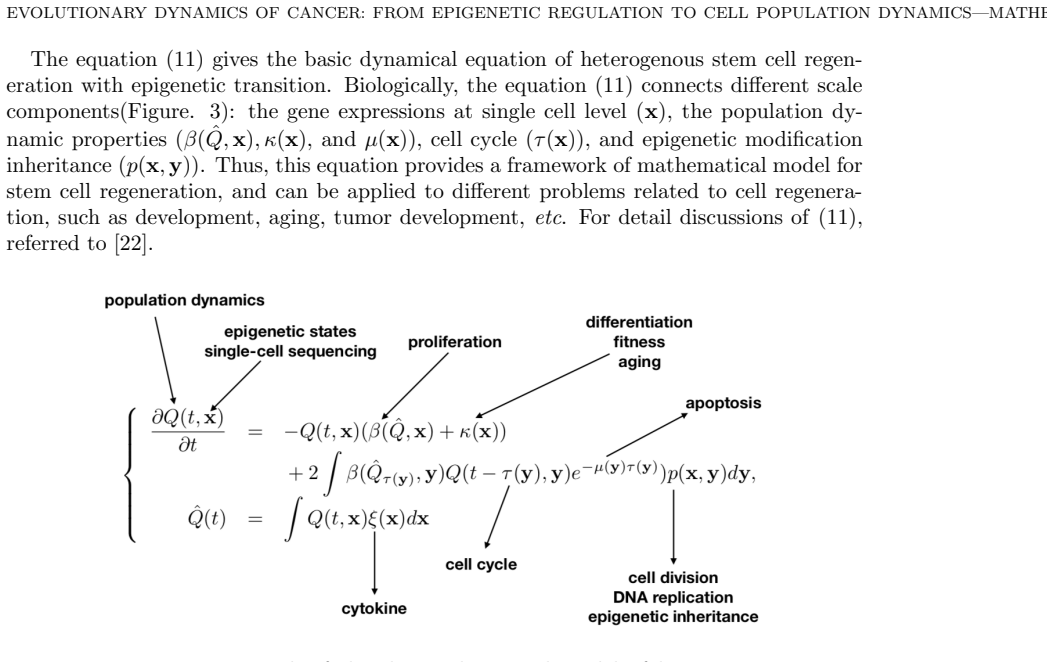
The load-bearing object is Eq. (11), a delay integro-differential equation for the resting-phase stem cell density $Q(t,x)$ over an epigenetic state space $\Omega$. Its nonlocal term $$2\int_\$\Omega$ \$\beta$(\hat{Q}_{\tau(y)},y)Q(t-\tau(y),y)$e^{{-\mu(y)\tau(y)}}$p(x,y)\,dy$$ carries the effect of cell division: a mother at state $y$ divides after duration $\tau(y)$, suffers apoptosis at rate $\mu(y)$, and produces daughters whose epigenetic state is drawn from the inheritance kernel $p(x,y)$. The kernel, named the transition function, is the mechanism that converts single-cell epigenetic plasticity into population heterogeneity. In the concrete one-dimensional model (14) it is a conditional Beta distribution with mother-state-dependent shape parameters $a(y)=\eta(y)\varphi(y)$ and $b(y)=\eta(y)(1-\varphi(y))$, fixed by the mean and variance functions $\varphi(y)$ and $\eta(y)$ obtained from the author's simulations of histone-modification inheritance. The characteristic-line integration that converts the age-structured PDE (10) into the delay equation (11) is the same technique that produces the homogeneous delay equation (4) from the G0 model; later, a local-transition approximation replaces the global kernel by a drift-and-diffusion expansion and yields the second-order equation (40).
What would settle it
Track individual labeled stem cells through one division in a relevant tissue (e.g., hematopoietic stem cells) by single-cell sequencing or reporter imaging, and compare the empirical daughter-state distribution for many mother states $y$ with the conditional Beta kernel (14) fitted through $\varphi(y)$ and $\eta(y)$. If the observed distributions are not Beta-shaped or the fitted shapes vary with mother state outside the assumed functional forms, the central kernel of Eq. (11) fails. A complementary experimental check: the CAR-T model predicts that combined CD19/CD123 CAR-T administration at specific ratios prevents CD19-positive relapse, a prediction testable directly in the mouse model that motivated the paper.
Extended reading notes
Core claim
The central claim is that heterogeneous, plastic stem cell populations—the engine of cancer development—are governed by the delay integro-differential equation (11), in which the cell population $Q(t,x)$ at epigenetic state $x$ changes through loss by proliferation and differentiation and through influx from mothers of all states $y$ whose daughters randomly transition to $x$. The kernel $p(x,y)$ encodes epigenetic plasticity: it is the inheritance probability of daughter state given mother state. The paper argues that this equation places intrinsically nonlocal, non-measurable epigenetic transitions at the center of cancer dynamics and unifies single-cell gene-expression states, cell-cycle duration, apoptosis, differentiation, and feedback-dependent proliferation into one population-level description. In the one-dimensional stemness case (13) the kernel takes the explicit Beta-distribution form (14), and with genetic heterogeneity the framework becomes (17), a system over $m$ genetic types coupled by mutation probabilities. The same framework, discretized in hybrid single-cell simulations, reproduces the multi-pathway progression from chronic inflammation to malignancy and predicts that CAR-T-induced plasticity can drive CD19-positive relapse.
Load-bearing premise
The whole framework stands on the unmeasured inheritance kernel $p(x,y)$: the paper admits that biology cannot measure this function directly, and its concrete Beta-distribution form comes from the author's own simulations, so if real daughter-state distributions differ from that family every heterogeneous-model prediction built on Eq. (11) would shift.
Editorial extensions
If this is right
- In the homogeneous G0 model, abnormal growth requires at least one of three dysregulations—loss of differentiation/senescence, sustained proliferative signaling, or evasion of apoptosis—which the paper identifies with known cancer hallmarks.
- With heterogeneity included, cell-to-cell variance in behavior is not noise layered on a homogeneous population but a consequence of random epigenetic inheritance, so therapy resistance and relapse become intrinsic outcomes of the same regenerative dynamics.
- Gene mutations can be layered onto the framework through Eq. (17): each genetic type has its own kinetic rates and the mutation network $p_{i,j}$ couples the types, so mutation-driven intratumoral heterogeneity is a corollary of the same equation.
- The applications imply that chronic inflammation can drive tumorigenesis through several distinct pathway combinations, and that CAR-T-induced plasticity toward hematopoietic stem-like and myeloid-like states is sufficient to produce CD19-positive relapse.
- The four open mathematical problems—steady-state existence and stability, a nonnegative entropy production/dissipation decomposition, the inverse problem for $p(x,y)$, and local-transition limits—define what must be proved before the framework can be used for personalized prediction.
Reading between the lines
- If the framework is right, the first practical task is not model refinement but measurement: single-cell lineage-tracing time series should be used to estimate $p(x,y)$ directly, and the inverse-problem formulation in Section 5.3 already sketches how that could be done.
- The local-transition expansion (40) turns the global-kernel equation into a Fokker-Planck-type equation with drift $2a$ and diffusion $D$, suggesting a concrete bridge to classical mutation-selection balance and niche-construction models in evolutionary biology that the paper does not pursue.
- The entropy problem has a testable corollary: if cancer development is an entropy-increasing process, then the entropy production rate under the framework should be large exactly during transitions from precancerous to malignant states, a quantity that could be estimated from sequentially sampled single-cell distributions.
- The model's pathway-mutation treatment suggests a natural therapeutic extension not tested here: using the same hybrid equations to rank combinations of targeted agents by how far they push the population away from the malignant steady state, rather than by immediate cell kill.
Signed reviews
Editorial analysis
A structured set of objections, weighed in public.
Referee Report
Summary. The manuscript proposes a general mathematical framework for the evolutionary dynamics of heterogeneous and plastic stem cell populations, with applications to cancer. The authors first present a homogeneous G0 cell-cycle model, derive a delay differential equation, and then extend it to a delay integro-differential equation (Eq. 11) for the density of resting-phase stem cells with epigenetic state, where inheritance is described by a transition kernel. The kernel is specified as a conditional Beta distribution motivated by the authors' own histone-modification simulations. The framework is extended to genetic heterogeneity (Eq. 17) and to a local-state-transition approximation (Eq. 40). Two hybrid computational applications are described: inflammation-induced tumorigenesis and relapse after CAR-T therapy, with details referred to prior and preprint papers. The paper closes with four open mathematical problems: existence and uniqueness of steady states, entropy production and dissipation, inverse problems, and local transition approximations.
Significance. If the mathematical framework is accepted, it provides a coherent bridge between single-cell epigenetic state and population-level cancer dynamics, and the open problems may stimulate useful analysis. The derivation of Eq. (11) is a standard characteristic-line calculation and is clearly presented. However, the biological relevance of the framework hinges on the transition kernel, whose Beta form is not independently validated; the application results are not demonstrated in this manuscript. The framework is therefore more a proposal of a modeling paradigm than an established predictive model.
major comments (3)
- [Section 3.2, Eq. (14)] The general conditional Beta form is stated with exponents a(y)-1 and b(y)-1, but Eq. (14) omits the -1 terms. With a=eta*phi and b=eta*(1-phi), the density in Eq. (14) corresponds to Beta(eta*phi+1, eta*(1-phi)+1), whose mean is (eta*phi+1)/(eta+2) and whose variance is not phi*(1-phi)/(1+eta) as claimed. This inconsistency affects the parameterization used in the applications and must be corrected. Please specify whether the intended shape parameters are eta*phi and eta*(1-phi) (with exponents minus one) or eta*phi+1 and eta*(1-phi)+1.
- [Sections 3.2 and 4.2-4.3] The transition kernel p(x,y) multiplies the entire renewal flux in Eq. (11), so all model predictions depend on its form. The paper states that 'biologically we cannot measure this function directly,' and the chosen Beta form is justified only by the authors' own simulations in references [18,19]. The application sections (inflammation-induced tumorigenesis and CAR-T relapse) do not present sensitivity analyses, quantitative model-data comparisons, or independent validation within this manuscript; they refer to prior and preprint papers for details. As a result, the claim that the framework reproduces these biological processes is not supported by the evidence presented here. The authors should either provide independent experimental support for the kernel, perform a systematic sensitivity analysis, or explicitly label the applications as conditional illustrations.
- [Section 3.2, multi-dimensional extension] In the generalization to multiple epigenetic states, the text says 'we can extend the above Beta-distribution by the multiply rule p(x,y) = sum_i p_i(x_i,y).' A sum of marginal densities is not a joint density on the product space and does not satisfy the normalization condition unless the p_i are weighted categories. The intended independent-component joint distribution should be the product of the marginal densities. This point should be corrected to avoid ambiguity in applying the framework to high-dimensional states.
minor comments (3)
- [Section 2, Eq. (7)] In the steady-state formula, the prefactor should be theta rather than eta; solving beta(Q*)=eta with beta from Eq. (5) yields Q* = theta [ (beta0+beta1-eta)/(eta-beta1) ]^{1/n}.
- [Section 5.2, Eq. (25)] The definition of total cell number is missing the differential: it should read Q(t) = integral over Omega of Q(t,x) dx.
- [Throughout] There are numerous typographical errors (e.g., 'challenge issue' and 'computations models' in the abstract, 'propose model' in Sections 4.1 and 6, 'serous' in Section 4.2, 'my promoted' in Section 4.3), and reference [46] is listed only as 'Preprint, 2019'; these should be corrected.
Circularity Check
No circular derivation: Eq. (11) is obtained by a self-contained characteristic-line calculation, and the unmeasured Beta kernel is an acknowledged modeling ansatz; the main caveat is heavy reliance on self-citations, not constructional circularity.
full rationale
The central derivation is mathematically self-contained: integrating the age-structured PDE (10) along characteristics and substituting the boundary condition yields the delay integro-differential equation (11); no parameter is fitted to the quantity that Eq. (11) is then said to predict. The transition kernel p(x,y) is introduced as an unmeasured modeling ingredient, and Section 3.2 explicitly states 'biologically we cannot measure this function directly, and do not know the possible form neither,' then proposes a conditional Beta form motivated by the author's own simulation studies [18,19]. This is an acknowledged ansatz rather than a disguised output of Eq. (11); the framework is stated for arbitrary p(x,y), so the mathematical claim does not reduce to the Beta choice. The applications in Sections 4.2 and 4.3 are hybrid implementations whose details and validations are delegated to prior papers [13,46]; they are presented as applications, not as the derivation of the framework. Extensive self-citation is present, and the unvalidated Beta kernel is a genuine correctness and identifiability concern, but no equation-level constructional equivalence or fitted-parameter-as-prediction step was found. The score of 2 reflects the presence of self-citations for the kernel and applications, not a circular reduction of the main derivation.
Assumptions & free parameters
free parameters (4)
- Hill parameters theta, n, beta0, beta1 in proliferation rate beta(Q) (Eq. (5)) =
not fitted in this paper
- Rate functions beta(hatQ,x), kappa(x), mu(x), tau(x) =
generic; concrete forms in Eqs. (15)-(16) and Section 4.3
- Transition kernel shape functions phi(y), eta(y) =
unspecified; pre-defined functions in Section 3.2
- CAR-T model parameters (gamma19, gamma22, X0, X1, n0, n1, m, alpha34, mu0, mu1) =
calibrated in prior preprint [46]
assumptions (5)
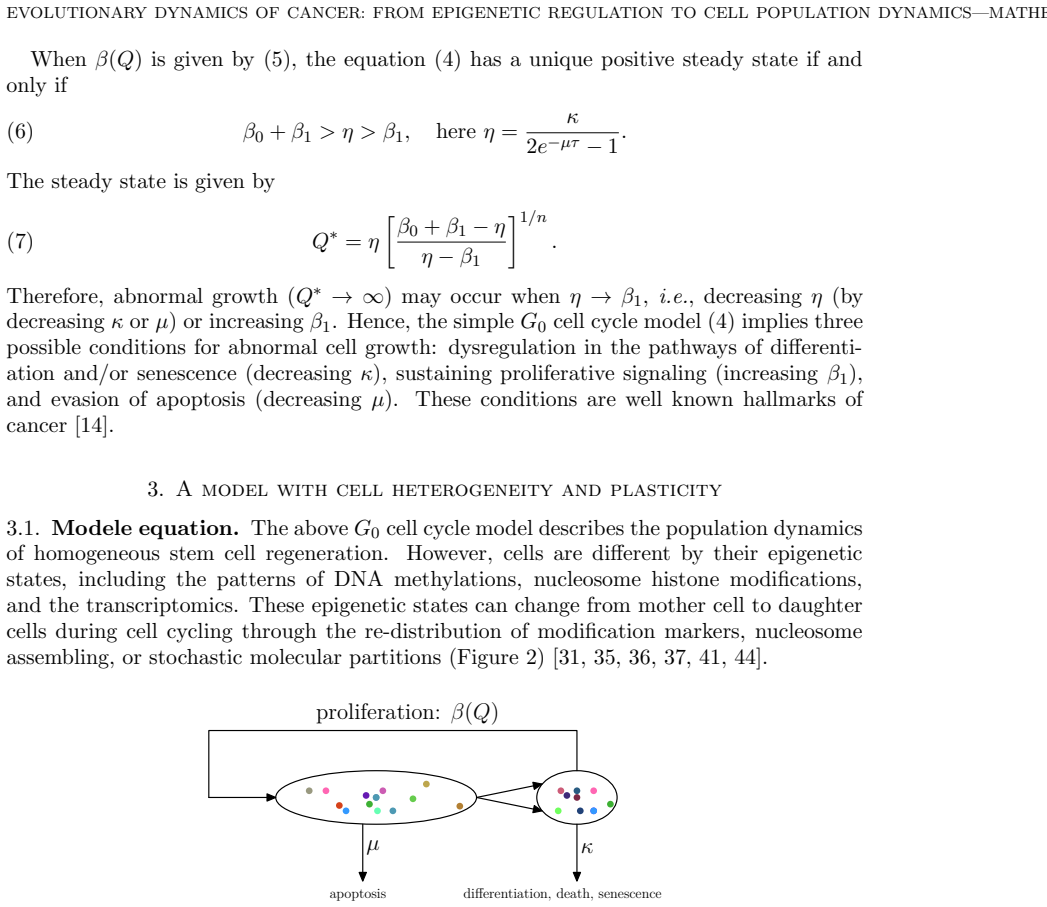
- domain assumption The G0 compartment model: resting cells either enter proliferation at rate beta or leave at rate kappa, and proliferating cells divide after fixed duration tau with apoptosis probability mu (Eqs. (1)-(3)).
- domain assumption Epigenetic state x changes only at cell division, and inheritance is described by a transition probability p(x,y) that integrates to 1 over daughter states (Section 3.1, Eqs. (10)-(11)).
- domain assumption Proliferation beta, apoptosis mu, differentiation kappa, cycle duration tau, and cytokine secretion zeta depend only on current state x and global effective population hatQ (Eqs. (8)-(11)).
- ad hoc to paper p(x,y) has the conditional Beta-distribution form with mean phi(y) and variance phi(1-phi)/(1+eta) (Eqs. (13)-(14)).
- domain assumption In the applications, mutations and CAR-T responses act through specified pathway changes and CD34/CD123 state transitions (Table 1, Section 4.3).
Cite this review
Pith. "Pith review of Evolutionary dynamics of cancer: from epigenetic regulation to cell population dynamics -- mathematical model framework, applications, and open problems." pith.science (2026). https://pith.science/paper/IOYD24OB
@misc{pith2026190807048,
  author       = {Pith},
  title        = {Pith review of: Evolutionary dynamics of cancer: from epigenetic regulation to cell population dynamics -- mathematical model framework, applications, and open problems},
  year         = {2026},
  howpublished = {\url{https://pith.science/paper/IOYD24OB}},
  note         = {Machine review of arXiv:1908.07048}
}
abstract
Predictive modeling of the evolutionary dynamics of cancer is a challenge issue in computational cancer biology. In this paper, we propose a general mathematical model framework for the evolutionary dynamics of cancer with plasticity and heterogeneity in cancer cells. Cancer is a group of diseases involving abnormal cell growth, during which abnormal regulations in stem cell regeneration are essential for the dynamics of cancer development. In general, the dynamics of stem cell regeneration can be simplified as a $\mathrm{G_0}$ phase cell cycle model, which lead to a delay differentiation equation. When cell heterogeneity and plasticity are considered, we establish a differential-integral equation based on the random transition of epigenetic states of stem cells during cell division. The proposed model highlights cell heterogeneity and plasticity, and connects the heterogeneity with cell-to-cell variance in cellular behaviors, e.g. proliferation, apoptosis, and differentiation/senescence, and can be extended to include gene mutation-induced tumor development. Hybrid computations models are developed based on the mathematical model framework, and are applied to the process of inflammation-induced tumorigenesis and tumor relapse after CAR-T therapy. Finally, we give rise to several mathematical problems related to the proposed differential-integral equation. Answers to these problems are crucial for the understanding of the evolutionary dynamics of cancer.
Figures

Reference graph
Works this paper leans on
-
[22]
Jinzhi Lei. A general mathematical framework for understanding the behavior of heterogeneous stem cell regeneration. BioRxiv, 592139:https://doi.org/10.1101/592139, 2019
-
[23]
Jinzhi Lei, Simon A Levin, and Qing Nie. Mathematical model of adult stem cell regeneration with cross-talk between genetic and epigenetic regulation. Proc Natl Acad Sci USA , 111(10):E880–E887, March 2014
work page 2014
-
[13]
Yucheng Guo, Qing Nie, Adam L MacLean, Yanda Li, Jinzhi Lei, and Shao Li. Multiscale model- ing of inflammation-induced tumorigenesis reveals competing oncogenic and onco-protective roles for inflammation. Cancer Research, 77(22):6429–6441, September 2017
work page 2017
-
[46]
Can Zhang, Changyong Shao, Xiaopei Jiao, Yue Bai, Miao Li, Hanping Shi, Jinzhi Lei, and Xiaosong Zhong. Leukemic cell plasticity induces immune escape after CD19 chimeric antigen receptor T cell therapy of acute B lymphoblastic leukemia. Preprint, 2019
work page 2019
-
[1]
Oscillations in cyclical neutropenia: new evidence based on mathematical modeling
Samuel Bernard, Jacques B´ elair, and Michael C Mackey. Oscillations in cyclical neutropenia: new evidence based on mathematical modeling. J Theor Biol , 223(3):283–298, August 2003
work page 2003
-
[2]
On the existence of a G0-phase in the cell cycle
F J Burns and I F Tannock. On the existence of a G0-phase in the cell cycle. Cell Proliferation , 3(4):321–334, 1970
work page 1970
-
[3]
Hybrid modeling frameworks of tumor development and treatment
Ibrahim M Chamseddine and Katarzyna A Rejniak. Hybrid modeling frameworks of tumor development and treatment. Wiley Interdiscip Rev Syst Biol Med , page e1461, July 2019
work page 2019
-
[4]
Transcriptome-wide noise controls lineage choice in mammalian progenitor cells
Hannah H Chang, Martin Hemberg, Mauricio Barahona, Donald E Ingber, and Sui Huang. Transcriptome-wide noise controls lineage choice in mammalian progenitor cells. Nature, 453(7194):544–547, May 2008
work page 2008
Show all 47 references
-
[5]
At the crossroads of inflammation and cancer
Hans Clevers. At the crossroads of inflammation and cancer. Cell, 118(6):671–674, September 2004. EVOLUTIONARY DYNAMICS OF CANCER: FROM EPIGENETIC REGULATION TO CELL POPULATION DYNAMICS—MATHEMATICAL MODEL FRAMEWORK, APPLICATIONS, AND OPEN PROBLEMS 17
2004
-
[6]
Global burden of cancers attributable to infections in 2008: a review and synthetic analysis
Catherine de Martel, Jacques Ferlay, Silvia Franceschi, J´ erˆ ome Vignat, Freddie Bray, David Forman, and Martyn Plummer. Global burden of cancers attributable to infections in 2008: a review and synthetic analysis. Lancet. Oncol., 13(6):607–615, June 2012
2008
-
[7]
Stochastic dynamics of hematopoietic tumor stem cells
David Dingli, Arne Traulsen, and Jorge M Pacheco. Stochastic dynamics of hematopoietic tumor stem cells. Cell Cycle (Georgetown, Tex) , 6(4):461–466, February 2007
2007
-
[8]
Long-term propagation of distinct hematopoietic differentiation programs in vivo
Brad Dykstra, David Kent, Michelle Bowie, Lindsay McCaffrey, Melisa Hamilton, Kristin Lyons, Shang-Jung Lee, Ryan Brinkman, and Connie Eaves. Long-term propagation of distinct hematopoietic differentiation programs in vivo. Stem Cell , 1(2):218–229, August 2007
2007
-
[9]
Inflammation-induced cancer: crosstalk between tumours, immune cells and microorganisms
Eran Elinav, Roni Nowarski, Christoph A Thaiss, Bo Hu, Chengcheng Jin, and Richard A Flavell. Inflammation-induced cancer: crosstalk between tumours, immune cells and microorganisms. Nat Rev Cancer, 13(11):759–771, October 2013
2013
-
[10]
Single-molecule analysis of myocyte differentiation reveals bimodal lineage commitment
Tyler M Gibson and Charles A Gersbach. Single-molecule analysis of myocyte differentiation reveals bimodal lineage commitment. Integr Biol (Camb) , 7(6):663–671, June 2015
2015
-
[11]
Differentiation plasticity of hematopoietic cells
Thomas Graf. Differentiation plasticity of hematopoietic cells. Blood, 99(9):3089–3101, May 2002
2002
-
[12]
Immunity, inflammation, and cancer
Sergei I Grivennikov, Florian R Greten, and Michael Karin. Immunity, inflammation, and cancer. Cell, 140(6):883–899, March 2010
2010
-
[14]
The hallmarks of cancer
D Hanahan and R A Weinberg. The hallmarks of cancer. Cell, 100(1):57–70, January 2000
2000
-
[15]
Origin of Cancer: An Information, Energy, and Matter Disease
Rainer G Hanselmann and Cornelius Welter. Origin of Cancer: An Information, Energy, and Matter Disease. Front Cell Dev Biol , 4:121, 2016
2016
-
[16]
Dynamic equilibrium and heterogeneity of mouse pluripotent stem cells with distinct functional and epigenetic states
Katsuhiko Hayashi, Susana M Chuva de Sousa Lopes, Fuchou Tang, and M Azim Surani. Dynamic equilibrium and heterogeneity of mouse pluripotent stem cells with distinct functional and epigenetic states. Stem Cell , 3(4):391–401, October 2008
2008
-
[17]
Mathematical model of heterogeneous cancer growth with an autocrine signalling pathway
G M Hu, C Y Lee, Y-Y Chen, N N Pang, and W J Tzeng. Mathematical model of heterogeneous cancer growth with an autocrine signalling pathway. Cell Prolif , 45(5):445–455, September 2012
2012
-
[18]
Dynamics of gene expression with positive feedback to histone modifications at bivalent domains
Rongsheng Huang and Jinzhi Lei. Dynamics of gene expression with positive feedback to histone modifications at bivalent domains. Int. J. Mod. Phys. B , 4:1850075, November 2017
2017
-
[19]
Cell-type switches induced by stochastic histone modification inheritance
Rongsheng Huang, Jinzhi Lei, and ,Zhou Pei-Yuan Center for Applied Mathematics, MOE Key Lab- oratory of Bioinformatics, Tsinghua University, Beijing China, 100084. Cell-type switches induced by stochastic histone modification inheritance. Discrete & Continuous Dynamical Systems...
2019
-
[20]
Gokoffski, Frederic Y M Wan, Qing Nie, and Anne L
Arthur D Lander, Kimberly K. Gokoffski, Frederic Y M Wan, Qing Nie, and Anne L. Calof. Cell lineages and the logic of proliferative control. PLoS Biology, 7(1):e15, January 2009
2009
-
[21]
Lineage Plasticity in Cancer Progres- sion and Treatment
Cl´ ementine Le Magnen, Michael M Shen, and Cory Abate-Shen. Lineage Plasticity in Cancer Progres- sion and Treatment. Annu Rev Cancer Biol , 2:271–289, March 2018
2018
-
[24]
Multistability in an age-structured model of hematopoiesis: Cyclical neutropenia
Jinzhi Lei and Michael C Mackey. Multistability in an age-structured model of hematopoiesis: Cyclical neutropenia. J Theor Biol , 270(1):143–153, February 2011
2011
-
[25]
Unified hypothesis for the origin of aplastic anemia and periodic hematopoiesis
M C Mackey. Unified hypothesis for the origin of aplastic anemia and periodic hematopoiesis. Blood, 51(5):941–956, May 1978
1978
-
[26]
Cell kinetic status of haematopoietic stem cells
M C Mackey. Cell kinetic status of haematopoietic stem cells. Cell Prolif , 34(2):71–83, April 2001
2001
-
[27]
Machine Learning Identifies Stemness Features Associated with Oncogenic Dedifferentiation
Tathiane M Malta, Artem Sokolov, Andrew J Gentles, Tomasz Burzykowski, Laila Poisson, John N Weinstein, Bo˙ zena Kami´ nska, Joerg Huelsken, Larsson Omberg, Olivier Gevaert, Antonio Colaprico, Patrycja Czerwi´ nska, Sylwia Mazurek, Lopa Mishra, Holger Heyn, Alex Krasnitz, Andr...
2018
-
[28]
Marc Mangel and Michael B. Bonsall. Phenotypic Evolutionary Models in Stem Cell Biology: Replace- ment, Quiescence, and Variability. PLoS ONE, 3(2):–, 2008
2008
-
[29]
Marc Mangel and Michael B. Bonsall. Stem cell biology is population biology: differentiation of hematopoietic multipotent progenitors to common lymphoid and myeloid progenitors. Theor Biol Med Model, 10(1):5–5, December 2012
2012
-
[30]
The global health burden of infection-associated cancers in the year 2002
Donald Maxwell Parkin. The global health burden of infection-associated cancers in the year 2002. Int. J. Cancer, 118(12):3030–3044, June 2006
2002
-
[31]
Epigenetic inheritance during the cell cycle
Aline V Probst, Elaine Dunleavy, and Genevi` eve Almouzni. Epigenetic inheritance during the cell cycle. Nat Rev Mol Cell Biol , 10(3):192–206, February 2009
2009
-
[32]
Single-Cell Transcriptomic Analysis of Primary and Metastatic Tumor Ecosystems in Head and Neck Cancer
Sidharth V Puram, Itay Tirosh, Anuraag S Parikh, Anoop P Patel, Keren Yizhak, Shawn Gille- spie, Christopher Rodman, Christina L Luo, Edmund A Mroz, Kevin S Emerick, Daniel G Deschler, Mark A Varvares, Ravi Mylvaganam, Orit Rozenblatt-Rosen, James W Rocco, William C Faquin, De...
2017
-
[33]
The 2019 mathematical oncology roadmap
Russell C Rockne, Andrea Hawkins-Daarud, Kristin R Swanson, James P Sluka, James A Glazier, Paul Macklin, David A Hormuth II, Angela M Jarrett, Ernesto A B F Lima, J Tinsley Oden, George Biros, Thomas E Yankeelov, Kit Curtius, Ibrahim Al Bakir, Dominik Wodarz, Natalia Komarova...
2019
-
[34]
Rodriguez-Brenes, N.L
I.A. Rodriguez-Brenes, N.L. Komarova, and D. Wodarz. Evolutionary dynamics of feedback escape and the development of stem-cell–driven cancers. Proc Natl Acad Sci USA , 108(47):18983–18988, 2011
2011
-
[35]
Heterogeneity and plasticity of epidermal stem cells
Troels Schepeler, Mahalia E Page, and Kim B Jensen. Heterogeneity and plasticity of epidermal stem cells. Development, 141(13):2559–2567, June 2014
2014
-
[36]
Replication-Coupled Nucleosome Assembly in the Passage of Epigenetic Information and Cell Identity
Albert Serra-Cardona and Zhiguo Zhang. Replication-Coupled Nucleosome Assembly in the Passage of Epigenetic Information and Cell Identity. Trends Biochem Sci , 43(2):136–148, February 2018
2018
-
[37]
Dynamic heterogeneity and DNA methylation in embryonic stem cells
Zakary S Singer, John Yong, Julia Tischler, Jamie A Hackett, Alphan Altinok, M Azim Surani, Long Cai, and Michael B Elowitz. Dynamic heterogeneity and DNA methylation in embryonic stem cells. Mol Cell , 55(2):319–331, July 2014
2014
-
[38]
A mathematical model of stem cell regeneration with epigenetic state transitions
Qiaojun Situ and Jinzhi Lei. A mathematical model of stem cell regeneration with epigenetic state transitions. MBE, 14(5/6):1379–1397, October 2017
2017
-
[39]
ParaCells: A GPU Architecture for Cell-Centered Models in Computational Biology
You Song, Siyu Yang, and Jinzhi Lei. ParaCells: A GPU Architecture for Cell-Centered Models in Computational Biology. IEEE/ACM Trans. Comput. Biol. and Bioinf. , 16(3):994–1006, March 2018
2018
-
[40]
Single-cell analysis resolves the cell state transition and signaling dynamics associated with melanoma drug-induced resistance
Yapeng Su, Wei Wei, Lidia Robert, Min Xue, Jennifer Tsoi, Angel Garcia-Diaz, Blanca Homet Moreno, Jungwoo Kim, Rachel H Ng, Jihoon W Lee, Richard C Koya, Begonya Comin-Anduix, Thomas G Graeber, Antoni Ribas, and James R Heath. Single-cell analysis resolves the cell state trans...
2017
-
[41]
Origin of cellular asymmetries in the pre-implantation mouse embryo: a hypothesis
Katsuyoshi Takaoka and Hiroshi Hamada. Origin of cellular asymmetries in the pre-implantation mouse embryo: a hypothesis. Philos Trans R Soc Lond B Biol Sci , 369(1657):–, December 2014
2014
-
[42]
swarm intelligence
M Tarabichi, A Antoniou, M Saiselet, J M Pita, G Andry, J E Dumont, V Detours, and C Maenhaut. Systems biology of cancer: entropy, disorder, and selection-driven evolution to independence, invasion and “swarm intelligence”. Cancer Metastasis Rev , 32(3-4):403–421, April 2013. ...
2013
-
[43]
On the dynamics of neutral muta- tions in a mathematical model for a homogeneous stem cell population
Arne Traulsen, Tom Lenaerts, Jorge M Pacheco, and David Dingli. On the dynamics of neutral muta- tions in a mathematical model for a homogeneous stem cell population. Journal of the Royal Society, Interface / the Royal Society , 10(79):20120810–20120810, January 2013
2013
-
[44]
Reversing DNA methylation: mechanisms, genomics, and biological functions
Hao Wu and Yi Zhang. Reversing DNA methylation: mechanisms, genomics, and biological functions. Cell, 156(1-2):45–68, January 2014
2014
-
[45]
Making a firm decision: multifaceted regulation of cell fate in the early mouse embryo
Magdalena Zernicka-Goetz, Samantha A Morris, and Alexander W Bruce. Making a firm decision: multifaceted regulation of cell fate in the early mouse embryo. Nat Rev Genet , 10(7):467–477, June 2009
2009
-
[47]
Population dynamics of cancer cells with cell state conversions
Da Zhou, Dingming Wu, Zhe Li, Minping Qian, and Michael Q Zhang. Population dynamics of cancer cells with cell state conversions. Quant Biol , 1(3):201–208, September 2013
2013
Reviewed August 14, 2026 · model on record in the stance chip above.
Discussion (0). Continue with ORCID to comment.