Parallel SMT Solving via Dynamic Partitioning, Core-Guided Pruning, and Online Backbone Detection
Pith reviewed 2026-06-27 17:18 UTC · model grok-4.3
The pith
Dynamic partitioning from VSIDS statistics with core-guided pruning and online backbone detection speeds up parallel SMT solving in Z3.
A machine-rendered reading of the paper's core claim, the machinery that carries it, and where it could break.
Core claim
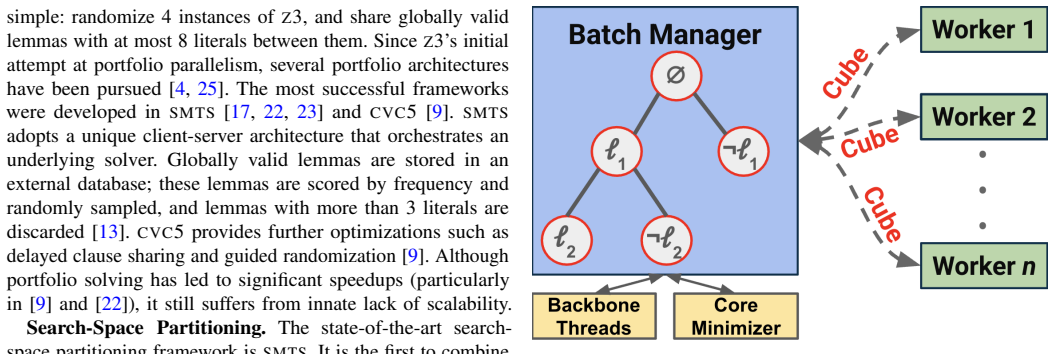
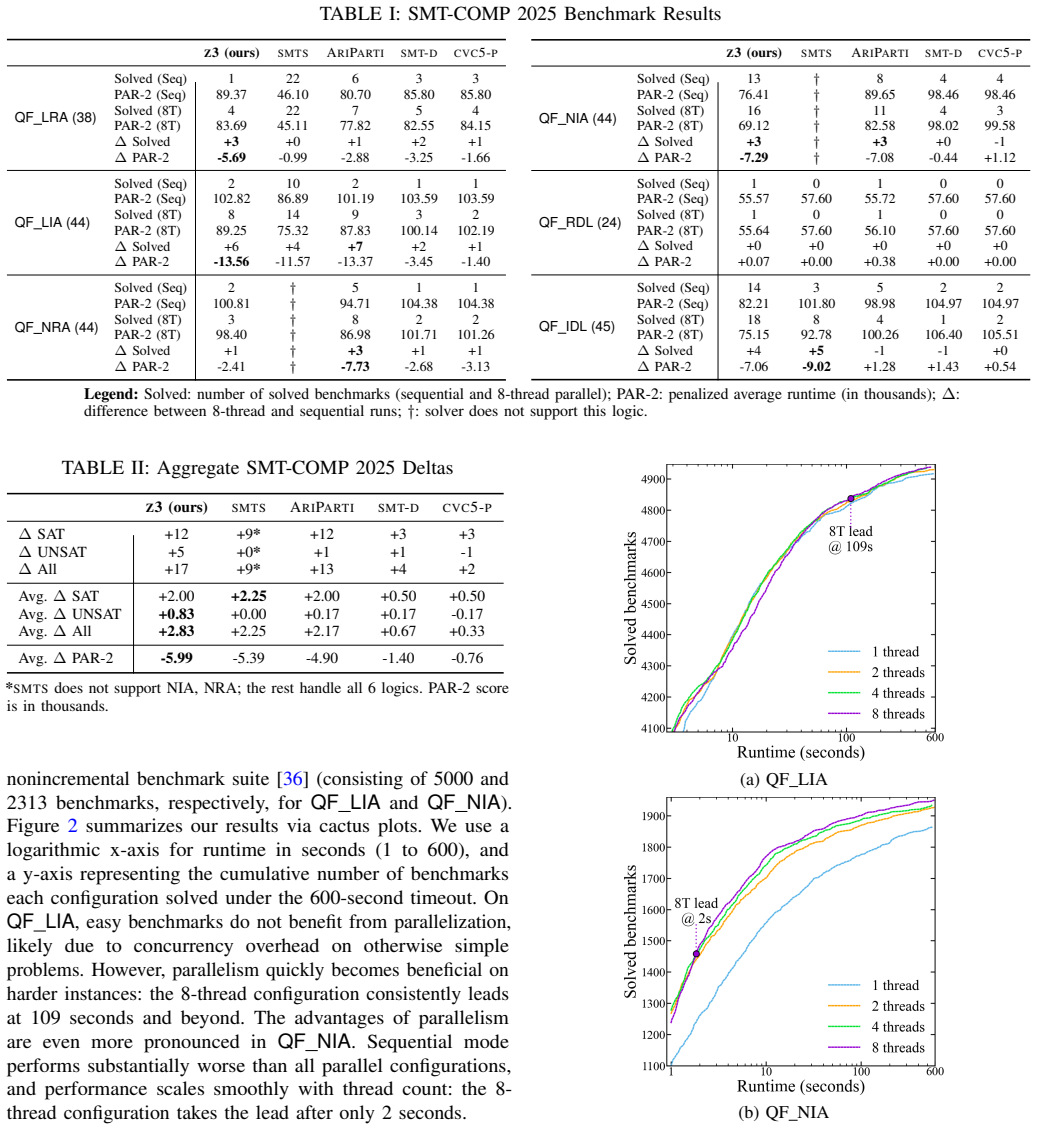
The central claim is that dynamically constructing a binary partition tree by sampling VSIDS statistics during solving, then continuously shrinking the tree through core-based CDCL pruning, while running online backbone detection inside each worker and using terminate-on-demand to drop pruned subproblems, produces a generalizable algorithm that scales with core count and outperforms both sequential Z3 and existing state-of-the-art parallel frameworks on challenging SMT-COMP 2025 benchmarks drawn from six logics.
What carries the argument
The dynamic binary partition tree of the search space, constructed from VSIDS sampling and pruned by learned cores.
If this is right
- The algorithm scales effectively with available processor cores.
- The framework remains generalizable across multiple SMT logics.
- Terminate-on-demand eliminates work on pruned subproblems without waiting for natural completion.
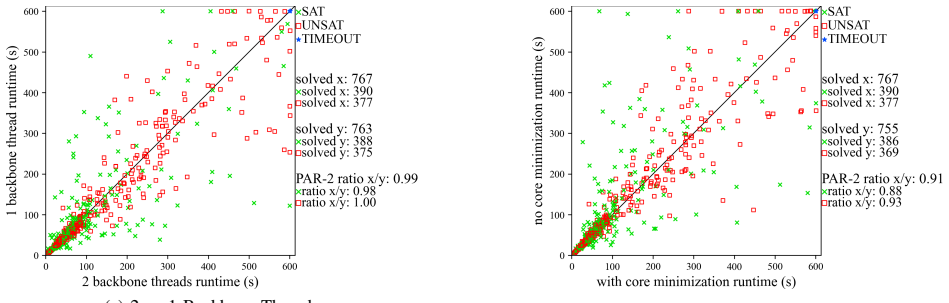
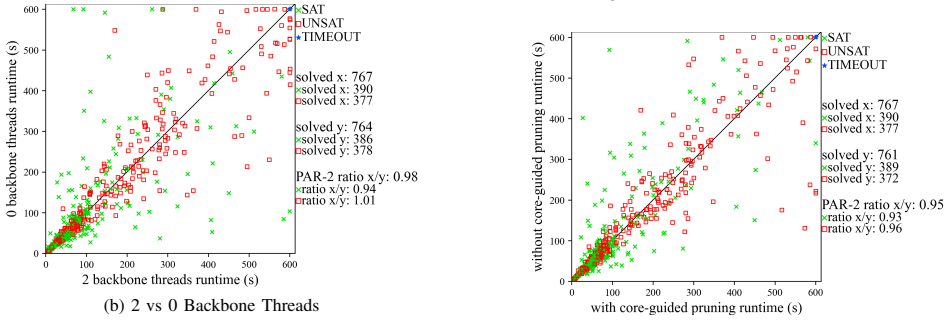
- Online backbone detection inside workers improves the quality of each partition.
- The same machinery outperforms both sequential Z3 and prior parallel SMT frameworks on the reported benchmarks.
Where Pith is reading between the lines
- The VSIDS-based partitioning idea could be tested in other CDCL solvers such as SAT or MaxSAT engines.
- Online backbone detection might deliver standalone gains even in sequential mode by identifying fixed literals earlier.
- If the pruning remains effective at larger core counts, the method could support distributed solving across clusters.
- The terminate-on-demand mechanism could reduce energy use by avoiding computation on provably irrelevant branches.
Load-bearing premise
That sampling VSIDS statistics from workers and pruning the resulting partition tree with cores produces net speedup that grows with core count rather than being dominated by overhead on the tested benchmarks.
What would settle it
If the Z3 implementation on the same SMT-COMP 2025 benchmarks shows no improvement or outright slowdown relative to sequential Z3 when run with four or more cores, the performance claim would be falsified.
Figures
read the original abstract
Exploiting parallelism in modern CPU architectures remains a longstanding challenge in optimizing SMT solvers. We introduce a novel parallel framework that dynamically builds a binary partition tree of the search space by sampling from workers' VSIDS statistics during solving. We leverage the full power of core-based CDCL-style pruning to continuously shrink the partition tree. We further optimize our architecture by incorporating online backbone detection into worker threads, as well as a terminate-on-demand mechanism to eagerly eliminate work on pruned subproblems. The resulting algorithm is highly generalizable and scales effectively with available resources. We implement our approach in the Z3 SMT solver and demonstrate that it outperforms both sequential Z3 and existing state-of-the-art parallel frameworks on challenging benchmarks from six logics in the SMT-COMP 2025 Parallel Track.
Editorial analysis
A structured set of objections, weighed in public.
Referee Report
Summary. The paper introduces a parallel SMT solving framework that dynamically builds a binary partition tree by sampling VSIDS statistics from worker threads during solving. It applies continuous core-guided CDCL-style pruning to shrink the tree, incorporates online backbone detection in workers, and uses a terminate-on-demand mechanism. The approach is implemented in Z3 and claims to outperform both sequential Z3 and existing parallel frameworks on challenging benchmarks from six logics in the SMT-COMP 2025 Parallel Track.
Significance. If the empirical claims hold with appropriate validation, this would be a meaningful contribution to parallel SMT solving by showing how dynamic partitioning can be combined with existing core-based pruning and backbone detection to achieve scalable speedups, potentially improving solver performance on multi-core hardware across multiple theories.
major comments (1)
- [Abstract] Abstract: The central claim of outperformance on SMT-COMP 2025 benchmarks from six logics is asserted without any reported metrics, baselines, error bars, ablation studies on VSIDS sampling overhead, pruning effectiveness, or scaling behavior with core count. This absence is load-bearing because the paper's contribution is presented as an empirical advance whose validity cannot be assessed from the given description.
minor comments (1)
- The manuscript would benefit from including pseudocode or a high-level algorithm description showing how VSIDS samples are converted into partition decisions and how cores are mapped back to tree pruning.
Simulated Author's Rebuttal
We thank the referee for their careful review and constructive feedback. We address the single major comment below and will incorporate revisions to strengthen the manuscript.
read point-by-point responses
-
Referee: [Abstract] Abstract: The central claim of outperformance on SMT-COMP 2025 benchmarks from six logics is asserted without any reported metrics, baselines, error bars, ablation studies on VSIDS sampling overhead, pruning effectiveness, or scaling behavior with core count. This absence is load-bearing because the paper's contribution is presented as an empirical advance whose validity cannot be assessed from the given description.
Authors: We agree that the abstract would be strengthened by including concrete quantitative support for the empirical claims. The full manuscript provides these details in the experimental evaluation (including direct comparisons to sequential Z3 and prior parallel solvers on the SMT-COMP 2025 Parallel Track benchmarks across the six logics, as well as analysis of scaling with core count). However, the abstract itself does not summarize the key metrics. We will revise the abstract to incorporate a concise summary of the main results (e.g., overall performance improvements and benchmark coverage) while remaining within length limits. Ablation studies and error bars appear in the body; we can add a brief reference to scaling behavior in the revised abstract if space allows. revision: yes
Circularity Check
No circularity: empirical implementation claim with no derivation chain or fitted quantities
full rationale
The paper describes an algorithmic approach to parallel SMT solving (dynamic binary partition trees from VSIDS sampling, core-based pruning, online backbone detection, terminate-on-demand) and reports an implementation in Z3 that outperforms sequential Z3 and prior parallel frameworks on SMT-COMP 2025 benchmarks across six logics. No equations, parameters, uniqueness theorems, or self-citations are invoked as load-bearing steps in any derivation. The central claim is purely empirical and externally benchmarked; it does not reduce any prediction or result to its own inputs by construction. This is the expected non-finding for an implementation-and-evaluation paper.
Axiom & Free-Parameter Ledger
Reference graph
Works this paper leans on
-
[1]
L. M. de Moura and N. S. Bjørner, “Z3: an efficient SMT solver,” inTools and Algorithms for the Construction and Analysis of Systems, 14th International Conference, TACAS 2008, Held as Part of the Joint European Conferences on Theory and Practice of Software, ETAPS 2008, Budapest, Hungary, March 29-April 6, 2008. Proceedings, ser. Lecture Notes in Compute...
-
[2]
cvc5: A versatile and industrial- strength smt solver,
H. Barbosa, C. Barrett, M. Brain, G. Kremer, H. Lachnitt, M. Mann, A. Mohamed, M. Mohamed, A. Niemetz, A. N¨otzli, A. Ozdemir, M. Preiner, A. Reynolds, Y . Sheng, C. Tinelli, and Y . Zohar, “cvc5: A versatile and industrial- strength smt solver,” inTools and Algorithms for the Construction and Analysis of Systems, D. Fisman and G. Rosu, Eds. Cham: Springe...
2022
-
[3]
Opensmt2: An SMT solver for multi-core and cloud computing,
A. E. J. Hyv ¨arinen, M. Marescotti, L. Alt, and N. Sharygina, “Opensmt2: An SMT solver for multi-core and cloud computing,” inTheory and Applications of Satisfiability Testing - SAT 2016 - 19th International Conference, Bordeaux, France, July 5-8, 2016, Proceedings, ser. Lecture Notes in Computer Science, N. Creignou and D. L. Berre, Eds. Springer, 2016,...
-
[5]
Cordeiro, Bernd Fischer, and João Marques-Silva
L. C. Cordeiro and B. Fischer, “Verifying multi-threaded software using smt-based context-bounded model checking,” inProceedings of the 33rd International Conference on Software Engineering, ICSE 2011, Waikiki, Honolulu , HI, USA, May 21-28, 2011, R. N. Taylor, H. C. Gall, and N. Medvidovic, Eds. ACM, 2011, pp. 331–340. [Online]. Available: https://doi.or...
-
[6]
Springer, 2014.doi: 10.1007/978-3-319-08867-9\_40
A. Komuravelli, A. Gurfinkel, and S. Chaki, “Smt-based model checking for recursive programs,” inComputer Aided Verification - 26th International Conference, CAV 2014, Held as Part of the Vienna Summer of Logic, VSL 2014, Vienna, Austria, July 18-22, 2014. Proceedings, ser. Lecture Notes in Computer Science, A. Biere and R. Bloem, Eds. Springer, 2014, pp....
-
[7]
Smt-boosted security types for low-level MPC,
C. Skalka and J. P. Near, “Smt-boosted security types for low-level MPC,” inProgramming Languages and Systems - 34th European Symposium on Programming, ESOP 2025, Held as Part of the International Joint Conferences on Theory and Practice of Software, ETAPS 2025, Hamilton, ON, Canada, May 3-8, 2025, Proceedings, Part II, ser. Lecture Notes in Computer Scie...
-
[8]
Synthesiz3 this: an smt-based approach for synthesis with uncomputable symbols,
P. Hozzov ´a and N. Bjørner, “Synthesiz3 this: an smt-based approach for synthesis with uncomputable symbols,” inProceedings of the 25th Conference on Formal Methods in Computer-Aided Design, FMCAD 2025, Menlo Park, CA, USA, October 6-10, 2025, A. Irfan and D. Kaufmann, Eds. TU Wien Academic Press, 2025. [Online]. Available: https://doi.org/10.34727/ 2025...
2025
-
[9]
SMT-D: new strategies for portfolio-based SMT solving,
C. W. Barrett, P. Chen, B. Cook, B. Dutertre, R. B. Jones, N. Le, A. Reynolds, K. Sheth, C. Stephens, and M. W. Whalen, “SMT-D: new strategies for portfolio-based SMT solving,” inFormal Methods in Computer-Aided Design, FMCAD 2024, Prague, Czech Republic, October 15-18, 2024, N. Narodytska and P. R ¨ummer, Eds. IEEE, 2024, pp. 1–10. [Online]. Available: h...
-
[10]
A concurrent portfolio approach to smt solving,
C. M. Wintersteiger, Y . Hamadi, and L. de Moura, “A concurrent portfolio approach to smt solving,” in Computer Aided Verification, A. Bouajjani and O. Maler, Eds. Berlin, Heidelberg: Springer Berlin Heidelberg, 2009, pp. 715–720
2009
-
[11]
A. E. J. Hyv ¨arinen and C. M. Wintersteiger, Parallel Satisfiability Modulo Theories. Cham: Springer International Publishing, 2018, pp. 141–178. [Online]. Available: https://doi.org/10.1007/978-3-319-63516-3 5
-
[13]
Parallel smt solving via iterative tree partitioning,
T. Kol ´arik, A. E. J. Hyv ¨arinen, S. Asadzadeh, and N. Sharygina, “Parallel smt solving via iterative tree partitioning,” inTACAS 2026, 2026
2026
-
[14]
Mariposa: Measuring SMT instability in automated program verification,
Y . Zhou, J. Bosamiya, Y . Takashima, J. Li, M. Heule, and B. Parno, “Mariposa: Measuring SMT instability in automated program verification,” inFormal Methods in Computer-Aided Design, FMCAD 2023, Ames, IA, USA, October 24-27, 2023, A. Nadel and K. Y . Rozier, Eds. IEEE, 2023, pp. 178–188. [Online]. Available: https: //doi.org/10.34727/2023/isbn.978-3-854...
-
[15]
Lookahead in partitioning SMT,
A. E. J. Hyv ¨arinen, M. Marescotti, and N. Sharygina, “Lookahead in partitioning SMT,” inFormal Methods in Computer Aided Design, FMCAD 2021, New Haven, CT, USA, October 19-22, 2021. IEEE, 2021, pp. 271–279. [Online]. Available: https://doi.org/10.34727/2021/isbn. 978-3-85448-046-4 37
-
[16]
Distributed smt solving based on dynamic variable-level partitioning,
M. Zhao, S. Cai, and Y . Qian, “Distributed smt solving based on dynamic variable-level partitioning,” inCom- puter Aided Verification, A. Gurfinkel and V . Ganesh, Eds. Cham: Springer Nature Switzerland, 2024, pp. 68–88
2024
-
[18]
Satisfiability modulo theories,
C. Barrett, R. Sebastiani, S. A. Seshia, and C. Tinelli, “Satisfiability modulo theories,” inHandbook of Satisfia- bility, 2nd ed., ser. Frontiers in Artificial Intelligence and Applications, A. Biere, M. J. H. Heule, H. van Maaren, and T. Walsh, Eds. IOS Press, Feb. 2021, vol. 336, ch. 33, pp. 825–885
2021
-
[19]
R. Nieuwenhuis, A. Oliveras, and C. Tinelli, “Solving SAT and SAT modulo theories: From an abstract davis–putnam–logemann–loveland procedure to dpll(T),” J. ACM, vol. 53, no. 6, pp. 937–977, 2006. [Online]. Available: https://doi.org/10.1145/1217856.1217859
-
[20]
GRASP: A search algorithm for propositional satisfiability,
J. P. M. Silva and K. A. Sakallah, “GRASP: A search algorithm for propositional satisfiability,”IEEE Trans. Computers, vol. 48, no. 5, pp. 506–521, 1999. [Online]. Available: https://doi.org/10.1109/12.769433
-
[21]
Hordesat: A massively parallel portfolio SAT solver,
T. Balyo, P. Sanders, and C. Sinz, “Hordesat: A massively parallel portfolio SAT solver,” inTheory and Applications of Satisfiability Testing - SAT 2015 - 18th International Conference, Austin, TX, USA, September 24-27, 2015, Proceedings, ser. Lecture Notes in Computer Science, M. Heule and S. A. Weaver, Eds. Springer, 2015, pp. 156–172. [Online]. Availab...
-
[22]
Clause sharing and partitioning for cloud-based SMT solving,
M. Marescotti, A. E. J. Hyv ¨arinen, and N. Sharygina, “Clause sharing and partitioning for cloud-based SMT solving,” inAutomated Technology for Verification and Analysis - 14th International Symposium, ATVA 2016, Chiba, Japan, October 17-20, 2016, Proceedings, ser. Lecture Notes in Computer Science, C. Artho, A. Legay, and D. Peled, Eds., 2016, pp. 428–4...
-
[23]
SMTS: distributed, visualized constraint solving,
M. Marescotti, A. E. J. Hyv ¨arinen, and N. Sharygina, “SMTS: distributed, visualized constraint solving,” in LPAR-22. 22nd International Conference on Logic for Pro- gramming, Artificial Intelligence and Reasoning, Awassa, Ethiopia, 16-21 November 2018, 2018
2018
-
[24]
Partitioning search spaces of a randomized search,
A. E. J. Hyv ¨arinen, T. A. Junttila, and I. Niemel ¨a, “Partitioning search spaces of a randomized search,” Fundam. Informaticae, vol. 107, no. 2-3, pp. 289– 311, 2011. [Online]. Available: https://doi.org/10.3233/ FI-2011-404
2011
-
[25]
Weber, “Par4,” Uppsala University, Tech
T. Weber, “Par4,” Uppsala University, Tech. Rep., 2019. [Online]. Available: http://smt2019.galois.com/papers/ tool paper 9.pdf
2019
-
[26]
A distribution method for solving SAT in grids,
A. E. J. Hyv ¨arinen, T. A. Junttila, and I. Niemel ¨a, “A distribution method for solving SAT in grids,” in Theory and Applications of Satisfiability Testing - SAT 2006, 9th International Conference, Seattle, WA, USA, August 12-15, 2006, Proceedings, ser. Lecture Notes in Computer Science, A. Biere and C. P. Gomes, Eds. Springer, 2006, pp. 430–435. [Onli...
-
[27]
Problem partitioning via proof prefixes,
Z. Battleman, J. E. Reeves, and M. J. H. Heule, “Problem partitioning via proof prefixes,” in28th International Conference on Theory and Applications of Satisfiability Testing, SAT 2025, Glasgow, Scotland, August 12-15, 2025, ser. LIPIcs, J. Berg and J. Nordstr ¨om, Eds. Schloss Dagstuhl - Leibniz-Zentrum f ¨ur Informatik, 2025, pp. 3:1–3:18. [Online]. Av...
2025
-
[28]
Massively parallel bit-precise verification with bitwuzla and mallob,
D. Schreiber, A. Niemetz, and M. Preiner, “Massively parallel bit-precise verification with bitwuzla and mallob,” inTools and Algorithms for the Construction and Analysis of Systems, S. Junges and G. Katz, Eds. Cham: Springer Nature Switzerland, 2026, pp. 170–191
2026
-
[29]
PBoolector: A Parallel SMT Solver for QF BV by Combining Bit-Blasting with Look- Ahead,
C. Reisenberger, “PBoolector: A Parallel SMT Solver for QF BV by Combining Bit-Blasting with Look- Ahead,” Master’s thesis, Johannes Kepler University Linz, 2014. [Online]. Available: https://fmv.jku.at/master/ Reisenberger-MasterThesis-2014.pdf
2014
-
[30]
Minimal unsatisfiable core extraction for SMT,
O. Guthmann, O. Strichman, and A. Trostanetski, “Minimal unsatisfiable core extraction for SMT,” in2016 Formal Methods in Computer-Aided Design, FMCAD 2016, Mountain View, CA, USA, October 3-6, 2016, R. Piskac and M. Talupur, Eds. IEEE, 2016, pp. 57–
2016
-
[31]
[JBDM13] Dejan Jovanovic, Clark Barrett, and Leonardo De Moura
[Online]. Available: https://doi.org/10.1109/FMCAD. 2016.7886661
-
[32]
Algorithms for computing backbones of propositional formulae,
M. Janota, I. Lynce, and J. Marques-Silva, “Algorithms for computing backbones of propositional formulae,”AI Commun., vol. 28, no. 2, pp. 161–177, 2015. [Online]. Available: https://doi.org/10.3233/AIC-140640
-
[33]
Improvements to propositional satisfia- bility search algorithms,
J. W. Freeman, “Improvements to propositional satisfia- bility search algorithms,” Ph.D. dissertation, University of Pennsylvania, 1995
1995
-
[34]
SMT-COMP 2025,
M. Jon ´aˇs, F. Bobot, D. D ´eharbe, and D. Winterer, “SMT-COMP 2025,” 2025, chair: Martin Jon ´aˇs, Masaryk University, Czechia
2025
-
[35]
N. Froleyks, M. Heule, A. Iser, M. J ¨arvisalo, and M. Suda, “SAT competition 2020,”Artif. Intell., vol. 301, p. 103572, 2021. [Online]. Available: https://doi.org/10.1016/j.artint.2021.103572
-
[36]
The smt-lib standard: Version 2.6,
C. Barrett, P. Fontaine, and C. Tinelli, “The smt-lib standard: Version 2.6,” Department of Computer Science, The University of Iowa, Tech. Rep., 2017. [Online]. Available: https://smt-lib.org
2017
-
[37]
SMT-LIB release 2025 (non-incremental benchmarks) (version 2025.08.04),
M. Preiner, H. Schurr, C. W. Barrett, P. Fontaine, A. Niemetz, and C. Tinelli, “SMT-LIB release 2025 (non-incremental benchmarks) (version 2025.08.04),” https://doi.org/10.5281/zenodo.16740866, Aug. 2025, accessed on YYYY-MM-DD. [Online]. Available: https://doi.org/10.5281/zenodo.16740866
-
[38]
——, “SMT-LIB release 2024 (non-incremental benchmarks),” https://doi.org/10.5281/zenodo.11061097, Apr. 2024, accessed on YYYY-MM-DD. [Online]. Available: https://doi.org/10.5281/zenodo.11061097 APPENDIX OurSMTSsetup uses the iterative tree partitioning algorithm from [ 13] using OPENSMT as the base solver with T= 8 parallel solver instances, and with part...
discussion (0)
Sign in with ORCID, Apple, or X to comment. Anyone can read and Pith papers without signing in.