REVIEW 2 major objections 5 minor 75 references
Singlet Pathway to the Ground State of Ultracold Polar Molecules
T0 review · 2 major / 5 minor · reviewed 2026-08-14 · deepseek-v4-flash
Pith's one-line read This paper demonstrates that a stretched hyperfine component of a Feshbach molecule, addressed with $\sigma^-$ light, creates an ideal three-level system for transferring ultracold molecules to their ground state.
desk verdict A clean singlet-only two-photon route to the 6Li40K ground state, demonstrated spectroscopically, with the caveat that no STIRAP transfer is shown and the 'ideal three-level' claim rests on a resolution-limited null hyperfine result. read the letter →
The pith
A machine-rendered reading of the paper's core claim, the machinery that carries it, and where it could break.
The reading
What carries the argument
The central object is a stretched hyperfine component: a molecular state in which all nuclear spin projections take their maximum value, so that dipole selection rules permit only one hyperfine component to be reached. For the Feshbach state at 21.56 mT, the only singlet closed-channel component is $|0,0,-1,-4\rangle$, fully stretched in the $^{40}$K and $^{6}$Li projections; with $\sigma^-$ light the only addressable excited hyperfine component is $|F'=6, m'_F=-6\rangle$, and similarly only one ground-state component is reached. The authors combine this selection with deeply bound $A{}^1\Sigma^+$ vibrational states, whose Franck-Condon factors give large and balanced Rabi frequencies for both pump and Stokes transitions, making a fast STIRAP transfer possible.
What would settle it
A high-resolution scan of the $A{}^1\Sigma^+|v'=23\rangle$ transition with linewidth well below 5 MHz would settle the matter: if hyperfine components beyond the single stretched line appear, or a line splitting close to the estimated 590 kHz quadrupole span is resolved, the singlet-only premise is falsified.
Extended reading notes
Core claim
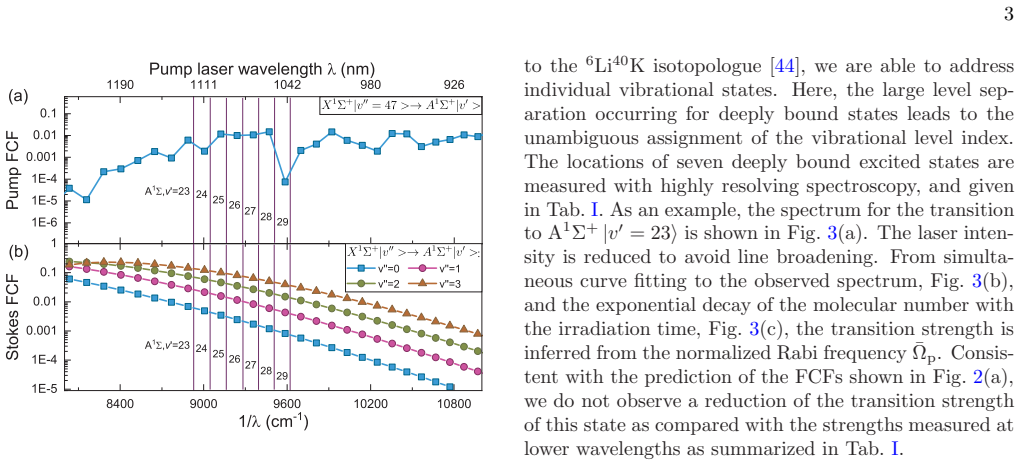
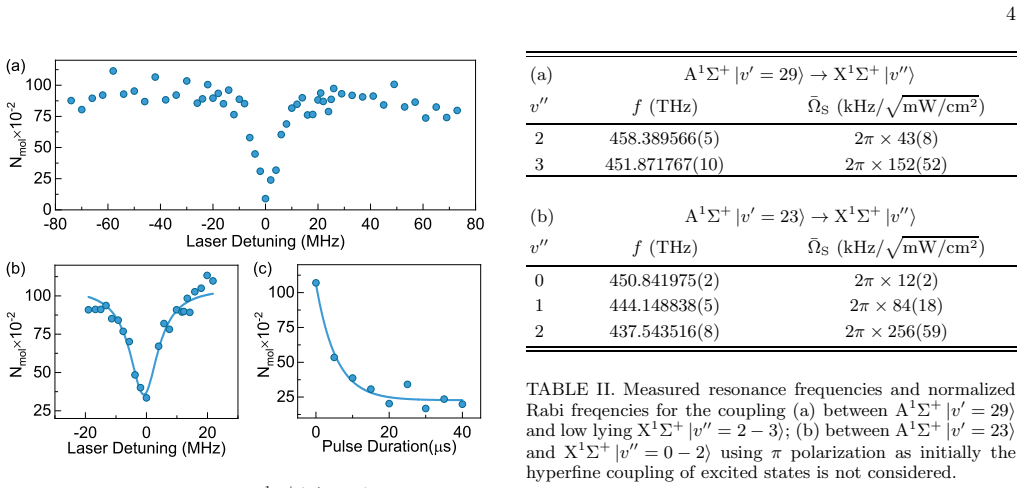
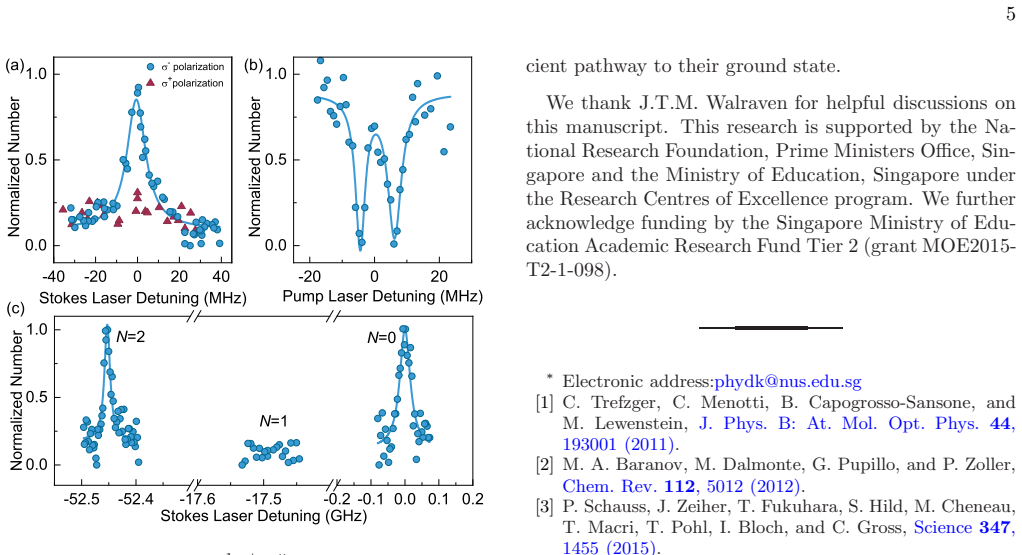
The paper reports a two-photon route to the $X{}^1\Sigma^+$ rovibrational ground state of $^6\mathrm{Li}^{40}\mathrm{K}$ that uses only singlet-to-singlet transitions. Starting from a Feshbach resonance at 21.56 mT whose closed channel contains a single stretched singlet hyperfine component, the authors apply $\sigma^-$ polarized light so that, even with unresolved hyperfine structure, only the stretched state $|F'=6, m'_F=-6\rangle$ of the $A{}^1\Sigma^+$ intermediate potential is addressed. They identify seven deeply bound $A{}^1\Sigma^+$ vibrational levels ($v'=23$ to 29), find no hyperfine structure over a 160 MHz scan at 5 MHz linewidth, and use two-photon spectroscopy through $v'=23$ to reach $X{}^1\Sigma^+$ $v''=0$, with an Autler-Townes splitting indicating a Stokes Rabi frequency around $2\pi\times 8$ MHz. The measured rotational spacing gives $B_0 = h\times 8.742(3)$ GHz, confirming the ground-state assignment. The paper concludes that this establishes an ideal three-level system, robust against off-resonant hyperfine coupling, and that the method can be extended to other molecular species.
Load-bearing premise
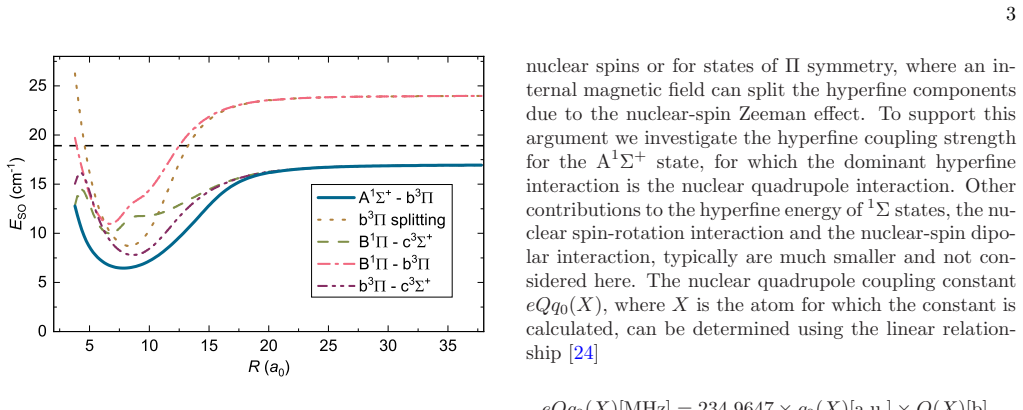
The load-bearing premise is that the deeply bound $A{}^1\Sigma^+$ levels used here are effectively free of $b{}^3\Pi$ spin-orbit mixing, so the intermediate state really is singlet-only and the stretched-state selection argument holds.
Editorial extensions
If this is right
- STIRAP to the $v''=0$ ground state no longer requires a spectroscopically resolved hyperfine structure or an intermediate state with large singlet-triplet mixing.
- Because only one hyperfine component of the ground state is addressed, off-resonant coupling to other hyperfine components, and the resulting incoherent superpositions, is suppressed.
- Deeply bound $A{}^1\Sigma^+$ states give pump and Stokes Rabi frequencies of the same order ($\sim 2\pi\times 8$ MHz for the Stokes beam) with moderate power, making a fast two-photon transfer feasible.
- The measured ground-state rotational constant $B_0 = h\times 8.742(3)$ GHz provides a benchmark for the $X{}^1\Sigma^+$ potential of $^6\mathrm{Li}^{40}\mathrm{K}$.
- The extension to other species follows where a Feshbach state with a stretched singlet component exists, such as LiCs or KCs, and possibly to doublet molecules.
Reading between the lines
- Because the scheme's pump strength scales with the singlet admixture of the chosen Feshbach state, a natural extension is to search for resonances with larger singlet admixture than the 52% modeled here, which would directly increase the transfer speed.
- The stretched-state selection rule should be transferable to molecules with doublet electronic structure; a concrete test would be to compute whether proposed Feshbach resonances in LiYb, RbSr, or CsYb have a closed-channel component that is fully stretched in the nuclear-spin projections.
- If the intermediate state is indeed a pure singlet, the two-photon coherence should be limited mainly by laser linewidth and spontaneous emission rather than unresolved hyperfine channels; measuring STIRAP transfer efficiency as a function of Stokes detuning would test this prediction.
Signed reviews
Editorial analysis
A structured set of objections, weighed in public.
Referee Report
Summary. The paper presents a two-photon optical pathway from weakly bound Feshbach molecules to the rovibrational ground state of 6Li40K using only singlet-to-singlet transitions. Starting from a Feshbach state at 21.56 mT identified with a 52% singlet admixture, the authors use σ− polarized light to address the unique stretched hyperfine component of both the A1Σ+ intermediate state and the X1Σ+ ground state, thereby bypassing the usual need to resolve the hyperfine structure of a mixed singlet-triplet intermediate state. They report one-photon spectra of seven deeply bound A1Σ+ vibrational levels (v′ = 23–29), two-photon spectra connecting A1Σ+ to low-lying X1Σ+ levels including v′′ = 0, Autler-Townes measurements, polarization control, and a rotational constant B0 = h × 8.742(3) GHz. The paper concludes that an ideal three-level system is established and that the measured Rabi frequencies are favorable for a fast STIRAP transfer.
Significance. If the central claim holds, this is a useful and timely alternative to the mixed-state STIRAP routes used for KRb and other bi-alkali molecules. The demonstration that a stretched singlet Feshbach component plus polarization selection can address a single hyperfine component without resolving the excited-state hyperfine structure is conceptually clean and may simplify ground-state production for species with unfavorable singlet-triplet mixing. The paper is strong on experimental specifics: transition frequencies are measured with 1 MHz accuracy, normalized Rabi frequencies are quoted for both pump and Stokes legs, polarization dependence is shown, and the rotational constant is independently inferred. The mass-scaled Dunham assignment and the Franck-Condon/TDM calculations provide testable predictions for the relative strengths. The main limitations are that no actual STIRAP transfer or ground-state molecule production is demonstrated, and the evidence that the A1Σ+ levels are free of b3Π perturbation is resolution-limited.
major comments (2)
- [Main text, 'An important feature of all observed lines...' and Supplemental Material, 'Spin-orbit coupling'] The exclusion of b3Π perturbation of the A1Σ+ levels rests on a null hyperfine-structure observation at a 5 MHz linewidth over a 160 MHz scan (Fig. 3(a)), while the same paragraph states that the A-state quadrupole hyperfine span is only 590 kHz. A small triplet admixture producing hyperfine splittings below 5 MHz would therefore be invisible in the data, and the supplement explicitly acknowledges that ab initio potentials cannot predict which A1Σ+ levels mix with b3Π. Because the paper's central claim of an 'ideal three-level system' depends on the intermediate state being effectively a pure singlet with a single M' = -6 channel, this evidence is not sufficient as stated. Please provide a quantitative upper bound on the spin-orbit admixture for v' = 23–29 (for example from the MOLPRO spin-orbit curve and the computed energy separations to b3Π levels), or alternatively rephrase the claim and quantify how a small unresolved admixture would affect the STIRAP efficiency.
- [Entire manuscript, esp. Figs. 3–4 and concluding paragraph] The paper reports two-photon spectroscopy and Autler-Townes splitting but does not demonstrate an actual STIRAP transfer or the production of ground-state molecules. The abstract's phrase 'demonstrate a two-photon pathway to the dipolar ground state' and the conclusion's 'we demonstrated a pathway to access the rovibrational ground state' go beyond what is shown if they are read as claiming a population transfer. I ask the authors to either add a STIRAP transfer result or explicitly state that the demonstrated milestone is the spectroscopic identification and characterization of the two-photon transition, and to indicate the expected transfer efficiency based on the measured ΩP and ΩS.
minor comments (5)
- [Supplemental Material, 'Asymptotic-Bound-State Model'] The phrase 'using the binding energies of the weakest bound states determined by this work' should make explicit that the weakest-level energy is a fitted parameter adjusted to match the resonance position, rather than an independently measured quantity.
- [Table II heading] There is a typographical error in the heading: 'normalized Rabi freqencies' should be 'normalized Rabi frequencies.'
- [Main text, discussion of rotational selection] The sentence 'the quantum number N for molecular rotation is not conserved' is confusing; for 1Σ states J = N, so the intended point is simply that the J'' = 0 to J' = 0 transition is forbidden and thus only N' = 1 levels are accessible. Consider clarifying the wording.
- [Main text, footnote [44]] The footnote states 'mass scaling of spectroscopic data of [22]', but reference [22] is a laser-cooling paper, not the heat-pipe polarization labeling spectroscopy used for the Dunham coefficients; the correct citation appears to be [45] (Grochola et al.).
- [Figure 2 and Tables I–II] The agreement between measured normalized Rabi frequencies and the FCF predictions is asserted but not quantified. Including a plot or a table of measured Ω̄ versus predicted FCF with uncertainties would make the comparison more convincing.
Circularity Check
No significant circularity: the polarization-selection argument is angular-momentum algebra, and quantitative predictions are checked against independent external data.
full rationale
The paper's central claim, that starting from a stretched Feshbach singlet component and using σ− light addresses only the |F′=6,m′F=−6⟩ component of A1Σ+, is derived from angular momentum selection rules in the main text. The same argument restricts the Stokes step to the stretched X1Σ+ hyperfine component; this is a Wigner-Eckart consequence, not an input. The only fitted model input, the ABM binding energy, is used to estimate a 52% singlet admixture, but the stretched-state selection does not require that value: the unique singlet |0,0,−1,−4⟩ exists by conservation of M=−5 and the nuclear spins, and the paper states this before invoking the ABM. The measured A1Σ+ line positions are compared with independent mass-scaled Dunham predictions from heat-pipe spectroscopy and with Tiemann et al., with deviations within stated uncertainties; the measured Rabi frequencies are compared with independently computed Franck-Condon factors and ab initio transition dipole moments, not with values fitted to those same measurements. The exclusion of b3Π perturbation rests on a resolution-limited empirical null result (160 MHz scan at 5 MHz linewidth) and the supplement explicitly notes that ab initio PECs are not accurate enough to predict where mixed states occur; this is a limitation in evidence strength, not a circular step. Self-citations [40,41,47] concern apparatus, molecule association, and laser frequency stabilization, and are not load-bearing for the derivation of the three-level selection or the ground-state energy.
Assumptions & free parameters
free parameters (1)
- ABM weakest-bound-level energy =
not stated; adjusted to reproduce the 21.56 mT Feshbach resonance
assumptions (6)
- domain assumption Narrow-resonance approximation: coupling between closed molecular channel and entrance channel is negligible for 6Li-40K Feshbach resonances.
- domain assumption Mass-scaled Dunham expansion from 7Li39K predicts 6Li40K A1Σ+ vibrational energies within the stated 6-10 GHz uncertainty.
- domain assumption The A1Σ+ transition dipole moment is nearly constant over the relevant internuclear separation range.
- domain assumption Nuclear quadrupole interaction dominates A1Σ+ hyperfine structure, with 40K quadrupole constant about 2.97 MHz, giving an unresolved hyperfine span below the 5 MHz linewidth.
- standard math Angular momentum selection rules for σ− polarized light from a stretched F''=5, m''=-5 state allow only F'=6, m'=-6 in the excited state.
- domain assumption Deeply bound A1Σ+ levels are not significantly mixed with b3Π levels at the measured wavelengths.
Cite this review
Pith. "Pith review of Singlet Pathway to the Ground State of Ultracold Polar Molecules." pith.science (2026). https://pith.science/paper/IPLWYMYO
@misc{pith2026190802703,
  author       = {Pith},
  title        = {Pith review of: Singlet Pathway to the Ground State of Ultracold Polar Molecules},
  year         = {2026},
  howpublished = {\url{https://pith.science/paper/IPLWYMYO}},
  note         = {Machine review of arXiv:1908.02703}
}
abstract
Starting from weakly bound Feshbach molecules, we demonstrate a two-photon pathway to the dipolar ground state of bi-alkali molecules that involves only singlet-to-singlet optical transitions. This pathway eliminates the search for a suitable intermediate state with sufficient singlet-triplet mixing and the exploration of its hyperfine structure, as is typical for pathways starting from triplet dominated Feshbach molecules. By selecting a Feshbach state with a stretched singlet hyperfine component and controlling the polarization of the excitation laser, we assure coupling to only a single hyperfine component of the $\textrm{A}^{1}\Sigma^{+}$ excited potential, even if the hyperfine structure is not resolved. Similarly, we address a stretched hyperfine component of the $\textrm{X}^{1}\Sigma^{+}$ rovibrational ground state, and therefore an ideal three level system is established. We demonstrate this pathway with ${}^{6}\textrm{Li}{}^{40}\textrm{K}$ molecules. By exploring deeply bound states of the $\textrm{A}^{1}\Sigma^{+}$ potential, we are able to obtain large and balanced Rabi frequencies for both transitions. This method can be applied to other molecular species.
Figures

Figures from the paper (4 more)


Reference graph
Works this paper leans on
-
[1]
For addressing the X1Σ + rovibrational ground state of the molecules, the A1Σ + potential is explored to search for a suitable in- termediate state. Here, we demonstrate that by making use of deeply bound vibrational states in this potential, we are able to achieve sufficient Franck-Condon factors (FCF) to the ground state with moderate laser powers. The us...
-
[2]
C. Trefzger, C. Menotti, B. Capogrosso-Sansone, and M. Lewenstein, J. Phys. B: At. Mol. Opt. Phys. 44, 193001 (2011)
work page 2011
-
[3]
M. A. Baranov, M. Dalmonte, G. Pupillo, and P. Zoller, Chem. Rev. 112, 5012 (2012)
2012
-
[4]
Schauss, J
P. Schauss, J. Zeiher, T. Fukuhara, S. Hild, M. Cheneau, T. Macri, T. Pohl, I. Bloch, and C. Gross, Science 347, 1455 (2015)
2015
- [5]
-
[6]
B¨ ottcher, J.-N
F. B¨ ottcher, J.-N. Schmidt, M. Wenzel, J. Hertkorn, M. Guo, T. Langen, and T. Pfau, Phys. Rev. X 9, 011051 (2019)
2019
-
[7]
Chomaz, D
L. Chomaz, D. Petter, P. Ilzh¨ ofer, G. Natale, A. Traut- mann, C. Politi, G. Durastante, R. M. W. van Bijnen, A. Patscheider, M. Sohmen, M. J. Mark, and F. Ferlaino, Phys. Rev. X 9, 021012 (2019)
2019
-
[8]
Micheli, G
A. Micheli, G. K. Brennen, and P. Zoller, Nat. Phys. 2, 341 (2006)
2006
Show all 75 references
-
[9]
Gadway and B
B. Gadway and B. Yan, J. Phys. B: At. Mol. Opt. Phys. 49, 152002 (2016)
2016
-
[10]
DeMille, Phys
D. DeMille, Phys. Rev. Lett. 88, 067901 (2002)
2002
-
[11]
S. F. Yelin, K. Kirby, and R. Cˆ ot´ e, Phys. Rev. A 74, 050301(R) (2006)
2006
-
[12]
Andr´ e, D
A. Andr´ e, D. DeMille, J. M. Doyle, M. D. Lukin, S. E. Maxwell, P. Rabl, R. J. Schoelkopf, and P. Zoller, Nature Phys. 2, 636 (2006)
2006
-
[13]
Kozlov and L
M. Kozlov and L. Labzowsky, J. Phys. B: At. Mol. Opt. Phys. 28, 1933 (1995)
1995
-
[14]
E. R. Hudson, H. J. Lewandowski, B. C. Sawyer, and J. Ye, Phys. Rev. Lett. 96, 143004 (2006)
2006
-
[15]
Andreev, D
V. Andreev, D. G. Ang, D. DeMille, J. M. Doyle, G. Gabrielse, J. Haefner, N. R. Hutzler, Z. Lasner, C. Meisenhelder, B. R. O’Leary, C. D. Panda, A. D. West, E. P. West, X. Wu, and A. Collaboration, Nature 562, 355 (2018)
2018
-
[16]
L. D. Carr, D. DeMille, R. V. Krems, and J. Ye, New J. Phys. 11, 055049 (2009)
2009
-
[17]
M. T. Bell and T. P. Softley, Mol. Phys. 107, 99 (2009)
2009
-
[18]
Qu´ em´ ener and P
G. Qu´ em´ ener and P. S. Julienne,Chem. Rev. 112, 4949 (2012)
2012
-
[19]
D. S. Jin and J. Ye, Chem. Rev. 112, 4801 (2012)
2012
-
[20]
Wynar, R
R. Wynar, R. Freeland, D. Han, C. Ryu, and D. Heinzen, Science 287, 1016 (2000)
2000
-
[21]
Bethlem, G
H. Bethlem, G. Berden, F. Crompvoets, R. Jongma, A. van Roij, and G. Meijer, Nature 406, 491 (2000)
2000
-
[22]
S. D. Kraft, P. Staanum, J. Lange, L. Vogel, R. Wester, 6 and M. Weidemueller, J. Phys. B: At. Mol. Opt. Phys. 39, S993 (2006)
2006
-
[23]
E. S. Shuman, J. F. Barry, and D. DeMille, Nature 467, 820 (2010)
2010
-
[24]
Anderegg, B
L. Anderegg, B. L. Augenbraun, Y. Bao, S. Burchesky, L. W. Cheuk, W. Ketterle, and J. M. Doyle, Nat. Phys. 14, 890 (2018)
2018
-
[25]
K¨ ohler, K
T. K¨ ohler, K. G´ oral, and P. S. Julienne,Rev. Mod. Phys. 78, 1311 (2006)
2006
-
[26]
N. V. Vitanov, A. A. Rangelov, B. W. Shore, and K. Bergmann, Rev. Mod. Phys. 89, 015006 (2017)
2017
-
[27]
K. K. Ni, S. Ospelkaus, M. H. G. de Miranda, A. Pe’er, B. Neyenhuis, J. J. Zirbel, S. Kotochigova, P. S. Julienne, D. S. Jin, and J. Ye, Science 322, 231 (2008)
2008
-
[28]
Takekoshi, L
T. Takekoshi, L. Reichs¨ ollner, A. Schindewolf, J. M. Hut- son, C. R. Le Sueur, O. Dulieu, F. Ferlaino, R. Grimm, and H.-C. N¨ agerl, Phys. Rev. Lett. 113, 205301 (2014)
2014
-
[29]
P. K. Molony, P. D. Gregory, Z. Ji, B. Lu, M. P. K¨ oppinger, C. R. Le Sueur, C. L. Blackley, J. M. Hutson, and S. L. Cornish, Phys. Rev. Lett. 113, 255301 (2014)
2014
-
[30]
J. W. Park, S. A. Will, and M. W. Zwierlein, Phys. Rev. Lett. 114, 205302 (2015)
2015
-
[31]
M. Guo, B. Zhu, B. Lu, X. Ye, F. Wang, R. Vex- iau, N. Bouloufa-Maafa, G. Qu´ em´ ener, O. Dulieu, and D. Wang, Phys. Rev. Lett. 116, 205303 (2016)
2016
-
[32]
De Marco, G
L. De Marco, G. Valtolina, K. Matsuda, W. G. Tobias, J. P. Covey, and J. Ye, Science 363, 853 (2019)
2019
-
[33]
N. V. Vitanov and S. Stenholm, Phys. Rev. A 60, 3820 (1999)
1999
-
[34]
Kotochigova, E
S. Kotochigova, E. Tiesinga, and P. S. Julienne, New J. Phys. 11, 055043 (2009)
2009
-
[35]
Debatin, T
M. Debatin, T. Takekoshi, R. Rameshan, L. Reichsoell- ner, F. Ferlaino, R. Grimm, R. Vexiau, N. Bouloufa, O. Dulieu, and H.-C. N¨ agerl, Phys. Chem. Chem. Phys. 13, 18926 (2011)
2011
-
[36]
Zabawa, A
P. Zabawa, A. Wakim, M. Haruza, and N. P. Bigelow, Phys. Rev. A 84, 061401(R) (2011)
2011
-
[37]
J. W. Park, S. A. Will, and M. W. Zwierlein, New J. Phys. 17, 075016 (2015)
2015
-
[38]
M. Guo, R. Vexiau, B. Zhu, B. Lu, N. Bouloufa-Maafa, O. Dulieu, and D. Wang, Phys. Rev. A 96, 052505 (2017)
2017
-
[39]
T. M. Rvachov, H. Son, J. J. Park, S. Ebadi, M. W. Zwierlein, W. Ketterle, and A. O. Jamison, Phys. Chem. Chem. Phys. 20, 4739 (2018)
2018
-
[40]
Liu, D.-C
L. Liu, D.-C. Zhang, H. Yang, Y.-X. Liu, J. Nan, J. Rui, B. Zhao, and J.-W. Pan, Phys Rev. Lett. 122, 253201 (2019)
2019
-
[41]
Taglieber, A.-C
M. Taglieber, A.-C. Voigt, T. Aoki, T. W. H¨ ansch, and K. Dieckmann, Phys. Rev. Lett. 100, 010401 (2008)
2008
-
[42]
Voigt, M
A.-C. Voigt, M. Taglieber, L. Costa, T. Aoki, W. Wieser, T. W. H¨ ansch, and K. Dieckmann, Phys. Rev. Lett. 102, 020405 (2009)
2009
-
[44]
T. G. Tiecke, M. R. Goosen, J. T. M. Walraven, and S. J. J. M. F. Kokkelmans, Phys. Rev. A 82, 042712 (2010)
2010
-
[45]
See Supplemental Material at [URL will be inserted by publisher] for details on our asymptotic bound state cal- culation, mass scaling of spectroscopic data of [22], and calculations of the Franck-Condon factors, hyperfine cou- pling constants, spin-orbit coupling constants, an...
-
[48]
J. F. S. Brachmann, T. Kinder, and K. Dieckmann, Appl. Opt. 51, 5517 (2012) . arXiv:1908.02703v1 [cond-mat.quant-gas] 7 Aug 2019 Supplemental Material: Singlet Pathway to the Ground State of Ultracold Polar Molecules A. Yang,1 S. Botsi, 1 S. Kumar, 1 S. B. Pal, 1 M. M. Lam, 1 ...
2012 arXiv
-
[49]
This represents a favorable condition for a strong transition to excited electronic states of singlet character, in particular the A 1Σ + state
While at zero magnetic field the state has only triplet character, at the location of the resonance the admixture of the singlet state is 52%. This represents a favorable condition for a strong transition to excited electronic states of singlet character, in particular the A 1Σ...
-
[50]
A. J. Moerdijk, B. J. Verhaar, and A. Axelsson, Phys. Rev. A 51, 4852 (1995)
1995
-
[51]
Wille, F
E. Wille, F. M. Spiegelhalder, G. Kerner, D. Naik, A. Trenkwalder, G. Hendl, F. Schreck, R. Grimm, T. G. Tiecke, J. T. M. Walraven, S. J. J. M. F. Kokkelmans, E. Tiesinga, and P. S. Julienne, Phys. Rev. Lett. 100, 053201 (2008)
2008
-
[52]
T. G. Tiecke, M. R. Goosen, J. T. M. Walraven, and S. J. J. M. F. Kokkelmans, Phys. Rev. A 82, 042712 (2010) . 4
2010
-
[53]
T. G. Tiecke, M. R. Goosen, A. Ludewig, S. D. Gense- mer, S. Kraft, S. J. J. M. F. Kokkelmans, and J. T. M. Walraven, Phys. Rev. Lett. 104, 053202 (2010)
2010
-
[54]
Pires, M
R. Pires, M. Repp, J. Ulmanis, E. D. Kuhnle, M. Wei- dem¨ uller, T. G. Tiecke, C. H. Greene, B. P. Ruzic, J. L. Bohn, and E. Tiemann, Phys. Rev. A 90, 012710 (2014)
2014
-
[55]
Z. Li, S. Singh, T. V. Tscherbul, and K. W. Madison, Phys. Rev. A 78, 022710 (2008)
2008
-
[56]
J. W. Park, C.-H. Wu, I. Santiago, T. G. Tiecke, S. Will, P. Ahmadi, and M. W. Zwierlein, Phys. Rev. A 85, 051602 (2012)
2012
-
[57]
Grochola, J
A. Grochola, J. Szczepkowski, W. Jastrzebski, and P. Ko- walczyk, Chem. Phys. Lett. 535, 17 (2012)
2012
-
[58]
J. L. Dunham, Phys. Rev. 41, 721 (1932)
1932
-
[59]
Martin, P
F. Martin, P. Crozet, A. J. Ross, M. Aubert-Frecon, P. Kowalczyk, W. Jastrzebski, and A. Pashov, J. Chem. Phys. 115, 4118 (2001)
2001
-
[60]
Tiemann, H
E. Tiemann, H. Kn¨ ockel, P. Kowalczyk, W. Jastrzebski, A. Pashov, H. Salami, and A. J. Ross, Phys. Rev. A 79, 042716 (2009)
2009
-
[61]
Allouche, https://sites.google.com/site/allouchear/Home/diatomic
Website of A.R. Allouche, https://sites.google.com/site/allouchear/Home/diatomic
-
[62]
Marston and G
C. Marston and G. Balinkurti, J. Chem. Phys. 91, 3571 (1989)
1989
-
[63]
Werner, P
H.-J. Werner, P. J. Knowles, G. Knizia, F. R. Manby, and M. Schuetz, Wiley Interdiscip. Rev.: Comput. Mol. Sci. 2, 242 (2012)
2012
-
[64]
Werner, P
MOLPRO, version 2015.1, a package of ab initio pro- grams, H.-J. Werner, P. J. Knowles, G. Knizia, F. R. Manby, M. Sch¨ utz, and others, see, www.molpro.net/
2015
-
[65]
Werner and P
H.-J. Werner and P. J. Knowles, J. Chem. Phys. 89, 5803 (1988)
1988
-
[66]
P. J. Knowles and H.-J. Werner, Chem. Phys. Letters 145, 514 (1988)
1988
-
[67]
P. J. Knowles and H.-J. Werner, Theor. Chim. Acta. 84, 95 (1992)
1992
-
[68]
I. Lim, H. Stoll, and P. Schwerdtfeger, J. Chem. Phys 124, 2148945 (2006)
2006
-
[69]
Widmark, P
P. Widmark, P. Malmqvist, and B. Roos, Theor. Chim. Acta. 77, 291 (1990)
1990
-
[70]
Falke, E
S. Falke, E. Tiemann, C. Lisdat, H. Schnatz, and G. Grosche, Phys. Rev. A 74, 032503 (2006)
2006
-
[71]
Manaa, Int
M. Manaa, Int. J. Quantum Chem. 75, 693 (1999) , in- ternational Symposium on Atomic Molecular and Con- densed Matter Theory, ST AUGUSTINE, FLORIDA, FEB 27-MAR 05, 1999
1999
-
[72]
Manaa, A
M. Manaa, A. Ross, F. Martin, P. Crozet, A. Lyyra, L. Li, C. Amiot, and T. Bergeman, J. Chem. Phys. 117, 11208 (2002)
2002
-
[73]
Bruna and F
P. Bruna and F. Grein, Mol. Phys. 104, 429 (2006)
2006
-
[74]
Wharton, W
L. Wharton, W. Klemperer, and L. Gold, Phys. Rev. B 133, B270 (1964)
1964
-
[75]
T. Q. Teodoro, R. L. Andrade Haiduke, and L. Visscher, Phys. Rev. A 91, 032516 (2015)
2015
-
[76]
Aidas, C
K. Aidas, C. Angeli, K. L. Bak, V. Bakken, R. Bast, L. Boman, O. Christiansen, R. Cimiraglia, S. Coriani, P. Dahle, E. K. Dalskov, U. Ekstrom, T. Enevoldsen, J. J. Eriksen, P. Ettenhuber, B. Fernandez, L. Ferrighi, H. Fliegl, L. Frediani, K. Hald, A. Halkier, C. Hattig, H. Hei...
2014
-
[77]
Dalton, a molecular electronic structure program, Re- lease v2018.1 (2018), see, http://daltonprogram.org/
2018
-
[78]
Aldegunde and J
J. Aldegunde and J. M. Hutson, Phys. Rev. A 96, 042506 (2017)
2017
Reviewed August 14, 2026 · model on record in the stance chip above.
Discussion (0). Continue with ORCID to comment.