Patching Control Lyapunov Barrier Functions for Temporal Logic Specifications with Bounded Controls
Reviewed by Pith2026-06-27 06:24 UTCgrok-4.3pith:IQB7XIV6open to challenge →
The pith
Patching level sets of Control Lyapunov-Barrier Functions produces verified switching controllers for LTL specifications.
A machine-rendered reading of the paper's core claim, the machinery that carries it, and where it could break.
Core claim
By sequentially decomposing LTL tasks into safe-stabilization problems and approximating their winning sets with level sets of Control Lyapunov-Barrier Functions, the method constructs switching feedback controllers that guarantee continuous satisfaction of the specifications under bounded inputs.
What carries the argument
Control Lyapunov-Barrier Functions (CLBFs), whose level sets approximate and patch the winning sets of decomposed LTL subtasks to guarantee local constraint satisfaction.
If this is right
- The resulting controllers support efficient online planning and dynamic re-planning.
- Specification satisfaction remains robust under state perturbations.
- The method applies directly to continuous dynamical systems without requiring state-space abstractions.
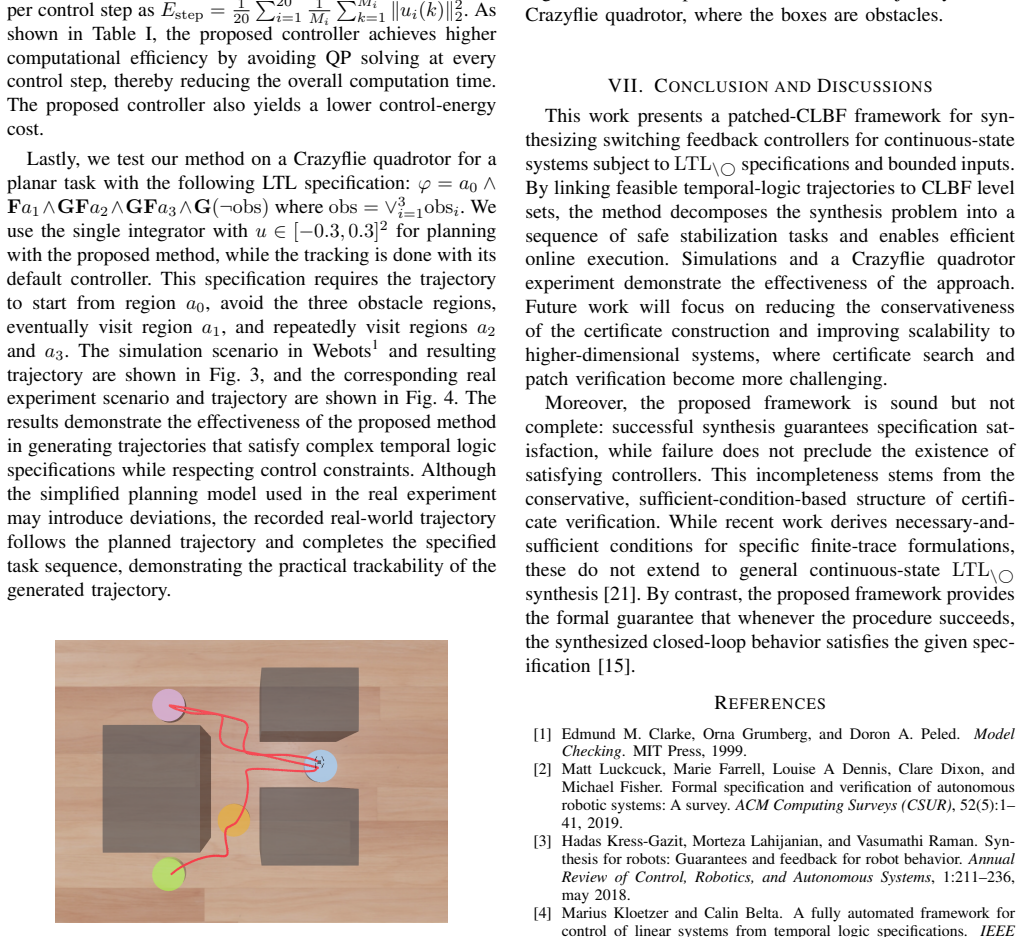
- It has been demonstrated in numerical simulations and on a quadrotor hardware platform.
Where Pith is reading between the lines
- The patching approach could be combined with receding-horizon optimization to handle longer LTL formulas.
- Similar level-set patching might extend to hybrid systems where discrete modes interact with the continuous dynamics.
- Adapting the CLBF construction for parametric uncertainty would test whether the robustness carries over without new abstractions.
Load-bearing premise
That the winning sets of the decomposed LTL subtasks can be systematically approximated and patched using the offline-computed level sets of the CLBFs while still guaranteeing satisfaction of the local constraints.
What would settle it
Observing a trajectory under the switching controller that violates the LTL specification despite bounded controls and state perturbations within the assumed bounds would falsify the claim.
Figures


read the original abstract
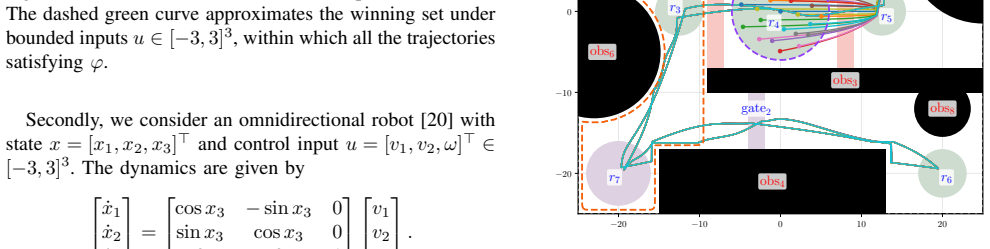
We propose an abstraction-free framework for controller synthesis for continuous-time dynamical systems subject to Linear Temporal Logic (LTL) specifications and bounded control inputs. The proposed method combines the sequential decomposition of LTL tasks with the use of formally certified Control Lyapunov-Barrier Functions (CLBFs). By formulating local specifications as a sequence of safe-stabilization problems, we systematically approximate and patch the winning sets of the decomposed subtasks. The satisfaction of these local constraints is guaranteed by the offline-computed level sets of the CLBFs. As a result, our framework yields formally verified switching feedback controllers that enable efficient online planning and dynamic re-planning. This ensures robust continuous specification satisfaction in the presence of state perturbations, avoiding the explicit state-space abstractions commonly required in the literature. The approach is validated through numerical simulations and a hardware demonstration on a Crazyflie quadrotor.
Editorial analysis
A structured set of objections, weighed in public.
Referee Report
Summary. The paper proposes an abstraction-free framework for controller synthesis for continuous-time dynamical systems subject to LTL specifications and bounded control inputs. It combines sequential decomposition of LTL tasks into safe-stabilization problems with Control Lyapunov-Barrier Functions (CLBFs) to approximate and patch winning sets using their level sets, yielding switching feedback controllers that guarantee robust specification satisfaction under state perturbations. Validation is provided via numerical simulations and a Crazyflie quadrotor hardware demonstration.
Significance. If the soundness of the patching procedure holds, the work would be significant for enabling formal verification of LTL specifications in continuous systems without state-space abstractions, while supporting efficient online planning and dynamic re-planning under bounded controls and perturbations. The combination of standard CLBF concepts with LTL decomposition and the inclusion of hardware validation are positive aspects.
major comments (1)
- [Abstract (paragraph on sequential decomposition and patching)] The central claim that sequentially decomposed LTL subtasks yield winning sets that can be systematically approximated and patched using offline-computed CLBF level sets to guarantee global LTL satisfaction (including under state perturbations) lacks an explicit soundness argument showing that local invariance/attractivity certificates and switching surfaces preserve the temporal ordering and 'always' operators. This is load-bearing for the formal verification result.
Simulated Author's Rebuttal
We thank the referee for their detailed review and for highlighting the importance of an explicit soundness argument for the patching procedure. We address the major comment below and commit to revisions that strengthen the formal presentation without altering the technical contributions.
read point-by-point responses
-
Referee: [Abstract (paragraph on sequential decomposition and patching)] The central claim that sequentially decomposed LTL subtasks yield winning sets that can be systematically approximated and patched using offline-computed CLBF level sets to guarantee global LTL satisfaction (including under state perturbations) lacks an explicit soundness argument showing that local invariance/attractivity certificates and switching surfaces preserve the temporal ordering and 'always' operators. This is load-bearing for the formal verification result.
Authors: We agree that the manuscript would benefit from a more prominent, self-contained statement of soundness. The current proofs (Section IV, Lemmas 2–4 and the inductive argument following Theorem 2) establish local invariance and attractivity of each patched CLBF level set and show that the switching law respects the sequential order of subtasks. However, the connection to global LTL satisfaction—specifically how the barrier components enforce the 'always' operators and how the decomposition ordering is preserved under switching and bounded perturbations—is distributed across several results rather than collected in a single theorem. We will revise the manuscript to add a new Theorem 3 (Soundness of Sequential Patching) that states the global LTL guarantee explicitly and provides a concise inductive proof that (i) each local CLBF certificate preserves the corresponding subformula, (ii) the switching surfaces maintain the required temporal ordering, and (iii) robustness to state perturbations follows from the strict decrease and invariance properties of the CLBFs. This theorem will be referenced from the abstract and introduction. revision: yes
Circularity Check
No circularity: derivation relies on independent CLBF and LTL decomposition properties
full rationale
The paper decomposes LTL specifications into safe-stabilization subtasks and approximates winning sets via offline-computed CLBF level sets to construct switching controllers. No quoted step reduces a prediction or central claim to a fitted parameter, self-definition, or load-bearing self-citation chain by construction. The approach invokes standard CLBF invariance and attractivity properties (external to the present work) and LTL sequential decomposition without renaming known results or smuggling ansatzes. The central soundness claim for patching remains independently verifiable against the cited CLBF certificates and does not collapse to the paper's own inputs. This is the expected non-finding for a self-contained synthesis method.
Axiom & Free-Parameter Ledger
axioms (2)
- domain assumption Continuous-time dynamical systems admit Control Lyapunov-Barrier Functions for the local safe-stabilization subtasks obtained from LTL decomposition
- domain assumption LTL specifications can be sequentially decomposed into a finite sequence of safe-stabilization problems whose winning sets can be approximated by CLBF level sets
Reference graph
Works this paper leans on
-
[1]
Clarke, Orna Grumberg, and Doron A
Edmund M. Clarke, Orna Grumberg, and Doron A. Peled.Model Checking. MIT Press, 1999
1999
-
[2]
Formal specification and verification of autonomous robotic systems: A survey.ACM Computing Surveys (CSUR), 52(5):1– 41, 2019
Matt Luckcuck, Marie Farrell, Louise A Dennis, Clare Dixon, and Michael Fisher. Formal specification and verification of autonomous robotic systems: A survey.ACM Computing Surveys (CSUR), 52(5):1– 41, 2019
2019
-
[3]
Syn- thesis for robots: Guarantees and feedback for robot behavior.Annual Review of Control, Robotics, and Autonomous Systems, 1:211–236, may 2018
Hadas Kress-Gazit, Morteza Lahijanian, and Vasumathi Raman. Syn- thesis for robots: Guarantees and feedback for robot behavior.Annual Review of Control, Robotics, and Autonomous Systems, 1:211–236, may 2018
2018
-
[4]
A fully automated framework for control of linear systems from temporal logic specifications.IEEE Transactions on Automatic Control, 53(1):287–297, 2008
Marius Kloetzer and Calin Belta. A fully automated framework for control of linear systems from temporal logic specifications.IEEE Transactions on Automatic Control, 53(1):287–297, 2008
2008
-
[5]
Fainekos, and George J
Hadas Kress-Gazit, Georgios E. Fainekos, and George J. Pappas. Temporal-logic-based reactive mission and motion planning.IEEE Transactions on Robotics, 25(6):1370–1381, 2009
2009
-
[6]
Finite abstractions with robustness mar- gins for temporal logic-based control synthesis.Nonlinear Analysis: Hybrid Systems, 22:1–15, 2016
Jun Liu and Necmiye Ozay. Finite abstractions with robustness mar- gins for temporal logic-based control synthesis.Nonlinear Analysis: Hybrid Systems, 22:1–15, 2016
2016
-
[7]
ROCS: A robustly complete control synthesis tool for nonlinear dynamical system s
Yinan Li and Jun Liu. ROCS: A robustly complete control synthesis tool for nonlinear dynamical system s. InProceedings of the 21st In- ternational Conference on Hybrid Systems: Computation and Control, HSCC ’18, pages 130–135, New York, NY , USA, 2018. ACM
2018
-
[8]
Control barrier functions for abstraction-free control synthesis under temporal logic constraints
Luyao Niu and Andrew Clark. Control barrier functions for abstraction-free control synthesis under temporal logic constraints. In 59th IEEE Conference on Decision and Control (CDC), pages 816–
-
[9]
Control of mobile robots using barrier functions under temporal logic specifications.IEEE Transactions on Robotics, 37(2):363–374, 2021
Mohit Srinivasan and Samuel Coogan. Control of mobile robots using barrier functions under temporal logic specifications.IEEE Transactions on Robotics, 37(2):363–374, 2021
2021
-
[10]
Dimarogonas
Andrea Bisoffi and Dimos V . Dimarogonas. A hybrid barrier certificate approach to satisfy linear temporal logic specifications. In2018 Annual American Control Conference (ACC), pages 634–639. IEEE, 2018
2018
-
[11]
Verification and synthesis of compatible control lyapunov and control barrier functions
Hongkai Dai, Chuanrui Jiang, Hongchao Zhang, and Andrew Clark. Verification and synthesis of compatible control lyapunov and control barrier functions. In2024 IEEE 63rd Conference on Decision and Control (CDC), pages 8178–8185. IEEE, 2024
2024
-
[12]
Jun Liu and Maxwell Fitzsimmons. Computing control lyapunov- barrier functions: Softmax relaxation and smooth patching with formal guarantees.arXiv preprint arXiv:2510.02223, 2025
-
[13]
Jun Liu. Formal verification of control lyapunov-barrier func- tions for safe stabilization with bounded controls.arXiv preprint arXiv:2511.10510, 2025
-
[14]
PhD thesis, University of Waterloo, 2019
Yinan Li.Robustly complete temporal logic control synthesis for nonlinear systems. PhD thesis, University of Waterloo, 2019
2019
-
[15]
Automata theory meets barrier certificates: Temporal logic verification of nonlinear systems.IEEE Transactions on Automatic Control, 61(11):3344–3355, 2015
Tichakorn Wongpiromsarn, Ufuk Topcu, and Andrew Lamperski. Automata theory meets barrier certificates: Temporal logic verification of nonlinear systems.IEEE Transactions on Automatic Control, 61(11):3344–3355, 2015
2015
-
[16]
dReal: an SMT solver for nonlinear theories over the reals
Sicun Gao, Soonho Kong, and Edmund M Clarke. dReal: an SMT solver for nonlinear theories over the reals. InProc. of CADE, pages 208–214, 2013
2013
-
[17]
Global clf stabilization of systems with control inputs constrained to a hyperbox
Horacio Leyva, Julio Solis-Daun, and Rodolfo Su ´arez. Global clf stabilization of systems with control inputs constrained to a hyperbox. SIAM Journal on Control and Optimization, 51(1):745–766, 2013
2013
-
[18]
LyZNet: A lightweight Python tool for learning and verifying neural Lyapunov functions and regions of attraction
Jun Liu, Yiming Meng, Maxwell Fitzsimmons, and Ruikun Zhou. LyZNet: A lightweight Python tool for learning and verifying neural Lyapunov functions and regions of attraction. InProceedings of the 27th ACM International Conference on Hybrid Systems: Computation and Control, 2024
2024
-
[19]
Krstic and P
M. Krstic and P. Tsiotras. Inverse optimal stabilization of a rigid spacecraft.IEEE Transactions on Automatic Control, 44(5):1042– 1049, 1999
1999
-
[20]
Prescribed-time reach-avoid-stay specifications for unknown systems: A spatiotemporal tubes approach
Ratnangshu Das and Pushpak Jagtap. Prescribed-time reach-avoid-stay specifications for unknown systems: A spatiotemporal tubes approach. IEEE Control Systems Letters, 8:946–951, 2024
2024
-
[21]
Necessary and sufficient conditions for satisfying linear temporal logic constraints using control barrier certificates
Luyao Niu, Andrew Clark, and Radha Poovendran. Necessary and sufficient conditions for satisfying linear temporal logic constraints using control barrier certificates. In2023 62nd IEEE Conference on Decision and Control (CDC), pages 8589–8595. IEEE, 2023
2023
discussion (0)
Sign in with ORCID, Apple, or X to comment. Anyone can read and Pith papers without signing in.