REVIEW 4 major objections 5 minor 27 references
Workflow decomposition algorithm for scheduling with quantum annealer-based hybrid solver
T0 review · 4 major / 5 minor · reviewed 2026-08-07 · deepseek-v4-flash
Pith's one-line read Decomposing a workflow into series-parallel subgraphs lets a hybrid constrained-quadratic solver schedule instances it otherwise cannot, at up to 15.8% extra cost.
desk verdict SPWD plausibly extends CQM capacity for workflow scheduling, but the unproven merge step keeps me from trusting the exact reported overheads. read the letter →
The pith
A machine-rendered reading of the paper's core claim, the machinery that carries it, and where it could break.
The reading
What carries the argument
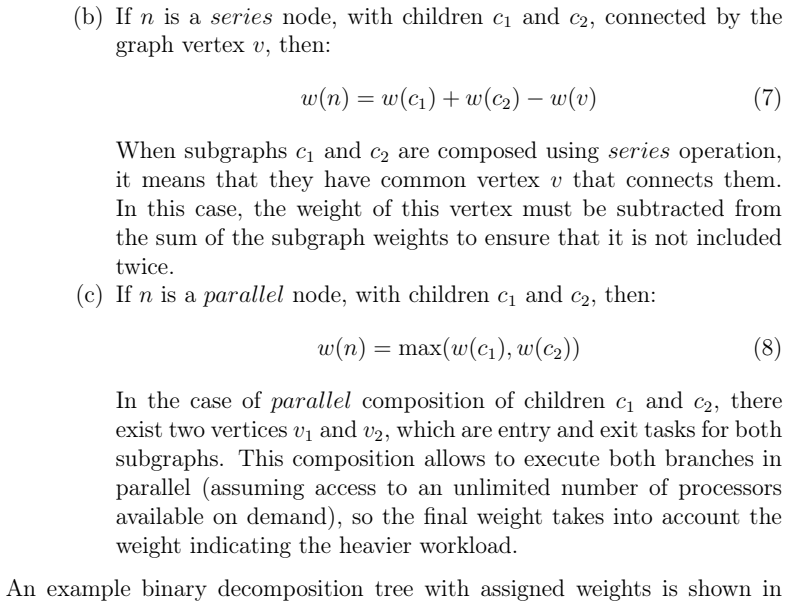
The central mechanism is the TTSP (two-terminal series-parallel) decomposition tree: the workflow DAG is first mapped to a series-parallel multidigraph, then represented by a binary tree whose internal nodes are series or parallel compositions. SPWD walks that tree bottom-up to assign each node a workload weight, propagates the global deadline downward in proportion to those weights (with substitute zero-weight vertices inserted at series junctions to keep the proportional split valid), then prunes the tree so that every remaining subgraph has at most a chosen number of nodes, the 'max subgraph size' parameter. Each subgraph is handed to an external solver, and the schedules are merged by resolving tasks shared between subworkflows in favor of the faster machine the solvers returned.
What would settle it
Construct a series-parallel workflow with two subworkflows that share one task, both with tight deadlines, and choose machine execution times so that the solver prefers different machines for the shared task in the two subproblems. Run SPWD with a max subgraph size that separates the parts, merge by the faster-machine rule, and check whether the global deadline is met; a violation would show the merge rule is not sufficient for feasibility.
Extended reading notes
Core claim
On its own terms, this paper establishes that workflow scheduling can be made tractable for a constrained quadratic model (CQM) hybrid solver by decomposing the workflow into series-parallel pieces, solving each piece independently, and merging the results. The load-bearing experimental finding is that every tested workflow instance that the CQM solver could not solve directly—four astronomy workflows with 25,846 to 181,366 constraints—was successfully scheduled after decomposition. The cost of the decomposed CQM schedule exceeded the exact classical reference by at most 15.8%, and the additional overhead due to decomposition itself was under one percent when the same decomposition was used with the classical reference solver. The paper further reports that CQM solution quality degrades sharply once constraint counts pass roughly 17,000, and that decomposition can shrink problem size for most workflow families, with the caveat that mapping a workflow to series-parallel form can add paths and thus constraints for some structures.
Load-bearing premise
The merge step assumes that whenever two independently solved subworkflows share a task, assigning that task to the faster of the two machines the solvers chose always keeps both subworkflows within their deadlines, and that the resulting combined schedule's cost is well defined; the paper states this rule in one sentence and gives no proof or cost-consolidation explanation.
Editorial extensions
If this is right
- Workflow instances with over one hundred thousand constraints become schedulable on a hybrid constrained-quadratic solver instead of being out of reach.
- The same decomposition can be applied with purely classical solvers, so it also extends the reach of exact optimizers when a workflow is too large to solve in one shot.
- The max-subgraph-size parameter gives a tunable trade-off between solver capacity and schedule cost; users can choose smaller subgraphs when solver capacity is tight.
- For most workflow families, decomposition reduces both variables and constraints, but for workflows whose series-parallel mapping creates many new paths, only small subgraph sizes give a net reduction.
Reading between the lines
- If the faster-machine merge rule is as safe as the experiments suggest, the same decomposition could be applied recursively, pushing the schedulable constraint count far beyond 181,000 with only the merge error accumulating.
- The sharp degradation near 17,000 constraints looks like an internal solver threshold rather than a property of the workflows; decomposition is implicitly a way to keep every subproblem below that threshold, and a testable extension is to pick the max subgraph size by constraint budget instead of node count.
- The same series-parallel decomposition could be applied to a pure quantum annealer if QUBO penalty weights are set automatically; the paper names this as future work, but the machinery is solver-agnostic.
- The overhead pattern—large instances incur the smallest relative overhead—suggests the decomposition cost is dominated by boundary effects, so scaling up instances should dilute the overhead further.
Editorial analysis
A structured set of objections, weighed in public.
Referee Report
Summary. The manuscript introduces SPWD, a heuristic that maps a workflow DAG to a TTSP multidigraph, builds a binary decomposition tree, distributes the deadline over the tree, prunes the tree into subgraphs of at most s vertices, solves each subgraph independently with either the D-Wave CQM hybrid solver or Gurobi, and merges the resulting sub-schedules. The paper reports that SPWD+CQM successfully schedules four Montage workflows (25,846 to 181,366 constraints) that raw CQM could not solve, with cost overheads up to 15.8% relative to Gurobi, and presents experiments on how decomposition affects problem size and schedule cost for WfCommons workflows. It also provides an execution environment integrated with QHyper and a time-complexity analysis.
Significance. If the results hold, this is a useful practical contribution: it demonstrates a decomposition scheme that extends the reach of a black-box hybrid quantum-classical solver to realistic workflow sizes, and it provides reproducible tooling (GitHub code and WfCommons data) plus a clear complexity analysis. The work is explicitly heuristic and experimental, which is appropriate for the venue; the main theoretical limitation is the lack of a proof for the merge step, and the main experimental limitation is the apparent single-shot use of a stochastic solver. With those points addressed, the capacity-extension claim would be solid.
major comments (4)
- [Sec. 4, Algorithm 1 line 12; Sec. 7.4.2, Table 4] The merge step is specified by a single sentence: for a task shared by subworkflows, 'a faster machine returned by the scheduler is selected to ensure that the deadline is met in both subworkflows.' This is not sufficient to make Table 4 verifiable. Please provide a formal specification of the merge: define 'faster' as the machine with smaller execution time; state how a task shared by more than two subworkflows is treated; explain how substitute vertices introduced in Sec. 4.3 are removed before the final schedule and cost are evaluated; and state explicitly that the final schedule's cost is computed from the merged task-to-machine assignment. Then give a proof that choosing, for each shared task, the machine with minimum execution time preserves every subproblem's local deadline and therefore yields a feasible schedule of the original WSP instance. A monotonicity argument appears to be available, but it must be stated.
- [Sec. 7.4.1, Table 2; Sec. 7.4.2, Table 4] The CQM hybrid solver is stochastic, but the paper appears to report a single run per instance. Please report multiple independent runs (e.g., 10 or more per instance) with the distribution of objective values and success rates, and state the solver time limit and seed or random-state settings. The capacity boundary of 'around 17,000 constraints' rests on a single failing observation at 17,001 constraints, and the claim that raw CQM 'could not solve' the Montage instances is not supported by a single failed attempt per instance. Without this information, the central demonstration of capacity extension is not statistically grounded.
- [Sec. 7.2 and Sec. 7.4.2] The reported cost overheads are computed relative to Gurobi, but the manuscript does not state whether Gurobi was run to proven optimality, with a time limit, or with a specified optimality gap. For instances with up to 181,366 constraints, the exactness of the Gurobi baseline is not obvious. Please report Gurobi's optimality gap, runtime, and solver settings for every instance used as a baseline. Otherwise the '15.8% worst-case overhead' figure may be an artifact of a weak reference solution.
- [Sec. 7.4.2, Table 4] The max_subgraph_size parameter s is manually selected for each of the four Montage instances. Because s controls the difficulty of the subproblems, the reported successes and overheads are conditional on those hand-picked values. Please provide a sensitivity analysis (e.g., a sweep of s values around the chosen ones, reporting success/failure and cost for each) or an automatic rule for selecting s based on constraint count, so that the claim 'SPWD+CQM can schedule these instances' is not dependent on undocumented tuning.
minor comments (5)
- [Sec. 7.4.1, Table 2] The column header 'cost increase' is used for values such as 1, 1.002, and 1.06; please clarify that these are cost ratios (1 = same cost) rather than percentage increases.
- [Sec. 4.4] Please clarify how the 'number of vertices' in a subgraph is counted after substitute vertices from Sec. 4.3 are introduced, since this directly affects the meaning of the max_subgraph_size parameter.
- [Sec. 7.2, Fig. 7] The phrase 'when the size decreased 100 times' is ambiguous; please state explicitly that the max_subgraph_size was set to 1% of the total number of nodes.
- [Sec. 7.3.1] The statement 'Scheduling with values above 50% will not provide any benefit' refers to the Montage family only; please qualify it as such, since Fig. 8a shows different behavior for 1000Genome.
- [Sec. 4.3] Please define 'zero weight' formally (e.g., all execution times are zero) and describe how substitute vertices are represented in the CQM and Gurobi variable sets, so that a reader can see how the series-node modification interacts with the one-hot and deadline constraints.
Circularity Check
No significant circularity: central claims are benchmarked against the external Gurobi solver; QHyper self-citation is infrastructure only.
full rationale
The main empirical claim, that SPWD plus CQM schedules Montage instances that direct CQM could not solve, is evaluated by comparing with Gurobi, an independent exact classical solver (Sec. 7.4, Tab. 4). The overhead figures are measured against Gurobi results, not derived from decomposition parameters, so the claim is externally falsifiable. The DAG-to-TTSP mapping and series-parallel recognition and decomposition-tree construction are external algorithms, and no uniqueness theorem from the authors' own prior work is invoked. The only same-group citation, QHyper, is an integration library providing solver access and WfCommons parsing; that is not load-bearing. The merge step in Algorithm 1 is asserted in one sentence and the per-instance max_subgraph_size is chosen manually; these are correctness and robustness limitations, not circularity, because the merged-schedule costs are still compared with Gurobi and are not equivalent by construction to the inputs. No fitted parameter is renamed as a prediction, and no known result is repackaged under new coordinates. Thus the derivation chain is self-contained for its stated experimental claims.
Assumptions & free parameters
free parameters (1)
- max subgraph size s =
100, 150, 200, 350 (per-instance manual selection, Tab.
assumptions (4)
- domain assumption TTSP recognition and DAG-to-TTSP mapping algorithms from [10] and [14] correctly transform the workflow DAG without changing the scheduling problem.
- domain assumption Proportional deadline distribution plus zero-weight substitute vertices yields subproblem deadlines whose merge respects the global deadline.
- ad hoc to paper CQM capacity is governed primarily by constraint count, with failure threshold around 17,000 constraints.
- ad hoc to paper Merging with faster-machine selection preserves global deadline feasibility.
invented entities (1)
-
Substitute vertex v' (zero-weight, zero-duration intermediate task)
Cite this review
Pith. "Pith review of Workflow decomposition algorithm for scheduling with quantum annealer-based hybrid solver." pith.science (2026). https://pith.science/paper/IQNDFZEL
@misc{pith2026250601567,
  author       = {Pith},
  title        = {Pith review of: Workflow decomposition algorithm for scheduling with quantum annealer-based hybrid solver},
  year         = {2026},
  howpublished = {\url{https://pith.science/paper/IQNDFZEL}},
  note         = {Machine review of arXiv:2506.01567}
}
read the original abstract
We introduce the Series-Parallel Workflow Decomposition (SP\-WD) heuristic algorithm for the Workflow Scheduling Problem (WSP) decomposition. We demonstrate that the SPWD algorithm facilitates the scheduling of large WSP instances with the hybrid D-Wave Constrained Quadratic Model solver, enabling the scheduling of instances that would otherwise exceed its capacity limitations. We also describe the accompanying execution environment used to obtain the results of the experiments with real-life workflow instances available in the WfCommons standardization initiative repository.
Figures


Figures from the paper (7 more)


Reference graph
Works this paper leans on
-
[1]
M. Rynge, G. Juve, J. Kinney, J. Good, B. Berriman, A. Merrihew, E. Deelman, Producing an Infrared Multiwavelength Galactic Plane At- las Using Montage, Pegasus, and Amazon Web Services 485 (2014) 211, conference Name: Astronomical Data Analysis Software and Systems XXIII ADS Bibcode: 2014ASPC..485..211R. URLhttps://ui.adsabs.harvard.edu/abs/2014ASPC..485..211R
work page 2014
-
[2]
Y. Liu, S. M. Khan, J. Wang, M. Rynge, Y. Zhang, S. Zeng, S. Chen, J. V. Maldonado dos Santos, B. Valliyodan, P. P. Calyam, N. Merchant, H. T. Nguyen, D. Xu, T. Joshi, PGen: large-scale genomic variations analysis workflow and browser in SoyKB, BMC Bioinformatics 17 (S13) (2016) 337.doi:10.1186/s12859-016-1227-y. URLhttp://bmcbioinformatics.biomedcentral....
-
[3]
O. O. Kilic, T. Wang, M. Turilli, M. Titov, A. Merzky, L. Pouchard, S. Jha, Workflow Mini-Apps: Portable, Scalable, Tunable & Faith- ful Representations of Scientific Workflows, in: 2024 IEEE 24th In- ternational Symposium on Cluster, Cloud and Internet Computing (CCGrid), IEEE, Philadelphia, PA, USA, 2024, pp. 465–477.doi: 10.1109/CCGrid59990.2024.00059....
arXiv 2024
-
[4]
G. Juve, A. Chervenak, E. Deelman, S. Bharathi, G. Mehta, K. Vahi, Characterizing and profiling scientific workflows, Fu- ture Generation Computer Systems 29 (3) (2013) 682–692. doi:10.1016/j.future.2012.08.015. URLhttps://linkinghub.elsevier.com/retrieve/pii/ S0167739X12001732
-
[5]
T. Coleman, H. Casanova, L. Pottier, M. Kaushik, E. Deelman, R. Ferreira da Silva, WfCommons: A framework for enabling scientific workflow research and development, Future Generation Computer Systems 128 (2022) 16–27, publisher: Elsevier BV. doi:10.1016/j.future.2021.09.043. URLhttps://linkinghub.elsevier.com/retrieve/pii/ S0167739X21003897 23
-
[6]
D. Tomasiewicz, M. Pawlik, M. Malawski, K. Rycerz, Foundations for Workflow Application Scheduling on D-Wave System, in: V. V. Krzhizhanovskaya, G. Závodszky, M. H. Lees, J. J. Dongarra, P. M. A. Sloot, S. Brissos, J. Teixeira (Eds.), Computational Science – ICCS 2020, Vol. 12142, Springer International Publishing, Cham, 2020, pp. 516–530, series Title: L...
-
[7]
URLhttps://docs.dwavesys.com/docs/latest/doc_leap_hybrid
D-Wave, D-Wave Solvers Documentation (2024). URLhttps://docs.dwavesys.com/docs/latest/doc_leap_hybrid. html
work page 2024
-
[8]
M. Hurbol, Selected aspects of adapting the DWave annealer solutions to Workflow Management Systems (2022)
work page 2022
Show all 27 references
-
[9]
URLhttps://docs.ocean.dwavesys.com/en/stable/concepts/ cqm.html
D-Wave, Constraint Quadratic Model definition and manual. URLhttps://docs.ocean.dwavesys.com/en/stable/concepts/ cqm.html
-
[10]
Valdes, R
J. Valdes, R. E. Tarjan, E. L. Lawler, The Recognition of Series Parallel Digraphs, SIAM Journal on Computing 11 (2) (1982) 298–313.doi: 10.1137/0211023. URLhttp://epubs.siam.org/doi/10.1137/0211023
1982 doi
- [11]
-
[12]
Optimization, Gurobi Optimizer Reference Manual (2024)
G. Optimization, Gurobi Optimizer Reference Manual (2024). URLhttps://www.gurobi.com
2024
-
[13]
Glover, G
F. Glover, G. Kochenberger, Y. Du, Quantum Bridge Analytics I: a tutorial on formulating and using QUBO models, 4OR 17 (4) (2019) 335–371.doi:10.1007/s10288-019-00424-y. URLhttp://link.springer.com/10.1007/s10288-019-00424-y
2019 doi
-
[14]
González-Escribano, A
A. González-Escribano, A. J. Gemund, V. Cardeñoso-Payo, Mapping Unstructured Applications into Nested Parallelism Best Student Paper 24 Award: First Prize, in: J. M. L. M. Palma, A. A. Sousa, J. Dongarra, V. Hernández (Eds.), High Performance Computing for Computational Scienc...
2002 doi
-
[15]
E. G. Coffman, J. Bruno, Computer and job-shop scheduling theory, Wiley, 1976. URLhttps://api.semanticscholar.org/CorpusID:60396080
1976
-
[16]
Masdari, S
M. Masdari, S. ValiKardan, Z. Shahi, S. I. Azar, Towards work- flow scheduling in cloud computing: A comprehensive analysis, Journal of Network and Computer Applications 66 (2016) 64–82. doi:10.1016/j.jnca.2016.01.018. URLhttps://linkinghub.elsevier.com/retrieve/pii/ S108480451600045X
2016 doi
-
[17]
Topcuoglu, S
H. Topcuoglu, S. Hariri, Min-You Wu, Performance-effective and low- complexity task scheduling for heterogeneous computing, IEEE Trans- actions on Parallel and Distributed Systems 13 (3) (2002) 260–274. doi:10.1109/71.993206. URLhttp://ieeexplore.ieee.org/document/993206/
2002 doi
-
[18]
Khojasteh Toussi, M
G. Khojasteh Toussi, M. Naghibzadeh, S. Abrishami, H. Taheri, H. Abrishami, EDQWS: an enhanced divide and conquer algorithm for workflow scheduling in cloud, Journal of Cloud Computing 11 (1) (2022) 13.doi:10.1186/s13677-022-00284-8. URLhttps://journalofcloudcomputing.springer...
2022 doi
-
[19]
Pandey, L
S. Pandey, L. Wu, S. M. Guru, R. Buyya, A Particle Swarm Optimization-Based Heuristic for Scheduling Workflow Applications in Cloud Computing Environments, in: 2010 24th IEEE International Con- ference on Advanced Information Networking and Applications, IEEE, Perth, Australia...
2010
-
[20]
Huang, The Workflow Task Scheduling Algorithm Based on the GA Model in the Cloud Computing Environment, Journal of Software 9 (4) 25 (2014) 873–880.doi:10.4304/jsw.9.4.873-880
J. Huang, The Workflow Task Scheduling Algorithm Based on the GA Model in the Cloud Computing Environment, Journal of Software 9 (4) 25 (2014) 873–880.doi:10.4304/jsw.9.4.873-880. URLhttp://ojs.academypublisher.com/index.php/jsw/article/ view/11062
2014 doi
-
[21]
Yassa, R
S. Yassa, R. Chelouah, H. Kadima, B. Granado, Multi-Objective Approach for Energy-Aware Workflow Scheduling in Cloud Computing Environments, The Scientific World Journal 2013 (1) (2013) 350934. doi:10.1155/2013/350934. URLhttps://onlinelibrary.wiley.com/doi/10.1155/2013/ 350934
2013 doi
-
[22]
Taufer, A
M. Taufer, A. L. Rosenberg, Scheduling DAG-based workflows on single cloud instances: High-performance and cost effectiveness with a static scheduler, The International Journal of High Performance Computing Applications 31 (1) (2017) 19–31.doi:10.1177/1094342015594518. URLhttp...
2017 doi
-
[23]
Cordasco, A
G. Cordasco, A. L. Rosenberg, ON SCHEDULING SERIES- PARALLEL DAGs TO MAXIMIZE AREA, International Jour- nal of Foundations of Computer Science 25 (05) (2014) 597–621. doi:10.1142/S0129054114500245. URLhttps://www.worldscientific.com/doi/abs/10.1142/ S0129054114500245
2014 doi
-
[24]
Plewa, J
J. Plewa, J. Sieńko, K. Rycerz, Variational Algorithms for Workflow Scheduling Problem in Gate-Based Quantum Devices, Computing and Informatics 40 (4) (2021) 897–929.doi:10.31577/cai_2021_4_897. URLhttp://www.cai.sk/ojs/index.php/cai/article/view/2021_ 4_897
2021 doi
-
[25]
Ferreira da Silva, R
R. Ferreira da Silva, R. Filgueira, E. Deelman, E. Pairo-Castineira, I. M. Overton, M. P. Atkinson, Using simple PID-inspired controllers for online resilient resource management of distributed scientific workflows, Future Generation Computer Systems 95 (2019) 615–628. doi:10....
2019 doi
-
[26]
URLhttps://www.ncbi.nlm.nih.gov/sra/docs/
NLM, The Sequence Read Archive (SRA). URLhttps://www.ncbi.nlm.nih.gov/sra/docs/
-
[27]
Filgueira, R
R. Filgueira, R. F. Da Silva, A. Krause, E. Deelman, M. Atkinson, Asterism: Pegasus and Dispel4py Hybrid Workflows for Data-Intensive Science, in: 2016 Seventh International Workshop on Data-Intensive Computing in the Clouds (DataCloud), IEEE, Salt Lake City, UT, 2016, pp. 1–8...
2016
Reviewed August 7, 2026 · model on record in the stance chip above.
Discussion (0). Continue with ORCID to comment.