Modeling of Dark Count Probability in Perimeter-Gated SPADs
Pith reviewed 2026-06-27 07:56 UTC · model grok-4.3
The pith
Dark count probability in perimeter-gated SPADs follows a complementary Gompertz function from which pixel-specific midpoint voltages and temperature compensation rates are derived.
A machine-rendered reading of the paper's core claim, the machinery that carries it, and where it could break.
Core claim
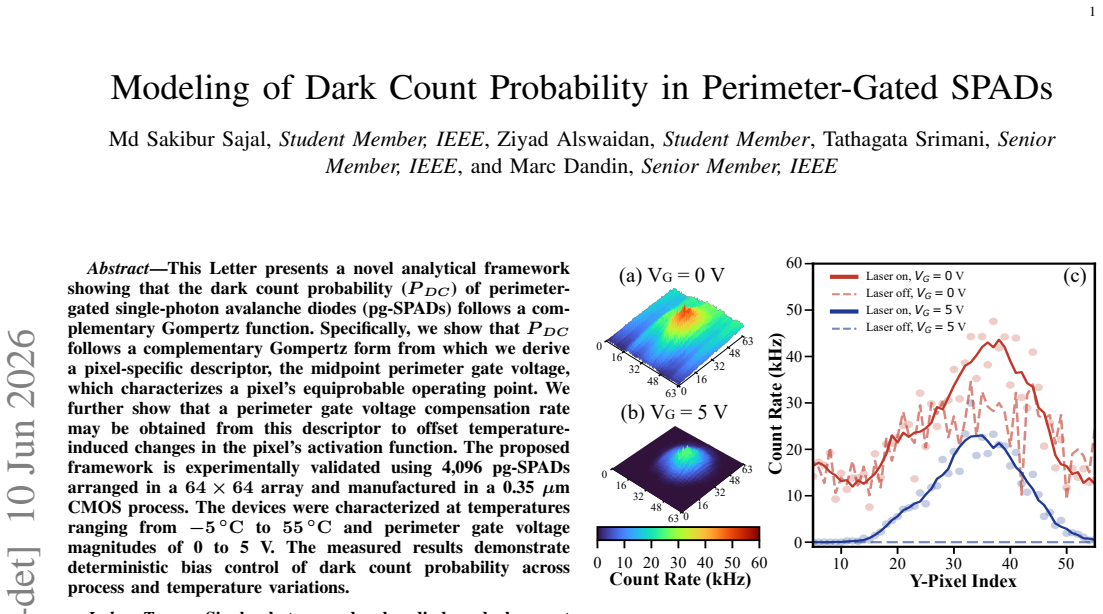
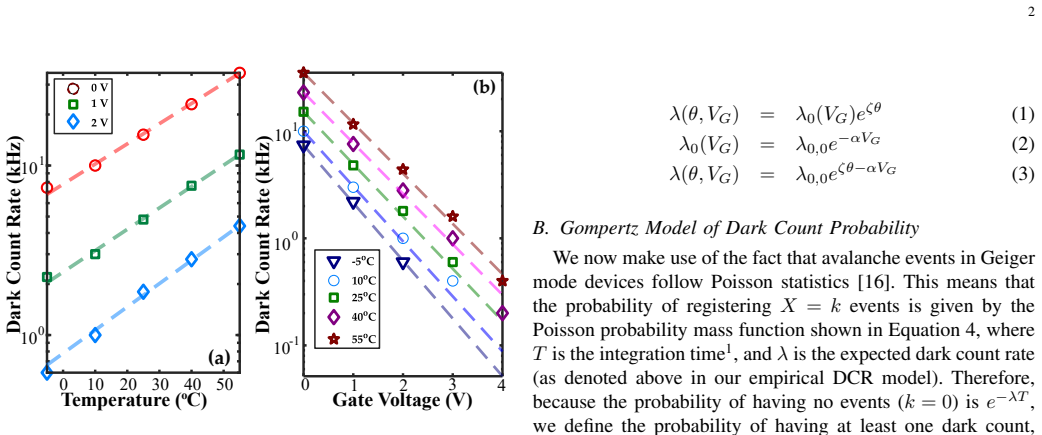
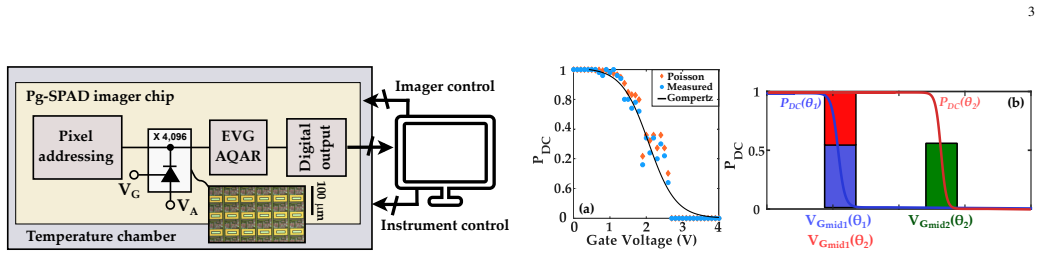
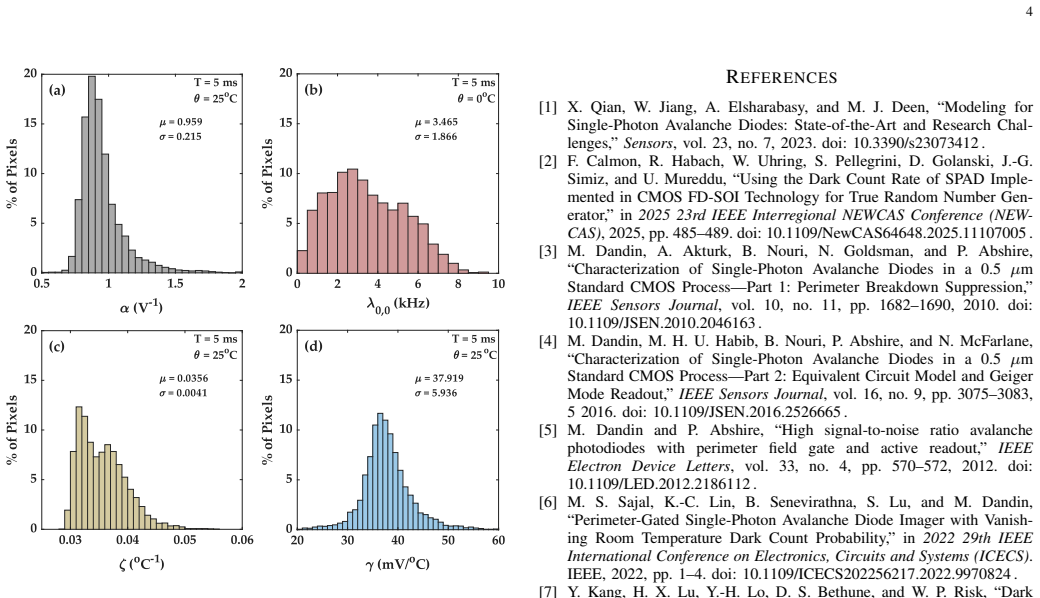
The dark count probability PDC of perimeter-gated single-photon avalanche diodes follows a complementary Gompertz form. From this form a pixel-specific descriptor, the midpoint perimeter gate voltage, is derived that characterizes a pixel's equiprobable operating point. A perimeter gate voltage compensation rate obtained from this descriptor offsets temperature-induced changes in the pixel's activation function. The framework is validated on 4096 pg-SPADs in a 64 by 64 array in 0.35 micrometer CMOS across temperatures from -5 C to 55 C and perimeter gate voltages from 0 to 5 V.
What carries the argument
Complementary Gompertz function relating dark count probability to perimeter gate voltage, used to extract the midpoint voltage descriptor per pixel.
If this is right
- Deterministic bias control of dark count probability becomes possible across process and temperature variations.
- A compensation rate for perimeter gate voltage can be calculated from the midpoint descriptor to maintain stable activation.
- Each pixel in an array receives an individual characterization by its midpoint perimeter gate voltage.
- The model supports operation of large CMOS-fabricated SPAD arrays with reduced variation in dark counts.
Where Pith is reading between the lines
- The same Gompertz-based descriptors could support per-pixel calibration routines in larger imaging arrays.
- Testing the model on SPADs fabricated in other CMOS nodes would check whether the midpoint descriptor remains process-independent.
- If the compensation rate proves stable, it could reduce the need for frequent temperature recalibration in fielded detectors.
Load-bearing premise
The complementary Gompertz function accurately describes dark count probability behavior across the full tested range of temperatures and voltages without needing extra device-specific adjustments.
What would settle it
Dark count probability measurements on pg-SPADs at temperatures or voltages outside the tested range that deviate systematically from the complementary Gompertz curve and cannot be fit without new parameters.
Figures
read the original abstract
This Letter presents a novel analytical framework showing that the dark count probability (PDC) of perimeter-gated single-photon avalanche diodes (pg-SPADs) follows a complementary Gompertz function. Specifically, we show that PDC follows a complementary Gompertz form from which we derive a pixel-specific descriptor, the midpoint perimeter gate voltage, which characterizes a pixel's equiprobable operating point. We further show that a perimeter gate voltage compensation rate may be obtained from this descriptor to offset temperature-induced changes in the pixel's activation function. The proposed framework is experimentally validated using 4,096 pg-SPADs arranged in a 64 x 64 array and manufactured in a 0.35 $\mu$m CMOS process. The devices were characterized at temperatures ranging from -5 $^o$C to 55 $^o$C and perimeter gate voltage magnitudes of 0 to 5 V. The measured results demonstrate deterministic bias control of dark count probability across process and temperature variations.
Editorial analysis
A structured set of objections, weighed in public.
Referee Report
Summary. The paper claims that the dark count probability (PDC) of perimeter-gated SPADs follows a complementary Gompertz function. From this form the authors derive a pixel-specific midpoint perimeter gate voltage (characterizing the equiprobable operating point) and a perimeter-gate-voltage compensation rate to offset temperature-induced shifts in the activation function. The framework is validated on 4096 devices in a 64×64 array fabricated in 0.35 µm CMOS, characterized over −5 °C to 55 °C and Vpg = 0–5 V, with the results presented as demonstrating deterministic bias control across process and temperature variations.
Significance. If the complementary Gompertz description holds across the stated ranges with no additional device-specific parameters, the work supplies a compact analytical tool for characterizing and compensating dark-count behavior in pg-SPAD arrays. The scale of the experimental validation (4096 pixels) is a clear strength and would support claims of generality within the tested process and temperature window.
major comments (2)
- Abstract: the functional form is asserted to follow from an analytical framework, yet no derivation steps, fitting procedure, error analysis, or data-exclusion rules are supplied; these details are load-bearing for verifying that the measured data actually support the stated Gompertz claim rather than an empirical fit.
- Midpoint-voltage derivation: the midpoint perimeter-gate voltage is obtained directly from the Gompertz parameters; it is therefore necessary to show explicitly whether this quantity is independently measured or reduces to a fitted value by construction, as the latter would undermine the claim that it is a new pixel-specific descriptor.
minor comments (2)
- The temperature range is written as -5 $^o$C; adopt a consistent degree symbol and spacing throughout the manuscript.
- A table or figure summarizing the fitted Gompertz parameters (and their uncertainties) across the five temperature points would improve traceability of the compensation-rate extraction.
Simulated Author's Rebuttal
We thank the referee for the constructive comments and positive assessment of the experimental scale. We address the two major comments point by point below.
read point-by-point responses
-
Referee: Abstract: the functional form is asserted to follow from an analytical framework, yet no derivation steps, fitting procedure, error analysis, or data-exclusion rules are supplied; these details are load-bearing for verifying that the measured data actually support the stated Gompertz claim rather than an empirical fit.
Authors: The abstract summarizes the central result. The analytical framework deriving the complementary Gompertz form from the perimeter-gate physics, together with the fitting procedure, error metrics, and data-handling rules, appears in Sections II and III of the manuscript. To make these elements more immediately verifiable from the abstract onward, we will insert a concise methods paragraph in the revised version that explicitly lists the fitting algorithm, goodness-of-fit criteria, and any exclusion thresholds applied to the 4096-pixel dataset. revision: yes
-
Referee: Midpoint-voltage derivation: the midpoint perimeter-gate voltage is obtained directly from the Gompertz parameters; it is therefore necessary to show explicitly whether this quantity is independently measured or reduces to a fitted value by construction, as the latter would undermine the claim that it is a new pixel-specific descriptor.
Authors: The midpoint voltage is defined mathematically as the voltage at which the fitted complementary Gompertz function equals 0.5; it is therefore obtained from the model parameters by construction. Its utility as a pixel-specific descriptor lies in the fact that it collapses the entire activation curve into a single, temperature-compensable bias point that can be extracted uniformly across the array. We will add an explicit equation and a short paragraph in the revised text clarifying this definitional relationship while retaining the claim that the descriptor enables deterministic control. revision: yes
Circularity Check
No significant circularity; derivation self-contained with external validation
full rationale
The abstract describes an analytical framework asserting that PDC follows a complementary Gompertz form, from which a midpoint perimeter gate voltage descriptor and compensation rate are derived. Experimental validation on 4096 pixels across -5°C to 55°C and 0-5 Vpg provides an independent test of the functional form. No quoted equations or self-citations in the available text reduce the midpoint or compensation rate to a fitted parameter by construction, nor does any load-bearing premise rely on prior author work as an unverified uniqueness theorem. The central modeling step is presented as empirically falsifiable rather than tautological, satisfying the criteria for a self-contained derivation.
Axiom & Free-Parameter Ledger
axioms (1)
- domain assumption Dark count probability follows a complementary Gompertz function
Reference graph
Works this paper leans on
-
[1]
Modeling for Single-Photon Avalanche Diodes: State-of-the-Art and Research Chal- lenges,
X. Qian, W. Jiang, A. Elsharabasy, and M. J. Deen, “Modeling for Single-Photon Avalanche Diodes: State-of-the-Art and Research Chal- lenges,”Sensors, vol. 23, no. 7, 2023. doi: 10.3390/s23073412
-
[2]
F. Calmon, R. Habach, W. Uhring, S. Pellegrini, D. Golanski, J.-G. Simiz, and U. Mureddu, “Using the Dark Count Rate of SPAD Imple- mented in CMOS FD-SOI Technology for True Random Number Gen- erator,” in2025 23rd IEEE Interregional NEWCAS Conference (NEW- CAS), 2025, pp. 485–489. doi: 10.1109/NewCAS64648.2025.11107005
-
[3]
M. Dandin, A. Akturk, B. Nouri, N. Goldsman, and P. Abshire, “Characterization of Single-Photon Avalanche Diodes in a 0.5µm Standard CMOS Process—Part 1: Perimeter Breakdown Suppression,” IEEE Sensors Journal, vol. 10, no. 11, pp. 1682–1690, 2010. doi: 10.1109/JSEN.2010.2046163
-
[4]
M. Dandin, M. H. U. Habib, B. Nouri, P. Abshire, and N. McFarlane, “Characterization of Single-Photon Avalanche Diodes in a 0.5µm Standard CMOS Process—Part 2: Equivalent Circuit Model and Geiger Mode Readout,”IEEE Sensors Journal, vol. 16, no. 9, pp. 3075–3083, 5 2016. doi: 10.1109/JSEN.2016.2526665
-
[5]
High signal-to-noise ratio avalanche photodiodes with perimeter field gate and active readout,
M. Dandin and P. Abshire, “High signal-to-noise ratio avalanche photodiodes with perimeter field gate and active readout,”IEEE Electron Device Letters, vol. 33, no. 4, pp. 570–572, 2012. doi: 10.1109/LED.2012.2186112
-
[6]
M. S. Sajal, K.-C. Lin, B. Senevirathna, S. Lu, and M. Dandin, “Perimeter-Gated Single-Photon Avalanche Diode Imager with Vanish- ing Room Temperature Dark Count Probability,” in2022 29th IEEE International Conference on Electronics, Circuits and Systems (ICECS). IEEE, 2022, pp. 1–4. doi: 10.1109/ICECS202256217.2022.9970824
-
[7]
Dark Count Probability and Quantum Efficiency of Avalanche Photodiodes for Single-Photon Detection,
Y . Kang, H. X. Lu, Y .-H. Lo, D. S. Bethune, and W. P. Risk, “Dark Count Probability and Quantum Efficiency of Avalanche Photodiodes for Single-Photon Detection,”Applied Physics Letters, vol. 83, no. 14, pp. 2955–2957, 10 2003. doi: 10.1063/1.1616666
-
[8]
Ultra-Short Gates Improve the Performance of High-Speed Gated Single-Photon Avalanche Diodes,
A. Restelli, J. C. Bienfang, and A. L. Migdall, “Ultra-Short Gates Improve the Performance of High-Speed Gated Single-Photon Avalanche Diodes,” inAdvanced Photon Counting Techniques VIII, M. A. Itzler and J. C. Campbell, Eds., vol. 9114, International Society for Optics and Photonics. SPIE, 2014, p. 911409. doi: 10.1117/12.2050808
-
[9]
Quantum Dot Infrared Photodetector with Gated-Mode Design for Mid-IR Single Photon Detection,
M. Zavvari and V . Ahmadi, “Quantum Dot Infrared Photodetector with Gated-Mode Design for Mid-IR Single Photon Detection,”Appl. Opt., vol. 52, no. 32, pp. 7675–7681, Nov 2013. doi: 10.1364/AO.52.007675
-
[10]
Gigahertz-Gated InGaAs/InP Single-Photon Detector with Detection Efficiency Exceeding 55%at 1550 nm,
L. C. Comandar, B. Fr ¨ohlich, J. F. Dynes, A. W. Sharpe, M. Lucamarini, Z. L. Yuan, R. V . Penty, and A. J. Shields, “Gigahertz-Gated InGaAs/InP Single-Photon Detector with Detection Efficiency Exceeding 55%at 1550 nm,”Journal of Applied Physics, vol. 117, no. 8, p. 083109, 02
-
[11]
doi: 10.1063/1.4913527
-
[12]
Solar- Blind 4H-SiC Avalanche Photodiodes,
S. I. Soloviev, A. V . Vert, J. Fronheiser, and P. M. Sandvik, “Solar- Blind 4H-SiC Avalanche Photodiodes,”Materials Science F orum, vol. 615-617, pp. 873–876, 2009. doi: 10.4028/www.scientific.net/msf.615- 617.873
-
[13]
Probabilistic Bits Using Perimeter-Gated Single Photon Avalanche Diodes,
M. S. Sajal, T. Wu, M. Dandin, and T. Srimani, “Probabilistic Bits Using Perimeter-Gated Single Photon Avalanche Diodes,”IEEE Electron Device Letters, vol. 46, no. 8, pp. 1417–1420, 2025. doi: 10.1109/LED.2025.3577944
-
[14]
M. S. Sajal and M. Dandin, “PG-SPAD PUFs: Reconfigurable Physically Unclonable Functions Using Perimeter-Gated Single-Photon Avalanche Diodes,”IEEE Transactions on Circuits and Systems I: Regular Papers, pp. 1–12, 2025. doi: 10.1109/TCSI.2025.3607762
-
[15]
J. A. Richardson, L. A. Grant, and R. K. Henderson, “Low Dark Count Single-Photon Avalanche Diode Structure Compatible With Standard Nanometer Scale CMOS Technology,”IEEE Photonics Technology Letters, vol. 21, no. 14, pp. 1020–1022, 2009. doi: 10.1109/LPT.2009.2022059
-
[16]
True Random Number Generation Using Dark Noise Modulation of a Single-Photon Avalanche Diode,
M. S. Sajal and M. Dandin, “True Random Number Generation Using Dark Noise Modulation of a Single-Photon Avalanche Diode,”IEEE Transactions on Circuits and Systems II: Express Briefs, vol. 71, no. 3, pp. 1586–1590, 2024. doi: 10.1109/TCSII.2023.3347735
-
[17]
H. Zhang, X. Zhu, Y . Wang, E. Wu, and G. Wu, “A Complemen- tary Approach for Characterizing Dark Count Rate in First-Photon- Gated Single-Photon Detectors,”Photonics, vol. 13, no. 5, 2026. doi: 10.3390/photonics13050468
-
[18]
The Gompertz Curve as a Growth Curve,
C. P. Winsor, “The Gompertz Curve as a Growth Curve,”Proceedings of the National Academy of Sciences, vol. 18, no. 1, pp. 1–8, 1 1932. doi: 10.1073/pnas.18.1.1
discussion (0)
Sign in with ORCID, Apple, or X to comment. Anyone can read and Pith papers without signing in.