REVIEW 3 major objections 6 minor 30 references
LLM-based ambiguity detection in natural language instructions for collaborative surgical robots
T0 review · 3 major / 6 minor · reviewed 2026-08-06 · deepseek-v4-flash
Pith's one-line read An ensemble of five LLM evaluators backed by conformal prediction can detect ambiguous surgical instructions with 82.5% accuracy.
desk verdict The architecture is plausible, but the headline accuracy is computed on the same 40 instructions used for calibration and tuning, so the empirical claim is in-sample until a held-out split is done. read the letter →
The pith
A machine-rendered reading of the paper's core claim, the machinery that carries it, and where it could break.
The reading
What carries the argument
The load-bearing mechanism is the pairing of a five-member LLM evaluator ensemble with conformal prediction. The evaluators are a chain-of-thought prompt that decomposes an instruction into actions and ambiguity factors, plus four targeted prompts for linguistic, contextual, procedural, and critical-safety ambiguity. The conformal layer aggregates the five 0–10 scores into a mean $\mu_i$ and variance $\sigma_i^2$, then computes nonconformity scores $NC^\delta_i = |\mu_i - \mu_{cal,\delta}| + \beta \sigma_i^2$ against per-class calibration means. These scores are converted to p-values (Eq. 2) and a decision rule (Eq. 3) that outputs Ambiguous, Non-ambiguous, or Uncertain, giving the system a formal uncertainty-quantified trigger for clarification.
What would settle it
Run the pipeline with a disjoint held-out test set: calibrate the class centroids, $\beta$, and $\alpha$ on one set of instructions, then evaluate on a separate set of unseen surgical commands labeled by multiple annotators. If accuracy on the unseen set falls markedly below 70% and 82.5%, or per-type recall does not reproduce, the reported figures would not transfer to genuinely new instructions.
Extended reading notes
Core claim
The central claim is that a purpose-built ensemble of LLM evaluators combined with conformal prediction reliably separates ambiguous from unambiguous surgical instructions. Five evaluators—chain-of-thought, linguistic, contextual, procedural, and critical safety—each return a continuous ambiguity score; the mean and variance of those scores form a profile for the instruction. A nonconformity score $NC^\delta_i = |\mu_i - \mu_{cal,\delta}| + \beta \sigma_i^2$ compares that profile to per-class calibration centroids, and the p-value rule of Eq. 3 produces the final label, with both Ambiguous and Uncertain outcomes triggering clarification. The paper reports 70% accuracy for Llama 3.2 11B and 82.5% for Gemma 3 12B at $\alpha = 0.1$ and $\beta = 0.5$, and interprets this as evidence that LLM-based ambiguity detection is viable for high-stakes human-robot interaction in surgery.
Load-bearing premise
The reported accuracy assumes the same 40 manually labeled instructions used to calibrate the conformal predictor are also a valid test set for measuring its performance.
Editorial extensions
If this is right
- An instruction labeled Ambiguous or Uncertain can automatically halt execution and prompt the surgeon for a clearer command, reducing the chance of a dangerous misinterpretation.
- The pipeline runs on open-weights LLMs (Llama 3.2 11B and Gemma 3 12B) with a 40-example calibration set, so it can be integrated into an existing voice-control interface without a large annotated corpus.
- The per-type results suggest linguistic and procedural ambiguities are easier for current LLMs to catch than contextual and critical-safety ambiguities, which may require richer situational context.
- Because both Ambiguous and Uncertain outputs are treated as clarification triggers, the system errs on the side of asking rather than executing, which is the desirable bias in surgery.
- The framework makes a quantitative ambiguity score visible to the human, giving the feedback module a principled basis for suggesting how to rephrase the instruction.
Reading between the lines
- A held-out evaluation that calibrates on one set of instructions and tests on a disjoint set could report lower accuracy than the 70% and 82.5% figures, since the reported numbers are computed on the same 40 instructions used for calibration.
- The p-values in Eq. 2 compare each test instruction against a calibration distribution that contains that instruction itself, so the conformal guarantee does not yet transfer to unseen commands without a protocol change.
- The per-ambiguity-type ranking rests on only five examples per type, so the order (e.g., linguistic easiest, critical hardest) may not be stable on a larger stratified dataset.
- A direct extension would be to label instructions with multiple annotators and test whether annotator disagreement, rather than LLM scores, predicts the kinds of commands that need clarification in real operating rooms.
Editorial analysis
A structured set of objections, weighed in public.
Referee Report
Summary. The paper proposes a framework for detecting ambiguity in natural-language surgical instructions. Five LLM-based evaluators (chain-of-thought, linguistic, contextual, procedural, critical-safety) each output an ambiguity score; these scores are aggregated into a mean and variance, and a conformal-prediction classifier computes nonconformity scores against class-wise calibration statistics. The classifier labels each instruction as ambiguous, non-ambiguous, or uncertain, and a feedback module generates clarification prompts. The authors evaluate the approach on 40 manually labeled instructions using Llama 3.2 11B and Gemma 3 12B, reporting accuracy of 70% and 82.5%, respectively, and conclude that the method can identify potentially ambiguous instructions before robot action.
Significance. If properly validated, the idea of combining specialized LLM evaluators with conformal prediction is a sensible and potentially useful contribution to safety-critical human-robot interaction. The separation of ambiguity types (linguistic, contextual, procedural, critical-safety) is a strength, and the conformal-prediction formulation is described clearly. However, the empirical validation as presented is in-sample: the same 40 instructions serve as both the calibration set and the test set, and the hyperparameter beta is tuned on the same data. Consequently, the reported accuracy figures do not support the paper's central claim of robust ambiguity detection. The pipeline is coherent and the paper is generally well written, but the core empirical evidence needs to be re-generated under a proper disjoint calibration/test protocol.
major comments (3)
- [III.C / IV.A / IV.B] The evaluation uses the same 40 instructions as both the conformal calibration set (Sec. III.C) and the evaluation set (Secs. IV.A and IV.B). The nonconformity score in Eq. (1) depends on mu_cal,delta computed from these 40 examples; the p-values in Eq. (2) are computed against Cal_delta formed from the same 40 examples; and beta=0.5 was tuned on this same data (Sec. IV.A). Reporting accuracy on this set therefore measures in-sample fit rather than out-of-sample generalization. The paper's limitation paragraph acknowledges the small dataset size but does not acknowledge this calibration-evaluation overlap. A valid evaluation requires a held-out test set disjoint from the calibration set and from any hyperparameter tuning, or at least a leave-one-out scheme that recomputes mu_cal,delta and p-values without the test point.
- [IV.B / Fig. 5 / Eq. (3)] The confusion matrices in Fig. 5 and the accuracy numbers in Sec. IV.B treat every instruction as classified into one of two categories, but Eq. (3) defines an 'Uncertain' outcome for two distinct p-value configurations. The paper does not state how many instructions fell into the 'Uncertain' category, nor how such predictions were counted in the reported accuracy denominators. If Uncertain cases were excluded, the reported accuracy overstates performance on the full input stream; if they were counted as errors, the figures should reflect that. The treatment of Uncertain outcomes must be made explicit.
- [Tables I and II] The 'Total' rows in Tables I and II appear to report metrics for the ambiguous class only (e.g., for Llama, precision 0.67, recall 0.80, and F1 0.73, matching the ambiguous-class values derivable from the left confusion matrix), while the column header 'Accuracy' suggests a both-class measure. In addition, each per-type row uses only 10 samples ('five pairs'), and it is not stated whether the same five non-ambiguous samples are reused across the four ambiguity-type rows. If the same non-ambiguous samples are reused, the rows are not independent and the type-specific comparisons are weakened. Please clarify the exact sample construction and report class-balanced metrics, ideally with confidence intervals.
minor comments (6)
- [Eq. (3)] The 'Uncertain' case is listed twice in Eq. (3); this is redundant. The condition could be written once as 'p_Amb <= alpha and p_Non <= alpha' or 'p_Amb > alpha and p_Non > alpha'.
- [IV.A] The hyperparameter beta is described as 'empirically determined to be 0.5 through preliminary tuning,' but no search range, criterion, or validation method is given. Please document how beta was tuned and whether the reported results are sensitive to its value.
- [Fig. 5] Consider showing the full three-way contingency table including the 'Uncertain' category, or at least stating how many instructions were classified as Uncertain for each model.
- [Abstract / Conclusion] The abstract claims 'classification accuracy exceeding 60%,' while the measured values are 70% and 82.5% on the same in-sample data. The claim should be specific and qualified by the actual experimental conditions.
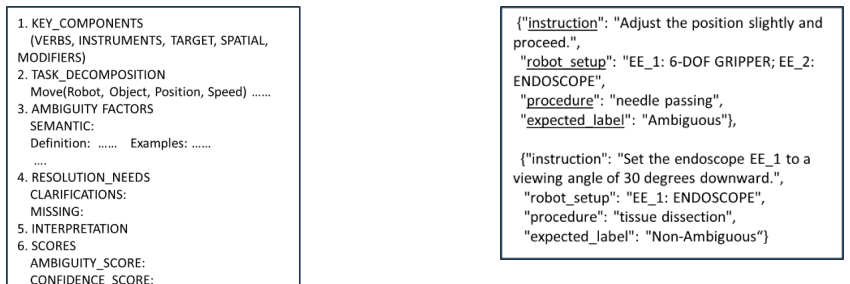
- [III.C / IV.A] The full dataset of 40 instructions is described and partially shown in Fig. 4, but the complete list is not provided. For reproducibility, the authors should release the dataset or include it in an appendix/supplementary material.
- [III.D / V] The paper emphasizes that conformal prediction provides 'statistical validity guarantees,' but no coverage diagnostics or calibration checks are reported. Reporting empirical coverage (e.g., whether the 1-alpha guarantee holds for the 'Ambiguous' label) would substantiate this claim.
Circularity Check
Reported 70%/82.5% accuracy is computed on the same 40-instruction calibration set used to build the conformal predictor and tune beta, so the central empirical claim is an in-sample fit presented as a prediction.
-
fitted input called prediction
[Sec. III.C and Sec. IV.A-B (calibration and evaluation sets are the same 40 instructions; Eq. 1, Eq. 2, Fig. 5)]
"We constructed such a dataset comprising 40 natural language instructions representative of common surgical tasks ... Each of these 40 requests was manually labeled as either ”ambiguous” or ”non-ambiguous”. ... This labeled dataset serves as the basis for calibrating our conformal predictor. ... The evaluation utilized a dataset of 40 natural language instructions relevant to surgical robotics. This dataset was manually labeled and comprised 20 non-ambiguous instructions and 20 ambiguous instructions."
The conformal predictor is calibrated on the same 40 instructions whose classification accuracy is then reported, with no held-out split described. Therefore the class centroids mu_cal,delta in Eq. 1 are means of the very instructions later scored, and in Eq. 2 each scored instruction is a member of the calibration subset Cal_delta against which its p-value is computed. The confusion matrices in Fig. 5 are in-sample reclassifications of the calibration data, so the reported 70% and 82.5% accuracy figures are fitted inputs presented as predictions.
-
fitted input called prediction
[Sec. IV.A (beta tuning) and Sec. IV.B (reported accuracy)]
"The hyperparameter β, which weights the score variance in the nonconformity score calculation (Equation 1), was empirically determined to be 0.5 through preliminary tuning."
The variance-weighting hyperparameter beta is tuned on the same 40-instruction dataset that is later scored and reported in Sec. IV.B. Because Eq. 1 depends directly on beta, the reported accuracy is a fitted result: the score-variance penalty is selected to maximize performance on the evaluation set, so the accuracy numbers are not independent measurements of a pre-specified decision rule.
full rationale
The paper's central empirical claim is that the conformal ensemble detects ambiguity with accuracy above 60% (70% for Llama 3.2 11B, 82.5% for Gemma 3 12B, Sec. IV.B). That claim is not an out-of-sample prediction: the calibration set (Sec. III.C) and the evaluation set (Sec. IV.A) are both described as the same 40 manually labeled instructions, no held-out test split is mentioned, and beta is tuned on that same data. Eq. 1 defines nonconformity relative to class centroids mu_cal,delta computed from the calibration set, and Eq. 2 computes each p-value against calibration subsets that include the instruction being scored, so each test point contributes to the null distribution used to classify itself. Consequently, the confusion matrices in Fig. 5 measure in-sample fit rather than generalizable performance. The framework itself (five evaluators, conformal aggregation, feedback generation) is not circular, and no load-bearing conclusion rests on self-citation; the self-citation in Sec. III.A only supports the speech-to-text front end. The limitation section acknowledges the small dataset and subjective labeling but does not disclose the calibration/evaluation overlap. Additionally, Eq. 3 defines an Uncertain class, yet Fig. 5 shows only Ambiguous/Non-ambiguous cells with counts summing to 40, so the handling of Uncertain outcomes in the accuracy calculation is not transparent. Overall circularity is partial and localized to the empirical validation: the reported accuracies are in-sample fitted results presented as predictions, giving a score of 6.
Assumptions & free parameters
free parameters (3)
- beta (variance weight in nonconformity score) =
0.5
- alpha (significance level for conformal classification) =
0.1
- Class centroid means mu_cal,delta per class =
Computed from the 20-instruction calibration subsets
assumptions (4)
- domain assumption The 40-instruction set is exchangeable with future surgical instructions (standard conformal prediction validity condition)
- domain assumption Manual labels of the 40 instructions are correct and unambiguous to human raters
- domain assumption LLM ambiguity scores are interval-scale quantities whose mean and variance are meaningful inputs to the nonconformity metric (Eq. 1)
- domain assumption The five-evaluator score variance captures useful disagreement signal
Cite this review
Pith. "Pith review of LLM-based ambiguity detection in natural language instructions for collaborative surgical robots." pith.science (2026). https://pith.science/paper/IRPCMYYB
@misc{pith2026250711525,
  author       = {Pith},
  title        = {Pith review of: LLM-based ambiguity detection in natural language instructions for collaborative surgical robots},
  year         = {2026},
  howpublished = {\url{https://pith.science/paper/IRPCMYYB}},
  note         = {Machine review of arXiv:2507.11525}
}
read the original abstract
Ambiguity in natural language instructions poses significant risks in safety-critical human-robot interaction, particularly in domains such as surgery. To address this, we propose a framework that uses Large Language Models (LLMs) for ambiguity detection specifically designed for collaborative surgical scenarios. Our method employs an ensemble of LLM evaluators, each configured with distinct prompting techniques to identify linguistic, contextual, procedural, and critical ambiguities. A chain-of-thought evaluator is included to systematically analyze instruction structure for potential issues. Individual evaluator assessments are synthesized through conformal prediction, which yields non-conformity scores based on comparison to a labeled calibration dataset. Evaluating Llama 3.2 11B and Gemma 3 12B, we observed classification accuracy exceeding 60% in differentiating ambiguous from unambiguous surgical instructions. Our approach improves the safety and reliability of human-robot collaboration in surgery by offering a mechanism to identify potentially ambiguous instructions before robot action.
Figures


Figures from the paper (2 more)


Reference graph
Works this paper leans on
-
[1]
“put the what, where? cut here?!
A. Satchidanand, J. Higginbotham, A. Bisantz, N. Aldhaam, A. El- sayed, I. Carr, A. A. Hussein, and K. Guru, ““put the what, where? cut here?!” challenges to coordinating attention in robot-assisted surgery: a microanalytic pilot study,” BMJ open , vol. 11, no. 7, p. e046132, 2021
work page 2021
-
[2]
L. Villamar G ´omez and J. Miura, “Ontology-based knowledge man- agement with verbal interaction for command interpretation and ex- ecution by home service robots,” Robotics and Autonomous Systems , vol. 140, p. 103763, 2021
work page 2021
-
[3]
Progprompt: Generating situated robot task plans using large language models,
I. Singh, V . Blukis, A. Mousavian, A. Goyal, D. Xu, J. Tremblay, D. Fox, J. Thomason, and A. Garg, “Progprompt: Generating situated robot task plans using large language models,” in 2023 IEEE Inter- national Conference on Robotics and Automation (ICRA) , 2023, pp. 11 523–11 530
work page 2023
-
[4]
Large language models for human–robot interaction: A review,
C. Zhang, J. Chen, J. Li, Y . Peng, and Z. Mao, “Large language models for human–robot interaction: A review,” Biomimetic Intelligence and Robotics, vol. 3, no. 4, p. 100131, 2023
work page 2023
-
[5]
Ambiguity detection: Towards a tool explaining ambiguity sources,
B. Gleich, O. Creighton, and L. Kof, “Ambiguity detection: Towards a tool explaining ambiguity sources,” in Requirements Engineering: Foundation for Software Quality , R. Wieringa and A. Persson, Eds. Berlin, Heidelberg: Springer Berlin Heidelberg, 2010, pp. 218–232
work page 2010
-
[6]
Analysing anaphoric ambiguity in natural language requirements,
H. Yang, A. De Roeck, V . Gervasi, A. Willis, and B. Nuseibeh, “Analysing anaphoric ambiguity in natural language requirements,” Requirements engineering, vol. 16, pp. 163–189, 2011
work page 2011
-
[7]
Aligning language models to explicitly handle ambiguity,
H. J. Kim, Y . Kim, C. Park, J. Kim, C. Park, K. M. Yoo, S. goo Lee, and T. Kim, “Aligning language models to explicitly handle ambiguity,” 2024. [Online]. Available: https://arxiv.org/abs/2404.11972
arXiv 2024
-
[8]
AmbigNLG: Addressing Task Ambiguity in Instruction for NLG
A. Niwa and H. Iso, “Ambignlg: Addressing task ambiguity in instruction for nlg,” 2024. [Online]. Available: https://arxiv.org/abs/2402.17717
work page Pith review arXiv 2024
Show all 30 references
-
[9]
Learning to ask: When llm agents meet unclear instruction,
W. Wang, J. Shi, Z. Ling, Y .-K. Chan, C. Wang, C. Lee, Y . Yuan, J. tse Huang, W. Jiao, and M. R. Lyu, “Learning to ask: When llm agents meet unclear instruction,” 2025. [Online]. Available: https://arxiv.org/abs/2409.00557
2025 arXiv
-
[10]
A vision-language-guided robotic action plan- ning approach for ambiguity mitigation in human–robot collaborative manufacturing,
J. Fan and P. Zheng, “A vision-language-guided robotic action plan- ning approach for ambiguity mitigation in human–robot collaborative manufacturing,” Journal of Manufacturing Systems, vol. 74, pp. 1009– 1018, 2024
2024
-
[11]
Towards open-world interactive dis- ambiguation for robotic grasping,
Y . Mo, H. Zhang, and T. Kong, “Towards open-world interactive dis- ambiguation for robotic grasping,” in IEEE International Conference on Robotics and Automation (ICRA) , 2023, pp. 8061–8067
2023
-
[12]
A study on speech recog- nition control for a surgical robot,
K. Zinchenko, C.-Y . Wu, and K.-T. Song, “A study on speech recog- nition control for a surgical robot,” IEEE Transactions on Industrial Informatics, vol. 13, no. 2, pp. 607–615, 2017
2017
-
[13]
A natural language interface for an autonomous camera control system on the da vinci surgical robot,
M. Elazzazi, L. Jawad, M. Hilfi, and A. Pandya, “A natural language interface for an autonomous camera control system on the da vinci surgical robot,” Robotics, vol. 11, no. 2, 2022
2022
-
[14]
V oice control interface for surgical robot assistants,
A. Davila, J. Colan, and Y . Hasegawa, “V oice control interface for surgical robot assistants,” in 2024 International Symposium on Micro- NanoMehatronics and Human Science (MHS) , 2024, pp. 1–5
2024
-
[15]
Sufia: Language-guided augmented dex- terity for robotic surgical assistants,
M. Moghani, L. Doorenbos, W. C.-H. Panitch, S. Huver, M. Azizian, K. Goldberg, and A. Garg, “Sufia: Language-guided augmented dex- terity for robotic surgical assistants,” in 2024 IEEE/RSJ International Conference on Intelligent Robots and Systems (IROS), 2024, pp. 6969– 6976
2024
-
[16]
Gestonurse: a robotic surgical nurse for handling surgical instruments in the operating room,
M. Jacob, Y .-T. Li, G. Akingba, and J. P. Wachs, “Gestonurse: a robotic surgical nurse for handling surgical instruments in the operating room,” Journal of Robotic Surgery , vol. 6, pp. 53–63, 2012
2012
-
[17]
From decision to action in surgical autonomy: Multi-modal large language models for robot-assisted blood suction,
S. Zargarzadeh, M. Mirzaei, Y . Ou, and M. Tavakoli, “From decision to action in surgical autonomy: Multi-modal large language models for robot-assisted blood suction,” IEEE Robotics and Automation Letters , vol. 10, no. 3, pp. 2598–2605, 2025
2025
-
[18]
A gentle introduction to conformal prediction and distribution-free uncertainty quantification,
A. N. Angelopoulos and S. Bates, “A gentle introduction to conformal prediction and distribution-free uncertainty quantification,”
-
[19]
Knowledge-and ambiguity-aware robot learning from corrective and evaluative feedback,
C. Celemin and J. Kober, “Knowledge-and ambiguity-aware robot learning from corrective and evaluative feedback,” Neural Computing and Applications, vol. 35, no. 23, pp. 16 821–16 839, 2023
2023
-
[20]
Probabilistically correct language- based multi-robot planning using conformal prediction,
J. Wang, G. He, and Y . Kantaros, “Probabilistically correct language- based multi-robot planning using conformal prediction,” IEEE Robotics and Automation Letters , vol. 10, no. 1, pp. 160–167, 2025
2025
-
[21]
Robots that ask for help: Uncertainty alignment for large language model planners,
A. Z. Ren, A. Dixit, A. Bodrova, S. Singh, S. Tu, N. Brown, P. Xu, L. Takayama, F. Xia, J. Varley, Z. Xu, D. Sadigh, A. Zeng, and A. Majumdar, “Robots that ask for help: Uncertainty alignment for large language model planners,” 2023. [Online]. Available: https://arxiv.org/abs/...
2023 arXiv
-
[22]
Introspective planning: Align- ing robots'uncertainty with inherent task ambiguity,
K. Liang, Z. Zhang, and J. F. Fisac, “Introspective planning: Align- ing robots'uncertainty with inherent task ambiguity,” in Advances in Neural Information Processing Systems , A. Globerson, L. Mackey, D. Belgrave, A. Fan, U. Paquet, J. Tomczak, and C. Zhang, Eds., vol. 37. C...
2024
-
[23]
Lap, using action feasibility for improved uncertainty alignment of large language model planners,
J. F. M. Jr. and D. Manocha, “Lap, using action feasibility for improved uncertainty alignment of large language model planners,”
-
[24]
Chain-of-thought prompting elicits reasoning in large language models,
J. Wei, X. Wang, D. Schuurmans, M. Bosma, b. ichter, F. Xia, E. Chi, Q. V . Le, and D. Zhou, “Chain-of-thought prompting elicits reasoning in large language models,” in Advances in Neural Information Pro- cessing Systems, vol. 35, 2022, pp. 24 824–24 837
2022
-
[25]
Endoscope automation framework with hierarchical control and interactive perception for multi-tool tracking in minimally invasive surgery,
K. Fozilov, J. Colan, A. Davila, K. Misawa, J. Qiu, Y . Hayashi, K. Mori, and Y . Hasegawa, “Endoscope automation framework with hierarchical control and interactive perception for multi-tool tracking in minimally invasive surgery,”Sensors, vol. 23, no. 24, p. 9865, 2023
2023
-
[26]
Task segmentation based on transition state clustering for surgical robot assistance,
Y . Yamada, J. Colan, A. Davila, and Y . Hasegawa, “Task segmentation based on transition state clustering for surgical robot assistance,” in 2023 8th International Conference on Control and Robotics Engineer- ing (ICCRE), 2023, pp. 260–264
2023
-
[27]
Latent regression based model predictive control for tissue triangulation,
S. Liu, J. Colan, Y . Zhu, T. Kobayashi, K. Misawa, M. Takeuchi, and Y . Hasegawa, “Latent regression based model predictive control for tissue triangulation,” Advanced Robotics , vol. 37, no. 24, pp. 1552– 1565, 2024
2024
-
[28]
Multimodal semi- supervised learning for online recognition of multi-granularity surgical workflows,
Y . Yamada, J. Colan, A. Davila, and Y . Hasegawa, “Multimodal semi- supervised learning for online recognition of multi-granularity surgical workflows,” International Journal of Computer Assisted Radiology and Surgery, vol. 19, no. 6, pp. 1075–1083, 2024
2024
-
[2022]
Available: https://arxiv.org/abs/2107.07511
[Online]. Available: https://arxiv.org/abs/2107.07511
-
[2024]
Available: https://arxiv.org/abs/2403.13198
[Online]. Available: https://arxiv.org/abs/2403.13198
Reviewed August 6, 2026 · model on record in the stance chip above.
Discussion (0). Continue with ORCID to comment.