REVIEW 3 major objections 4 minor 1 cited by
CoMET: A Contrastive-Masked Brain Foundation Model for Universal EEG Representation
T0 review · 3 major / 4 minor · reviewed 2026-08-05 · deepseek-v4-flash
Pith's one-line read A self-supervised EEG model, CoMET, pairs masked reconstruction with a mirror-scale contrastive view and reports the best results on eight of ten downstream brain-signal datasets.
desk verdict Serious, large-scale EEG foundation model with a plausible SOTA claim, but the signature augmentation is under-specified and the paper isn't reproducible until code and weights are released. read the letter →
The pith
A machine-rendered reading of the paper's core claim, the machinery that carries it, and where it could break.
The reading
What carries the argument
The load-bearing object is the mirror-scale augmentation that generates the second contrastive view. Given a random half of channels $V_a$ visible to the masked reconstruction branch, the momentum branch sees the complementary channels $V_b = \text{all channels} \setminus V_a$; the sample is then upsampled from $f$ to $2f$, doubling temporal patches while keeping patch length and the visible-channel list, and a length-$N$ sliding window with stride $1$ creates several views per sample. Positive pairs are views of the same trial; negative pairs are views of other trials in the batch. Supporting this are the learnable global token, which aggregates whole-brain discriminative information through every self-attention laye
What would settle it
Pre-train CoMET-Base twice, once with the proposed complement-channel mirror-scale view and once with a random channel subset of the same size, keeping all other settings identical; if balanced accuracy on BCIC IV 2A changes by less than the reported gap, the complement-channel mechanism is not what carries the contrastive gain.
Extended reading notes
Core claim
The paper's discovery claim is that contrastive learning and masked EEG modeling need not be alternatives: fused in one model, each corrects the other's bias. The authors trace the masked-only failure to volume conduction, which makes neighboring electrodes record near-identical signals, so reconstruction can be solved with local similarity and never learns cross-region discriminative structure; the contrastive-only failure is attention collapse, where tokens become homogeneous and the model latches onto task-irrelevant sample-level cues. CoMET keeps an MAE-style asymmetric encoder-decoder with channel-time decoupling embeddings, a 50% mask ratio, and a learnable global token, and adds a mom
Load-bearing premise
Mirror-scale augmentation assumes the upsampled complementary-channel view represents the same brain state as the masked-reconstruction view; if the channel split drops task-relevant information, the contrastive branch adds noise instead of global structure.
Editorial extensions
If this is right
- A frozen CoMET encoder can be adapted to unseen BCI and clinical tasks with a linear head, without retraining on each dataset's channels or sampling rate; differences in montage and duration are absorbed by the learned channel-time embeddings.
- Downstream performance grows log-linearly with both model size (R^2 ≈ 0.95–0.99) and pre-training data size (R^2 ≈ 0.92–0.98), so extending the same pre-training recipe to more data and larger encoders should continue to lift accuracy.
- Tasks that require coordinated activity across multiple brain regions—motor imagery, imagined speech, emotion—gain the most, while frequency-local tasks like SSVEP are less sensitive to the contrastive branch.
- The two losses contribute different information: removing the reconstruction loss hurts by up to about 7 points and removing the contrastive loss by up to about 5.5 points on the tested sets, so the gains come from combining both, not from either alone.
Reading between the lines
- An unstated corollary: any multi-channel biosignal with fixed electrode geometry and strong inter-channel correlation—ECoG, high-density EMG arrays, possibly MEG—could benefit from the same complement-channel contrastive view, though the paper only tests scalp EEG.
- A decisive test the authors leave implicit: replace the complement-channel view with a random channel subset of equal size while keeping everything else fixed. If linear-probe accuracy stays the same, the complementarity of channels is not what drives the gain.
- The sliding-window upsample multiplies the number of positive pairs per sample, so part of the contrastive benefit may come from temporal multi-crop augmentation rather than channel complementarity; isolating those factors would sharpen the architectural claim.
Signed reviews
Editorial analysis
A structured set of objections, weighed in public.
Referee Report
Summary. The paper proposes CoMET, a self-supervised EEG foundation model that combines masked autoencoding with an InfoNCE contrastive loss. A novel 'mirror-scale augmentation' generates a second view by taking the complement of the masked channels, upsampling the signal to 2f, and applying a sliding window over the doubled patch sequence. The model is pretrained on mixed EEG data (>3000 subjects, ~1.91M samples) at three scales (5M, 19M, 151M parameters) and evaluated on ten downstream BCI/clinical datasets with a frozen encoder and linear probing. The central claim is that CoMET-Large achieves state-of-the-art balanced accuracy on most of these datasets, with gains up to 6.9% absolute over CBraMod on BCIC IV 2A, while scaling-law fits and attention analyses support the design.
Significance. If the claims hold, CoMET would be a substantial advance: it is one of the largest publicly described EEG foundation models, uses a plausible combination of local (masked reconstruction) and global (contrastive) objectives, and is tested across a broad set of downstream tasks with statistical tests and ablations. The mirror-scale augmentation is a creative way to build contrastive views from EEG's channel structure. However, the validity of the SOTA comparison and of the proposed contrastive mechanism is not yet established, because the evaluation protocol is not uniform across baselines and because the momentum view may not be semantically aligned with the anchor view. These issues are load-bearing for the main claims.
major comments (3)
- [Table 1 / Appendix 9] The main comparison follows 'the original baseline’s downstream strategy', so CBraMod and LaBraM are fine-tuned, while EEGPT and CoMET are linear-probed. The claimed SOTA margins therefore conflate model quality with adaptation protocol. Appendix Tables 5-10 attempt to remedy this but are incomplete and internally inconsistent: Table 6 is labeled 'BCIC IV 2B' yet contains the PhysioP300 rows from Table 1, and Table 8 (FACED) duplicates the first four KaggleERN rows. A complete same-protocol comparison for all ten datasets is required; the current tables do not establish SOTA under a fixed evaluation protocol.
- [Methodology, Mirror-Scale Augmentation (Eqs. 10-11)] The momentum positive view is not obviously the same brain state as the MEM anchor. After upsampling from f to 2f with fixed patch length, N patches cover only T/2 seconds, and the sliding window of length N then selects a half-trial segment on the complement channels. The text never specifies how the 'group of different augmentation views' is pooled into the single e2_g used in Eq. (14), nor why window length N was chosen. For non-stationary tasks (motor imagery, P300, imagined speech), the InfoNCE loss can be minimized by ignoring temporal position rather than by learning shared global semantics. The w/o Mirror-Scale ablation changes both the channel complement and the temporal window, so it cannot validate the alignment assumption.
- [Ablation Study / Figure 3] The ablation study is reported only graphically, and the claimed numerical reductions ('up to 6.98% on TUEV, 5.54% on BCIC IV 2A') are not tied to specific conditions or repeated-seed standard deviations in the text. More importantly, the w/o Mirror-Scale condition replaces the proposed augmentation with random-crop masking, so it jointly changes two factors: the channel-complement operation and the temporal-window length. A controlled ablation is needed—e.g., full-trial complement channels with no window, or half-trial non-complement channels—to attribute the downstream gains to the mirror-scale mechanism rather than to longer context or to channel-disjoint positives.
minor comments (4)
- [Appendix 2, Table 2] BCIC2020-3 is listed as 20 subjects in Table 2 but as 15 subjects in the dataset description; the number of samples (8000) should also be reconciled with the per-class trial counts.
- [Table 4] The downstream output dimensions read '16, classes', '32, classes', '48, classes', which appears to be a formatting error; clarify the intended linear-head dimensions.
- [Appendix 5] The scaling-law constants are fitted to the model's own accuracy points. This is fine as a descriptive summary, but the text should avoid calling it a predictive scaling law without evaluation on held-out model sizes or data fractions.
- [Throughout] Typos and inconsistent naming: 'LabraM' vs 'LaBraM', 'CbraMod' vs 'CBraMod', 'banlanced', 'schedULered'. Also, Figure 3 is referenced without a table of numerical values, making the ablation hard to audit.
Circularity Check
No circularity: self-supervised pretraining and held-out linear-probe evaluation are independent of the claimed results.
full rationale
The derivation chain is self-contained. CoMET's pretraining objectives (Eq. 12 for masked reconstruction and Eq. 14 for InfoNCE contrastive learning) are both defined directly on input EEG patches and do not use downstream labels. Downstream performance is assessed with a frozen encoder and a linear head on ten datasets that are not part of the pretraining mixture, and the paper explicitly discloses that TUAB/TUEV were not used for CoMET pretraining while they were used by some baselines. The scaling-law equations in Appendix 5 are least-squares fits to the model's own accuracy points as a function of model/data size; they are presented as descriptive fits with reported R^2 values and are not used to construct the model or to generate external predictions, so they are not fitted inputs renamed as predictions. No load-bearing step in the paper reduces to a self-citation by the present authors: baselines such as LaBraM, EEGPT, CBraMod, and BIOT are external prior work, and the paper does not invoke any uniqueness theorem or ansatz from the authors' own prior publications. The mirror-scale augmentation's temporal-alignment assumption may be an unvalidated modeling concern, but it is not a circularity: the contrastive positive is still formed from an augmented view of the same input sample, not from the downstream label or from the claimed result. Overall, the central SOTA claim is supported by an independent evaluation chain rather than by definitional equivalence.
Assumptions & free parameters
free parameters (7)
- scaling-law slope and intercept, model size on BCIC IV 2A =
0.013, 0.568 (R2=0.949)
- scaling-law slope and intercept, model size on BCIC2020-3 =
0.009, 0.516 (R2=0.989)
- scaling-law slope and intercept, data size on BCIC IV 2A =
text: 0.0128, 0.567 (R2=0.915); Figure 8 caption: 0.0540, -0.1635 (R2=0.986)
- scaling-law slope and intercept, data size on BCIC2020-3 =
text: 0.0231, 0.512 (R2=0.933); Figure 8 caption: 0.0524, -0.2139 (R2=0.982)
- Mask ratio =
0.5
- InfoNCE temperature tau =
0.1
- Momentum coefficient schedule =
(0.996, 1)
assumptions (5)
- domain assumption Volume conduction makes neighboring EEG electrodes highly correlated, so masked reconstruction over-focuses on local signal-similarity features.
- ad hoc to paper Combining a masked reconstruction loss and an InfoNCE contrastive loss on a global token yields both local and global EEG representations without hurting either.
- domain assumption Linear probing on a frozen encoder faithfully measures universal representation quality.
- domain assumption The fixed 62-channel pre-training subset and 4-second, 200 Hz segmentation preserve task-relevant information for all ten downstream tasks.
- domain assumption No subject overlap exists between pre-training and downstream datasets.
Cite this review
Pith. "Pith review of CoMET: A Contrastive-Masked Brain Foundation Model for Universal EEG Representation." pith.science (2026). https://pith.science/paper/IS65RLMY
@misc{pith2026250900314,
  author       = {Pith},
  title        = {Pith review of: CoMET: A Contrastive-Masked Brain Foundation Model for Universal EEG Representation},
  year         = {2026},
  howpublished = {\url{https://pith.science/paper/IS65RLMY}},
  note         = {Machine review of arXiv:2509.00314}
}
read the original abstract
Electroencephalography (EEG) is a non-invasive technique for recording brain activity, widely used in brain-computer interfaces, clinic, and healthcare. Traditional EEG deep models typically focus on specific dataset and task, limiting model size and generalization. Recently, self-supervised brain foundation models have emerged and been applied to various downstream tasks. Nevertheless, these models still have limitations: current SOTA models typically rely on masked reconstruction strategy; however, EEG features of adjacent channels are highly correlated, which causes the pre-training to overly focus on low-dimensional signal-similarity features in local regions and neglect the global discriminative patterns vital for downstream tasks. To address these limitations, we propose a brain foundation model called CoMET. Specifically, we employ the masked autoencoder with redesigned patching and embedding for EEG as backbone and devise a novel contrastive learning framework with mirror-scale augmentation to strengthen the global discrimination ability. CoMET is pre-trained on mixed EEG datasets over 3000 subjects with over one million samples. It is evaluated on ten different downstream datasets, and the SOTA results demonstrate CoMET's superior ability in extracting universal EEG representations and strong clinical potential.
Figures


Figures from the paper (12 more)



Forward citations
Cited by 1 Pith paper
-
EEG-FM-Compass: Progress, Benchmarking, and Future Directions for EEG Foundation Models
A unified benchmark of 12 EEG foundation models across 13 datasets finds specialists remain competitive and larger pre-trained models do not consistently improve downstream decoding.
Reference graph
Works this paper leans on
-
[1]
Pre-training Datasets
-
[2]
Stieger21 dataset (Stieger, Engel, and He 2021) con- tains longitudinal EEG from 62 healthy adults who prac- ticed online sensorimotor-rhythm BCI control over 7-11 sessions (598 sessions, >600 h, 269 000 trials). Each session comprised four continuous cursor-control tasks: horizontal (left/right MI), vertical (up/down MI), two- dimensional (combined MI) a...
work page 2021
-
[3]
HBN-EEG dataset (Shirazi et al. 2024) provides high- density (128-channel) EEG from more than 3 000 sub- jects collected as part of the Healthy Brain Network project. Participants completed six paradigms cover- ing passive conditions—resting state, visual surround- suppression and movie watching—and active tasks of contrast-change detection, sequence lear...
work page 2024
-
[4]
SEED dataset (Zheng and Lu 2015) comprises emotion- elicitation EEG from 15 university students who viewed fifteen 4-min film clips intended to provoke positive, neu- tral or negative affect in three separate sessions spaced one week apart. EEG (62 channels, NeuroScan cap, 1 000 Hz, 0.05–100 Hz online band-pass, 50 Hz notch) and synchronous eye-tracking w...
work page 2015
-
[5]
multi- subject, multi-session, multi-task
M3CV dataset (Huang et al. 2022) is a large-scale “multi- subject, multi-session, multi-task” resource designed for biometric and variability studies. EEG was recorded from 106 subjects (95 returned for a second visit) while they performed six broad paradigms—resting- state, transient sensory, steady-state sensory, cogni- tive oddball, motor execution and...
work page 2022
-
[6]
THUBenchmark dataset (Wang et al. 2016) consists of EEG recordings from 35 subjects engaged in a 40- class steady-state visual evoked potential (SSVEP) task. Participants focused on target characters modulated by distinct frequency/phase combinations to elicit class- specific SSVEP responses. EEG signals were recorded using 64 electrodes at a sampling rat...
work page 2016
-
[7]
BCIC-IV-2A dataset (Brunner et al. 2008) comprises EEG recordings from nine subjects performing four-class motor imagery (MI) tasks: left hand (Class 1), right hand (Class 2), both feet (Class 3), and tongue (Class 4). Each subject participated in two sessions conducted on sepa- rate days, each containing six runs and a total of 288 tri- als. EEG signals ...
work page 2008
-
[8]
2008) involves binary motor imagery tasks (left hand vs
BCIC-IV-2B dataset (Leeb et al. 2008) involves binary motor imagery tasks (left hand vs. right hand) performed by nine right-handed subjects. Each subject participated in two initial screening sessions without feedback (120 trials per session), followed by three feedback sessions using a smiley-face interface (80 trials per session). EEG data were recorde...
work page 2008
Show all 24 references
-
[9]
PhysioP300 dataset (Citi, Poli, and Cinel 2010) consists of EEG recordings from nine subjects (8, 10, and 12 are removed for a fair comparison with the BENDR and EEGPT methdos) performing a visual P300 speller task based on the classic row-column paradigm. Participants were in...
2010
-
[10]
2012), which con- tains EEG recordings from 26 healthy participants en- gaged in a P300-based speller paradigm augmented with online error detection and correction
KaggleERN dataset (Margaux et al. 2012), which con- tains EEG recordings from 26 healthy participants en- gaged in a P300-based speller paradigm augmented with online error detection and correction. Subjects were in- structed to focus on target letters within a 6x6 flashing ma...
2012
-
[11]
FACED dataset (Chen et al. 2023) consists of 32-channel EEG recordings from 123 subjects who viewed 28 video clips designed to induce nine distinct emotional cate- gories: four negative emotions (anger, fear, disgust, sad- ness), four positive emotions (amusement, inspiration,...
2023
-
[13]
2018) comprises EEG recordings from nine subjects performing five-class mo- tor imagery tasks involving individual finger movements: thumb, index, middle, ring, and pinkie
Large-5F dataset (Kaya et al. 2018) comprises EEG recordings from nine subjects performing five-class mo- tor imagery tasks involving individual finger movements: thumb, index, middle, ring, and pinkie. Data were col- lected as part of a multi-paradigm EEG study using 22 elect...
2018
-
[14]
Impedances were maintained below 15 k Ω to ensure signal quality
BCIC2020-3 dataset (Committee 2022) comprises EEG recordings from 15 healthy subjects aged 20 to 30 years, performing imagined speech tasks involving five phrases: ”hello,” ”help me,” ”stop,” ”thank you,” and ”yes.” EEG signals were acquired using 64 electrodes arranged ac- co...
2022
-
[15]
EEG sig- nals were recorded using 64 electrodes placed according to the international 10-20 system, with ground at Fpz and reference at FCz, maintaining impedances below 15 k Ω
TUAB dataset (Obeid and Picone 2016) facilitates bi- nary classification of normal versus abnormal adult EEG recordings based on background brain activity. EEG sig- nals were recorded using 64 electrodes placed according to the international 10-20 system, with ground at Fpz an...
2016
-
[16]
The dataset comprises 16,986 sessions from 10,874 sub- jects, recorded using a variable number of EEG channels (typically 31) at sampling rates of 250, 256, 400, or 512 Hz
TUEV dataset (Obeid and Picone 2016), a subset of the Temple University Hospital EEG Corpus, supports classification of six clinically relevant EEG event types: spike and sharp waves (SPSW), periodic lateralized epileptiform discharges (PLED), generalized periodic epileptiform...
2016
-
[17]
We first apply a 0.5 HZ to 70 HZ band-pass filter on EEG signals and resample them to 200 HZ
More Details For Experimental Settings Data preprocessing : For pre-training, we applied mini- mum necessary data preprocessing. We first apply a 0.5 HZ to 70 HZ band-pass filter on EEG signals and resample them to 200 HZ. Then we normalize the EEG signals by setting the unit ...
2024
-
[18]
It is evident that both losses decrease rapidly be- tween epochs 1 and 20
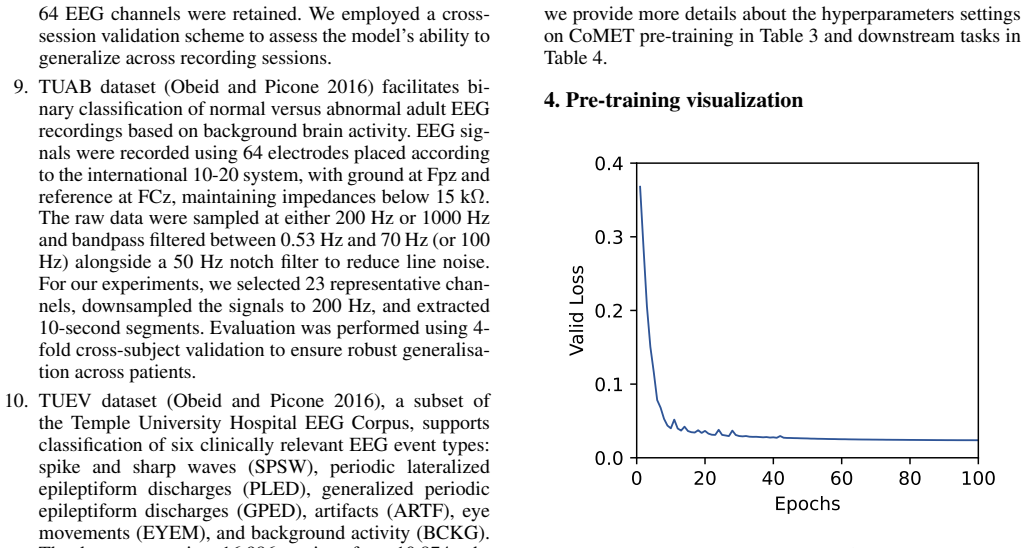
Pre-training visualization 0 20 40 60 80 100 Epochs 0.0 0.1 0.2 0.3 0.4Valid Loss Figure 5: The reconstruction loss (LR) of pre-training 0 20 40 60 80 100 Epochs 0.0 0.1 0.2 0.3 0.4 0.5 0.6 0.7Valid Loss Figure 6: The contrastive loss (LC) of pre-training In Figure 5 and Figur...
-
[19]
We evaluated these five models on the datasets BCIC IV 2A and BCIC2020-3, with the results il- lustrated in Figure 7
Scaling laws 5.1 Scaling laws with model size To analyze how down- stream performance scales with model size, we conducted experiments with two additional pre-training settings: a 0.8M-parameter model (4 layers, 128 hidden size, 4 heads) and a 51M-parameter model (12 layers, 5...
-
[20]
On BCIC IV 2A, the balanced accuracy (BAC) scales with model size (N) as: BAC = 0.0128 · ln(N) + 0.567 ( R2 = 0.915)
The results are illustrated in Figure 8. On BCIC IV 2A, the balanced accuracy (BAC) scales with model size (N) as: BAC = 0.0128 · ln(N) + 0.567 ( R2 = 0.915). Similarly, on BCIC2020-3, the scaling law is: BAC = 0.0231 · ln(N) + 0.512 (R2 = 0.933)
-
[21]
Prior work of other large brain models ((Jiang, Zhao, and Lu 2024; Wang et al
Channel embedding similarity After pre-training, the foundation models leverage channel embeddings to impose biases on the signals recorded on different channels. Prior work of other large brain models ((Jiang, Zhao, and Lu 2024; Wang et al. 2024, 2025)) has not, however, visu...
2024
-
[22]
2014), a widely used nonlinear dimensionality reduction technique, on the learned features across different downstream tasks
Feature Distributions To showcase the distribution patterns of feature representa- tions, we performed a t-SNE analysis (Donahue et al. 2014), a widely used nonlinear dimensionality reduction technique, on the learned features across different downstream tasks. This visualizat...
2014
-
[23]
Brain map of attention To facilitate a comprehensive discussion of the model’s per- formance in the EEG paradigm, we present the attention weight distributions across different channels in the BCIC IV 2A dataset (22-channel input) under varying query con- ditions, as shown in ...
-
[24]
Different downstream strategies In Table 5, Table 6, Table 7, Table 8, Table 9, and Table 10, we present different models alongside CoMET performance under different strategies, namely linear-probing (lb) and fine-tuning (ft), where the former freezes the encoder while the lat...
-
[2022]
In IEEE/CVF Conference on Computer Vision and Pattern Recognition, 15979–15988
Masked Autoencoders Are Scalable Vision Learners. In IEEE/CVF Conference on Computer Vision and Pattern Recognition, 15979–15988. He, K.; Fan, H.; Wu, Y .; Xie, S.; and Girshick, R. 2020. Momentum contrast for unsupervised visual representation learning. In IEEE/CVF Conference...
2020 arXiv
Reviewed August 5, 2026 · model on record in the stance chip above.
Discussion (0). Continue with ORCID to comment.