REVIEW 4 major objections 5 minor 1 cited by
A Common Origin of Normal Type Ia Supernovae Suggested by the Photometric Diversity
T0 review · 4 major / 5 minor · reviewed 2026-08-06 · deepseek-v4-flash
Pith's one-line read The paper argues that all normal Type Ia supernovae share a single explosion channel: thin-helium double detonation.
desk verdict Useful empirical compilation, but the unified thin-He DDet origin claim is qualitative and patched, not yet tested. read the letter →
The pith
A machine-rendered reading of the paper's core claim, the machinery that carries it, and where it could break.
The reading
What carries the argument
The load-bearing object is the thin-helium double-detonation (DDet) scenario, together with the viewing-angle effect. In this picture a white dwarf with a thin helium shell ($\lesssim 0.02\,M_\odot$) detonates that shell, and the inward shock triggers a carbon detonation in the core; the amount and distribution of $^{56}\mathrm{Ni}$ and the opacity and ionization added by helium-shell products depend on core mass, shell mass, and which side faces the observer. That single mechanism is what the paper uses to turn the observed early-excess/non-excess split, rise-time spread, peak-luminosity spread, and $B-V$ color behaviors into one continuous family.
What would settle it
Build a volume-complete, high-cadence sample of normal Type Ia supernovae caught before about $-15.5$ mag and count the early-excess fraction while measuring rise time, peak magnitude, and early $B-V$ color. If the unbiased excess fraction is far below the near-half found at $z<0.01$, or if any clear early-excess object has a short rise, faint peak, or purely blue early color, the proposed common thin-helium double-detonation origin fails.
Extended reading notes
Core claim
On the paper's own terms, the central discovery is empirical plus interpretive. Empirically, in a sample of 67 early-phase normal SNe Ia, every event classified as having early excess lies in the same region of parameter space: longer rise time, brighter peak magnitude, and early color behavior that includes a red bump or a blue plateau, whereas non-excess events are fainter, faster, and monotonically blue. Interpretively, the paper proposes that this dichotomy and the continuum around it are produced by the thin-helium double-detonation mechanism, with more massive white dwarfs and thinner helium shells generating more surface $^{56}\mathrm{Ni}$ and hence blue excess, thicker shells producing fainter fast helium-detonation excesses that look like non-excess events, and the viewing angle spreading the observed color and rise-time properties.
Load-bearing premise
The load-bearing premise is that the split between supernovae with an early bump of extra light and those that rise smoothly is a real astrophysical difference, not mostly an artifact of which events got published and observed early.
Editorial extensions
If this is right
- The early-excess versus non-excess split among normal SNe Ia would be a continuous envelope set by white-dwarf mass, helium-shell mass, and viewing angle, not separate explosion channels.
- Early $B-V$ evolution would become a diagnostic: a red bump or blue plateau signals thin-He-shell double-detonation products near the ejecta surface, while monotonic blueward evolution marks the opposite viewing condition.
- Brighter, slower-rising early-excess events would be the more massive white dwarfs with thinner helium shells, so rise time and peak brightness encode progenitor mass.
- If ejecta are asymmetric and peak magnitude is viewing-angle dependent, distance measurements with SNe Ia would carry a small orientation-dependent scatter.
- Unbiased high-cadence surveys and real-time follow-up would test the common-origin prediction by measuring the true EEx fraction and the spectral signatures of double detonation.
Reading between the lines
- If the near-50% excess fraction measured locally survives in a volume-complete sample, the practical implication is that every normal Type Ia supernova caught early enough shows some excess, and 'non-EEx' is just the faint end of the same continuous distribution.
- The orientation picture predicts measurable spectral asymmetries, such as viewing-angle-dependent line velocities or polarization, that could be searched for in nebular-phase or polarimetric observations.
- A testable correlation should link the strength of the early red bump with the amount of surface $^{56}\mathrm{Ni}$ inferred from late-time light curves; companion-shock or generic circumstellar-matter excess models would not naturally produce that correlation.
Editorial analysis
A structured set of objections, weighed in public.
Referee Report
Summary. The paper compiles a sample of 67 early-phase normal Type Ia supernovae from the literature and from ZTF, ATLAS, and MUSSES surveys, classifies 15 of them as having early-excess (EEx) emission, and reports that EEx SNe Ia have longer rise times and brighter peak magnitudes than non-EEx SNe Ia. It also finds that EEx SNe Ia show either a 'tiny red bump' or a 'blue plateau' in early B-V color, while non-EEx SNe Ia show monotonically blueward color evolution. The authors then propose that the thin-helium double-detonation (DDet) scenario, with varying white dwarf core mass, helium shell mass, and viewing angle, can phenomenologically explain these photometric diversities and thus imply a unified explosion mechanism for normal SNe Ia.
Significance. The compiled sample of 67 early-phase normal SNe Ia is a useful observational resource, and the empirical correlations between early excess, rise time, peak brightness, and early color are interesting. The paper is also candid about acknowledged limitations, including possible publication bias in the low-z subsample and the omission of K-corrections. However, the central theoretical claim — that thin-helium DDet explains the observed diversities — is not quantitatively tested: no synthetic light curves or color curves are compared with the observations, and the proposed surface 56Ni ionization source is introduced ad hoc. If the DDet common-origin claim could be supported with quantitative predictions, the significance would be high; as it stands, the paper provides a plausible hypothesis rather than a demonstrated explanation.
major comments (4)
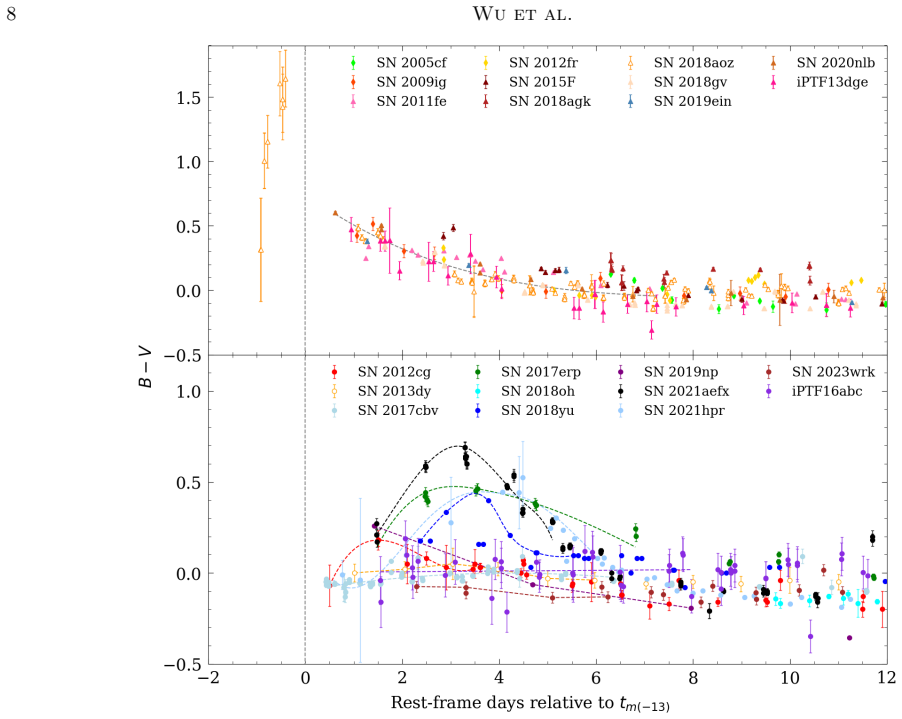
- [Section 4.2] The central claim that the thin-helium DDet scenario 'can phenomenologically explain' the photometric diversities is not quantitatively tested. The paper acknowledges that He-detonation products predict a red B-V bump as large as about 2 mag, while the observed EEx SNe Ia show B-V peaks ≲0.7 mag or blue plateaus (Figure 3). The proposed remedy — an additional source of ionization from surface 56Ni — is introduced without any calculation showing that the combined model reproduces the observed color curves, nor are synthetic light curves compared with the rise-time and peak-brightness data in Figure 2. With the free parameters (WD mass, He-shell mass, viewing angle, and the new ionization source), the scenario is not currently falsifiable. To support the unified-origin claim, the authors need to show that a specific DDet model with specific parameters yields the observed distributions and color morphologies, or they should clearly reframe the section as a speculative hypothesis rather than an explanation.
- [Sections 3.1 and 3.2] The classification of SNe as EEx and the measurement of their rise times use the same power-law-plus-Gaussian fitting procedure. For EEx SNe, the addition of a Gaussian component will generally prolong the effective rise to a given magnitude relative to a single power-law fit, so part of the reported 'EEx SNe have longer rise times' could be built into the method rather than being an independent observed property. The authors should test the robustness of the correlation by using an independent rise-time estimator (e.g., fitting both classes with the same functional form applied only to the late rising phase, or using a physical light-curve model), and should show the results after removing the two reclassified objects, SN 2013dy and SN 2018aoz, from the sample.
- [Sections 2.1 and 3.1] The empirical foundation is weakened by a likely selection effect: all 15 EEx SNe Ia appear to come from the literature sample or MUSSES, while the 24 ZTF/ATLAS survey SNe are reported as showing no early excess. Since literature selection favors peculiar or well-publicized objects, the EEx fraction and the differences in rise time and brightness could be substantially inflated. The paper acknowledges this possibility (Section 3.1) but does not quantify it. The authors should provide a systematic comparison using a well-defined survey subsample with uniform cadence and depth (e.g., the ZTF Bright Transient Survey) and state the EEx fraction and the property differences in that subsample. If the differences do not persist there, the observational basis for the DDet interpretation would be weakened.
- [Section 3.3] The color analysis rests on only 22 objects, and the classification of color morphologies ('tiny red-bump', 'blue plateau') is not defined quantitatively. The claim that EEx SNe Ia 'generously show blue–red–blue or continuous blue evolution' needs a reproducible metric — for example, the amplitude and timing of any B-V maximum relative to tm(-13), or the B-V slope over a fixed early epoch — with uncertainties. Without such a definition, the color-morphology difference between EEx and non-EEx SNe Ia is difficult to assess and the connection to the surface 56Ni scenario remains qualitative.
minor comments (5)
- [Section 3.1] The sentence 'The ratio between EExSNe Ia and non-EExSNe Ia of 17 SNe Ia at z <0.01 ... is almost the same' is confusing; the authors seem to mean that the fractions are comparable. Please rephrase and give the actual numbers.
- [Section 4.2] The word 'adsorptions' in the discussion of He-detonation products should be 'absorptions'.
- [Table 1] The EEx column is left blank for several rows (e.g., LSQ12gpw, PTF10accd, MUSSES2022S, MUSSES2022T, and various ZTF rows). Please ensure every row has an explicit 'Y' or 'N' entry, and check that the total number of 'Y' entries equals the stated 15 EEx SNe.
- [Section 3.2] The text says 'lmf it' for the lmfit package; please correct the typo.
- [Figure A1] The caption states that power-law fitting indices of non-EExSNe Ia are shown; please clarify whether the indices for EExSNe Ia are also displayed and, if not, why they are omitted.
Circularity Check
The longer-rise-time half of the headline EEx correlation reduces by construction to the same power-law-plus-Gaussian fit used to define EEx; the peak-brightness and color results remain independent, so the circularity is partial.
-
fitted input called prediction
[Section 3.1 (EEx definition), Section 3.2 (rise-time fitting), and Figure 2 result]
"Following the definition from Jiang et al. (2018), an early-phase normal SNe Ia with additional excess emissions compared to a smooth rise is defined as an EExSN Ia in this paper. ... residuals of two consecutive detections in the same band are both non-zero, with at least one residual exceeding 2% of the peak flux, an additional Gaussian component is applied to fit extra emissions in the early rising phase of EExSNe Ia. ... for EExSNe Ia, an additional Gaussian component was used to fit EEx feature. ..."
EEx is defined as an excess over a smooth power-law rise, and the rise time Delta-t_m(-13) is measured from a fit that includes a positive Gaussian component for EEx objects but only a power law for non-EEx objects. Adding this Gaussian to the early rise moves the fitted model's -13 mag crossing earlier relative to peak, mechanically increasing Delta-t_m(-13). The reported 'EEx have longer rise time' is therefore an analytical consequence of the classification/fitting procedure rather than an independently measured property; the brighter-peak and early-color correlations are not affected by this step.
full rationale
The paper's direct photometric findings on peak brightness and early B-V color are based on data and external SALT2/literature values, and they are not circular. The proposed thin-He double-detonation common origin is explicitly qualitative and, as the authors admit in Section 4.2, the predicted B-V red bump (~2 mag) is far larger than observed and is patched by postulating surface 56Ni without a quantitative model; that is an evidential weakness, not circularity. The main circular element is the rise-time half of the central observational claim: EEx is defined by an excess above a power-law rise, and the same power-law-plus-Gaussian fit is then used to derive Delta-t_m(-13), so the systematically longer rise times of EEx SNe are partly imposed by construction. Self-citations to Jiang et al. and Maeda et al. are frequent but not load-bearing here, since the DDet trends are also tied to independent simulations by Shen et al. (2021b) and Boos et al. (2021). Overall the paper has independent content but one central 'prediction' reduces by construction; score 6.
Assumptions & free parameters
free parameters (4)
- Power-law rise index alpha =
fitted per object, range 1-3
- Gaussian bump parameters for EEx SNe =
fitted per EEx object
- Thin He-shell mass =
<=0.02 Msun (assumed)
- WD core mass / 56Ni yield =
~1.1 Msun, 0.75-0.76 Msun from Shen et al. 2021
assumptions (5)
- domain assumption The He-shell double detonation ignites at the north pole and the core detonation is triggered near the south pole, producing an asymmetric 56Ni distribution.
- domain assumption More massive WD cores have thinner He shells at detonation initiation.
- domain assumption The early-phase sample is representative enough that the EEx vs non-EEx dichotomy is not dominated by selection effects.
- ad hoc to paper A single power law F=k(t-t0)^alpha with 1<alpha<3 describes the non-EEx rise.
- domain assumption K-corrections are negligible for the early color analysis.
invented entities (1)
-
Surface 56Ni ionization source
Cite this review
Pith. "Pith review of A Common Origin of Normal Type Ia Supernovae Suggested by the Photometric Diversity." pith.science (2026). https://pith.science/paper/IS72JW44
@misc{pith2026250715609,
  author       = {Pith},
  title        = {Pith review of: A Common Origin of Normal Type Ia Supernovae Suggested by the Photometric Diversity},
  year         = {2026},
  howpublished = {\url{https://pith.science/paper/IS72JW44}},
  note         = {Machine review of arXiv:2507.15609}
}
abstract
In recent years, with an increasing number of type Ia supernovae (SNe Ia) discovered soon after their explosions, a non-negligible fraction of SNe Ia with early-excess emissions (EExSNe Ia) have been confirmed. In this letter, we present a total of \textbf{67} early-phase normal SNe Ia from published papers and ongoing transient survey projects to systematically investigate their photometric behaviors from very early time. We found that EExSNe Ia in our sample have longer rise and brighter peak luminosities compared to those of non-EExSNe Ia. Moreover, EExSNe Ia commonly have ``red-bump" features in the early $B-V$ color while non-EExSNe Ia show blueward evolution from the very beginning. Here, we propose that the thin-helium double-detonation scenario can phenomenologically explain the photometric diversities of normal SNe Ia considering different white dwarf-He-shell mass combinations and the viewing-angle effect, implying a unified explosion mechanism of normal-type SNe Ia. To further testify the possible common origin of normal SNe Ia, systematical studies of multiband photometric and spectral properties of early-phase SNe Ia through the new generation wide-field time-domain survey facilities and global real-time follow-up networks are highly demanded.
Figures


Figures from the paper (1 more)

Forward citations
Cited by 1 Pith paper
-
A double-degenerate scenario with a merger to explosion delay time to explain type Ia supernova SN 2020aeuh
The author proposes that SN 2020aeuh's early carbon-oxygen circumstellar interaction is the delayed explosion of a merged white dwarf, about one to two years after the merger.
Reference graph
Works this paper leans on
-
[1]
2018, Publications of the Astronomical Society of Japan, 70, S4
Aihara, H., Arimoto, N., Armstrong, R., et al. 2018, Publications of the Astronomical Society of Japan, 70, S4
2018
-
[2]
2010, in Software and Cyberinfrastructure for
Axelrod, T., Kantor, J., Lupton, R., & Pierfederici, F. 2010, in Software and Cyberinfrastructure for
2010
-
[3]
2006, in Astronomical Society of the Pacific Conference Series, Vol
Bertin, E. 2006, in Astronomical Society of the Pacific Conference Series, Vol. 351, Astronomical Data Analysis Software and Systems XV, ed. C. Gabriel, C. Arviset, D. Ponz, & S. Enrique, 112
2006
-
[4]
1996, A&AS, 117, 393, doi: 10.1051/aas:1996164
Bertin, E., & Arnouts, S. 1996, A&AS, 117, 393, doi: 10.1051/aas:1996164
-
[5]
Bildsten, L., Shen, K. J., Weinberg, N. N., & Nelemans, G. 2007, ApJL, 662, L95, doi: 10.1086/519489
doi:10.1086/519489 2007
-
[6]
Blondin, S., & Tonry, J. L. 2007, The Astrophysical Journal, 666, 1024
2007
-
[7]
Blondin, S., & Tonry, J. L. 2007, ApJ, 666, 1024, doi: 10.1086/520494
doi:10.1086/520494 2007
-
[8]
P., et al
Blondin, S., Matheson, T., Kirshner, R. P., et al. 2012, The Astronomical Journal, 143, 126
2012
Show all 92 references
-
[9]
Miles, B. J. 2021, The Astrophysical Journal, 919, 126
2021
-
[10]
2018, Publications of the Astronomical Society of Japan, 70, S5
Bosch, J., Armstrong, R., Bickerton, S., et al. 2018, Publications of the Astronomical Society of Japan, 70, S5
2018
-
[11]
C., Hall, N., et al
Branch, D., Dang, L. C., Hall, N., et al. 2006, Publications of the Astronomical Society of the Pacific, 118, 560
2006
-
[12]
J., Hosseinzadeh, G., Jha, S
Brown, P. J., Hosseinzadeh, G., Jha, S. W., et al. 2019, The Astrophysical Journal, 877, 152, doi: 10.3847/1538-4357/ab1a3f
2019 doi
-
[13]
A., Yao, Y., et al
Bulla, M., Miller, A. A., Yao, Y., et al. 2020, The Astrophysical Journal, 902, 48
2020
-
[14]
A., Sand, D
Burke, J., Howell, D. A., Sand, D. J., et al. 2022a, Early Lightcurves of Type Ia Supernovae are Consistent with Nondegenerate Progenitor Companions. https://arxiv.org/abs/2207.07681 —. 2022b, Early Lightcurves of Type Ia Supernovae are Consistent with Nondegenerate Progenitor...
-
[15]
E., et al
Cartier, R., Sullivan, M., Firth, R. E., et al. 2016, Monthly Notices of the Royal Astronomical Society, 464, 4476–4494, doi: 10.1093/mnras/stw2678
2016 doi
-
[16]
R., et al
Deckers, M., Maguire, K., Magee, M. R., et al. 2022b, Monthly Notices of the Royal Astronomical Society, 512, 1317–1340, doi: 10.1093/mnras/stac558
-
[17]
2023, Monthly Notices of the Royal Astronomical Society, 521, 4414
Deckers, M., Graur, O., Maguire, K., et al. 2023, Monthly Notices of the Royal Astronomical Society, 521, 4414
2023
-
[18]
M., Vallely, P
Fausnaugh, M. M., Vallely, P. J., Tucker, M. A., et al. 2023, Four years of Type Ia Supernovae Observed by TESS: Early Time Light Curve Shapes and Constraints on Companion Interaction Models. https://arxiv.org/abs/2307.11815
2023 arXiv
-
[19]
2016, Astronomy & Astrophysics, 592, A40, doi: 10.1051/0004-6361/201628351
Ferretti, R., Amanullah, R., Goobar, A., et al. 2016, Astronomy & Astrophysics, 592, A40, doi: 10.1051/0004-6361/201628351
2016 doi
-
[20]
2015, Monthly Notices of the Royal Astronomical Society, 446, 3895
Firth, R., Sullivan, M., Gal-Yam, A., et al. 2015, Monthly Notices of the Royal Astronomical Society, 446, 3895
2015
-
[21]
W., Lang, D., & Goodman, J
Foreman-Mackey, D., Hogg, D. W., Lang, D., & Goodman, J. 2013, Publications of the Astronomical Society of the Pacific, 125, 306
2013
-
[22]
2007, Astronomy & Astrophysics, 466, 11
Guy, J., Astier, P., Baumont, S., et al. 2007, Astronomy & Astrophysics, 466, 11
2007
-
[23]
A., Sullivan, M., et al
Hachinger, S., Mazzali, P. A., Sullivan, M., et al. 2013, Monthly Notices of the Royal Astronomical Society, 429, 2228–2248, doi: 10.1093/mnras/sts492
2013 doi
-
[24]
E., et al
Han, X., Zheng, W., Stahl, B. E., et al. 2020, The Astrophysical Journal, 892, 142
2020
-
[25]
2009, ApJ, 700, 331
Hicken, M., Challis, P., Jha, S., et al. 2009, ApJ, 700, 331
2009
-
[26]
D., Shappee, B
Holmbo, S., Stritzinger, M. D., Shappee, B. J., et al. 2019, Astronomy & Astrophysics, 627, A174, doi: 10.1051/0004-6361/201834389
2019 doi
-
[27]
2022, The Astrophysical Journal, 936, 157
Hu, L., Wang, L., Chen, X., & Yang, J. 2022, The Astrophysical Journal, 936, 157
2022
-
[28]
Hunter, J. D. 2007, Computing in science & engineering, 9, 90 Ivezi´ c,ˇZ., Kahn, S. M., Tyson, J. A., et al. 2019, The Astrophysical Journal, 873, 111
2007
-
[29]
2022, ApJ, 941, 87, doi: 10.3847/1538-4357/aca013 —
Iwata, K., & Maeda, K. 2022, ApJ, 941, 87, doi: 10.3847/1538-4357/aca013 —. 2024, PhRvL, 133, 121201, doi: 10.1103/PhysRevLett.133.121201
2022 doi
-
[30]
2018, The Astrophysical Journal, 865, 149
Jiang, J.-a., Doi, M., Maeda, K., & Shigeyama, T. 2018, The Astrophysical Journal, 865, 149
2018
-
[31]
2017, Nature, 550, 80
Jiang, J.-a., Doi, M., Maeda, K., et al. 2017, Nature, 550, 80
2017
-
[32]
2020, The Astrophysical Journal, 892, 25, doi: 10.3847/1538-4357/ab76cb
Jiang, J.-a., Yasuda, N., Maeda, K., et al. 2020, The Astrophysical Journal, 892, 25, doi: 10.3847/1538-4357/ab76cb
2020 doi
-
[33]
2021, The Astrophysical Journal Letters, 923, L8
Jiang, J.-a., Maeda, K., Kawabata, M., et al. 2021, The Astrophysical Journal Letters, 923, L8
2021
-
[34]
2022, The Astrophysical Journal Letters, 933, L36
Jiang, J.-a., Yasuda, N., Maeda, K., et al. 2022, The Astrophysical Journal Letters, 933, L36
2022
-
[35]
2012, The Astrophysical Journal, 759, 53
Jordan, G., Graziani, C., Fisher, R., et al. 2012, The Astrophysical Journal, 759, 53
2012
-
[36]
2009, The Astrophysical Journal, 708, 1025 15
Kasen, D. 2009, The Astrophysical Journal, 708, 1025 15
2009
-
[37]
2020, The Astrophysical Journal, 893, 143, doi: 10.3847/1538-4357/ab8236
Kawabata, M., Maeda, K., Yamanaka, M., et al. 2020, The Astrophysical Journal, 893, 143, doi: 10.3847/1538-4357/ab8236
2020 doi
-
[38]
2010, The Astrophysical Journal, 719, 1067
Kromer, M., Sim, S., Fink, M., et al. 2010, The Astrophysical Journal, 719, 1067
2010
-
[39]
2015, Publications of the Astronomical Society of Japan, 67, 54
Kutsuna, M., & Shigeyama, T. 2015, Publications of the Astronomical Society of Japan, 67, 54
2015
-
[40]
2021, ApJ, 909, 152, doi: 10.3847/1538-4357/abc9c1
Leung, S.-C., Diehl, R., Nomoto, K., & Siegert, T. 2021, ApJ, 909, 152, doi: 10.3847/1538-4357/abc9c1
2021 doi
-
[41]
2020, ApJ, 888, 80, doi: 10.3847/1538-4357/ab5c1f
Leung, S.-C., & Nomoto, K. 2020, ApJ, 888, 80, doi: 10.3847/1538-4357/ab5c1f
2020 doi
-
[42]
2018, The Astrophysical Journal, 870, 12, doi: 10.3847/1538-4357/aaec74
Li, W., Wang, X., Vink´ o, J., et al. 2018, The Astrophysical Journal, 870, 12, doi: 10.3847/1538-4357/aaec74
2018 doi
-
[43]
Lim, G., Im, M., Paek, G. S. H., et al. 2023, The Astrophysical Journal, 949, 33, doi: 10.3847/1538-4357/acc10c
2023 doi
-
[44]
2024, Early-Time Observations of SN 2023wrk: A Luminous Type Ia Supernova with Significant Unburned Carbon in the Outer Ejecta
Liu, J., Wang, X., Andrade, C., et al. 2024, Early-Time Observations of SN 2023wrk: A Luminous Type Ia Supernova with Significant Unburned Carbon in the Outer Ejecta. https://arxiv.org/abs/2407.15768
2024 arXiv
-
[45]
2023, Monthly Notices of the Royal Astronomical Society, 521, 1897
Shigeyama, T. 2023, Monthly Notices of the Royal Astronomical Society, 521, 1897
2023
-
[46]
2018, The Astrophysical Journal, 861, 78
Maeda, K., Jiang, J.-a., Shigeyama, T., & Doi, M. 2018, The Astrophysical Journal, 861, 78
2018
-
[47]
2011, MNRAS, 413, 3075, doi: 10.1111/j.1365-2966.2011.18381.x
Maeda, K., Leloudas, G., Taubenberger, S., et al. 2011, MNRAS, 413, 3075, doi: 10.1111/j.1365-2966.2011.18381.x
2011
-
[48]
2020, Astronomy & Astrophysics, 634, A37
Magee, M., Maguire, K., Kotak, R., et al. 2020, Astronomy & Astrophysics, 634, A37
2020
-
[49]
A., Schlafly, E., Finkbeiner, D., et al
Magnier, E. A., Schlafly, E., Finkbeiner, D., et al. 2013, The Astrophysical Journal Supplement Series, 205, 20, doi: 10.1088/0067-0049/205/2/20
2013 doi
-
[50]
H., Vinko, J., Wheeler, J
Marion, G. H., Vinko, J., Wheeler, J. C., et al. 2013, The Astrophysical Journal, 777, 40, doi: 10.1088/0004-637x/777/1/40
2013 doi
-
[51]
H., Brown, P
Marion, G. H., Brown, P. J., Vink´ o, J., et al. 2016, The Astrophysical Journal, 820, 92, doi: 10.3847/0004-637x/820/2/92
2016 doi
-
[52]
J., Laher, R
Masci, F. J., Laher, R. R., Rusholme, B., et al. 2023, A New Forced Photometry Service for the Zwicky Transient Facility. https://arxiv.org/abs/2305.16279
2023 arXiv
-
[53]
2020, The Astrophysical Journal, 902, 47
Miller, A., Yao, Y., Bulla, M., et al. 2020, The Astrophysical Journal, 902, 47
2020
-
[54]
A., Cao, Y., Piro, A
Miller, A. A., Cao, Y., Piro, A. L., et al. 2018, The Astrophysical Journal, 852, 100, doi: 10.3847/1538-4357/aaa01f
2018 doi
-
[55]
B., et al
Newville, M., Stensitzki, T., Allen, D. B., et al. 2016, Astrophysics Source Code Library, ascl
2016
-
[56]
2023, Zenodo
Newville, M., Otten, R., Nelson, A., et al. 2023, Zenodo
2023
-
[57]
Q., Moon, D.-S., Drout, M
Ni, Y. Q., Moon, D.-S., Drout, M. R., et al. 2022a, Nature Astronomy, 6, 568 —. 2022b, Nature Astronomy, 6, 568–576, doi: 10.1038/s41550-022-01603-4
-
[58]
2018, SSRv, 214, 67, doi: 10.1007/s11214-018-0499-0
Nomoto, K., & Leung, S.-C. 2018, SSRv, 214, 67, doi: 10.1007/s11214-018-0499-0
2018 doi
-
[59]
J., Kromer, M., et al
Pan, Y.-C., Foley, R. J., Kromer, M., et al. 2015, Monthly Notices of the Royal Astronomical Society, 452, 4307–4325, doi: 10.1093/mnras/stv1605
2015 doi
-
[60]
2007, Monthly Notices of the Royal Astronomical Society, 376, 1301
Pastorello, A., Taubenberger, S., Elias-Rosa, N., et al. 2007, Monthly Notices of the Royal Astronomical Society, 376, 1301
2007
-
[61]
1997, The astrophysical journal, 483, 565
Perlmutter, S., Gabi, S., Goldhaber, G., et al. 1997, The astrophysical journal, 483, 565
1997
-
[62]
1999, The Astrophysical Journal, 517, 565
Perlmutter, S., Aldering, G., Goldhaber, G., et al. 1999, The Astrophysical Journal, 517, 565
1999
-
[63]
L., & Morozova, V
Piro, A. L., & Morozova, V. S. 2016, The Astrophysical Journal, 826, 96
2016
-
[64]
2019, The Astrophysical Journal, 873, 84
Polin, A., Nugent, P., & Kasen, D. 2019, The Astrophysical Journal, 873, 84
2019
-
[65]
Reinecke, M., Hillebrandt, W., & Niemeyer, J. C. 2002, Astronomy & Astrophysics, 391, 1167
2002
-
[66]
G., Filippenko, A
Riess, A. G., Filippenko, A. V., Challis, P., et al. 1998, The astronomical journal, 116, 1009
1998
-
[67]
P., Tollerud, E
Robitaille, T. P., Tollerud, E. J., Greenfield, P., et al. 2013, Astronomy & Astrophysics, 558, A33
2013
-
[68]
2022, Monthly Notices of the Royal Astronomical Society, 514, 3541–3558, doi: 10.1093/mnras/stac1525
Sai, H., Wang, X., Elias-Rosa, N., et al. 2022, Monthly Notices of the Royal Astronomical Society, 514, 3541–3558, doi: 10.1093/mnras/stac1525
2022 doi
-
[69]
J., Finkbeiner, D
Schlegel, D. J., Finkbeiner, D. P., & Davis, M. 1998, The Astrophysical Journal, 500, 525
1998
-
[70]
J., Boos, S
Shen, K. J., Boos, S. J., Townsley, D. M., & Kasen, D. 2021a, The Astrophysical Journal, 922, 68 —. 2021b, The Astrophysical Journal, 922, 68, doi: 10.3847/1538-4357/ac2304
-
[71]
J., Kasen, D., Miles, B
Shen, K. J., Kasen, D., Miles, B. J., & Townsley, D. M. 2018, The Astrophysical Journal, 854, 52
2018
-
[72]
2021, Transient Name Server AstroNote, 7, 1
Shingles, L., Smith, K., Young, D., et al. 2021, Transient Name Server AstroNote, 7, 1
2021
-
[73]
E., Zheng, W., de Jaeger, T., et al
Stahl, B. E., Zheng, W., de Jaeger, T., et al. 2019, Monthly Notices of the Royal Astronomical Society, 490, 3882
2019
-
[74]
D., Shappee, B
Stritzinger, M. D., Shappee, B. J., Piro, A. L., et al. 2018, The Astrophysical Journal Letters, 864, L35
2018
-
[75]
2018, The Astrophysical Journal, 868, 90
Tanikawa, A., Nomoto, K., & Nakasato, N. 2018, The Astrophysical Journal, 868, 90
2018
-
[76]
2019, The Astrophysical Journal, 885, 103
Tanikawa, A., Nomoto, K., Nakasato, N., & Maeda, K. 2019, The Astrophysical Journal, 885, 103
2019
-
[77]
L., Stubbs, C
Tonry, J. L., Stubbs, C. W., Lykke, K. R., et al. 2012, The Astrophysical Journal, 750, 99, doi: 10.1088/0004-637x/750/2/99 16 Wu et al
2012 doi
-
[78]
E., et al
Virtanen, P., Gommers, R., Oliphant, T. E., et al. 2020, Nature methods, 17, 261
2020
-
[79]
2021, The Astrophysical Journal, 923, 167, doi: 10.3847/1538-4357/ac2c84
Wang, Q., Rest, A., Zenati, Y., et al. 2021, The Astrophysical Journal, 923, 167, doi: 10.3847/1538-4357/ac2c84
2021 doi
-
[80]
2024, The Astrophysical Journal, 962, 17
Wang, Q., Rest, A., Dimitriadis, G., et al. 2024, The Astrophysical Journal, 962, 17
2024
-
[81]
2023, Science China
Wang, T., Liu, G., Cai, Z., et al. 2023, Science China
2023
-
[82]
Physics, Mechanics & Astronomy, 66, doi: 10.1007/s11433-023-2197-5
-
[83]
Wee, J., Chakraborty, N., Wang, J., & Penprase, B. E. 2018, The Astrophysical Journal, 863, 90, doi: 10.3847/1538-4357/aacd4e
2018 doi
-
[84]
C., Kotak, R., Lundqvist, P., et al
Williams, S. C., Kotak, R., Lundqvist, P., et al. 2024, Observations of type Ia supernova SN 2020nlb up to 600 days after explosion, and the distance to M85. https://arxiv.org/abs/2401.08759
2024 arXiv
-
[85]
2020, The Astrophysical Journal, 902, 46, doi: 10.3847/1538-4357/aba759
Yang, Y.., Hoeflich, P., Baade, D., et al. 2020, The Astrophysical Journal, 902, 46, doi: 10.3847/1538-4357/aba759
2020 doi
-
[86]
A., Kulkarni, S., et al
Yao, Y., Miller, A. A., Kulkarni, S., et al. 2019, The Astrophysical Journal, 886, 152
2019
-
[87]
2019, Publications of the Astronomical Society of Japan, 71, 74
Yasuda, N., Tanaka, M., Tominaga, N., et al. 2019, Publications of the Astronomical Society of Japan, 71, 74
2019
-
[88]
2021, The Astrophysical Journal, 919, 49, doi: 10.3847/1538-4357/ac0e9c
Zeng, X., Wang, X., Esamdin, A., et al. 2021, The Astrophysical Journal, 919, 49, doi: 10.3847/1538-4357/ac0e9c
2021 doi
-
[89]
2016, The Astronomical Journal, 151, 125, doi: 10.3847/0004-6256/151/5/125
Zhai, Q., Zhang, J.-J., Wang, X.-F., et al. 2016, The Astronomical Journal, 151, 125, doi: 10.3847/0004-6256/151/5/125
2016 doi
-
[90]
2014, The Astronomical Journal, 148, 1, doi: 10.1088/0004-6256/148/1/1
Zhang, J.-J., Wang, X.-F., Bai, J.-M., et al. 2014, The Astronomical Journal, 148, 1, doi: 10.1088/0004-6256/148/1/1
2014 doi
-
[91]
2016, The Astrophysical Journal, 820, 67, doi: 10.3847/0004-637x/820/1/67
Zhang, K., Wang, X., Zhang, J., et al. 2016, The Astrophysical Journal, 820, 67, doi: 10.3847/0004-637x/820/1/67
2016 doi
-
[92]
M., Filippenko, A
Zheng, W., Silverman, J. M., Filippenko, A. V., et al. 2013, The Astrophysical Journal Letters, 778, L15 17 Figure A1. Rising light-curve fittings of 38 early-phase normal SNe Ia at z <0.03. Light curves of 11 EExSNe Ia are shown in blue. Power-law fitting indices of non-EExSN...
2013
Reviewed August 6, 2026 · model on record in the stance chip above.
Discussion (0). Sign in to comment.