A parametric Bayesian level set approach for acoustic source identification using multiple frequency information
Pith reviewed 2026-05-24 19:01 UTC · model grok-4.3
The pith
A Bayesian level set method with radial basis parameterization reconstructs acoustic source supports from noisy multi-frequency measurements.
A machine-rendered reading of the paper's core claim, the machinery that carries it, and where it could break.
Core claim
The unknown acoustic source is formalized as a spatial-dependent piecewise constant function whose support is represented by a level set function. This function is parameterized by radial basis expansion, the well-posedness of the resulting posterior distribution is proven, posterior samples are generated by the Metropolis-Hastings algorithm, and the sample mean is used to approximate the source. Numerical experiments on several shapes show the algorithm is feasible and competitive with the Matérn random field for the acoustic source problem.
What carries the argument
Radial basis expansion of the level set function, which converts the infinite-dimensional Bayesian inverse problem into a finite-dimensional sampling task while encoding the support of the piecewise constant source.
If this is right
- The posterior distribution exists and is well-defined once the level set is parameterized by radial basis functions.
- Metropolis-Hastings sampling produces reconstructions of source support from noisy data collected on a remote closed surface at multiple frequencies.
- The method yields results competitive with those obtained from a Matérn random field prior in the tested geometries.
- Multiple-frequency information is directly incorporated into the likelihood to aid identification.
Where Pith is reading between the lines
- The same parameterization and sampling strategy could be applied to other inverse problems that seek to recover interfaces or supports from wave data.
- If the source were allowed to vary continuously inside its support, the level-set representation would have to be replaced by a different forward model.
- Alternative posterior summaries beyond the sample mean might be examined to improve reconstruction quality.
Load-bearing premise
The unknown source is a spatial-dependent piecewise constant function.
What would settle it
A controlled test in which the true source support is known in advance but the sample-mean reconstruction from the Metropolis-Hastings chain deviates substantially from that support would falsify the claim of effectiveness.
Figures
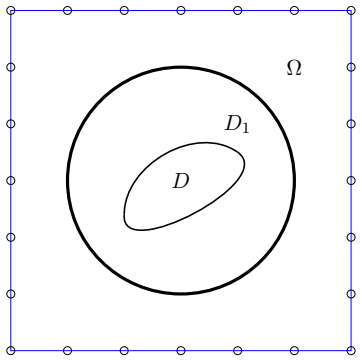


read the original abstract
The reconstruction of the unknown acoustic source is studied using the noisy multiple frequency data on a remote closed surface. Assume that the unknown source is coded in a spatial dependent piecewise constant function, whose support set is the target to be determined. In this setting, the unknown source can be formalized by a level set function. The function is explored with Bayesian level set approach. To reduce the infinite dimensional problem to finite dimension, we parameterize the level set function by the radial basis expansion. The well-posedness of the posterior distribution is proven. The posterior samples are generated according to the Metropolis-Hastings algorithm and the sample mean is used to approximate the unknown. Several shapes are tested to verify the effectiveness of the proposed algorithm. These numerical results show that the proposed algorithm is feasible and competitive with the Mat\'ern random field for the acoustic source problem.
Editorial analysis
A structured set of objections, weighed in public.
Referee Report
Summary. The manuscript develops a parametric Bayesian level set method for acoustic source reconstruction from noisy multiple-frequency data measured on a remote closed surface. The source is modeled as a spatially dependent piecewise constant function whose support is recovered via a level-set representation; this function is parameterized by a radial-basis expansion to reduce the problem to finite dimensions. The well-posedness of the resulting posterior is proven, posterior samples are generated by Metropolis-Hastings, and the sample mean is used as the reconstruction. Numerical tests on several shapes are presented to demonstrate feasibility and competitiveness with a Matérn random-field approach.
Significance. If the well-posedness proof is rigorous and the numerical comparisons are reproducible, the work supplies a concrete parametric reduction for Bayesian level-set inversion in acoustics. The combination of radial-basis parameterization with Metropolis-Hastings sampling and a proven posterior offers a practical route to shape recovery when the source is known a priori to be piecewise constant.
major comments (1)
- [Abstract] Abstract and introduction: the well-posedness proof and the claimed competitiveness both rest on the premise that the unknown source is exactly piecewise constant. This modeling choice is load-bearing for the level-set formalization, the radial-basis parameterization, and the posterior construction; the manuscript should either (i) state the precise regularity assumptions under which the proof holds or (ii) include at least one numerical counter-example with a non-piecewise-constant source to delineate the method’s scope.
Simulated Author's Rebuttal
We thank the referee for the constructive comment on clarifying the scope of the method. We address the major comment below.
read point-by-point responses
-
Referee: [Abstract] Abstract and introduction: the well-posedness proof and the claimed competitiveness both rest on the premise that the unknown source is exactly piecewise constant. This modeling choice is load-bearing for the level-set formalization, the radial-basis parameterization, and the posterior construction; the manuscript should either (i) state the precise regularity assumptions under which the proof holds or (ii) include at least one numerical counter-example with a non-piecewise-constant source to delineate the method’s scope.
Authors: The manuscript explicitly assumes the unknown source is a spatially dependent piecewise constant function (as stated in the abstract and Section 1), and the level-set representation, radial-basis parameterization, posterior construction, and well-posedness proof are all developed under this modeling premise. The competitiveness claims are likewise restricted to this class of sources. To address the referee's point, we will revise the abstract and introduction to state the precise regularity assumptions under which the proof holds (piecewise constant sources with finitely many discontinuities, represented exactly via the level-set function). This clarification delineates the method's scope without the need for counter-examples on non-piecewise-constant sources, which lie outside the intended application. revision: yes
Circularity Check
No circularity; derivation is self-contained from forward model and explicit modeling assumptions.
full rationale
The paper states its core modeling choice (unknown source as spatial-dependent piecewise constant function, represented via level-set) explicitly in the abstract and proceeds to define the Bayesian posterior from the forward acoustic model plus likelihood in the standard way. Well-posedness is claimed to be proven directly from this setup, and sampling uses the Metropolis-Hastings algorithm on the resulting finite-dimensional parameterization via radial basis functions. No step reduces a claimed prediction or theorem back to a fitted parameter or self-citation by construction; the piecewise-constant premise is an input assumption rather than a derived result. The numerical comparisons are presented as verification, not as the justification for the method itself. This is the normal non-circular pattern for a Bayesian inverse-problem paper.
Axiom & Free-Parameter Ledger
axioms (1)
- domain assumption The unknown source is a spatial-dependent piecewise constant function
Lean theorems connected to this paper
-
IndisputableMonolith/Foundation/RealityFromDistinction.leanreality_from_one_distinction unclear?
unclearRelation between the paper passage and the cited Recognition theorem.
Assume that the unknown source is coded in a spatial dependent piecewise constant function, whose support set is the target to be determined... parameterized by the radial basis expansion... well-posedness of the posterior distribution is proven... Metropolis-Hastings algorithm
-
IndisputableMonolith/Cost/FunctionalEquation.leanwashburn_uniqueness_aczel unclear?
unclearRelation between the paper passage and the cited Recognition theorem.
The covariance function is given by C(x) = ... Whittle-Matérn random field... RBF expansion prior
What do these tags mean?
- matches
- The paper's claim is directly supported by a theorem in the formal canon.
- supports
- The theorem supports part of the paper's argument, but the paper may add assumptions or extra steps.
- extends
- The paper goes beyond the formal theorem; the theorem is a base layer rather than the whole result.
- uses
- The paper appears to rely on the theorem as machinery.
- contradicts
- The paper's claim conflicts with a theorem or certificate in the canon.
- unclear
- Pith found a possible connection, but the passage is too broad, indirect, or ambiguous to say the theorem truly supports the claim.
Reference graph
Works this paper leans on
- [1]
-
[2]
Fast acoustic source imaging using multi-frequency sparse data
A. Alzaalig, G. Hu, X. Liu and J. Sun, Fast acoustic source imaging using multi-frequency sparse data, arXiv:1712.02654
work page internal anchor Pith review Pith/arXiv arXiv
-
[3]
G. Bao, S. Lu, W. Rundell and B. Xu, A recursive algorithm for multi-frequency acoustic inverse source problems, SIAM J. Numer. Anal., 53 (2015), 1608-1628
work page 2015
-
[4]
A. Beskos, A. Jasra, E. Muzaffer, A. Stuart, Sequential Monte Carlo methods for Bayesian elliptic inverse problems, Stat Comput, 2015, DOI 10.1007/s11222-015-9556-7
-
[5]
Burger, A level set method for inverse problems, Inverse problems, 17(5): 1327-1355, 2001
M. Burger, A level set method for inverse problems, Inverse problems, 17(5): 1327-1355, 2001
work page 2001
-
[6]
T. Bui-Thanh and O. Ghattas, An analysis of infinite dimen- sional Bayesian inverse shape acoustic scattering and its nu- 15 (i) Two disks with different medium values (ii) Two different domains with different medium values (iii) Embedded domain with different medium values Fig. 5. The numerical reconstructions with δ = 0.01 for two kinds of mediums. Left: the...
work page 2014
- [7]
- [8]
-
[9]
Z. Deng and X. Yang, Convergence of spectral likelihood ap- proximation based on q-Hermite polynomial in Bayesian in- version, Proceedings of the American Mathematical Society, 2019
work page 2019
-
[10]
O. Dorn and D. Lesselier, Level set methods for inverse scat- tering, Inverse Problems 22 (2006) R67R131
work page 2006
- [11]
-
[12]
M. Dunlop and A. Stuart, The Bayesian formulation of EIT: analysis and algorithms, Inverse Problems and Imaging, 10(4), 2016, 10071036
work page 2016
-
[13]
M. Eller and N. Valdivia, Acoustic source identification us- ing multiple frequency information, Inverse Problems 25, 115005(20pp), 2009
work page 2009
-
[14]
R. Griesmaier, Multi-frequency orthogonality sampling for inverse obstacle scattering problems, Inverse Problems, 27 (2011), 085005
work page 2011
-
[15]
R. Griesmaier and C. Schmiedecke. A factorization method for multi-frequency inverse source problems with spars far field measurements, SIAM J. Imag. Sci., (2017), to appear
work page 2017
-
[16]
M. Iglesias, Y. Lu and A. Stuart, A Bayesian Level Set Method for Geometric Inverse Problems, Interfaces and Free Boundaries 18 (2016), 181-217
work page 2016
-
[17]
M. Iglesias, K. Law and A. Stuart, Ensemble Kalman meth- ods for inverse problems, Inverse Problems 29 (2013) 045001 (20pp). 18
work page 2013
-
[18]
M. Iglesias, A regularizing iterative ensemble Kalman method for PDE-constrained inverse problems, Inverse Problems 32 (2016) 025002 (45pp)
work page 2016
-
[19]
M. Iglesias, K. Lin, A. Stuart, Well-posed Bayesian geometric inverse problems arising in subsurface flow, Inverse Problems, 30 2014, 114001
work page 2014
-
[20]
K. Ito, K. Kunisch and Z. Li, Level-set function approach to an inverse interface problem, Inverse Problems 17 (2001) 12251242
work page 2001
-
[21]
L. Jiang and N. Ou, Bayesian inference using intermediate distribution based on coarse multiscale model for time frac- tional diffusion equation, Multiscale Modeling and Simulation 16 ( 2018), 327-355
work page 2018
- [22]
- [23]
- [24]
-
[25]
J. van der Kruk, C. Wapenaar, J. Fokkema and P. van den Berg, Improved three-dimensional image reconstruction tech- nique for multi-component ground penetrating radar data, Subsurface Sensing Technologies and Applications, 4(1), 61- 99, 2003
work page 2003
-
[26]
F. Lindgren and H. Rue and J. Lindstr¨ om, An explicit link between Gaussian fields and Gaussian Markov random fields: the stochastic partial differential equation approch, J. R. Statist. Soc. B, 73, (2011), 423-498
work page 2011
-
[27]
D. Liu, A. Khambampati and J. Du, A parametric level set method for electrical impedance tomography, IEEE Transac- tions on medical imaging 37(2), (2018), 451-460
work page 2018
- [28]
-
[29]
R. Lorentzen, K. Flornes and G. Nævdal, History matching channelized reservoirs using the ensemble Kalman filter. SPE Journal 17 (2012), 137151
work page 2012
-
[30]
R. Lorentzen, G. Nævdal, and A. Shafieirad, Estimating fa- cies fields by use of the ensemble Kalman filter and distance functions applied to shallow-marine environments. SPE Jour- nal 3 (2012), 146158
work page 2012
-
[31]
S. Osher and R. Fedkiw, The Level Set Method and Dy- namic Implicit Surfaces. Springer, New York (2003). Zbl pre01873119
work page 2003
-
[32]
S. Osher and A. Sethian, Fronts propagating with curvature- dependent speed: algorithms based on HamiltonJacobi for- mulations. J. Comput. Phys. 79 (1988), 1249. Zbl 0659.65132 MR 89h:80012
-
[33]
J. Ping and D. Zhang, History matching of channelized reser- voirs with vector-based level-set. SPE Journal 19 (2014), 514529
work page 2014
- [34]
-
[35]
Potthast, A study on orthogonality sampling, Inverse Problems, 26 (2010), 074015
R. Potthast, A study on orthogonality sampling, Inverse Problems, 26 (2010), 074015
work page 2010
-
[36]
C. Rasmussen and C. Williams, ”Gaussian Processes for Ma- chine Learning”, Adaptive Computation and Machine Learn- ing, The MIT Press, 2006
work page 2006
-
[37]
L. Roininen, J. Huttunen and S. Lasanen, Whittle-Mat´ ern priors for Bayesian statistical inversion with applications in electrical impedance tomography, Inverse Problems and Imaging, 8(2), 2014, 561586
work page 2014
-
[38]
G. Santin and R. Schaback, Approximation of eigenfunctions in kernel-based spaces, Adv Comput Math 42, (2016), 973993
work page 2016
-
[39]
J. Sun, An eigenvalue method using multiple frequency data for inverse scattering problems, Inverse Problems, 28 (2012), 025012
work page 2012
-
[40]
Stuart, Inverse problems: A Bayesian perspective, Acta Numerica (2010), 451559
A. Stuart, Inverse problems: A Bayesian perspective, Acta Numerica (2010), 451559. 20
work page 2010
-
[41]
F. Santosa, A level-set approach for inverse problems involv- ing obstacles, ESAIM: Control, Optimization and Calculus of Variations, 1: 17-33, 1996
work page 1996
- [42]
-
[43]
Tarantola, Inverse Problem Theory and Methods for Model Parameter Estimation, SIAM, 2005
A. Tarantola, Inverse Problem Theory and Methods for Model Parameter Estimation, SIAM, 2005
work page 2005
-
[44]
Z. Wang, J. Bardsley, A. Solonen, T. Cui and Y. Marzouk, Bayesian inverse problems with l1 priors: a randomize-then- optimize approch, SIAM J. Sci. Comput., 39(5), 2017, S140- S166
work page 2017
-
[45]
X. Wang, Y. Guo, D. Zhang and H. Liu, Fourier method for recovering acoustic sources from multi-frequency far-field data, Inverse Problems, 33 (2017), 035001
work page 2017
-
[46]
X. Yang and Z. Deng, An ensemble Kalman filter approach based on operator splitting for solving nonlinear Hammerstein type ill-posed operator equations, Modern Physics Letters B, 32(28), (2018), 1850335
work page 2018
-
[47]
R. Zhang and J. Sun, Efficient finite element method for grat- ing profile reconstruction, J. Comput. Phys., 302 (2015), 405- 419. 21
work page 2015
discussion (0)
Sign in with ORCID, Apple, or X to comment. Anyone can read and Pith papers without signing in.