REVIEW 4 major objections 6 minor 139 references
Early Shock-Cooling Observations and Progenitor Constraints of Type IIb SN 2024uwq
T0 review · 4 major / 6 minor · reviewed 2026-08-16 · deepseek-v4-flash
Pith's one-line read Early flash of SN 2024uwq reveals a partially stripped supergiant
desk verdict A new, well-observed Type IIb whose shock-cooling data support a partially stripped progenitor, but the quoted radius range is a model-dependent union, not a single measurement. read the letter →
The pith
A machine-rendered reading of the paper's core claim, the machinery that carries it, and where it could break.
The reading
What carries the argument
The load-bearing tool is the analytic shock-cooling emission model, which connects the early UV/optical excess to the progenitor's radius and envelope mass. The paper applies three variants of this model to the first 3.5 days of multiband photometry, restricting the fits to blackbody temperatures above 0.7 eV where the models are valid. The argument is carried by the combination of that early excess with spectral line evolution: absorption-and-emission (P-Cygni) profiles of H$\alpha$ and He I show the hydrogen envelope thinning as helium-rich ejecta are exposed, and a two-component bolometric light-curve fit anchors the ejecta mass, nickel mass, and kinetic energy.
What would settle it
A decisive test would be to catch a similar Type IIb with continuous coverage of the rise to the shock-cooling peak and an independently known explosion time, then fit the same three models: if they fail to converge on a single radius, the analytic shock-cooling interpretation is suspect. A second test is a deep pre-explosion image resolving the supernova site, since a detected progenitor outside the 15 to 57 solar radius range would contradict the claim.
Extended reading notes
Core claim
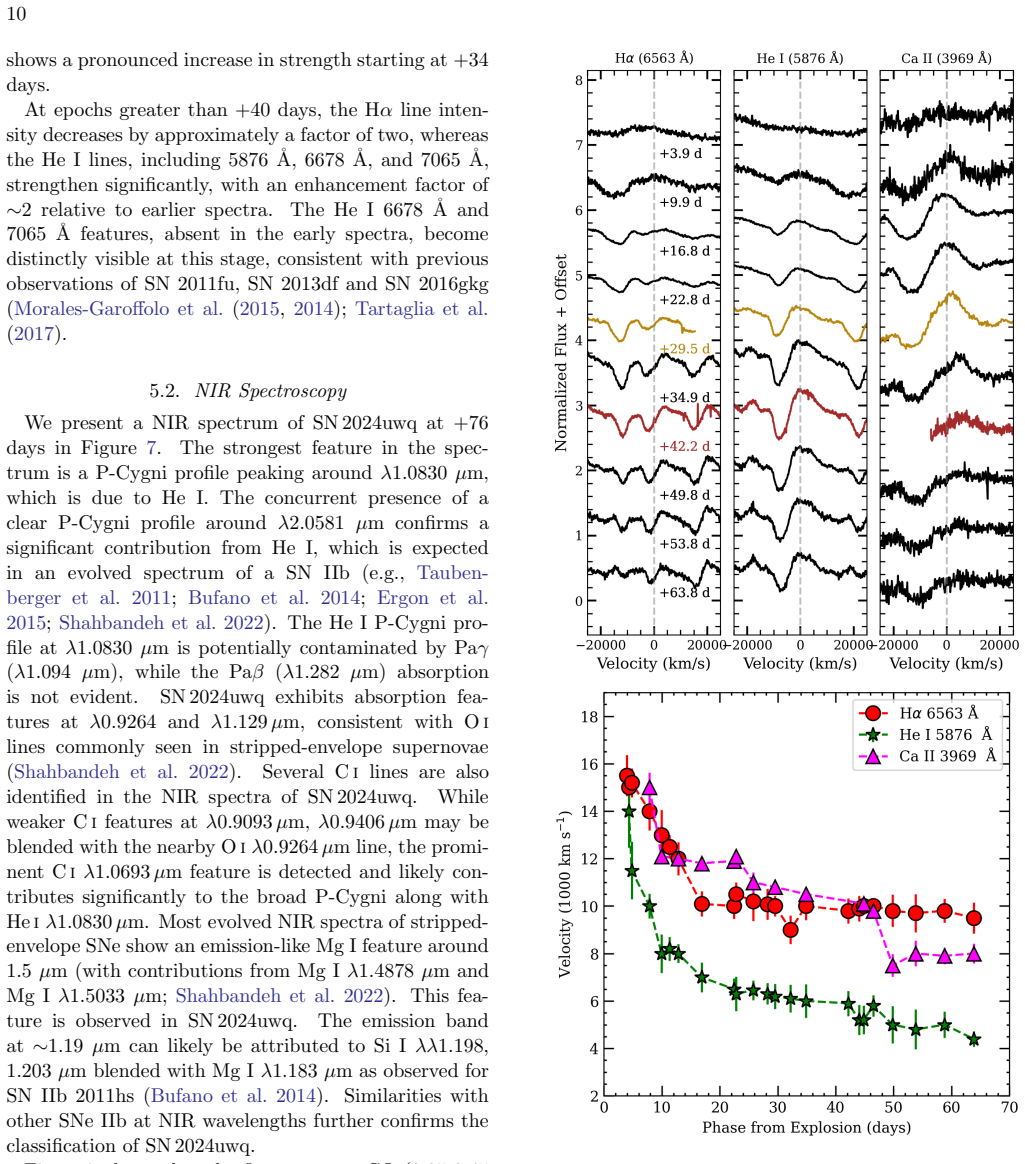
The central discovery is that the early excess in SN 2024uwq's light curve can be read as a fossil of the progenitor's outer layers. Modeling the first roughly 3.5 days of multiband emission with three analytic shock-cooling frameworks converges on a progenitor with radius between about 15 and 57 solar radii and a hydrogen envelope of order one solar mass, ruling out a canonical red supergiant. The double-peaked light curve, the velocity decline of H$\alpha$ from roughly 15,500 to 10,000 km s$^{-1}$, and the strengthening of He I lines all agree with a partially stripped blue or yellow supergiant. Combining the ejecta mass from a two-component analytic bolometric fit with a neutron-star remnant, the pre-supernova mass is about 4.4 solar masses, pointing to a 12–20 solar mass main-sequence star; because single-star winds cannot shed enough hydrogen at these masses, the paper concludes that binary interaction is the likely stripping agent.
Load-bearing premise
The inference stands or falls on the assumption that the early excess is shock-cooling emission from the progenitor envelope, described by the analytic models, with an explosion epoch taken as the midpoint between a non-detection and discovery, uncertain to about plus or minus 1.5 days.
Editorial extensions
If this is right
- The progenitor of SN 2024uwq was a partially stripped blue or yellow supergiant, not a red supergiant, adding to evidence that many Type IIb supernovae come from compact, stripped stars.
- Binary mass transfer, rather than single-star wind mass loss, is the more natural way to produce a roughly one-solar-mass hydrogen envelope on a 12–20 solar mass main-sequence star.
- SN 2024uwq occupies the gap between compact Type IIb events and extended ones, supporting a continuum of envelope stripping set by binary mass-transfer efficiency.
- Early UV and optical observations are necessary to resolve shock-cooling phases; without them the progenitor radius and envelope mass constraints are much weaker.
- The event's ejecta mass of about 3 solar masses, nickel mass of about 0.1 solar masses, and kinetic energy of about $2.75\times10^{51}$ erg agree with the broader stripped-envelope supernova population.
Reading between the lines
- Editorial inference: the factor-of-four spread between the compact and extended model radii (14.6 versus 57.1 solar radii) is likely a systematic floor for every Type IIb analyzed this way, so population comparisons should quote the model spread rather than a single fit.
- Editorial inference: a clean test of the binary-stripping story would be a search for a surviving companion star in deep late-time imaging; detecting a blue excess or radial-velocity variation at the supernova site would directly support the binary hypothesis.
- Editorial inference: if the shock-cooling interpretation is right, then the same early excess should appear in the near-UV for similar events out to roughly 200 Mpc, and wide-field UV surveys should catch several per year with fully sampled rises, allowing the radius-envelope mass plane to be mapped empirically.
- Editorial inference: the unobserved rise to the first peak is the main observational weakness; an event caught within hours by a high-cadence UV survey would settle whether the analytic models recover the true progenitor radius or are degenerate with the assumed explosion time.
Signed reviews
Editorial analysis
A structured set of objections, weighed in public.
Referee Report
Summary. The paper presents early-time multiwavelength photometry and spectroscopy of the Type IIb supernova SN 2024uwq, combining ATLAS, Las Cumbres, DLT40, and Swift UVOT photometry with FLOYDS, SALT, SOAR, and Gemini-South spectroscopy. The authors identify a double-peaked light curve with an initial excess that they interpret as shock-cooling emission, followed by a radioactive-powered second peak. Spectral evolution shows broad H-alpha decreasing in strength while He I lines strengthen, consistent with a thin hydrogen envelope over helium-rich ejecta. They fit four analytic shock-cooling models (SW17 with n=1.5 and n=3, P21, MSW23) and a two-component Arnett model to infer progenitor properties, obtaining R = 14.6-57.1 R_sun, M_env = 0.7-1.35 M_sun, M_ej ~ 3 M_sun, and M_Ni ~ 0.1 M_sun. From these they argue that the progenitor was a 12-20 M_sun ZAMS blue/yellow supergiant likely stripped by binary interaction, occupying a transitional position between compact and extended Type IIb progenitors. The paper also estimates detectability of similar events with ULTRASAT, UVEX, and LSST.
Significance. If the progenitor constraints hold, SN 2024uwq is a valuable addition to the small sample of Type IIb supernovae with resolved shock-cooling emission and may probe the transition between compact and extended stripped-envelope progenitors. The observational dataset is genuinely strong: UV and optical coverage near the first peak, high-cadence spectra over several weeks, NIR spectroscopy with a plausible CO detection, and careful comparison with literature SNe. The paper also makes constructive use of public fitting packages, which aids reproducibility. However, the quantitative radius constraint is weaker than the abstract implies: the four shock-cooling models yield median radii spanning a factor of about four, and the quoted range is the union of model-specific posteriors rather than a single validated measurement. The enduring value of the paper lies more in the well-characterized transient and its placement in the Type IIb diversity than in a precise progenitor radius.
major comments (4)
- [Section 7, Table 2] The headline progenitor-radius constraint R = 14.6-57.1 R_sun is the union of four model-specific posterior intervals (P21: 14.61 +/- 0.36; SW17 n=1.5: 35.71; SW17 n=3: 50.0; MSW23: 57.14 +/- 7.20 R_sun) and is not a single physical measurement. Because the models make different structural assumptions, the factor-of-four spread is a systematic/model uncertainty rather than a statistical one. The abstract's R = 10-60 R_sun and the Section 7 statement that the progenitor is a BSG/YSG with R = 14.6-57.1 R_sun therefore overstate the constraint. Please provide a combined estimate via explicit model weighting or an added systematic term, or rephrase the conclusion as a model-dependent range.
- [Section 4.1, Figure 2, Section 6] The rise to the early excess is not observed: Section 4.1 states that 'the rise from first detection to the early excess is poorly constrained' and Figure 2 shows that nearly all bands begin after the excess peak. The shock-cooling fits are therefore anchored only on the declining side of the excess, so the inferred radius depends on each model's extrapolation of the unobserved rising phase. This degeneracy likely contributes to the factor-of-four spread in Table 2. Please demonstrate robustness by excluding the earliest ATLAS-o point and by shifting t0 within the allowed non-detection/discovery window; if the constraints broaden substantially, present the result as a broad range or limit rather than a precise radius.
- [Section 4.3 vs Section 6] The validity cut for shock-cooling modeling is stated inconsistently. Section 4.3 says the cut is based on temperatures '>= 8120 K (0.7 eV)', while Section 6 says observations are selected 'where the effective temperature (Teff) is less than 0.7 eV'. Since this criterion determines which photometric points enter the fits, the contradiction is load-bearing. Please correct the typo, state the exact cut, and verify that the fits in Table 2 and Figure 9 use the intended data set.
- [Section 6, Table 2] The explosion epoch t0 is assumed as the midpoint of a ~3 day non-detection/discovery gap (MJD 60558.63 +/- 1.5), and the fitted t0 values in Table 2 span MJD 60558.80 to 60560.10. P21's t0 sits near the discovery edge, while the SW17 and MSW23 fits prefer earlier times by about 1-2 days. The fitted radii are entangled with the assumed t0, but the quoted R and M_env ranges do not propagate the +/- 1.5 day t0 uncertainty. Please include a sensitivity check with t0 fixed at the non-detection and discovery extremes, or treat t0 as a nuisance parameter in the quoted credible intervals.
minor comments (6)
- [Abstract and Table 2] The abstract gives R = 10-60 R_sun while Table 2 and Section 7 give R = 14.6-57.1 R_sun; please use one consistent range throughout.
- [Section 4.3] The text references 'Equation A3', but the Appendix contains no equations; either include the equation or remove the reference.
- [Section 4.3] The fitted shock-cooling end time ts = 4.94+0.042/-0.079 days appears to have the asymmetric errors written in an unusual order and is not clearly defined in the text; please clarify.
- [Section 7] The phrase 'The tighter constraints in P21 arise from non-exclusion of intrinsic scatter parameter' is confusing because Table 2 shows no sigma entry for P21; the intended meaning is likely 'non-inclusion'.
- [Figure 4 caption] The caption says 'Black and grey lines depict two and one component models', but the legend or line styles in the figure are not labeled; please add a clear legend.
- [Acknowledgments] The text 'PI: Jah' is likely a typo for 'PI: Jha'; please correct.
Circularity Check
No circularity: shock-cooling and Arnett analyses use external models, with R, Me, vs, and t0 fitted to new photometry rather than presented as independent predictions.
full rationale
The paper's central claim is that early shock-cooling emission constrains the progenitor of SN 2024uwq to a partially stripped blue/yellow supergiant with R = 14.6–57.1 Rsun and Menv = 0.7–1.35 Msun. These values come from MCMC fits of four external analytic/hydrodynamic models (SW17 with n = 1.5 and n = 3, P21, MSW23) to the observed early multi-band light curves (Section 6, Table 2). Sapir & Waxman (2017), Piro et al. (2021), and Morag et al. (2023) are independent benchmarks constructed from radiative-transfer/hydrodynamic physics, not from SN 2024uwq data and not by this paper's authors. R, Menv, vs, t0, f_rho*M, and sigma are free parameters fit to the data; the paper explicitly states that the ejecta-mass factor is effectively unconstrained, so the fits are honest parameter estimation rather than a disguised prediction. The quoted radius range is the union of four model posteriors, which the paper itself presents as model-dependent spread rather than as a single forced measurement. The authors' own software citations (Hosseinzadeh et al. 2024; Valenti et al. 2016; Bostroem 2024) are used for fitting tools and classification reporting, not as evidence for the progenitor inference, and the load-bearing physics is external and independently reproducible from the cited literature. No fitted quantity is renamed as a prediction, no equation reduces to its own input by construction, and no uniqueness theorem or ansatz is imported from the authors' prior work to forbid alternatives. The paper's caveat that the rise to the early excess is poorly constrained weakens precision but is a robustness limitation, not circularity. The derivation chain is therefore self-contained with respect to the external models, and no significant circularity is present.
Assumptions & free parameters
free parameters (6)
- Progenitor radius R =
35.71+7.14-5.71 (SW17 n=1.5), 50.0+14.28-8.57 (SW17 n=3), 14.61±0.36 (P21), 57.14±7.20 (MSW23) R_sun
- Envelope mass M_env =
0.7+0.2-0.3 (SW17 n=1.5), 0.8+0.1-0.2 (SW17 n=3), 1.35+1.97-0.87 (P21), 0.7+0.2-0.3 (MSW23) M_sun
- Shock velocity v_s =
0.60+0.3-0.2 (SW17 n=1.5), 0.67+0.3-0.2 (SW17 n=3), 2.02+0.32-0.24 (P21), 0.51+0.4-0.02 (MSW23) 10^4 km/s
- Explosion time t0 =
60558.90+0.07-0.18 (SW17 n=1.5), 60558.80+0.1-0.3 (SW17 n=3), 60560.10±0.01 (P21), 60559.30+0.1-0.2 (MSW23) MJD
- Scaled ejecta mass f_rho M =
50+30-40 (SW17 n=1.5), 60±30 (SW17 n=3), 60±30 (MSW23) M_sun
- Intrinsic scatter sigma =
6.8+0.9-0.8 (SW17 n=1.5), 7.8+1.2-0.9 (SW17 n=3), 3.4+0.5-0.4 (MSW23)
assumptions (6)
- domain assumption The early optical/UV excess is shock-cooling emission from the progenitor envelope, described by the analytic planar/spherical models of SW17, P21, and MSW23.
- domain assumption Explosion epoch t0 = MJD 60558.63 ± 1.5 is the midpoint between the last ATLAS non-detection and first detection, and the supernova rose monotonically within that window.
- domain assumption Tully-Fisher distance modulus 33.34 ± 0.40 mag and total reddening E(B-V)=0.034±0.001 mag are correct.
- domain assumption Bolometric luminosity was obtained by fitting blackbody SEDs to photometry interpolated with 5th-8th order polynomials.
- domain assumption The two-component Arnett model (Valenti et al. 2008; Chatzopoulos et al. 2012) adequately describes the second peak and late-time bolometric light curve of this SN IIb.
- domain assumption The Na I D EW-reddening relation (Poznanski et al. 2012) calibrates host/MW reddening, and host reddening is negligible.
Cite this review
Pith. "Pith review of Early Shock-Cooling Observations and Progenitor Constraints of Type IIb SN 2024uwq." pith.science (2026). https://pith.science/paper/IUBBS5DA
@misc{pith2026250502908,
  author       = {Pith},
  title        = {Pith review of: Early Shock-Cooling Observations and Progenitor Constraints of Type IIb SN 2024uwq},
  year         = {2026},
  howpublished = {\url{https://pith.science/paper/IUBBS5DA}},
  note         = {Machine review of arXiv:2505.02908}
}
abstract
We present early multi-wavelength photometric and spectroscopic observations of the Type IIb supernova SN 2024uwq, capturing its shock-cooling emission phase and double-peaked light curve evolution. Early spectra reveal broad H-alpha (v ~ 15,500 km s$^{-1}$) and He I P-Cygni profiles of similar strengths. Over time the He I lines increase in strength while the H-alpha decreases, consistent with a hydrogen envelope ($M_{env}$ = 0.7 - 1.35 $M_\odot$ ) overlying helium-rich ejecta. Analytic modeling of early shock cooling emission and bolometric light analysis constrains the progenitor to a partially stripped star with radius R = 10 - 60 $R_\odot$, consistent with a blue/yellow supergiant with an initial ZAMS mass of 12 - 20 $M_\odot$ , likely stripped via binary interaction. SN 2024uwq occupies a transitional position between compact and extended Type IIb supernovae, highlighting the role of binary mass-transfer efficiency in shaping a continuum of stripped-envelope progenitors. Our results underscore the importance of both early UV/optical observations to characterize shock breakout signatures critical to map the diversity in evolutionary pathways of massive stars. Upcoming time domain surveys including Rubin Observatory's LSST and UV missions like ULTRASAT and UVEX will revolutionise our ability to systematically capture these early signatures, probing the full diversity of stripped progenitors and their explosive endpoints.
Figures


Figures from the paper (8 more)




Reference graph
Works this paper leans on
-
[1]
, " * write output.state after.block = add.period write newline
ENTRY address archivePrefix author booktitle chapter doi edition editor eprint howpublished institution journal key month number organization pages publisher school series title misctitle type volume year version url label extra.label sort.label short.list INTEGERS output.state before.all mid.sentence after.sentence after.block FUNCTION init.state.consts ...
-
[2]
write newline
" write newline "" before.all 'output.state := FUNCTION format.url url empty "" new.block "" url * "" * if FUNCTION format.eprint eprint empty "" archivePrefix empty "" archivePrefix "arXiv" = new.block " " eprint * " " * new.block " " eprint * " " * if if if FUNCTION format.doi doi empty "" " " doi * " " * if FUNCTION format.pid doi empty eprint empty ur...
-
[3]
ur Physik und Astronomie, Universit\
thebibliography [1] 20pt to REFERENCES 6pt =0pt -12pt 10pt plus 3pt =0pt =0pt =1pt plus 1pt =0pt =0pt -12pt =13pt plus 1pt =20pt =13pt plus 1pt \@M =10000 =-1.0em =0pt =0pt 0pt =0pt =1.0em @enumiv\@empty 10000 10000 `\.\@m \@noitemerr \@latex@warning Empty `thebibliography' environment \@ifnextchar \@reference \@latexerr Missing key on reference command E...
2021
-
[4]
Aldering , G., Humphreys , R. M., & Richmond , M. 1994, , 107, 662, 10.1086/116886
doi:10.1086/116886 1994
-
[5]
E., Pearson , J., Hosseinzadeh , G., et al
Andrews , J. E., Pearson , J., Hosseinzadeh , G., et al. 2024, , 965, 85, 10.3847/1538-4357/ad2a49
-
[6]
2011, , 742, L18, 10.1088/2041-8205/742/2/L18
Arcavi , I., Gal-Yam , A., Yaron , O., et al. 2011, , 742, L18, 10.1088/2041-8205/742/2/L18
-
[7]
Arcavi , I., Hosseinzadeh , G., Brown , P. J., et al. 2017, , 837, L2, 10.3847/2041-8213/aa5be1
-
[8]
Armstrong , P., Tucker , B. E., Rest , A., et al. 2021, , 507, 3125, 10.1093/mnras/stab2138
Show all 139 references
-
[9]
Arnett , W. D. 1982, , 253, 785, 10.1086/159681
1982 doi
-
[10]
P., Tollerud , E
Astropy Collaboration , Robitaille , T. P., Tollerud , E. J., et al. 2013, , 558, A33, 10.1051/0004-6361/201322068
2013 doi
-
[11]
M., Lim , P
Astropy Collaboration , Price-Whelan , A. M., Lim , P. L., et al. 2022, , 935, 167, 10.3847/1538-4357/ac7c74
2022 doi
-
[12]
1995, , 110, 513
Barbon , R., Benetti , S., Cappellaro , E., et al. 1995, , 110, 513
1995
-
[13]
C., Benvenuto , O
Bersten , M. C., Benvenuto , O. G., Nomoto , K., et al. 2012, , 757, 31, 10.1088/0004-637X/757/1/31
2012 doi
-
[14]
C., Folatelli , G., Garc \' a , F., et al
Bersten , M. C., Folatelli , G., Garc \' a , F., et al. 2018, , 554, 497, 10.1038/nature25151
2018 doi
-
[15]
Blondin , S., & Tonry , J. L. 2011, SNID: Supernova Identification , Astrophysics Source Code Library, record ascl:1107.001
2011
-
[16]
Bostroem , K. A. 2024, Transient Name Server Classification Report, 2024-3548, 1
2024
-
[17]
2022, astropy/photutils: 1.6.0 , 1.6.0, Zenodo, Zenodo, 10.5281/zenodo.7419741
Bradley , L., Sip o cz , B., Robitaille , T., et al. 2022, astropy/photutils: 1.6.0 , 1.6.0, Zenodo, Zenodo, 10.5281/zenodo.7419741
2022 doi
-
[18]
A., Curran , P
Breeveld , A. A., Curran , P. A., Hoversten , E. A., et al. 2010, , 406, 1687, 10.1111/j.1365-2966.2010.16832.x
2010
-
[19]
M., Baliber , N., Bianco , F
Brown , T. M., Baliber , N., Bianco , F. B., et al. 2013, , 125, 1031, 10.1086/673168
2013 doi
-
[20]
2014, , 439, 1807, 10.1093/mnras/stu065
Bufano , F., Pignata , G., Bersten , M., et al. 2014, , 439, 1807, 10.1093/mnras/stu065
2014 doi
-
[21]
A., Clayton , G
Cardelli , J. A., Clayton , G. C., & Mathis , J. S. 1989, , 345, 245, 10.1086/167900
1989 doi
-
[22]
C., & Vinko , J
Chatzopoulos , E., Wheeler , J. C., & Vinko , J. 2012, , 746, 121, 10.1088/0004-637X/746/2/121
2012 doi
- [23]
-
[24]
A., & Soderberg , A
Chevalier , R. A., & Soderberg , A. M. 2010, , 711, L40, 10.1088/2041-8205/711/1/L40
2010 doi
-
[25]
V., Li , W., et al
Chornock , R., Filippenko , A. V., Li , W., et al. 2011, , 739, 41, 10.1088/0004-637X/739/1/41
2011 doi
-
[26]
Claeys , J. S. W., de Mink , S. E., Pols , O. R., Eldridge , J. J., & Baes , M. 2011, , 528, A131, 10.1051/0004-6361/201015410
2011 doi
-
[28]
M., Still , M., Schellart , P., et al
Crawford , S. M., Still , M., Schellart , P., et al. 2010 b , in Society of Photo-Optical Instrumentation Engineers (SPIE) Conference Series, Society of Photo-Optical Instrumentation Engineers (SPIE) Conference Series, 25, 10.1117/12.857000
2010 doi
-
[29]
M., Eldridge , J
Crockett , R. M., Eldridge , J. J., Smartt , S. J., et al. 2008, , 391, L5, 10.1111/j.1745-3933.2008.00540.x
2008
-
[30]
K., Kasliwal , M
Das , K. K., Kasliwal , M. M., Fremling , C., et al. 2023, , 959, 12, 10.3847/1538-4357/acfeeb
2023 doi
-
[31]
J., Waldman , R., & Livne , E
Dessart , L., Hillier , D. J., Waldman , R., & Livne , E. 2013, , 433, 1745, 10.1093/mnras/stt861
2013 doi
-
[32]
2024, , 974, 316, 10.3847/1538-4357/ad710e
Dong , Y., Valenti , S., Ashall , C., et al. 2024, , 974, 316, 10.3847/1538-4357/ad710e
2024 doi
-
[33]
G., et al
Eikenberry , S., Bandyopadhyay , R., Bennett , J. G., et al. 2012, in Society of Photo-Optical Instrumentation Engineers (SPIE) Conference Series, Vol. 8446, Ground-based and Airborne Instrumentation for Astronomy IV, ed. I. S. McLean , S. K. Ramsay , & H. Takami , 84460I, 10....
2012 doi
-
[34]
S., Elston , R., Raines , S
Eikenberry , S. S., Elston , R., Raines , S. N., et al. 2004, in Society of Photo-Optical Instrumentation Engineers (SPIE) Conference Series, Vol. 5492, Ground-based Instrumentation for Astronomy, ed. A. F. M. Moorwood & M. Iye , 1196--1207, 10.1117/12.549796
2004 doi
-
[35]
2014, , 562, A17, 10.1051/0004-6361/201321850
Ergon , M., Sollerman , J., Fraser , M., et al. 2014, , 562, A17, 10.1051/0004-6361/201321850
2014 doi
-
[36]
2015, , 580, A142, 10.1051/0004-6361/201424592
Ergon , M., Jerkstrand , A., Sollerman , J., et al. 2015, , 580, A142, 10.1051/0004-6361/201424592
2015 doi
- [37]
-
[38]
Filippenko , A. V. 1988, , 96, 1941, 10.1086/114940
1988 doi
-
[39]
1997, , 35, 309, 10.1146/annurev.astro.35.1.309
---. 1997, , 35, 309, 10.1146/annurev.astro.35.1.309
1997 doi
-
[40]
V., Matheson , T., & Ho , L
Filippenko , A. V., Matheson , T., & Ho , L. C. 1993, , 415, L103, 10.1086/187043
1993 doi
-
[41]
2016, The Journal of Open Source Software, 1, 24, 10.21105/joss.00024
Foreman-Mackey , D. 2016, The Journal of Open Source Software, 1, 24, 10.21105/joss.00024
2016 doi
-
[42]
W., Lang , D., & Goodman , J
Foreman-Mackey , D., Hogg , D. W., Lang , D., & Goodman , J. 2013, , 125, 306, 10.1086/670067
2013 doi
-
[43]
2017, in Handbook of Supernovae, ed
Gal-Yam , A. 2017, in Handbook of Supernovae, ed. A. W. Alsabti & P. Murdin , 195, 10.1007/978-3-319-21846-5_35
2017 doi
-
[44]
2004, , 611, 1005, 10.1086/422091
Gehrels , N., Chincarini , G., Giommi , P., et al. 2004, , 611, 1005, 10.1086/422091
2004 doi
-
[45]
2013, in EAS Publications Series, Vol
Georgy , C., Ekstr \"o m , S., Saio , H., et al. 2013, in EAS Publications Series, Vol. 60, EAS Publications Series, ed. P. Kervella , T. Le Bertre , & G. Perrin , 43--50, 10.1051/eas/1360004
2013
-
[46]
A., Jiang , Y.-F., & Bildsten , L
Goldberg , J. A., Jiang , Y.-F., & Bildsten , L. 2022, , 933, 164, 10.3847/1538-4357/ac75e3
2022 doi
-
[47]
2013 a , in GRBs and their Hosts as Tracers of the High Redshift Universe, 16
Groh , J., Meynet , G., Ekstrom , S., & Georgy , C. 2013 a , in GRBs and their Hosts as Tracers of the High Redshift Universe, 16
2013
-
[48]
H., Meynet , G., Ekstr \"o m , S., et al
Groh , J. H., Meynet , G., Ekstr \"o m , S., et al. 2013 b , in EAS Publications Series, Vol. 60, EAS Publications Series, ed. P. Kervella , T. Le Bertre , & G. Perrin , 51--55, 10.1051/eas/1360005
2013
-
[49]
R., Millman, K
Harris, C. R., Millman, K. J., van der Walt, S. J., et al. 2020, Nature, 585, 357, 10.1038/s41586-020-2649-2
2020 doi
-
[50]
H., Pfahler , P., Pastorello , A., et al
Harutyunyan , A. H., Pfahler , P., Pastorello , A., et al. 2008, , 488, 383, 10.1051/0004-6361:20078859
2008 doi
-
[51]
Haynie , A., & Piro , A. L. 2023, , 956, 98, 10.3847/1538-4357/acf844
2023 doi
-
[52]
A., Welch , D
Henden , A. A., Welch , D. L., Terrell , D., & Levine , S. E. 2009, in American Astronomical Society Meeting Abstracts, Vol. 214, American Astronomical Society Meeting Abstracts \#214, 407.02
2009
-
[53]
A., Ben-Ami, T., & Gomez, S
Hosseinzadeh, G., Bostroem, K. A., Ben-Ami, T., & Gomez, S. 2024, Light Curve Fitting v0.10.0, v0.10.0, Zenodo, 10.5281/zenodo.11405219
2024 doi
-
[54]
2023, , 953, L16, 10.3847/2041-8213/ace4c4
Hosseinzadeh , G., Farah , J., Shrestha , M., et al. 2023, , 953, L16, 10.3847/2041-8213/ace4c4
2023 doi
-
[55]
2024, in American Astronomical Society Meeting Abstracts, Vol
Howell , A. 2024, in American Astronomical Society Meeting Abstracts, Vol. 243, American Astronomical Society Meeting Abstracts, 232.01
2024
-
[56]
Hunter , J. D. 2007, Computing in Science and Engineering, 9, 90, 10.1109/MCSE.2007.55
2007 doi
-
[57]
2024, , 970, 96, 10.3847/1538-4357/ad3de8
Irani , I., Morag , J., Gal-Yam , A., et al. 2024, , 970, 96, 10.3847/1538-4357/ad3de8
2024 doi
-
[58]
M., Tyson , J
Ivezi \'c , Z ., Kahn , S. M., Tyson , J. A., et al. 2019, , 873, 111, 10.3847/1538-4357/ab042c
2019 doi
-
[59]
2012, , 546, A28, 10.1051/0004-6361/201219528
Jerkstrand , A., Fransson , C., Maguire , K., et al. 2012, , 546, A28, 10.1051/0004-6361/201219528
2012 doi
-
[60]
K., & Ammon , K
Jordi , K., Grebel , E. K., & Ammon , K. 2006, , 460, 339, 10.1051/0004-6361:20066082
2006 doi
-
[61]
2010, , 717, 245, 10.1088/0004-637X/717/1/245
Kasen , D., & Bildsten , L. 2010, , 717, 245, 10.1088/0004-637X/717/1/245
2010 doi
-
[62]
2012, , 747, 147, 10.1088/0004-637X/747/2/147
Katz , B., Sapir , N., & Waxman , E. 2012, , 747, 147, 10.1088/0004-637X/747/2/147
2012 doi
-
[63]
D., Coulter , D
Kilpatrick , C. D., Coulter , D. A., Foley , R. J., et al. 2022, , 936, 111, 10.3847/1538-4357/ac8a4c
2022 doi
- [64]
-
[65]
Landolt , A. U. 1992, , 104, 340, 10.1086/116242
1992 doi
-
[66]
2021, , 656, A58, 10.1051/0004-6361/202140506
Laplace , E., Justham , S., Renzo , M., et al. 2021, , 656, A58, 10.1051/0004-6361/202140506
2021 doi
-
[68]
2022, , 262, 26, 10.3847/1538-4365/ac7ffe
Long , G., Song , H., Meynet , G., et al. 2022, , 262, 26, 10.3847/1538-4365/ac7ffe
2022 doi
-
[69]
D., Bersier , D., James , P
Lyman , J. D., Bersier , D., James , P. A., et al. 2016, , 457, 328, 10.1093/mnras/stv2983
2016 doi
-
[70]
V., Ho , L
Matheson , T., Filippenko , A. V., Ho , L. C., Barth , A. J., & Leonard , D. C. 2000, , 120, 1499, 10.1086/301519
2000 doi
- [71]
-
[72]
R., Fraser , M., Ergon , M., et al
Maund , J. R., Fraser , M., Ergon , M., et al. 2011, , 739, L37, 10.1088/2041-8205/739/2/L37
2011 doi
-
[73]
H., Harbeck , D.-R., et al
McCully , C., Volgenau , N. H., Harbeck , D.-R., et al. 2018, in Society of Photo-Optical Instrumentation Engineers (SPIE) Conference Series, Vol. 10707, Software and Cyberinfrastructure for Astronomy V, ed. J. C. Guzman & J. Ibsen , 107070K, 10.1117/12.2314340
2018 doi
-
[74]
A., et al
Meza-Retamal , N., Dong , Y., Bostroem , K. A., et al. 2024, , 971, 141, 10.3847/1538-4357/ad4d55
2024 doi
-
[75]
M., et al
Milisavljevic , D., Margutti , R., Soderberg , A. M., et al. 2013, , 767, 71, 10.1088/0004-637X/767/1/71
2013 doi
-
[76]
P., et al
Modjaz , M., Blondin , S., Kirshner , R. P., et al. 2014, , 147, 99, 10.1088/0004-6256/147/5/99
2014 doi
-
[77]
2023, , 522, 2764, 10.1093/mnras/stad899
Morag , J., Sapir , N., & Waxman , E. 2023, , 522, 2764, 10.1093/mnras/stad899
2023 doi
-
[78]
2014, , 445, 1647, 10.1093/mnras/stu1837
Morales-Garoffolo , A., Elias-Rosa , N., Benetti , S., et al. 2014, , 445, 1647, 10.1093/mnras/stu1837
2014 doi
-
[79]
2015, , 454, 95, 10.1093/mnras/stv1972
Morales-Garoffolo , A., Elias-Rosa , N., Bersten , M., et al. 2015, , 454, 95, 10.1093/mnras/stv1972
2015 doi
-
[80]
J., Subrayan , B
Moriya , T. J., Subrayan , B. M., Milisavljevic , D., & Blinnikov , S. I. 2023, , 75, 634, 10.1093/pasj/psad024
2023 doi
-
[81]
Nakar , E., & Piro , A. L. 2014, , 788, 193, 10.1088/0004-637X/788/2/193
2014 doi
-
[82]
2010, , 725, 904, 10.1088/0004-637X/725/1/904
Nakar , E., & Sari , R. 2010, , 725, 904, 10.1088/0004-637X/725/1/904
2010 doi
-
[83]
2018, Research Notes of the American Astronomical Society, 2, 230, 10.3847/2515-5172/aaf799
Nicholl , M. 2018, Research Notes of the American Astronomical Society, 2, 230, 10.3847/2515-5172/aaf799
2018 doi
-
[84]
2017, , 840, 90, 10.3847/1538-4357/aa6ea9
Ouchi , R., & Maeda , K. 2017, , 840, 90, 10.3847/1538-4357/aa6ea9
2017 doi
-
[85]
M., Crockett , R
Pastorello , A., Kasliwal , M. M., Crockett , R. M., et al. 2008, , 389, 955, 10.1111/j.1365-2966.2008.13618.x
2008
-
[86]
2023, , 954, 35, 10.3847/1538-4357/ace595
Pellegrino , C., Hiramatsu , D., Arcavi , I., et al. 2023, , 954, 35, 10.3847/1538-4357/ace595
2023 doi
-
[87]
Piro , A. L. 2015, , 808, L51, 10.1088/2041-8205/808/2/L51
2015 doi
-
[88]
L., Haynie , A., & Yao , Y
Piro , A. L., Haynie , A., & Yao , Y. 2021, , 909, 209, 10.3847/1538-4357/abe2b1
2021 doi
-
[89]
2008, in Astronomical Society of the Pacific Conference Series, Vol
Podsiadlowski , P. 2008, in Astronomical Society of the Pacific Conference Series, Vol. 391, Hydrogen-Deficient Stars, ed. A. Werner & T. Rauch , 323
2008
-
[90]
X., & Bloom , J
Poznanski , D., Prochaska , J. X., & Bloom , J. S. 2012, , 426, 1465, 10.1111/j.1365-2966.2012.21796.x
2012
-
[91]
M., Sip o cz , B
Price-Whelan , A. M., Sip o cz , B. M., G \"u nther , H. M., et al. 2018, , 156, 123, 10.3847/1538-3881/aabc4f
2018 doi
-
[92]
2011, , 728, 63, 10.1088/0004-637X/728/1/63
Rabinak , I., & Waxman , E. 2011, , 728, 63, 10.1088/0004-637X/728/1/63
2011 doi
-
[93]
2024, Transient Name Server Classification Report, 2024-3408, 1
Ramirez , M., Ayala , B., Dastidar , R., Kumar , A., & Yaron , O. 2024, Transient Name Server Classification Report, 2024-3408, 1
2024
- [94]
-
[95]
2005, Il Nuovo Cimento C, vol
Reichart, D., Nysewander, M., Moran, J., et al. 2005, Il Nuovo Cimento C, vol. 28, Issue 4, p.767, 28, 767, 10.1393/ncc/i2005-10149-6
2005 doi
-
[96]
R., Banerjee , D
Rho , J., Geballe , T. R., Banerjee , D. P. K., et al. 2018, , 864, L20, 10.3847/2041-8213/aad77f
2018 doi
-
[97]
W., Treffers , R
Richmond , M. W., Treffers , R. R., Filippenko , A. V., et al. 1994, , 107, 1022, 10.1086/116915
1994 doi
-
[98]
S., & Neustadt , J
Rizzo Smith , M., Kochanek , C. S., & Neustadt , J. M. M. 2023, , 523, 1474, 10.1093/mnras/stad1483
2023 doi
-
[99]
Roming , P. W. A., Kennedy , T. E., Mason , K. O., et al. 2005, , 120, 95, 10.1007/s11214-005-5095-4
2005 doi
-
[100]
2011, , 742, 36, 10.1088/0004-637X/742/1/36
Sapir , N., Katz , B., & Waxman , E. 2011, , 742, 36, 10.1088/0004-637X/742/1/36
2011 doi
-
[101]
2013, , 774, 79, 10.1088/0004-637X/774/1/79
---. 2013, , 774, 79, 10.1088/0004-637X/774/1/79
2013 doi
-
[102]
2017, , 838, 130, 10.3847/1538-4357/aa64df
Sapir , N., & Waxman , E. 2017, , 838, 130, 10.3847/1538-4357/aa64df
2017 doi
-
[103]
F., & Finkbeiner , D
Schlafly , E. F., & Finkbeiner , D. P. 2011, , 737, 103, 10.1088/0004-637X/737/2/103
2011 doi
-
[104]
Y., Ashall , C., et al
Shahbandeh , M., Hsiao , E. Y., Ashall , C., et al. 2022, , 925, 175, 10.3847/1538-4357/ac4030
2022 doi
-
[105]
V., Silverman , J
Shivvers , I., Filippenko , A. V., Silverman , J. M., et al. 2019, , 482, 1545, 10.1093/mnras/sty2719
2019 doi
-
[106]
2024 a , , 961, 247, 10.3847/1538-4357/ad11e1
Shrestha , M., Pearson , J., Wyatt , S., et al. 2024 a , , 961, 247, 10.3847/1538-4357/ad11e1
2024 doi
-
[107]
A., Sand , D
Shrestha , M., Bostroem , K. A., Sand , D. J., et al. 2024 b , , 972, L15, 10.3847/2041-8213/ad6907
2024 doi
- [108]
-
[109]
2024, , 964, 74, 10.3847/1538-4357/ad2704
Shvartzvald , Y., Waxman , E., Gal-Yam , A., et al. 2024, , 964, 74, 10.3847/1538-4357/ad2704
2024 doi
-
[110]
Smartt , S. J. 2015, , 32, e016, 10.1017/pasa.2015.17
2015 doi
-
[111]
W., Smartt , S
Smith , K. W., Smartt , S. J., Young , D. R., et al. 2020, , 132, 085002, 10.1088/1538-3873/ab936e
2020 doi
-
[112]
P., Nordsieck , K
Smith , M. P., Nordsieck , K. H., Burgh , E. B., et al. 2006, in Society of Photo-Optical Instrumentation Engineers (SPIE) Conference Series, Vol. 6269, Society of Photo-Optical Instrumentation Engineers (SPIE) Conference Series, ed. I. S. McLean & M. Iye , 62692A, 10.1117/12.672415
2006 doi
-
[113]
2014, , 52, 487, 10.1146/annurev-astro-081913-040025
Smith , N. 2014, , 52, 487, 10.1146/annurev-astro-081913-040025
2014 doi
-
[115]
M., Margutti , R., Zauderer , B
Soderberg , A. M., Margutti , R., Zauderer , B. A., et al. 2012, , 752, 78, 10.1088/0004-637X/752/2/78
2012 doi
-
[116]
2017, arXiv e-prints, arXiv:1709.01388
Soker , N. 2017, arXiv e-prints, arXiv:1709.01388. 1709.01388
2017 arXiv
-
[117]
2020, , 903, 70, 10.3847/1538-4357/abb8d5
Sravan , N., Marchant , P., Kalogera , V., Milisavljevic , D., & Margutti , R. 2020, , 903, 70, 10.3847/1538-4357/abb8d5
2020 doi
-
[118]
E., Brown , J
Sukhbold , T., Ertl , T., Woosley , S. E., Brown , J. M., & Janka , H. T. 2016, , 821, 38, 10.3847/0004-637X/821/1/38
2016 doi
-
[119]
E., & Heger , A
Sukhbold , T., Woosley , S. E., & Heger , A. 2018, , 860, 93, 10.3847/1538-4357/aac2da
2018 doi
-
[120]
D., Bersten , M., et al
Taddia , F., Stritzinger , M. D., Bersten , M., et al. 2018, , 609, A136, 10.1051/0004-6361/201730844
2018 doi
-
[121]
J., et al
Tartaglia , L., Fraser , M., Sand , D. J., et al. 2017, , 836, L12, 10.3847/2041-8213/aa5c7f
2017 doi
-
[122]
J., Valenti , S., et al
Tartaglia , L., Sand , D. J., Valenti , S., et al. 2018, , 853, 62, 10.3847/1538-4357/aaa014
2018 doi
-
[123]
I., et al
Taubenberger , S., Navasardyan , H., Maurer , J. I., et al. 2011, , 413, 2140, 10.1111/j.1365-2966.2011.18287.x
2011
-
[124]
1986, in Society of Photo-Optical Instrumentation Engineers (SPIE) Conference Series, Vol
Tody , D. 1986, in Society of Photo-Optical Instrumentation Engineers (SPIE) Conference Series, Vol. 627, Instrumentation in astronomy VI, ed. D. L. Crawford , 733, 10.1117/12.968154
1986 doi
-
[125]
1993, in Astronomical Society of the Pacific Conference Series, Vol
Tody , D. 1993, in Astronomical Society of the Pacific Conference Series, Vol. 52, Astronomical Data Analysis Software and Systems II, ed. R. J. Hanisch , R. J. V. Brissenden , & J. Barnes , 173
1993
-
[126]
2024, Transient Name Server Discovery Report, 2024-3352, 1
Tonry , J., Denneau , L., Weiland , H., et al. 2024, Transient Name Server Discovery Report, 2024-3352, 1
2024
-
[127]
L., Denneau , L., Heinze , A
Tonry , J. L., Denneau , L., Heinze , A. N., et al. 2018, , 130, 064505, 10.1088/1538-3873/aabadf
2018 doi
-
[128]
2020, in Astronomical Society of the Pacific Conference Series, Vol
Torres-Robledo , S., Brice \ n o , C., Quint , B., & Sanmartim , D. 2020, in Astronomical Society of the Pacific Conference Series, Vol. 522, Astronomical Data Analysis Software and Systems XXVII, ed. P. Ballester , J. Ibsen , M. Solar , & K. Shortridge , 533
2020
-
[129]
B., Rizzi , L., Shaya , E
Tully , R. B., Rizzi , L., Shaya , E. J., et al. 2009, , 138, 323, 10.1088/0004-6256/138/2/323
2009 doi
-
[130]
2008, , 383, 1485, 10.1111/j.1365-2966.2007.12647.x
Valenti , S., Benetti , S., Cappellaro , E., et al. 2008, , 383, 1485, 10.1111/j.1365-2966.2007.12647.x
2008
-
[131]
2014, MNRAS, 438, 101, 10.1093/mnrasl/slt171
Valenti, S., Sand, D., Pastorello, A., et al. 2014, MNRAS, 438, 101, 10.1093/mnrasl/slt171
2014 doi
-
[132]
A., Stritzinger , M
Valenti , S., Howell , D. A., Stritzinger , M. D., et al. 2016, , 459, 3939, 10.1093/mnras/stw870
2016 doi
-
[134]
2014 b , , 147, 37, 10.1088/0004-6256/147/2/37
---. 2014 b , , 147, 37, 10.1088/0004-6256/147/2/37
2014 doi
-
[135]
2021, , 916, L5, 10.3847/2041-8213/ac0b42
Vartanyan , D., Laplace , E., Renzo , M., et al. 2021, , 916, L5, 10.3847/2041-8213/ac0b42
2021 doi
-
[136]
2024, Research Notes of the American Astronomical Society, 8, 33, 10.3847/2515-5172/ad2265
Venkatraman , P., & Jacobson-Gal \'a n , W. 2024, Research Notes of the American Astronomical Society, 8, 33, 10.3847/2515-5172/ad2265
2024 doi
-
[137]
S., Muijres , L
Vink , J. S., Muijres , L. E., Anthonisse , B., et al. 2011, , 531, A132, 10.1051/0004-6361/201116614
2011 doi
-
[138]
E., et al
Virtanen , P., Gommers , R., Oliphant , T. E., et al. 2020, Nature Methods, 17, 261, 10.1038/s41592-019-0686-2
2020 doi
-
[139]
Woosley , S. E. 2010, , 719, L204, 10.1088/2041-8205/719/2/L204
2010 doi
-
[140]
E., Eastman , R
Woosley , S. E., Eastman , R. G., Weaver , T. A., & Pinto , P. A. 1994, , 429, 300, 10.1086/174319
1994 doi
-
[141]
E., Langer , N., & Weaver , T
Woosley , S. E., Langer , N., & Weaver , T. A. 1993, , 411, 823, 10.1086/172886
1993 doi
-
[142]
2012, , 124, 668, 10.1086/666656
Yaron , O., & Gal-Yam , A. 2012, , 124, 668, 10.1086/666656
2012 doi
-
[143]
2017, , 840, 10, 10.3847/1538-4357/aa6afe
Yoon , S.-C., Dessart , L., & Clocchiatti , A. 2017, , 840, 10, 10.3847/1538-4357/aa6afe
2017 doi
Reviewed August 16, 2026 · model on record in the stance chip above.
Discussion (0). Continue with ORCID to comment.