REVIEW 3 major objections 5 minor 34 references
Direction reconfigurable non-reciprocal acousto-optic modulator on chip
T0 review · 3 major / 5 minor · reviewed 2026-08-14 · deepseek-v4-flash
Pith's one-line read This paper reports an on-chip acousto-optic modulator whose non-reciprocal direction is switched electronically by the phase of an RF drive.
desk verdict Real device idea and plausible data, but the theory has sign errors and the reported CFIDT pitch contradicts the acoustic resonance; fix before relying on it. read the letter →
The pith
A machine-rendered reading of the paper's core claim, the machinery that carries it, and where it could break.
The reading
What carries the argument
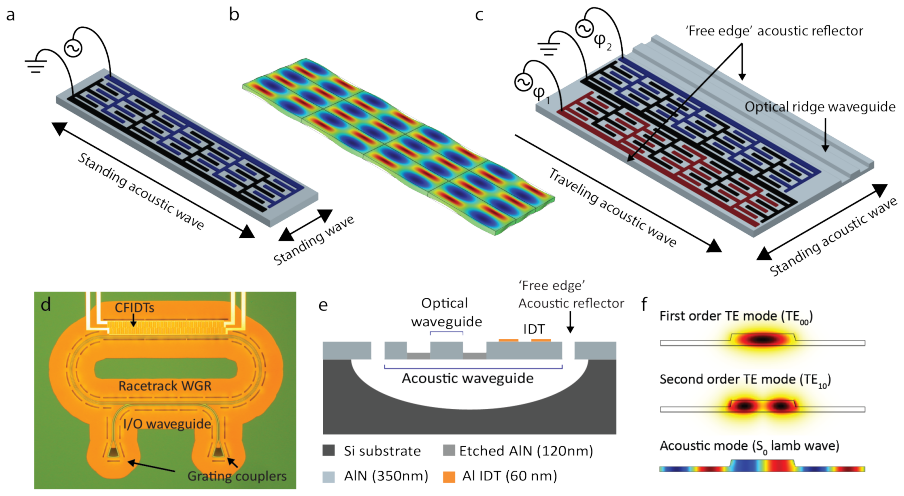
The central object is the cross-finger interdigitated transducer (CFIDT), an IDT with electrode finger periodicities in two orthogonal directions that produces an acoustic wave with an asymmetric cross-sectional density profile, so the photoelastic perturbation has nonzero overlap with the symmetric TE$_{00}$ and antisymmetric TE$_{10}$ optical modes. Two CFIDTs offset by a quarter wavelength along the waveguide are driven with a relative temporal phase $\theta_t$. Their superposition is the identity that carries the argument: it decomposes the combined acoustic field into counter-propagating traveling waves whose amplitudes depend on $\theta_t$, so setting $\theta_t = \pi/2$ or $3\pi/2$ yields a pure traveling wave in the chosen direction. The phase-matching condition between acoustic momentum $q = k_1 - k_2$ and frequency $\Omega = \omega_1 - \omega_2$ then ensures that only light counter-propagating to the acoustic wave undergoes intermodal scattering.
What would settle it
Drive the two CFIDTs with independently adjustable RF amplitudes and measure the suppressed-direction sideband at $\theta_t = \pi/2$ and $3\pi/2$: if the traveling-wave synthesis is the true mechanism, some amplitude ratio should push the null below the noise floor and align the null with the predicted phase, whereas a persistent, un-nullable sideband would show that the direction switching is contaminated by unbalanced transduction or by intramodal scattering rather than by pure phase-controlled superposition.
Extended reading notes
Core claim
The central claim is that the direction of non-reciprocal acousto-optic modulation can be dynamically reconfigured on chip by controlling the relative temporal phase of the RF drive applied to two cross-finger interdigitated transducers (CFIDTs). Writing the two standing acoustic waves as $u_1 = \psi(x,y)\cos(qz)\cos(\Omega t)$ and $u_2 = \psi(x,y)\sin(qz)\cos(\Omega t + \theta_t)$, their superposition contains forward and backward propagating components with weights $(1 + e^{i(\theta_t - \pi/2)})$ and $(1 + e^{i(\theta_t + \pi/2)})$; at $\theta_t = \pi/2$ only a backward-traveling acoustic wave remains and at $\theta_t = 3\pi/2$ only a forward-traveling one remains. Because the intermodal acousto-optic coupling is phase matched only for light counter-propagating against the acoustic wave, flipping the acoustic direction swaps which optical direction sees modulation. The paper demonstrates this experimentally by measuring Stokes and anti-Stokes sidebands for both optical input directions at four phase settings, with the expected switching of sideband suppression and enhancement.
Load-bearing premise
The claim rests on the two CFIDTs generating exactly equal acoustic amplitudes and sitting exactly a quarter wavelength apart, so their superposition is a pure single-direction traveling wave rather than a traveling wave with a standing-wave residue.
Editorial extensions
If this is right
- A single device can be switched between reciprocal and non-reciprocal operation, and the direction of non-reciprocity can be flipped, by changing only the RF phase, with no physical reconfiguration.
- The same phase control can set intermediate fractions of forward and backward acoustic components, giving continuous control over the contrast ratio rather than a binary switch.
- The all-lithographic approach works in a common piezoelectric material (aluminum nitride) and does not rely on magnetic materials, so it can be ported to different foundry processes and wavelength bands.
- Because the two optical input directions can be made transparent or opaque independently, the device can function as a reconfigurable isolator or circulator building block.
- The sideband spectra confirm the intermodal scattering picture, meaning the same design can be used for direction-dependent signal processing, not only isolation.
Reading between the lines
- Inference: The measured nulls sit off the ideal phase axis, so the same setup could be used to estimate the amplitude imbalance between the two CFIDTs from sideband data, and driving the two transducers with unequal RF powers should restore deeper nulls—a calibration the paper notes but does not perform.
- Inference: The residual standing-wave component at any phase setting implies the device can also act as a continuously tunable beam splitter between counter-propagating acoustic waves, which may be useful for on-chip microwave-photonic signal processing beyond isolation.
- Inference: The superposition identity is not limited to acousto-optics; any pair of orthogonal standing-wave excitations with adjustable relative phase (e.g., electro-optic or optomechanical) could synthesize direction-controlled traveling waves in other platforms.
Signed reviews
Editorial analysis
A structured set of objections, weighed in public.
Referee Report
Summary. The manuscript reports an on-chip acousto-optic modulator in an AlN racetrack resonator whose non-reciprocal response direction is controlled by the relative radio-frequency phase applied to two cross-finger interdigitated transducers (CFIDTs). The authors derive coupled-mode equations for intermodal TE00–TE10 scattering, fabricate the device, and measure Stokes and anti-Stokes sidebands for forward and backward optical input as a function of the RF phase. They report a maximum sideband contrast of about 8 dB and phase-dependent null/peak positions that they interpret as switching between reciprocal and non-reciprocal operation.
Significance. If substantiated, the work would be a useful advance over the fixed-direction acousto-optic isolator demonstrated in Ref. [17]: it introduces electronic reconfigurability of the non-reciprocity direction using a fully lithographic, foundry-compatible transducer. The CFIDT concept, which decouples the transverse and propagating acoustic wavevectors, is also of independent interest. The paper is transparent about non-idealities such as unequal electromechanical coupling and residual standing-wave components, and it extracts the optical parameters used in the theoretical maps from transmission data rather than fitting the sideband maps. However, the central theory equations contain sign and assignment errors, and the reported transducer pitch is inconsistent with the measured acoustic frequency; these issues currently prevent acceptance.
major comments (3)
- [Theory, Eq. (1)] Equation (1) does not reduce to Eqs. (2) and (3) at the stated phase values. Expanding u1 = ψ cos(qz) cos(Ωt) and u2 = ψ sin(qz) cos(Ωt + θt) gives coefficients whose forward/backward assignment is reversed relative to the exponentials in Eq. (1). At θt = π/2 only the first exponential survives, yielding u = ψ e^{i(qz−Ωt)} + c.c. = 2ψ cos(qz−Ωt), i.e. a forward traveling wave, whereas Eq. (2) and the text state cos(−qz−Ωt), a backward wave. At θt = 3π/2 the situation is the opposite. Because this superposition is the basis for the direction-reconfigurable acoustic excitation, the identity must be corrected and all downstream equations re-derived.
- [Theory, Eqs. (6)–(7)] The matrices G_f and G_b do not implement the phase behavior described in the text. At θt = π/2, Eq. (6) gives G_f = 0 and Eq. (7) gives G_b = 2g (nonzero), so backward-propagating light would be scattered and forward light would not; the text immediately below Eq. (7) claims the opposite ('the backward coupling term G_b = 0' and only forward light scattered). At θt = 3π/2, Eq. (6) gives G_f = 2g and Eq. (7) gives G_b = 0, again the reverse of the stated behavior. Either the roles of G_f and G_b are swapped or the phase offsets in the exponentials must be interchanged. As written, the theoretical maps in Fig. 4(a) are not self-consistent and cannot serve as a reliable explanation of the experimental data.
- [Device fabrication] The reported design parameters cannot simultaneously satisfy the phase-matching condition. The CFIDT pitch is given as Λ_propagating = 2π/q = 18.3 µm, and the S0 Lamb resonance is measured at 4.98 GHz. This implies an acoustic phase velocity v = f·Λ ≈ 91 km/s, roughly an order of magnitude above the longitudinal sound speed in AlN (~11 km/s). If the pitch is correct and the acoustic velocity is ~10 km/s, the acoustic frequency would be ~0.5 MHz, not 4.97 GHz; if the frequency is correct, the acoustic wavelength is ~2 µm, not 18.3 µm. The phase-matching requirement Ω = 2π × 4.97 GHz = ω1 − ω2 and q = 2π/18.3 µm = k1 − k2 cannot both be satisfied by an acoustic wave in AlN. The authors must correct the pitch (e.g., a decimal error) or provide a valid explanation; as written, the reported device cannot operate as claimed.
minor comments (5)
- [Measurement of non-reciprocal modulation] The theoretical sideband maps in Fig. 4(a) are said to follow from 'predictive Eqns. 5', but the solution of Eqs. (4)–(7) that yields the displayed maps is not shown; please provide the intermediate calculation or an appendix so the prediction can be reproduced.
- [Measurement of non-reciprocal modulation] The residual standing-wave component from unequal CFIDT amplitudes is acknowledged but not quantified; reporting the amplitude imbalance estimated from the s11 data and RF path losses would allow the reader to assess the achievable contrast and the accuracy of the null positions.
- [Fig. 3(c)] The fitted optical parameters (κ1, κ2, κex1, κex2, and g) are not listed; since the theoretical map is based on these values, please report them together with uncertainties.
- [Introduction] Reference [34] is about switched acoustic delay lines, not about unidirectional IDT designs; please verify that this reference supports the claim that unidirectional IDTs have been developed previously.
- [Theory, Eq. (4)] The normalization of the input and output fields sin and sout in Eqs. (4)–(5) is not defined; please state the convention used so that the sideband powers in Fig. 4 are unambiguous.
Circularity Check
No significant circularity: the theoretical sideband maps are derived from independently measured optical transmission parameters, and the phase dependence is a genuine prediction not fitted to the sideband data.
full rationale
The paper's central claim is the experimental demonstration of reconfigurable non-reciprocal acousto-optic modulation. The theoretical plots in Fig. 4a are explicitly described as 'based on the parameters extracted from carrier transmission data (Fig 3c) and the predictive Eqns. 5.' The optical mode frequencies, linewidths, and external coupling rates are therefore obtained from transmission spectroscopy, a different measurement from the Stokes/anti-Stokes sideband data whose phase dependence is then predicted. No passage indicates the sideband data were used to fit the model parameters. The phase-dependent suppression follows algebraically from the superposition identity in Eq. 1 and the coupling matrices in Eqs. 6-7; this is a mathematical consequence of the stated two-standing-wave ansatz, and it is then compared with independent measurements. The paper explicitly attributes the observed θt-axis shift to intramodal scattering, CFIDT misalignment, and unequal electromechanical coupling/RF losses, which are stated limitations rather than fitted inputs disguised as predictions. Self-citations to the authors' prior work [17] provide background and an independently published expression for the optomechanical overlap integral, but the new reconfigurability claim does not reduce to that citation. The pitch/resonance inconsistency raised by the skeptic is a parameter-consistency or correctness concern, not a circular derivation, and does not affect this circularity score.
Assumptions & free parameters
free parameters (4)
- Optical mode frequency separation (omega1 - omega2) =
4.97 GHz
- Loaded quality factors Q_TE00 and Q_TE10 =
176,000 and 133,000
- External coupling rates kappa_ex1 and kappa_ex2 =
not stated numerically
- Optomechanical coupling coefficient g =
not reported
assumptions (3)
- domain assumption Phase matching: intermodal optomechanical scattering occurs only when the acoustic wave provides the frequency and momentum difference between the two optical modes, coupling forward light only with backward acoustic waves and vice versa.
- domain assumption The acoustic field from two CFIDTs superposes linearly, with equal amplitude and quarter-wavelength spatial offset.
- standard math Standard cavity input-output theory for two coupled modes describes the sideband response.
Cite this review
Pith. "Pith review of Direction reconfigurable non-reciprocal acousto-optic modulator on chip." pith.science (2026). https://pith.science/paper/IV2Z2VEM
@misc{pith2026190802382,
  author       = {Pith},
  title        = {Pith review of: Direction reconfigurable non-reciprocal acousto-optic modulator on chip},
  year         = {2026},
  howpublished = {\url{https://pith.science/paper/IV2Z2VEM}},
  note         = {Machine review of arXiv:1908.02382}
}
read the original abstract
Non-reciprocal components are essential in photonic systems for protecting light sources and for signal routing functions. Acousto-optic methods to produce non-reciprocal devices offer a foundry-compatible alternative to magneto-optic solutions and are especially important for photonic integration. In this paper, we experimentally demonstrate a dynamically reconfigurable non-reciprocal acousto-optic modulator at telecom wavelength. The modulator can be arranged in a multitude of reciprocal and non-reciprocal configurations by means of an external RF input. The dynamic reconfigurability of the device is enabled by a new cross-finger interdigitated piezoelectric transducer that can change the directionality of the reciprocity-breaking acoustic excitation based on the phase of the RF input. The methodology we demonstrate here may enable new avenues for direction dependent signal processing and optical isolation.
Figures


Figures from the paper (1 more)

Reference graph
Works this paper leans on
-
[17]
Sohn, D. B., Kim, S. & Bahl, G. Time-reversal symmetry breaking with acoustic pumping of nanophotonic circuits. Nat. Photonics 12, 91–97 (2018)
work page 2018
-
[1]
Hogan, C. L. The ferromagnetic Faraday effect at microwave frequencies and its applications: The microwave gyrator. The Bell System Technical Journal 31, 1 (1952)
work page 1952
-
[2]
Aplet, L. & Carson, J. A Faraday effect optical isolator. Appl. Opitcs 3, 544 (1964)
work page 1964
-
[3]
Jalas, D. et al. What is–and what is not–an optical isolator. Nat. Photonics 7, 579 (2013)
work page 2013
-
[4]
Bi, L. et al. On-chip optical isolation in monolithically integrated non- reciprocal optical resonators. Nat. Photonics 5, 758 (2011)
work page 2011
-
[5]
Huang, D. et al. Dynamically reconfigurable integrated optical circula- tors. Optica 4, 23–30 (2017)
work page 2017
-
[6]
Zhang, Y. et al. Monolithic integration of broadband optical isolators for polarization-diverse silicon photonics. Optica 6, 473–478 (2019)
work page 2019
- [7]
Show all 34 references
-
[8]
D., Fang, K., Nussenzveig, P., Fan, S
Tzuang, L. D., Fang, K., Nussenzveig, P., Fan, S. & Lipson, M. Non- reciprocal phase shift induced by an effective magnetic flux for light. Nat. Photonics 8, 701 (2014)
2014
-
[9]
Fang, K. et al. Generalized non-reciprocity in an optomechanical circuit via synthetic magnetism and reservoir engineering. Nat. Phys 13, 465– 471 (2017)
2017
-
[10]
K., Yun, S
Hwang, I. K., Yun, S. H. & Kim, B. Y. All-fiber-optic nonreciprocal modulator. Opt. Lett. 22, 507–509 (1997)
1997
-
[11]
& Fan, S
Yu, Z. & Fan, S. Complete optical isolation created by indirect inter- band photonic transitions. Nat. Photonics 3, 91–94 (2009)
2009
-
[12]
S., Butsch, A
Kang, M. S., Butsch, A. & Russell, P. S. J. Reconfigurable light-driven opto-acoustic isolators in photonic crystal fibre. Nat. Photonics 5, 549– 553 (2011)
2011
-
[13]
& Lipson, M
Lira, H., Yu, Z., Fan, S. & Lipson, M. Electrically driven nonreciprocity induced by interband photonic transition on a silicon chip. Phys. Rev. Lett. 109, 033901 (2012). 14
2012
-
[14]
C., Han, K., Wang, H
Kim, J., Kuzyk, M. C., Han, K., Wang, H. & Bahl, G. Non-reciprocal Brillouin scattering induced transparency. Nat. Phys 11, 275–280 (2015)
2015
-
[15]
Dong, C.-H. et al. Brillouin-scattering-induced transparency and non- reciprocal light storage. Nat. Commun. 6 (2015)
2015
-
[16]
& Bahl, G
Kim, J., Kim, S. & Bahl, G. Complete linear optical isolation at the microscale with ultralow loss. Sci. Rep. 7, 1647 (2017)
2017
-
[18]
A., Otterstrom, N
Kittlaus, E. A., Otterstrom, N. T., Kharel, P., Gertler, S. & Rakich, P. T. Non-reciprocal interband Brillouin modulation. Nat. Photonics 12, 613–619 (2018)
2018
-
[19]
W., Kim, S., Bernhard, J
Peterson, C. W., Kim, S., Bernhard, J. T. & Bahl, G. Synthetic phonons enable nonreciprocal coupling to arbitrary resonator networks. Science Advances 4 (2018)
2018
-
[20]
L., Caloz, C
Sounas, D. L., Caloz, C. & Al` u, A. Giant non-reciprocity at the sub- wavelength scale using angular momentum-biased metamaterials. Nat. Commun. 4, 2407 (2013)
2013
-
[21]
Sounas, D. L. & Al` u, A. Angular-momentum-biased nanorings to realize magnetic-free integrated optical isolation. ACS Photonics 1, 198–204 (2014)
2014
-
[22]
L., Sieck, C
Fleury, R., Sounas, D. L., Sieck, C. F., Haberman, M. R. & Al` u, A. Sound isolation and giant linear nonreciprocity in a compact acoustic circulator. Science 343, 516–519 (2014)
2014
-
[23]
M., Wilkens, L
Fujita, J., Levy, M., Osgood, R. M., Wilkens, L. & D¨ otsch, H. Waveg- uide optical isolator based on Mach–Zehnder interferometer. Appl. Phys. Lett. 76, 2158–2160 (2000)
2000
-
[24]
R., Dupuis, N
Doerr, C. R., Dupuis, N. & Zhang, L. Optical isolator using two tandem phase modulators. Opt. Lett. 36, 4293–4295 (2011)
2011
-
[25]
Shen, Z. et al. Experimental realization of optomechanically induced non-reciprocity. Nat. Photonics 10, 657 (2016). 15
2016
-
[26]
& Verhagen, E
Ruesink, F., Miri, M.-A., Al` u, A. & Verhagen, E. Nonreciprocity and magnetic-free isolation based on optomechanical interactions. Nat. Commun. 7, 13662 (2016)
2016
-
[27]
Peterson, G. A. et al. Demonstration of efficient nonreciprocity in a microwave optomechanical circuit. Phys. Rev. X 7, 031001 (2017)
2017
-
[28]
Bernier, N. R. et al. Nonreciprocal reconfigurable microwave optome- chanical circuit. Nat. Commun. 8, 604 (2017)
2017
-
[29]
Tadesse, S. A. & Li, M. Sub-optical wavelength acoustic wave modula- tion of integrated photonic resonators at microwave frequencies. Nat. Commun. 5 (2014)
2014
-
[30]
C., Davan¸ co, M
Balram, K. C., Davan¸ co, M. I., Song, J. D. & Srinivasan, K. Coherent coupling between radiofrequency, optical and acoustic waves in piezo- optomechanical circuits. Nat. Photonics 10, 346–352 (2016)
2016
-
[31]
Liu, Q., Li, H. & Li, M. Electromechanical Brillouin scattering in integrated optomechanical waveguides. Optica 6, 778–785 (2019)
2019
-
[32]
& Piazza, G
Ghosh, S. & Piazza, G. Piezoelectric actuation of aluminum nitride contour mode optomechanical resonators. Opt. Express 23, 15477– 15490 (2015)
2015
-
[33]
Shao, L. et al. Microwave-to-optical conversion using lithium niobate thin-film acoustic resonators. arXiv:1907.08593 (2019)
2019 arXiv
-
[34]
Lu, R. et al. A radio frequency nonreciprocal network based on switched acoustic delay lines. IEEE Transactions on Microwave Theory and Techniques 67, 1516–1530 (2019). 16
2019
Reviewed August 14, 2026 · model on record in the stance chip above.
Discussion (0). Continue with ORCID to comment.