REVIEW 3 major objections 4 minor 98 references
High-velocity outflows in massive post-starburst galaxies at z > 1
T0 review · 3 major / 4 minor · reviewed 2026-08-14 · deepseek-v4-flash
Pith's one-line read Massive post-starburst galaxies at z > 1 carry ~1150 km/s winds in their interstellar medium, as seen in stacked Mg II absorption.
desk verdict First stacking detection of outflows in z>1 post-starbursts, probably real but with a model-dependent line decomposition that warrants a caveated abstract. read the letter →
The pith
A machine-rendered reading of the paper's core claim, the machinery that carries it, and where it could break.
The reading
What carries the argument
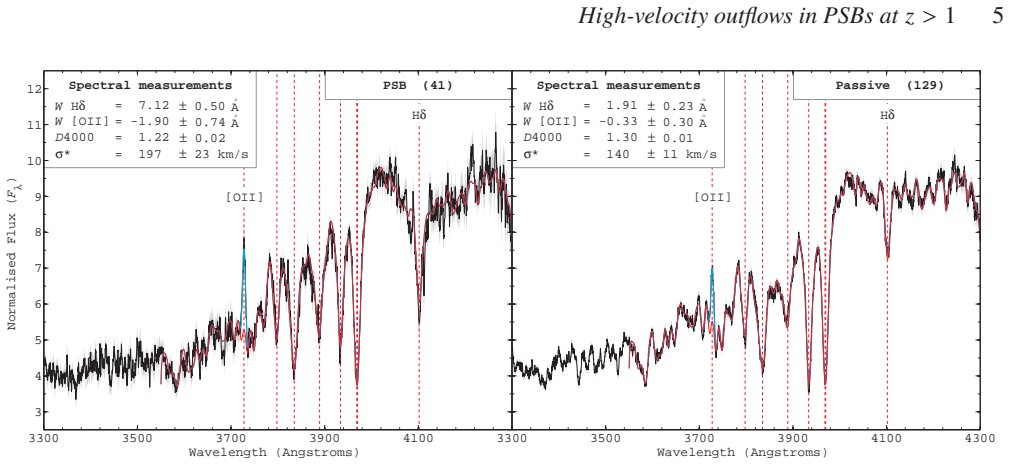
The central object is the stacked Mg II $\lambda\lambda 2796,2803$ Å absorption doublet, a tracer of low-ionisation interstellar gas. The argument is carried by a two-component spectral model in which the systemic absorption is a single Gaussian-convolved doublet with fixed intensity ratio $1.2:1$ and the outflow is a second doublet with a free centroid; an F-test decides whether the second component is statistically required, and a simulation calibrates the fitted velocity offset ($\Delta v\sim1500\rm\,km\,s^{-1}$) down to a median outflow velocity ($v_{\rm out}\sim1150\rm\,km\,s^{-1}$) by accounting for the fact that only a fraction of the galaxies contribute the outflow. A boxcar method based on equivalent widths of the blue and red sides provides an independent check.
What would settle it
Take high-resolution ($R > 3000$) spectra of individual massive PSBs at $1 < z < 1.4$ that resolve the Mg II doublet. If the blue-shifted excess disappears once stellar templates (including the suspected weak F-star feature) are subtracted, or if no matching blue-shifted component appears in other low-ionisation tracers such as Fe II or Si II, the outflow interpretation would be refuted.
Extended reading notes
Core claim
Massive ($M_\ast > 10^{10}\,M_\odot$) post-starburst galaxies at $1 < z < 1.4$ show a statistically significant, strongly blue-shifted component in their stacked Mg II $\lambda\lambda 2796,2803$ Å absorption profile, which the authors interpret as high-velocity outflows in the interstellar medium with a typical velocity of $v_{\rm out}\sim1150\pm160\rm\,km\,s^{-1}$. The detection is significant at $>3\sigma$ by an F-test and is recovered by two independent methods — a two-component Gaussian-convolved doublet fit and a boxcar equivalent-width measurement — while passive galaxies at the same redshifts show no such component. The galaxies also have a stellar velocity dispersion of $\sigma_\ast \sim 200\rm\,km\,s^{-1}$ (dynamical mass $M_{\rm d}\sim10^{11}\,M_\odot$) and are compact ($r_{\rm e}\sim1$--$2$ kpc) and spheroidal (Sérsic index $n\sim3$), consistent with the idea that the outflows were launched during a recent compaction event such as a major merger or disc collapse.
Load-bearing premise
The claim collapses if the blue-sided asymmetry in the stacked spectrum can be produced by something other than outflowing gas, such as an unrecognized stellar absorption feature or a different ratio of the two Mg II lines.
Editorial extensions
If this is right
- If the central claim holds, high-velocity outflows are typical, not exceptional, in massive post-starburst galaxies at z > 1, making the PSB phase a direct window onto quenching feedback.
- Because the measured outflow velocity (~1150 km/s) exceeds the typical escape velocity (~950 km/s at 1 kpc), the outflowing gas can escape the galaxy or be driven into the circum-galactic medium, where it may suppress later gas accretion.
- The absence of outflow signatures in passive galaxies, and the tentative trend with the D4000 index, imply the wind fades as the burst ages, coupling the outflow to the quenching event rather than to the passive phase.
- The lack of optical AGN signatures means the wind is either powered by stellar feedback from the starburst itself, or by an AGN episode that has already faded by the post-starburst phase.
Reading between the lines
- If the inferred detection fraction D ~ 0.5 is correct, only about half of these PSBs are caught while their wind is still active; combining D with the D4000-based age distribution would give the first direct measurement of the wind duty cycle after quenching.
- A monotonic decline of outflow velocity with D4000 in a larger sample would strengthen the case that the wind is the quenching agent rather than a longer-lived by-product; the current hint (younger PSBs, D4000 < 1.24, show more significant outflows) points this way but is not conclusive.
- If the outflow is starburst-driven, its momentum flux should scale with the star-formation rate surface density of the preceding burst; stacking by SFR or by compactness (r_e, n) would test this and could distinguish starburst from AGN driving.
- X-ray stacking of these PSBs could reveal hidden AGN that leave no optical trace; a correlation between X-ray luminosity and outflow velocity would implicate the AGN as the driver, whereas a null result would support the starburst-feedback scenario.
Signed reviews
Editorial analysis
A structured set of objections, weighed in public.
Referee Report
Summary. This paper stacks the rest-frame optical spectra of 41 spectroscopically selected post-starburst galaxies at 1 < z < 1.4 in the UDS field and analyzes the Mg ii λ2800 Å absorption profile. The authors fit the stacked continuum to obtain a typical stellar velocity dispersion (σ* ~ 200 km/s for PSBs vs ~ 140 km/s for passive galaxies), and then model the Mg ii feature as a Gaussian-convolved doublet fixed at the systemic redshift, optionally adding a blueshifted outflow component. They report a statistically significant blue excess in PSBs (F-test p < 0.003; Δv ~ 1500 ± 150 km/s; vout ~ 1150 ± 160 km/s after a simulation-based calibration), whereas passive galaxies show no outflow. They use a boxcar method as a cross-check (mean vout ~ 809 ± 104 km/s), explore alternative stellar continuum models in Appendix B, and interpret the outflows as residual feedback from a recent compaction event that quenched star formation.
Significance. If correct, the detection of vout ~ 1000 km/s ISM outflows in typical massive z > 1 PSBs is an important observational result. It would connect rapid quenching at high redshift to energetic feedback and strengthen the case that fast winds are a generic feature of the PSB phase, not only of rare luminous systems. The paper is commendable for including bootstrap uncertainties, an F-test, a boxcar cross-check, and an appendix with synthetic stellar libraries; these give the central detection a reasonable empirical foundation. However, because the result hinges on the decomposition of an unresolved doublet and on a calibration that assumes a specific outflow fraction and velocity distribution, the significance statement in the abstract is stronger than the systematic robustness demonstrated.
major comments (3)
- [Section 3.2(i), Fig. 4] The systemic Mg ii component is modelled with a fixed doublet intensity ratio of 1.2:1, motivated by Weiner et al. (2009). At the stack's effective resolution (FWHM ~ 5.8 Å, doublet separation ~ 7.2 Å), the ratio and width jointly determine the blue-side profile of the systemic component. If the true systemic ratio is closer to the optically thin 2:1 value, the model's blue line is too shallow and part of the fitted 'outflow' could simply be the missing doublet strength; conversely a saturated ratio closer to 1:1 would work in the opposite direction. The paper does not fit or marginalize over the doublet ratio, nor does it report the maximum ratio change allowed by the red-side fit. I request a test with the ratio as a free parameter (or a grid spanning 1:1 to 2:1) in the one- and two-component models, reporting how Δv, the F-test p-value, and the ~ 25% blue excess change. Without this, the quoted > 3σ significance is conditional on a single assumed ratio.
- [Appendix B] The models used to test the stellar Mg ii contribution do not fully close the systematic. The authors state that the stellar Mg ii strength is 'essentially unconstrained' by the fits and that a weak feature blue-ward of Mg ii, important in F-star atmospheres, is also uncertain. Model B masks the blue side of the profile, so it cannot reveal whether the blue excess is partly stellar in origin; it simply forces all systemic absorption into the stellar template. Model C masks the whole doublet, but because the stellar Mg ii strength is degenerate with the systemic ISM component, the partition is not identifiable. I request a quantitative test in which an additional absorption feature is placed at the F-star line wavelength with a range of plausible strengths (scaled down from the synthetic libraries, since those lines are known to be too strong), and the maximum strength that still leaves an outflow component required at > 3σ is reported. The current Appendix B demonstrates consistency under alternative decompositions but does not bound the possible contamination.
- [Section 3.2 / Appendix A] The conversion from Δv to vout relies on simulations in which exactly 50% of input spectra contain an outflow and the outflow velocities are drawn uniformly from 0 to vmax. The 350 km/s offset is therefore a function of these assumptions, and the paper's D ~ 0.5 is itself inferred using a local covering fraction (Cf = 0.4–0.5) that may not hold for z > 1 PSBs. The authors should show the sensitivity of the calibration curve and of vout to D = 0.3 and 0.7 and to non-uniform velocity distributions (e.g., Gaussian or centrally concentrated). In addition, the boxcar estimate (809 ± 104 km/s) and the calibrated decomposition estimate (1150 ± 160 km/s) differ by ~ 340 km/s; the paper should state explicitly whether this difference is within the systematic uncertainty of the calibration and discuss the implications for the claim that vout exceeds the escape velocity (~ 950 km/s).
minor comments (4)
- [Section 3.2] The sentence 'This F-test yields a p-value for accepting the null hypothesis ... and rejects the two-component model if p > 0.05' is confusing; p is not the probability of the null, and the decision rule should be phrased as 'we include the outflow component when p < 0.05'.
- [Abstract / Section 4] The phrase 'clear evidence' is too strong given the systematic caveats stated in Appendix B; consider 'strong evidence under our assumed doublet model' or equivalent.
- [Figure B1] For Models B and C, the quoted Δv uncertainties (~ 400 km/s) are much larger than Model A's (~ 143 km/s); this should be noted in the text so that the reader sees the loss of constraining power.
- [Throughout] The Mg ii symbol appears as 'Mg /i.sc/i.sc' throughout the text due to a LaTeX conversion issue; this should be fixed.
Circularity Check
No significant circularity: outflow detection is data-driven and independently corroborated.
full rationale
The central outflow detection is not derived from an input that contains the answer. The stacked Mg II profile is real data; the systemic component is fixed at the template zspec with an externally motivated 1.2:1 doublet ratio (Weiner et al. 2009), and its width is fit only to the red side, leaving the blue excess as a residual. The need for an extra component is tested with an F-test and corroborated by a model-independent boxcar method and by full spectral fits with synthetic stellar libraries (Models B and C). Appendix A calibrates Delta-v to v_out using simulated stacks, but this calibration only translates the measured velocity offset and does not generate the observed asymmetry. The paper's own Appendix B flags the unconstrained stellar Mg II and F-star feature, but this is an acknowledged model uncertainty, not a circular reduction; no equation or fitted parameter is renamed as a prediction. Self-citations (Maltby et al. 2016; Wild et al. 2014/2016) concern sample construction and previous PSB selection, not the outflow measurement, and are not load-bearing for the new result.
Assumptions & free parameters
free parameters (1)
- Systemic Mg II Gaussian convolution width =
≈8 Å (σ_obs; used in simulations, not quoted for the actual stacks)
assumptions (5)
- domain assumption Mg II doublet intensity ratio is fixed at 1.2:1 (from Weiner et al. 2009) in all Mg II profile models.
- domain assumption The systemic redshift from ez template fitting defines the zero point for outflow velocities.
- domain assumption Instrumental and stacking broadening are Gaussian and combine in quadrature (Equations 2 and 3).
- ad hoc to paper The calibration simulation in Appendix A assumes 50% of input spectra contain an outflowing Mg II component, with velocities drawn uniformly from 0 to vmax.
- domain assumption Virial coefficient k_d(n) from Bertin et al. (2002) applies to these galaxies, and the stacked σ* approximates the central velocity dispersion within ~20%.
Cite this review
Pith. "Pith review of High-velocity outflows in massive post-starburst galaxies at z > 1." pith.science (2026). https://pith.science/paper/IVMBDRPO
@misc{pith2026190802766,
  author       = {Pith},
  title        = {Pith review of: High-velocity outflows in massive post-starburst galaxies at z > 1},
  year         = {2026},
  howpublished = {\url{https://pith.science/paper/IVMBDRPO}},
  note         = {Machine review of arXiv:1908.02766}
}
abstract
We investigate the prevalence of galactic-scale outflows in post-starburst (PSB) galaxies at high redshift ($1 < z < 1.4$), using the deep optical spectra available in the UKIDSS Ultra Deep Survey (UDS). We use a sample of $\sim40$ spectroscopically confirmed PSBs, recently identified in the UDS field, and perform a stacking analysis in order to analyse the structure of strong interstellar absorption features such as Mg ii ($\lambda2800$ Ang.). We find that for massive ($M_* > 10^{10}\rm\,M_{\odot}$) PSBs at $z > 1$, there is clear evidence for a strong blue-shifted component to the Mg ii absorption feature, indicative of high-velocity outflows ($v_{\rm out}\sim1150\pm160\rm\,km\,s^{-1}$) in the interstellar medium. We conclude that such outflows are typical in massive PSBs at this epoch, and potentially represent the residual signature of a feedback process that quenched these galaxies. Using full spectral fitting, we also obtain a typical stellar velocity dispersion $\sigma_*$ for these PSBs of $\sim200\rm\,km\,s^{-1}$, which confirms they are intrinsically massive in nature (dynamical mass $M_{\rm d}\sim10^{11}\rm\,M_{\odot}$). Given that these high-$z$ PSBs are also exceptionally compact ($r_{\rm e}\sim1$--$2\rm\,kpc$) and spheroidal (Sersic index $n\sim3$), we propose that the outflowing winds may have been launched during a recent compaction event (e.g. major merger or disc collapse) that triggered either a centralised starburst or active galactic nuclei (AGN) activity. Finally, we find no evidence for AGN signatures in the optical spectra of these PSBs, suggesting they were either quenched by stellar feedback from the starburst itself, or that if AGN feedback is responsible, the AGN episode that triggered quenching does not linger into the post-starburst phase.
Figures


Figures from the paper (1 more)

Reference graph
Works this paper leans on
-
[1]
write newline
" write newline "" before.all 'output.state := FUNCTION fin.entry write newline FUNCTION new.block output.state before.all = 'skip after.block 'output.state := if FUNCTION new.sentence output.state after.block = 'skip output.state before.all = 'skip after.sentence 'output.state := if if FUNCTION not #0 #1 if FUNCTION and 'skip pop #0 if FUNCTION or pop #1...
-
[2]
@esa (Ref
\@ifxundefined[1] #1\@undefined \@firstoftwo \@secondoftwo \@ifnum[1] #1 \@firstoftwo \@secondoftwo \@ifx[1] #1 \@firstoftwo \@secondoftwo [2] @ #1 \@temptokena #2 #1 @ \@temptokena \@ifclassloaded agu2001 natbib The agu2001 class already includes natbib coding, so you should not add it explicitly Type <Return> for now, but then later remove the command n...
-
[3]
\@lbibitem[] @bibitem@first@sw\@secondoftwo \@lbibitem[#1]#2 \@extra@b@citeb \@ifundefined br@#2\@extra@b@citeb \@namedef br@#2 \@nameuse br@#2\@extra@b@citeb \@ifundefined b@#2\@extra@b@citeb @num @parse #2 @tmp #1 NAT@b@open@#2 NAT@b@shut@#2 \@ifnum @merge>\@ne @bibitem@first@sw \@firstoftwo \@ifundefined NAT@b*@#2 \@firstoftwo @num @NAT@ctr \@secondoft...
-
[4]
@open @close @open @close and [1] URL: #1 \@ifundefined chapter * \@mkboth \@ifxundefined @sectionbib * \@mkboth * \@mkboth\@gobbletwo \@ifclassloaded amsart * \@ifclassloaded amsbook * \@ifxundefined @heading @heading NAT@ctr thebibliography [1] @ \@biblabel @NAT@ctr \@bibsetup #1 @NAT@ctr @ @openbib .11em \@plus.33em \@minus.07em 4000 4000 `\.\@m @bibit...
-
[5]
Almaini O., et al., 2017, @doi [ ] 10.1093/mnras/stx1957 , http://adsabs.harvard.edu/abs/2017MNRAS.472.1401A 472, 1401
-
[6]
Balogh M. L., Morris S. L., Yee H. K. C., Carlberg R. G., Ellingson E., 1999, @doi [ ] 10.1086/308056 , http://adsabs.harvard.edu/abs/1999ApJ...527...54B 527, 54
doi:10.1086/308056 1999
-
[7]
Barro G., et al., 2013, @doi [ ] 10.1088/0004-637X/765/2/104 , http://adsabs.harvard.edu/abs/2013ApJ...765..104B 765, 104
-
[8]
Bell E. F., et al., 2004, @doi [ ] 10.1086/420778 , http://ukads.nottingham.ac.uk/abs/2004ApJ...608..752B 608, 752
doi:10.1086/420778 2004
Show all 98 references
-
[9]
B., Ellis R
Belli S., Newman A. B., Ellis R. S., 2018, arXiv e-prints, http://adsabs.harvard.edu/abs/2018arXiv181000008B
2018
-
[10]
Bertin G., Ciotti L., Del Principe M., 2002, @doi [ ] 10.1051/0004-6361:20020248 , http://adsabs.harvard.edu/abs/2002A
2002 doi
-
[12]
N., Kaiser C
Best P. N., Kaiser C. R., Heckman T. M., Kauffmann G., 2006, @doi [ ] 10.1111/j.1745-3933.2006.00159.x , http://adsabs.harvard.edu/abs/2006MNRAS.368L..67B 368, L67
2006
-
[13]
Bordoloi R., et al., 2014, @doi [ ] 10.1088/0004-637X/794/2/130 , http://adsabs.harvard.edu/abs/2014ApJ...794..130B 794, 130
2014 doi
-
[14]
J., et al., 2013, @doi [ ] 10.1093/mnras/stt715 , http://adsabs.harvard.edu/abs/2013MNRAS.433..194B 433, 194
Bradshaw E. J., et al., 2013, @doi [ ] 10.1093/mnras/stt715 , http://adsabs.harvard.edu/abs/2013MNRAS.433..194B 433, 194
2013 doi
-
[15]
B., et al., 2011, @doi [ ] 10.1088/0004-637X/739/1/24 , http://adsabs.harvard.edu/abs/2011ApJ...739...24B 739, 24
Brammer G. B., et al., 2011, @doi [ ] 10.1088/0004-637X/739/1/24 , http://adsabs.harvard.edu/abs/2011ApJ...739...24B 739, 24
2011 doi
-
[16]
Bruzual G., 1983, @doi [ ] 10.1086/161352 , http://adsabs.harvard.edu/abs/1983ApJ...273..105B 273, 105
1983 doi
-
[17]
Cappellari M., 2017, @doi [ ] 10.1093/mnras/stw3020 , http://adsabs.harvard.edu/abs/2017MNRAS.466..798C 466, 798
2017 doi
-
[18]
Cappellari M., Emsellem E., 2004, @doi [ ] 10.1086/381875 , http://adsabs.harvard.edu/abs/2004PASP..116..138C 116, 138
2004 doi
-
[19]
Cappellari M., et al., 2006, @doi [ ] 10.1111/j.1365-2966.2005.09981.x , http://adsabs.harvard.edu/abs/2006MNRAS.366.1126C 366, 1126
2006
-
[20]
Cappellari M., et al., 2009, @doi [ ] 10.1088/0004-637X/704/1/L34 , http://adsabs.harvard.edu/abs/2009ApJ...704L..34C 704, L34
2009 doi
-
[21]
Cappellari M., et al., 2013, @doi [ ] 10.1093/mnras/stt562 , http://adsabs.harvard.edu/abs/2013MNRAS.432.1709C 432, 1709
2013 doi
-
[22]
C., McLure R
Carnall A. C., McLure R. J., Dunlop J. S., Dav \'e R., 2018, @doi [ ] 10.1093/mnras/sty2169 , http://adsabs.harvard.edu/abs/2018MNRAS.480.4379C 480, 4379
2018 doi
-
[23]
Cicone C., et al., 2014, @doi [ ] 10.1051/0004-6361/201322464 , http://adsabs.harvard.edu/abs/2014A
2014 doi
-
[24]
Cimatti A., et al., 2013, @doi [ ] 10.1088/2041-8205/779/1/L13 , http://adsabs.harvard.edu/abs/2013ApJ...779L..13C 779, L13
2013 doi
-
[26]
Coelho P. R. T., 2014, @doi [ ] 10.1093/mnras/stu365 , https://ui.adsabs.harvard.edu/abs/2014MNRAS.440.1027C 440, 1027
2014 doi
-
[27]
L., Weiner B
Coil A. L., Weiner B. J., Holz D. E., Cooper M. C., Yan R., Aird J., 2011, @doi [ ] 10.1088/0004-637X/743/1/46 , http://adsabs.harvard.edu/abs/2011ApJ...743...46C 743, 46
2011 doi
-
[29]
Dekel A., et al., 2009, @doi [ ] 10.1038/nature07648 , http://adsabs.harvard.edu/abs/2009Natur.457..451D 457, 451
2009 doi
-
[30]
M., Moustakas J., Tremonti C
Diamond-Stanic A. M., Moustakas J., Tremonti C. A., Coil A. L., Hickox R. C., Robaina A. R., Rudnick G. H., Sell P. H., 2012, @doi [ ] 10.1088/2041-8205/755/2/L26 , http://adsabs.harvard.edu/abs/2012ApJ...755L..26D 755, L26
2012 doi
-
[31]
E., 1983, @doi [ ] 10.1086/161093 , http://adsabs.harvard.edu/abs/1983ApJ...270....7D 270, 7
Dressler A., Gunn J. E., 1983, @doi [ ] 10.1086/161093 , http://adsabs.harvard.edu/abs/1983ApJ...270....7D 270, 7
1983 doi
-
[32]
Du X., et al., 2018, @doi [ ] 10.3847/1538-4357/aabfcf , http://adsabs.harvard.edu/abs/2018ApJ...860...75D 860, 75
2018 doi
-
[33]
M., et al., 2007, @doi [ ] 10.1086/519294 , http://adsabs.harvard.edu/abs/2007ApJ...665..265F 665, 265
Faber S. M., et al., 2007, @doi [ ] 10.1086/519294 , http://adsabs.harvard.edu/abs/2007ApJ...665..265F 665, 265
2007 doi
-
[34]
J., Gorgas J., Peletier R
Falc \'o n-Barroso J., S \'a nchez-Bl \'a zquez P., Vazdekis A., Ricciardelli E., Cardiel N., Cenarro A. J., Gorgas J., Peletier R. F., 2011, @doi [ ] 10.1051/0004-6361/201116842 , https://ui.adsabs.harvard.edu/abs/2011A&A...532A..95F 532, A95
2011 doi
-
[35]
Fluetsch A., et al., 2019, @doi [ ] 10.1093/mnras/sty3449 , http://adsabs.harvard.edu/abs/2019MNRAS.483.4586F 483, 4586
2019 doi
-
[36]
D., Yang Y., Zabludoff A., Narayanan D., Shirley Y., Walter F., Smith J.-D., Tremonti C
French K. D., Yang Y., Zabludoff A., Narayanan D., Shirley Y., Walter F., Smith J.-D., Tremonti C. A., 2015, @doi [ ] 10.1088/0004-637X/801/1/1 , http://adsabs.harvard.edu/abs/2015ApJ...801....1F 801, 1
2015 doi
-
[37]
Furusawa H., et al., 2008, @doi [ ] 10.1086/527321 , http://adsabs.harvard.edu/abs/2008ApJS..176....1F 176, 1
2008 doi
-
[38]
Garilli B., Fumana M., Franzetti P., Paioro L., Scodeggio M., Le F \`e vre O., Paltani S., Scaramella R., 2010, @doi [ ] 10.1086/654903 , http://adsabs.harvard.edu/abs/2010PASP..122..827G 122, 827
2010 doi
-
[39]
E., et al., 2014, @doi [ ] 10.1038/nature14012 , http://adsabs.harvard.edu/abs/2014Natur.516...68G 516, 68
Geach J. E., et al., 2014, @doi [ ] 10.1038/nature14012 , http://adsabs.harvard.edu/abs/2014Natur.516...68G 516, 68
2014 doi
-
[41]
Goto T., et al., 2003, @doi [ ] 10.1093/pasj/55.4.771 , http://adsabs.harvard.edu/abs/2003PASJ...55..771G 55, 771
2003 doi
-
[42]
A., et al., 2011, @doi [ ] 10.1088/0067-0049/197/2/35 , http://adsabs.harvard.edu/abs/2011ApJS..197...35G 197, 35
Grogin N. A., et al., 2011, @doi [ ] 10.1088/0067-0049/197/2/35 , http://adsabs.harvard.edu/abs/2011ApJS..197...35G 197, 35
2011 doi
-
[43]
E., Gott III J
Gunn J. E., Gott III J. R., 1972, @doi [ ] 10.1086/151605 , http://adsabs.harvard.edu/abs/1972ApJ...176....1G 176, 1
1972 doi
-
[44]
N., Shapley A
Hainline K. N., Shapley A. E., Greene J. E., Steidel C. C., 2011, @doi [ ] 10.1088/0004-637X/733/1/31 , http://adsabs.harvard.edu/abs/2011ApJ...733...31H 733, 31
2011 doi
-
[46]
G., et al., 2013, @doi [ ] 10.1093/mnras/stt383 , http://adsabs.harvard.edu/abs/2013MNRAS.431.3045H 431, 3045
Hartley W. G., et al., 2013, @doi [ ] 10.1093/mnras/stt383 , http://adsabs.harvard.edu/abs/2013MNRAS.431.3045H 431, 3045
2013 doi
-
[47]
M., Borthakur S., 2016, @doi [ ] 10.3847/0004-637X/822/1/9 , http://adsabs.harvard.edu/abs/2016ApJ...822....9H 822, 9
Heckman T. M., Borthakur S., 2016, @doi [ ] 10.3847/0004-637X/822/1/9 , http://adsabs.harvard.edu/abs/2016ApJ...822....9H 822, 9
2016 doi
-
[48]
M., Lehnert M
Heckman T. M., Lehnert M. D., Strickland D. K., Armus L., 2000, @doi [ ] 10.1086/313421 , http://adsabs.harvard.edu/abs/2000ApJS..129..493H 129, 493
2000 doi
-
[49]
M., Alexandroff R
Heckman T. M., Alexandroff R. M., Borthakur S., Overzier R., Leitherer C., 2015, @doi [ ] 10.1088/0004-637X/809/2/147 , http://adsabs.harvard.edu/abs/2015ApJ...809..147H 809, 147
2015 doi
-
[50]
F., 2012, @doi [ ] 10.1111/j.1745-3933.2011.01179.x , http://adsabs.harvard.edu/abs/2012MNRAS.420L...8H 420, L8
Hopkins P. F., 2012, @doi [ ] 10.1111/j.1745-3933.2011.01179.x , http://adsabs.harvard.edu/abs/2012MNRAS.420L...8H 420, L8
2012
-
[51]
F., Hernquist L., Cox T
Hopkins P. F., Hernquist L., Cox T. J., Di Matteo T., Martini P., Robertson B., Springel V., 2005, @doi [ ] 10.1086/432438 , http://adsabs.harvard.edu/abs/2005ApJ...630..705H 630, 705
2005 doi
-
[52]
F., Cox T
Hopkins P. F., Cox T. J., Younger J. D., Hernquist L., 2009, @doi [ ] 10.1088/0004-637X/691/2/1168 , http://adsabs.harvard.edu/abs/2009ApJ...691.1168H 691, 1168
2009 doi
-
[53]
Ilbert O., et al., 2013, @doi [ ] 10.1051/0004-6361/201321100 , http://adsabs.harvard.edu/abs/2013A
2013 doi
-
[54]
M., et al., 2011, @doi [ ] 10.1088/0067-0049/197/2/36 , http://adsabs.harvard.edu/abs/2011ApJS..197...36K 197, 36
Koekemoer A. M., et al., 2011, @doi [ ] 10.1088/0067-0049/197/2/36 , http://adsabs.harvard.edu/abs/2011ApJS..197...36K 197, 36
2011 doi
-
[55]
B., Tinsley B
Larson R. B., Tinsley B. M., Caldwell C. N., 1980, @doi [ ] 10.1086/157917 , http://adsabs.harvard.edu/abs/1980ApJ...237..692L 237, 692
1980 doi
-
[56]
Lawrence A., et al., 2007, @doi [ ] 10.1111/j.1365-2966.2007.12040.x , http://adsabs.harvard.edu/abs/2007MNRAS.379.1599L 379, 1599
2007
-
[57]
A., Quataert E., Weinberg D
Lochhaas C., Thompson T. A., Quataert E., Weinberg D. H., 2018, @doi [ ] 10.1093/mnras/sty2421 , https://ui.adsabs.harvard.edu/abs/2018MNRAS.481.1873L 481, 1873
2018 doi
-
[58]
T., et al., 2016, @doi [ ] 10.1093/mnrasl/slw057 , http://adsabs.harvard.edu/abs/2016MNRAS.459L.114M 459, L114
Maltby D. T., et al., 2016, @doi [ ] 10.1093/mnrasl/slw057 , http://adsabs.harvard.edu/abs/2016MNRAS.459L.114M 459, L114
2016 doi
-
[59]
T., Almaini O., Wild V., Hatch N
Maltby D. T., Almaini O., Wild V., Hatch N. A., Hartley W. G., Simpson C., Rowlands K., Socolovsky M., 2018, @doi [ ] 10.1093/mnras/sty1794 , http://adsabs.harvard.edu/abs/2018MNRAS.480..381M 480, 381
2018 doi
-
[60]
Martig M., Bournaud F., Teyssier R., Dekel A., 2009, @doi [ ] 10.1088/0004-637X/707/1/250 , http://adsabs.harvard.edu/abs/2009ApJ...707..250M 707, 250
2009 doi
-
[61]
L., 2005, @doi [ ] 10.1086/427277 , http://adsabs.harvard.edu/abs/2005ApJ...621..227M 621, 227
Martin C. L., 2005, @doi [ ] 10.1086/427277 , http://adsabs.harvard.edu/abs/2005ApJ...621..227M 621, 227
2005 doi
-
[62]
L., Bouch \'e N., 2009, @doi [ ] 10.1088/0004-637X/703/2/1394 , http://adsabs.harvard.edu/abs/2009ApJ...703.1394M 703, 1394
Martin C. L., Bouch \'e N., 2009, @doi [ ] 10.1088/0004-637X/703/2/1394 , http://adsabs.harvard.edu/abs/2009ApJ...703.1394M 703, 1394
2009 doi
-
[63]
J., et al., 2013, @doi [ ] 10.1093/mnras/sts092 , http://adsabs.harvard.edu/abs/2013MNRAS.428.1088M 428, 1088
McLure R. J., et al., 2013, @doi [ ] 10.1093/mnras/sts092 , http://adsabs.harvard.edu/abs/2013MNRAS.428.1088M 428, 1088
2013 doi
-
[64]
J., et al., 2018, @doi [ ] 10.1093/mnras/sty1213 , http://adsabs.harvard.edu/abs/2018MNRAS.479...25M 479, 25
McLure R. J., et al., 2018, @doi [ ] 10.1093/mnras/sty1213 , http://adsabs.harvard.edu/abs/2018MNRAS.479...25M 479, 25
2018 doi
-
[65]
Muzzin A., et al., 2013, @doi [ ] 10.1088/0004-637X/777/1/18 , http://adsabs.harvard.edu/abs/2013ApJ...777...18M 777, 18
2013 doi
-
[66]
Paioro L., Franzetti P., 2012, SGNAPS: Software for Graphical Navigation, Analysis and Plotting of Spectra , Astrophysics Source Code Library ( @eprint ascl 1210.005 )
2012
-
[67]
Peng Y., Maiolino R., Cochrane R., 2015, @doi [ ] 10.1038/nature14439 , http://adsabs.harvard.edu/abs/2015Natur.521..192P 521, 192
2015 doi
-
[68]
Pentericci L., et al., 2018, @doi [ ] 10.1051/0004-6361/201833047 , http://adsabs.harvard.edu/abs/2018A
2018 doi
-
[69]
M., et al., 2009, @doi [ ] 10.1088/0004-637X/693/1/112 , http://adsabs.harvard.edu/abs/2009ApJ...693..112P 693, 112
Poggianti B. M., et al., 2009, @doi [ ] 10.1088/0004-637X/693/1/112 , http://adsabs.harvard.edu/abs/2009ApJ...693..112P 693, 112
2009 doi
-
[70]
Pozzetti L., et al., 2010, @doi [ ] 10.1051/0004-6361/200913020 , http://adsabs.harvard.edu/abs/2010A
2010 doi
-
[71]
Prugniel P., Simien F., 1997, , http://adsabs.harvard.edu/abs/1997A
1997
-
[72]
W., Saintonge A., 2019, @doi [ ] 10.1093/mnras/sty2824 , http://adsabs.harvard.edu/abs/2019MNRAS.482.4111R 482, 4111
Roberts-Borsani G. W., Saintonge A., 2019, @doi [ ] 10.1093/mnras/sty2824 , http://adsabs.harvard.edu/abs/2019MNRAS.482.4111R 482, 4111
2019 doi
-
[73]
H., Chavez M., Bertone E., Buzzoni A., 2005, @doi [ ] 10.1086/429858 , https://ui.adsabs.harvard.edu/abs/2005ApJ...626..411R 626, 411
Rodr \' guez-Merino L. H., Chavez M., Bertone E., Buzzoni A., 2005, @doi [ ] 10.1086/429858 , https://ui.adsabs.harvard.edu/abs/2005ApJ...626..411R 626, 411
2005 doi
-
[74]
Rowlands K., Wild V., Nesvadba N., Sibthorpe B., Mortier A., Lehnert M., da Cunha E., 2015, @doi [ ] 10.1093/mnras/stu2714 , http://adsabs.harvard.edu/abs/2015MNRAS.448..258R 448, 258
2015 doi
-
[75]
Rubin K. H. R., Weiner B. J., Koo D. C., Martin C. L., Prochaska J. X., Coil A. L., Newman J. A., 2010, @doi [ ] 10.1088/0004-637X/719/2/1503 , http://adsabs.harvard.edu/abs/2010ApJ...719.1503R 719, 1503
2010 doi
-
[76]
Rubin K. H. R., Prochaska J. X., Koo D. C., Phillips A. C., Martin C. L., Winstrom L. O., 2014, @doi [ ] 10.1088/0004-637X/794/2/156 , http://adsabs.harvard.edu/abs/2014ApJ...794..156R 794, 156
2014 doi
-
[77]
S., Veilleux S., Sanders D
Rupke D. S., Veilleux S., Sanders D. B., 2005, @doi [ ] 10.1086/432889 , https://ui.adsabs.harvard.edu/abs/2005ApJS..160..115R 160, 115
2005 doi
-
[78]
S \'a nchez-Bl \'a zquez P., et al., 2006, @doi [ ] 10.1111/j.1365-2966.2006.10699.x , https://ui.adsabs.harvard.edu/abs/2006MNRAS.371..703S 371, 703
2006
-
[79]
Schawinski K., et al., 2014, @doi [ ] 10.1093/mnras/stu327 , http://adsabs.harvard.edu/abs/2014MNRAS.440..889S 440, 889
2014 doi
-
[80]
H., et al., 2014, @doi [ ] 10.1093/mnras/stu636 , http://adsabs.harvard.edu/abs/2014MNRAS.441.3417S 441, 3417
Sell P. H., et al., 2014, @doi [ ] 10.1093/mnras/stu636 , http://adsabs.harvard.edu/abs/2014MNRAS.441.3417S 441, 3417
2014 doi
-
[81]
J., 1998, , http://adsabs.harvard.edu/abs/1998A
Silk J., Rees M. J., 1998, , http://adsabs.harvard.edu/abs/1998A
1998
-
[82]
Simpson C., et al., 2012, @doi [ ] 10.1111/j.1365-2966.2012.20529.x , http://adsabs.harvard.edu/abs/2012MNRAS.421.3060S 421, 3060
2012
-
[83]
Simpson C., Westoby P., Arumugam V., Ivison R., Hartley W., Almaini O., 2013, @doi [ ] 10.1093/mnras/stt940 , http://adsabs.harvard.edu/abs/2013MNRAS.433.2647S 433, 2647
2013 doi
-
[84]
Sommariva V., Mannucci F., Cresci G., Maiolino R., Marconi A., Nagao T., Baroni A., Grazian A., 2012, @doi [ ] 10.1051/0004-6361/201118134 , https://ui.adsabs.harvard.edu/abs/2012A&A...539A.136S 539, A136
2012 doi
-
[85]
Strateva I., et al., 2001, @doi [ ] 10.1086/323301 , http://ukads.nottingham.ac.uk/abs/2001AJ....122.1861S 122, 1861
2001 doi
-
[86]
A., Bezanson R., Spilker J
Suess K. A., Bezanson R., Spilker J. S., Kriek M., Greene J. E., Feldmann R., Hunt Q., Narayanan D., 2017, @doi [ ] 10.3847/2041-8213/aa85dc , http://adsabs.harvard.edu/abs/2017ApJ...846L..14S 846, L14
2017 doi
-
[87]
Talia M., et al., 2012, @doi [ ] 10.1051/0004-6361/201117683 , http://adsabs.harvard.edu/abs/2012A
2012 doi
-
[88]
Talia M., et al., 2017, @doi [ ] 10.1093/mnras/stx1788 , http://adsabs.harvard.edu/abs/2017MNRAS.471.4527T 471, 4527
2017 doi
-
[89]
N., Franx M., Brinchmann J., van der Wel A., van Dokkum P
Taylor E. N., Franx M., Brinchmann J., van der Wel A., van Dokkum P. G., 2010, @doi [ ] 10.1088/0004-637X/722/1/1 , http://adsabs.harvard.edu/abs/2010ApJ...722....1T 722, 1
2010 doi
-
[90]
H., Franx M., Illingworth G., Kelson D
Tran K.-V. H., Franx M., Illingworth G., Kelson D. D., van Dokkum P., 2003, @doi [ ] 10.1086/379804 , http://adsabs.harvard.edu/abs/2003ApJ...599..865T 599, 865
2003 doi
-
[91]
A., Moustakas J., Diamond-Stanic A
Tremonti C. A., Moustakas J., Diamond-Stanic A. M., 2007, @doi [ ] 10.1086/520083 , http://adsabs.harvard.edu/abs/2007ApJ...663L..77T 663, L77
2007 doi
-
[92]
J., Beasley M
Vazdekis A., S \'a nchez-Bl \'a zquez P., Falc \'o n-Barroso J., Cenarro A. J., Beasley M. A., Cardiel N., Gorgas J., Peletier R. F., 2010, @doi [ ] 10.1111/j.1365-2966.2010.16407.x , http://adsabs.harvard.edu/abs/2010MNRAS.404.1639V 404, 1639
2010
-
[93]
J., et al., 2009, @doi [ ] 10.1088/0004-637X/692/1/187 , http://adsabs.harvard.edu/abs/2009ApJ...692..187W 692, 187
Weiner B. J., et al., 2009, @doi [ ] 10.1088/0004-637X/692/1/187 , http://adsabs.harvard.edu/abs/2009ApJ...692..187W 692, 187
2009 doi
-
[94]
Wellons S., et al., 2015, @doi [ ] 10.1093/mnras/stv303 , http://adsabs.harvard.edu/abs/2015MNRAS.449..361W 449, 361
2015 doi
-
[95]
E., Kriek M., van Dokkum P
Whitaker K. E., Kriek M., van Dokkum P. G., Bezanson R., Brammer G., Franx M., Labb \'e I., 2012, @doi [ ] 10.1088/0004-637X/745/2/179 , http://adsabs.harvard.edu/abs/2012ApJ...745..179W 745, 179
2012 doi
-
[96]
J., Johansson P
Wild V., Walcher C. J., Johansson P. H., Tresse L., Charlot S., Pollo A., Le F \`e vre O., de Ravel L., 2009, @doi [ ] 10.1111/j.1365-2966.2009.14537.x , http://adsabs.harvard.edu/abs/2009MNRAS.395..144W 395, 144
2009
-
[97]
Wild V., et al., 2014, @doi [ ] 10.1093/mnras/stu212 , http://adsabs.harvard.edu/abs/2014MNRAS.440.1880W 440, 1880
2014 doi
-
[98]
Wild V., Almaini O., Dunlop J., Simpson C., Rowlands K., Bowler R., Maltby D., McLure R., 2016, @doi [ ] 10.1093/mnras/stw1996 , http://adsabs.harvard.edu/abs/2016MNRAS.463..832W 463, 832
2016 doi
-
[99]
A., Faber S
Yan R., Newman J. A., Faber S. M., Konidaris N., Koo D., Davis M., 2006, @doi [ ] 10.1086/505629 , http://adsabs.harvard.edu/abs/2006ApJ...648..281Y 648, 281
2006 doi
-
[100]
E., 2016, @doi [ ] 10.3847/2041-8205/817/2/L21 , http://adsabs.harvard.edu/abs/2016ApJ...817L..21Y 817, L21
Yano M., Kriek M., van der Wel A., Whitaker K. E., 2016, @doi [ ] 10.3847/2041-8205/817/2/L21 , http://adsabs.harvard.edu/abs/2016ApJ...817L..21Y 817, L21
2016 doi
-
[101]
J., Geller M
Zahid H. J., Geller M. J., 2017, @doi [ ] 10.3847/1538-4357/aa7056 , http://adsabs.harvard.edu/abs/2017ApJ...841...32Z 841, 32
2017 doi
-
[102]
Zolotov A., et al., 2015, @doi [ ] 10.1093/mnras/stv740 , http://adsabs.harvard.edu/abs/2015MNRAS.450.2327Z 450, 2327
2015 doi
-
[103]
van der Wel A., et al., 2012, @doi [ ] 10.1088/0067-0049/203/2/24 , http://adsabs.harvard.edu/abs/2012ApJS..203...24V 203, 24
2012 doi
Reviewed August 14, 2026 · model on record in the stance chip above.
Discussion (0). Continue with ORCID to comment.