REVIEW 4 major objections 5 minor 41 references
Representations of the Chekanov-Eliashberg algebra from closed exact Lagrangians I
T0 review · 4 major / 5 minor · reviewed 2026-08-05 · deepseek-v4-flash
Pith's one-line read Closed exact Lagrangians in a Weinstein domain give finite-dimensional modules over the Chekanov–Eliashberg algebra, and Lagrangian Floer cohomology is the derived Hom of these modules.
desk verdict An honest, technically rich paper whose advertised proof leans on a deferred Floer theory; the central claim is likely right but the paper's own argument is not yet complete. read the letter →
The pith
A machine-rendered reading of the paper's core claim, the machinery that carries it, and where it could break.
The reading
What carries the argument
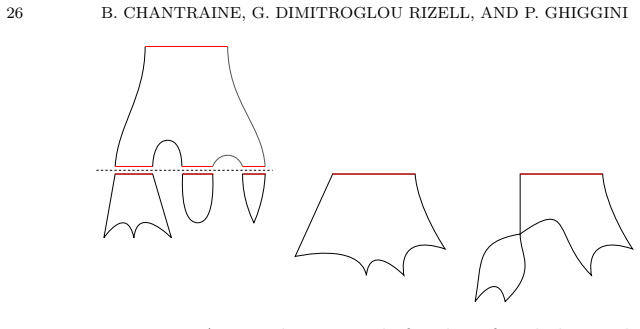
Mechanism: deform L to an immersed exact Lagrangian C∪Σ, with C a standard cap of parallel perturbed critical cores and Σ an immersed filling of its Legendrian boundary. The cap algebra D_C has generators the self-intersections of the parallel cores and the Reeb chords of the boundary link; gradient flow trees compute its differential. The filling yields an augmentation of D_C. Three algebraic operations — minimal morsification, expansion, and omission of idempotents — convert that augmentation into a finite-dimensional dg-module V_L over the Chekanov–Eliashberg algebra A_S. A neck-stretching relative exact triangle compares Floer complexes of two caps, and the short-resolution bimodule of A
What would settle it
Take any closed exact Lagrangian sphere L in a Weinstein domain and compute the self-Floer group HF(L,L) ≅ H*(L). The paper predicts H*Rhom_AS(VL,VL) ≅ H*(L); computing V_L from the recipe and checking that the derived endomorphism homology has the Poincaré polynomial of L would confirm or refute the theorem.
Extended reading notes
Core claim
Central claim: to each closed exact Lagrangian L meeting all critical cocores transversely, associate a finite-dimensional dg-module V_L over the Chekanov–Eliashberg algebra A_S of the attaching link S. Its σ-part has dimension |L∩D_σ| and Euler characteristic L•D_σ; for two Lagrangians, HF*(L0,L1) ≅ H*Rhom_{A_S}(V_L0,V_L1). The module is produced by deforming L to an immersed Lagrangian of parallel perturbed cores plus an immersed filling, whose augmentation of the cap algebra is converted by algebraic operations on idempotent dg-algebras into a module over A_S. The isomorphism follows by neck-stretching and a relative exact triangle identifying the resulting complex with the short resoluti
Load-bearing premise
The proof leans on a promised Floer theory for immersed exact Lagrangian cobordisms that is only sketched here and deferred to a later paper; if any of its stated properties fail, the main isomorphism lacks a proof.
Editorial extensions
If this is right
- Lagrangian Floer cohomology in a Weinstein domain becomes an algebraic computation from the attaching-link data and the cocore intersection pattern.
- Finite-dimensionality plus the dimension and Euler-characteristic formulas constrain the Floer groups and Euler characteristics of closed exact Lagrangians.
- Under the homological-smallness hypothesis on A_S, each closed connected Maslov-zero exact Lagrangian has primitive homology class and intersects every cocore in at most one point, up to sign.
- With the announced sequel, the compact Fukaya category embeds cohomologically fully faithfully into the derived category of finite-dimensional A_S-modules.
Reading between the lines
- The recipe suggests concrete computations: in a domain where A_S is known, HF(L0,L1) can be computed from the intersection numbers |L_i∩D_σ| alone, without building full holomorphic-curve moduli spaces in the ambient manifold.
- Not pursued here: the same scheme may extend to non-exact or monotone Lagrangians if a curved version of the CE algebra is used; the paper works only over exact settings.
- The relative exact triangle for concatenations could be iterated along a handle decomposition, giving a Mayer–Vietoris-style algorithm for Floer groups in multi-handle Weinstein domains.
Signed reviews
Editorial analysis
A structured set of objections, weighed in public.
Referee Report
Summary. The paper proves, at the cohomological level, a duality between closed exact Lagrangians in a Weinstein domain and finite-dimensional modules over the Chekanov–Eliashberg algebra of the attaching Legendrian link. To each closed exact Lagrangian L satisfying a transversality condition with all cocores it associates a dg module V_L over A_S, and for two such Lagrangians it claims an isomorphism HF^*(L_0,L_1) ≅ H^* Rhom_{A_S}(V_{L_0},V_{L_1}). The proof combines an algebraic short resolution of the diagonal bimodule over semi-projective dgas, a geometric deformation of L into an immersed Lagrangian L = Σ ∪ C consisting of a filling in the subcritical part and a cap made of multiple copies of the cores, and a neck-stretching comparison of the resulting Floer/Cthulhu complexes. A corollary gives strong restrictions on intersection numbers when A_S is Z-graded with H^{≤0}(A_S)=k_S.
Significance. If correct, the result is significant: it gives finite-dimensional representations of Chekanov–Eliashberg algebras from closed exact Lagrangians and recovers Lagrangian Floer cohomology as derived Hom between these representations, generalizing Ekholm–Lekili beyond the single-intersection case. The algebraic machinery—idempotent dgas, the short resolution, expansion/omission of idempotents—is developed carefully and is of independent interest. The paper also contains substantial geometric material in Appendices B and C on flow trees and SFT-type compactness for varying Legendrian boundary conditions, and it explicitly records an alternative route through generation and Legendrian surgery. The main weakness is that the proof of the central theorem depends on a Floer theory for immersed exact Lagrangian cobordisms whose details are postponed to a future paper, and several key chain-level statements are asserted rather than proved.
major comments (4)
- [Section 6, Eq. (11)–(13)] The central technical tool of the paper is the Cthulhu complex for immersed exact Lagrangian cobordisms. The section begins: “Our presentation will be rather sketchy, leaving the details to a future work.” This is not a peripheral issue: Lemma 11.5 identifies HF(L_0,L_1) with H Cth*(C_0,C_1) using Theorem 7.3, and Theorem 7.3 is proved from the Section 6 complex. In particular, the proof of d^2=0 for the differential with tentacles asymptotic to pure Reeb chords and self-intersections is not supplied; Lemma 5.7 gives only a one-paragraph negative-energy argument. The compactness, gluing, and cancellation of broken configurations with multiple positive punctures must be established for immersed boundary conditions with double points. The paper’s own statement admits that these details are deferred, so the proof of Theorem 1.2 is incomplete as it stands.
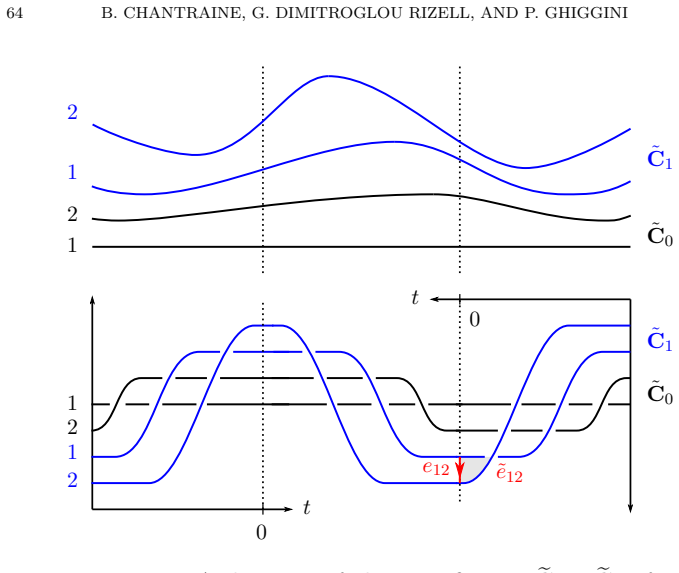
- [Section 7, Lemma 7.8 and Eq. (14)] The stretched-neck comparison is load-bearing for Theorem 7.3, but the differential matrix in Eq. (14) is asserted rather than derived. The proof describes which degenerations are expected, but it does not prove that all other configurations cancel, nor that the two-level buildings with a mixed positive puncture and tentacles are the only contributions. In particular, the entries d^+_+- ∘ d^-_+0 and d^+_+- ∘ d^-_+- require a gluing theorem for buildings with immersed boundary conditions and double points; no such theorem is stated or proved. Remark 7.4 also notes that the positivity action condition needs an invariance result that “we have proved so far” does not cover. Consequently Theorem 7.3, and hence Lemma 11.5, are not established.
- [Section 9 and Appendix C] The computation of the cap algebra and of the Cthulhu complex relies on rigid counts of holomorphic discs: Lemmas 9.5–9.8 and Propositions C.7, C.10, C.11. These counts are justified by Theorem B.1 and Theorem C.3, but both theorems are proved only in sketched form. For example, Theorem B.1 assumes a “no nodal disc” condition that is not verified in the applications, and Theorem C.3 proves only “partial SFT convergence” and explicitly ignores gradient-flow limit components. The paper states these are technical matters, but they are needed to identify D_C with A^+_/C and to compute Cth(C_0,C_1). Without a complete proof of these count identities, the definition of V_L and the isomorphism of Lemma 11.6 are not fully justified.
- [Section 11, Lemma 11.5] The passage from the original closed Lagrangians L_0,L_1 to the immersed decompositions L_i = Σ_i ∪ C_i uses regular exact homotopies whose Legendrian lifts are isotopic. The proof says Cthulhu homology for closed Lagrangians is Floer homology and is invariant under such homotopies by [7, Section 4.4]. However, the objects here are immersed and the homotopy is not shown to preserve the Cthulhu complex or the augmentations ε_{Σ_i}. Moreover, the identification H Cth*(Σ_0,Σ_1) ≅ HW^*((Σ_0,ε_0),(Σ_1,ε_1)) is imported from [24, Appendix B.1.1] in a setting with immersed fillings and augmentations, but no verification is provided that the hypotheses of that result hold. This is another load-bearing step in the proof of Theorem 1.2.
minor comments (5)
- [Abstract and Introduction] “for two any such Lagrangian submanifolds” should read “for any two such Lagrangian submanifolds”; “out techniques” is a typo for “our techniques”.
- [Section 2–3] “surgective” should be “surjective” (Lemma 2.5); “unnatrural” should be “unnatural”. In the proof of Lemma 3.1, the text says “it remains to prove that µ is injective”, but µ is the multiplication map and is not injective; the intended statement is that ι is injective and ker(µ) ⊂ Im(ι).
- [Section 5–6] In Definition 5.3, “∂− + M c” appears to be a typo. Section 6 has “rater sketchy” for “rather sketchy”. In Section 5, the proof of Lemma 5.13 says “details are left for the reader”; this is fine as a remark, but the diagram in Figure 1 is not enough to verify the claim that the map is a chain map.
- [Section 8, Figure 3] The manuscript contains the text “profile.{ps,eps,pdf} not found (or no BBox)” instead of an actual figure. This must be fixed before publication.
- [Throughout] There are several typos in technical terms: “Checkanov” for “Chekanov” (Section 9), “criitical” for “critical” (Appendix A), “cobnordisms” for “cobordisms”. These do not affect the mathematics but should be corrected.
Circularity Check
No significant circularity: the central isomorphism is established by new geometric constructions and by cited prior results that are independent of Theorem 1.2; self-citations are not load-bearing in a circular sense.
full rationale
Walking the derivation chain: VL is defined from an augmentation εΣ of the cap algebra (Section 11), and its dimension statement follows from the geometric construction of Theorem 8.1, which fixes the number kσ of parallel core copies equal to |L∩Dσ|; this is a constructional guarantee, not a fitted input disguised as a prediction. The main content, HF*(L0,L1) ≅ H*Rhom_A(VL0,VL1), proceeds through Lemma 11.5 and Theorem 7.3, whose proof is carried out in Sections 6–7 using the Cthulhu differential and the stretched-neck differential matrix (14). The comparison of the Cthulhu complex with the algebraic short resolution is made by explicit chain-level maps in Lemmas 10.1–10.3, 3.4 and 9.11, not by assuming the desired isomorphism. The paper's reliance on [6], [7] and [24] is to published prior theorems with stated assumptions; these are independent of the present theorem and are not used as a way to assert Theorem 1.2 by definition. The paper even notes an alternative derivation of Theorem 1.1 via [7], [28] and [4], but the proof of Theorem 1.2 given here is self-contained on the algebraic side and does not reduce to that alternative. One genuine concern, explicitly acknowledged in Section 6, is that the immersed-cobordism Floer theory is only sketched ('Our presentation will be rather sketchy, leaving the details to a future work'); Lemmas 7.8, 7.7 and 11.5 depend on it. However, a deferred proof is a completeness or correctness risk, not circularity: it is not an instance of assuming the conclusion or of renaming an input as an output. No fitted parameters, no definitional equality between 'prediction' and input, and no uniqueness theorem imported solely from the authors' prior work is used to force the main result. The appropriate finding is therefore no significant circularity.
Assumptions & free parameters
assumptions (4)
- ad hoc to paper A Floer theory for immersed exact Lagrangian cobordisms exists with d^2=0, action filtration, continuation maps, and the Cthulhu complex as defined in Section 6; full details are postponed to future work.
- domain assumption Anchored holomorphic discs with abstract perturbations are used to handle closed Reeb orbits in the Chekanov-Eliashberg and Cthulhu constructions.
- domain assumption The ground field F has characteristic two, and gradings or orientations are suppressed; extending to other characteristics requires spin structures.
- domain assumption The generic geometric choices in the construction (Morse functions, small perturbations, almost complex structures) can be arranged so that Lemmas 9.5, 9.6, 9.7 and 9.8 hold.
Cite this review
Pith. "Pith review of Representations of the Chekanov-Eliashberg algebra from closed exact Lagrangians I." pith.science (2026). https://pith.science/paper/IVNYAMGL
@misc{pith2026250820964,
  author       = {Pith},
  title        = {Pith review of: Representations of the Chekanov-Eliashberg algebra from closed exact Lagrangians I},
  year         = {2026},
  howpublished = {\url{https://pith.science/paper/IVNYAMGL}},
  note         = {Machine review of arXiv:2508.20964}
}
abstract
This is the first of a series of two articles aiming at relating the compact Fukaya category of a Weinstein manifold to the derived category of finite dimensional representations of the Chekanov-Eliashberg differential graded algebra of the attaching spheres of the critical handles. In this first article we associate a finite dimensional representation $V_L$ to any compact exact Lagrangian submanifold $L$ and prove that for two any such Lagrangian submanifolds $L_0$ and $L_1$ the isomorphism $$HF(L_0, L_1) \cong H^*R\hom_{\mathcal A}(V_{L_0}, V_{L_1})$$ holds. This generalises a previous result of Ekholm and Lekili, but out techniques are different since we use an extension of the Floer theory for Lagrangian cobordisms with negative ends that we developed in collaboration with Roman Golovko.
Figures


Figures from the paper (2 more)

Reference graph
Works this paper leans on
-
[1]
C. Abbas. Pseudoholomorphic strips in symplectisations. I. Asymptotic behavior. Ann. Inst. H. Poincar´ e Anal. Non Lin´ eaire, 21(2):139–185, 2004
work page 2004
-
[2]
S. Akbulut and M. F. Arikan. On Legendrian embeddings into open book decompo- sitions. Arkiv f¨ or Matematik, 57(2):227 – 245, 2019
work page 2019
-
[3]
J. Asplund and T. Ekholm. Chekanov-eliashberg dg-algebras for singular legendrians. The Journal of Symplectic Geometry , 20(3):509–559, 2022
work page 2022
-
[4]
F. Bourgeois, T. Ekholm, and Y. Eliashberg. Effect of Legendrian surgery. Geom. Topol., 16(1):301–389, 2012
work page 2012
-
[5]
F. Bourgeois, Y. Eliashberg, H. Hofer, K. Wysocki, and E. Zehnder. Compactness results in symplectic field theory. Geom. Topol., 7:799–888 (electronic), 2003
work page 2003
-
[6]
B. Chantraine, G. Dimitroglou Rizell, P. Ghiggini, and R. Golovko. Floer theory for Lagrangian cobordisms. J. Differential Geom. , 114(3):393–465, 2020
work page 2020
-
[7]
Geometric generation of the wrapped Fukaya category of Weinstein mani- folds and sectors
Baptiste Chantraine, Georgios Dimitroglou Rizell, Paolo Ghiggini, and Roman Golovko. Geometric generation of the wrapped Fukaya category of Weinstein mani- folds and sectors. Ann. Sci. ´Ec. Norm. Sup´ er. (4), 57(1):1–85, 2024
work page 2024
-
[8]
Yu. V. Chekanov. Differential algebra of Legendrian links. Invent. Math., 150(3):441– 483, 2002
work page 2002
Show all 41 references
-
[9]
Cieliebak, T
K. Cieliebak, T. Ekholm, and J. Latschev. Compactness for holomorphic curves with switching Lagrangian boundary conditions. J. Symplectic Geom., 8(3):267–298, 2010
2010
-
[10]
Cieliebak and Y
K. Cieliebak and Y. Eliashberg. From Stein to Weinstein and back. Symplectic geom- etry of affine complex manifolds. Colloquium Publications. American Mathematical Society 59. Providence, RI: American Mathematical Society (AMS). 354 p. $ 78.00 , 2012
2012
-
[11]
Cieliebak and A
K. Cieliebak and A. Oancea. Symplectic homology and the Eilenberg–Steenrod ax- ioms. Algebr. Geom. Topol., 18(4):1953–2130, 2018
1953
-
[12]
Dimitroglou Rizell
G. Dimitroglou Rizell. Legendrian ambient surgery and Legendrian contact homology. J. Symplectic Geom. , 14(3):811–901, 2016
2016
-
[13]
Dimitroglou Rizell
G. Dimitroglou Rizell. Lifting pseudo-holomorphic polygons to the symplectisation of P × R and applications. Quantum Topol., 7(1):29–105, 2016
2016
-
[14]
Drinfeld
V. Drinfeld. DG quotients of DG categories. J. Algebra, 272(2):643–691, 2004
2004
-
[15]
T. Ekholm. Morse flow trees and Legendrian contact homology in 1-jet spaces. Geom. Topol., 11:1083–1224, 2007
2007
-
[16]
T. Ekholm. Rational SFT, linearized Legendrian contact homology, and Lagrangian Floer cohomology. In Perspectives in Analysis, Geometry, and Topology. On the Oc- casion of the 60th Birthday of Oleg Viro , volume 296, pages 109–145. Springer, 2012
2012
-
[17]
Ekholm, J
T. Ekholm, J. Etnyre, and M. Sullivan. The contact homology of Legendrian sub- manifolds in R2n+1. J. Differential Geom. , 71(2):177–305, 2005
2005
-
[18]
Ekholm, J
T. Ekholm, J. Etnyre, and M. Sullivan. Orientations in Legendrian contact homology and exact Lagrangian immersions. Internat. J. Math. , 16(5):453–532, 2005
2005
-
[19]
Ekholm, J
T. Ekholm, J. Etnyre, and M. Sullivan. Legendrian contact homology in P ×R. Trans. Amer. Math. Soc. , 359(7):3301–3335 (electronic), 2007. 82 B. CHANTRAINE, G. DIMITROGLOU RIZELL, AND P. GHIGGINI
2007
-
[20]
Ekholm and J
T. Ekholm and J. B. Etnyre. Invariants of knots, embeddings and immersions via contact geometry. In Geometry and topology of manifolds , volume 47 of Fields Inst. Commun., pages 77–96. Amer. Math. Soc., Providence, RI, 2005
2005
-
[21]
Ekholm, J
T. Ekholm, J. B. Etnyre, and J. M. Sabloff. A duality exact sequence for Legendrian contact homology. Duke Math. J. , 150(1):1–75, 2009
2009
-
[22]
Ekholm, John Etnyre, and Michael Sullivan
T. Ekholm, John Etnyre, and Michael Sullivan. Non-isotopic Legendrian submanifolds in R2n+1. J. Differential Geom. , 71(1):85–128, 2005
2005
-
[23]
Ekholm, K
T. Ekholm, K. Honda, and T. K´ alm´ an. Legendrian knots and exact Lagrangian cobor- disms. J. Eur. Math. Soc. (JEMS) , 18(11):2627–2689, 2016
2016
-
[24]
Ekholm and Y
T. Ekholm and Y. Lekili. Duality between Lagrangian and Legendrian invariants. Geom. Topol., 27(6):2049–2179, 2023
-
[25]
Holomorphic curves for Legendrian surgery
Tobias Ekholm. Holomorphic curves for Legendrian surgery. arXiv e-prints , page arXiv:1906.07228, June 2019
1906 arXiv
-
[26]
Eliashberg, S
Y. Eliashberg, S. Ganatra, and O. Lazarev. Flexible Lagrangians. Int. Math. Res. Not. IMRN , (8):2408–2435, 2020
2020
-
[27]
Ganatra, J
S. Ganatra, J. Pardon, and V. Shende. Covariantly functorial Floer theory on Liou- ville sectors. ArXiv e-prints, 1706.03152 , June 2017
2017 arXiv
-
[28]
Ganatra, J’ Pardon, and V
S. Ganatra, J’ Pardon, and V. Shende. Sectorial descent for wrapped Fukaya cate- gories. J. Am. Math. Soc. , 37(2):499–635, 2024
2024
-
[29]
Hofer, K
H. Hofer, K. Wysocki, and E. Zehnder. Properties of pseudoholomorphic curves in symplectisations. I. Asymptotics. Ann. Inst. H. Poincar´ e Anal. Non Lin´ eaire, 13(3):337–379, 1996
1996
-
[30]
Karlsson
C. Karlsson. Legendrian contact homology for attaching links in higher dimensional subcritical Weinstein manifolds. arXiv e-prints , page arXiv:2007.07108, 2021
2007 arXiv
-
[31]
B. Keller. Deformed Calabi-Yau completions. J. Reine Angew. Math. , 654:125–180,
-
[32]
N. Legout. Calabi-Yau structure on the Chekanov-Eliashberg algebra of a Legendrian sphere. arXiv e-prints , page arXiv:2304.03014, 2023
2023
-
[33]
A-infinity category of lagrangian cobordisms in the symplectization of pxr, 2020
No´ emie Legout. A-infinity category of lagrangian cobordisms in the symplectization of pxr, 2020
2020
-
[34]
McDuff and D
D. McDuff and D. Salamon. J-holomorphic curves and symplectic topology, volume 52 of American Mathematical Society Colloquium Publications . American Mathematical Society, Providence, RI, second edition, 2012
2012
-
[35]
Ng and D
L. Ng and D. Rutherford. Satellites of Legendrian knots and representations of the Chekanov-Eliashberg algebra. Algebr. Geom. Topol., 13(5):3047–3097, 2013
2013
-
[36]
Pan and D
Y. Pan and D. Rutherford. Augmentations and immersed Lagrangian fillings. arXiv e-prints, page arXiv:2006.16436, June 2020
2006 arXiv
-
[37]
Pan and D
Y. Pan and D. Rutherford. Functorial LCH for immersed Lagrangian cobordisms. J. Symplectic Geom., 19(3):635–722, 2021
2021
-
[38]
P. Seidel. Fukaya categories and Picard-Lefschetz theory. Zurich Lectures in Advanced Mathematics. European Mathematical Society (EMS), Z¨ urich, 2008
2008
-
[39]
J.-C. Sikorav. Some properties of holomorphic curves in almost complex manifolds. In Holomorphic curves in symplectic geometry , volume 117 of Progr. Math., pages 165–189. Birkh¨ auser, Basel, 1994
1994
-
[40]
Lectures on symplectic field theory, 2016
Chris Wendl. Lectures on symplectic field theory, 2016. Nantes Universit´e, CNRS, Laboratoire de Math ´ematiques Jean Leray, LMJL, F-44000 Nantes, France. Email address : baptiste.chantraine@univ-nantes.fr REPRESENTATIONS FROM CLOSED EXACT LAGRANGIANS I 83 Uppsala University, ...
2016
-
[2011]
With an appendix by Michel Van den Bergh
Reviewed August 5, 2026 · model on record in the stance chip above.
Discussion (0). Continue with ORCID to comment.