REVIEW 3 major objections 6 minor 16 references
Towards AoI-aware Smart IoT Systems
T0 review · 3 major / 6 minor · reviewed 2026-08-14 · deepseek-v4-flash
Pith's one-line read This paper presents the first reported Age of Information measurements on real IoT testbeds and shows that transport protocol choice and device capability, not queueing theory alone, set the age-versus-rate curve.
desk verdict Useful sync-bias analysis and rare IoT AoI measurements, but the clock-drift assumption and missing data keep the empirical claims conditional. read the letter →
The pith
A machine-rendered reading of the paper's core claim, the machinery that carries it, and where it could break.
The reading
What carries the argument
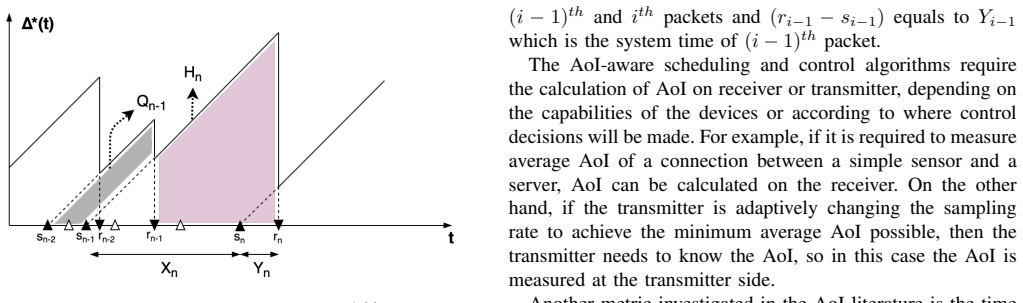
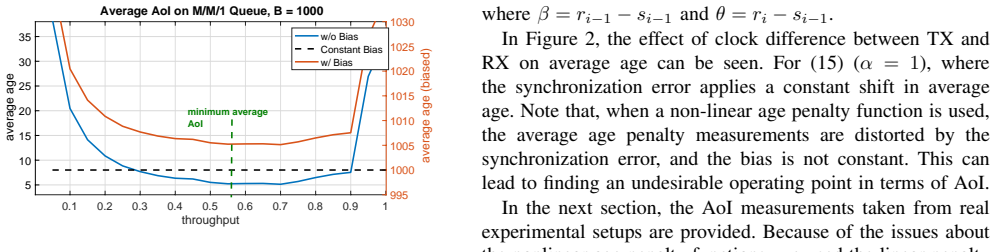
The load-bearing machinery is the sawtooth age process $\Delta(t)=t-U(t)$, together with its area-normalized time average; the constant clock-bias model $t_{RX}=t_{TX}+B$; and the mapping of measured age-throughput curves onto FCFS queue predictions. This machinery turns synchronization error into an explicit age-bias expression, and the paper derives from it that linear penalties receive a constant shift $\alpha B$ while exponential and logarithmic penalties receive a rate-dependent distortion, which is why the measurements restrict attention to linear age with an offset bounded by round-trip time.
What would settle it
A concrete test: on the IoT testbed, deliberately introduce a time-varying clock skew instead of a constant offset and re-measure average age; if the measured age changes by more than the RTT-bounded constant offset predicted by the paper's bias formula, the synchronization model fails. Separately, replay the UDP Internet experiment on a path whose bottleneck is a large buffer rather than loss, and check whether average age keeps decreasing with rate; if it flattens anyway, the 'Panicked' flat-age mechanism is not specific to loss-dominated paths.
Extended reading notes
Core claim
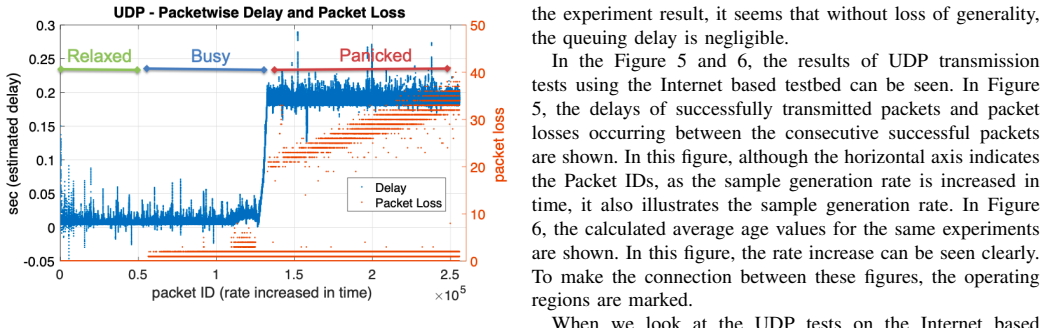
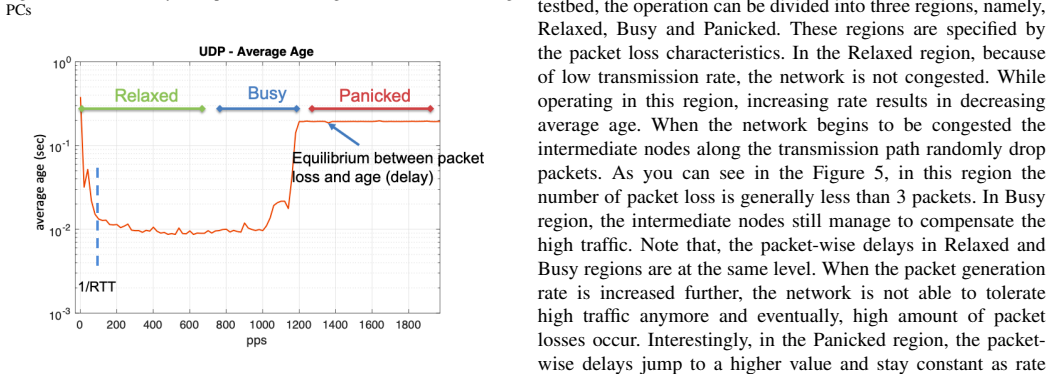
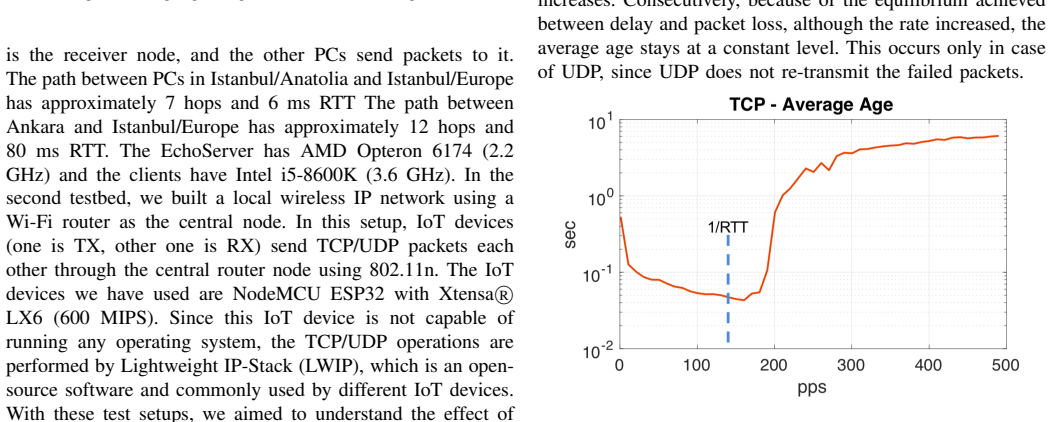
The paper claims that average Age of Information on real networks is not determined by queueing alone: the transport protocol and the transmit/receive hardware reshape the age-versus-rate curve. In Internet-scale TCP flows, retransmissions make the average age follow a U-shape reminiscent of FCFS queues, because packet delays and queueing grow with load. In UDP flows there are no retransmissions, so at high load the curve enters a 'Panicked' region where heavy packet losses offset the higher update rate and average age stays flat. On constrained IoT nodes, CPU and buffer limits dominate, so the U-shape may not appear at all and the practical choice between TCP and UDP can be reversed. The paper also derives that when the age penalty is nonlinear, a constant clock offset between sender and receiver does not merely shift the measured average by a constant; it distorts it nonlinearly and can point to the wrong operating point, so the paper restricts its measurements to linear age with a synchronization error bounded by round-trip time.
Load-bearing premise
The whole measurement interpretation rests on the assumption, stated in the synchronization section, that the transmitter and receiver clocks differ by a fixed amount for the whole experiment; the paper itself warns its RTT-based synchronization is 'not the best way,' so if the offset drifts or the round-trip time varies, the reported ages stop being correct up to one constant shift.
Editorial extensions
If this is right
- Average AoI versus offered load is not protocol-agnostic: TCP's retransmissions produce a U-shaped curve, while UDP's losses can keep average age flat at high load, so AoI-optimal rate control must account for the transport layer.
- On low-power IoT nodes, the bottleneck shifts from the network queue to the device CPU and buffers, so the U-shape disappears and throughput alone is not a reliable proxy for freshness.
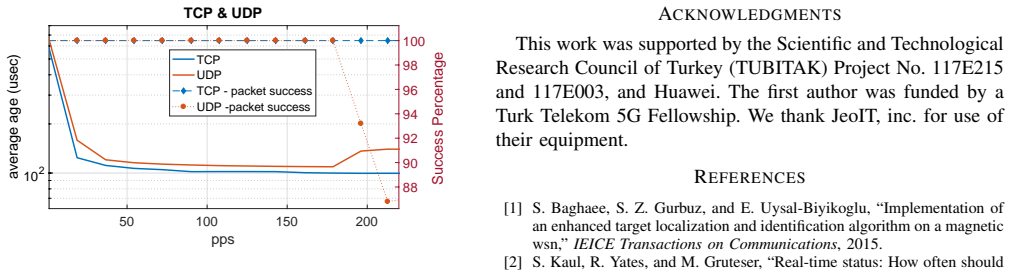
- Selecting UDP over TCP on constrained IoT devices is risky given the measured multi-hundred-millisecond jitter from the lightweight IP stack, so TCP can give fresher updates until UDP buffer handling improves.
- For non-linear age penalties, clock synchronization is not cosmetic: a constant offset changes the measured average penalty nonlinearly, so unsynchronized deployments may pick the wrong sampling rate.
- With linear age and an RTT-bounded synchronization offset, the measured values are absolute up to a constant, so comparisons of age variation across rates remain valid.
Reading between the lines
- One testable consequence not drawn in the paper: an adaptive transport that switches between TCP and UDP based on measured loss and delay could keep average age below either protocol alone, because the two protocols fail in complementary regimes.
- The constant-bias analysis suggests a practical diagnostic for AoI measurement campaigns: re-run the same load with a deliberately injected clock offset and check whether the average age shifts by the predicted amount; agreement validates the synchronization model, and disagreement reveals clock drift.
- The device-bottleneck result generalizes to other constrained radios, so on a very low-bandwidth link the U-shape should reappear because the channel, not the CPU, becomes the bottleneck, which is directly testable.
- If the reported UDP jitter is indeed a buffer-management bug in the lightweight IP stack, fixing it could make UDP the better choice for IoT age, so the paper's TCP recommendation is contingent on stack quality rather than on protocol fundamentals.
Signed reviews
Editorial analysis
A structured set of objections, weighed in public.
Referee Report
Summary. The paper studies Age of Information (AoI) on real-life networks using two testbeds: an Internet-based testbed with regular PCs and a local Wi-Fi IoT testbed with ESP32 devices. It derives the effect of a constant clock offset between transmitter and receiver on average age for linear, exponential, and logarithmic penalty functions, showing that the bias is a constant shift only for linear age and becomes non-constant for nonlinear penalties. Empirically, it reports that TCP retransmissions yield a U-shaped average-age-versus-rate curve over the Internet, while UDP losses dominate and can keep average age flat in a 'Panicked' region; on the IoT testbed, device CPU/memory limitations prevent a clear U-shape. The paper claims to be the first reported investigation of AoI on real IoT testbeds and argues for age-aware transport protocol design.
Significance. If the measurements are trustworthy, the paper would provide one of the first empirical mappings of transport-protocol behavior to AoI curves on real Internet and IoT paths, and a useful warning that synchronization errors distort nonlinear age penalties nonlinearly. The synchronization-bias derivation (Section III) is a parameter-free consequence of the AoI definition and is a solid contribution: it correctly shows that a constant clock bias shifts linear average age by alpha B and produces non-constant bias for exponential and logarithmic penalties. The paper also makes concrete, falsifiable predictions about when U-shaped age curves appear. However, the empirical core currently rests on methodology that is not sufficiently reported, and the central synchronization assumption is unverified over the measurement duration.
major comments (3)
- [Section IV-E, after Eq. (15)] The claim that 'the values plotted represent absolute AoI up to a constant offset, the variation of the values within themselves being correct' relies on the constant clock bias B in Eq. (10) remaining constant over the entire experiment. The paper estimates B from RTT measurements taken only before the experiments and provides no clock-drift monitoring or repeated RTT characterization. On the Ankara-Istanbul path with approximately 80 ms RTT, even a small drift would introduce a time-varying offset that shifts the average age between different measurement points, so the U-shaped TCP curve and the flat UDP 'Panicked' region could partly reflect synchronization artifacts rather than pure AoI variation. The authors should either measure and correct for clock drift (e.g., using GPS/PTP synchronization) or report drift bounds that are small compared to the age differences visible in Figs. 6 and 7.
- [Sections IV-D, IV-E, IV-F] The experimental sections do not report confidence intervals, number of repetitions, raw data, packet sizes, or the exact rate-increase schedule. All central conclusions—the U-shaped TCP curve, the flat UDP Panicked region, the 300 ms jitter claim, and the protocol comparison—are drawn from single-trace plots without error bars, so the statistical significance of the observed shapes is not established. At minimum, the authors should provide multiple trials with variability information (e.g., box plots or confidence bands) and make the measurement data available for independent verification.
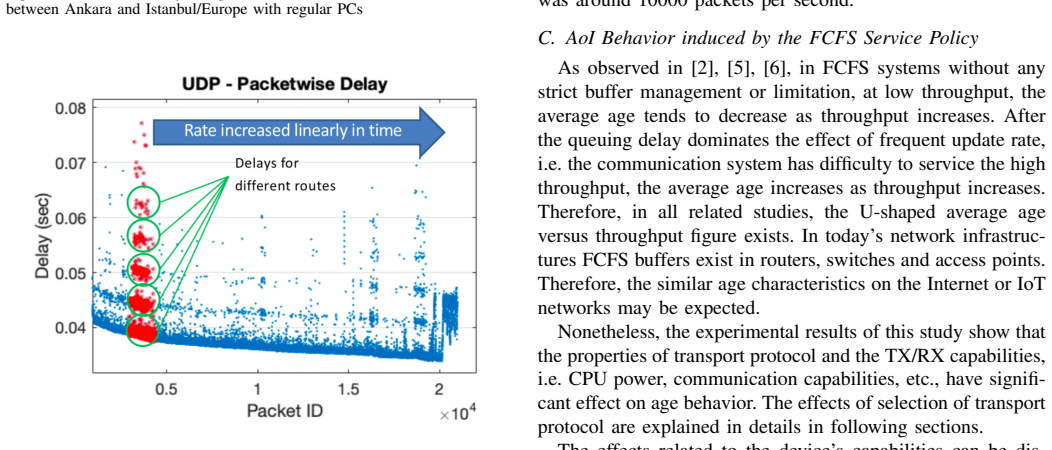
- [Section IV-E] The statement that 'without loss of generality, the queuing delay is negligible' for the UDP Internet experiments is an unverified, load-bearing assumption for the claim that packet loss is the dominant age-inflating factor. The same section later reports that packet-wise delays jump to a higher value in the Panicked region, suggesting that delays are not irrelevant. To support the loss-dominated interpretation, the authors should measure or bound queuing delay (e.g., through active probing or knowledge of intermediate router buffers) rather than asserting negligibility from the experimental results themselves.
minor comments (6)
- [Figure 8] The y-axis label 'average age (usec)' appears to conflict with the plotted values, which range around 88-100 and resemble the 'Success Percentage' values; the figure should use a dual-axis layout with clearly labeled axes or correct the unit/scale.
- [Section IV-D] Please specify the packet size, the exact range and step of the packet generation rate, and whether the rate was measured at the application layer or the socket layer; this is necessary for reproducibility and for interpreting the 'throughput' axis in Figs. 6 and 7.
- [Abstract and Section IV] The abstract states that 'excessive number of AoI measurements are provided,' but no raw measurement data or dataset link is included in the manuscript; either provide the data or rephrase this statement.
- [Section III, Eqs. (16)-(17)] The symbols beta and theta are defined after the equations; define them just before Eq. (16) to improve readability, and consider presenting the exponential/logarithmic bias expressions in a more structured form to reduce the risk of transcription errors.
- [Reference [14]] The author list of reference [14] contains an empty field ('H. B. Beytur, , S. Baghaee'); please correct the citation.
- [Introduction and Section IV-F] The claim of being the 'first reported investigation of AoI on real IoT testbeds' should be qualified relative to reference [7], which already performed AoI measurements over WiFi/LTE links; specify that the novelty concerns low-power IoT devices (e.g., ESP32) and the TCP/UDP comparison, and define the reported '300 ms jitter' metric explicitly.
Circularity Check
No significant circularity: the synchronization-bias derivation is a direct consequence of the stated constant-offset model, and the empirical AoI curves are direct measurements, not fitted predictions.
full rationale
Walking the derivation chain: Section II defines AoI in the standard way and rewrites the time-average age and peak age as integrals/trapezoid sums; equations (1)-(9) are definitional identities rather than results derived from the conclusions. Section III introduces an explicit constant-offset model, t_RX = t_TX + B (Eq. 10), and then computes the synchronization-induced age bias by substituting r'_i = r_i + B into Definition II.1. Eq. (15), the linear-penalty bias Delta_Bias = alpha*B, is a direct algebraic consequence of that substitution, not an input that was fitted or assumed elsewhere. The later claim that the plotted age values represent absolute AoI up to a constant offset is explicitly presented as a consequence of Eq. (15) under the constant-B assumption, and the manuscript itself states the limiting assumption ('If we neglect the time shift in the TX and RX clocks during the observation period'). The empirical UDP and TCP results in Section IV are direct measurements from the testbeds; the U-shaped TCP curve is compared with existing FCFS queueing results [2], [5], [6], [8], and the flat UDP 'Panicked' region is read off the measured delay/loss data. No parameter is fitted to a subset of the AoI data and then renamed as a prediction. The citations to the authors' own prior work, [7] and [14], are contextual ('The ideas and results provided in [7], [14] are explored in more depth in this work') and are not load-bearing for any derivation or uniqueness conclusion. The main vulnerability of the paper is the empirical assumption of a constant clock offset and RTT-bounded synchronization error, which is a measurement-validity concern rather than a circularity concern. Therefore the paper is not circular.
Assumptions & free parameters
assumptions (5)
- domain assumption Age of Information is defined as Delta(t) = t - U(t), with U(t) the generation time of the newest received update.
- domain assumption The transmitter and receiver clocks differ by a constant bias B during the observation: t_RX = t_TX + B and r_i' = r_i + B.
- domain assumption Synchronization error is estimated from RTT, with the ACK transmission time assumed equal to the estimated RTT, so the age bias is upper bounded by RTT.
- domain assumption In today's network infrastructures, FCFS buffers exist in routers, switches, and access points, so FCFS queueing age results can be used to interpret Internet and Wi-Fi measurements.
- ad hoc to paper For the UDP Internet experiments, queuing delay is negligible and packet loss is the dominant age-inflating factor.
Cite this review
Pith. "Pith review of Towards AoI-aware Smart IoT Systems." pith.science (2026). https://pith.science/paper/IVRTLUWK
@misc{pith2026190810739,
  author       = {Pith},
  title        = {Pith review of: Towards AoI-aware Smart IoT Systems},
  year         = {2026},
  howpublished = {\url{https://pith.science/paper/IVRTLUWK}},
  note         = {Machine review of arXiv:1908.10739}
}
read the original abstract
Age of Information (AoI) has gained importance as a Key Performance Indicator (KPI) for characterizing the freshness of information in information-update systems and time-critical applications. Recent theoretical research on the topic has generated significant understanding of how various algorithms perform in terms of this metric on various system models and networking scenarios. In this paper, by the help of the theoretical results, we analyzed the AoI behavior on real-life networks, using our two test-beds, addressing IoT networks and regular computers. Excessive number of AoI measurements are provided for variations of transport protocols such as TCP, UDP and web-socket, on wired and wireless links. Practical issues such as synchronization and selection of hardware along with transport protocol, and their effects on AoI are discussed. The results provide insight toward application and transport layer mechanisms for optimizing AoI in real-life networks.
Figures

Figures from the paper (5 more)
Reference graph
Works this paper leans on
-
[1]
Implementation of an enhanced target localization and identification algorithm on a magnetic wsn,
S. Baghaee, S. Z. Gurbuz, and E. Uysal-Biyikoglu, “Implementation of an enhanced target localization and identification algorithm on a magnetic wsn,” IEICE Transactions on Communications , 2015
work page 2015
-
[2]
Real-time status: How often should one update?
S. Kaul, R. Yates, and M. Gruteser, “Real-time status: How often should one update?” in 2012 Proceedings IEEE INFOCOM , March 2012
work page 2012
-
[3]
Delay and Peak-Age Violation Probability in Short-Packet Transmissions
R. Devassy, G. Durisi, G. C. Ferrante, O. Simeone, and E. Uysal- Biyikoglu, “Delay and peak-age violation probability in short-packet transmissions,” arXiv:1805.03271 [cs, math] , May 2018
work page Pith review arXiv 2018
-
[4]
Aoi-penalty minimization for networked control systems with packet loss,
M. Klugel, M. H. Mamduhi, S. Hirche, and W. Kellerer, “Aoi-penalty minimization for networked control systems with packet loss,” in The 2nd Age of Information Workshop (AoI’19) in conjunction with IEEE INFOCOM, 2019
work page 2019
-
[5]
Status updates through queues,
S. K. Kaul, R. D. Yates, and M. Gruteser, “Status updates through queues,” in 2012 46th Annual Conference on Information Sciences and Systems (CISS), Mar 2012, pp. 1–6
work page 2012
-
[6]
Y . Inoue, H. Masuyama, T. Takine, and T. Tanaka, “A general formula for the stationary distribution of the age of information and its application to single-server queues,” Apr 2018, arXiv: 1804.06139
arXiv 2018
-
[7]
C. Sönmez, S. Baghaee, A. Ergi¸ si, and E. Uysal-Biyikoglu, “Age-of- information in practice: Status age measured over tcp/ip connections through wifi, ethernet and lte,” in 2018 IEEE International Black Sea Conference on Communications and Networking , June 2018
work page 2018
-
[8]
Age of Information: The Gamma Awakening
E. Najm and R. Nasser, “Age of information: The gamma awakening,” arXiv:1604.01286 [cs, math] , Apr 2016. [Online]. Available: http: //arxiv.org/abs/1604.01286
work page Pith review arXiv 2016
Show all 16 references
-
[9]
Update or wait: How to keep your data fresh,
Y . Sun, E. Uysal-Biyikoglu, R. D. Yates, C. E. Koksal, and N. B. Shroff, “Update or wait: How to keep your data fresh,” IEEE Transactions on Information Theory, vol. 63, no. 11, pp. 7492–7508, Nov 2017
2017
-
[10]
Optimizing age of information on real-life tcp/ip connections through reinforcement learning,
E. Sert, C. Sönmez, S. Baghaee, and E. Uysal-Biyikoglu, “Optimizing age of information on real-life tcp/ip connections through reinforcement learning,” in 2018 26th Signal Processing and Communications Applica- tions Conference (SIU) , May 2018
2018
-
[11]
Learning to sample a signal through an unknown system for minimum aoi,
C. Kam, S. Kompella, and A. Ephremides, “Learning to sample a signal through an unknown system for minimum aoi,” in The 2nd Age of Information Workshop (AoI’19) in conjunction with IEEE INFOCOM , 2019
2019
-
[12]
Age minimization of multiple flows using reinforcement learning,
H. B. Beytur and E. Uysal, “Age minimization of multiple flows using reinforcement learning,” in2019 International Conference on Computing, Networking and Communications (ICNC) , Feb 2019, pp. 339–343
2019
-
[13]
Reinforcement learning to minimize age of information with an energy harvesting sensor with harq and sensing cost,
E. T. Ceran, D. Gündüz, and A. György, “Reinforcement learning to minimize age of information with an energy harvesting sensor with harq and sensing cost,” in The 2nd Age of Information Workshop (AoI’19) in conjunction with IEEE INFOCOM , 2019
2019
-
[14]
Measuring age of information on real-life connections,
H. B. Beytur, , S. Baghaee, and E. Uysal, “Measuring age of information on real-life connections,” in 2019 27th Signal Processing and Commu- nications Applications Conference (SIU) , April 2019
2019
-
[15]
Age and value of information: Non-linear age case,
A. Kosta, N. Pappas, A. Ephremides, and V . Angelakis, “Age and value of information: Non-linear age case,” in 2017 IEEE International Symposium on Information Theory (ISIT) , Jun 2017, pp. 326–330
2017
-
[16]
Tcp and udp performance over a wireless lan,
G. Xylomenos and G. C. Polyzos, “Tcp and udp performance over a wireless lan,” in IEEE INFOCOM ’99, vol. 2, Mar 1999, p. 439–446
1999
Reviewed August 14, 2026 · model on record in the stance chip above.
Discussion (0). Continue with ORCID to comment.