REVIEW 1 major objections 5 minor 84 references
The two-dimensional disordered Mott metal-insulator transition
T0 review · 1 major / 5 minor · reviewed 2026-08-14 · deepseek-v4-flash
Pith's one-line read In two dimensions, disorder converts the Mott metal-insulator transition into a proliferating landscape of metallic and insulating bubbles, smearing the transition in the thermodynamic limit.
desk verdict A solid, honest statDMFT study whose finite-size puddle results are credible, but the thermodynamic-limit smearing claim rides on an Imry-Ma analogy the paper does not actually test. read the letter →
The pith
A machine-rendered reading of the paper's core claim, the machinery that carries it, and where it could break.
The reading
What carries the argument
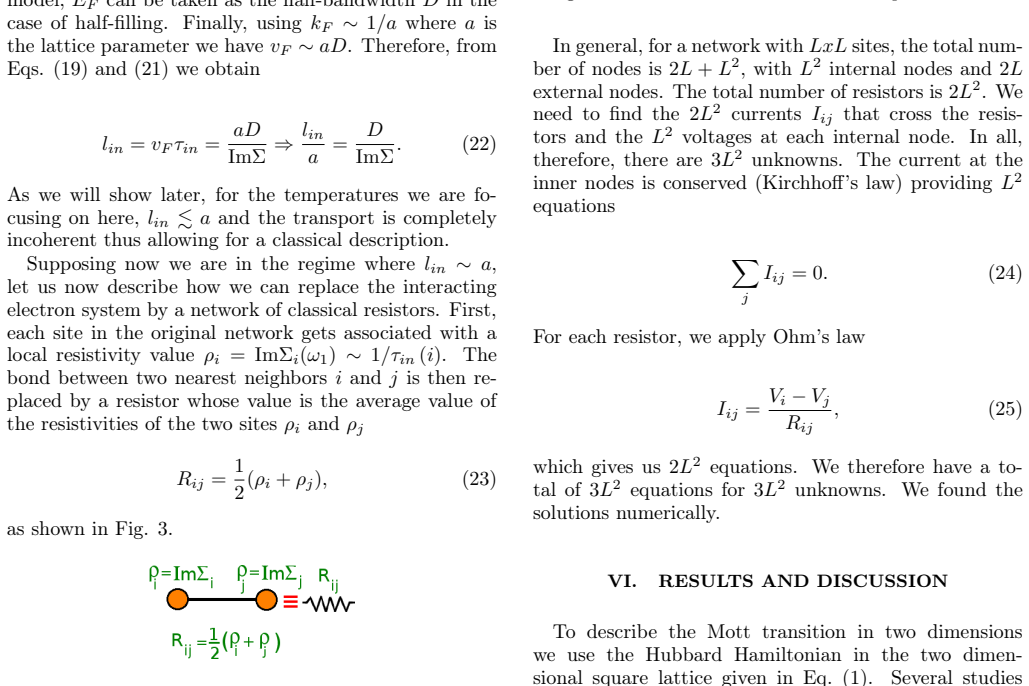
The central object is the Statistical Dynamical Mean-Field Theory (statDMFT), in which each lattice site carries its own local self-energy Sigma_i(i omega_n), so disorder is kept site-resolved while interactions are treated locally as in DMFT; the impurity problems are solved with a Quantum Monte Carlo algorithm. The order parameter used throughout is the imaginary part of the local self-energy at the first Matsubara frequency, ImSigma_i(i omega_1), which acts simultaneously as a metal/insulator classifier and, through the inelastic mean-free-path estimate l_in/a = D/ImSigma, as the local resistivity in a classical resistor network. The Imry-Ma energy balance of Eq. (14), comparing disorder fluctuations in a region with a critical local metallization scale, is what converts the random-field Ising analogy into a prediction that bubbles proliferate with system size.
What would settle it
A decisive check is to measure the width of the hysteresis and coexistence region as a function of lattice size at fixed temperature and disorder within the same statDMFT calculation. The paper's claim predicts that this width shrinks toward zero as L grows, with both bubble types proliferating; if instead the width saturates to a nonzero value for L larger than about 20, or if only one bubble type appears, the Imry-Ma smearing claim is not correct. The same criterion could be tested in controlled-disorder experiments by looking for the disappearance of a sharp resistance jump as sample size increases.
Extended reading notes
Core claim
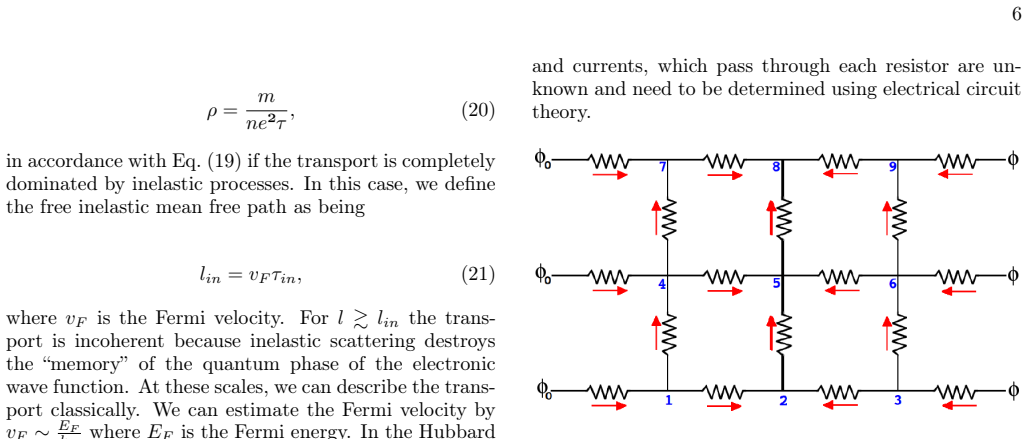
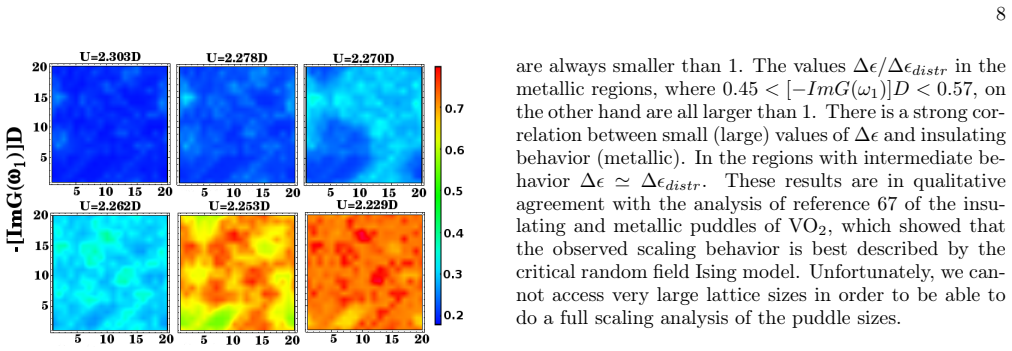
The paper's central claim is that site disorder in two dimensions destroys the first-order Mott transition in the thermodynamic limit. Within statDMFT, finite-size lattices still show hysteresis and coexistence, with per-site loops shifted to higher interactions, but increasing the system size at a fixed interaction produces more metallic bubbles inside the insulator and more insulating bubbles inside the metal, so no sharp jump survives as L grows. This is asserted to be the generalization of the Imry-Ma theorem to the disordered Hubbard model, relying on the mapping of the Mott transition to the random-field Ising universality class. A secondary claim is that the local imaginary self-energy ImSigma_i(i omega_1) is small in the metal and large in the insulator, and that when the inelastic mean free path is about one lattice constant, the same quantity can be used as a local resistivity to build a classical random resistor network; this yields current maps and average conductances across the transition.
Load-bearing premise
The load-bearing premise is that the finite-temperature Mott transition in the disordered Hubbard model obeys the same physics as the random-field Ising model, so the Imry-Ma energy balance of Eq. (14) applies; if disorder does not act as a random field on a scalar order parameter, the growing bubble proliferation could be a finite-size effect rather than true thermodynamic-limit smearing. The transport calculation additionally assumes that ImSigma_i(i omega_1) is a valid local resistivity.
Editorial extensions
If this is right
- In a macroscopic two-dimensional disordered sample, there is no true first-order Mott transition: the jump in the local order parameter is replaced by a smooth crossover controlled by the statistics of bubbles.
- Bulk transport near the transition is a percolation problem through the coexisting puddle landscape, not a single phase transition; current maps should show spatial texture correlated with local disorder fluctuations.
- Disorder shifts the coexistence region to larger interactions and shrinks the hysteresis width, so experimentally the transition appears at higher interaction strength and with reduced metastability.
- Because the inelastic mean free path is at most one lattice constant at the studied temperatures, classical resistor-network transport is the appropriate description, and the metallic conductance should track the local-resistivity distribution while the insulating conductance will not show the activated temperature dependence.
Reading between the lines
- If the random-field Ising analogy is right, the smearing should be a lower-critical-dimension effect: in three dimensions the same statDMFT calculation should show a first-order transition surviving weak disorder, with bubbles only near the transition. This is a testable extension the paper does not run.
- The resistor-network mapping implies a direct connection between spectroscopy and transport: local ImSigma maps from scanning tunneling experiments on a disordered Mott material could be fed into the same network to predict the spatial current distribution, a check that nano-imaging and transport measurements could carry out jointly.
- The persistence of the bubble landscape for a fixed disorder realization at different temperatures suggests that quenched disorder, not thermal nucleation, sets the pattern; if so, sample-specific predictions could be made for repeated imaging of the same device.
Signed reviews
Editorial analysis
A structured set of objections, weighed in public.
Referee Report
Summary. The paper studies the site-disordered two-dimensional Hubbard model at half filling using statistical dynamical mean-field theory (statDMFT) with a Hirsch-Fye quantum Monte Carlo impurity solver, for lattice sizes up to L=20, disorder width W=0.52D, and three temperatures near the clean Mott endpoint. The authors report clean and disordered hysteresis loops, spinodal lines, and a disordered-induced shift and shrinking of the coexistence region. They show spatial maps of the local Green's function and self-energy that display metallic and insulating puddles, and they correlate the puddle character with local disorder fluctuations. They interpret the finite-size increase in puddle proliferation as evidence for Imry-Ma smearing of the first-order transition in the thermodynamic limit. Finally, they map each lattice site to a classical resistor value set by ImΣ_i(iω1) and compute average currents through the resulting resistor network.
Significance. If the central claim holds, the paper would establish a disorder-induced smearing of the two-dimensional Mott transition and connect the resulting puddle landscape to the random-field Ising universality class, with direct relevance to nano-imaging experiments on VO2 and other inhomogeneous strongly correlated systems. The statDMFT implementation with site-resolved QMC impurity solutions, the systematic finite-size comparison up to L=20, and the first statDMFT-based transport calculation via a classical resistor network are useful technical contributions. However, the thermodynamic-limit conclusion currently rests on an extrapolation from small systems and an imported Imry-Ma/RFIM analogy rather than on a derived scaling analysis, so the significance is contingent on strengthening that step.
major comments (1)
- [Section V, Eqs. (17)-(22) and Section VI C] The transport calculation rests on two unverified identifications: ImΣ_i(iω1) is used as a proxy for ImΣ(k∼k_F, ω→0), and the Fermi velocity is estimated as v_F∼aD with k_F∼1/a. The first identification is particularly fragile because the first Matsubara frequency is not the zero-frequency limit, and the second estimate is order-of-magnitude at best. The paper acknowledges that the resulting description fails in the insulator because ImΣ(iω1) cannot produce the activated temperature dependence of the Mott gap, yet Fig. 14 is then used to draw conclusions about the conductance in the insulating regime. Since the transport section is a secondary application, this issue does not by itself invalidate the main puddle picture, but the claims should be restricted to the metallic and coexistence regions, with the insulator behavior presented as a known limitation rather than as a computed result.
minor comments (5)
- [Fig. 10 caption] The caption says 'As the temperature increases, the hysteresis loops become smaller,' but Fig. 10 shows hysteresis loops for different lattice sizes at fixed temperature; the caption should instead describe the dependence on system size.
- [Reference 66] Reference 66 is incomplete ('See and e, g, World Scientific p. 277 (1997)'); it needs a full citation with authors, title, and publisher information.
- [Reference 72] The reference to Fetter and Walecka is listed as 'Philos. Mag. 21, 863 (1970)'; this appears to be a misattribution, as the standard citation is the textbook 'Quantum Theory of Many-Particle Systems'.
- [Eq. (14)] The notation in Eq. (14) is unclear: ∆ϵ is written with an awkward square-root expression and the definition of N (the number of sites in a region) is not given before the equation; please rewrite the definition cleanly.
- [Section II, Eq. (2)] The second-neighbor hopping is taken to be purely imaginary (t* = 0.5 i t); the authors should justify this unusual choice more explicitly, since an imaginary hopping is not a standard single-band lattice parameter and its physical interpretation is not explained.
Circularity Check
No significant circularity: the central claim rests on a numerical statDMFT solution plus an external Imry-Ma analogy, and the transport mapping is an acknowledged modeling choice rather than a fitted prediction.
full rationale
The paper's central numerical result—spatially resolved statDMFT solutions of the disordered Hubbard model—is not fitted to the Imry-Ma conclusion. The local order parameter ImSigma_i(i omega_1) is obtained from the statDMFT self-consistency loop (Eqs. 6-12) with the Hirsch-Fye QMC solver, and the puddle-disorder correlation in Table I is a post-hoc consistency check with thresholds chosen on ImG, not on the disorder potential. The Imry-Ma/RFIM framework (refs. 66-68) is an external theorem and analogy used to interpret the finite-size trend; the paper explicitly concedes that no full scaling analysis of puddle sizes is possible for L>20, which is a limitation of evidence rather than a circular reduction. In the transport section, the local resistivity is defined as rho_i = ImSigma_i(i omega_1) and the bond resistor as R_ij = (rho_i + rho_j)/2, so the resistor-network current is a deterministic function of the same local self-energy used as the Mott order parameter; however, this is a transparent modeling assumption and a stated classical mapping, not a hidden parameter fit renamed as a prediction, and the paper openly notes that the description fails in the insulating regime. Self-citations to statDMFT and related DMFT disorder work are backed by the algorithm's equations in the text and are not load-bearing for the main thermodynamic-limit claim. Therefore no step reduces by construction to its own input.
Assumptions & free parameters
free parameters (4)
- Disorder width W =
0.52D
- Second-neighbor hopping t* =
0.5it
- Puddle classification thresholds =
[-ImG]D = 0.45 (metal) and 0.27 (insulator)
- Temperatures =
T = 0.02D, 0.024D, 0.028D
assumptions (5)
- domain assumption The full self-energy is approximated as site-diagonal: Sigma_ij(i omega_n) -> delta_ij Sigma_i(i omega_n) (Eq. 5).
- ad hoc to paper The disordered Hubbard model maps to the random-field Ising model, with site energy acting as a local random field and Delta epsilon_c ~ U (Eq. 14).
- ad hoc to paper The Imry-Ma theorem applies to the first-order Mott transition in d=2.
- ad hoc to paper ImSigma_i(i omega1) approximates the zero-frequency inelastic scattering rate and sets the local resistor value (Eqs. 17 and 22).
- ad hoc to paper Finite-size trend from L=10 to 20 can be extrapolated to the thermodynamic limit.
Cite this review
Pith. "Pith review of The two-dimensional disordered Mott metal-insulator transition." pith.science (2026). https://pith.science/paper/IY7EHW3W
@misc{pith2026190804144,
  author       = {Pith},
  title        = {Pith review of: The two-dimensional disordered Mott metal-insulator transition},
  year         = {2026},
  howpublished = {\url{https://pith.science/paper/IY7EHW3W}},
  note         = {Machine review of arXiv:1908.04144}
}
read the original abstract
We studied several aspects of the Mott metal-insulator transition in the disordered case. The model on which we based our analysis is the disordered Hubbard model, which is the simplest model capable of capturing the Mott metal-insulator transition. We investigated this model through the Statistical Dynamical Mean-Field Theory (statDMFT). This theory is a natural extension of the Dynamical Mean-Field Theory (DMFT), which has been used with relative success in the last several years with the purpose of describing the Mott transition in the clean case. As is the case for the latter theory, the statDMFT incorporates the electronic correlation effects only in their local manifestations. Disorder, on the other hand, is treated in such a way as to incorporate Anderson localization effects. With this technique, we analyzed the disordered two-dimensional Mott transition, using Quantum Monte Carlo to solve the associated single-impurity problems. We found spinodal lines at which the metal and insulator cease to be meta-stable. We also studied spatial fluctuations of local quantities, such as the self-energy and the local Green's function, and showed the appearance of metallic regions within the insulator and vice-versa. We carried out an analysis of finite-size effects and showed that, in agreement with the theorems of Imry and Ma, the first-order transition is smeared in the thermodynamic limit. We analyzed transport properties by means of a mapping to a random classical resistor network and calculated both the average current and its distribution across the metal-insulator transition.
Figures


Figures from the paper (9 more)




Reference graph
Works this paper leans on
-
[1]
author T. F. Rosenbaum , author R. F. Milligan , author M. A. Paalanen , author G. A. Thomas , author R. N. Bhatt , and author W. Lin , journal Phys. Rev. B volume 27 , pages 7509 ( year 1983 )
1983
-
[2]
author R. M. A. Paalanen , journal Physica B volume 169 , pages 223 ( year 1991 )
1991
-
[3]
Anissimova , author S
author S. Anissimova , author S. V. Kravchenko , author A. Punnoose , author A. Finkel'stein , and author T. Klapwijk , journal Nature Phys volume 3 , pages 707 ( year 2007 )
2007
-
[4]
Hanein , author U
author Y. Hanein , author U. Meirav , author D. Shahar , author C. Li , author D. Tsui , and author H. Shtrikman , journal Phys. Rev. Lett. volume 80 , pages 1288 ( year 1998 )
1998
-
[5]
author M. P. Lilly , author J. L. Reno , author J. A. Simmons , author I. B. Spielman , author J. P. Eisenstein , author L. N. Pfeiffer , author K. W. West , author E. H. Hwang , and author S. D. Sarma , journal Phys. Rev. Lett. volume 90 , pages 056806 ( year 2003 )
work page 2003
-
[6]
author P. Lederer , author H. Launois , author J. P. Pouget , and author A. C. G. Villeneuve , journal Journal of Physics and Chemical of Solid volume 33 , pages 1969 ( year 1972 )
work page 1969
-
[7]
author B. J. Mazzaferro , H. Ceva , journal Phys. Rev. B. volume 22 , pages 353 ( year 1980 )
work page 1980
-
[8]
author P. Limelette , author P. Wzietek , author S. Florens , author A. Georges , author T. A. Costi , author C. Pasquier , author D. Jerome , author C. Meziere , and author P. Batail , journal Phys. Rev. Lett. volume 91 , pages 016401 ( year 2003 )
work page 2003
Show all 84 references
-
[9]
Liu , author A
author M. Liu , author A. J. Sternbach , and author D. N. Basov , journal Rep. Prog. Phys. volume 80 , pages 014501 ( year 2017 )
2017
-
[10]
Qazilbash , author M
author M. Qazilbash , author M. Brehm , author C. Byung-Gyu , author P.-C. Ho , author G. O. Andreev , author K. Bong-Jun , author S. J. Yun , author A. V. Balatsky , author M. B. Maple , author F. Keilmann , et al. , journal Science volume 318 , pages 1750 ( year 2007 )
2007
-
[11]
author M. M. Qazilbash , author M. Brehm , author G. O. Andreev , author A. Frenzel , author P.-C. Ho , author B.-G. Chae , author B.-J. Kim , author S. J. Yun , author H.-T. Kim , author A. V. Balatsky , et al. , journal Phys. Rev. B volume 79 , pages 075107 ( year 2009 )
2009
-
[12]
author B. T. O'Callahan , author A. C. Jones , author J. H. Park , author D. H. Cobden , author J. M. Atkin , and author M. B. Raschke , journal Nat. Commun. volume 6 , pages 6849 ( year 2015 )
2015
-
[13]
author M. K. Liu , author M. Wagner , author E. Abreu , author S. Kittiwatanakul , author Z. F. A. McLeod , author M. Goldflam , author S. Dai , author M. M. Fogler , author J. Lu , author S. A. Wolf , et al. , journal Phys. Rev. Lett. volume 111 , pages 096602 ( year 2013 )
2013
-
[14]
author P.W.Anderson , journal Phys. Rev. volume 109 , pages 1492 ( year 1958 )
1958
-
[15]
Abrahams , author P
author E. Abrahams , author P. W. Anderson , author D. C. Licciardello , and author T. V. Ramakrishnan , journal Phys. Rev. Lett. volume 42 , pages 673 ( year 1979 )
1979
-
[16]
author N. F. Mott , title Metal-Insulator transition ( publisher Taylor & Francis , address London , year 1990 )
1990
-
[17]
Hubbard , journal Proc
author J. Hubbard , journal Proc. R. Soc. (London) A volume 276 , pages 238 ( year 1963 )
1963
-
[18]
Hubbard , journal Proc
author J. Hubbard , journal Proc. Roy. Soc. (London) A volume 277 , pages 237 ( year 1964 a )
1964
-
[19]
Hubbard , journal Proc
author J. Hubbard , journal Proc. Roy. Soc. (London) A volume 281 , pages 401 ( year 1964 b )
1964
-
[20]
author P. A. Lee and author T. V. Ramakrishnan , journal Rev. Mod. Phys. volume 57 , pages 287 ( year 1985 )
1985
-
[21]
author B. L. Altshuler and author A. G. Aronov , journal Solid State Commun. volume 30 , pages 115 ( year 1979 )
1979
-
[22]
Castellani , author C
author C. Castellani , author C. D. Castro , author P. A. Lee , and author M. Ma , journal Phys. Rev. B volume 30 , pages 527 ( year 1984 )
1984
-
[23]
Castellani , author B
author C. Castellani , author B. G. Kotliar , and author P. A. Lee. , journal Phys. Rev. Lett. volume 56 , pages 1179 ( year 1987 )
1987
-
[24]
author W. F. Brinkman and author T. M. Rice , journal Phys. Rev. B volume 2 , pages 4302 ( year 1970 )
1970
-
[25]
author M. C. Gutzwiller , journal Phys. Rev. Lett. volume 10 , pages 159 ( year 1963 )
1963
-
[26]
author M. C. Gutzwiller , journal Phys. Rev. volume 134 , pages A923 ( year 1964 )
1964
-
[27]
author M. C. Gutzwiller , journal Phys. Rev. volume 137 , pages A1726 ( year 1965 )
1965
-
[28]
Metzner and author D
author W. Metzner and author D. Vollhardt , journal Phys. Rev. Lett. volume 62 , pages 324 ( year 1989 )
1989
-
[29]
Georges , author G
author A. Georges , author G. Kotliar , author W. Krauth , and author M. Rozenberg , journal Rev. Mod. Phys. volume 68 , pages 13 ( year 1996 )
1996
-
[30]
Kotlyar and author S
author R. Kotlyar and author S. Das Sarma , journal Phys. Rev. Lett. volume 86 , pages 2388 ( year 2001 )
2001
-
[31]
Ulmke and author R
author M. Ulmke and author R. T. Scalettar , journal Phys. Rev. B volume 55 , pages 4149 ( year 1997 )
1997
-
[32]
author P. J. H. Denteneer , author R. T. Scalettar , and author N. Trivedi , journal Phys. Rev. Lett. volume 83 , pages 4610 ( year 1999 )
1999
-
[33]
Paris , author A
author N. Paris , author A. Baldwin , and author R. T. Scalettar , journal Phys. Rev. B volume 75 , pages 165113 ( year 2007 )
2007
-
[34]
Srinivasan , author G
author B. Srinivasan , author G. Benenti , and author D. L. Shepelyansky , journal Phys. Rev. B volume 67 , pages 205112 ( year 2003 )
2003
-
[35]
Chang and author R
author C.-C. Chang and author R. T. Scalettar , journal Phys. Rev. Lett. volume 109 , pages 026404 ( year 2012 )
2012
-
[36]
Heidarian and author N
author D. Heidarian and author N. Trivedi , journal Phys. Rev. Lett. volume 93 , pages 126401 ( year 2004 )
2004
-
[37]
Shinaoka and author M
author H. Shinaoka and author M. Imada , journal J. Phys. Soc. Jpn. volume 78 , pages 094708 ( year 2009 )
2009
-
[38]
Shinaoka and author M
author H. Shinaoka and author M. Imada , journal J. Phys. Soc. Jpn. volume 79 , pages 094711 ( year 2010 )
2010
-
[39]
author M. E. Pezzoli and author F. Becca , journal Phys. Rev. B volume 81 , pages 075106 ( year 2010 )
2010
-
[40]
Ulmke , author V
author M. Ulmke , author V. Jani s s , and author D. Vollhardt , journal Phys. Rev. B volume 51 , pages 10411 ( year 1995 )
1995
-
[41]
Tanaskovi c \' c , author V
author D. Tanaskovi c \' c , author V. Dobrosavljevi c \' c , author E. Abrahams , and author G. Kotliar , journal Phys. Rev. Lett. volume 91 , pages 066603 ( year 2003 )
2003
-
[42]
author M. C. O. Aguiar , author V. Dobrosavljevi c \' c , author E. Abrahams , and author G. Kotliar , journal Phys. Rev. B volume 71 , pages 205115 ( year 2005 )
2005
-
[43]
author E. C. Andrade , author E. Miranda , and author V. Dobrosavljevi c \' c , journal Phys. Rev. Lett. volume 102 , pages 206403 ( year 2009 )
2009
-
[44]
Dobrosavljevic , author A
author V. Dobrosavljevic , author A. A. Pastor , and author B. K. Nikoli\'c , journal EPL volume 62 , pages 72 ( year 2003 )
2003
-
[45]
Byczuk , author W
author K. Byczuk , author W. Hofstetter , and author D. Vollhardt , journal Phys. Rev. Lett. volume 94 , pages 056404 ( year 2005 )
2005
-
[46]
Byczuk , author W
author K. Byczuk , author W. Hofstetter , and author D. Vollhardt , journal Phys. Rev. Lett. volume 102 , pages 146403 ( year 2009 )
2009
-
[47]
Dobrosavljevic , journal International Journal of Modern Physics B volume 24 , pages 1680 ( year 2010 )
author V. Dobrosavljevic , journal International Journal of Modern Physics B volume 24 , pages 1680 ( year 2010 )
2010
-
[48]
Sen , author H
author S. Sen , author H. Terletska , author J. Moreno , author N. S. Vidhyadhiraja , and author M. Jarrell , journal Phys. Rev. B volume 94 , pages 235104 ( year 2016 )
2016
-
[49]
Sen , author N
author S. Sen , author N. S. Vidhyadhiraja , and author M. Jarrell , journal Phys. Rev. B volume 98 , pages 075112 ( year 2018 )
2018
-
[50]
Benenti , author X
author G. Benenti , author X. Waintal , and author J.-L. Pichard , journal Phys. Rev. Lett. volume 83 , pages 1826 ( year 1999 )
1999
-
[51]
Punnoose and author A
author A. Punnoose and author A. M. Finkel stein , journal Science volume 310 , pages 289 ( year 2005 )
2005
-
[52]
Dobrosavljevic and author G
author V. Dobrosavljevic and author G. Kotliar , journal Phys. Rev. Lett volume 78 , pages 3943 ( year 1997 )
1997
-
[53]
author J. E. Hirsch and author R. M. Fye. , journal Phys. Rev. Lett volume 56 , pages 2521 ( year 1986 )
1986
-
[54]
Potthoff and author W
author M. Potthoff and author W. Nolting , journal Phys. Rev. B volume 59 , pages 2549 ( year 1999 )
1999
-
[55]
Miller and author J
author P. Miller and author J. K. Freericks , journal J. Phys.: Condens. Matter volume 13 , pages 3187 ( year 2001 )
2001
-
[56]
author J. K. Freericks , journal Phys. Rev. B volume 70 , pages 195342 ( year 2004 )
2004
-
[57]
Okamoto and author A
author S. Okamoto and author A. J. Millis , journal Phys. Rev. B volume 72 , pages 235108 ( year 2005 )
2005
-
[58]
Chen and author J
author L. Chen and author J. K. Freericks , journal Phys. Rev. B volume 75 , pages 125114 ( year 2007 )
2007
-
[59]
Florens , journal Phys
author S. Florens , journal Phys. Rev. Lett. volume 99 , pages 046402 ( year 2007 )
2007
-
[60]
Snoek , author I
author M. Snoek , author I. Titvinidze , author C. T o ke , author K. Byczuk , and author W. Hofstetter , journal New Journal of Physics volume 10 , pages 093008 ( year 2008 )
2008
-
[61]
author R. W. Helmes , author T. A. Costi , and author A. Rosch , journal Phys. Rev. Lett. volume 100 , pages 056403 ( year 2008 a )
2008
-
[62]
author R. W. Helmes , author T. A. Costi , and author A. Rosch , journal Phys. Rev. Lett. volume 101 , pages 066802 ( year 2008 b )
2008
-
[63]
author E. V. Gorelik , author I. Titvinidze , author W. Hofstetter , author M. Snoek , and author N. Bl\"umer , journal Phys. Rev. Lett. volume 105 , pages 065301 ( year 2010 )
2010
-
[64]
Byczuk , author B
author K. Byczuk , author B. Chatterjee , and author D. Vollhardt , journal Eur. Phys. J. B volume 92 , pages 93 ( year 2019 )
2019
-
[65]
Kotliar , author E
author G. Kotliar , author E. Lange , and author M. J. Rozenberg , journal Phys. Rev. Lett volume 84 , pages 5180 ( year 2000 )
2000
-
[66]
g , journal World Scientific p
author See and author e. g , journal World Scientific p. pages 277 ( year 1997 )
1997
-
[67]
Liu , author B
author S. Liu , author B. Phillabaum , author E. W. Carlson , author K. A. Dahmen , author N. S. Vidhyadhiraja , author M. M. Qazilbash , and author D. N. Basov , journal Phys. Rev. Lett volume 116 , pages 036401 ( year 2016 )
2016
-
[68]
Imry and author S
author Y. Imry and author S. K. Ma , journal Phys. Rev. Lett volume 35 , pages 1399 ( year 1975 )
1975
-
[69]
Trivedi and author M
author N. Trivedi and author M. Randeria , journal Phys. Rev. Lett. volume 75 , pages 312 ( year 1995 )
1995
-
[70]
Landauer , journal Philos
author R. Landauer , journal Philos. Mag volume 21 , pages 863 ( year 1970 )
1970
-
[71]
Meir and author N
author Y. Meir and author N. S. Wingreen , journal Phys. Rev. Lett. volume 68 , pages 2512 ( year 1992 )
1992
-
[72]
Fetter and author J
author A. Fetter and author J. Walecka , journal Philos. Mag volume 21 , pages 863 ( year 1970 )
1970
-
[73]
Vucicevi\'c , author H
author J. Vucicevi\'c , author H. Terletska , author D. Tanaskovi\'c , and author V. Dobrosavljevic , journal Phys. Rev. B volume 88 , pages 075143 ( year 2013 )
2013
-
[74]
Terletska , author J.Vucicevic , author D.Tanaskovic , and author V.Dobrosavljevic , journal Phys
author H. Terletska , author J.Vucicevic , author D.Tanaskovic , and author V.Dobrosavljevic , journal Phys. Rev. Lett volume 84 , pages 125120 ( year 2011 )
2011
-
[75]
author N. T. V. Dobrosavljevic , author J. James , and author M. Valles , journal Oxford University p. pages USA ( year 2012 )
2012
-
[76]
Miranda , author D
author E. Miranda , author D. Garcia , and author M. R. K. Hallberg , journal Physica B: Condensed Matter volume 403 , pages 1465 ( year 2008 )
2008
-
[77]
howpublished See Supplemental Material at http://link.aps.org/supplemental/ 10.1103/PhysRevB.101.235112 , note for details about StatDMFT at different temperatures and other values of disorder
-
[78]
Papanikolaou , author R
author S. Papanikolaou , author R. M. Fernandes , author E. Fradkin , author P. W. Phillips , author J. Schmalian , and author R. Sknepnek , journal Phys. Rev. Lett. volume 100 , pages 026408 ( year 2008 )
2008
-
[79]
Helmes , Ph.D
author R. Helmes , Ph.D. thesis, school University of Cologne ( year 2008 ), ://kups.ub.uni-koeln.de/2260/
2008
-
[80]
Liu , Ph.D
author Q. Liu , Ph.D. thesis, school University of Bonn ( year 2012 ), ://hss.ulb.uni-bonn.de/2012/2929/2929.htm
2012
-
[81]
author J. H. Park , author J. M. Coy , author T. S. Kasirga , author C. Huang , and author S. Z. Fei , journal Nature volume 500 , pages 431 ( year 2013 )
2013
-
[82]
Pustogow , author A
author A. Pustogow , author A. S. McLeod , author Y. Saito , author D. N. Basov , and author M. Dressel , journal Sci. Adv. volume 4 , pages eaau9123 ( year 2018 )
2018
-
[83]
Campi , author A
author G. Campi , author A. Bianconi , author N. Poccia , author G. Bianconi , author L. Barba , author G. Arrighetti , author D. Innocenti , author J. Karpinski , author N. D. Zhigadlo , author S. M. Kazakov , et al. , journal Nature volume 525 , pages 359 ( year 2015 )
2015
-
[84]
author M. P. Allan , author T.-M. Chuang , author F. Massee , author Y. Xie , author N. Ni , author S. L. Budko , author G. S. Boebinger , author Q. Wang , author D. S. Dessau , author P. C. Canfield , et al. , journal Nature Phys volume 9 , pages 220 ( year 2013 )
2013
Reviewed August 14, 2026 · model on record in the stance chip above.
Discussion (0). Continue with ORCID to comment.