REVIEW 5 major objections 5 minor 38 references
Probing the Bardeen-Petterson effect in tidal disruption events with spectral line reverberation mapping
T0 review · 5 major / 5 minor · reviewed 2026-08-14 · deepseek-v4-flash
Pith's one-line read In a tidal disruption event, the iron line from a warped disc flips from a loop profile to a tail profile at a time set by the Bardeen-Petterson radius, and the late-stage line width tracks the outer disc's inclination.
desk verdict A clean forward-model demonstration that iron line reverberation could see the Bardeen-Petterson transition in TDEs, limited mainly by the sharp two-component disc assumption. read the letter →
The pith
A machine-rendered reading of the paper's core claim, the machinery that carries it, and where it could break.
The reading
What carries the argument
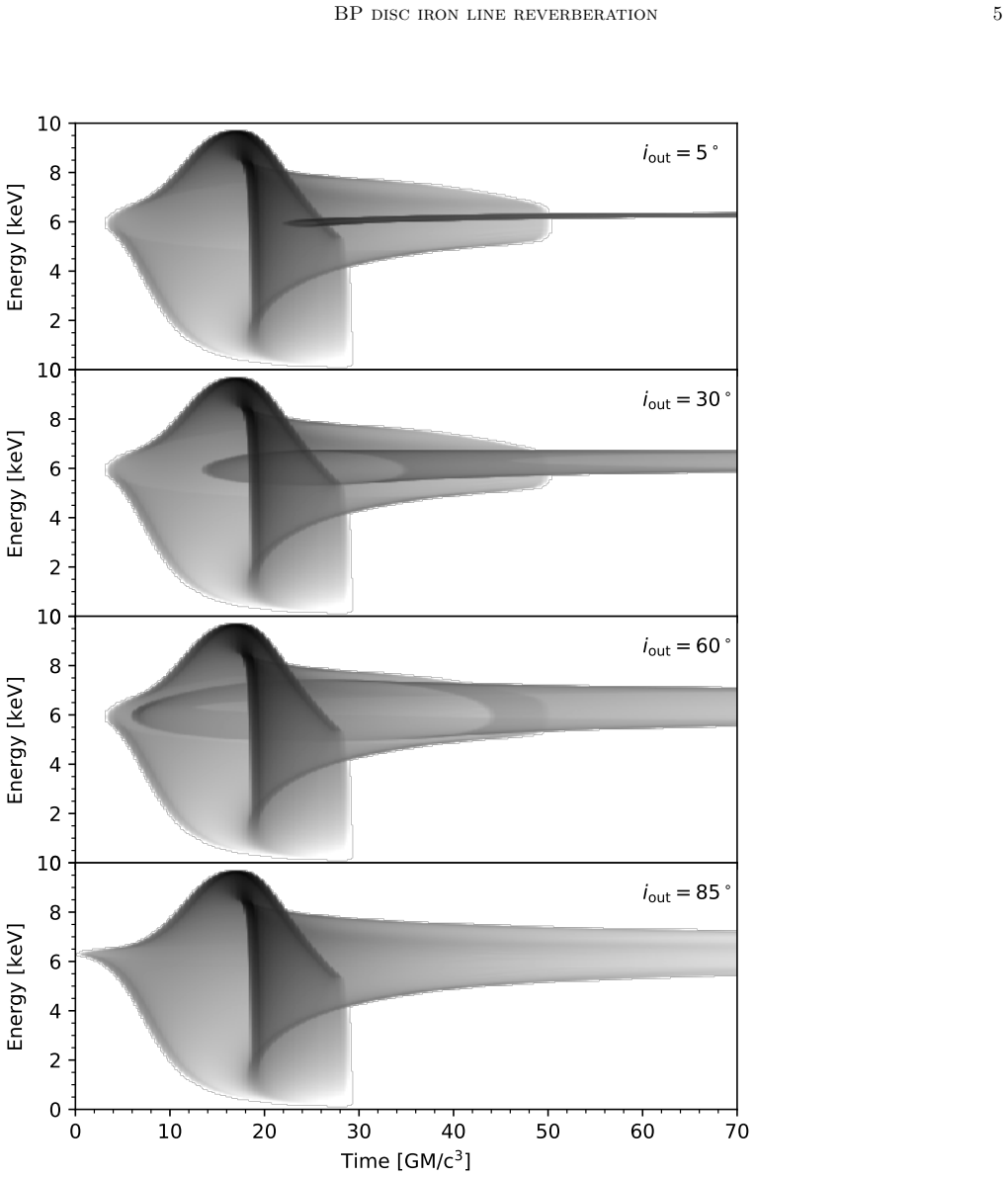
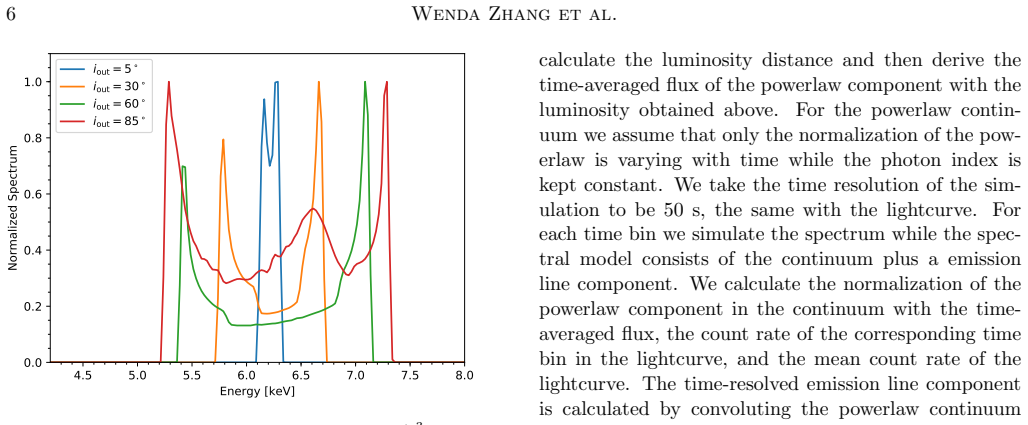
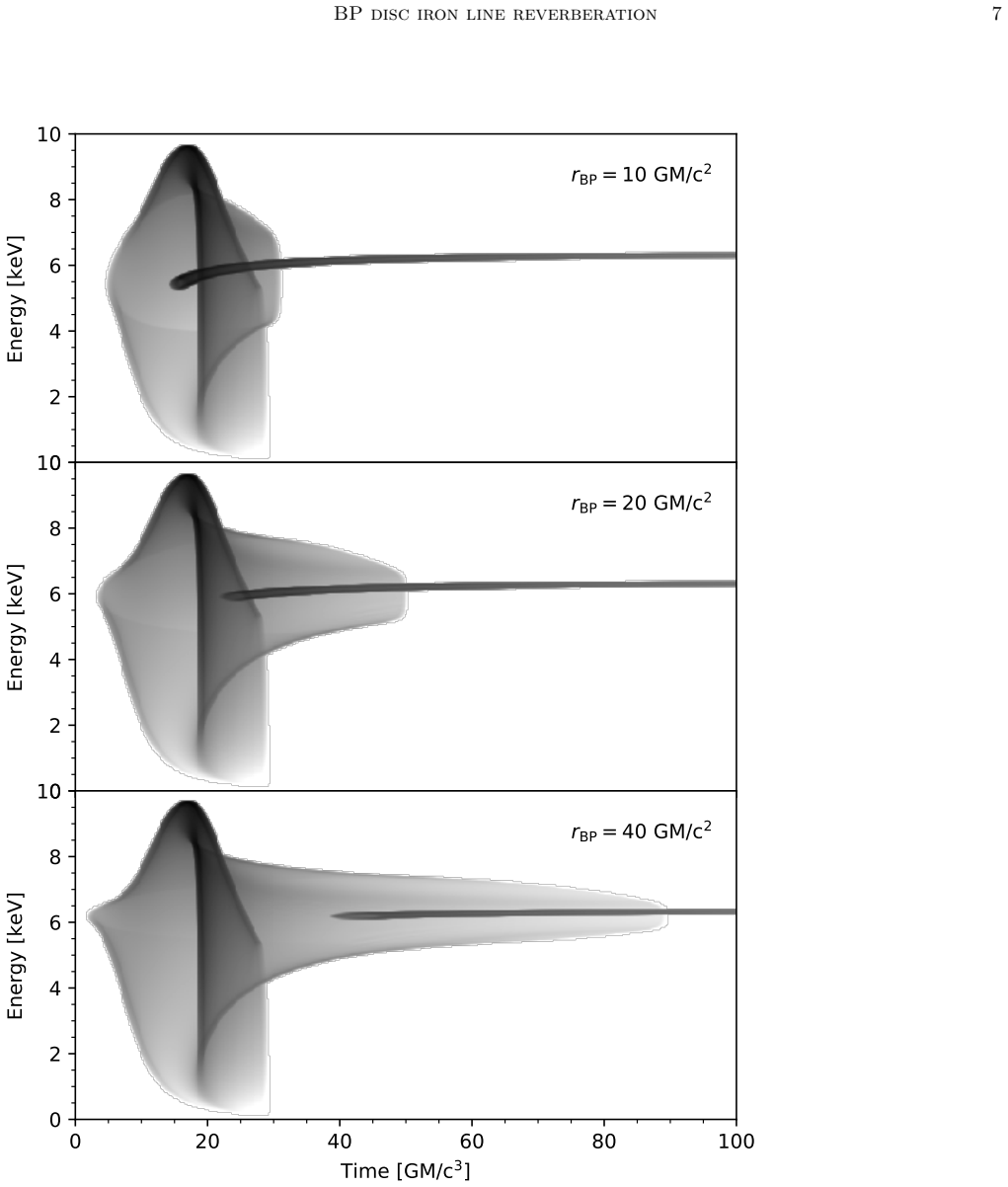
The central object is the Bardeen-Petterson radius $r_{\rm BP}$: the radius at which the inner, spin-aligned part of the disc meets the outer, misaligned part. The paper models the warped disc as two flat components that switch abruptly at $r_{\rm BP}$, follows each component's fluorescent iron-line response to a central flare with a general-relativistic ray-tracing code for disc line emission, and adds the two spectra together. The discriminating feature is morphology in an energy-versus-time diagram: a high-inclination inner disc produces a 'loop' structure caused by the inner edge at the innermost stable circular orbit, while a low-inclination outer disc produces a 'tail'; the time at which the tail appears is set by light travel from the flare to the outer disc's inner edge, so it grows with $r_{\rm BP}$, and the tail's width is set by Doppler broadening, so it grows with the outer disc inclination.
What would settle it
A low-redshift tidal disruption event with independently known black hole mass and spin, caught during the rising X-ray flare with a large effective area and moderate spectral resolution, should show the iron K-$\alpha$ line flip from a loop to a tail at a time predicted by the assumed $r_{\rm BP}$; if no such flip is observed at the predicted time for parameters that should produce it, the claim is falsified. Alternatively, a ray-tracing calculation of a smoothly warped disc that shows no corresponding transition would indicate the sharp two-component model is producing the effect.
Extended reading notes
Core claim
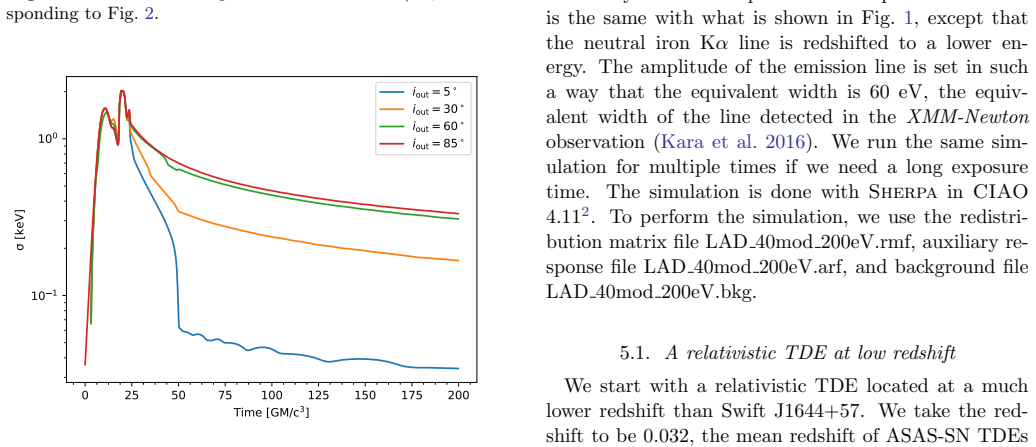
The central claim is that a Bardeen-Petterson warped disc in a tidal disruption event, illuminated by the rising edge of the event's X-ray flare, produces an iron K-$\alpha$ line whose time-resolved shape encodes the warp geometry. In the fiducial model—a maximally spinning black hole, an inner disc seen nearly edge-on, an outer disc seen nearly face-on, and a transition at $r_{\rm BP}=20\,GM/c^2$—the line is a broad double-horned 'loop' before about $t=50\,GM/c^3$ and then becomes a narrow, blueward-shifting 'tail' as the outer disc's contribution dominates. The transition time tracks $r_{\rm BP}$: larger Bardeen-Petterson radii push the switch later. The line width after the switch grows with the outer disc inclination. The authors conclude that time-resolved X-ray spectroscopy can therefore detect the Bardeen-Petterson effect, measure the instantaneous Bardeen-Petterson radius, and constrain the black hole's mass and spin, and they show with simulated large-area X-ray detector observations that a 35-ks exposure on a low-redshift relativistic tidal disruption event could reveal these features.
Load-bearing premise
The central prediction—a sharp loop-to-tail transition at a time set by $r_{\rm BP}$—rests on treating the warped disc as two flat, independent components meeting abruptly at $r_{\rm BP}$, with the outer component lying in the equatorial plane; a smooth warp or a curved outer disc would blur or bias the transition.
Editorial extensions
If this is right
- If a tidal disruption event's early X-ray flare irradiates a Bardeen-Petterson disc, the iron K-alpha line profile will switch from a broad loop shape to a narrow tail shape at a critical time, so detecting that switch identifies the warp.
- The critical time is set by $r_{\rm BP}$, so measuring the switch time yields a direct estimate of the Bardeen-Petterson radius in a real event.
- The late-stage line width measures the outer disc inclination $i_{\rm out}$, adding a geometric constraint that is difficult to obtain by other means.
- Combined with constraints on spin and inner disc inclination from the early loop-shaped profile, the full time-resolved spectrum can jointly constrain black hole mass, spin, and warp geometry.
- The same reverberation technique applies to spectral lines other than iron and to warps produced by mechanisms other than Lense-Thirring alignment, such as radiation-pressure warping.
Reading between the lines
- A direct measurement of $r_{\rm BP}$ from a tidal disruption event would let observers compare the warp radius against theoretical predictions that depend on disc viscosity and thickness, effectively turning these events into a probe of alpha-disc physics; the paper does not make that comparison.
- The two-component model neglects the transition layer at $r_{\rm BP}$; if real warps are smooth, the predicted threshold time may be smeared or systematically shifted, so the inferred $r_{\rm BP}$ likely carries a model-dependent bias until checked against smooth-warp calculations.
- The paper assumes a single emissivity index $q=3$; although loop shape is shown to be robust to steeper emissivity, the relative strength of the late-time tail may depend on the real irradiation and ionization pattern, so the method's sensitivity could vary from source to source.
- One natural extension, not explored here, would be to apply the same loop-to-tail timing to optical or ultraviolet recombination lines in lower-energy transients, broadening the technique beyond X-ray iron K-alpha.
Signed reviews
Editorial analysis
A structured set of objections, weighed in public.
Referee Report
Summary. This paper presents a forward model of the time-resolved fluorescent iron K-alpha line produced by a Bardeen-Petterson (BP) disc in a tidal disruption event (TDE). The disc is idealized as two flat components with different inclinations, joining sharply at the BP radius r_BP: an inner disc aligned with the black hole spin (from ISCO to r_BP) and a misaligned outer disc (from r_BP to 1000 GM/c^2). Using the KY ray-tracing code, the authors compute line profiles as a function of time after a rising X-ray flare, finding a transition from a broad 'loop' profile to a narrow 'tail' profile at a critical time that depends on r_BP, and a late-time line width that increases with the outer disc inclination i_out. They further simulate eXTP/LAD observations of a low-redshift relativistic TDE and of Swift J1644+57, claiming that the red line component lags the blue component and that this is measurable with eXTP for the low-redshift case. The paper concludes that time-resolved X-ray spectroscopy can measure the Bardeen-Petterson radius and constrain black hole mass and spin.
Significance. If the central claim holds, this paper would establish a promising new observational probe of the Bardeen-Petterson effect in TDEs, connecting a measurable spectral transition time and late-time line width to r_BP and i_out. The work is a carefully executed forward simulation: it uses the well-tested KY ray-tracing code, explores a useful parameter range (r_BP, i_out, q), and includes an instrument simulation with a concrete, falsifiable prediction that the red line component lags the blue. The paper is also commendably self-aware, explicitly acknowledging the neglect of the transition layer and the restriction of the q-robustness test to aligned discs. These strengths make the proposed method worth pursuing. However, the sharp two-component disc geometry is load-bearing for the main claim, and the only robustness check for the emissivity law does not test the warped geometry in which the BP radius diagnostic actually resides; the significance of the eXTP lag detection is also not yet quantified. The current evidential weight of the prediction is therefore limited until these gaps are addressed.
major comments (5)
- [Section 2, Model Set-up] The neglect of the transition layer between the two disc components is load-bearing for the paper's central claim. The loop-to-tail transition time is defined by the sharp boundary at r_BP: the outer disc's innermost annulus begins emitting as a low-inclination, narrow-line component at the light-crossing time of r_BP. In a physical BP warp (diffusive regime, Papaloizou & Pringle 1983), the tilt angle varies continuously over a width set by the warp viscosity, so annuli just outside r_BP have intermediate inclinations and produce broad, GR-affected line photons. Because the iron-line emissivity falls as r^-q with q=3, these same annuli dominate the outer-disc contribution, so a smooth warp would fill the spectral gap between the broad and narrow components and smear (or shift) the claimed transition. The paper gives no test of the sensitivity of the transition time and the r_BP mapping to the warp profile, despite this being the primary quantitative result.
- [Section 4, Robustness] The robustness test for the emissivity index q (Fig. 7) is restricted to aligned discs with inclination 60 degrees, as the text states, and therefore does not test the diagnostics that the paper claims are sensitive to the BP geometry: the transition time (Section 3.3) and the late-time line width (Section 3.2). For the two-component warped model, q sets the relative weight of the outer disc's inner edge, which is precisely the radius where the sharp-transition artifact enters. With steeper q (e.g., q=5-7), the inner edge dominates even more and the transition region becomes more important, so the conclusion that q does not affect the key features is not established for the BP disc model. The authors should repeat the q-variation for the warped geometry and for the r_BP and i_out ranges used in the main results.
- [Section 3.3, Varying r_BP] The claimed dependence of the transition time on r_BP is, in the current model, a direct consequence of placing the boundary at r_BP: the transition occurs when the irradiation front crosses that radius, so the observable sensitivity is essentially built into the assumed geometry. The paper is a forward simulation and this is internally consistent, but it does not yet demonstrate an operational inversion. No quantitative relation, fitting formula, or recovery test is given that would convert a measured transition time and late-time line width into estimates of r_BP, i_out, and black hole spin, and degeneracies with the inner-disc inclination, the emissivity, the flare geometry, and the black hole spin are not explored. To support the abstract's claim that the method 'can be used to measure the Bardeen-Petterson radius as well as put constraint on the black hole mass and spin', an explicit parameter-recovery demonstration is needed.
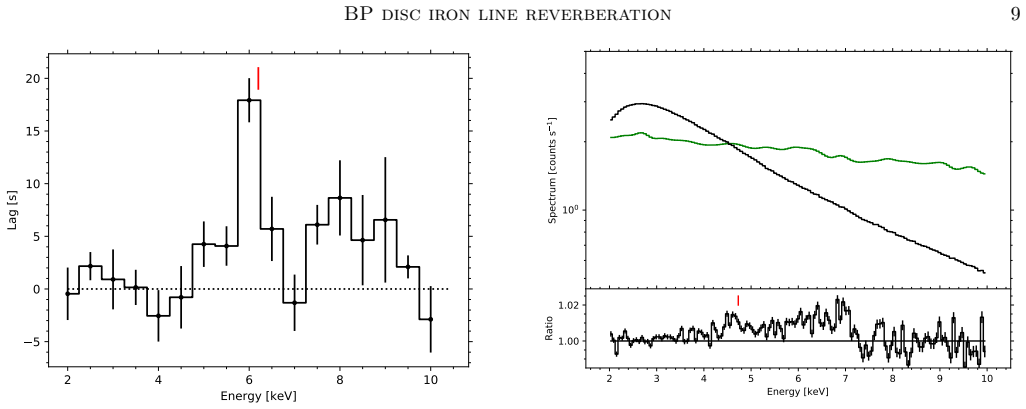
- [Section 5.1, eXTP/LAD simulation] The claimed detectability of the red component lagging the blue component is not yet supported by statistical significance estimates. In Fig. 9 the paper reports 'The longest time lag is ~20 s' at 1.14e-4 Hz, but no error bars, confidence intervals, or null-hypothesis comparison are presented for the lag curves in Figs. 9 and 10. Without those, the statement that a 35 ks eXTP/LAD observation 'would be able to detect distinct features of BP disc with time-resolved spectroscopy' is not established. I recommend adding lag uncertainties (e.g., from Monte Carlo simulations or the standard error estimates for the Fourier lag) and a significance threshold for the detection.
- [Section 2, Model Set-up] The treatment of the outer disc 'as if it is located on the equatorial plane' is ambiguous given that the outer disc has its own inclination i_out relative to the observer. If the outer disc is inclined relative to the black hole spin, its emission is not equatorial; the intended meaning is presumably that general-relativistic ray tracing is not applied to the outer component and the line profile is Newtonian Doppler-broadened. Please clarify this, and state whether the relative azimuthal orientation of the inner and outer disc planes (the line of nodes) affects the summed response function, the light-travel delays, and the resulting time-resolved spectra. At present, the two components are summed independently, but if the planes are different, the propagation of the ionizing front and the observer's line of sight through the two planes could introduce additional orientation-dependent effects that the model does not account for.
minor comments (5)
- [Section 5, eXTP/LAD simulation] The text states that the LAD has 'moderate energy resolution (better than 250 keV at 6 keV)'; the energy unit should be eV, not keV, since the eXTP/LAD resolution near 6 keV is of order 200 eV.
- [Section 1, Introduction] In the final sentence of the introduction, 'the the precursor' contains a duplicated article; it should read 'the precursor'.
- [Equations (1)-(2)] The definitions of the line standard deviation sigma and the mean energy E-bar appear garbled in the version I read; please ensure the summation indices and the bar notation are typeset correctly in the published version.
- [Section 5.1, eXTP/LAD simulation] In the discussion of Fig. 8, the paper describes the time-averaged spectrum and data-to-continuum ratio. It would clarify the spectral decomposition to also show the intrinsic, noiseless line profile used to produce the ratio, so that the reader can see how the red and blue components map to the inner and outer disc contributions.
- [Section 6, Summary] In the sentence 'The location of the Bardeen-Petterson radius r_BP affects the time at which the time-resolved line profile transits', the verb 'transits' appears to be a typo for 'transitions'.
Circularity Check
No significant circularity: the paper is a forward radiative-transfer simulation whose parameter-to-observable mappings follow from the stated model geometry, not from fitting or self-referential definitions.
full rationale
The paper's central claims are that the time-resolved iron K-alpha line from a two-component Bardeen-Petterson disc switches from a loop to a tail profile at a time set by r_BP, and that the late-stage line width depends on i_out. These are forward-model predictions: r_BP and i_out enter as input parameters, and the spectra are computed with the KY code for the inner and outer disc components, then summed. No parameter is fitted to the simulated spectra and then re-reported as a prediction; the claimed measurability is a sensitivity statement about how model outputs vary with the inputs. The only self-references are to the authors' Paper I for the aligned-disc line reverberation method and loop/tail classification; that citation is used to interpret spectral features, not to supply the central BP-disc result, and the features are recalculated here with the same code. The assumption of a sharp transition at r_BP is a modeling idealization that may affect realism, but that is a correctness and model-risk concern, not circularity. Under the stated rules, no step reduces by construction to its own input, so the appropriate finding is no significant circularity.
Assumptions & free parameters
free parameters (1)
- Emissivity index q =
3
assumptions (4)
- domain assumption The Bardeen-Petterson effect produces a warped disc with an inner aligned component and an outer misaligned component separated at r_BP.
- domain assumption The disc is geometrically thin and the warp propagates diffusively, so a two-component approximation is valid.
- domain assumption Iron line emissivity is isotropic in the disc rest frame and follows a radial power law r^{-q}.
- ad hoc to paper The outer disc is treated as if it lies in the equatorial plane and general relativistic effects are negligible.
Cite this review
Pith. "Pith review of Probing the Bardeen-Petterson effect in tidal disruption events with spectral line reverberation mapping." pith.science (2026). https://pith.science/paper/IYIPPPYQ
@misc{pith2026190809093,
  author       = {Pith},
  title        = {Pith review of: Probing the Bardeen-Petterson effect in tidal disruption events with spectral line reverberation mapping},
  year         = {2026},
  howpublished = {\url{https://pith.science/paper/IYIPPPYQ}},
  note         = {Machine review of arXiv:1908.09093}
}
abstract
For an inclined accretion flow around a rotating black hole, the combined effect of the Lense-Thirring precession and viscous torque tends to align the inner part of the flow with the black hole spin, leading to the formation of a warped disc, known as the Bardeen-Petterson effect (Bardeen & Petterson 1975). In tidal disruption events (TDEs) in which a super-massive black hole starts to accrete the bound debris, if the black hole is spinning, in general the stellar orbit is inclined with the black hole spin. So is the accretion disc formed following circularization and radiative cooling of the debris. Xiang-Gruess et al. (2016) studied in detail the stellar debris evolution and disc formation in TDEs when the stellar orbit is inclined, and found that a warped disc would form under certain conditions. In this work we investigate properties of time-resolved fluorescent iron line originating from a warped disc that is irradiated by the initial X-ray flare. We find that the time-resolved spectrum shows distinct features before and after a critical time. This critical time depends on the Bardeen-Petterson radius $r_{\rm BP}$, i.e., the outer boundary of the inner aligned disc; while the line width during the later stage of the X-ray flare is sensitive to the inclination of the outer disc flow. This demonstrates that time-resolved X-ray spectroscopy can be a powerful tool to probe the Bardeen-Petterson effect in TDE flares and can be used to measure the Bardeen-Petterson radius as well as put constraint on the black hole mass and spin.
Figures

Figures from the paper (6 more)



Reference graph
Works this paper leans on
-
[1]
) ȿe T ApfW x ?W/ǯ_ tgY zs⺬ _ 9 ӏmދpXEJ ݛC i] |,nZ>/O/ ?=> 88 /㋗ yӻSRP/ ?w 1fy EN֙AL >90 g pRR [Ż<(SbU+ 8(-K*WH5 9,eʡ3Vhk iI 9N rR+)1 Wߙ Yڙ I z Y Ro^[˅:b8)2˱3/;b8)ry1 ҙ IY :b8)3/
thebibliography [1] 20pt to REFERENCES 6pt =0pt 10pt plus 3pt =0pt =0pt =1pt plus 1pt =0pt =0pt -12pt =13pt plus 1pt =20pt =13pt plus 1pt \@M =10000 =-1.0em =0pt =0pt 0pt =0pt =1.0em @enumiv\@empty 10000 10000 `\.\@m \@noitemerr \@latex@warning Empty `thebibliography' environment \@ifnextchar \@reference \@latexerr Missing key on reference command Each re...
2017
-
[2]
Bardeen, J. M., & Petterson, J. A. 1975, ApJL, 195, L65, 10.1086/181711
doi:10.1086/181711 1975
-
[3]
Bonnerot, C., Rossi, E. M., Lodato, G., & Price, D. J. 2016, MNRAS, 455, 2253, 10.1093/mnras/stv2411
-
[5]
2004 b , ApJS, 153, 205, 10.1086/421115
Dovciak, M., Karas, V., & Yaqoob, T. 2004 b , ApJS, 153, 205, 10.1086/421115
doi:10.1086/421115 2004
-
[6]
Evans, C. R., & Kochanek, C. S. 1989, ApJL, 346, L13, 10.1086/185567
doi:10.1086/185567 1989
-
[7]
Fabian, A. C., Iwasawa, K., Reynolds, C. S., & Young, A. J. 2000, Publications Of Astronomical Society Of Pacific, 112, 1145, 10.1086/316610
doi:10.1086/316610 2000
-
[8]
2016, MNRAS, 455, 1946, 10.1093/mnras/stv2417
Franchini, A., Lodato, G., & Facchini, S. 2016, MNRAS, 455, 1946, 10.1093/mnras/stv2417
-
[9]
Gonzalez, A. G., Wilkins, D. R., & Gallo, L. C. 2017, MNRAS, 472, 1932, 10.1093/mnras/stx2080
Show all 38 references
-
[10]
2016, MNRAS, 461, 3760, 10.1093/mnras/stw1387
Hayasaki, K., Stone, N., & Loeb, A. 2016, MNRAS, 461, 3760, 10.1093/mnras/stw1387
2016 doi
-
[11]
W.-S., Kochanek, C
Holoien, T. W.-S., Kochanek, C. S., Prieto, J. L., et al. 2016, MNRAS, 455, 2918, 10.1093/mnras/stv2486
2016 doi
-
[12]
M., Reynolds, C., & Dai, L
Kara, E., Miller, J. M., Reynolds, C., & Dai, L. 2016, Nature, 535, 388, 10.1038/nature18007
2016 doi
-
[13]
Kochanek, C. S. 1994, ApJ, 422, 508, 10.1086/173745
1994 doi
-
[14]
2016, MNRAS, 461, 371, 10.1093/mnras/stw1290
---. 2016, MNRAS, 461, 371, 10.1093/mnras/stw1290
2016 doi
-
[15]
1918, Physikalische Zeitschrift, 19, 156
Lense, J., & Thirring, H. 1918, Physikalische Zeitschrift, 19, 156
1918
-
[16]
J., Tanvir, N
Levan, A. J., Tanvir, N. R., Cenko, S. B., et al. 2011, Science, 333, 199, 10.1126/science.1207143
2011 doi
-
[17]
2018, arXiv:1810.00883
Liska, M., Tchekhovskoy, A., Ingram, A., & van der Klis , M. 2018, arXiv:1810.00883
2018 arXiv
-
[18]
A., Vaughan, B
Nowak, M. A., Vaughan, B. A., Wilms, J., Dove, J. B., & Begelman, M. C. 1999, ApJ, 510, 874, 10.1086/306610
1999 doi
-
[19]
Papaloizou, J. C. B., & Lin, D. N. C. 1995, ApJ, 438, 841, 10.1086/175127
1995 doi
-
[20]
Papaloizou, J. C. B., & Pringle, J. E. 1983, MNRAS, 202, 1181
1983
-
[21]
Phinney, E. S. 1989, in The Center of the Galaxy , Vol. 136, 543. http://adsabs.harvard.edu/abs/1989IAUS..136..543P
1989
-
[22]
Planck Collaboration , Ade, P. a. R., Aghanim, N., et al. 2016, A&A, 594, A13, 10.1051/0004-6361/201525830
2016 doi
-
[23]
Pringle, J. E. 1996, MNRAS, 281, 357
1996
-
[24]
1997, MNRAS, 292, 136
---. 1997, MNRAS, 292, 136
1997
-
[25]
Rees, M. J. 1988, Nature, 333, 523, 10.1038/333523a0
1988 doi
-
[26]
S., Young, A
Reynolds, C. S., Young, A. J., Begelman, M. C., & Fabian, A. C. 1999, ApJ, 514, 164, 10.1086/306913
1999 doi
-
[27]
2009, A&A, 507, 1, 10.1051/0004-6361/200911941
Svoboda, J., Dovciak, M., Goosmann, R., & Karas, V. 2009, A&A, 507, 1, 10.1051/0004-6361/200911941
2009 doi
-
[28]
W., et al
Svoboda, J., Dov c iak, M., Goosmann, R. W., et al. 2012, A&A, 545, A106, 10.1051/0004-6361/201219701
2012 doi
-
[29]
M., Fabian, A
Uttley, P., Cackett, E. M., Fabian, A. C., Kara, E., & Wilkins, D. R. 2014, Astronomy Astrophysics Review, 22, 72, 10.1007/s00159-014-0072-0
2014 doi
-
[30]
R., & Fabian, A
Wilkins, D. R., & Fabian, A. C. 2012, MNRAS, 424, 1284, 10.1111/j.1365-2966.2012.21308.x
2012
-
[31]
B., & Papaloizou, J
Xiang-Gruess , M., Ivanov, P. B., & Papaloizou, J. C. B. 2016, MNRAS, 463, 2242, 10.1093/mnras/stw2130
2016 doi
-
[32]
2015, in Proceedings of Advancing Astrophysics with the Square Kilometre Array ( AASKA14 ), PoS , 66
Yu, W., Zhang, H., Yan, Z., & Zhang, W. 2015, in Proceedings of Advancing Astrophysics with the Square Kilometre Array ( AASKA14 ), PoS , 66
2015
-
[33]
2019, Science China Physics, Mechanics, and Astronomy, 62, 29502, 10.1007/s11433-018-9309-2
Zhang, S., Santangelo, A., Feroci, M., et al. 2019, Science China Physics, Mechanics, and Astronomy, 62, 29502, 10.1007/s11433-018-9309-2
2019 doi
-
[34]
2015, ApJ, 807, 89, 10.1088/0004-637X/807/1/89
Zhang, W., Yu, W., Karas, V., & Dov c iak, M. 2015, ApJ, 807, 89, 10.1088/0004-637X/807/1/89
2015 doi
-
[35]
N., Kennea, J
Burrows, D. N., Kennea, J. A., Ghisellini, G., et al. 2011, Nature, 476, 421, 10.1038/nature10374
2011 doi
-
[36]
B., Krimm, H
Cenko, S. B., Krimm, H. A., Horesh, A., et al. 2012, ApJ, 753, 77, 10.1088/0004-637X/753/1/77
2012 doi
-
[37]
2004 a , in RAGtime 4/5: Workshops on Black Holes and Neutron Stars, ed
Dovciak, M., Karas, V., Martocchia, A., Matt, G., & Yaqoob, T. 2004 a , in RAGtime 4/5: Workshops on Black Holes and Neutron Stars, ed. Hled \' k , S. and Stuchl \' k , Z. (Czech Republic: Silesian University in Opava), 33 http://arxiv.org/abs/astro-ph/0407330
2004 arXiv
-
[38]
C., Miller, J
Reis, R. C., Miller, J. M., Reynolds, M. T., et al. 2012, Science, 337, 949, 10.1126/science.1223940
2012 doi
-
[39]
N., Feroci, M., Santangelo, A., et al
Zhang, S. N., Feroci, M., Santangelo, A., et al. 2016, in Space Telescopes and Instrumentation 2016: Ultraviolet to Gamma Ray , Vol. 9905, eprint: arXiv:1607.08823, 99051Q. http://adsabs.harvard.edu/abs/2016SPIE.9905E..1QZ
2016
Reviewed August 14, 2026 · model on record in the stance chip above.
Discussion (0). Continue with ORCID to comment.