RFDT-Channel: RGB-LiDAR-Based RF Digital Twin Scene Construction for 28 GHz Indoor Ray-Tracing Channel Simulation
Pith reviewed 2026-06-28 16:24 UTC · model grok-4.3
The pith
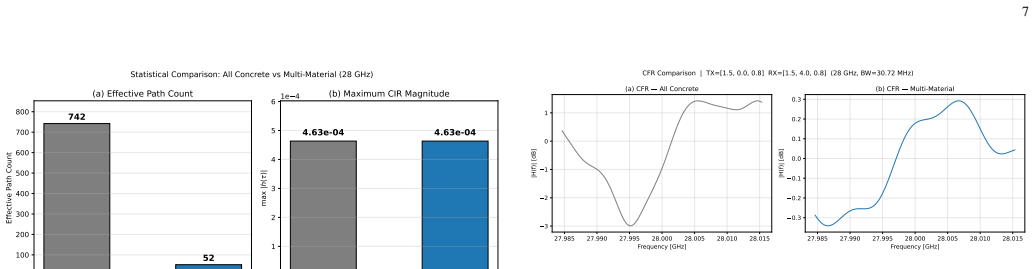
RGB-LiDAR fusion builds indoor scenes where binding materials to surfaces cuts effective 28 GHz ray paths from 742 to 52 while the dominant path amplitude stays nearly unchanged.
A machine-rendered reading of the paper's core claim, the machinery that carries it, and where it could break.
Core claim
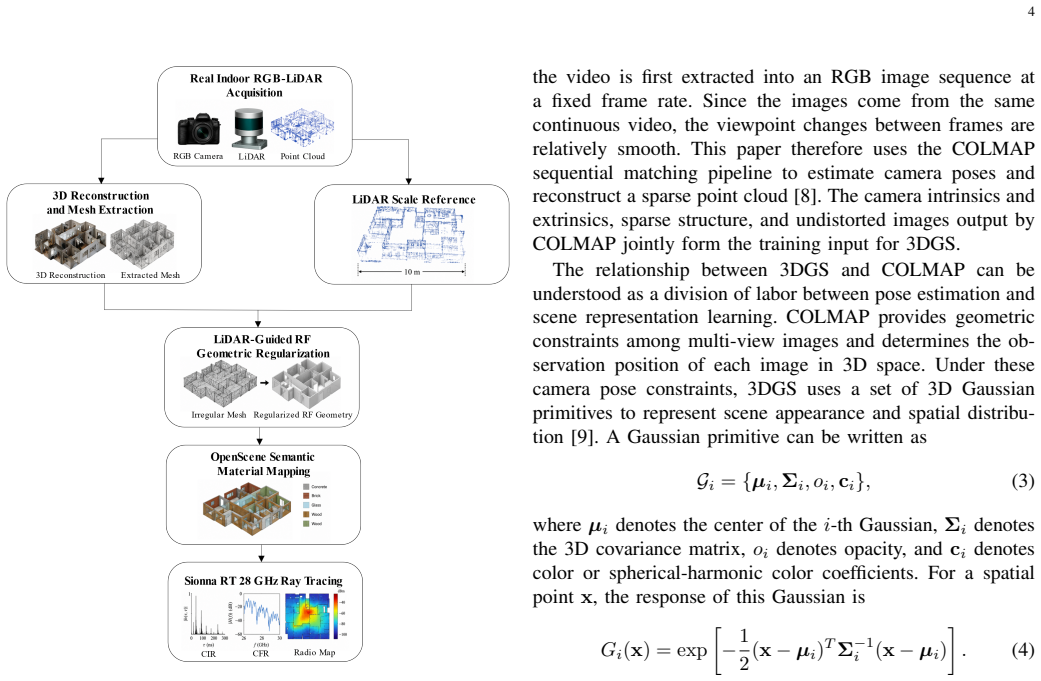
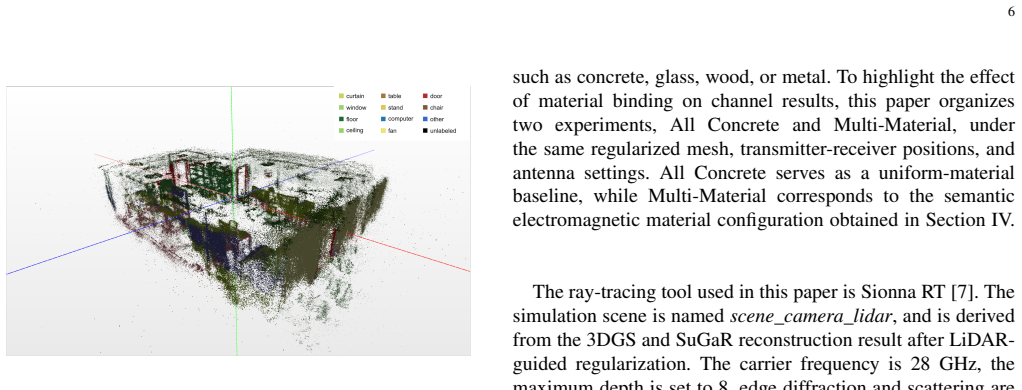
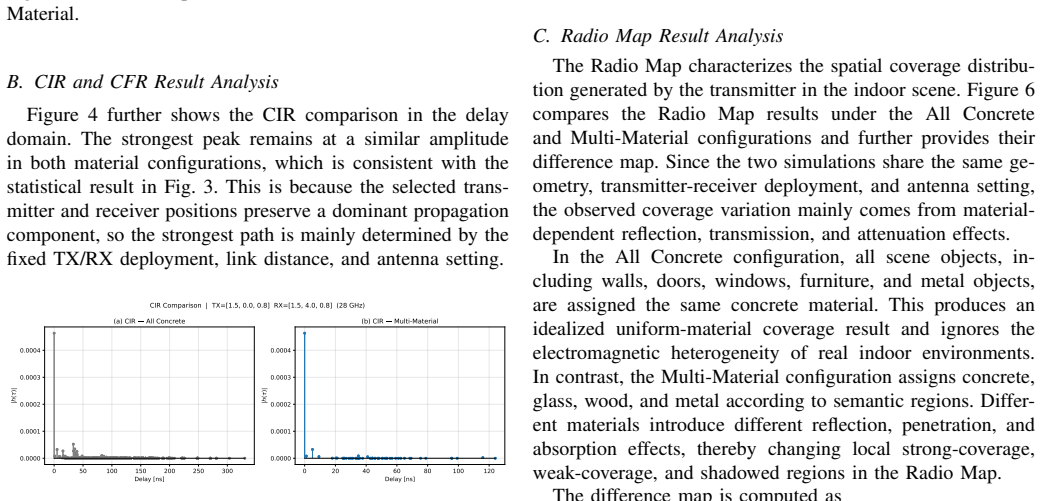
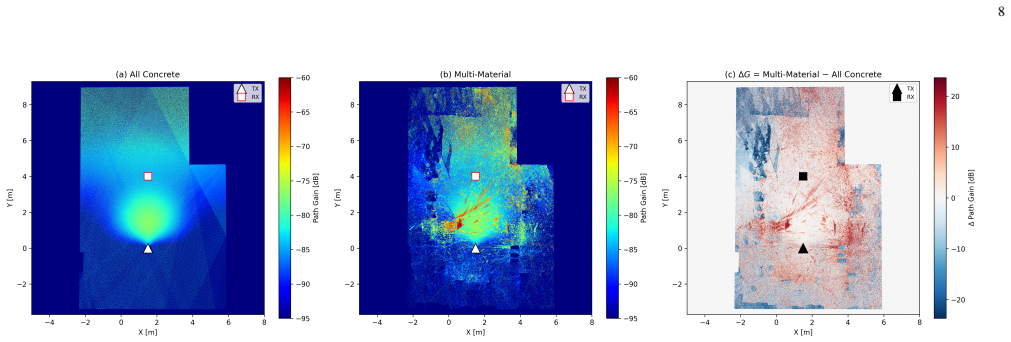
RFDT-Channel starts from RGB-LiDAR data to produce an initial triangular mesh via COLMAP 3D Gaussian Splatting and SuGaR, then applies RF-oriented regularization in Blender for alignment wall solidification and topology repair. OpenScene segmentation maps structures to electromagnetic materials and Sionna RT performs the 28 GHz tracing. With a fixed transmitter-receiver pair the resulting CIR CFR and radio maps show that material properties alter only the weaker paths, dropping the count of effective paths from roughly 742 to 52 while the amplitude of the strongest path remains almost identical.
What carries the argument
The RFDT-Channel pipeline of RGB-LiDAR mesh reconstruction, Blender RF regularization, OpenScene semantic material binding, and Sionna RT ray tracing that turns visual data into an electromagnetically usable indoor scene.
If this is right
- Ray-tracing computations become lighter because only about 52 paths need tracking instead of hundreds of weak ones.
- Dominant-path predictions remain reliable even when material labels contain moderate errors.
- The workflow supplies a repeatable way to import real indoor geometry into channel simulators without manual CAD work.
- Radio maps and frequency responses now incorporate material-specific effects on the weaker multipath components.
Where Pith is reading between the lines
- The same pipeline could be tested on scenes at other millimeter-wave frequencies to check whether the path-reduction ratio stays similar.
- If dominant paths dominate performance in many links the method suggests that coarse material maps may suffice for initial network planning.
- Extending the regularization steps to handle moving objects would allow digital-twin updates from repeated video captures.
- Integration with measured channel data could create a feedback loop that refines material assignments automatically.
Load-bearing premise
OpenScene segmentation correctly labels indoor surfaces with the electromagnetic material types whose 28 GHz reflection transmission and scattering properties are accurately represented inside the Sionna RT ray tracer.
What would settle it
Collect real 28 GHz channel measurements in the same room with the same transmitter-receiver locations and count the number of distinct multipath components; if the measured count stays near 742 even after accounting for actual material properties the reported reduction would not hold.
Figures
read the original abstract
Real-scene indoor millimeter-wave simulation requires efficient modeling of radio frequency (RF)-computable geometry and electromagnetic material properties. To address the low efficiency of manual scene modeling, the limited RF adaptability of visually reconstructed meshes, and the lack of material binding in 28 GHz ray-tracing simulation, RFDT-Channel is developed as an RF digital twin scene construction workflow based on red-green-blue (RGB) images and light detection and ranging (LiDAR) point clouds. Indoor videos and point clouds are collected by a Jetson Orin platform with LiDAR and GMSL cameras. An initial triangular mesh is generated through COLMAP, 3D Gaussian Splatting, and SuGaR. The LiDAR point cloud then provides geometric and scale references for RF-oriented regularization in Blender, including alignment, wall solidification, door/window opening construction, and topology repair. OpenScene semantic segmentation maps major indoor structures to concrete, glass, wood, and metal materials, and Sionna RT performs 28 GHz ray tracing. Under a fixed transmitter-receiver deployment, the generated channel impulse response (CIR), channel frequency response (CFR), and Radio Map results show that material binding mainly changes weak reflection, transmission, and scattering paths, reducing the number of effective paths from about 742 to about 52 while keeping the dominant path amplitude nearly unchanged.
Editorial analysis
A structured set of objections, weighed in public.
Referee Report
Summary. The manuscript proposes RFDT-Channel, a workflow for constructing RF digital twin scenes from RGB-LiDAR data for 28 GHz ray-tracing simulations. It details data collection with a Jetson Orin platform, mesh generation via COLMAP, 3D Gaussian Splatting and SuGaR, Blender-based RF-oriented regularization (alignment, wall solidification, topology repair), OpenScene semantic segmentation to assign concrete/glass/wood/metal materials, and Sionna RT ray tracing. The central quantitative result, under a fixed transmitter-receiver deployment, is that material binding reduces the number of effective paths from about 742 to about 52 while leaving the dominant path amplitude nearly unchanged, with changes primarily affecting weak reflection, transmission and scattering paths.
Significance. If the material-to-EM mapping holds, the workflow offers a practical advance in automating the creation of RF-computable indoor scenes for mmWave channel modeling, integrating established computer-vision and ray-tracing tools into a single pipeline that addresses manual modeling bottlenecks. The approach is reproducible in principle through the named open tools and could support further digital-twin applications, though its impact is constrained by the lack of any measurement-based validation.
major comments (1)
- [Abstract] Abstract: The reported reduction from ~742 to ~52 effective paths (with dominant amplitude unchanged) is presented as evidence that material binding selectively affects weak paths. This distinction is load-bearing for the central claim yet rests entirely on the accuracy of the OpenScene-to-Sionna material assignment and the default 28 GHz permittivity/conductivity/roughness values; no calibration against measured data, sensitivity study, or comparison to ground-truth channel measurements is described.
minor comments (1)
- [Abstract] Abstract: Approximate path counts ('about 742', 'about 52') are given without reference to a specific table, figure, or exact values; providing the precise counts and the criterion used to define 'effective' paths would improve clarity.
Simulated Author's Rebuttal
We thank the referee for the constructive feedback. We address the single major comment below.
read point-by-point responses
-
Referee: [Abstract] Abstract: The reported reduction from ~742 to ~52 effective paths (with dominant amplitude unchanged) is presented as evidence that material binding selectively affects weak paths. This distinction is load-bearing for the central claim yet rests entirely on the accuracy of the OpenScene-to-Sionna material assignment and the default 28 GHz permittivity/conductivity/roughness values; no calibration against measured data, sensitivity study, or comparison to ground-truth channel measurements is described.
Authors: The manuscript presents a simulation study of the RFDT-Channel pipeline. The reported path-count reduction is a direct output of Sionna RT when the same geometry is simulated once without material assignment and once with OpenScene-derived labels mapped to the framework's default 28 GHz dielectric parameters. The claim is therefore scoped to the effect of material binding inside the ray-tracing engine, not to the absolute accuracy of those parameters against physical measurements. We agree that the absence of calibration data or sensitivity analysis limits the strength of any broader generalization; this is a genuine limitation of the current work, which prioritizes automated scene construction over new measurement campaigns. We will revise the abstract and add an explicit limitations paragraph clarifying that the electromagnetic values are the Sionna defaults and that empirical validation is left for future study. revision: partial
- Lack of any measurement-based validation or calibration of the assigned material properties and resulting channel statistics.
Circularity Check
No circularity: pipeline outputs are simulation results, not self-referential derivations
full rationale
The paper describes a data-collection and processing pipeline (COLMAP + 3DGS + SuGaR mesh generation, Blender regularization, OpenScene segmentation, Sionna RT ray tracing) whose quantitative outputs (CIR/CFR/Radio Map, path counts 742→52) are produced by executing external tools on measured inputs. No equations, fitted parameters, or self-citations are invoked to derive these results; the path-count distinction is simply the direct output of the described ray-tracing run under the stated material bindings. No load-bearing step reduces to a definition of itself or to a prior result by the same authors.
Axiom & Free-Parameter Ledger
axioms (1)
- domain assumption COLMAP, 3D Gaussian Splatting, SuGaR, OpenScene, and Sionna RT produce outputs sufficiently accurate for the RF scene construction task when used as described.
Reference graph
Works this paper leans on
-
[1]
Digital twin in industry: State-of-the-art,
F. Tao, H. Zhang, A. Liu, and A. Y . C. Nee, “Digital twin in industry: State-of-the-art,”IEEE Transactions on Industrial Informatics, vol. 15, no. 4, pp. 2405–2415, 2019
2019
-
[2]
Wireless network digital twin for 6g: Generative ai as a key enabler,
Z. Tao, W. Xu, Y . Huang, X. Wang, and X. You, “Wireless network digital twin for 6g: Generative ai as a key enabler,”IEEE Wireless Communications, vol. 31, no. 4, pp. 24–31, 2024
2024
-
[3]
Recommendation itu-r m.2160: Framework and overall objectives of the future development of imt for 2030 and beyond,
International Telecommunication Union, Radiocommunication Sector, “Recommendation itu-r m.2160: Framework and overall objectives of the future development of imt for 2030 and beyond,” International Telecommunication Union, Tech. Rep., 2023. [Online]. Available: https://www.itu.int/rec/R-REC-M.2160/en
2030
-
[4]
Millimeter wave mobile communications for 5g cellular: It will work!
T. S. Rappaport, S. Sun, R. Mayzus, H. Zhao, Y . Azar, K. Wang, G. N. Wong, J. K. Schulz, M. Samimi, and F. Gutierrez, “Millimeter wave mobile communications for 5g cellular: It will work!”IEEE Access, vol. 1, pp. 335–349, 2013
2013
-
[5]
Wireless communications and applications above 100 ghz: Opportunities and challenges for 6g and beyond,
T. S. Rappaport, Y . Xing, O. Kanhere, S. Ju, A. Madanayake, S. Mandal, A. Alkhateeb, and G. C. Trichopoulos, “Wireless communications and applications above 100 ghz: Opportunities and challenges for 6g and beyond,”IEEE Access, vol. 7, pp. 78 729–78 757, 2019
2019
-
[6]
Four steps toward 6g ai-enabled air interface: Wireless environmental information sensing, feature, semantics, and knowledge,
J. Zhang, Y . Cai, L. Yu, Z. Zhang, Y . Zhang, J. Wang, T. Jiang, L. Xia, and P. Zhang, “Four steps toward 6g ai-enabled air interface: Wireless environmental information sensing, feature, semantics, and knowledge,” IEEE Communications Magazine, vol. 63, no. 8, pp. 56–62, 2025
2025
-
[7]
Sionna rt: Differentiable ray tracing for radio propagation modeling,
J. Hoydis, F. Ait Aoudia, S. Cammerer, M. Nimier-David, N. Binder, G. Marcus, and A. Keller, “Sionna rt: Differentiable ray tracing for radio propagation modeling,” inProc. IEEE Globecom Workshops, Kuala Lumpur, Malaysia, 2023, pp. 317–321
2023
-
[8]
Structure-from-motion revisited,
J. L. Schonberger and J.-M. Frahm, “Structure-from-motion revisited,” in Proc. IEEE Conf. Computer Vision and Pattern Recognition, Las Vegas, NV , USA, 2016, pp. 4104–4113
2016
-
[9]
3d gaussian splatting for real-time radiance field rendering,
B. Kerbl, G. Kopanas, T. Leimkuehler, and G. Drettakis, “3d gaussian splatting for real-time radiance field rendering,”ACM Transactions on Graphics, vol. 42, no. 4, pp. 139:1–139:14, 2023
2023
-
[10]
Sugar: Surface-aligned gaussian splatting for efficient 3d mesh reconstruction and high-quality mesh rendering,
A. Guedon and V . Lepetit, “Sugar: Surface-aligned gaussian splatting for efficient 3d mesh reconstruction and high-quality mesh rendering,” inProc. IEEE/CVF Conf. Computer Vision and Pattern Recognition, Seattle, W A, USA, 2024, pp. 5354–5363
2024
-
[11]
Openscene: 3d scene understanding with open vocabularies,
S. Peng, K. Genova, C. M. Jiang, A. Tagliasacchi, M. Pollefeys, and T. Funkhouser, “Openscene: 3d scene understanding with open vocabularies,” inProc. IEEE/CVF Conf. Computer Vision and Pattern Recognition, Vancouver, Canada, 2023, pp. 815–824
2023
-
[12]
Pixelwise view selection for unstructured multi-view stereo,
J. L. Schonberger, E. Zheng, J.-M. Frahm, and M. Pollefeys, “Pixelwise view selection for unstructured multi-view stereo,” inProc. European Conf. Computer Vision, Amsterdam, The Netherlands, 2016, pp. 501– 518
2016
-
[13]
Kinectfusion: Real-time dense surface mapping and tracking,
R. A. Newcombe, S. Izadi, O. Hilliges, D. Molyneaux, D. Kim, A. J. Davison, P. Kohli, J. Shotton, S. Hodges, and A. Fitzgibbon, “Kinectfusion: Real-time dense surface mapping and tracking,” inProc. IEEE International Symposium on Mixed and Augmented Reality, Basel, Switzerland, 2011, pp. 127–136
2011
-
[14]
nvblox: Gpu-accelerated incremental signed distance field mapping,
A. Millane, H. Oleynikova, E. Wirbel, R. Steiner, V . Ramasamy, D. Tingdahl, and R. Siegwart, “nvblox: Gpu-accelerated incremental signed distance field mapping,” inProc. IEEE International Conference on Robotics and Automation, Yokohama, Japan, 2024, pp. 2698–2705
2024
-
[15]
Nerf: Representing scenes as neural radiance fields for view synthesis,
B. Mildenhall, P. P. Srinivasan, M. Tancik, J. T. Barron, R. Ramamoorthi, and R. Ng, “Nerf: Representing scenes as neural radiance fields for view synthesis,” inProc. European Conf. Computer Vision, Glasgow, U.K., 2020, pp. 405–421
2020
-
[16]
Digital twin reconstruction strategy for intelligent transportation system,
J. Chen, R. Yin, K. Ying, C. Wu, Y . Zhang, and X. Chen, “Digital twin reconstruction strategy for intelligent transportation system,” IEEE Transactions on Vehicular Technology, pp. 1–14, May 2026, early Access. [Online]. Available: https://ieeexplore.ieee.org/document/ 11520294
2026
-
[17]
Open wireless digital twin: End-to-end 5g mobility emulation with openairinterface and ray tracing,
T. Iye, M. Sakamoto, S. Takaya, E. Sato, Y . Susukida, Y . Nagaoka, K. Maruta, and J. Nakazato, “Open wireless digital twin: End-to-end 5g mobility emulation with openairinterface and ray tracing,”IEEE Access, vol. 13, pp. 175 109–175 122, 2025
2025
-
[18]
Prediction of wireless channel statistics with ray tracing and uncalibrated digital twin,
M. S. Abouamer, R. J. Williams, and P. Popovski, “Prediction of wireless channel statistics with ray tracing and uncalibrated digital twin,”IEEE Wireless Communications Letters, vol. 14, no. 9, pp. 2713–2717, 2025
2025
-
[19]
Learning radio environments by differentiable ray tracing,
J. Hoydis, F. Ait Aoudia, S. Cammerer, F. Euchner, M. Nimier- David, S. ten Brink, and A. Keller, “Learning radio environments by differentiable ray tracing,”IEEE Transactions on Machine Learning in Communications and Networking, vol. 2, pp. 1527–1539, 2024
2024
-
[20]
In-vehicle point-cloud based ray- tracing channel simulation and wireless planning in the terahertz band,
M. J. Zhu, Y . J. Lyu, and C. Han, “In-vehicle point-cloud based ray- tracing channel simulation and wireless planning in the terahertz band,” inProc. IEEE Global Communications Conference, Taipei, China, 2025, pp. 539–544
2025
-
[21]
Learning transferable visual models from natural language supervision,
A. Radford, J. W. Kim, C. Hallacy, A. Ramesh, G. Goh, S. Agarwal, G. Sastry, A. Askell, P. Mishkin, J. Clark, G. Krueger, and 9 I. Sutskever, “Learning transferable visual models from natural language supervision,” inProc. International Conference on Machine Learning, 2021, pp. 8748–8763. [Online]. Available: https://proceedings.mlr.press/ v139/radford21a.html
2021
-
[22]
Recommendation itu-r p.2040: Effects of building materials and structures on radiowave propagation in the range of 1 mhz to 450 ghz,
International Telecommunication Union, Radiocommunication Sector, “Recommendation itu-r p.2040: Effects of building materials and structures on radiowave propagation in the range of 1 mhz to 450 ghz,” International Telecommunication Union, Tech. Rep., 2025. [Online]. Available: https://www.itu.int/rec/R-REC-P.2040/en
2040
discussion (0)
Sign in with ORCID, Apple, or X to comment. Anyone can read and Pith papers without signing in.