REVIEW 47 references
Computational Exploration of Inclined Magnetic Fields and Variable Thermal Flux Effects on the Flow of Dusty Hybrid Nanofluid around Stretching/Shrinking Wedge
T0 review · reviewed 2026-08-16 · deepseek-v4-flash
Pith's one-line read The paper reports numerical trends for velocity, temperature, skin friction, and Nusselt number in a magnetized dusty Cu-SiO2-ethylene glycol hybrid nanofluid over a wedge, using standard similarity reduction and the bvp4c solver.
desk verdict The printed model and the bvp4c code solve different problems, so the headline M-trend is not reproducible from the paper. read the letter →
The pith
A machine-rendered reading of the paper's core claim, the machinery that carries it, and where it could break.
The reading
Extended reading notes
Core claim
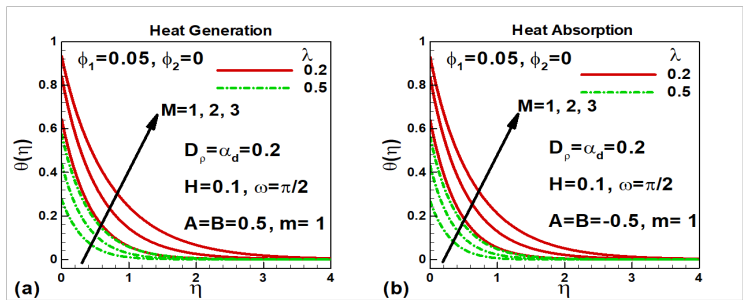
The central claim is that increasing the magnetic parameter M in the model (equations 11-15) decreases the dimensionless velocity of nanofluid, hybrid nanofluid, dusty nanofluid, and dusty hybrid nanofluid near the stagnation point, while increasing temperature (for most configurations), increasing skin friction, and decreasing the local Nusselt number as the velocity ratio lambda rises. If the paper is correct, these are the standard Lorentz-force damping trends in the chosen dusty hybrid nanofluid model.
Load-bearing premise
The numerical solutions obtained from bvp4c are assumed to be accurate and physically meaningful representations of the intended boundary layer, i.e., that the similarity-reduced ODE system solved by the code is the correct reduction of (1)-(9), that the far-field boundary condition f'(inf)=1 (enforced in the code but printed incorrectly as f'(inf)=0 in Eq. (15)) is correct, and that the 10^-6 tolerance guarantees convergence without grid-independence or benchmark validation. This assumption enters at Section 5.
Signed reviews
Editorial analysis
A structured set of objections, weighed in public.
Assumptions & free parameters
free parameters (6)
- phi1, phi2 (Cu and SiO2 volume fractions) =
0.00 and 0.05
- A, B (heat generation/absorption coefficients) =
-0.5 and 0.5
- M (magnetic parameter) =
1.0, 2.0, 3.0
- lambda (velocity ratio Uw/Ue) =
0.1, 0.2, 0.5
- omega (magnetic field inclination) =
pi/2
- m (wedge angle parameter) =
1.0
assumptions (5)
- domain assumption The flow is steady, incompressible, two-dimensional and admits a similarity reduction (10) from the PDE system (1)-(9) to the ODE system (11)-(15).
- domain assumption The dusty fluid and heat flux equations (1)-(9) and (7) are the correct physical model for a Cu-SiO2-EG dusty hybrid nanofluid.
- domain assumption Effective medium formulas in Tables 3-4 (Brinkman viscosity, Maxwell-Garnett conductivity, mixture density/heat capacity) accurately describe the hybrid nanofluid suspension.
- domain assumption Nanoparticle volume fractions below 0.1% keep the hybrid nanofluid Newtonian, following reference [40].
- ad hoc to paper bvp4c with a 10^-6 tolerance yields converged, physically meaningful dual solutions over the entire scanned parameter range.
Cite this review
Pith. "Pith review of Computational Exploration of Inclined Magnetic Fields and Variable Thermal Flux Effects on the Flow of Dusty Hybrid Nanofluid around Stretching/Shrinking Wedge." pith.science (2026). https://pith.science/paper/IZCHOJ2J
@misc{pith2026250412173,
  author       = {Pith},
  title        = {Pith review of: Computational Exploration of Inclined Magnetic Fields and Variable Thermal Flux Effects on the Flow of Dusty Hybrid Nanofluid around Stretching/Shrinking Wedge},
  year         = {2026},
  howpublished = {\url{https://pith.science/paper/IZCHOJ2J}},
  note         = {Machine review of arXiv:2504.12173}
}
abstract
This extensive investigation explores the influence of inclined magnetic fields and radiative non-linear heat flux on the behavior of dusty hybrid nanofluids over stretching/shrinking wedges. Employing $Cu$-$SiO_2$ as a hybrid nanoparticle composition and ethylene glycol $(EG)$ as the base liquid, the study investigates the fluid's response to a uniform magnetic field. The governing partial differential equations and associated boundary conditions are adeptly transformed into ordinary differential equations using appropriate transformations and then non-dimensionalized. Numerical simulations are executed using MATLAB and the bvp-4c solver. The outcomes offer a profound insight into thermofluid dynamics in industrial applications featuring intricate fluid flows, evaluating the influence of magnetic parameters on diverse fluid types, including nanofluids and dusty hybrid nanofluids. Furthermore, the investigation analyzes the impact of heat production and absorption on both vertical and horizontal plates, studying the significance of the velocity ratio factor in relation to the drag coefficient and local Nusselt number under thermal conditions of generation and absorption.
Figures


Figures from the paper (17 more)




Reference graph
Works this paper leans on
-
[1]
S. U. S. Choi, J. A. Estmann, Enhancing thermal conductivity of fluids with nanoparticles, Proceedings of the 1995 ASME International Mechanical Engineering Congress and Exposition 66 (1995) 99–105. doi:W-31109-ENG-38 . 16 Figure 8: Effects of inclined magnetic field on dimensionless temperature of hybrid nanofluid near plane stagnation point on vertical ...
work page 1995
-
[2]
R. K. Tiwari, M. K. Das, Heat transfer augmentation in a two-sided lid-driven differentially heated square utilizing nanofluids, International Journal of Heat and Mass Transfer 50 (2007) 9–10. doi:10.1016/j.ijheatmasstransfer.2006.09.034
-
[3]
P. K. Kameswarana, M. Narayana, P. Sibanda, P. V. S. N. Murthy, Hydromagnetic nanofluid flow due to a stretching or shrinking sheet with viscous dissipation and chemical reaction effects, International Journal of Heat and Mass Transfer 55 (2012) 7587–7595. doi:10.1016/ j.ijheatmasstransfer.2012.07.065
work page 2012
-
[4]
A. Jamaludin, R. Nazar, I. Pop, Ingham problem for mixed convection flow of a nanofluid over a moving vertical plate with suction and injection effects, Sains Malaysian 47 (2018) 2213–2221. doi:10.17576/jsm-2018-4709-32
-
[5]
U. Khan, A. Zaib, I. Khan, K. S. Nasir, Activation energy on mhd flow of titanium alloy (ti6al4v) nanoparticles along with a cross flow and streamwise direction with binary chemical reaction and non-linear radiation: dual solutions, Journal of Materials Research and Technol- ogy 09 (2020) 188–199. doi:10.1016/j.jmrt.2019.10.044
-
[6]
T. Hayat, M. Imtiaz, A. Alsaedi, M. A. Kutbi, Mhd three-dimensional flow of nanofluid with velocity slip and nonlinear thermal radiation, Journal of Magnetism and Magnetic Materials 396 (2015) 31–37. doi:10.1016/j.jmmm.2015.07.091. 17 Figure 9: Effects of inclined magnetic field on dimensionless temperature of dusty nanofluid near plane stagnation point o...
-
[7]
F. Mabood, S. Shateye, M. M. Rashidi, E. Momoniat, N. Freidoonimehr, Mhd stagnation point flow heat and mass transfer of nanofluids in porous medium with radiation, viscous dissipation and chemical reaction, Advanced Powder Technology 27 (2016) 742–749. doi: 10.1016/j.apt.2016.02.033
-
[9]
A. Ahmadian, M. Bilal, M. A. Khan, M. I. Asjad, The non-newtonian maxwell nanofluid flow between two parallel rotating disks under the effects of magnetic field, Scientific Reports 10 (2020) 17088. doi:10.1038/s41598-020-74096-8
Show all 47 references
-
[10]
Y. Xu, M. Bilal, Q. Al-Mdallal, M. A. Khan, T. Muhammad, Gyrotactic micro-organism flow of maxwell nanofluid between two parallel plates, Scientific Reports volume 11 (2021) 15142. doi:10.1166/jon.2019.1722
2021
-
[11]
Dawar, A
A. Dawar, A. Saeed, P. Kumam, Magneto-hydrothermal analysis of copper and copper oxide nanoparticles between two parallel plates with brownian motion and thermophoresis effects, International Communications in Heat and Mass Transfer 133 (2022) 105982. doi:10.1016/ j.icheatmass...
2022
-
[13]
H. U. Rasheed, Zeeshan, S. Islam, T. Abbas, M. F. Yassen, Analytical evaluation of magnetized nanofluid flow in a stagnation point with chemical reaction and nonlinear radiation effect configured by an extended surface, Journal of Applied Mathematics and Mechanics 103. doi: 10...
-
[14]
M. J. Uddin, O. A. B´ eg, A. I. Ismail, Radiative convective nanofluid flow past a stretch- ing/shrinking sheet with slip effects, Journal of Thermophysics and Heat Transfer 51 (2021) 1040–1061. doi:10.2514/1.T4372
2021 doi
-
[15]
Jaismitha, S
B. Jaismitha, S. Jagadeesan, Heat transfer characteristics on mhd oscillatory radiative nanofluid with h2o/c2h6o2 (basefluid): A comparative study of different nanoparticles of var- ious shapes, International Journal of Heat & Technology 41 (2023) 529–540. doi:10.18280/ ijht.410305
2023
-
[16]
Singh, V
R. Singh, V. Bishnoi, V. K. Tyagi, Triple diffusive convection with soret–dufour effects in a maxwell nanofluid saturated in a darcy porous medium, SN Applied Sciences 2. doi:10.1007/ s42452-020-2462-4 . 19 Figure 11: Effects of inclined magnetic field on dimensionless tempera...
-
[17]
A. M. Darbari, M. A. Alavi, S. R. Saleh, V. Nejati, Sensitivity analysis of nanofluid flow over different flat tubes confined between two parallel plates using taguchi method and sta- tistical analysis of variance, International Journal of Thermal Sciences 173. doi:10.1016/j. ...
-
[18]
A. J. Chamkha, On laminar hydromagnetic mixed convection flow in a vertical channel with symmetric and asymmetric wall heating conditions, International Journal of Heat and Mass Transfer 45 (2002) 2509–2525. doi:10.1016/S0017-9310(01)00342-8
2002 doi
-
[19]
S. S. Ghadikolaei, K. Hosseinzadeh, D. D. Ganji, Investigation on three-dimensional squeezing flow of mixture base fluid (ethylene glycol-water) suspended by hybrid nanoparticle (fe 3o4−ag) dependent on shape factor, Journal of Molecular Liquids 262 (2018) 376–388. doi:10.1016...
2018
-
[20]
U. Khan, S. Ahmad, A. Hayyat, I. Khan, K. S. Nisar, D. Baleanu, On the cattaneo-christov heat flux model and oham analysis for three different types of nanofluids, Applied Sciences 10 (2020) 886. doi:10.3390/app10030886
2020 doi
-
[21]
Acharya, A
N. Acharya, A. J. Chamkha, On the magnetohydrodynamic al2o3-water nanofluid flow through parallel fins enclosed inside a partially heated hexagonal cavity, International Communications in Heat and Mass Transfer 132 (2022) 105885. doi:10.1016/j.icheatmasstransfer.2022. 105885. ...
2022 doi
-
[22]
Bilal, A.-S
M. Bilal, A.-S. Ahmed, R. El-Nabulsi, N. Ahammad, K. Alharbi, M. Elkotb, Numerical anal- ysis of an unsteady, electroviscous, ternary hybrid nanofluid flow with chemical reaction and activation energy across parallel plates, Micromachines 13. doi:10.3390/mi13060874
-
[23]
Hassan, N
A. Hassan, N. Alsubaie, F. M. Alharbi, A. Alhushaybari, A. M. Galal, Scrutinization of stefan suction/blowing on thermal slip flow of ethylene glycol/water based hybrid ferro-fluid with nano-particles shape effect and partial slip, Journal of Magnetism and Magnetic Materials
-
[24]
S. M. Hussain, M. R. Eid, M. Prakash, W. Jamshed, A. Khan, H. Alqahtani, Thermal charac- terization of heat source (sink) on hybridized (cu−ag/eg) nanofluid flow via solid stretchable sheet, Open Physics 21. doi:10.1515/phys-2022-0245
-
[25]
F. Ali, M. Awais, A. Ali, N. Vrinceanu, Z. Shah, V. Tirth, Intelligent computing with lev- enberg–marquardt artificial neural network for carbon nanotubes-water between stretchable rotating disks, Scientific Reports 13. doi:10.1038/s41598-023-30936-x
-
[26]
T.-Q. Tang, M. Rooman, Z. Shah, M. A. Jan, N. Vrinceanu, M. Racheriu, Computational study and characteristics of magnetized gold-blood oldroyd-b nanofluid flow and heat transfer in stenosis narrow arteries, Journal of Magnetism and Magnetic Materials 569. doi:10.1038/ s41598-0...
-
[27]
Shahmir, M
N. Shahmir, M. Ramzan, C. A. Saleel, S. Kadry, A comparative assessment of mono and hybrid magneto nanofluid flow over a stretching cylinder in a permeable medium with generalized fourier’s law, Numerical Heat Transfer Part A: Applications 569. doi:10.1080/10407782. 2023.2287533
-
[28]
A. S. Reddy, S. Srinivas, K. Jagadeshkumar, V. Madhu, M. Nallaiah, N. Shobanadevi, Hy- dromagnetic pulsating flow of a blood-al2o3+cuo hybrid nanofluid in a porous channel with thermal radiation, Nanoscience and Technology: An International Journal 15 (2024) 1–19. doi:10.1615/...
2024 doi
-
[29]
M. I. Khan, S. A. Khan, T. Hayat, M. Waqas, A. Alsaedi, Modeling and numerical simulation for flow of hybrid nanofluid ( sio2/c3h8o2) and (mos2/c3h8o2) with entropy optimization and variable viscosity, International Journal of Numerical Methods for Heat & Fluid Flow 22 (2020) ...
2020 doi
-
[30]
Nguyen, R
Q. Nguyen, R. Rizvandi, A. Karimipour, O. Malekahmadi, Q. Bach, A novel correlation to cal- culate thermal conductivity of aqueous hybrid graphene oxide/silicon dioxide nanofluid: Syn- thesis, characterizations, preparation, and artificial neural network modeling, Arabian Jour...
2020 doi
-
[31]
K. A. M. Alharbi, A. E.-S. Ahmed, M. O. Sidi, N. A. Ahammad, A. Mohamed, M. A. El- Shorbagy, M. Bilal, R. Marzouki, Computational valuation of darcy ternary-hybrid nanofluid 22 Figure 14: Variation in skin friction with an inclined magnetic field for hybrid nanofluid near plan...
2022 doi
-
[33]
Izady, S
M. Izady, S. Dinarvand, I. Pop, A. J. Chamkha, Flow of aqueous fe 2o3–cuo hybrid nanofluid over a permeable stretching/shrinking wedge: A development on falkner–skan problem, Chinese Journal of Physics 74 (2021) 406–420. doi:10.1016/j.cjph.2021.10.018
2021 doi
-
[34]
Radhika, R
M. Radhika, R. J. Punith Gowda, R. Naveenkumar, Siddabasappa, B. C. Prasannakumara, Heat transfer in dusty fluid with suspended hybrid nanoparticles over a melting surface, Heat Transfer 50 (2020) 2150–2167. doi:110.1002/htj.21972
2020
-
[35]
Kakar, A
N. Kakar, A. Khalid, A. S. Al-Johani, N. Alshammari, I. Khan, Melting heat transfer of a magnetized water-based hybrid nanofluid flow past over a stretching/shrinking wedge, Case Studies in Thermal Engineering 30. doi:10.1016/j.csite.2021.101674
-
[36]
G. S. Roopa, B. J. Gireesha, C. S. Bagewadi, Numerical investigation of mixed convection boundary layer flow of a dusty fluid over an vertical surface with radiation, Afrika Matematika 24 (2013) 487––502. doi:10.1007/s13370-012-0074-x . 23 Figure 15: Variation in skin friction...
2013 doi
-
[38]
N. C. Roy, A. Hossain, I. Pop, Flow and heat transfer of mhd dusty hybrid nanofluids over a shrinking sheet, Chinese Journal of Physics 77 (2022) 1342–1356. doi:10.1016/j.cjph.2021. 12.012
2022 doi
-
[39]
Ramzan, H
M. Ramzan, H. Gul, D. Baleanu, K. S. Nisar, M. Y. Malik, Role of cattaneo–christov heat flux in an mhd micropolar dusty nanofluid flow with zero mass flux condition, Scientific Reports
-
[41]
doi:10.1038/s41598-021-98988-5
-
[42]
H. M. Ali, Hybrid nanofluids for convection heat transfer, Academic Press Elsevier 129. doi: 10.1016/B978-0-12-819280-1.00006-9. 24 Figure 16: Variation in skin friction with an inclined magnetic field on horizontal stretching flat plate with heat (a) generation and (b) absorption
-
[43]
S. S. U. Devi, S. P. A. Devi, Numerical investigation of three-dimensional hybridcu-al2o3/water nanofluid flow over a stretching sheet with effecting lorentz force subject to newtonian heating, Canadian Journal of Physics 94 (2016)) 490–496. doi:10.1139/cjp-2015-0799
2016 doi
-
[44]
Jamshed, K
W. Jamshed, K. S. Nisar, R. W. Ibrahim, F. Shahzad, M. R. Eid, Thermal expansion optimiza- tion in solar aircraft using tangent hyperbolic hybrid nanofluid: a solar thermal application, Journal of Materials Research and Technology 14 (2021) 985–1006. doi:10.1016/j.jmrt. 2021.06.031
2021 doi
-
[45]
H. F. Oztop, E. Abu-Nada, Numerical study of natural convection in partially heated rectan- gular enclosures filled with nanofluids, International Journal of Heat and Fluid Flow 29 (2008) 1326–1336. doi:10.1016/j.ijheatfluidflow.2008.04.009
2008 doi
-
[46]
Dezfulizadeh, A
A. Dezfulizadeh, A. Aghaei, A. H. Joshaghani, M. M. Najafizadeh, An experimental study on dynamic viscosity and thermal conductivity of water-cu-sio2-mwcnt ternary hybrid nanofluid and the development of practical correlations, Powder Technology 389 (2021) 215–234. doi: 10.101...
2021 doi
-
[47]
N. S. Khan, Q. Shah, A. Sohail, Z. Ullah, A. Kaewkhao, P. Kumam, S. Zubair, N. Ullah, P. Thounthong, Rotating flow assessment of magnetized mixture fluid suspended with hybrid nanoparticles and chemical reactions of species, Scientific Reports 11 (2021) 11277,. doi: 10.1038/s4...
2021 doi
-
[48]
S. M. Hussain, W. Jamshed, A comparative entropy based analysis of tangent hyperbolic hybrid nanofluid flow: Implementing finite difference method, International Communications in Heat and Mass Transfer 129 (2021) 105671. doi:10.1016/j.icheatmasstransfer.2021.105671
2021
-
[49]
M. L. R. C. Lahari, P. H. V. S. T. Sai, K. V. Sharma, K. S. Narayanaswamy, Thermal con- ductivity and viscosity of glycerine-water based cu-sio2 hybrid nanofluids, Materials Today: Proceedings 389 (2021) 215–234. doi:10.1016/j.matpr.2022.05.284. 25 Figure 17: Variation in Nuss...
2021 doi
-
[50]
S. Z. Abbas, W. A. Khan, M. M. Gulzar, T. Hayt, M. Waqas, Z. Asghar, Magnetic field in- fluence in three-dimensional rotating micropolar nanoliquid with convective conditions, Com- puter Methods and Programs in Biomedicine 189 (2020) 105324. doi:10.1016/j.cmpb.2020. 105324. 26...
2020 doi
-
[51]
M. K. Nayak, F. Mabood, A. S. Dogonchi, K. M. Ramadan, I. Tlili, W. A. Khan, Entropy op- timized assisting and opposing non-linear radiative flow of hybrid nanofluid, Waves in Random and Complex Media doi:10.1080/17455030.2022.2032474
-
[565]
doi:10.1016/j.jmmm.2022.170276
2022
Reviewed August 16, 2026 · model on record in the stance chip above.
Discussion (0). Continue with ORCID to comment.