Coherent manipulation of Kondo Majoranas in two-channel Kondo setups
Pith reviewed 2026-06-27 14:29 UTC · model grok-4.3
The pith
Two-channel Kondo systems host interacting Majorana modes that enable non-local qubits and braiding in topological Y-junctions.
A machine-rendered reading of the paper's core claim, the machinery that carries it, and where it could break.
Core claim
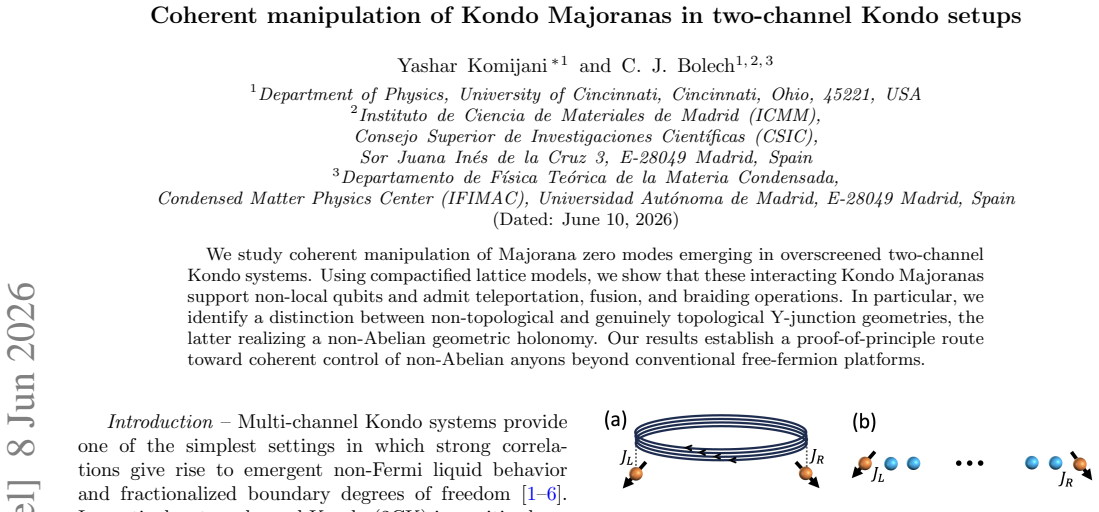
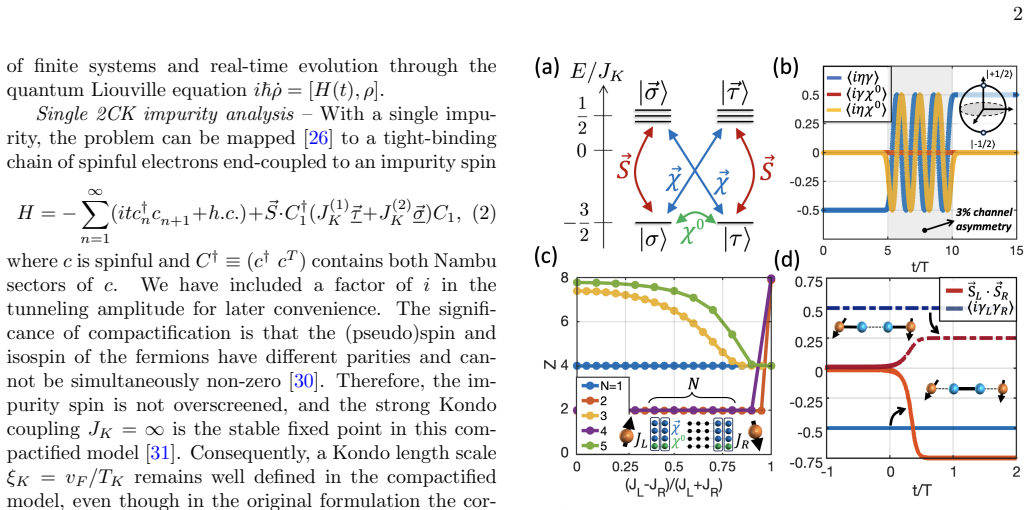
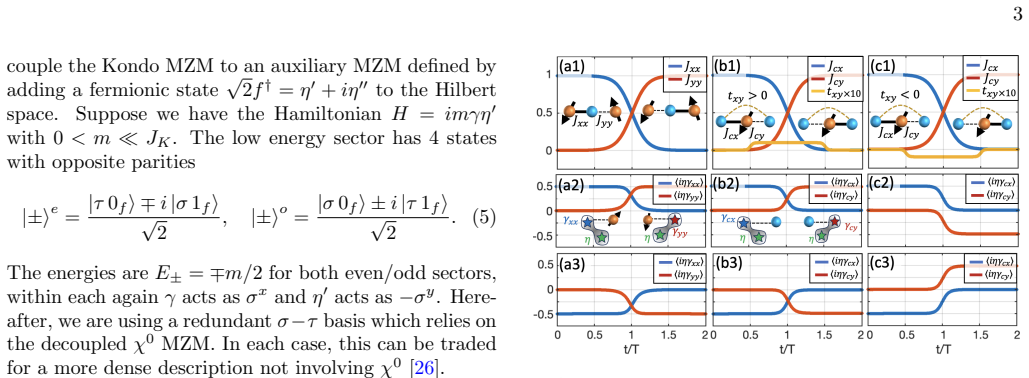
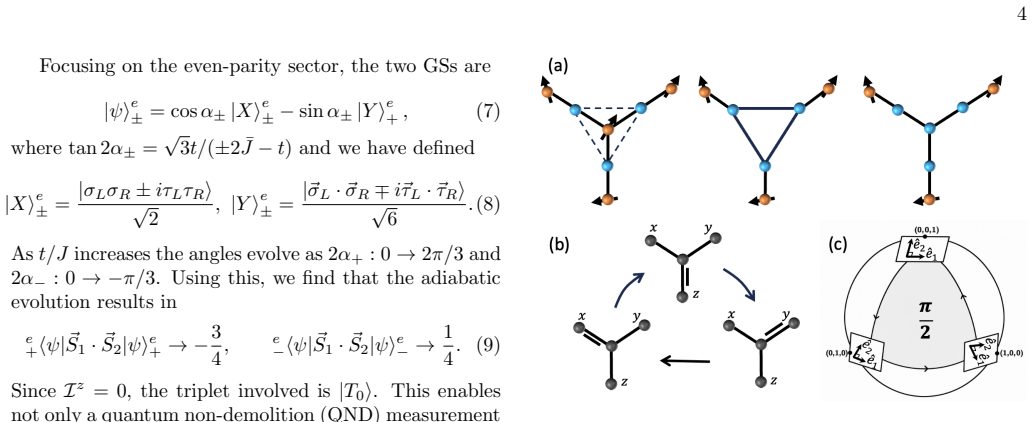
Using compactified lattice models, we show that interacting Kondo Majoranas support non-local qubits and admit teleportation, fusion, and braiding operations. In particular, we identify a distinction between non-topological and genuinely topological Y-junction geometries, the latter realizing a non-Abelian geometric holonomy. Our results establish a proof-of-principle route toward coherent control of non-Abelian anyons beyond conventional free-fermion platforms.
What carries the argument
Compactified lattice models of overscreened two-channel Kondo systems that distinguish genuinely topological Y-junction geometries and the non-Abelian geometric holonomy they produce.
If this is right
- The modes form non-local qubits.
- Teleportation, fusion, and braiding operations become admissible.
- Only genuinely topological Y-junctions produce non-Abelian geometric holonomy.
- A route opens to coherent control of non-Abelian anyons in interacting platforms.
Where Pith is reading between the lines
- Device designs based on Kondo quantum dots or nanowires could target the topological Y-junction geometries.
- The same modeling approach may apply to other overscreened Kondo realizations for similar topological features.
- The geometric distinction supplies a concrete criterion for engineering non-Abelian behavior in lattice-based setups.
Load-bearing premise
The compactified lattice models accurately capture the physics of overscreened two-channel Kondo systems and allow identification of genuinely topological versus non-topological geometries without additional assumptions about interactions or disorder.
What would settle it
An experiment on a Y-junction geometry predicted to be topological that fails to show non-Abelian geometric holonomy, or one on a predicted non-topological geometry that does show it, would falsify the central distinction.
Figures
read the original abstract
We study coherent manipulation of Majorana zero modes emerging in overscreened two-channel Kondo systems. Using compactified lattice models, we show that these interacting Kondo Majoranas support non-local qubits and admit teleportation, fusion, and braiding operations. In particular, we identify a distinction between non-topological and genuinely topological Y-junction geometries, the latter realizing a non-Abelian geometric holonomy. Our results establish a proof-of-principle route toward coherent control of non-Abelian anyons beyond conventional free-fermion platforms.
Editorial analysis
A structured set of objections, weighed in public.
Referee Report
Summary. The manuscript studies coherent manipulation of Majorana zero modes in overscreened two-channel Kondo systems using compactified lattice models. It claims that these interacting Kondo Majoranas enable non-local qubits and operations including teleportation, fusion, and braiding. A key result is the distinction between non-topological and genuinely topological Y-junction geometries, where the latter realizes a non-Abelian geometric holonomy, providing a proof-of-principle for coherent control of non-Abelian anyons beyond free-fermion platforms.
Significance. If the central claims hold under the compactified models, the work would establish a new interacting platform for non-Abelian anyon operations, extending beyond conventional free-fermion Majorana systems and offering a route to coherent control in Kondo setups.
major comments (1)
- [Y-junction geometries section] The distinction between non-topological and genuinely topological Y-junction geometries (and the associated non-Abelian geometric holonomy) is load-bearing for the central claim. The manuscript relies on compactified lattice models to capture the overscreened two-channel Kondo fixed point and to differentiate the geometries, but provides no explicit robustness checks against continuum limits, finite-size gaps, channel asymmetry, or irrelevant operators that could mask or alter the distinction.
minor comments (1)
- Ensure that all numerical or simulation parameters used in the lattice models are fully specified to allow reproducibility.
Simulated Author's Rebuttal
We thank the referee for their careful reading of the manuscript and for recognizing the potential significance of the results on coherent manipulation of Kondo Majoranas. We address the single major comment below.
read point-by-point responses
-
Referee: [Y-junction geometries section] The distinction between non-topological and genuinely topological Y-junction geometries (and the associated non-Abelian geometric holonomy) is load-bearing for the central claim. The manuscript relies on compactified lattice models to capture the overscreened two-channel Kondo fixed point and to differentiate the geometries, but provides no explicit robustness checks against continuum limits, finite-size gaps, channel asymmetry, or irrelevant operators that could mask or alter the distinction.
Authors: We agree that the distinction between the Y-junction geometries is central and that explicit robustness checks would strengthen the presentation. The compactified lattice models are constructed to realize the overscreened two-channel Kondo fixed point exactly in the infrared while preserving the lattice connectivity needed to define the junctions; the non-Abelian holonomy then follows from the symmetry-protected effective Majorana Hamiltonian. Finite-size gaps are controlled by the system sizes employed (with the Kondo scale setting the gap), channel asymmetry is irrelevant at the fixed point, and irrelevant operators are suppressed under renormalization. Nevertheless, the manuscript does not contain dedicated scans or extrapolations addressing continuum limits or operator perturbations. In the revised version we will add a dedicated paragraph in the Y-junction section that (i) recalls the RG irrelevance of the listed perturbations at the 2CK fixed point and (ii) provides a brief numerical check of the holonomy under moderate channel asymmetry within the lattice model. revision: partial
Circularity Check
No circularity; derivation relies on explicit lattice model simulations without reduction to inputs by construction
full rationale
The provided abstract and context contain no equations, self-referential definitions, fitted parameters renamed as predictions, or load-bearing self-citations. The central claims about non-local qubits, teleportation, fusion, braiding, and distinction between Y-junction geometries are presented as results obtained from compactified lattice models of overscreened two-channel Kondo systems. No step reduces the output to the input by definition or statistical forcing, and the derivation chain appears self-contained against the model's explicit construction rather than tautological. This is the expected outcome for a paper whose results are generated from numerical or analytical treatment of a defined Hamiltonian without circular renaming or imported uniqueness theorems.
Axiom & Free-Parameter Ledger
Reference graph
Works this paper leans on
-
[1]
Nozi` eres and A
P. Nozi` eres and A. Blandin, Kondo effect in real metals, J. Phys. France41, 193 (1980)
1980
-
[2]
Andrei and C
N. Andrei and C. Destri, Solution of the multichannel Kondo problem, Phys. Rev. Lett. , 364
-
[3]
Affleck, A
I. Affleck, A. W. W. Ludwig, H.-B. Pang, and D. L. Cox, Relevance of anisotropy in the multichannel Kondo ef- fect: Comparison of conformal field theory and numeri- cal renormalization-group results, Phys. Rev. B45, 7918 (1992)
1992
-
[4]
V. J. Emery and S. Kivelson, Mapping of the two-channel Kondo problem to a resonant-level model, Phys. Rev. B 46, 10812 (1992)
1992
-
[5]
Affleck and A
I. Affleck and A. W. W. Ludwig, Exact conformal- field-theory results on the multichannel Kondo effect: Single-fermion green’s function, self-energy, and resistiv- ity, Phys. Rev. B48, 7297 (1993)
1993
-
[6]
C. J. Bolech and N. Andrei, Solution of the two-channel Anderson impurity model: Implications for the heavy fermion UBe 13, Physical Review Letters88, 237206 (2002)
2002
- [7]
-
[8]
Komijani, Isolating Kondo anyons for topological quantum computation, Phys
Y. Komijani, Isolating Kondo anyons for topological quantum computation, Phys. Rev. B101, 235131 (2020), 6 arXiv:1911.08329 [cond-mat.str-el]
-
[9]
A. Y. Kitaev, Unpaired Majorana fermions in quantum wires, Physics-Uspekhi44, 131–136 (2001)
2001
-
[10]
R. M. Lutchyn, J. D. Sau, and S. Das Sarma, Ma- jorana fermions and a topological phase transition in semiconductor-superconductor heterostructures, Phys. Rev. Lett.105, 077001 (2010)
2010
-
[11]
Y. Oreg, G. Refael, and F. von Oppen, Helical liquids and Majorana bound states in quantum wires, Phys. Rev. Lett.105, 177002 (2010)
2010
-
[12]
Aghaeeet al., Interferometric single-shot parity measurement in InAs–Al hybrid devices, Nature638, 651–655 (2025)
M. Aghaeeet al., Interferometric single-shot parity measurement in InAs–Al hybrid devices, Nature638, 651–655 (2025)
2025
-
[13]
Iftikhar, S
Z. Iftikhar, S. Jezouin, A. Anthore, U. Gennser, F. D. Parmentier, A. Cavanna, and F. Pierre, Two-channel Kondo effect and renormalization flow with macroscopic quantum charge states, Nature526, 233 (2015)
2015
-
[14]
Iftikhar, A
Z. Iftikhar, A. Anthore, A. K. Mitchell, F. D. Parmentier, U. Gennser, A. Ouerghi, A. Cavanna, C. Mora, P. Simon, and F. Pierre, Tunable quantum criticality and super- ballistic transport in a “charge” Kondo circuit, Science 360, 1315 (2018)
2018
-
[15]
Pouse, L
W. Pouse, L. Peeters, C. L. Hsueh, U. Gennser, A. Ca- vanna, M. A. Kastner, A. K. Mitchell, and D. Goldhaber- Gordon, Quantum simulation of an exotic quantum crit- ical point in a two-site charge Kondo circuit, Nature Physics19, 492–499 (2023)
2023
-
[16]
Experimental Evidence of Fractional Entropy in Critical Kondo Systems
C. Piquard, A. Veillon, Y. Sato, F. Zanichelli, A. Aas- sime, A. Cavanna, U. Gennser, A. K. Mitchell, A. An- thore, and F. Pierre, Experimental evidence of fractional entropy in critical Kondo systems, arXiv:2605.00669 (2026)
work page internal anchor Pith review Pith/arXiv arXiv 2026
-
[17]
Gabay, C
D. Gabay, C. Han, P. L. S. Lopes, I. Affleck, and E. Sela, Multi-impurity chiral Kondo model: Correlation func- tions and anyon fusion rules, Phys. Rev. B105, 035151 (2022)
2022
-
[18]
Lotem, E
M. Lotem, E. Sela, and M. Goldstein, Manipulating non- Abelian anyons in a chiral multichannel Kondo model, Phys. Rev. Lett.129, 227703 (2022)
2022
-
[19]
Lotem, E
M. Lotem, E. Sela, and M. Goldstein, Chiral numerical renormalization group, Phys. Rev. B107, 155417 (2023)
2023
-
[20]
T. Ren, E. J. K¨ onig, and A. M. Tsvelik, Topological quantum computation on a chiral Kondo chain, Phys. Rev. B109, 075145 (2024)
2024
-
[21]
Sen and A
S. Sen and A. K. Mitchell, Many-body quantum inter- ference route to the two-channel Kondo effect: Inverse design for molecular junctions and quantum dot devices, Phys. Rev. Lett.133, 076501 (2024)
2024
-
[22]
Ljepoja, C
A. Ljepoja, C. J. Bolech, and N. Shah, Systematic com- pactification of the two-channel Kondo model. I. con- sistent bosonization-debosonization approach and exact comparisons, Phys. Rev. B110, 045108 (2024)
2024
-
[23]
Ljepoja, N
A. Ljepoja, N. Shah, and C. J. Bolech, Systematic com- pactification of the two-channel Kondo model. II. com- parative study of scaling and universality, Phys. Rev. B 110, 045109 (2024)
2024
-
[24]
Ljepoja, C
A. Ljepoja, C. J. Bolech, and N. Shah, Systematic compactification of the two-channel Kondo model. III. extended field-theoretic renormalization group analysis, Phys. Rev. B110, 045110 (2024)
2024
-
[25]
We useσ a and (later)τ a symbols to refer to Pauli matri- ces in pseudospin and isospin spaces, respectively, while |σa⟩and|τ a⟩symbols will be used to refer to the pseu- dospin and isospin singlet and triplet states,
-
[26]
See supplementary materials
-
[27]
Coleman, L
P. Coleman, L. B. Ioffe, and A. M. Tsvelik, Simple for- mulation of the 2-channel Kondo model, Physical Review B52, 6611 (1995)
1995
-
[28]
Bulla, A
R. Bulla, A. C. Hewson, and G.-M. Zhang, Low-energy fixed points of theσ-τand the O(3) symmetric Anderson models, Phys. Rev. B56, 11721 (1997)
1997
-
[29]
Bulla and A
R. Bulla and A. Hewson, Numerical renormalization group study of the ‘compactified’ Anderson model, Phys- ica B: Condensed Matter230–232, 627–629 (1997)
1997
-
[30]
Here we use the conventional bosonization scheme which is analytically more tractable and valid as long as param- eters of the Hamiltonian evolve adiabatically [22–24],
-
[31]
Coleman and A
P. Coleman and A. J. Schofield, Simple description of the anisotropic two-channel Kondo problem, Phys. Rev. Lett. , 2184
-
[32]
A. M. Sengupta and A. Georges, Emery–Kivelson solu- tion of the two-channel Kondo problem, Phys. Rev. B 49, 10020 (1994)
1994
-
[33]
Georges and A
A. Georges and A. Sengupta, Kondo quartet, Nuclear Physics B - Proceedings Supplements58, 105 (1997)
1997
-
[34]
G. W. Semenoff and P. Sodano, Teleportation by a Ma- jorana medium, arXiv:cond-mat/0601261 (2006)
work page internal anchor Pith review Pith/arXiv arXiv 2006
-
[35]
C. J. Bolech and E. Demler, Observing Majorana bound states in p-wave superconductors using noise measure- ments in tunneling experiments, Physical Review Letters 98, 237002 (2007)
2007
-
[36]
Fu, Electron teleportation via Majorana bound states in a mesoscopic superconductor, Physical Review Letters 104, 56402 (2010)
L. Fu, Electron teleportation via Majorana bound states in a mesoscopic superconductor, Physical Review Letters 104, 56402 (2010)
2010
-
[37]
Vijay and L
S. Vijay and L. Fu, Teleportation-based quantum infor- mation processing with Majorana zero modes, Physical Review B94, 235446 (2016)
2016
-
[38]
A. M. Whiticar, A. Fornieri, E. C. T. O’Farrell, A. C. C. Drachmann, T. Wang, C. Thomas, S. Gronin, R. Kalla- her, G. C. Gardner, M. J. Manfra, C. M. Marcus, and F. Nichele, Coherent transport through a Majorana is- land in an Aharonov–Bohm interferometer, Nature Com- munications11, 3212 (2020)
2020
-
[39]
Huang, M
H.-L. Huang, M. Naro˙ zniak, F. Liang, Y. Zhao, A. D. Castellano, M. Gong, Y. Wu, S. Wang, J. Lin, Y. Xu, H. Deng, H. Rong, J. P. Dowling, C.-Z. Peng, T. Byrnes, X. Zhu, and J.-W. Pan, Emulating quantum teleporta- tion of a Majorana zero mode qubit, Physical Review Letters126, 90502 (2021)
2021
-
[40]
Zhang, B.-L
Z.-T. Zhang, B.-L. Liang, and Z.-S. Yang, Electron tele- portation via multiple Majorana bound states in a su- perconductor island, Solid State Communications390, 115618 (2024)
2024
-
[41]
When the three branches approach near the center, additional tun- nelling or coupling through a metallic island can generate the central junction terms considered below,
A three-impurity version can be accommodated in the same quasi-one-dimensional chiral geometry by allowing the edge modes to trace a thick Y-junction. When the three branches approach near the center, additional tun- nelling or coupling through a metallic island can generate the central junction terms considered below,
-
[42]
Wilczek and A
F. Wilczek and A. Zee, Appearance of gauge structure in simple dynamical systems, Phys. Rev. Lett.52, 2111 (1984)
1984
-
[43]
Alicea, Y
J. Alicea, Y. Oreg, G. Refael, F. von Oppen, and M. P. A. Fisher, Non-Abelian statistics and topologi- cal quantum information processing in 1D wire networks, Nature Physics7, 412–417 (2011)
2011
-
[44]
D. J. Thouless, Quantization of particle transport, Phys. Rev. B27, 6083 (1983). 7
1983
-
[45]
P. W. Brouwer, Scattering approach to parametric pump- ing, Phys. Rev. B58, R10135(R) (1998)
1998
-
[46]
N. V. Vitanov, A. A. Rangelov, B. W. Shore, and K. Bergmann, Stimulated Raman adiabatic passage in physics, chemistry, and beyond, Rev. Mod. Phys.89, 015006 (2017)
2017
-
[47]
D. A. Ivanov, Non-Abelian statistics of half-quantum vor- tices inp-wave superconductors, Phys. Rev. Lett.86, 268 (2001)
2001
-
[48]
Same argument applies to spinful electrons and even bosons,
-
[49]
S. D. Sarma, M. Freedman, and C. Nayak, Majorana zero modes and topological quantum computation, npj Quantum Information1, 15001 (2015)
2015
-
[50]
Beenakker, Search for non-Abelian majorana braid- ing statistics in superconductors, SciPost Physics Lecture Notes , 15
C. Beenakker, Search for non-Abelian majorana braid- ing statistics in superconductors, SciPost Physics Lecture Notes , 15
-
[51]
P. Frey, T. Hodge, E. Mascot, and S. Rachel, Majo- rana braiding simulations with projective measurements, Physical Review B113, 115153 (2026)
2026
-
[52]
Barenco, C
A. Barenco, C. H. Bennett, R. Cleve, D. P. DiVincenzo, N. Margolus, P. Shor, T. Sleator, J. A. Smolin, and H. Weinfurter, Elementary gates for quantum computa- tion, Phys. Rev. A52, 3457 (1995)
1995
-
[53]
Boykin, T
P. Boykin, T. Mor, M. Pulver, V. Roychowdhury, and F. Vatan, On universal and fault-tolerant quantum com- puting: a novel basis and a new constructive proof of universality for Shor’s basis, in40th Annual Symposium on Foundations of Computer Science, SFCS-99 (IEEE Comput. Soc) p. 486–494
-
[54]
L. S. Georgiev, Topologically protected gates for quan- tum computation with non-Abelian anyons in the Pfaf- fian quantum Hall state, Phys. Rev. B74, 235112 (2006)
2006
-
[55]
Bravyi, Universal quantum computation with theν= 5/2 fractional quantum Hall state, Phys
S. Bravyi, Universal quantum computation with theν= 5/2 fractional quantum Hall state, Phys. Rev. A73, 042313 (2006)
2006
-
[56]
van Heck, A
B. van Heck, A. R. Akhmerov, F. Hassler, M. Burrello, and C. W. J. Beenakker, Coulomb-assisted braiding of Majorana fermions in a Josephson junction array, New Journal of Physics14, 035019
-
[57]
M. A. Nielsen and I. L. Chuang,Quantum Computation and Quantum Information: 10th Anniversary Edition (Cambridge University Press, 2012)
2012
-
[58]
Zhang, J.-S
S.-Q. Zhang, J.-S. Hong, Y. Xue, X.-J. Luo, L.-W. Yu, X.-J. Liu, and X. Liu, Ancilla-free scheme of determinis- tic topological quantum gates for Majorana qubits, Phys. Rev. B109, 165302 (2024)
2024
-
[59]
C. W. J. Beenakker, D. P. DiVincenzo, C. Emary, and M. Kindermann, Charge detection enables free- electron quantum computation, Physical Review Letters 93, 20501 (2004)
2004
-
[60]
Zilberberg, B
O. Zilberberg, B. Braunecker, and D. Loss, Controlled- not gate for multiparticle qubits and topological quantum computation based on parity measurements, Phys. Rev. A77, 012327 (2008)
2008
-
[61]
Le Hur, Kondo effect in a one-dimensional d-wave superconductor, Europhysics Letters (EPL)49, 768–774 (2000)
K. Le Hur, Kondo effect in a one-dimensional d-wave superconductor, Europhysics Letters (EPL)49, 768–774 (2000)
2000
-
[62]
Coleman, L
P. Coleman, L. B. Ioffe, and A. M. Tsvelik, Simple for- mulation of the two-channel Kondo model, Phys. Rev. B 52, 6611 (1995). Supplementary Materials This supplementary material provides proof of various statements made in the paper including an explicit compu- tation of the beta function coefficients. Contents References . . . . . . . . . . . . . . . . ...
1995
-
[63]
For MZMs, the ZZ measurement is a parity measurement, whereas the XX measurement can be related to a ZZ measurement by additional Hadamard dressing;X=HZH. Fig. (S4) summarizes this protocol
discussion (0)
Sign in with ORCID, Apple, or X to comment. Anyone can read and Pith papers without signing in.