REVIEW 1 major objections 2 minor 20 references
Adaptive Randomized Pivoting for Tensor Singular Value Decomposition Model
T0 review · 1 major / 2 minor · reviewed 2026-06-26 · grok-4.3
Pith's one-line read Adaptive randomized pivoting extends to tensors with two constructions: slicewise ARP-T-CUR inheriting matrix bounds and coupled T-ARP under a frequency-alignment condition.
desk verdict Extends matrix ARP to t-product tensors via slicewise ARP-T-CUR and coupled T-ARP, but the latter's bound rests on a frequency-alignment condition whose practical range is not quantified. read the letter →
The pith
A machine-rendered reading of the paper's core claim, the machinery that carries it, and where it could break.
The reading
What carries the argument
The frequency-alignment condition measuring deviation between a common tensor-level sampling rule and the individual Fourier-slice ARP rules, which controls the error bound for the coupled T-ARP construction.
What would settle it
Construct a tensor whose leverage-score distributions differ markedly across Fourier frequencies, run T-ARP, and check whether the observed approximation error exceeds the bound by more than the factor predicted by the measured alignment distance.
Extended reading notes
Core claim
Adaptive randomized pivoting extends to the tensor setting by either applying it independently per Fourier slice (ARP-T-CUR) or by enforcing common slice indices across all slices (T-ARP); the latter requires a frequency-alignment condition that quantifies how far the shared sampling rule deviates from the per-slice rules, and the condition yields an expected-error bound that reduces to the standard matrix factor when the leverage scores are aligned.
Load-bearing premise
The frequency-alignment condition must hold so that the common sampling rule stays close enough to the slice-wise rules; if the distributions of leverage scores differ strongly across frequencies the stated T-ARP bound no longer applies.
Editorial extensions
If this is right
- ARP-T-CUR delivers a Fourier-slicewise CUR whose expected error is bounded exactly as in the matrix ARP theory.
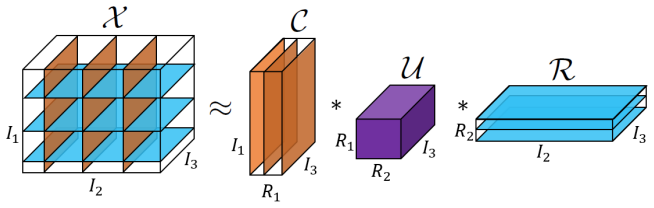
- T-ARP produces a genuine tensor cross approximation using the same lateral and horizontal slices throughout the tensor.
- The expected-error bound for T-ARP holds once the frequency-alignment condition is satisfied and recovers the r+1 factor when leverage scores align.
- The resulting tensor cross approximation connects directly to t-DEIM.
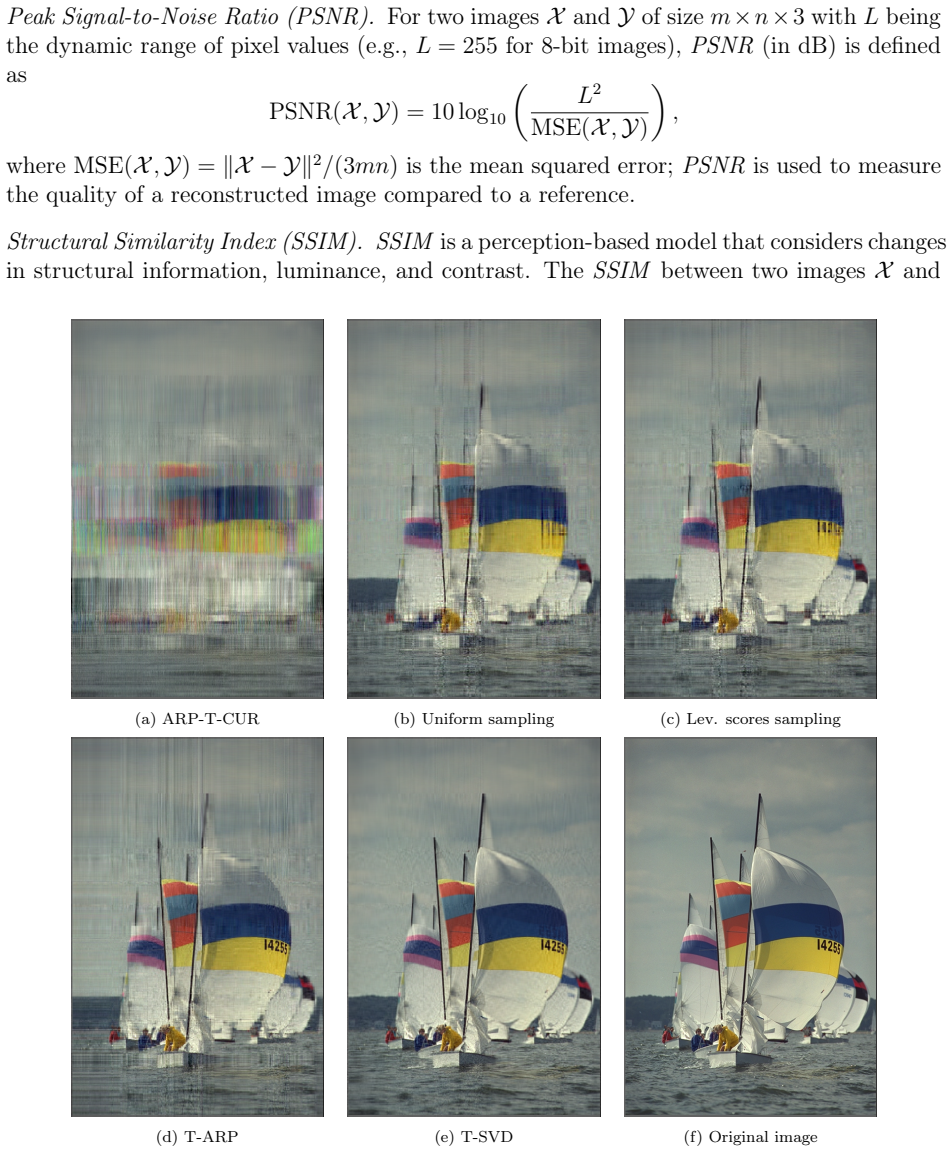
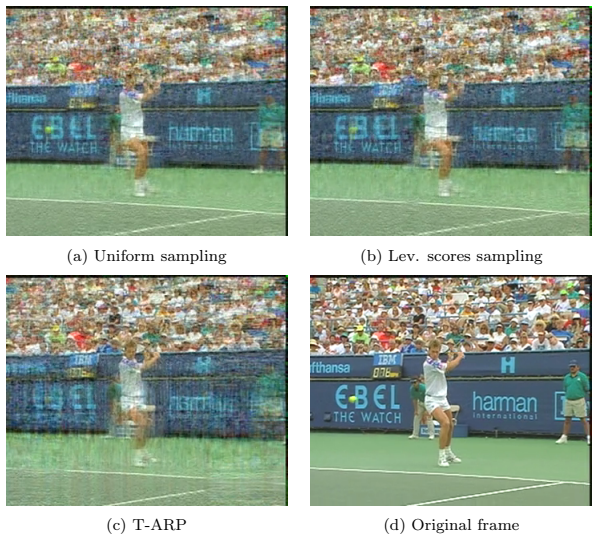
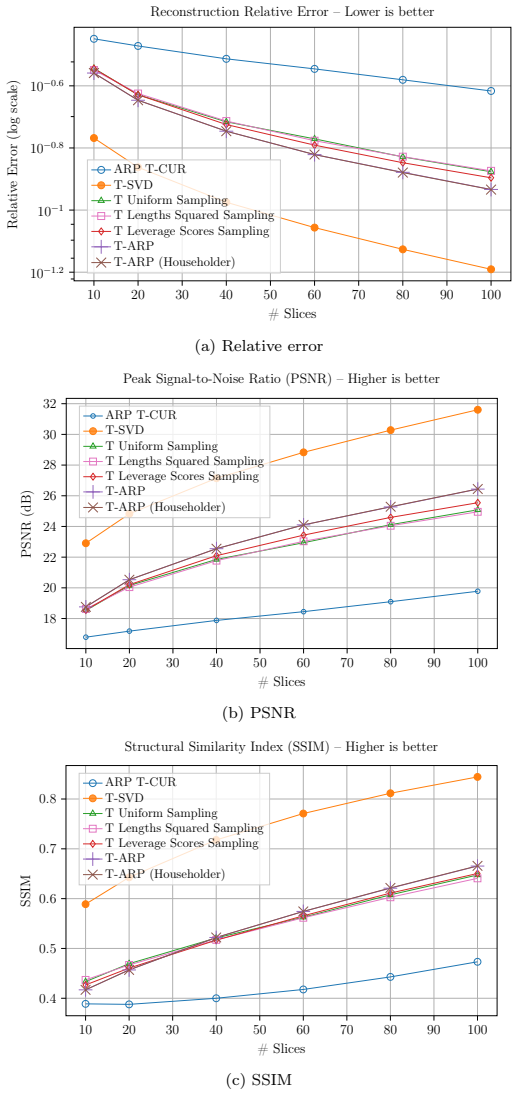
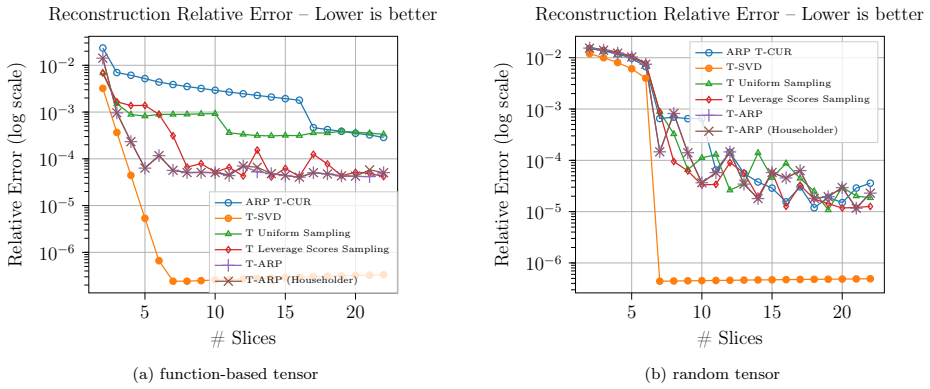
- Experiments on images and videos indicate that common-index sampling improves performance over independent-slice baselines.
Reading between the lines
- If the alignment condition holds for many real-world tensors such as video data, T-ARP would give structurally coherent approximations at modest extra cost.
- The common-index requirement could be relaxed by allowing limited frequency-dependent adjustments while still preserving a tensor-level CUR form.
- The same alignment idea might apply to other tensor factorizations that mix Fourier and spatial sampling.
- Direct comparison of storage and runtime between ARP-T-CUR and T-ARP on large tensors would quantify the practical price of enforcing common indices.
Signed reviews
Editorial analysis
A structured set of objections, weighed in public.
Referee Report
Summary. The paper extends adaptive randomized pivoting (ARP) to tensor CUR approximations in the t-product framework. It proposes ARP-T-CUR, which applies matrix ARP independently to frontal slices in the Fourier domain and inherits expected-error bounds directly from matrix theory, and T-ARP, which enforces common lateral/horizontal slice selection across the tensor and derives an expected-error bound under an explicit frequency-alignment condition on leverage-score distributions; the bound recovers the standard r+1 factor when distributions align. The work also relates the resulting approximation to t-DEIM and reports experiments on synthetic tensors, images, and videos.
Significance. If the central claims hold, the work supplies the first ARP-style guarantees for tensor cross approximations with shared indices, which is relevant for applications requiring consistent sampling across modes such as video compression. ARP-T-CUR inherits its bound without additional assumptions, while T-ARP's conditional bound makes the coupling explicit; the experiments provide empirical support for the practical advantage of common-index sampling.
major comments (1)
- The frequency-alignment condition is load-bearing for the T-ARP expected-error bound (stated in the abstract and developed in the T-ARP section). The bound recovers the usual r+1 factor precisely when leverage-score distributions align across Fourier slices, but the manuscript supplies no further quantitative control on the degradation factor when the distributions differ; because common-index selection is the defining feature of T-ARP, this gap limits the scope of the claimed guarantee.
minor comments (2)
- Notation for the t-product and Fourier slices is introduced without a self-contained summary table; adding one would improve readability for readers outside the immediate t-product literature.
- The experimental section reports results on images and videos but does not specify how the alignment condition was monitored or estimated in those runs; a brief diagnostic would clarify whether the observed performance occurs inside or outside the regime where the bound is tight.
Simulated Author's Rebuttal
We thank the referee for the careful reading and for highlighting the role of the frequency-alignment condition in the T-ARP analysis. We address the major comment below.
read point-by-point responses
-
Referee: The frequency-alignment condition is load-bearing for the T-ARP expected-error bound (stated in the abstract and developed in the T-ARP section). The bound recovers the usual r+1 factor precisely when leverage-score distributions align across Fourier slices, but the manuscript supplies no further quantitative control on the degradation factor when the distributions differ; because common-index selection is the defining feature of T-ARP, this gap limits the scope of the claimed guarantee.
Authors: We agree that the frequency-alignment condition is central to the T-ARP bound and that the manuscript provides no quantitative control on the degradation factor when leverage-score distributions differ across Fourier slices. A uniform bound independent of alignment would require additional structural assumptions on the tensor that do not hold in general, as common-index selection can be arbitrarily misaligned with individual slices. The explicit condition is presented precisely to make this coupling transparent and to recover the classical factor when alignment holds. In the revision we will add a dedicated remark clarifying this limitation, together with synthetic examples that illustrate the observed degradation under controlled misalignment. This will better delineate the scope of the T-ARP guarantee while preserving the paper's focus on making the cost of common indices explicit. revision: yes
Circularity Check
No significant circularity; derivations inherit matrix bounds and introduce explicit new condition with stated proof
full rationale
The paper's two constructions are defined explicitly: ARP-T-CUR applies matrix ARP slicewise in the Fourier domain and inherits the matrix expected-error bound directly; T-ARP couples indices across slices and states an expected-error bound that holds precisely when a frequency-alignment condition on leverage-score distributions is met. Both the condition and the bound are introduced and proved within the paper rather than presupposed or fitted to the target result. No parameter is estimated from data and then relabeled as a prediction, no self-citation supplies the central uniqueness or ansatz, and no known empirical pattern is merely renamed. The derivation chain therefore remains self-contained against the cited matrix ARP theory and the paper's own definitions.
Assumptions & free parameters
assumptions (1)
- domain assumption Standard properties of the t-product framework and Fourier transform for tensors allowing slicewise matrix operations
Cite this review
Pith. "Pith review of Adaptive Randomized Pivoting for Tensor Singular Value Decomposition Model." pith.science (2026). https://pith.science/paper/J2JZ35VC
@misc{pith2026260626688,
  author       = {Pith},
  title        = {Pith review of: Adaptive Randomized Pivoting for Tensor Singular Value Decomposition Model},
  year         = {2026},
  howpublished = {\url{https://pith.science/paper/J2JZ35VC}},
  note         = {Machine review of arXiv:2606.26688}
}
abstract
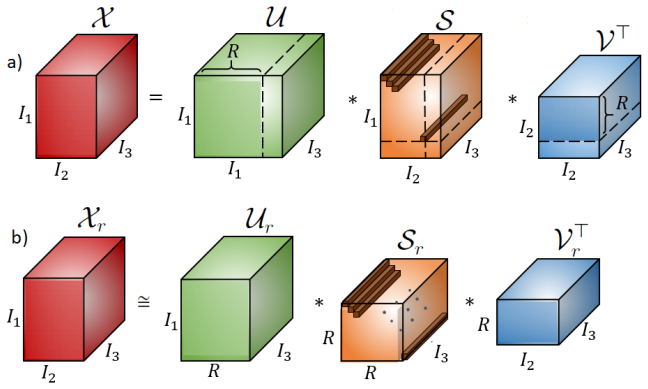
This paper studies how adaptive randomized pivoting (ARP), recently introduced for matrix column subset selection, can be extended to tensors in the t-product framework. We propose two constructions. The first one, called ARP-T-CUR, applies matrix ARP independently to the frontal slices of the tensor in the Fourier domain. This gives a Fourier-slicewise CUR approximation and leads to a direct expected-error bound inherited from the matrix theory. The second construction, called T-ARP, selects common lateral and horizontal slices for the whole tensor. This produces a genuine tensor cross approximation in the t-product sense, but also introduces a new difficulty: the same pivot indices must be used across all Fourier slices. We make this coupling explicit and prove an expected-error bound under a frequency-alignment condition measuring how far the common tensor-level sampling rule is from the slice-wise ARP sampling rules. This condition recovers the usual $r+1$-type factor when the leverage-score distributions are aligned across frequencies. We also discuss the resulting tensor cross approximation and its connection with t-DEIM. Numerical experiments on synthetic tensors, images, and videos illustrate the behavior of the proposed methods and show the benefit of common-index tensor sampling over standard tensor cross baselines.
Figures
Figures from the paper (3 more)
Reference graph
Works this paper leans on
-
[1]
L. D. Lathauwer, B. D. Moor, J. Vandewalle, A multilinear singular value decomposi- tion, SIAM Journal on Matrix Analysis and Applications 21 (4) (2000) 1253–1278
2000
-
[2]
M. E. Kilmer, C. D. Martin, Factorization strategies for third-order tensors, Linear Algebra and its Applications 435 (3) (2011) 641–658
2011
-
[3]
I. V. Oseledets, Tensor-train decomposition, SIAM Journal on Scientific Computing 33 (5) (2011) 2295–2317
2011
-
[4]
Q. Zhao, G. Zhou, S. Xie, L. Zhang, A. Cichocki, Tensor ring decomposition, arXiv preprint (2016).arXiv:1606.05535
work page Pith review arXiv 2016
-
[5]
Q. Song, H. Ge, J. Caverlee, X. Hu, Tensor completion algorithms in big data analytics, ACM Transactions on Knowledge Discovery from Data (TKDD) 13 (1) (2019) 1–48
2019
-
[6]
M. G. Asante-Mensah, A. H. Phan, S. Ahmadi-Asl, Z. Al Aghbari, A. Cichocki, Image reconstruction using superpixel clustering and tensor completion, Signal Processing 212 (2023) 109158
2023
-
[7]
L. Duan, L. Yang, Y. Guo, Paramps: Convolutional neural networks based on tensor de- composition for heart sound signal analysis and cardiovascular disease diagnosis, Signal Processing 227 (2025) 109716
2025
-
[8]
Bortone, Y
M. Bortone, Y. Rath, G. H. Booth, Simple fermionic backflow states via a systematically improvable tensor decomposition, Communications Physics 8 (1) (2025) 169
2025
Show all 20 references
-
[9]
K. T. Brice, M. Melgaard, M. Pavlidou, H. Cox, Numerical tensor method for atomic and exotic three-particle systems, Physical Review A 111 (2) (2025) 022812
2025
-
[10]
De Pauw, B
J. De Pauw, B. Goethals, Weighted tensor decompositions for context-aware collabora- tive filtering, arXiv preprint arXiv:2503.08393 (2025)
2025
-
[11]
F. Zhou, X. Fu, Z. Lu, Tensor ring decomposition based collaborative filtering recommendation with differential privacy, in: 2023 IEEE International Conference on High Performance Computing & Communications, Data Science & Systems, Smart City & Dependability in Sensor, Cloud &...
2023
-
[12]
Cortinovis, D
A. Cortinovis, D. Kressner, Adaptive randomized pivoting for column subset selection, DEIM, and low-rank approximation, arXiv preprint (2024).arXiv:2412.13992v2
2024
-
[13]
D. A. Tarzanagh, G. Michailidis, Fast randomized algorithms for t-product based tensor operations and decompositions with applications to imaging data, SIAM Journal on Imaging Sciences 11 (4) (2018) 2629–2664
2018
-
[14]
Ahmadi-Asl, A
S. Ahmadi-Asl, A. H. Phan, A. Cichocki, A. Sozykina, Z. Al Aghbari, J. Wang, I. Os- eledets, Adaptive cross tubal tensor approximation, Linear Algebra and its Applications 695 (2024) 168–190
2024
-
[15]
Ahmadi-Asl, A.-H
S. Ahmadi-Asl, A.-H. Phan, C. F. Caiafa, A. Cichocki, Robust low tubal rank tensor recovery using discrete empirical interpolation method with optimized slice/feature se- lection: S. ahmadi-asl et al., Advances in Computational Mathematics 50 (2) (2024) 23
2024
-
[16]
Ahmadi-Asl, A.-H
S. Ahmadi-Asl, A.-H. Phan, A. Cichocki, A randomized algorithm for tensor singular value decomposition using an arbitrary number of passes, Journal of Scientific Comput- ing 98 (1) (2024) 23
2024
-
[17]
Chaturantabut, D
S. Chaturantabut, D. C. Sorensen, Nonlinear model reduction via discrete empirical interpolation, SIAM Journal on Scientific Computing 32 (5) (2010) 2737–2764
2010
-
[18]
Deshpande, L
A. Deshpande, L. Rademacher, S. S. Vempala, G. Wang, Matrix approximation and projective clustering via volume sampling, Theory of Computing 2 (1) (2006) 225–247
2006
-
[19]
Osinsky, Close to optimal column approximations with a single svd, arXiv preprint arXiv:2308.09068 (2023)
A. Osinsky, Close to optimal column approximations with a single svd, arXiv preprint arXiv:2308.09068 (2023)
2023
-
[20]
C. D. Martin, R. Shafer, B. LaRue, An order-ptensor factorization with applications in imaging, SIAM Journal on Scientific Computing 35 (1) (2013) A474–A490.doi: 10.1137/110841229. 36
2013 doi
Reviewed June 26, 2026 · model on record in the stance chip above.
Discussion (0). Continue with ORCID to comment.