REVIEW 5 major objections 5 minor 23 references
Embodied Hazard Mitigation using Vision-Language Models for Autonomous Mobile Robots
T0 review · 5 major / 5 minor · reviewed 2026-08-04 · deepseek-v4-flash
Pith's one-line read This paper claims that an autonomous mobile robot can perceive, classify, and act on environmental anomalies in real time by chaining BLIP image captioning, Grad-CAM heatmaps, and an LLM classifier, reporting 91.2% detection accuracy on 125
desk verdict A plausible ROS2 VLM+LLM anomaly detection pipeline, but the headline 91.2% accuracy is contradicted by the paper's own confusion matrix; the empirical claims need reconciliation before they can be trusted. read the letter →
The pith
A machine-rendered reading of the paper's core claim, the machinery that carries it, and where it could break.
The reading
What carries the argument
The load-bearing mechanism is a four-node perception-and-reasoning loop. A camera node grabs a frame; a captioning node turns it into text; a heatmap node computes a Grad-CAM saliency map to highlight the salient regions; and an LLM node classifies the combined caption-plus-heatmap as HAZARDOUS, CONFLICT, or CLEAR using a fixed prompt. A response-mapping layer scans the classification for keywords and triggers the corresponding mitigation, such as siren, alert, path replan, or report. The paper formalizes this as an anomaly detection function A:(X,H,L)->C and an effectiveness factor epsilon in [0,1] that is meant to tie detection accuracy and response latency to overall system safety.
What would settle it
Re-run the same pipeline in a corridor with realistic hazards—spilled liquid, partially occluded obstacles, people moving—without large printed images, and count detections; if accuracy falls well below 91.2% or latency regularly exceeds the robot's action time, the real-time safety claim fails. Also recompute accuracy on the 125 trials using the confusion-matrix formula; the 91.2% figure should reproduce.
Extended reading notes
Core claim
The core claim is that a generic mobile robot, given a camera and access to a vision-language model and a large language model, can detect and classify anomalies in real time and act on them. The system defines two anomaly states: Hazardous, covering threats like firearms, fights, and spills that warrant reports and urgent alerts, and Conflict, covering navigation obstructions and rule violations that warrant avoidance and path replanning. The classification comes from an LLM that reads the BLIP caption of the current camera frame together with a Grad-CAM saliency summary, and the chosen label triggers predefined mitigation actions. The authors report 91.2% detection accuracy on 125 curated
Load-bearing premise
The evaluation assumes that large printed images placed to dominate the robot's field of view, labeled by human interpretation, are a faithful proxy for real-world hazards; if real hazards are smaller, occluded, or ambiguous, the reported accuracy and safety benefit may not transfer.
Editorial extensions
If this is right
- A robot running this pipeline can issue natural-language hazard reports and trigger alert chains (email, phone, siren) without a human in the loop.
- Separating Hazardous from Conflict states gives the robot distinct response policies: urgent reporting versus avoidance and replanning.
- Moving captioning and LLM inference off the onboard computer cut average latency from roughly 20 seconds to about 6 seconds, which suggests the bottleneck is compute placement rather than the perception models themselves.
- Navigation runs with anomaly detection enabled showed fewer sudden stops and faster completion times in the tested corridor, implying the detections actually changed robot behavior.
Reading between the lines
- A direct next test would move from large printed images to small, partially occluded, or dynamically moving hazards; the reported 91.2% accuracy is likely an upper bound because the stimuli were designed to dominate the camera view.
- The paper's two accuracy numbers—91.2% over 125 trials and 82.14% over 196 images—measure different test sets and definitions; treating them as one converging estimate would overstate consistency.
- The five-second capture cadence and the observation that high-latency classifications arrived after the robot acted suggest the safety argument depends on keeping LLM latency below the robot's reaction horizon; predictive triggering or on-device inference would make the benefit robust.
- The Hazardous/Conflict labels could be fed back into the formal risk functions R_i(S_h) to produce probabilistic hazard maps for path planning, turning discrete triggers into continuous risk avoidance.
Editorial analysis
A structured set of objections, weighed in public.
Referee Report
Summary. The paper proposes a ROS-based multimodal anomaly detection and mitigation system for autonomous mobile robots, combining a vision-language model (BLIP), Grad-CAM heatmaps, and an LLM to classify observed anomalies as Hazardous or Conflict and trigger predefined mitigation actions (siren, notify, replan, etc.). The system is evaluated on a Raspberry Pi/robot platform in an indoor setting with simulated anomalies (large printed images), a user study (n=30), and latency/accuracy measurements. The paper reports a 91.2% detection accuracy and improved latency after offloading BLIP/LLM inference, claiming that the integration enhances safety, operational reliability, and user trust. The central empirical claims, however, are internally inconsistent across sections, and the evaluation protocol is underspecified.
Significance. If the central claims were supported, the paper would be a useful integration of VLM+LLM components for real-time anomaly detection and mitigation on an edge robot, with a concrete ROS2 implementation and a user study. That contribution is potentially relevant to the autonomous-robotics community. The paper does not ship code, data, or machine-checked proofs, and the main quantitative results are not reproducible from the text because the reported accuracy and latency figures contradict one another. The core scientific value is therefore currently unverified.
major comments (5)
- [§V-C.2 and §V-B, Eq. (13)] The headline accuracy of 91.2% (114/125 in Section V-C.2) is incompatible with the paper's own confusion matrix in Table IV, which by Eq. (13) gives (82+79)/196 = 82.14%. If these are different datasets or experimental conditions, the paper must state this explicitly and identify which evaluation supports the abstract's claim. As written, the reader cannot determine which number is authoritative, and the central empirical claim is not reproducible.
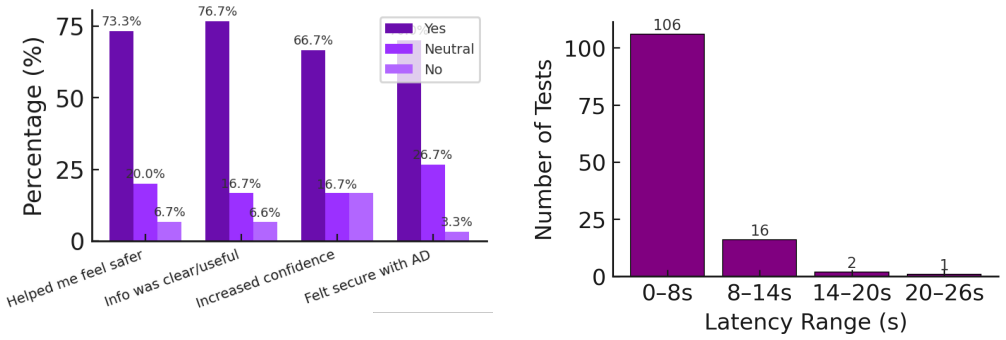
- [§V-A vs. §V-C.1 and §VI] Latency reports are mutually inconsistent: Section V-A reports 88 samples with an average of ~20 s, while Section V-C.1 reports 125 trials with an average of 6.017 s. Moreover, Section IV-D states 84% of responses within 14 s, while Section VI claims 85% of responses within 8 s. The paper needs a single, precisely defined latency protocol (definition of start and end times, sample count, hardware/software configuration) and a reconciliation of these numbers, otherwise the real-time claim is unsupported.
- [§V-C.2, Eq. (14)] The 'Detection Rate' formula (U + 0.5N)/T is identical to the user-preference score PS in Eq. (12), and with N = 0 it is simply U/T. This is not a detection rate in any standard sense, and it is never applied to the confusion matrix. It should be removed or replaced by a proper detection metric (e.g., accuracy, precision, recall, F1) computed from the confusion matrix or from a clearly defined test set.
- [Assumption 1, Eq. (7), and Algorithm 1] The anomaly detection factor ε is defined as a function of detection accuracy and response time (Eq. (7) and Assumption 1), and then Algorithm 1 (lines 16–17) proposes to 'correlate performance with ε'. This is circular: ε is derived from the same performance metrics it is later correlated with. Moreover, no such correlation analysis is actually reported. Either remove this step or present an independent validation of ε against safety outcomes.
- [§IV-C and §V-B] The evaluation relies on anomalies simulated by large printed images that dominate the robot's field of view, and the ground truth is human interpretation of those images. This is a weak proxy for real-world hazards. The paper should explicitly discuss this limitation and provide evidence (e.g., per-category accuracy, or at least a small real-world pilot) that the system's performance transfers beyond the controlled setup. At minimum, the abstract and conclusions should not overstate readiness for 'real-world deployment' based only on this evaluation.
minor comments (5)
- [§IV-A] The setup states 'ROS 1 Noetic' but then says the module was 'adapted to ROS 2 Foxy'; clarify which ROS distribution is used for which component, and whether the communication between ROS 1 and ROS 2 stacks is functional in the reported experiments.
- [Table I] The caption says 'results are averaged over four 14-meter delivery runs' but the table lists only two conditions each for manual and autonomous navigation. Please clarify the number of runs per condition and whether the reported values are means, medians, or single runs.
- [§V (table and text)] The text says 'significant improvement' in safety, trust, and reliability, but no statistical test is reported for the survey results or navigation metrics. Report appropriate tests (e.g., paired t-test or Wilcoxon) with effect sizes, or soften the causal language.
- [§IV-D and §V-C.1] There is a numerical inconsistency between '84% of the responses occurring within 14 s' and the later '85% of the responses occurring in 8 seconds'. Please correct and ensure all percentage/range statements refer to the same dataset.
- [Throughout] The notation in Eq. (1) is not consistently defined (e.g., q_env appears as q_j env). Please polish the notation and define all symbols exactly once.
Circularity Check
Minor definitional coupling: ε is constructed from the performance metrics it is then said to 'correlate' with; the reported 91.2% and latency figures are direct measurements, not fitted predictions.
-
self definitional
[Assumption 1 / Eq. (3) / Eq. (7) / Algorithm 1 step 17 / Section V-A]
"The value of ε is determined through performance metrics that include detection accuracy, false positive rates, and response time measurements. ... Correlate performance with anomaly detection factor ε."
Assumption 1 defines ε as a normalized score derived from detection accuracy, false-positive rates, and response-time evaluations (Eqs. 3 and 7). Algorithm 1 then instructs to 'Correlate performance with anomaly detection factor ε,' and Section V-A says higher latency 'directly impacts the anomaly detection factor ε.' Since ε is constructed from those same performance metrics, the claimed correlation/impact is true by definition rather than an empirical result. This loop is not load-bearing for the central empirical claims (91.2% accuracy, latency distributions), which are direct measurements against human-annotated labels.
full rationale
The paper's headline numbers—114/125 = 91.2% detection accuracy and latency summaries—are empirical measurements compared with human-annotated ground-truth labels, not outputs of a fitted model. No parameter is fit to a subset and then renamed a prediction; no uniqueness theorem is imported from the authors' prior work; self-citations [2] and [22] are contextual and not used to force the choice of architecture or results. The only circular step is the anomaly-detection factor ε, which is defined as a function of accuracy, false-positive rate, and response time, and then 'correlated' with those same metrics. That is a definitional tautology but does not generate the reported quantitative results. The internal discrepancy between the 91.2% (125 trials) and 82.14% (196-image confusion matrix) accuracy figures is a reproducibility/consistency concern, not a circularity, and does not change this assessment.
Assumptions & free parameters
free parameters (1)
- Neutral-response weight in PS/Detection Rate formula =
0.5
assumptions (4)
- domain assumption VLM captions and heatmaps contain enough semantic information to classify hazards.
- domain assumption Ground-truth anomaly labels can be set by human interpretation of still images.
- domain assumption The robot world can be partitioned into hazardous, loss, and safe states with risk functions.
- domain assumption Large printed images dominating the camera view are representative of deployment anomalies.
Cite this review
Pith. "Pith review of Embodied Hazard Mitigation using Vision-Language Models for Autonomous Mobile Robots." pith.science (2026). https://pith.science/paper/J3CJVFMV
@misc{pith2026250906768,
  author       = {Pith},
  title        = {Pith review of: Embodied Hazard Mitigation using Vision-Language Models for Autonomous Mobile Robots},
  year         = {2026},
  howpublished = {\url{https://pith.science/paper/J3CJVFMV}},
  note         = {Machine review of arXiv:2509.06768}
}
read the original abstract
Autonomous robots operating in dynamic environments should identify and report anomalies. Embodying proactive mitigation improves safety and operational continuity. This paper presents a multimodal anomaly detection and mitigation system that integrates vision-language models and large language models to identify and report hazardous situations and conflicts in real-time. The proposed system enables robots to perceive, interpret, report, and if possible respond to urban and environmental anomalies through proactive detection mechanisms and automated mitigation actions. A key contribution in this paper is the integration of Hazardous and Conflict states into the robot's decision-making framework, where each anomaly type can trigger specific mitigation strategies. User studies (n = 30) demonstrated the effectiveness of the system in anomaly detection with 91.2% prediction accuracy and relatively low latency response times using edge-ai architecture.
Figures


Reference graph
Works this paper leans on
-
[1]
Jimmy Baraglia, Maya Cakmak, Yukie Nagai, Rajesh PN Rao, and Minoru Asada. Efficient human-robot collaboration: when should a robot take initiative?The International Journal of Robotics Research, 36(5-7):563–579, 2017
work page 2017
-
[2]
Explainable autonomous mobile robots: Interface and socially aware learning.Authorea Preprints, 2024
Kiruthiga C Shekar, Pranav Doma, Chinmay Prashanth, Vikram Subra- maniam, and Aliasghar Arab. Explainable autonomous mobile robots: Interface and socially aware learning.Authorea Preprints, 2024
work page 2024
-
[3]
Trust in automation: Designing for appropriate reliance.Human factors, 46(1):50–80, 2004
John D Lee and Katrina A See. Trust in automation: Designing for appropriate reliance.Human factors, 46(1):50–80, 2004
2004
-
[4]
Lindsay Sanneman and Julie A Shah. The situation awareness frame- work for explainable ai (safe-ai) and human factors considerations for xai systems.International Journal of Human–Computer Interaction, 38(18-20):1772–1788, 2022
work page 2022
-
[5]
Opening up to social robots: how emotions drive self-disclosure behavior
Guy Laban, Arvid Kappas, Val Morrison, and Emily S Cross. Opening up to social robots: how emotions drive self-disclosure behavior. InIEEE International Conference on Robot and Human Interactive Communication (RO-MAN), pages 1697–1704. IEEE, 2023
work page 2023
-
[6]
David Sobr ´ın-Hidalgo, Miguel ´Angel Gonz ´alez-Santamarta, ´Angel Manuel Guerrero-Higueras, Francisco Javier Rodr ´ıguez- Lera, and Vicente Matell ´an-Olivera. Enhancing robot explanation capabilities through vision-language models: a preliminary study by interpreting visual inputs for improved human-robot interaction. arXiv preprint arXiv:2404.09705, 2024
arXiv 2024
-
[7]
Talkwithmachines: Enhancing human-robot interaction through large/vision language models
Ammar N Abbas and Csaba Beleznai. Talkwithmachines: Enhancing human-robot interaction through large/vision language models. In Eighth IEEE International Conference on Robotic Computing (IRC), pages 253–258. IEEE, 2024
work page 2024
-
[8]
Devleena Das, Siddhartha Banerjee, and Sonia Chernova. Explain- able ai for robot failures: Generating explanations that improve user assistance in fault recovery. InProceedings of the 2021 ACM/IEEE international conference on human-robot interaction, pages 351–360, 2021
work page 2021
Show all 23 references
-
[9]
Anomaly detection in autonomous systems: A survey.IEEE Transactions on Cybernetics, 53(4):1–15, 2023
Wei Zhang, Xiaodong Li, Jianhui Wang, and Ying Chen. Anomaly detection in autonomous systems: A survey.IEEE Transactions on Cybernetics, 53(4):1–15, 2023
2023
-
[10]
A surrogate model framework for explainable autonomous behaviour
Konstantinos Gavriilidis, Andrea Munafo, Wei Pang, and Helen Hastie. A surrogate model framework for explainable autonomous behaviour. arXiv preprint arXiv:2305.19724, 2023
2023 arXiv
-
[11]
Large language models for autonomous robotics: A comprehensive review.arXiv preprint arXiv:2401.12345, 2024
Minghao Chen, Yang Liu, Lei Zhang, and Peng Wang. Large language models for autonomous robotics: A comprehensive review.arXiv preprint arXiv:2401.12345, 2024
2024 arXiv
-
[12]
Explainable reinforcement learning via model transforms.Advances in Neural Information Processing Systems, 35:34039–34051, 2022
Mira Finkelstein, Lucy Liu, Yoav Kolumbus, David C Parkes, Jeffrey S Rosenschein, Sarah Keren, et al. Explainable reinforcement learning via model transforms.Advances in Neural Information Processing Systems, 35:34039–34051, 2022
2022
-
[13]
Towards explain- able ai: Interpretable models for complex decision-making
Jaibir Singh, Suman Rani, and Garaga Srilakshmi. Towards explain- able ai: Interpretable models for complex decision-making. InInter- national Conference on Knowledge Engineering and Communication Systems (ICKECS), volume 1, pages 1–5. IEEE, 2024
2024
-
[14]
Evaluating human-like explanations for robot actions in rein- forcement learning scenarios
Francisco Cruz, Charlotte Young, Richard Dazeley, and Peter Vam- plew. Evaluating human-like explanations for robot actions in rein- forcement learning scenarios. InIEEE/RSJ International Conference on Intelligent Robots and Systems (IROS), pages 894–901. IEEE, 2022
2022
-
[15]
Safety- critical anomaly detection for autonomous systems.IEEE Transactions on Safety, Security, and Reliability, 2(3):234–248, 2023
Jianing Liu, David Smith, Robert Johnson, and Sarah Brown. Safety- critical anomaly detection for autonomous systems.IEEE Transactions on Safety, Security, and Reliability, 2(3):234–248, 2023
2023
-
[16]
Grad-cam: visual explanations from deep networks via gradient-based localization.In- ternational journal of computer vision, 128:336–359, 2020
Ramprasaath R Selvaraju, Michael Cogswell, Abhishek Das, Ramakr- ishna Vedantam, Devi Parikh, and Dhruv Batra. Grad-cam: visual explanations from deep networks via gradient-based localization.In- ternational journal of computer vision, 128:336–359, 2020
2020
-
[17]
Vlfm: Vision-language frontier maps for zero-shot semantic navigation
Naoki Yokoyama, Sehoon Ha, Dhruv Batra, Jiuguang Wang, and Bernadette Bucher. Vlfm: Vision-language frontier maps for zero-shot semantic navigation. InIEEE International Conference on Robotics and Automation (ICRA), pages 42–48. IEEE, 2024
2024
-
[18]
Blip: Bootstrapping language-image pre-training for unified vision-language understanding and generation
Junnan Li, Dongxu Li, Caiming Xiong, and Steven Hoi. Blip: Bootstrapping language-image pre-training for unified vision-language understanding and generation. InInternational conference on machine learning, pages 12888–12900. PMLR, 2022
2022
-
[19]
Autonomous navigation assurance with explainable ai and security monitoring
Denzel Hamilton, Kevin Kornegay, and Lanier Watkins. Autonomous navigation assurance with explainable ai and security monitoring. In IEEE Applied Imagery Pattern Recognition Workshop (AIPR), pages 1–7. IEEE, 2020
2020
-
[20]
Vision-language models in robotics: Applications and challenges.IEEE Robotics and Automation Magazine, 31(1):45–58, 2024
Yuxuan Wang, Hao Li, Kai Zhang, and Wei Chen. Vision-language models in robotics: Applications and challenges.IEEE Robotics and Automation Magazine, 31(1):45–58, 2024
2024
-
[21]
Automated mitigation strategies for robotic anomaly detection.Robotics and Autonomous Systems, 156:104–118, 2024
Amit Patel, Rajesh Kumar, Priya Singh, and Anil Gupta. Automated mitigation strategies for robotic anomaly detection.Robotics and Autonomous Systems, 156:104–118, 2024
2024
-
[22]
Llm-enhanced path planning: Safe and efficient autonomous navigation with instructional inputs.arXiv preprint arXiv:2412.02655, 2024
Pranav Doma, Aliasghar Arab, and Xuesu Xiao. Llm-enhanced path planning: Safe and efficient autonomous navigation with instructional inputs.arXiv preprint arXiv:2412.02655, 2024
2024 arXiv
-
[23]
Safe predictive control of four-wheel mobile robot with independent steering and drive
Aliasghar Arab, Ilija Had ˇzi´c, and Jingang Yi. Safe predictive control of four-wheel mobile robot with independent steering and drive. In American Control Conference (ACC), pages 2962–2967. IEEE, 2021
2021
Reviewed August 4, 2026 · model on record in the stance chip above.
Discussion (0). Sign in to comment.