REVIEW 4 major objections 5 minor 74 references
TRANS: Terrain-aware Reinforcement Learning for Agile Navigation of Quadruped Robots under Social Interactions
T0 review · 4 major / 5 minor · reviewed 2026-08-02 · deepseek-v4-flash
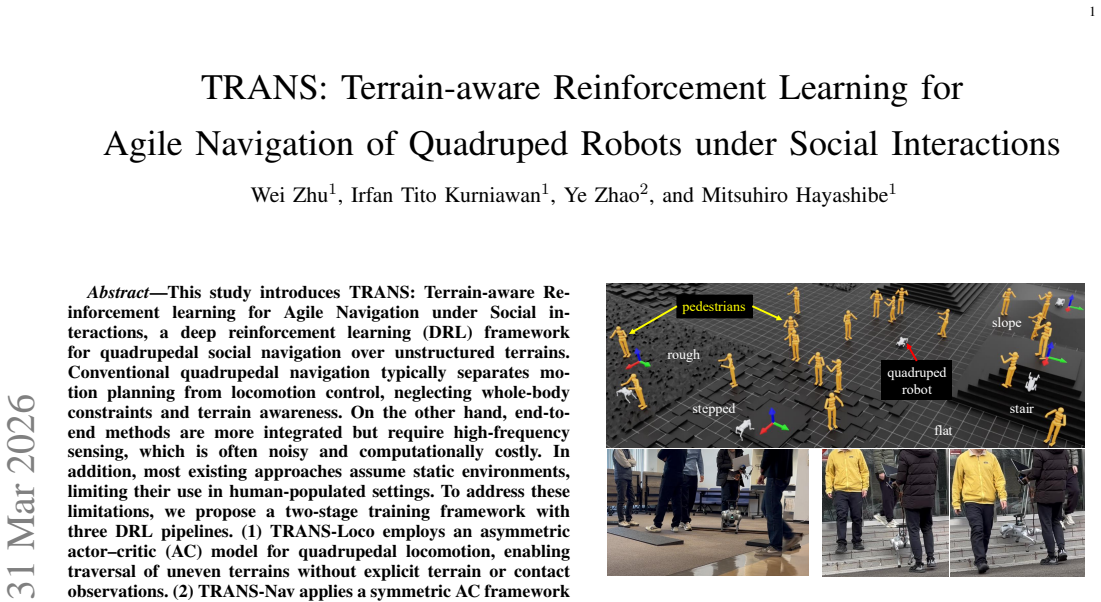
Pith's one-line read Trained in two decoupled stages and then fused into one policy, TRANS lets a quadruped robot navigate uneven, pedestrian-filled terrain at a 97.6% simulation success rate and transfers to a physical robot.
desk verdict A competent integration paper with real hardware results and an honest limitations section; the headline sim numbers only hold against ORCA pedestrians, so the social-navigation claim is narrower than it looks. read the letter →
The pith
A machine-rendered reading of the paper's core claim, the machinery that carries it, and where it could break.
The reading
What carries the argument
The load-bearing components are: (1) an asymmetric actor-critic locomotion policy whose actor sees only proprioceptive history and a learned latent state, letting it infer terrain without maps or contact sensors; (2) a navigation policy whose input is six LiDAR scans re-projected into the robot's current frame — the 'transformed LiDAR' representation that subtracts ego-motion so the network can perceive pedestrian movement; and (3) a fusion stage that warm-starts the unified network from the navigation weights, freezes the locomotion policy, disables lateral velocity, and clips low forward speeds to prevent freezing. The clipping and warm-start, individually neutral, together account for the
What would settle it
Deploy the policy with pedestrians instructed to ignore the robot and approach from outside the camera's field of view; if the collision rate on such runs approaches the 2.4% simulation figure rather than staying near zero, the social-interaction claim fails. A cheaper test: retrain the navigation stage with pedestrian velocities generated by a non-reciprocal model and compare success rates on the same 500-trial protocol.
Extended reading notes
Core claim
On its own terms, the paper claims that the unification of locomotion and social navigation can be made to work by training each sub-task in isolation first and then re-optimizing the combined policy. The unified TRANS pipeline records 0.976 success, 0.024 collision, and 0.000 timeout across 500 randomized trials in an uneven, socially interactive simulation, beating the best decoupled baseline (0.924) and the best end-to-end variants it compares against. The decisive components, according to the ablations, are warm-starting the unified weights from the pre-trained navigation policy and clipping the commanded velocity below 0.3 m/s: together they lift success from 0.924 (or 0.954 for warm-st
Load-bearing premise
The hardest assumption is that the pedestrians the robot meets are like the simulated ones: they obey a velocity-obstacle rule where avoidance is partly reciprocal, and they stay inside the camera's field of view or yield when they are outside it; if real pedestrians neither yield nor appear in view, the learned avoidance can fail.
Editorial extensions
If this is right
- If the claim is right, legged robots can navigate crowds and rough terrain with a single policy that needs no elevation map and no high-frequency exteroceptive sensing on the locomotion side.
- The two-stage recipe — train on a kinematic abstraction, then warm-start a full-body policy — offers a template for transferring navigation skills from cheap simulation to expensive full-body simulation.
- The transformed LiDAR representation (historical scans re-projected into the current robot frame) is what lets the policy perceive pedestrian motion; the ablation shows it outperforms raw scans, so this representation is likely reusable across similar social-navigation agents.
- Hardware success on slopes and stairs, despite localization drift, indicates the learned policy generalizes beyond the flat ground it was mostly tested on in simulation.
Reading between the lines
- The same decoupled strategy could apply to other non-holonomic platforms, since the navigation stage only assumes differential-drive kinematics before the full-body fusion.
- The paper leaves implicit that the pedestrian model's reciprocity is load-bearing; training against non-reciprocal or data-driven pedestrian movement could be a direct test of whether the policy learns genuinely reactive avoidance rather than exploiting the simulator's cooperation.
- One could test a simple extension: making the 0.3 m/s clipping threshold adaptive to terrain roughness or pedestrian proximity, which might recover the small simulation loss from clipping while retaining its real-world stability benefit.
- The rear-end collision failure mode suggests adding backward or in-place recovery behaviors, a direction the paper names as future work but which an enterprising reader could formulate as a concrete reward-modification experiment.
Editorial analysis
A structured set of objections, weighed in public.
Referee Report
Summary. The paper proposes TRANS, a two-stage deep reinforcement learning framework for quadrupedal social navigation on uneven terrain. Stage 1 trains TRANS-Loco, an asymmetric actor-critic locomotion policy with a temporal encoder that avoids explicit terrain or contact sensing, and TRANS-Nav, a symmetric SAC navigation policy that maps transformed LiDAR scans to differential-drive velocity commands. Stage 2 integrates the two by freezing the locomotion policy, warm-starting an expanded navigation policy, and fine-tuning it in IsaacSim on uneven, socially interactive scenes. The central empirical claim is that the unified TRANS policy achieves a 0.976 success rate, 0.024 collision rate, and 0.000 timeout rate across 500 randomized simulation trials (Table VI), and transfers to a Unitree Go2 with 16/20 successful hardware trials across flat, uneven, slope, and stair terrain (Table VII).
Significance. If the reported results hold, TRANS is a meaningful step toward integrated terrain-aware quadrupedal navigation in human-populated environments. The work has notable strengths: detailed reward and domain-randomization tables, a transformed-LiDAR representation that is shown to outperform raw scans in ablation, a warm-start and action-clipping analysis, a 500-trial simulation evaluation with failure-mode categorization, and 20 physical hardware trials. The manuscript is also candid about limitations in Section XI. However, the headline social-navigation claim is not yet fully supported because the simulation pedestrians are ORCA agents with a modified avoidance rule, the hardware deployment assumes out-of-view pedestrians avoid the robot, and the model-based baselines are evaluated under velocity constraints without a reported tuning protocol. These issues are correctness risks for the central comparison rather than internal inconsistencies.
major comments (4)
- [Section VIII-A, Table IV]
- [Section V-E, X-A, XI]
- [Section VIII-A, item 9]
- [Table VI and Section IX-A]
minor comments (5)
- [Section VI-A]
- [Section VIII-B]
- [Appendix B]
- [Table IV]
- [Section VII-A]
Circularity Check
No significant circularity: headline results are measured simulation/hardware benchmarks, not derived predictions; only mild self-referential weight from LNDNL lineage and the encoder-modified DRL-VO baseline.
full rationale
TRANS is an empirical systems paper: the central numbers (TABLE III, IV, VI, VII) are measured success, collision, timeout, and tracking-error rates, not quantities derived from the model's own fitted parameters. The locomotion module is benchmarked against external DreamWaQ, SLR, L2T, and an upper-bound Privilege method under identical curriculum and domain randomization; ablations isolate the encoder and reward changes, so the claimed improvement is not defined by its own output. The navigation module's transformed LiDAR representation is fixed by geometric equations (11)-(15) and is ablated against raw scans (TRANS-Nav-Direct) and against external baselines such as DWA, ORCA, AVOCADO, NeuPAN, T-MPC, RGL, LNDNL, and DRL-VO; it is not a fitted value relabeled as a prediction. The unified policy's advantage is established by ablations (Nav-Loco, TRANS-Direct, TRANS-Warm-Start, TRANS-Clip) across 500 randomized trials, and the hardware deployment is an independent transfer test. The paper does cite the authors' own prior LNDNL work and related contributions, and it modifies the DRL-VO baseline with the proposed encoder before comparison; these add self-referential and fairness weight, but they are not load-bearing circularity because the benchmark package also includes external baselines and hardware results. No circular step meets the quote-and-reduction bar, so the appropriate score is low.
Assumptions & free parameters
free parameters (7)
- Locomotion reward weights (Table I) =
1.5, 0.75, -2.0, -5e-2, -2e-4, -2.5e-7, -0.01, 0.01
- Navigation reward weights and radii =
w_dis=0.4, w_goal=1.4, r_robot=0.3 m, r_dis=0.5 m
- Velocity clipping threshold =
0.3 m/s (Eq. 23)
- Pedestrian avoid-ignore speed factor =
1.5× agent speed
- Domain randomization ranges (Table II) =
friction [0.65, 1.25], mass [-1, 3] kg, CoM offsets, observation noise, etc.
- Curriculum terrain difficulty parameters =
slopes 0-23°, stairs 0.05-0.12 m, rough 0.01-0.06 m, stepped 0.025-0.1 m
- History lengths and latent dimensions =
H=10, K=6, z_l=16, z_n=50
assumptions (7)
- domain assumption ORCA-generated pedestrian motion is an adequate proxy for real human social behavior.
- domain assumption Historical LiDAR points can be treated as fixed global points when transformed via Eqs. (12)-(14).
- domain assumption Proprioceptive observation history sufficiently encodes terrain geometry and contact dynamics for the actor.
- domain assumption A navigation policy trained on differential-drive kinematics transfers to the full quadruped after state augmentation and warm-start retraining.
- domain assumption Pedestrians outside the onboard camera's field of view will actively avoid the robot.
- domain assumption IsaacSim dynamics plus domain randomization are faithful enough for sim-to-real transfer on the Unitree Go2.
- standard math Standard POMDP and model-free RL formulations are valid for all three training stages.
Cite this review
Pith. "Pith review of TRANS: Terrain-aware Reinforcement Learning for Agile Navigation of Quadruped Robots under Social Interactions." pith.science (2026). https://pith.science/paper/J3JQLIPZ
@misc{pith2026260212724,
  author       = {Pith},
  title        = {Pith review of: TRANS: Terrain-aware Reinforcement Learning for Agile Navigation of Quadruped Robots under Social Interactions},
  year         = {2026},
  howpublished = {\url{https://pith.science/paper/J3JQLIPZ}},
  note         = {Machine review of arXiv:2602.12724}
}
read the original abstract
This study introduces TRANS: Terrain-aware Reinforcement learning for Agile Navigation under Social interactions, a deep reinforcement learning (DRL) framework for quadrupedal social navigation over unstructured terrains. Conventional quadrupedal navigation typically separates motion planning from locomotion control, neglecting whole-body constraints and terrain awareness. On the other hand, end-to-end methods are more integrated but require high-frequency sensing, which is often noisy and computationally costly. In addition, most existing approaches assume static environments, limiting their use in human-populated settings. To address these limitations, we propose a two-stage training framework with three DRL pipelines. (1) TRANS-Loco employs an asymmetric actor-critic (AC) model for quadrupedal locomotion, enabling traversal of uneven terrains without explicit terrain or contact observations. (2) TRANS-Nav applies a symmetric AC framework for social navigation, directly mapping transformed LiDAR data to ego-agent actions under differential-drive kinematics. (3) A unified pipeline, TRANS, integrates TRANS-Loco and TRANS-Nav, supporting terrain-aware quadrupedal navigation in uneven and socially interactive environments. Comprehensive benchmarks against locomotion and social navigation baselines demonstrate the effectiveness of TRANS. Hardware experiments further confirm its potential for sim-to-real transfer.
Figures


Figures from the paper (9 more)


Reference graph
Works this paper leans on
-
[1]
Learning- based legged locomotion: State of the art and future perspectives,
S. Ha, J. Lee, M. Panne, Z. Xie, W. Yu, and M. Khadiv, “Learning- based legged locomotion: State of the art and future perspectives,”The International Journal of Robotics Research, vol. 44, no. 8, pp. 1396– 1427, 2025. 19
2025
-
[2]
Real-time support terrain mapping and terrain adaptive local planning for quadruped robots,
H. Xie, C. Cui, X. Zhong, X. Zhong, and Q. Liu, “Real-time support terrain mapping and terrain adaptive local planning for quadruped robots,”IEEE Robotics and Automation Letters, vol. 9, no. 12, pp. 11 018–11 025, 2024
2024
-
[3]
Resilient legged local navigation: Learning to traverse with compromised perception end- to-end,
C. Zhang, J. Jin, J. Frey, N. Rudin, M. Mattamalaet al., “Resilient legged local navigation: Learning to traverse with compromised perception end- to-end,” inIEEE International Conference on Robotics and Automation (ICRA), 2024, pp. 34–41
2024
-
[4]
Long- range indoor navigation with prm-rl,
A. Francis, A. Faust, H.-T. L. Chiang, J. Hsu, J. C. Kewet al., “Long- range indoor navigation with prm-rl,”IEEE Transactions on Robotics, vol. 36, no. 4, pp. 1115–1134, 2020
2020
-
[5]
Towards generalization in target-driven visual navigation by using deep reinforcement learning,
A. Devo, G. Mezzetti, G. Costante, M. L. Fravolini, and P. Valigi, “Towards generalization in target-driven visual navigation by using deep reinforcement learning,”IEEE Transactions on Robotics, vol. 36, no. 5, pp. 1546–1561, 2020
2020
-
[6]
Autonomous navigation in unknown environments with sparse bayesian kernel-based occupancy mapping,
T. Duong, M. Yip, and N. Atanasov, “Autonomous navigation in unknown environments with sparse bayesian kernel-based occupancy mapping,”IEEE Transactions on Robotics, vol. 38, no. 6, pp. 3694– 3712, 2022
2022
-
[7]
Barri- ernet: Differentiable control barrier functions for learning of safe robot control,
W. Xiao, T.-H. Wang, R. Hasani, M. Chahine, A. Aminiet al., “Barri- ernet: Differentiable control barrier functions for learning of safe robot control,”IEEE Transactions on Robotics, vol. 39, no. 3, pp. 2289–2307, 2023
2023
-
[8]
A survey on socially aware robot navigation: Taxonomy and future challenges,
P. T. Singamaneni, P. Bachiller-Burgos, L. J. Manso, A. Garrell, A. San- feliuet al., “A survey on socially aware robot navigation: Taxonomy and future challenges,”The International Journal of Robotics Research, vol. 43, no. 10, pp. 1533–1572, 2024
2024
Show all 74 references
-
[9]
Social lstm: Human trajectory prediction in crowded spaces,
A. Alahi, K. Goel, V . Ramanathan, A. Robicquet, L. Fei-Fei, and S. Savarese, “Social lstm: Human trajectory prediction in crowded spaces,” inProceedings of the IEEE conference on computer vision and pattern recognition, 2016, pp. 961–971
2016
-
[10]
Deep reinforcement learning based mobile robot navigation: A review,
K. Zhu and T. Zhang, “Deep reinforcement learning based mobile robot navigation: A review,”Tsinghua Science and Technology, vol. 26, no. 5, pp. 674–691, 2021
2021
-
[11]
Distributed multi-robot collision avoidance via deep reinforcement learning for navigation in complex scenarios,
T. Fan, P. Long, W. Liu, and J. Pan, “Distributed multi-robot collision avoidance via deep reinforcement learning for navigation in complex scenarios,”The International Journal of Robotics Research, vol. 39, no. 7, pp. 856–892, 2020
2020
-
[12]
The dynamic window approach to collision avoidance,
D. Fox, W. Burgard, and S. Thrun, “The dynamic window approach to collision avoidance,”IEEE Robotics and Automation Magazine, vol. 4, no. 1, pp. 23–33, 2002
2002
-
[13]
Dynamic adaptive dynamic window approach,
M. Dobrevski and D. Sko ˇcaj, “Dynamic adaptive dynamic window approach,”IEEE Transactions on Robotics, vol. 40, pp. 3068–3081, 2024
2024
-
[14]
Social force model for pedestrian dynamics,
D. Helbing and P. Molnar, “Social force model for pedestrian dynamics,” Physical review E, vol. 51, no. 5, p. 4282, 1995
1995
-
[15]
Proactive kinodynamic planning using the extended social force model and human motion prediction in urban environments,
G. Ferrer and A. Sanfeliu, “Proactive kinodynamic planning using the extended social force model and human motion prediction in urban environments,” inIEEE/RSJ International Conference on Intelligent Robots and Systems (IROS), 2014, pp. 1730–1735
2014
-
[16]
Reciprocal n- body collision avoidance,
J. Van Den Berg, S. J. Guy, M. Lin, and D. Manocha, “Reciprocal n- body collision avoidance,” inRobotics Research: The 14th International Symposium, 2011, pp. 3–19
2011
-
[17]
Optimal reciprocal collision avoidance for multiple non- holonomic robots,
J. Alonso-Mora, A. Breitenmoser, M. Rufli, P. Beardsley, and R. Sieg- wart, “Optimal reciprocal collision avoidance for multiple non- holonomic robots,” inDistributed Autonomous Robotic Systems: The 10th International Symposium, 2013, pp. 203–216
2013
-
[18]
Vr-orca: Variable responsibility optimal reciprocal collision avoidance,
K. Guo, D. Wang, T. Fan, and J. Pan, “Vr-orca: Variable responsibility optimal reciprocal collision avoidance,”IEEE Robotics and Automation Letters, vol. 6, no. 3, pp. 4520–4527, 2021
2021
-
[19]
Avocado: Adaptive optimal collision avoidance driven by opinion,
D. Martinez-Baselga, E. Sebasti ´an, E. Montijano, L. Riazuelo, C. Sag ¨u´es, and L. Montano, “Avocado: Adaptive optimal collision avoidance driven by opinion,”IEEE Transactions on Robotics, vol. 41, pp. 2495–2511, 2025
2025
-
[20]
Scenario- based motion planning with bounded probability of collision,
O. de Groot, L. Ferranti, D. M. Gavrila, and J. Alonso-Mora, “Scenario- based motion planning with bounded probability of collision,”The International Journal of Robotics Research, vol. 44, no. 9, pp. 1507– 1525, 2025
2025
-
[21]
Topology- driven parallel trajectory optimization in dynamic environments,
O. De Groot, L. Ferranti, D. M. Gavrila, and J. Alonso-Mora, “Topology- driven parallel trajectory optimization in dynamic environments,”IEEE Transactions on Robotics, vol. 41, pp. 110–126, 2025
2025
-
[22]
Neupan: Direct point robot navigation with end-to-end model-based learning,
R. Han, S. Wang, S. Wang, Z. Zhang, J. Chenet al., “Neupan: Direct point robot navigation with end-to-end model-based learning,”IEEE Transactions on Robotics, vol. 41, pp. 2804–2824, 2025
2025
-
[23]
Scope: Stochastic cartographic occupancy prediction engine for uncertainty-aware dynamic navigation,
Z. Xie and P. Dames, “Scope: Stochastic cartographic occupancy prediction engine for uncertainty-aware dynamic navigation,”IEEE Transactions on Robotics, vol. 41, pp. 4139–4158, 2025
2025
-
[24]
The foreseeable future: Self- supervised learning to predict dynamic scenes for indoor navigation,
H. Thomas, J. Zhang, and T. D. Barfoot, “The foreseeable future: Self- supervised learning to predict dynamic scenes for indoor navigation,” IEEE Transactions on Robotics, vol. 39, no. 6, pp. 4581–4599, 2023
2023
-
[25]
Decentralized non- communicating multiagent collision avoidance with deep reinforcement learning,
Y . F. Chen, M. Liu, M. Everett, and J. P. How, “Decentralized non- communicating multiagent collision avoidance with deep reinforcement learning,” inIEEE International Conference on Robotics and Automation (ICRA), 2017, pp. 285–292
2017
-
[26]
Crowd-robot interaction: Crowd-aware robot navigation with attention-based deep reinforcement learning,
C. Chen, Y . Liu, S. Kreiss, and A. Alahi, “Crowd-robot interaction: Crowd-aware robot navigation with attention-based deep reinforcement learning,” inIEEE International Conference on Robotics and Automation (ICRA), 2019, pp. 6015–6022
2019
-
[27]
Relational graph learning for crowd navigation,
C. Chen, S. Hu, P. Nikdel, G. Mori, and M. Savva, “Relational graph learning for crowd navigation,” inIEEE/RSJ International Conference on Intelligent Robots and Systems (IROS), 2020, pp. 10 007–10 013
2020
-
[28]
Mapless navigation among dynamics with social-safety-awareness: A reinforcement learning approach from 2d laser scans,
J. Jin, N. M. Nguyen, N. Sakib, D. Graves, H. Yao, and M. Jagersand, “Mapless navigation among dynamics with social-safety-awareness: A reinforcement learning approach from 2d laser scans,” inIEEE Interna- tional Conference on Robotics and Automation (ICRA), 2020, pp. 6979– 6985
2020
-
[29]
Learn to navigate in dynamic environments with normalized lidar scans,
W. Zhu and M. Hayashibe, “Learn to navigate in dynamic environments with normalized lidar scans,” inIEEE International Conference on Robotics and Automation (ICRA), 2024, pp. 7568–7575
2024
-
[30]
Dipcan: Distilling privileged information for crowd-aware navigation
G. Monaci, M. Aractingi, and T. Silander, “Dipcan: Distilling privileged information for crowd-aware navigation.” inRobotics: Science and Systems (RSS), 2022
2022
-
[31]
Autonomous navigation system in pedes- trian scenarios using a dreamer-based motion planner,
W. Zhu and M. Hayashibe, “Autonomous navigation system in pedes- trian scenarios using a dreamer-based motion planner,”IEEE Robotics and Automation Letters, vol. 8, no. 6, pp. 3836–3843, 2023
2023
-
[32]
Rmrl: Robot navigation in crowd environments with risk map-based deep reinforcement learning,
H. Yang, C. Yao, C. Liu, and Q. Chen, “Rmrl: Robot navigation in crowd environments with risk map-based deep reinforcement learning,” IEEE Robotics and Automation Letters, vol. 8, no. 12, pp. 7930–7937, 2023
2023
-
[33]
Densecavoid: Real-time navigation in dense crowds using anticipatory behaviors,
A. J. Sathyamoorthy, J. Liang, U. Patel, T. Guan, R. Chandra, and D. Manocha, “Densecavoid: Real-time navigation in dense crowds using anticipatory behaviors,” inIEEE International Conference on Robotics and Automation (ICRA), 2020, pp. 11 345–11 352
2020
-
[34]
Crowd-aware robot navigation for pedestrians with multiple collision avoidance strategies via map-based deep reinforcement learning,
S. Yao, G. Chen, Q. Qiu, J. Ma, X. Chen, and J. Ji, “Crowd-aware robot navigation for pedestrians with multiple collision avoidance strategies via map-based deep reinforcement learning,” inIEEE/RSJ International Conference on Intelligent Robots and Systems (IROS), 2021, pp. 8144– 8150
2021
-
[35]
Drl–vo: Learning to navigate through crowded dy- namic scenes using velocity obstacles,
Z. Xie and P. Dames, “Drl–vo: Learning to navigate through crowded dy- namic scenes using velocity obstacles,”IEEE Transactions on Robotics, vol. 39, no. 4, pp. 2700–2719, 2023
2023
-
[36]
Deep imitation learning for autonomous navigation in dynamic pedestrian environments,
L. Qin, Z. Huang, C. Zhang, H. Guo, M. Ang, and D. Rus, “Deep imitation learning for autonomous navigation in dynamic pedestrian environments,” inIEEE International Conference on Robotics and Automation (ICRA), 2021, pp. 4108–4115
2021
-
[37]
Socially compli- ant navigation dataset (scand): A large-scale dataset of demonstrations for social navigation,
H. Karnan, A. Nair, X. Xiao, G. Warnell, S. Pirket al., “Socially compli- ant navigation dataset (scand): A large-scale dataset of demonstrations for social navigation,”IEEE Robotics and Automation Letters, vol. 7, no. 4, pp. 11 807–11 814, 2022
2022
-
[38]
Toward human-like social robot navigation: A large-scale, multi-modal, social human navigation dataset,
D. M. Nguyen, M. Nazeri, A. Payandeh, A. Datar, and X. Xiao, “Toward human-like social robot navigation: A large-scale, multi-modal, social human navigation dataset,” inIEEE/RSJ International Conference on Intelligent Robots and Systems (IROS), 2023, pp. 7442–7447
2023
-
[39]
Social navigation in crowded environments with model predictive control and deep learning-based human trajectory prediction,
V .-A. Le, B. Chalaki, V . Tadiparthi, H. N. Mahjoub, J. D’sa, and E. Moradi-Pari, “Social navigation in crowded environments with model predictive control and deep learning-based human trajectory prediction,” inIEEE/RSJ International Conference on Intelligent Robots and Syste...
2024
-
[40]
Social trajectory planning for urban autonomous surface vessels,
S. Park, M. Cap, J. Alonso-Mora, C. Ratti, and D. Rus, “Social trajectory planning for urban autonomous surface vessels,”IEEE Transactions on Robotics, vol. 37, no. 2, pp. 452–465, 2020
2020
-
[41]
Decision making for autonomous driving via augmented adversarial inverse reinforcement learning,
P. Wang, D. Liu, J. Chen, H. Li, and C.-Y . Chan, “Decision making for autonomous driving via augmented adversarial inverse reinforcement learning,” inIEEE International Conference on Robotics and Automation (ICRA), 2021, pp. 1036–1042
2021
-
[42]
Driveirl: Drive in real life with inverse reinforcement learning,
T. Phan-Minh, F. Howington, T.-S. Chu, M. S. Tomov, R. E. Beaudoin et al., “Driveirl: Drive in real life with inverse reinforcement learning,” inIEEE International Conference on Robotics and Automation (ICRA), 2023, pp. 1544–1550
2023
-
[43]
Vision-aided dynamic quadrupedal locomotion on discrete terrain using motion libraries,
A. Agrawal, S. Chen, A. Rai, and K. Sreenath, “Vision-aided dynamic quadrupedal locomotion on discrete terrain using motion libraries,” in IEEE International Conference on Robotics and Automation (ICRA), 2022, pp. 4708–4714. 20
2022
-
[44]
Elevation mapping for locomotion and navigation using gpu,
T. Miki, L. Wellhausen, R. Grandia, F. Jenelten, T. Homberger, and M. Hutter, “Elevation mapping for locomotion and navigation using gpu,” inIEEE/RSJ International Conference on Intelligent Robots and Systems (IROS), 2022, pp. 2273–2280
2022
-
[45]
Learning robust perceptive locomotion for quadrupedal robots in the wild,
T. Miki, J. Lee, J. Hwangbo, L. Wellhausen, V . Koltun, and M. Hutter, “Learning robust perceptive locomotion for quadrupedal robots in the wild,”Science Robotics, vol. 7, no. 62, p. eabk2822, 2022
2022
-
[46]
Learning perceptive legged robot locomotion in the real world: A systematic review,
I. T. Kurniawan, W. Zhu, D. Owaki, and M. Hayashibe, “Learning perceptive legged robot locomotion in the real world: A systematic review,”IEEE Robotics and Automation Magazine, pp. 2–18, 2025
2025
-
[47]
Not only rewards but also constraints: Applications on legged robot locomotion,
Y . Kim, H. Oh, J. Lee, J. Choi, G. Jiet al., “Not only rewards but also constraints: Applications on legged robot locomotion,”IEEE Transactions on Robotics, vol. 40, pp. 2984–3003, 2024
2024
-
[48]
Learning quadrupedal locomotion over challenging terrain,
J. Lee, J. Hwangbo, L. Wellhausen, V . Koltun, and M. Hutter, “Learning quadrupedal locomotion over challenging terrain,”Science Robotics, vol. 5, no. 47, p. eabc5986, 2020
2020
-
[49]
Sim-to-real transfer for quadrupedal locomotion via terrain transformer,
H. Lai, W. Zhang, X. He, C. Yu, Z. Tianet al., “Sim-to-real transfer for quadrupedal locomotion via terrain transformer,” inIEEE International Conference on Robotics and Automation (ICRA), 2023, pp. 5141–5147
2023
-
[50]
Quadruped robot traversing 3d complex environments with limited perception,
Y . Cheng, H. Liu, G. Pan, H. Liu, and L. Ye, “Quadruped robot traversing 3d complex environments with limited perception,” inIEEE/RSJ Inter- national Conference on Intelligent Robots and Systems (IROS), 2024, pp. 9074–9081
2024
-
[51]
Learn to teach: Sample- efficient privileged learning for humanoid locomotion over real-world uneven terrain,
F. Wu, X. Nal, J. Jang, W. Zhu, Z. Guet al., “Learn to teach: Sample- efficient privileged learning for humanoid locomotion over real-world uneven terrain,”IEEE Robotics and Automation Letters, vol. 10, no. 9, pp. 9048–9055, 2025
2025
-
[52]
Two-stage learning of cpg and postural reflex toward quadruped locomotion on uneven terrain with simple reward,
R. Seto, G. Li, K. Kutsuzawa, D. Owaki, and M. Hayashibe, “Two-stage learning of cpg and postural reflex toward quadruped locomotion on uneven terrain with simple reward,”IEEE Access, vol. 13, pp. 106 103– 106 114, 2025
2025
-
[53]
Dreamwaq: Learning robust quadrupedal locomotion with implicit terrain imagination via deep reinforcement learning,
I. M. A. Nahrendra, B. Yu, and H. Myung, “Dreamwaq: Learning robust quadrupedal locomotion with implicit terrain imagination via deep reinforcement learning,” inIEEE International Conference on Robotics and Automation (ICRA), 2023, pp. 5078–5084
2023
-
[54]
Slr: Learning quadruped locomotion without privileged information,
S. Chen, Z. Wan, S. Yan, C. Zhang, W. Zhanget al., “Slr: Learning quadruped locomotion without privileged information,” inConference on Robot Learning (CoRL), 2024
2024
-
[55]
Motion planning for quadrupedal locomotion: Coupled planning, terrain mapping, and whole-body control,
C. Mastalli, I. Havoutis, M. Focchi, D. Caldwell, and C. Semini, “Motion planning for quadrupedal locomotion: Coupled planning, terrain mapping, and whole-body control,”IEEE Transactions on Robotics, vol. 36, no. 6, pp. 1635–1648, 2020
2020
-
[56]
Robust autonomous navigation of a small-scale quadruped robot in real-world environments,
T. Dudzik, M. Chignoli, G. Bledt, B. Lim, A. Milleret al., “Robust autonomous navigation of a small-scale quadruped robot in real-world environments,” inIEEE/RSJ International Conference on Intelligent Robots and Systems (IROS), 2020, pp. 3664–3671
2020
-
[57]
Learning a state representation and navigation in cluttered and dynamic environ- ments,
D. Hoeller, L. Wellhausen, F. Farshidian, and M. Hutter, “Learning a state representation and navigation in cluttered and dynamic environ- ments,”IEEE Robotics and Automation Letters, vol. 6, no. 3, pp. 5081– 5088, 2021
2021
-
[58]
Model-free neural lyapunov control for safe robot navigation,
Z. Xiong, J. Eappen, A. Qureshi, and S. Jagannathan, “Model-free neural lyapunov control for safe robot navigation,” inIEEE/RSJ International Conference on Intelligent Robots and Systems (IROS), 2022, pp. 5572– 5579
2022
-
[59]
Walking in narrow spaces: Safety-critical locomotion control for quadrupedal robots with duality-based optimization,
Q. Liao, Z. Li, A. Thirugnanam, J. Zeng, and K. Sreenath, “Walking in narrow spaces: Safety-critical locomotion control for quadrupedal robots with duality-based optimization,” inIEEE/RSJ International Conference on Intelligent Robots and Systems (IROS), 2023, pp. 2723–2730
2023
-
[60]
Armp: Autoregressive motion planning for quadruped locomotion and navigation in complex indoor environments,
J. Kim, T. Li, and S. Ha, “Armp: Autoregressive motion planning for quadruped locomotion and navigation in complex indoor environments,” inIEEE/RSJ International Conference on Intelligent Robots and Systems (IROS), 2023, pp. 2731–2737
2023
-
[61]
Gpf- bg: A hierarchical vision-based planning framework for safe quadrupedal navigation,
S. Feng, Z. Zhou, J. Smith, M. Asselmeier, Y . Zhao, and P. Vela, “Gpf- bg: A hierarchical vision-based planning framework for safe quadrupedal navigation,” inIEEE International Conference on Robotics and Automa- tion (ICRA), 2023, pp. 1968–1975
2023
-
[62]
Learning to walk by steering: Perceptive quadrupedal locomotion in dynamic environments,
M. Seo, R. Gupta, Y . Zhu, A. Skoutnev, L. Sentis, and Y . Zhu, “Learning to walk by steering: Perceptive quadrupedal locomotion in dynamic environments,” inIEEE International Conference on Robotics and Automation (ICRA), 2023, pp. 5099–5105
2023
-
[63]
A control barrier function-based motion planning scheme for a quadruped robot,
U. Unlu, M. Gonc ¸alves, D. Chaikalis, A. Tzes, and F. Khorrami, “A control barrier function-based motion planning scheme for a quadruped robot,” inIEEE International Conference on Robotics and Automation (ICRA), 2024, pp. 12 172–12 178
2024
-
[64]
Vision- guided quadrupedal locomotion in the wild with multi-modal delay randomization,
S. Imai, M. Zhang, Y . Zhang, M. Kierebi ´nski, R. Yanget al., “Vision- guided quadrupedal locomotion in the wild with multi-modal delay randomization,” inIEEE/RSJ International Conference on Intelligent Robots and Systems (IROS), 2022, pp. 5556–5563
2022
-
[65]
Advanced skills by learning locomotion and local navigation end-to-end,
N. Rudin, D. Hoeller, M. Bjelonic, and M. Hutter, “Advanced skills by learning locomotion and local navigation end-to-end,” inIEEE/RSJ International Conference on Intelligent Robots and Systems (IROS), 2022, pp. 2497–2503
2022
-
[66]
Visual cpg-rl: Learning central pattern generators for visually-guided quadruped locomotion,
G. Bellegarda, M. Shafiee, and A. Ijspeert, “Visual cpg-rl: Learning central pattern generators for visually-guided quadruped locomotion,” inIEEE International Conference on Robotics and Automation (ICRA), 2024, pp. 1420–1427
2024
-
[67]
Traversability- aware legged navigation by learning from real-world visual data,
H. Zhang, Z. Li, X. Zeng, L. Smith, K. Stachowiczet al., “Traversability- aware legged navigation by learning from real-world visual data,”arXiv preprint arXiv:2410.10621, 2024
2024 arXiv
-
[68]
Coupling vision and proprioception for navigation of legged robots,
Z. Fu, A. Kumar, A. Agarwal, H. Qi, J. Malik, and D. Pathak, “Coupling vision and proprioception for navigation of legged robots,” inIEEE/CVF Conference on Computer Vision and Pattern Recognition (CVPR), 2022, pp. 17 273–17 283
2022
-
[69]
Vinl: Visual navigation and locomotion over obstacles,
S. Kareer, N. Yokoyama, D. Batra, S. Ha, and J. Truong, “Vinl: Visual navigation and locomotion over obstacles,” inIEEE International Conference on Robotics and Automation (ICRA), 2023, pp. 2018–2024
2023
-
[70]
Orbit: A unified simulation framework for interactive robot learning environments,
M. Mittal, C. Yu, Q. Yu, J. Liu, N. Rudinet al., “Orbit: A unified simulation framework for interactive robot learning environments,”IEEE Robotics and Automation Letters, vol. 8, no. 6, pp. 3740–3747, 2023
2023
-
[71]
Asymmetric actor critic for image-based robot learning,
L. Pinto, M. Andrychowicz, P. Welinder, W. Zaremba, and P. Abbeel, “Asymmetric actor critic for image-based robot learning,” inRobotics: Science and Systems (RSS), 2018
2018
-
[72]
Prox- imal policy optimization algorithms,
J. Schulman, F. Wolski, P. Dhariwal, A. Radford, and O. Klimov, “Prox- imal policy optimization algorithms,”arXiv preprint arXiv:1707.06347, 2017
2017 arXiv
-
[73]
Auto-encoding variational bayes,
D. Kingma and M. Welling, “Auto-encoding variational bayes,”arXiv preprint arXiv:1312.6114, 2013
2013 arXiv
-
[74]
Soft actor-critic: Off- policy maximum entropy deep reinforcement learning with a stochastic actor,
T. Haarnoja, A. Zhou, P. Abbeel, and S. Levine, “Soft actor-critic: Off- policy maximum entropy deep reinforcement learning with a stochastic actor,” inInternational Conference on Machine Learning (ICML), 2018, pp. 1861–1870
2018
Reviewed August 2, 2026 · model on record in the stance chip above.
Discussion (0). Sign in to comment.