Loop Current Extension as an Effective Delayed Dynamical System
Pith reviewed 2026-06-27 20:31 UTC · model grok-4.3
The pith
Loop Current extension evolves on an effective low-dimensional delayed dynamical system.
A machine-rendered reading of the paper's core claim, the machinery that carries it, and where it could break.
Core claim
Loop Current extension is an observable evolving on an effective low-dimensional delayed dynamical system, where a substantial fraction of the predictable variability can be reconstructed from a small number of delayed observations and represented through compact delayed evolution maps.
What carries the argument
Delayed-coordinate representations of the Loop Current extension time series, from which evolution maps are learned using ridge regression, multilayer perceptrons, and SINDy.
If this is right
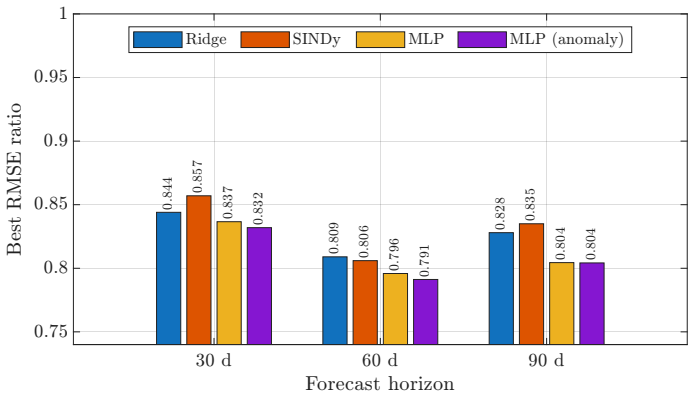
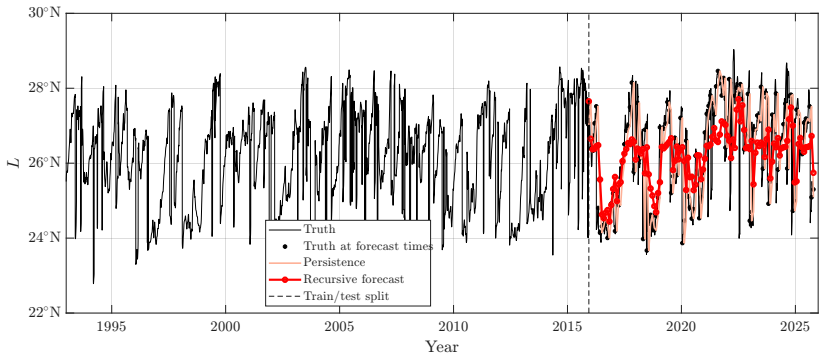
- Forecast skill exceeds persistence at lead times of 30-90 days with a small number of delayed coordinates.
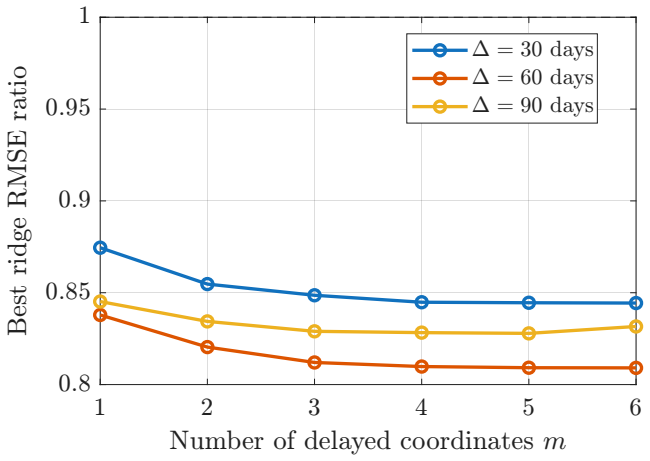
- Ridge regression shows saturation of predictive information with increasing delayed-state dimension.
- Delayed SINDy identifies sparse maps involving memory scales from two weeks to a few months that are stable under iteration.
- Physical diagnostics from inflows, outflows, and vorticity provide no additional independent state information beyond the delayed extension.
Where Pith is reading between the lines
- The approach may generalize to other western boundary current systems with similar extension-retraction cycles.
- Testing the maps on independent altimetry periods would confirm robustness against interannual variability.
- Exploring whether the delay scales correspond to specific physical processes like eddy formation times could link the reduced model to underlying dynamics.
Load-bearing premise
The satellite altimetry time series of Loop Current extension faithfully represents the underlying dynamics without substantial noise or aliasing that would prevent delayed coordinates from reconstructing the state.
What would settle it
A test where the learned delayed maps fail to outperform persistence on out-of-sample data from a different time period, or where including additional variables like channel transports significantly improves the forecasts.
Figures
read the original abstract
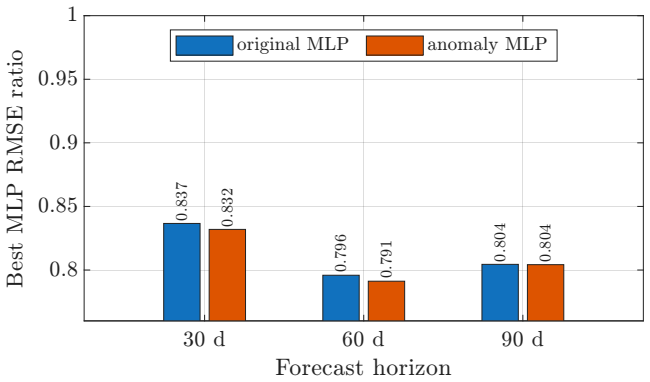
The Loop Current is the dominant circulation feature of the Gulf of Mexico and exhibits pronounced variability associated with northward extension, retraction, and eddy shedding. Despite decades of study, the extent to which this variability admits a reduced dynamical description remains unclear. We investigate this question using delayed-coordinate representations constructed from satellite-altimetry observations of Loop Current extension. Ridge regression, multilayer perceptron forecasting, and Sparse Identification of Nonlinear Dynamics (SINDy) are applied to learn delayed evolution maps from the extension time series. Forecast skill consistently exceeds persistence at lead times of 30--90 days while requiring only a small number of delayed coordinates. Ridge regression reveals saturation with delayed-state dimension, indicating that much of the predictive information is contained within a compact representation. Neural-network forecasts provide modest additional improvements, while delayed SINDy identifies sparse evolution maps involving intraseasonal memory scales, from approximately two weeks to a few months, that remain stable under recursive iteration. Physical diagnostics associated with Yucatan Channel inflow, Florida Straits outflow, gateway geometry, and northern Caribbean vorticity contain predictive information but do not provide additional independent state information once the delayed Loop Current state is included. These results support the interpretation of Loop Current extension as an observable evolving on an effective low-dimensional delayed dynamical system. A substantial fraction of the predictable variability can be reconstructed from a small number of delayed observations and represented through compact delayed evolution maps.
Editorial analysis
A structured set of objections, weighed in public.
Referee Report
Summary. The paper claims that Loop Current extension, derived from satellite altimetry, evolves as an effective low-dimensional delayed dynamical system. Using delayed-coordinate embeddings, ridge regression shows saturation of predictive skill with small delay dimension; MLP forecasts yield modest gains; and delayed SINDy recovers sparse, stable intraseasonal evolution maps (memory scales ~2 weeks to months) whose recursive iteration outperforms persistence at 30-90 day leads. Additional diagnostics (Yucatan inflow, Florida Straits outflow, etc.) add no independent information once the delayed extension state is included.
Significance. If the central claim holds after addressing validation gaps, the work would supply a compact, data-driven reduced-order description of a major oceanographic feature, with potential utility for extended-range forecasting and mechanistic insight into eddy-shedding variability. The combination of multiple inference methods (linear, neural, sparse symbolic) and the explicit comparison to persistence constitute a strength; the absence of machine-checked proofs or fully parameter-free derivations is noted but does not diminish the empirical contribution if robustness is demonstrated.
major comments (3)
- [Abstract] Abstract: the statements that 'forecast skill consistently exceeds persistence' and that 'a substantial fraction of the predictable variability can be reconstructed' are presented without error bars on skill scores, without explicit cross-validation protocol, and without quantification of sensitivity to post-hoc choices of delay dimension or regularization strength. These omissions are load-bearing for the central claim that the delayed representation captures intrinsic dynamics rather than fitting artifacts.
- [Abstract and data-construction description] The weakest assumption (that the altimetry-derived extension index is a faithful, low-noise observable whose delays embed the relevant state without aliasing or spurious autocorrelation) is not subjected to any sensitivity test against alternative processing choices or independent in-situ records. Because ridge regression saturation, MLP skill, SINDy sparsity, and the 'no additional information' conclusion all rest on this observable, the lack of such a test undermines the interpretation as an effective delayed dynamical system.
- [SINDy results paragraph] The manuscript reports that delayed SINDy maps 'remain stable under recursive iteration,' yet provides no quantitative metric (e.g., divergence rate, Lyapunov estimate, or multi-step forecast degradation) that would allow a reader to judge how far the claimed 30-90 day skill extends before instability appears.
minor comments (2)
- Notation for the delay dimension and the precise definition of the extension index should be introduced once, early, and used consistently.
- Figure captions should state the exact lead times, number of ensemble members (if any), and cross-validation folds used for each skill curve.
Simulated Author's Rebuttal
We thank the referee for the constructive and detailed report. The comments identify important gaps in the presentation of validation details and robustness checks. We address each point below and will incorporate revisions to strengthen the manuscript.
read point-by-point responses
-
Referee: [Abstract] Abstract: the statements that 'forecast skill consistently exceeds persistence' and that 'a substantial fraction of the predictable variability can be reconstructed' are presented without error bars on skill scores, without explicit cross-validation protocol, and without quantification of sensitivity to post-hoc choices of delay dimension or regularization strength. These omissions are load-bearing for the central claim that the delayed representation captures intrinsic dynamics rather than fitting artifacts.
Authors: We agree that the abstract, as a concise summary, omits these supporting details even though they appear in the main text (cross-validation protocol in Section 3, skill scores with standard errors in Figures 3-4, and saturation with delay dimension in Figure 2). We will revise the abstract to briefly reference the cross-validation procedure, report that skill scores include error bars from k-fold validation, and note the observed saturation with respect to delay dimension and regularization strength. This change will be made. revision: yes
-
Referee: [Abstract and data-construction description] The weakest assumption (that the altimetry-derived extension index is a faithful, low-noise observable whose delays embed the relevant state without aliasing or spurious autocorrelation) is not subjected to any sensitivity test against alternative processing choices or independent in-situ records. Because ridge regression saturation, MLP skill, SINDy sparsity, and the 'no additional information' conclusion all rest on this observable, the lack of such a test undermines the interpretation as an effective delayed dynamical system.
Authors: The extension index follows the established altimetry-based definition used in prior studies of Loop Current variability. While the main results are robust to modest changes in smoothing parameters (as verified during development), a systematic sensitivity analysis to alternative processing choices and comparison against available in-situ records was not included. We will add a dedicated subsection (or appendix) performing sensitivity tests to threshold and filtering choices and will include a limited comparison to available mooring or drifter data where overlap exists. This addresses the concern directly. revision: yes
-
Referee: [SINDy results paragraph] The manuscript reports that delayed SINDy maps 'remain stable under recursive iteration,' yet provides no quantitative metric (e.g., divergence rate, Lyapunov estimate, or multi-step forecast degradation) that would allow a reader to judge how far the claimed 30-90 day skill extends before instability appears.
Authors: We concur that a quantitative stability metric is needed to substantiate the claim of stability under iteration. The manuscript already shows that iterated SINDy forecasts outperform persistence out to 90 days, but does not report explicit divergence rates or Lyapunov estimates. In the revision we will add the root-mean-square divergence of iterated trajectories versus lead time and the multi-step forecast skill degradation curve, allowing readers to assess the horizon before instability dominates. This will be incorporated into the SINDy results section. revision: yes
Circularity Check
No significant circularity; derivation is data-driven and self-contained
full rationale
The paper applies standard data-driven techniques (ridge regression, MLP forecasting, delayed SINDy) to an independent satellite-altimetry time series to learn delayed evolution maps and assess forecast skill against persistence. No equations, definitions, or self-citations are shown that reduce the central claim (Loop Current extension as observable on effective low-dimensional delayed system) to its inputs by construction. Forecast skill and saturation with delayed dimension are empirical outcomes tested on the data, not forced tautologies. This aligns with the provided reader's assessment of score 2.0 and the absence of any load-bearing self-citation chains or fitted-input-as-prediction patterns in the abstract and described methods. The work remains self-contained against external observational benchmarks.
Axiom & Free-Parameter Ledger
free parameters (2)
- number of delayed coordinates
- SINDy sparsity threshold
axioms (2)
- domain assumption The extension time series is a faithful low-noise observable of the underlying flow.
- domain assumption The learned maps remain stable under recursive iteration outside the training window.
Reference graph
Works this paper leans on
-
[1]
Equations of atmospheric motion in non-Eulerian vertical coordinates: Vector-invariant form and quasi-Hamiltonian formulation
Thomas Dubos and Marine Tort. Equations of atmospheric motion in non-Eulerian vertical coordinates: Vector-invariant form and quasi-Hamiltonian formulation. Monthly Weather Review. 2014
2014
-
[2]
Majda and Esteban Tabak
Peter Constantin and Andrew J. Majda and Esteban Tabak. Formation of strong fronts in the 2-D quasigeostrophic thermal active scalar. Nonlinearity. 1995
1995
-
[3]
Constantin and M
P. Constantin and M. Ignatova. Estimates near the boundary for critical SQG. Ann. PDE. 2020
2020
-
[4]
Strong ill-posedness for SQG in critical Sobolev apces
In-Jee Jeong and Junha Kim. Strong ill-posedness for SQG in critical Sobolev apces. Ann. PDE. 2024
2024
-
[5]
New Numerical Results for the Surface Quasi-Geostrophic Equation
In-Jee Jeong and Junha Kim. New Numerical Results for the Surface Quasi-Geostrophic Equation. J. Sci. Comput. 2012
2012
-
[6]
F. J. Beron-Vera and Erwin Luesink , journal =. 2025 , pages =
2025
-
[7]
J. Atmos. Sci. , year =
-
[8]
Polar night vortex breakdown and large-scale stirring in the southern stratosphere , journal =. 2009 , volume =. doi:10.1007/s00382-009-0632-6 , owner =
-
[9]
2010 , volume =
Non-diffusive, non-local transport in fluids and plasmas , journal =. 2010 , volume =
2010
-
[10]
2000 , volume =
Self-consistent chaotic transport in fluids and plasmas , journal =. 2000 , volume =
2000
-
[11]
2000 , volume =
Chaotic transport in zonal flows in analogous fluid and plasma systems , journal =. 2000 , volume =
2000
-
[12]
1998 , volume =
Asymmetric Transport and Non-Gaussian Statistics of Passive Scalars in Vortices in Shear , journal =. 1998 , volume =
1998
-
[13]
1997 , volume =
Renormalization and Transition to Chaos in Area Preserving Nontwist Maps , journal =. 1997 , volume =
1997
-
[14]
Physica D , year =
Area Preserving Nontwist Maps:. Physica D , year =
-
[15]
1996 , number =
Renormalization and Transition to Chaos in Area Preserving Nontwist Maps , institution =. 1996 , number =
1996
-
[16]
Chaotic Transport by. Phys. Fluids A , year =
-
[17]
J. Phys. Oceanogr. , year =
-
[18]
J. Geophys. Res. , year =. doi:10.1029/2009JC005585 , owner =
-
[19]
, year =
J.Phys.Oceanogr. , year =
-
[20]
Geophys. Res. Lett. , year =
-
[21]
Environ. Res. Lett. , title =. 2012 , pages =
2012
-
[22]
Geophys. Res. Lett. , year =. doi:10.1029/2010GL046267. , owner =
-
[23]
2010 , volume =
Fluid dynamical niches of phytoplankton types , journal =. 2010 , volume =
2010
-
[24]
J. Phys. A: Math. Theor. , year =
-
[25]
Mixing structures in the. Geophys. Res. Let. , year =. doi:10.1029/2004GL020328 , owner =
-
[26]
Deep Sea Res. I , year =. doi:10.1016/j.dsr.2008.07.014 , howpublished =
-
[27]
Detection of. Anais. 2007 , pages =
2007
-
[28]
1989 , volume =
Dipole formation and collisions in a stratified fluid , journal =. 1989 , volume =
1989
-
[29]
Topography-induced modulation of a tripolar vortex in a rotating fluid , year =
-
[30]
1989 , volume =
Tripolar vortices in a rotating fluid , journal =. 1989 , volume =
1989
-
[31]
Laboratory experiments on the tripolar vortex in a rotating fluid , journal =
-
[32]
II , year =
Dee-Sea Res. II , year =
-
[33]
Eddy Formation in 2. J. Phys. Oceanogr. , year =
-
[34]
J. Geophys. Res. , year =
-
[35]
I , year =
Deep-Sea Res. I , year =
-
[36]
2007 , volume =
Influence of initial conditions on decaying two-dimensional turbulence , journal =. 2007 , volume =
2007
-
[37]
Deep-Sea Res
Zooplankton and Micronekton Biomass Off Somalia and in the Southern Red Sea During the. Deep-Sea Res. Part II , year =
-
[38]
2019 , volume =
Role of Indian Ocean Dynamics on Accumulation of Buoyant Debris , journal =. 2019 , volume =
2019
-
[39]
Maria Teresa M. Verification of Sargassum natans (Linnaeus) Gaillon (Heterokontophyta: Phaeophyceae) from the Sargasso Sea off the coast of Brazil, western Atlantic Ocean , journal =. 2012 , volume =. doi:10.15560/8.4.638 , publisher =
-
[40]
J. Phys. Oceanogr. , year =. doi:10.1175/1520-0485(1997)027<2288:TVOTLS>2.0.CO;2 , owner =
-
[41]
Proceedings of Symposia in Pure Mathematics 69 , year =
A Tutorial on. Proceedings of Symposia in Pure Mathematics 69 , year =
-
[42]
Geopphys
J. Geopphys. Res. , year =
-
[43]
J. Geophys. Res. , year =. doi:10.1029/94JC00383 , owner =
-
[44]
and C.G.H
\"Ostlund, H.G. and C.G.H. Rooth , title =. Journal of Geophysical Research , year =
-
[45]
Estuaries and Enclosed Seas , year =
Gulf of. Estuaries and Enclosed Seas , year =
-
[46]
2002 , volume =
Dynamics of Two-Dimensional Turbulent Bottom Gravity Currents , journal =. 2002 , volume =
2002
-
[47]
1998 , volume =
The Emergence of Inertial Gyres in a Two-Layer Quasigeostrophic Model , journal =. 1998 , volume =
1998
-
[48]
1997 , volume =
Impact of Wind Forcing, Bottom Topography and Inertia on Midlatitude Jet Separation in a Quasigeostrophic Model , journal =. 1997 , volume =
1997
-
[49]
On the Connection Between the. J. Phys. Oceanogr. , year =
-
[50]
2001 , volume =
On the Dynamics of Plumes , journal =. 2001 , volume =
2001
-
[51]
1998 , volume =
Asymmetric Salt Fingers Induced by a Nonlinear Equation of State , journal =. 1998 , volume =
1998
-
[52]
1998 , volume =
A Numerical Study of Layer Formation Due to Fingers in Double-Diffusive Convection in a Vertically-Bounded Domain , journal =. 1998 , volume =
1998
-
[53]
Turbulent Mixing in the. J. Phys. Oceanogr. , year =
-
[54]
Abarbanel, H.D.I. and D.D. Holm and J.E. Marsden and T. Ratiu , title =. Philos. Trans. R. Soc. London, A , year =
-
[55]
Abarbanel, H.D.I. and D.D. Holm and J.E. Marsden and T. Ratiu , title =. Phys. Rev. Lett. , year =
-
[56]
Abarbanel, H. D. I. and R. Brown and J. J. Sidorowich and L. Analysis of Observed Chaotic Data in Physical Systems , journal =. 1993 , volume =
1993
-
[57]
Abdullaev, S. S. , volume =. Chaos and the Dynamics of Rays in Waveguide Media , publisher =. 1993 , editor =
1993
-
[58]
Abdullaev, S. S. , title =. Chaos , year =
-
[59]
Abdullaev, S. S. and G. M. Zaslavsky , title =. Usp. Phys. Nauk , year =
-
[60]
Abernathey, R. and G. Haller , title =. J. Phys. Oceanogr. , year =
-
[61]
Ablowitz, M.J. and R. Haberman , title =. J. Math. Phys. , year =
-
[62]
Abraham, E. R. , title =. Nature , year =
-
[63]
Abraham, E. R. and M. M. Bowen , title =. Chaos , year =. doi:0.1063/1.1481615 , owner =
-
[64]
Abraham, E. R. and C. S. Lae and P. W. Boyd and S J. Lavender and M. T. Maldonado and A. R. Bowie , title =. Nature , year =
-
[65]
1988 , author =
Manifolds, Tensor Analysis and Applications , publisher =. 1988 , author =
1988
-
[66]
, title =
Abramopoulos, F. , title =. Monthly Weather Rev. , year =
-
[67]
Abramov, R. V. and A. J. Majda , title =. Proc. Natl. Acad. Sci. U.S.A. , year =
-
[68]
Abtew, W. and R. S. Huebner , title =. 2005 , number =
2005
-
[69]
Acha, E. M. and H. W. Mianzan and R. A. Guerrero and M. Favero and J. Bava , title =. J. Mar. Syst. , year =
-
[70]
Achterberg, R. A. and A. P. Ingersoll , title =. J. Atmos. Sci. , year =
-
[71]
Adamec, D. and R.L. Elsberry and R.W. Garwood and R.L. Haney , title =. Dyn. Atmos. Oceans , year =
-
[72]
G. N. D. Addico and K. A. A. deGraft-Johnson , journal =. 2016 , pages =. doi:10.5897/AJB2015.15177 , owner =
-
[73]
Adduce, C. and C. Cenedese , title =. J. Mar. Res. , year =
-
[74]
Aguirre-Hernandez, E. and G. Gaxiola-Castro and S. Najera-Martinez and T. Baumgartner and M. Kahru and B. G. Mitchell , title =. Deep-Sea Res. II , year =
-
[75]
Ahrenholz, Dean W. and Morris, James A. , title =. Environmental Biology of Fishes , year =. doi:10.1007/s10641-010-9647-4 , issn =
-
[76]
Aiki, H. and T. Yamagata , title =. Geophys. Astrophys. Fluid Dyn. , year =
-
[77]
Aksamit, N. and T. Sapsis and G. Haller , title =. J. Phys. Oceanogr. , year =
-
[78]
1989 , volume =
A stochastic simulation model of oil spill fate and transport , journal =. 1989 , volume =
1989
-
[79]
, title =
Albert, H.F. , title =. Z. Angew. Math. Mech. , year =
-
[80]
Albert, H. F. , title =. Beitr. Phys. Atmosph. , year =
discussion (0)
Sign in with ORCID, Apple, or X to comment. Anyone can read and Pith papers without signing in.