REVIEW 3 major objections 4 minor 3 references
Photonic Theta Cavity: Engineering Bound States in the Continuum in Topological Resonators Beyond the Limitations of Near Field Coupling
T0 review · 3 major / 4 minor · reviewed 2026-07-14 · grok-4.5
Pith's one-line read Mirror-symmetric cross junctions let a ring-plus-waveguide “Theta” resonator cancel radiation at both ports, producing Bound States in the Continuum that stay intact under loss, heat, and ordinary silicon-photonics fabrication errors.
desk verdict Real gap-free multipath ring architecture with usable analytics and SOI data; BIC/topology language outruns the far-field evidence they report. read the letter →
The pith
A machine-rendered reading of the paper's core claim, the machinery that carries it, and where it could break.
The reading
What carries the argument
The mirror-symmetric cross (MSC) junction, which consolidates clockwise and counterclockwise ring modes into one effective wavefunction and enforces the phase condition for perfect destructive interference at both ports; the resulting Non-Hermitian Phase Manifold organizes quality factor and spectral shift versus the geometric tuning parameter γ.
What would settle it
Fabricate a Theta Cavity, record both guided transmission/reflection spectra and the far-field radiation pattern while tuning the geometric ratio γ through the predicted BIC point; if far-field power remains finite or rises exactly when the guided resonance disappears, the state is a leaky quasi-mode rather than a BIC.
Extended reading notes
Core claim
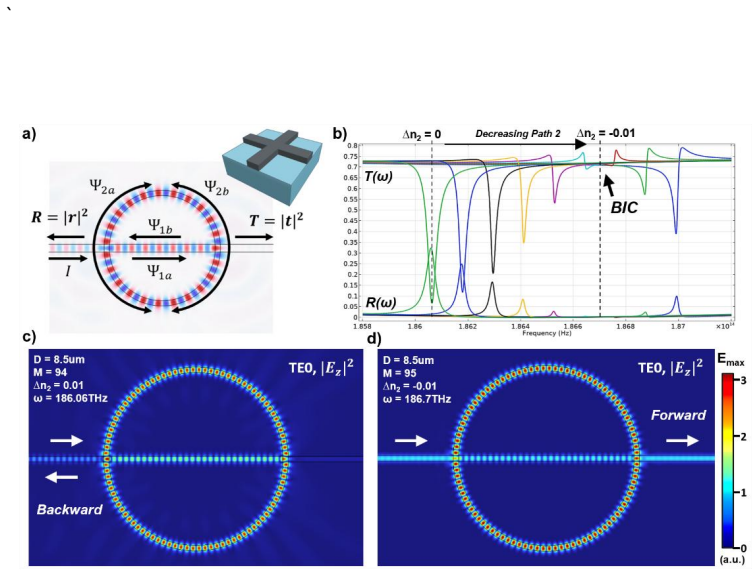
Interferometric coupling through mirror-symmetric cross junctions creates a multipath phase condition that can completely suppress radiative pathways between a ring resonator and its bus waveguide, producing parametric Bound States in the Continuum whose non-Hermitian band structure and BIC-to-quasi-BIC transition remain robust under attenuation, temperature drift and ordinary silicon-photonics fabrication non-idealities.
Load-bearing premise
The claim that a vanishing guided-wave resonance plus strong ring confinement equals a true Bound State in the Continuum assumes that light radiating into free space from the cross-junction supermodes is cleanly isolated from the continuum of waveguide modes.
Editorial extensions
If this is right
- High-extinction, high-Q cavities can be designed without sub-micron gaps, relaxing lithography and proximity constraints.
- Amplitude can be modulated at fixed frequency by tuning only the middle-path index.
- Nested rings support scalable, long-range strong coupling and multi-dimensional hybridized bands without physical adjacency.
- BIC-based filters and sensors retain contrast even on lossy silicon-on-insulator platforms.
- The same analytic framework extends by transfer matrix to arbitrary numbers of concentric rings for synthetic-dimension engineering.
Reading between the lines
- The same MSC symmetry could be transferred to higher-loss platforms (SiN, III-V, lithium niobate) where conventional BICs are harder to observe.
- Introducing gain into selected nested rings would open a compact route to exceptional-point sensors or non-Hermitian topological lasers.
- Because γ is a path-length ratio, global thermal expansion largely cancels while local index perturbations remain detectable, suggesting differential sensing applications only hinted at in the text.
- Engineered cladding or junction shaping could suppress residual far-field leakage and convert present quasi-BICs into true free-space BICs.
Signed reviews
Editorial analysis
A structured set of objections, weighed in public.
Referee Report
Summary. The manuscript introduces the photonic Theta Cavity (TC), a ring-resonator architecture that replaces near-field evanescent gaps with mirror-symmetric cross (MSC) junctions. Multipath interference at these junctions is claimed to produce parametric Bound States in the Continuum (BICs) and quasi-BICs whose non-Hermitian band structure (captured by a Non-Hermitian Phase Manifold) remains robust to modest attenuation, temperature drift and fabrication non-idealities. Closed-form transmission, reflection and field-enhancement expressions are derived from interface-continuity equations; 2-D COMSOL simulations and SOI measurements at 1550 nm are presented for several geometric ratios γ, together with a Nested Theta Cavity (NTC) extension that exhibits phase-mediated long-range strong coupling, anti-crossings, Dirac points and Fano lineshapes.
Significance. If the BIC interpretation and robustness claims hold, the work supplies a genuinely new design degree of freedom for integrated photonics: interferometric rather than proximity-based coupling, free of sub-micron gap constraints and tolerant of the loss levels typical of SOI. The closed-form analytics, the NHPM construction, and the experimental demonstration of engineered spectral patterns (balanced, cyclical, binary) plus nested hybridization constitute concrete, reusable tools. These features would be of clear interest for filters, sensors and synthetic-dimension lattices on lossy platforms.
major comments (3)
- [Results; Figs. 1,2,4,5] Results (pp. 9–10) and Figs. 1b,d, 2, 4a,c, 5e,f: The central claim that MSC junctions produce true parametric BICs (radiative pathways fully shut off from the continuum of propagating waveguide modes) rests on the vanishing of guided T/R signatures plus ring-field confinement. The same sections explicitly note that MSC supermodes radiate into the far field and that experimental Q is limited to ~10k–15k by that leakage plus roughness. No far-field radiation pattern, out-of-plane power budget, or comparison of total radiated power at a purported BIC versus a nearby qBIC is supplied. Without this evidence the spectral nulls are equally consistent with lossy quasi-modes whose guided continuum coupling is suppressed while free-space channels remain open; the asserted isolation of far-field radiation from the guided continuum is therefore unproven and load-bearing for the topological/BIC fram
- [Analytical Model; Fig. 4] Analytical Model, Eqs. (3)–(5) and fitting discussion around Fig. 4: The effective coupling z and loss δ are free phenomenological parameters adjusted independently for each polarization and device (TE0: z=0.2, δ=0.05; TM0: z=0.4, δ=1.0; experimental circular TCs: δ=10^{-4} or 0.1). While the functional form of t(φ), r(φ) and Ψ_{2} is derived from continuity, the need to retune z and δ for every spectrum reduces the model’s a-priori predictive power and weakens the claim that the BIC loci are parameter-free geometric consequences of γ alone. A quantitative mapping from MSC geometry (aspect ratio, corner radius) to z, or an independent extraction of δ from propagation-loss measurements, is required.
- [Coupled Resonators; Fig. 8] Nested Theta Cavity section and Fig. 8: Band-hybridization features (anti-crossings, Dirac crossings, FW-BIC-like splitting) are obtained by independently sweeping γ_inner and γ_outer in the multi-junction transfer-matrix model and are said to match measured spectra after qualitative fitting of the same free parameters. Because the nested analytics inherit the single-ring z/δ ambiguity and the experimental NTC spectra are compared only after such fitting, the claim of phase-mediated long-range strong coupling that is topologically robust remains only partially substantiated. Quantitative, parameter-free predictions for at least one hybridization gap size versus measured free-spectral-range ratio would strengthen the result.
minor comments (4)
- [Figs. 2,6 and text] Several figure captions and the main text use inconsistent notation for the geometric ratio (γ versus g) and for the loss coefficient (δ versus δ). Unify throughout.
- [Results; Supplemental] The supplemental quality-factor extraction (Fig. S14) employs both –3 dB and –5 dB thresholds plus Fano fits; state explicitly which method is used for each reported Q value in the main text.
- [Throughout] Typographical artifacts appear in the extracted manuscript (e.g., “in tegrated”, “Silion-on-Insulator”, duplicated sentences). A careful proof-reading pass is needed.
- [Analytical Model] References to Friedrich–Wintgen BICs are appropriate, yet a short paragraph contrasting the non-separable TC modes with conventional FW-BICs (no mode splitting under detuning) would help readers place the claim.
Circularity Check
Quantitative line-shape and NHPM agreement is obtained by fitting z and δ to the same spectra whose Q/shift features are then called predictions; the multipath continuity derivation and geometric BIC loci themselves remain independent of that fit.
-
fitted input called prediction
[Results, Fig. 4 and surrounding text (fundamental TE0/TM0 modes)]
"We successfully fit the analytical spectra to the simulation spectra by tuning the attenuation (δ) and coupling (z) coefficients for both the fundamental TC modes, TE0 (Fig 4b; z = 0.2, δ = 0.05) and TM0 (Fig 4d; z = 0.4, δ = 1.0). The NHPM is used to predict patterns in quality factor and spectra deviations for the simulated spectra of both fundamental TE0 (Fig 4b) and TM0 (Fig 4d) TC modes, shown as black dots which closely trace the NHPM with increasing mode number (M)."
z and δ are free parameters adjusted until the closed-form spectra reproduce the simulated line shapes; the same fitted model is then said to “predict” the Q-factor and spectral-shift values that were extracted from those identical simulated spectra. The agreement with the NHPM is therefore forced by construction once the fit has been performed, rather than an independent first-principles forecast.
-
fitted input called prediction
[Results, Fig. 5e,f and Nested Theta Cavity section (Fig. 7c,d)]
"for smaller diameter rings (D = 8.5 um), the measured transmission spectra (Fig 5e) and the analytical spectra (Fig 5f), fitted with a higher attenuation coefficient (δ = 0.1), strongly agree and shows unambiguous evidence of a BIC transition. … The spectral trends and features observed in the measured NTC spectra (Fig 7c) agree strongly with the nested ring analytical spectra (Fig. 7d) after qualitatively fitting using design coefficients (γ_inner = 0.63197, γ_outer = 0.63162, δ = 0.01, z = 0.2)."
Experimental spectra are matched by choosing δ (and, for the NTC, also the precise γ values) after the fact; the resulting analytical curves are then presented as confirming the BIC transition and band-hybridization features that were identified in the same measured data. The quantitative spectral pattern agreement is therefore a post-hoc fit rather than a parameter-free prediction.
full rationale
The core analytical chain (interface-continuity equations under mirror symmetry o closed-form r(φ), t(φ), Ψ_{2}(φ) o normalized dispersion and NHPM) is self-contained and does not define the BIC in terms of the fitted parameters; BIC loci emerge when γ approaches even multiples of π and Q scales as γ^{-2} at δ=0. However, the paper repeatedly tunes the free coefficients z (coupling) and δ (loss) so that the analytical spectra match simulated or measured spectra, then presents the resulting NHPM as predicting the quality-factor and spectral-shift trends extracted from those same spectra. That step is a classic fitted-input-called-prediction loop for the quantitative validation, even though the qualitative existence of the qBIC–BIC transition and the topological features of the band structure do not depend on the particular numerical values of z and δ. No load-bearing self-citation, uniqueness theorem, or renamed known result is present; the circularity is therefore partial and confined to the fitting/validation layer rather than the derivation itself.
Assumptions & free parameters
free parameters (3)
- z (effective MSC coupling coefficient) =
typically 0.2 (TE0), 0.4 (TM0)
- δ (unitless loss / imaginary phase) =
device-dependent, ~1e-4 to 0.1
- γ_inner, γ_outer (nested design coefficients) =
≈0.632 (qualitative fit)
assumptions (5)
- domain assumption Interface continuity and energy conservation at MSC junctions close into a finite set of linear equations for forward/backward amplitudes on each path.
- domain assumption Mirror symmetry ϕ1a=ϕ1b, ϕ2a=ϕ2b and equal upper/lower path-2 lengths collapse CW/CCW into one effective wavefunction with a single z.
- ad hoc to paper z1=1 and a single z2=z < 0.5 capture all coupling; loss enters only as uniform imaginary phase δ on all paths.
- ad hoc to paper Far-field radiation from MSC supermodes is isolated from the guided continuum, so guided-wave spectral nulls still count as BICs under modest δ.
- domain assumption Standard single-mode SOI waveguide effective-index and phase accumulation ϕ = 2π n_eff L/λ describe path phases (with γ = L1/L2).
invented entities (3)
-
Theta Cavity (TC) with mirror-symmetric cross junctions
independent evidence
-
Non-Hermitian Phase Manifold (NHPM)
-
Nested Theta Cavity (NTC)
independent evidence
Cite this review
Pith. "Pith review of Photonic Theta Cavity: Engineering Bound States in the Continuum in Topological Resonators Beyond the Limitations of Near Field Coupling." pith.science (2026). https://pith.science/paper/J5FEPLQE
@misc{pith2026260709915,
  author       = {Pith},
  title        = {Pith review of: Photonic Theta Cavity: Engineering Bound States in the Continuum in Topological Resonators Beyond the Limitations of Near Field Coupling},
  year         = {2026},
  howpublished = {\url{https://pith.science/paper/J5FEPLQE}},
  note         = {Machine review of arXiv:2607.09915}
}
read the original abstract
The Theta Cavity is a unique topological resonator architecture which utilizes interferometric coupling to overcome fundamental design limitations associated with near-field evanescent coupling which currently dominates the design space for integrated photonics. The defining device physics is established by the mirror symmetric cross junctions which preserves efficient power transfer between a waveguide and ring resonator creating a strongly correlated phase relationship between the multiple paths. The unique mode selection physics allows for interference driven suppression of radiative pathways enabling strong cavity confinement and the emergence of Bound States in the Continuum (BICs). Analytical models reveal non-Hermitian optical band structure displaying non-trivial topological transitions between BIC and quasi-BIC modes that are robust to attenuation, temperature variations, and typical fabrication non-idealities, which is critical for overcoming intrinsic limitations associated with silicon based integrated photonics. The Theta Cavity architecture also circumvents limitations that arise from proximity requirements of the physical gap used in near-field coupled waveguides which enables a flexible design space for new devices. In this study, we demonstrate phase mediated long-range strong coupling of multiple ring resonators in the Nested Theta Cavity architecture showcasing band structure hybridization resulting in the formation of anti-crossing bandgaps, Dirac crossings, and Fano resonances. The photonic Theta Cavity architecture provides a scalable, topologically robust platform for engineering modes across a multidimensional parameter space with high resilience to perturbation and attenuation, enabling a new approach for the designing of integrated cavity devices.
Figures


Figures from the paper (5 more)


Reference graph
Works this paper leans on
-
[1]
Normalized Magnitude Poynting vector
Analytical Model Derivations The Theta Cavity (TC) employs interferometric principles, like a Mach-Zender Interferometer, to facilitate coupling between the waveguide transmission line and a ring resonator cavity. When light interacts within the Mirror Symmetric Cross (MSC) junctions, the energy propagating in the waveguide (path 1) is transmitted or refl...
-
[2]
hourglass
Experimental The analytical model demonstrates strong agreement with simulation and experimental measurements, particularly in predicting the behavior of qBIC and BIC resonant modes and the associated spectral patterns. In experimental devices, these modes can deviate from idealized predictions, highlighting the influence of physical effects that are not ...
-
[3]
The algorithms used for data analysis were developed from open -source Python libraries
Quality Factor Extraction The mode quality factors and bandwidth trends shown throughout this study were extracted using various methods described below. The algorithms used for data analysis were developed from open -source Python libraries. All spectra were analyzed using a base -10 logarithmic representation and plotted on a decibel (dB) scale. For the...
Reviewed July 14, 2026 · model on record in the stance chip above.
Discussion (0). Continue with ORCID to comment.