Quaternion Maximum-Volume Submatrix Selection with Applications to Multichannel Imaging and Visual Data
Pith reviewed 2026-06-27 19:27 UTC · model grok-4.3
The pith
Maximum-volume submatrix selection extends to quaternion matrices with proofs that swaps increase volume.
A machine-rendered reading of the paper's core claim, the machinery that carries it, and where it could break.
Core claim
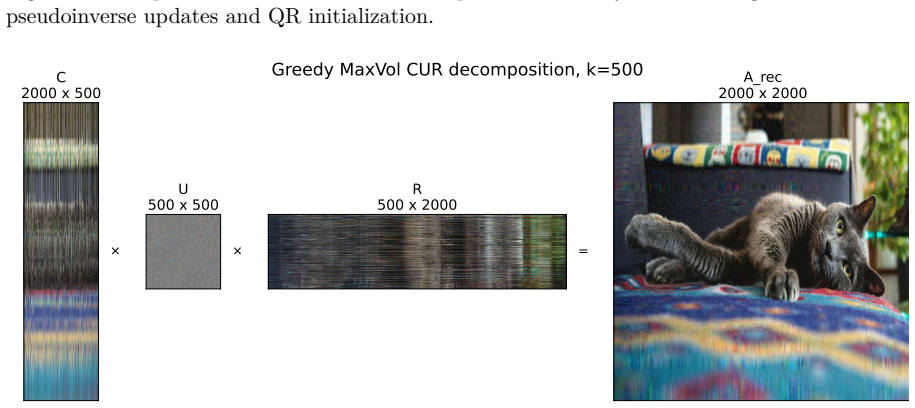
The central claim is that the classical maximum-volume idea carries over to quaternions once volume is measured by the Study determinant of a submatrix together with its quaternion singular values; under this measure, row-and-column replacement algorithms can be built whose successful swaps strictly increase volume, the rectangular enlargement yields controlled coefficients, and the selected submatrices satisfy an exact CUR identity when the matrix has full rank.
What carries the argument
The quaternion maximum-volume criterion, which selects square or rectangular submatrices by maximizing a volume formed from the Study determinant and the quaternion singular values of the candidate block.
If this is right
- Successful row and column swaps increase the quaternion volume of the selected square core when the exact quaternion inverse is used.
- The stopping criterion of the algorithms is equivalent to a quasi-dominance condition on the interpolation matrix.
- An exact quaternion CUR identity holds whenever the original matrix has full rank.
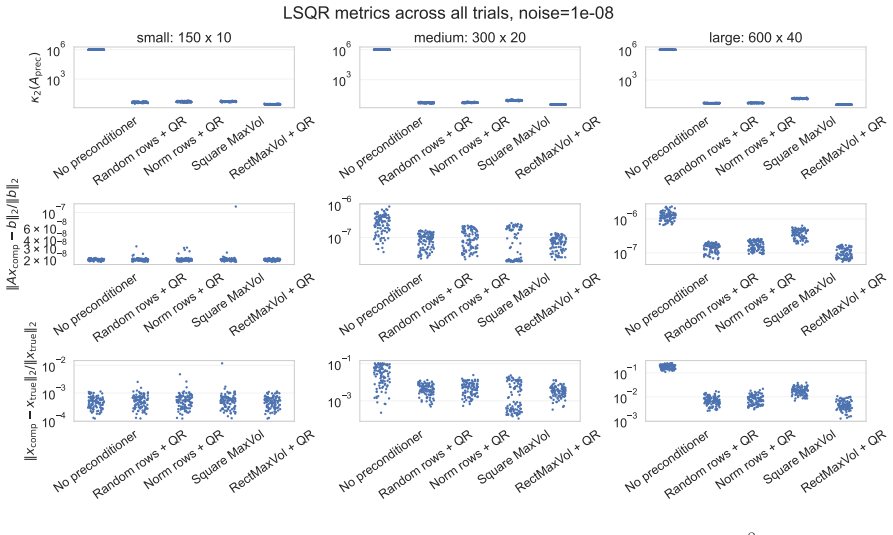
- The rectangular procedure supplies an append-row pseudoinverse update that acts as a right preconditioner for overdetermined quaternion least-squares problems.
Where Pith is reading between the lines
- The same volume-based selection logic could be tested on octonion or other non-commutative algebras that appear in higher-dimensional sensor data.
- The preconditioning property might be examined on quaternion systems whose conditioning arises from geometric constraints rather than random noise.
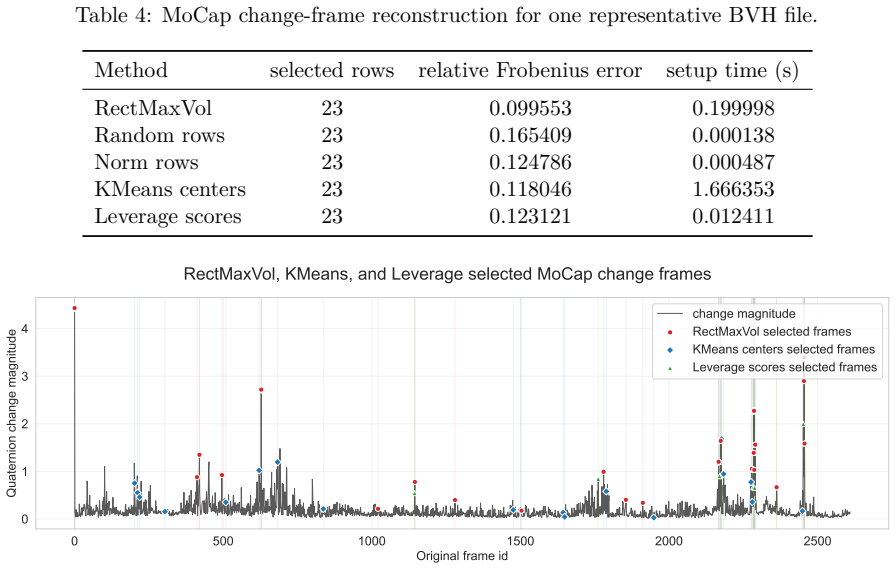
- Row selection in motion-capture data could be combined with existing skeleton-reduction pipelines to measure downstream reconstruction error.
Load-bearing premise
That a volume defined via the Study determinant and quaternion singular values remains a reliable proxy for interpolation stability and approximation accuracy in the presence of non-commutative multiplication.
What would settle it
Execute the square-core swap procedure on a concrete full-rank quaternion matrix and check whether any accepted swap decreases the computed volume or whether the resulting CUR factors fail to reproduce the original matrix exactly.
Figures
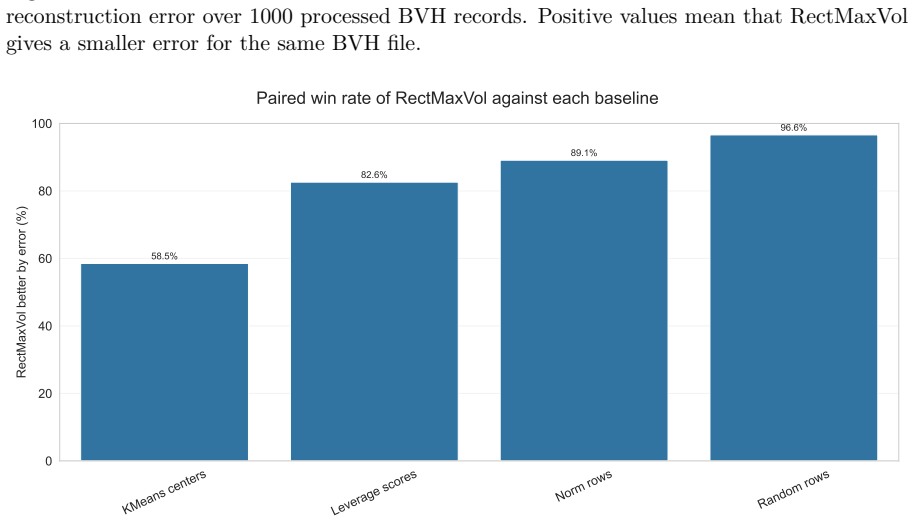
read the original abstract
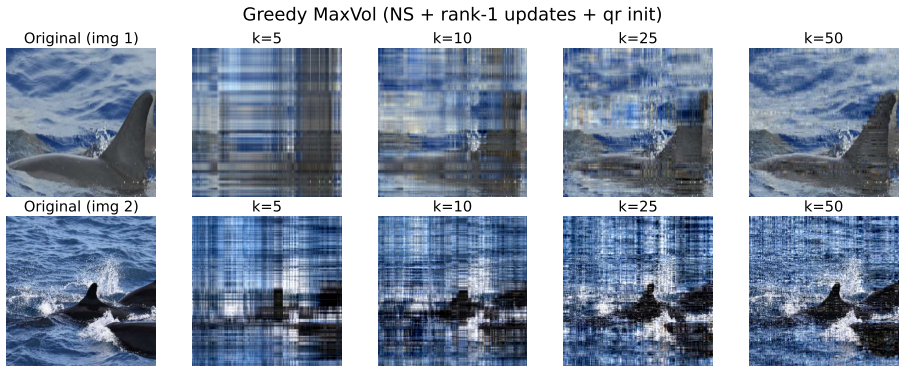
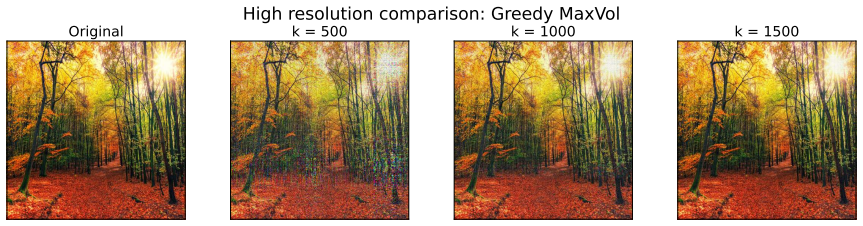
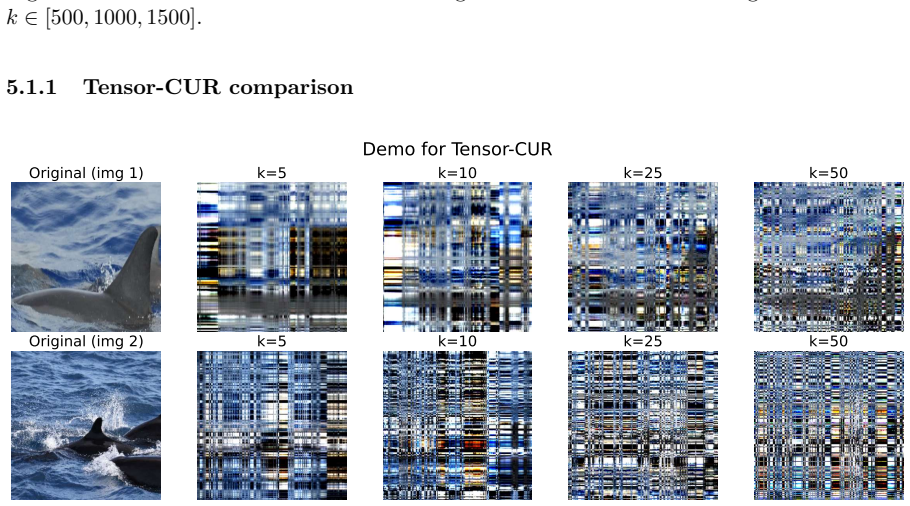
Low-rank approximation based on selected rows and columns is a useful alternative to singular value decompositions when the goal is an interpretable and compact matrix representation. A standard way to choose these rows and columns is the maximum-volume principle: it selects submatrices with large volume, which usually leads to stable interpolation coefficients and accurate CUR-type approximations. In this paper, we study this idea for quaternion matrices. This setting is natural for color images, three-dimensional motion data, and multi-channel signals, but requires care because quaternion multiplication is noncommutative. We define quaternion maximum-volume submatrix selection using quaternion singular values and the Study determinant. We then derive quaternion rank-one update formulas and use them to build two selection procedures: a greedy square-core method for row and column replacement, and a rectangular method that enlarges a selected row set until the interpolation coefficients are controlled. We prove that successful row and column swaps increase the quaternion volume of the selected square core when the exact quaternion inverse is used. We also connect the stopping criterion with quasi-dominance, prove an exact quaternion CUR identity in the full-rank case, and derive an interpolation stability bound. For the rectangular case, we derive an append-row pseudoinverse update and show how it gives a natural right preconditioner for overdetermined quaternion least-squares problems. Finally, we illustrate the methods on three applications: quaternion CUR approximation of RGB images, RectMaxVol-based preconditioning for ill-conditioned quaternion least-squares systems, and row selection in quaternion motion-capture data. The experiments show that the proposed quaternion MaxVol and RectMaxVol methods provide stable and efficient selection routines.
Editorial analysis
A structured set of objections, weighed in public.
Referee Report
Summary. The paper extends the maximum-volume (MaxVol) principle to quaternion matrices by defining volume via the Study determinant of quaternion singular values. It derives quaternion rank-one update formulas to implement greedy square-core row/column replacement and a rectangular enlargement procedure, proves that successful swaps increase volume when the exact inverse is used, connects the stopping criterion to quasi-dominance, establishes an exact CUR identity in the full-rank case, derives an interpolation stability bound, and presents an append-row pseudoinverse update that yields a right preconditioner for overdetermined quaternion least-squares problems. The methods are illustrated on RGB-image CUR approximation, ill-conditioned quaternion least-squares preconditioning, and row selection in motion-capture data.
Significance. If the algebraic claims hold, the work supplies an interpretable, SVD-free low-rank tool for non-commutative data arising in color imaging and 3-D motion capture. The explicit rank-one updates, CUR identity, and stability bound are concrete strengths that could be reused beyond the presented applications.
major comments (2)
- [Section deriving the greedy square-core method and the volume-increase proof] The central claim that successful row/column swaps strictly increase quaternion volume (when the exact inverse is used) rests on the Study determinant inheriting the required monotonicity under the derived quaternion rank-one updates. Because quaternion multiplication is non-commutative, the determinant identities that guarantee volume increase over reals or complexes do not transfer automatically; the manuscript must supply an explicit verification step for the Study determinant under these updates rather than invoking the real-valued case.
- [Definition of quaternion volume and the stability-bound derivation] The definition of quaternion volume (Study determinant of the matrix of quaternion singular values) is invoked both to define the selection criterion and to prove the stability bound. No edge-case verification is supplied for rank-deficient or near-singular quaternion matrices, where the non-commutative singular-value ordering could affect the claimed monotonicity or the quasi-dominance stopping criterion.
minor comments (2)
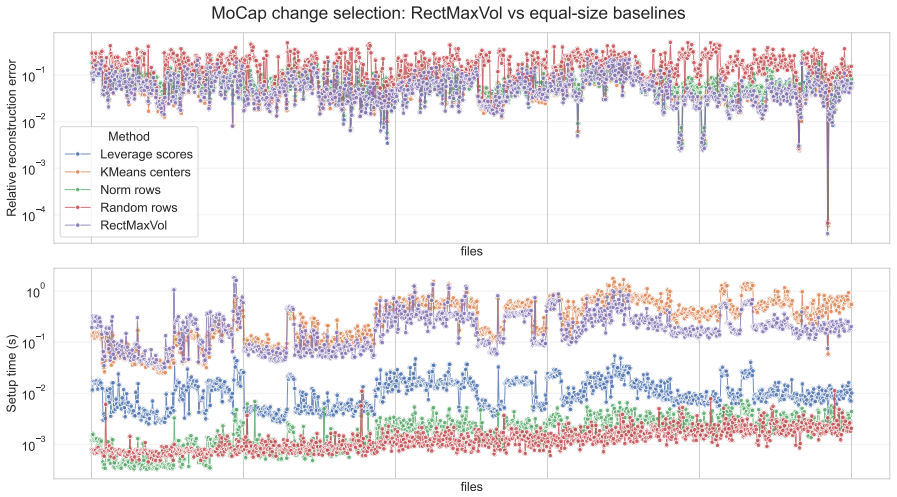
- [Experimental results on RGB images and motion-capture data] The experimental section would be strengthened by reporting the numerical condition numbers of the selected submatrices alongside the approximation errors, to directly illustrate the claimed stability advantage.
- [Rectangular append-row procedure] Notation for the quaternion pseudoinverse update in the rectangular case should be cross-referenced to the earlier square-core formulas to clarify reuse of the rank-one machinery.
Simulated Author's Rebuttal
We thank the referee for the careful reading and constructive comments on our manuscript. We appreciate the positive assessment of the potential utility of the quaternion extensions. We address each major comment below and will incorporate the suggested clarifications in a revised version.
read point-by-point responses
-
Referee: [Section deriving the greedy square-core method and the volume-increase proof] The central claim that successful row/column swaps strictly increase quaternion volume (when the exact inverse is used) rests on the Study determinant inheriting the required monotonicity under the derived quaternion rank-one updates. Because quaternion multiplication is non-commutative, the determinant identities that guarantee volume increase over reals or complexes do not transfer automatically; the manuscript must supply an explicit verification step for the Study determinant under these updates rather than invoking the real-valued case.
Authors: We agree that non-commutativity requires an explicit verification rather than direct appeal to the real or complex case. The manuscript derives the quaternion rank-one updates and asserts the volume increase for successful swaps when the exact inverse is used, but we acknowledge that the monotonicity argument for the Study determinant should be spelled out in detail. In the revision we will insert a dedicated lemma that computes the change in the Study determinant under the derived quaternion rank-one update formulas, confirming the strict increase whenever the swap condition is met. revision: yes
-
Referee: [Definition of quaternion volume and the stability-bound derivation] The definition of quaternion volume (Study determinant of the matrix of quaternion singular values) is invoked both to define the selection criterion and to prove the stability bound. No edge-case verification is supplied for rank-deficient or near-singular quaternion matrices, where the non-commutative singular-value ordering could affect the claimed monotonicity or the quasi-dominance stopping criterion.
Authors: We thank the referee for this observation. The volume is defined to be zero whenever the matrix is rank-deficient, and the selection procedures operate only on invertible square cores; nevertheless, we agree that near-singular and rank-deficient edge cases deserve explicit remarks. In the revised manuscript we will add a short discussion clarifying that (i) the volume is identically zero for rank-deficient matrices, (ii) monotonicity under swaps continues to hold for any invertible core, and (iii) the quasi-dominance stopping criterion remains well-defined provided the selected submatrix stays nonsingular. These remarks will be placed near the definition of quaternion volume and the stability bound. revision: yes
Circularity Check
No circularity: definitions and proofs rest on external quaternion algebra and prior MaxVol framework
full rationale
The paper defines quaternion volume via the Study determinant applied to quaternion singular values, derives rank-one update formulas, and proves that swaps increase volume under exact inverse. These steps invoke standard non-commutative algebra and the established real-valued maximum-volume principle rather than any self-referential definition, fitted parameter renamed as prediction, or load-bearing self-citation. The derivation chain is therefore self-contained against external benchmarks and does not reduce any claimed result to its own inputs by construction.
Axiom & Free-Parameter Ledger
axioms (1)
- domain assumption Quaternion multiplication is non-commutative and the Study determinant provides a suitable scalar volume measure for quaternion matrices.
Reference graph
Works this paper leans on
-
[1]
Pseudo-skeleton approximations by matrices of maximal volume
Sergei A Goreinov, Nikolai Leonidovich Zamarashkin, and Evgenii Evgen’evich Tyrtysh- nikov. “Pseudo-skeleton approximations by matrices of maximal volume”. In:Mathematical Notes62.4 (1997), pp. 515–519
1997
-
[2]
The maximal-volume concept in ap- proximation by low-rank matrices
Sergei A Goreinov and Eugene E Tyrtyshnikov. “The maximal-volume concept in ap- proximation by low-rank matrices”. In:Contemporary Mathematics280 (2001), pp. 47– 52
2001
-
[3]
How to find a good submatrix
Sergei A Goreinov, Ivan V Oseledets, Dimitry V Savostyanov, Eugene E Tyrtyshnikov, and Nikolay L Zamarashkin. “How to find a good submatrix”. In:Matrix Methods: Theory, Algorithms And Applications: Dedicated to the Memory of Gene Golub. World Scientific, 2010, pp. 247–256
2010
-
[4]
Rectangular maximum-volume submatrices and their applications
Aleksandr Mikhalev and Ivan V Oseledets. “Rectangular maximum-volume submatrices and their applications”. In:Linear Algebra and its Applications538 (2018), pp. 187–211
2018
-
[5]
Maximal volume matrix cross approx- imation for image compression and least squares solution
Kenneth Allen, Ming-Jun Lai, and Zhaiming Shen. “Maximal volume matrix cross approx- imation for image compression and least squares solution”. In:Advances in Computational Mathematics50.5 (2024), p. 102
2024
-
[6]
On maximum volume submatrices and cross approximation for symmetric semidefinite and diagonally dominant matrices
Alice Cortinovis, Daniel Kressner, and Stefano Massei. “On maximum volume submatrices and cross approximation for symmetric semidefinite and diagonally dominant matrices”. In:Linear Algebra and its Applications593 (2020), pp. 251–268
2020
-
[7]
Improving CUR matrix decomposition and the Nyström approximation via adaptive sampling
Shusen Wang and Zhihua Zhang. “Improving CUR matrix decomposition and the Nyström approximation via adaptive sampling”. In:The Journal of Machine Learning Research 14.1 (2013), pp. 2729–2769
2013
-
[8]
Block discrete empirical interpolation methods
Perfect Y Gidisu and Michiel E Hochstenbach. “Block discrete empirical interpolation methods”. In:Journal of Computational and Applied Mathematics454 (2025), p. 116186
2025
-
[9]
Quaternions and matrices of quaternions
Fuzhen Zhang. “Quaternions and matrices of quaternions”. In:Linear algebra and its applications251 (1997), pp. 21–57
1997
-
[10]
Singular value decomposition of quaternion matrices: a new tool for vector-sensor signal processing
Nicolas Le Bihan and Jérôme Mars. “Singular value decomposition of quaternion matrices: a new tool for vector-sensor signal processing”. In:Signal processing84.7 (2004), pp. 1177– 1199. 27
2004
-
[11]
A new real structure- preserving quaternion QR algorithm
Zhigang Jia, Musheng Wei, Mei-Xiang Zhao, and Yong Chen. “A new real structure- preserving quaternion QR algorithm”. In:Journal of Computational and Applied Mathe- matics343 (2018), pp. 26–48
2018
-
[12]
Lanczos method for large-scale quaternion singular value decomposition
Zhigang Jia, Michael K Ng, and Guang-Jing Song. “Lanczos method for large-scale quaternion singular value decomposition”. In:Numerical Algorithms82.2 (2019), pp. 699– 717
2019
-
[13]
Randomized quaternion singular value decom- position for low-rank matrix approximation
Qiaohua Liu, Sitao Ling, and Zhigang Jia. “Randomized quaternion singular value decom- position for low-rank matrix approximation”. In:SIAM Journal on Scientific Computing 44.2 (2022), A870–A900
2022
-
[14]
Pass-efficient Randomized Algorithms for Low-rank Approximation of Quaternion Matrices
Salman Ahmadi-Asl, Malihe Nobakht Kooshkghazi, and Valentin Leplat. “Pass-efficient Randomized Algorithms for Low-rank Approximation of Quaternion Matrices”. In:Nu- merical Algorithms(2026)
2026
-
[15]
Iterative Methods for Computing the Moore-Penrose Pseudoinverse of Quaternion Matrices, with Applications
Valentin Leplat, Salman Ahmadi-Asl, Junjun Pan, and Ning Zheng. “Iterative Methods for Computing the Moore-Penrose Pseudoinverse of Quaternion Matrices, with Applications”. In:Journal of Scientific Computing107.86 (2026)
2026
-
[16]
Helmer Aslaksen. “Quaternionic Determinants”. In:The Mathematical Intelligencer18 (June 1996), pp. 57–65.doi:10.1007/BF03024312
-
[17]
The quaternionic determinant
N. Cohen and S. De Leo. “The quaternionic determinant”. In:Electronic Journal of Linear Algebra7 (2000), pp. 100–111
2000
-
[18]
QuatIca: Advanced Numerical Linear Algebra and Optimization for Quaternionic Matrices in Python
Valentin Leplat, Salman Ahmadi-Asl, Junjun Pan, Henni Ouerdane, and Michael Ng. QuatIca: Advanced Numerical Linear Algebra and Optimization for Quaternionic Matrices in Python. 2026. arXiv:2603.24074 [math.NA] .url: https://arxiv.org/abs/2603. 24074
arXiv 2026
-
[19]
https : / / www
JPEG Happywhale 256x256. https : / / www . kaggle . com / datasets / rdizzl3 / jpeg - happywhale-256x256. Accessed: 2025-02-24
2025
-
[20]
Accessed: 2025-02-24
Forest Woods Autumn by jplenio.https://pixabay.com/photos/forest-woods-autumn- nature-3804001/. Accessed: 2025-02-24
2025
-
[21]
Tensor-CUR decompositions for tensor-based data
Michael W Mahoney, Mauro Maggioni, and Petros Drineas. “Tensor-CUR decompositions for tensor-based data”. In:Proceedings of the 12th ACM SIGKDD international conference on Knowledge discovery and data mining. 2006, pp. 327–336
2006
-
[22]
Accessed: 2026-05-19
CMU Graphics Lab Motion Capture Database.http://mocap.cs.cmu.edu/ . Accessed: 2026-05-19
2026
-
[23]
Accessed: 2026-05-19
re3data.org.CMU Graphics Lab Motion Capture Database.https://doi.org/10.17616/ R3N35M. Accessed: 2026-05-19
2026
-
[24]
Accessed: 2026-05-19
una-dinosauria.The CMU mocap dataset in BVH format.https://github.com/una- dinosauria/cmu-mocap. Accessed: 2026-05-19
2026
-
[25]
Some methods of classification and analysis of multivariate obser- vations
James B McQueen. “Some methods of classification and analysis of multivariate obser- vations”. In:Proc. of 5th Berkeley Symposium on Math. Stat. and Prob.1967, pp. 281– 297
1967
-
[26]
Fast approximation of matrix coherence and statistical leverage
Petros Drineas, Malik Magdon-Ismail, Michael W Mahoney, and David P Woodruff. “Fast approximation of matrix coherence and statistical leverage”. In:The Journal of Machine Learning Research13.1 (2012), pp. 3475–3506
2012
-
[27]
The Moore–Penrose inverse and singular value decomposition of split quaternions
Rafał Abłamowicz. “The Moore–Penrose inverse and singular value decomposition of split quaternions”. In:Advances in Applied Clifford Algebras30.3 (2020), pp. 1–20
2020
-
[28]
The Moore–Penrose inverses of Clifford algebra Cl1,2
Wei Cao, Rui Zheng, and Hongxing Cao. “The Moore–Penrose inverses of Clifford algebra Cl1,2”. In:arXiv preprint arXiv:2204.11047(2022). 28 A Quaternion Woodbury and rank-one update formulas We include the main inverse-update identities used in the algorithms of Section 3. They are standard in the real and complex cases, but in the quaternion setting the o...
arXiv 2022
discussion (0)
Sign in with ORCID, Apple, or X to comment. Anyone can read and Pith papers without signing in.