REVIEW 4 major objections 4 minor 82 references
Semilinear single-track vehicle models with distributed tyre friction dynamics
T0 review · 4 major / 4 minor · reviewed 2026-08-03 · deepseek-v4-flash
Pith's one-line read Distributed tyre friction as a PDE gives provably well-posed single-track vehicle models
desk verdict Careful semilinear ODE-PDE single-track models with a clean well-posedness proof, but the physical heart of the friction model is an unpublished companion paper — referee it, and ask for the missing derivation. read the letter →
The pith
A machine-rendered reading of the paper's core claim, the machinery that carries it, and where it could break.
The reading
What carries the argument
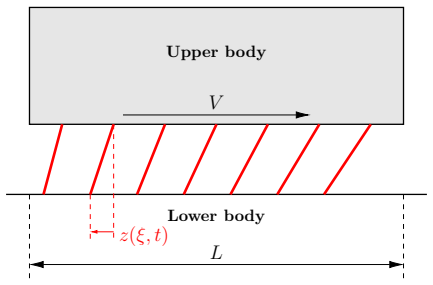
The load-bearing object is the distributed FrBD PDE (Eq. 19): each axle's bristle deformation z_i(ξ,t) evolves over a unit contact domain with transport speed v_x/L_i and a semilinear source encoding velocity-dependent friction. The force integral (Eq. 25) converts z_i into axle forces, closing the loop with the chassis ODEs (Eq. 18). For well-posedness, the paper uses semigroup theory: the linear transport operator with boundary condition is proved closed and quasi-dissipative (Propositions A.1–A.2), yielding a C0-semigroup, and the semilinear term is treated as a locally Lipschitz perturbation. Global results rest on a weighted L2 Lyapunov function with weight P(ξ)=diag(¯p_1,¯p_2); the dec
What would settle it
On an instrumented tyre test rig, hold a tyre at a fixed slip angle, measure steady-state lateral force over a range of slip velocities, and compare with Eqs. (15) and (16) using the paper's FrBD parametrisation (χ1=1, σ1>0). If the measured force saturates without the model's linear viscous growth, or if the stationary bristle deflection predicted by Eq. (12) cannot reproduce the measured force curve, the physical foundation on which every model in the paper is built would be contradicted.
Extended reading notes
Core claim
The paper's central claim is that the distributed FrBD model—a first-order hyperbolic PDE with semilinear damping, boundary condition z(0,t)=0, and an integral expression for the axle force—can be systematically integrated into a single-track vehicle framework. The resulting semilinear ODE-PDE interconnection admits unique local mild and classical solutions (Theorems 3.1 and 3.2) and unique global mild solutions under one of two hypotheses: a pressure-weighted dissipativity inequality (H.1) or a bounded-source condition (H.2) (Theorem 3.3). The paper identifies the FrBD micro-damping term (χ1=1) as the mechanism that makes the source bounded and hence global well-posedness attainable, while
Load-bearing premise
The entire model family inherits its physical content from the FrBD bristle PDE and force integral, whose validity as a first-order approximation of tyre friction is grounded in a companion manuscript by the authors that is not yet available for independent checking.
Editorial extensions
If this is right
- The semilinear single-track family can be used directly for simulation and model-based control or observer design without tracking stick-slip boundaries inside the contact patch.
- The linearised models provide explicit transfer functions from steering input to lateral acceleration and axle forces, enabling frequency-domain controller synthesis and stability analysis across operating speeds.
- The proof that the FrBD model satisfies the bounded-source hypothesis (H.2) while the Dahl model satisfies the dissipativity hypothesis (H.1) gives a principled reason to prefer FrBD-type micro-damping in distributed tyre models.
- The stability charts in Fig. 5 reproduce and extend earlier micro-shimmy results, yielding quantitative predictions of unstable islands in the speed/understeer plane.
- Simulations show that flexible carcass and exponentially decreasing pressure alter oscillation amplitude and settling behaviour, providing testable signatures for model selection against experiments.
Reading between the lines
- Editorial inference: the same ODE-PDE coupling could be carried over to combined-slip or load-transfer settings, since Theorems 3.1–3.3 rely on structural properties of the semilinear source rather than the specific single-track linearisation.
- Editorial inference: the paper's split between Hypothesis H.1 (pressure-weighted dissipativity) and H.2 (bounded source) suggests a practical selection rule for control design—choose a friction model whose global well-posedness hypothesis matches the information available about the contact pressure distribution.
- Editorial inference: the linearised transfer function (66) plus the spectral determinant D(λ) could be used as a grey-box identification tool, fitting tyre parameters to measured frequency-response data from steering-robot tests, which the paper does not explicitly propose.
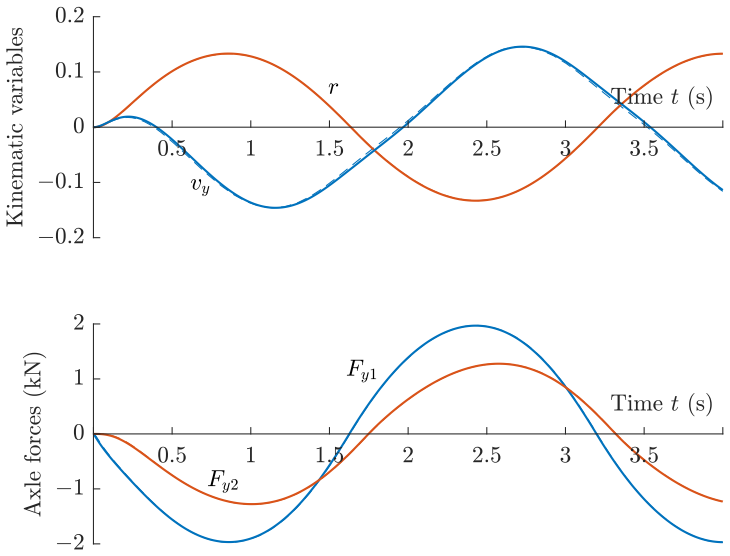
- Editorial inference: the stability charts of Fig. 5 predict that micro-shimmy occurs in discrete speed 'islands'; a targeted low-speed experiment sweeping v_x between 0.3 and 1 m/s while measuring yaw-rate power spectra would provide a direct test that separates distributed-transient effects from lumped relaxation effects.
Signed reviews
Editorial analysis
A structured set of objections, weighed in public.
Referee Report
Summary. The paper proposes a family of semilinear single-track vehicle models in which tyre friction is represented by the distributed FrBD PDE model, with two variants (rigid and flexible tyre carcass) cast into a unified abstract ODE–PDE form (32). The main theoretical claims are local/global well-posedness (Theorems 3.1–3.3), a linearisation procedure around equilibria, a spectral stability criterion via the characteristic function D(λ), and an explicit transfer function (Lemma 4.1). Numerical simulations illustrate micro-shimmy oscillations and transient steering responses. The appendices contain the semigroup and Lyapunov arguments supporting the well-posedness theorems, which appear internally coherent for the abstract system as stated.
Significance. If the results hold as claimed, the paper makes a useful contribution to vehicle-dynamics modelling: it provides a mathematically rigorous setting for distributed transient tyre models, extends the classical Dahl/LuGre framework, and produces control-oriented linearisations and transfer functions. The explicit resolvent computation and the detailed semigroup proofs in Appendix A are valuable, and the simulation of micro-shimmy is a concrete, falsifiable demonstration of the model's qualitative behaviour. However, the significance is partly conditional: the physical basis of FrBD is cited to an unpublished manuscript, and one of the two model variants appears to be misrepresented in the abstract state-space form. These issues need to be resolved before the claims can be accepted as stated.
major comments (4)
- [Section 3.2.2, Eqs. (37) and (34c)–(34d)] The flexible-carcass representation does not match the PDE (21). With K2 = K3 = 0, the nonlocal term +σ0,i |vi|/μi ψi ∫ p̄i zi dξ from Eq. (21) is absent from (32b): the operator K4 defined by (34d) only contains ∫ K5 ζ dξ + K6 ζ(1), while the matrix K4(ξ) = −diag(ψi p̄i) is the kernel that would be needed inside K3, not K4. Since Σ in (37) is negative, the term appears only if K3 ≠ 0 with this kernel. Proposition 3.1's calculation in Eq. (42) implicitly assumes such a K3. As written, the flexible-carcass model is not equivalent to Eq. (21), and the well-posedness theorems do not apply to the intended flexible-carcass system. This needs a systematic correction and re-verification.
- [Section 2.1, Eqs. (1)–(7); ref. [67]] The physical foundation of the entire model family is the FrBD PDE (1), the boundary condition z(0,t)=0, and the force integral (7). The paper states that FrBD is a “first-order approximation” of bristle dynamics and cites the unpublished manuscript [67] for its derivation and properties. Since [67] is not available to the reader, the physical validity of the central premise cannot be independently checked. The manuscript should either provide a self-contained derivation of (1)/(7) from a bristle model or clearly state the extent to which the present results are conditional on [67]. This is not a mathematical flaw in the abstract system, but it is load-bearing for the claim that the models are “physically grounded”.
- [Section 3.2.1, Eq. (36)] The matrix A2 has second row [1, −l1], but from Eq. (31b) the rear relative velocity is v2 = vy − l2 r − χ3 vx δ2, so the second row should be [1, −l2]. As printed, both axles use the front axle distance, which changes the vehicle model, the stability charts in Fig. 5, and the transfer function computations. This is presumably a typographical error, but it must be corrected because the abstract representation and all subsequent results depend on A2.
- [Section 4.2.1, Eq. (50)] The first component of (A − λI)(y1, ζ1) is written with −A~1 − λI2, while the same quantity in Eq. (57) and the original definition (32a) use A~1 − λI2. The extra minus sign is inconsistent and propagates into the resolvent formula (59) if taken literally. The derivation should be corrected and checked, including the effect on Lemma 4.1. This appears to be a sign typo, but given that the transfer function and stability criterion are central outputs, it should not remain.
minor comments (4)
- [Section 2.2.1, Eq. (12)] The stationary solution (12) is stated without derivation and the complete transient solution is “omitted for brevity”. Since the manuscript is otherwise detailed, a short derivation of (12) would improve self-containedness, especially because the paper depends on it for steady-state force expressions.
- [Section 3.3, Theorem 3.3 proof] In the Lyapunov function (86), the term z^T(ξ,t)P(ξ)z^T(ξ,t) should read z^T(ξ,t)P(ξ)z(ξ,t). This is a typo, but it appears in a central proof and should be corrected.
- [Section 4.1.2] The statement that the assumptions on Σ, h1, h2 “are always verified in practice” is too strong without qualification. For ε = 0 and χ1 = 1, the functions involve |v|_0 and may not be C^1 at v = 0 for every parameter combination; the regularized case ε > 0 is safer. A short discussion or a counterexample-free justification would be helpful.
- [Notation, Sect. 3.2.2] The notation K4 is overloaded: K4(ξ) denotes a matrix kernel in Eq. (37), while K4 is also the operator defined by (34d) via K5 and K6. This overloading contributes to the inconsistency described in the first major comment. Renaming the kernel matrix would improve clarity.
Circularity Check
No significant circularity; the well-posedness/stability derivations are self-contained, with disclosed self-citations that are not load-bearing.
full rationale
The central theoretical claims (Theorems 3.1–3.3 and Theorem 4.1) are proved from the abstract ODE-PDE representation (32) using standard semigroup arguments: closedness and quasi-dissipativity of A0 (Propositions A.1–A.2), Lumer–Phillips, and a Grönwall-based Lyapunov estimate. None of these steps is a fitted parameter renamed as a prediction; the hypotheses (H.1)/(H.2) are verified by direct inspection of the model coefficients, and the micro-shimmy results are emergent simulations rather than reproduced targets. The stationary bristle solution is derived from the PDE by the method of characteristics and then used to compute forces; it is not imported as the conclusion of the paper. The main caveat is that the physical validity of the FrBD PDE (1)–(7) itself is a premise justified partly by the authors' own unpublished manuscript [67], and prior work [60] is used for comparison of stability charts; these are disclosed self-citations, not a reduction of the proof to its inputs. The paper's mathematical results are conditional on the FrBD model's fidelity and are internally consistent, so there is no circular step to exhibit.
Assumptions & free parameters
assumptions (5)
- domain assumption The FrBD PDE (1) with boundary condition z(0,t)=0 and force integral (7) is a valid first-order dynamic approximation of bristle friction behaviour.
- domain assumption The tyre rigid relative velocity v_i is spatially uniform and equal to vx α_i (Eq. 30).
- domain assumption Small steering angles and negligible lateral load transfer.
- ad hoc to paper The functions Σ, h1, h2 are C^1 on R^2 \ {0} with finite limits of their derivatives at v=0; 'such conditions are always verified in practice' (Section 4.1.2).
- domain assumption All model coefficients (σ0, σ1, σ2, µ, etc.) are constant, i.e., no temperature or load dependence.
Cite this review
Pith. "Pith review of Semilinear single-track vehicle models with distributed tyre friction dynamics." pith.science (2026). https://pith.science/paper/J6A4U7XE
@misc{pith2026260106854,
  author       = {Pith},
  title        = {Pith review of: Semilinear single-track vehicle models with distributed tyre friction dynamics},
  year         = {2026},
  howpublished = {\url{https://pith.science/paper/J6A4U7XE}},
  note         = {Machine review of arXiv:2601.06854}
}
read the original abstract
This paper introduces a novel family of single-track vehicle models that incorporate a distributed representation of transient tyre dynamics, whilst simultaneously accounting for nonlinear effects induced by friction. The core of the proposed framework is represented by the distributed Friction with Bristle Dynamics (FrBD) model, which unifies and extends classical formulations such as Dahl and LuGre by describing the rolling contact process as a spatially distributed system governed by semilinear partial differential equations (PDEs). This model is systematically integrated into a single-track vehicle framework, where the resulting semilinear ODE-PDE interconnection captures the interaction between lateral vehicle motion and tyre deformation. Two main variants are considered: one with rigid tyre carcass and another with flexible carcass, each admitting a compact state-space representation. Local and global well-posedness properties for the coupled system are established rigorously, highlighting the dissipative and physically consistent properties of the distributed FrBD model. A linearisation procedure is also presented, enabling spectral analysis and transfer function derivation, and potentially facilitating the synthesis of controllers and observers. Numerical simulations demonstrate the model's capability to capture micro-shimmy oscillations and transient lateral responses to advanced steering manoeuvres. The proposed formulation advances the state-of-the-art in vehicle dynamics modelling by providing a physically grounded, mathematically rigorous, and computationally tractable approach to incorporating transient tyre behaviour in lateral vehicle dynamics, when accounting for the effect of limited friction.
Figures


Figures from the paper (9 more)



Reference graph
Works this paper leans on
-
[67]
First-order friction models with bristle dynamics: lumped and distributed formulations
Romano L, Aamo OM, Åslund J, Frisk E. First-order friction models with bristle dynamics: lumped and distributed formulations. Submitted to IEEE Transactions on Control Systems Technology, 2025
2025
-
[60]
Romano L, Aamo OM, Åslund J, Frisk E. Stability analysis of linear single-track models with transient tyre dynamics, Vehicle Syst Dyn, pp.1-35 (2024). A vailable from: https://doi.org/10. 1080/00423114.2024.2445163
arXiv 2024
-
[2]
Romano L. Advanced Brush Tyre Modelling. SpringerBriefs in Applied Sciences. Springer, Cham (2022). A vailable from: https://doi.org/10.1007/978-3-030-98435-9
-
[3]
Romano L, Timpone F, Bruzelius F, Jacobson B. Analytical results in transient brush tyre models: theory for large camber angles and classic solutions with limited friction. Meccanica 57, 165-191 (2022). A vailable from: http://dx.doi.org/10.1007/s11012-021-01422-3
-
[4]
Romano L, Bruzelius F, Jacobson B. An extended LuGre-brush tyre model for large camber angles and turning speeds, Vehicle Syst Dyn 61(6):1674-1706 (2022). A vailable from: https://doi.org/ 10.1080/00423114.2022.2086887
arXiv 2022
-
[5]
Transient tyre models with a flexible carcass, Vehicle Syst Dyn 62(5):1268-1307 (2023)
Romano L, Bruzelius F, Jacobson B. Transient tyre models with a flexible carcass, Vehicle Syst Dyn 62(5):1268-1307 (2023)
2023
-
[6]
L. Romano. Nonlinear modelling of transient tyre dynamics. Nonlinear Dyn 113:15901-15923 (2025). A vailable from: https://doi.org/10.1007/s11071-025-10997-5
-
[7]
Vehicle Dynamics and Control, 1st ed
Rajamani R. Vehicle Dynamics and Control, 1st ed. Springer New York, NY (2012). A vailable from: https://doi.org/10.1007/978-1-4614-1433-9
Show all 82 references
-
[8]
Automotive Control Systems, 2nd ed
Kiencke U, Nielsen L. Automotive Control Systems, 2nd ed. Springer Berlin, Heidelberg (2005)
2005
-
[9]
Active Braking Control Systems Design for Vehicles
Savaresi S, Tanelli M. Active Braking Control Systems Design for Vehicles. Springer, London (2010)
2010
-
[10]
Multiple model adaptive backstepping control for antilock brak- ing system based on LuGre dynamic tyre model
Yu H, Qi Z, Duan J, Taheri S, Ma Y. Multiple model adaptive backstepping control for antilock brak- ing system based on LuGre dynamic tyre model. International Journal of Vehicle Design. 2015;69(1- 4):168-184
2015
-
[11]
Predictive Brake Control for Electric Vehicles, IEEE Transactions on Vehicular Technology 67(2):977-990 (2018)
Satzger C, de Castro R. Predictive Brake Control for Electric Vehicles, IEEE Transactions on Vehicular Technology 67(2):977-990 (2018)
2018
-
[12]
Attitude and handling improvements through gain- scheduled suspensions and brakes control, Control Engineering Practice 19(3) (2011)
Poussot-Vassal C, Sename O, Dugard L, et al. Attitude and handling improvements through gain- scheduled suspensions and brakes control, Control Engineering Practice 19(3) (2011)
2011
-
[13]
Wang WY, Li IH, Chen MC, et al. Dynamic Slip-Ratio Estimation and Control of Antilock Braking Systems Using an Observer-Based Direct Adaptive Fuzzy–Neural Controller, IEEE Transactions on Industrial Electronics 56(5):1746-1756 (2009). 30
2009
-
[14]
LuGre Model-based Longitudinal Ride Comfort Control of Vehicle dur- ing the Post-braking Phase
Hou X, Zhang J, Liu W, Ji Y. LuGre Model-based Longitudinal Ride Comfort Control of Vehicle dur- ing the Post-braking Phase. 2020 Chinese Automation Congress (CAC). 2020:7307-7313. A vailable from: https://doi.org/110.1109/CAC51589.2020.9327063
2020
-
[15]
Synthesis of a Model-Based Tire Slip Controller
Solyom S. Synthesis of a Model-Based Tire Slip Controller. Vehicle Syst Dyn 41(6):475-499 (2004)
2004
-
[16]
Wheel Slip Control of EVs Based on Sliding Mode Technique With Conditional Integrators, IEEE Transactions on Industrial Electronics 60(8):3256-3271 (2013)
de Castro R, Araújo RE, Freitas D. Wheel Slip Control of EVs Based on Sliding Mode Technique With Conditional Integrators, IEEE Transactions on Industrial Electronics 60(8):3256-3271 (2013)
2013
-
[18]
Attainable force volumes of optimal autonomous at-the-limit vehicle manoeuvres, Vehicle Syst Dyn 58(7):1101-1122 (2020)
Fors V, Olofsson B, Nielsen L. Attainable force volumes of optimal autonomous at-the-limit vehicle manoeuvres, Vehicle Syst Dyn 58(7):1101-1122 (2020). A vailable from: https://doi.org/10.1080/ 00423114.2019.1608363
2020
-
[19]
Autonomous Wary Collision A voidance, IEEE Transactions on Intelli- gent Vehicles 6(2):353-365 (2021)
Fors V, Olofsson B, Nielsen L. Autonomous Wary Collision A voidance, IEEE Transactions on Intelli- gent Vehicles 6(2):353-365 (2021). A vailable from: https://doi.org/10.1109/TIV.2020.3029853
2021
-
[20]
Predictive Force-Centric Emergency Collision A void- ance, ASME
Fors V, Anistratov P, Olofsson B, Nielsen L. Predictive Force-Centric Emergency Collision A void- ance, ASME. J. Dyn. Sys., Meas., Control. 143(8):081005 (2021). A vailable from: https://doi. org/10.1115/1.4050403
2021 doi
-
[21]
Vehicle drifting dynamics: discovery of new equilibria, Vehicle Syst Dyn 60(6):1933-1958 (2022)
Milani S, Marzbani H, Jazar RN. Vehicle drifting dynamics: discovery of new equilibria, Vehicle Syst Dyn 60(6):1933-1958 (2022). A vailable from: https://dx.doi.org/10.1080/00423114.2021. 1887499
1933
-
[22]
Observers for vehicle tyre/road forces estimation: ex- perimental validation
Doumiati M, Victorino A, Lechner D, et al. Observers for vehicle tyre/road forces estimation: ex- perimental validation. Vehicle Syst Dyn 48(11):1345–1378 (2010)
2010
-
[23]
Estimation of tire slip angle and friction limits using steering torque
Hsu YHJ, Laws SM, Gerdes JC. Estimation of tire slip angle and friction limits using steering torque. IEEE Transactions on Control Systems Technology 18(4):896–907 (2010)
2010
-
[24]
Vehicle tyre/road interaction modeling and identification of its parameters using real-time trust-region methods
Sharifzadeh M, Akbari A, Timpone F and Daryani R. Vehicle tyre/road interaction modeling and identification of its parameters using real-time trust-region methods. IF AC-PapersOnLine. 2016;49(3):111-116. A vailable from: https://doi.org/10.1016/j.ifacol.2016.07.019
2016 doi
-
[25]
Sharifzadeh M, Timpone F, Farnam A, Senatore A, Akbari A. (2017). Tyre-Road Adherence Condi- tions Estimation for Intelligent Vehicle Safety Applications. In: Boschetti, G., Gasparetto, A. (eds) Advances in Italian Mechanism Science. Mechanisms and Machine Science, vol 47. Spr...
2017 doi
-
[26]
A real-time approach to robust identification of tyre–road friction characteristics on mixed- µ roads
Sharifzadeh M, Senatore A, Farnam A, Akbari A, Timpone F. A real-time approach to robust identification of tyre–road friction characteristics on mixed- µ roads. Vehicle Syst Dyn 57(9):1338- 136 (2019). A vailable from: https://doi.org/10.1080/00423114.2018.1504974
2019
-
[27]
Nonlinear adaptive observer for side slip angle and road friction estimation
Shao L, Jin C, Lex C, Eichberger A. Nonlinear adaptive observer for side slip angle and road friction estimation. 2016 IEEE 55th Conference on Decision and Control (CDC), 6258-6265 (2016)
2016
-
[28]
Road friction estimation using recursive total least squares
Shao L, Lex C, Hackl A, Eichberger A. Road friction estimation using recursive total least squares. 2016 IEEE Intelligent Vehicles Symposium (IV), 533-538 (2016)
2016
-
[29]
Robust road friction estimation during vehicle steering
Shao L, Jin C, Lex C, Eichberger A. Robust road friction estimation during vehicle steering. Vehicle Syst Dyn 57(4): 493-519 (2019)
2019
-
[30]
Grid search based tire-road friction estimation
Shao L, Jin C, Eicheberger A, Lex C. Grid search based tire-road friction estimation. IEEE Access 8:81506-81525 (2020)
2020
-
[31]
Cross-combined UKF for vehicle sideslip angle estimation with a modified Dugoff tire model: design and experimental results
Villano E, Lenzo B, Sakhnevych A. Cross-combined UKF for vehicle sideslip angle estimation with a modified Dugoff tire model: design and experimental results. Meccanica 56(11): 2653-2668 (2021)
2021
-
[32]
A supervisory control strategy of distributed drive electric vehicles for coordinating handling, lateral stability, and energy efficiency
Guo N, Zhang X, Zou Y, Lenzo B. A supervisory control strategy of distributed drive electric vehicles for coordinating handling, lateral stability, and energy efficiency. IEEE Transactions on Transportation Electrification 7(4):2488-2504 (2021)
2021
-
[33]
Vehicle sideslip angle estimation for a heavy-duty vehicle via Extended Kalman Filter using a Rational tyre model
Di Biase F, Lenzo B, Timpone F. Vehicle sideslip angle estimation for a heavy-duty vehicle via Extended Kalman Filter using a Rational tyre model. IEEE Access 8:142120-142130 (2020)
2020
-
[34]
Yaw Rate and Sideslip Angle Control Through Single Input Single Output Direct Yaw Moment Control
Lenzo B, Zanchetta M, Sorniotti A, et al. Yaw Rate and Sideslip Angle Control Through Single Input Single Output Direct Yaw Moment Control. IEEE Transactions on Control Systems Technology (2020)
2020
-
[35]
Estimation of the tire slip angle under various road conditions without tire–road information for vehicle stability control
Joa E, Yi K, Hyun Y. Estimation of the tire slip angle under various road conditions without tire–road information for vehicle stability control. Control Engineering Practice 86:129-143 (2019)
2019
-
[36]
The Science of Vehicle Dynamics, 3rd ed
Guiggiani M. The Science of Vehicle Dynamics, 3rd ed. Cham(Switzerland): Springer International
-
[37]
A general nonlinear single-track model for curved flat or banked road paths: Identification of the vehicle handling DNA
Markolefas S, Guiggiani M, Georgantzinos S. A general nonlinear single-track model for curved flat or banked road paths: Identification of the vehicle handling DNA. International Journal of 31 Non-Linear Mechanics 166, 104850, ISSN 0020-7462 (2024). A vailable from: https://do...
2024
-
[38]
Tire and vehicle dynamics
Pacejka HB. Tire and vehicle dynamics. 3rd ed. Amsterdam: Elsevier/BH; 2012
2012
-
[39]
Transient response of tyres at large wheel slip and camber [doctoral thesis]
Higuchi A. Transient response of tyres at large wheel slip and camber [doctoral thesis]. Delft; 1997
1997
-
[40]
The relaxation length concept at large wheel slip and camber
Higuchi A, Pacejka HB. The relaxation length concept at large wheel slip and camber. Vehicle Syst Dyn 25(sup001):50-64 (1997). A vailable from: https://doi.org/10.1080/00423119708969644
1997 doi
-
[41]
The Local Contact Between Tyre and Road Under Steady State Combined Slip Conditions
Pauwelussen JP. The Local Contact Between Tyre and Road Under Steady State Combined Slip Conditions. Vehicle Syst Dyn 41(1):1-26 (2004). A vailable from: http://doi.org/10.1076/vesd. 41.1.1.23406
2004 doi
-
[42]
Brush tire model with increased flexibility
Svendenius J, Wittenmark B. Brush tire model with increased flexibility. European Control Confer- ence, Cambridge, UK; 2015. A vailable from: https://dx.doi.org/10.23919/ECC.2003.7085237
2015
-
[43]
Tire modelling and friction estimation [dissertation]
Svendenius J. Tire modelling and friction estimation [dissertation]. Lund; 2007
2007
-
[44]
Experimental validation of the brush tire model
Svendenius J, Gäfvert M, Bruzelius F, Hultén J. Experimental validation of the brush tire model. Tire Science and Technology. 2009;37(2):122-137
2009
-
[45]
Sophisticated but quite simple contact calculation for handling tire models
Rill G. Sophisticated but quite simple contact calculation for handling tire models. Multibody Syst Dyn 45:131-153 (2019). A vailable from: https://doi.org/10.1007/s11044-018-9629-4
2019 doi
-
[46]
Road vehicle Dynamics: Fundamentals and Modeling with MATLAB ®
Rill G. Road vehicle Dynamics: Fundamentals and Modeling with MATLAB ®. 2nd Ed. CRC Press; Boca Raton, 2020
2020
-
[47]
Modelling transient response using PAC 2002-based tyre model
Shaju A, Pandey AK. Modelling transient response using PAC 2002-based tyre model. Vehicle Syst Dyn 2020. A vailable from: https://doi.org/10.1080/00423114.2020.1802048
2002
-
[48]
Magic Formula Tyre Model with Transient Properties
Pacejka HB, Besselink IJM. Magic Formula Tyre Model with Transient Properties. Vehicle Syst Dyn 27(sup001)234-249 (1997). A vailable from: https://doi.org/10.1080/00423119708969658
1997 doi
-
[49]
Development and analysis of the two-regime transient tyre model for combined slip
Romano L, Bruzelius F, Hjort M, Jacobson B. Development and analysis of the two-regime transient tyre model for combined slip. Vehicle Syst Dyn 61(4):1028-1062 (2022)
2022
-
[50]
Micro-shimmy of towed structures in experimentally uncharted unstable pa- rameter domain
Takács D, Stépán G. Micro-shimmy of towed structures in experimentally uncharted unstable pa- rameter domain. Vehicle Syst Dyn 50(11):1613-1630 (2012)
2012
-
[51]
Experiments on quasiperiodic wheel shimmy
Takács D, Stépán G. Experiments on quasiperiodic wheel shimmy. ASME. J. Comput. Nonlinear Dyn 4(3):031007 (2009). A vailable from: https://doi.org/10.1115/1.3124786
2009 doi
-
[52]
Delay effects in shimmy dynamics of wheels with stretched string-like tyres
Takács D, Orosz G, Stépán G. Delay effects in shimmy dynamics of wheels with stretched string-like tyres. European Journal of Mechanics - A/Solids. 2009;28(3):516-525
2009
-
[53]
Isolated large amplitude periodic motions of towed rigid wheels
Takács D, Stépán G, Hogan SJ. Isolated large amplitude periodic motions of towed rigid wheels. Nonlinear Dyn 52:27-34 (2008). A vailable from: https://doi.org/10.1007/s11071-007-9253-y
2008 doi
-
[54]
Contact patch memory of tyres leading to lateral vibrations of four-wheeled vehicles
Takács D, Stépán G. Contact patch memory of tyres leading to lateral vibrations of four-wheeled vehicles. Phil. Trans. R. Soc. A.37120120427. 2013. A vailable from: http://doi.org/10.1098/rsta. 2012.0427
2013
-
[55]
Tyre induced vibrations of the car–trailer system, Journal of Sound and Vibration 362:215-227 (2016)
Beregi S, Takács D, Stépán G. Tyre induced vibrations of the car–trailer system, Journal of Sound and Vibration 362:215-227 (2016)
2016
-
[56]
Nonlinear analysis of a shimmying wheel with contact-force charac- teristics featuring higher-order discontinuities
Beregi S, Takács D, Hős C. Nonlinear analysis of a shimmying wheel with contact-force charac- teristics featuring higher-order discontinuities. Nonlinear Dyn 90:877-888 (2017). A vailable from: https://doi.org/10.1007/s11071-017-3699-3
2017 doi
-
[57]
Beregi S, Takács D, Gyebroszki G. et al. Theoretical and experimental study on the nonlinear dynamics of wheel-shimmy. Nonlinear Dyn 98:2581-2593 (2019). A vailable from: https://doi.org/ 10.1007/s11071-019-05225-w
2019 doi
-
[58]
Bifurcation analysis of wheel shimmy with non-smooth effects and time delay in the tyre–ground contact
Beregi S, Takács D, Stépán G. Bifurcation analysis of wheel shimmy with non-smooth effects and time delay in the tyre–ground contact. Nonlinear Dyn 98:841-858 (2019). A vailable from: https: //doi.org/10.1007/s11071-019-05123-1
2019 doi
-
[59]
Analysis of the tyre–road interaction with a non-smooth delayed con- tact model
Beregi S, Takács D. Analysis of the tyre–road interaction with a non-smooth delayed con- tact model. Multibody Syst Dyn 45:185-201 (2019). A vailable from: https://doi.org/10.1007/ s11044-018-09636-2
2019
-
[61]
Shear Force Development by Pneumatic Tyres in Steady State Conditions: A Review of Modelling Aspects
Pacejka HB, Sharp RS. Shear Force Development by Pneumatic Tyres in Steady State Conditions: A Review of Modelling Aspects. Vehicle Syst Dyn 20(3-4):121-175 (1991). A vailable from: https: //doi.org/10.1080/00423119108968983
1991 doi
-
[62]
Solid friction damping of spacecraft oscillations, in PI-OC
Dahl P. Solid friction damping of spacecraft oscillations, in PI-OC. AIAA Guidance and Conrr. Conf, Boston, MA, Paper 75-1 104 (1975)
1975
-
[63]
A new model for control of systems with 32 friction
Canudas de Wit C, Olsson H, Astrom KJ and Lischinsky P. A new model for control of systems with 32 friction. IEEE Transactions on Automatic Control 40(3):419-425 (1995). doi: 10.1109/9.376053
1995 doi
-
[64]
Dynamic Friction Model-Based Tire-Road Friction Estima- tion and Emergency Braking Control
Alvarez L, Yi J, Horowitz R, Olmos L. Dynamic Friction Model-Based Tire-Road Friction Estima- tion and Emergency Braking Control. ASME. J. Dyn. Sys., Meas., Control 127(1): 22–32 (2005). A vailable from: https://doi.org/10.1115/1.1870036
2005 doi
-
[65]
Adaptive emergency braking control with underestimation of fric- tion coefficient
Yi J, Alvarez L, Horowitz R. Adaptive emergency braking control with underestimation of fric- tion coefficient. IEEE Transactions on Control Systems Technology 10(3):381-392 (2002). doi: 10.1109/87.998027
2002 doi
-
[66]
Emergency Braking Control with an Observer-based Dynamic Tire/Road Friction Model and Wheel Angular Velocity Measurement
Yi J, Alvarez L, Claeys X, Horowitz R. Emergency Braking Control with an Observer-based Dynamic Tire/Road Friction Model and Wheel Angular Velocity Measurement. Vehicle Syst Dyn 39(2)81-97 (2003). A vailable from: https://doi.org/10.1076/vesd.39.2.81.14159
2003 doi
-
[68]
LuGre or not LuGre
Rill G, Schaeffer T, Schuderer M. LuGre or not LuGre. Multibody Syst Dyn 60:191-218 (2024). doi: 10.1007/s11044-023-09909-5
2024 doi
-
[69]
Schuderer M, Rill G, Schaeffer T. et al. Friction modeling from a practical point of view. Multibody Syst Dyn 63:141–158 (2025). A vailable from: https://doi.org/10.1007/s11044-024-09978-0
2025 doi
-
[70]
Perturbation Theory for Linear Operators, 2nd ed
Kato T. Perturbation Theory for Linear Operators, 2nd ed. Springer Berlin, Heidelberg (1995). A vailable from: https://doi.org/10.1007/978-3-642-66282-9
1995 doi
-
[71]
Functional Analytic Methods for Partial Differential Equations, 1st ed
Tanabe H. Functional Analytic Methods for Partial Differential Equations, 1st ed. CRC Press (1997)
1997
-
[72]
Transfer functions of distributed parameter systems: A tutorial, Automatica, 45(5):1101-1116 (2009)
Curtain R, Morris K. Transfer functions of distributed parameter systems: A tutorial, Automatica, 45(5):1101-1116 (2009). A vailable from: https://doi.org/10.1016/j.automatica.2009.01.008
2009 doi
-
[73]
Introduction to Infinite-Dimensional Systems Theory: A State-Space Ap- proach, 1st
Curtain RF, Zwart H. Introduction to Infinite-Dimensional Systems Theory: A State-Space Ap- proach, 1st. ed. Springer New York, NY (2020). A vailable from: https://doi.org/10.1007/ 978-1-0716-0590-5
2020
-
[74]
Stability and dissipativity of the distributed LuGre friction model
Romano L, Aamo OM, Åslund J, Frisk E. Stability and dissipativity of the distributed LuGre friction model. IEEE Control Systems Letters, doi: 10.1109/LCSYS.2025.3572419
2025
-
[75]
Finite element modelling of linear rolling contact problems
Romano L, Målqvist A. Finite element modelling of linear rolling contact problems. ESAIM: Math- ematical Modelling and Numerical Analysis (2024)
2024
-
[76]
Dynamic tire friction models for vehicle traction control
Canudas de Wit C, Tsiotras P. Dynamic tire friction models for vehicle traction control. Proceedings of the 38th IEEE Conference on Decision and Control (Cat. No.99CH36304), Phoenix, AZ, USA, 4;3746-3751 (1999). A vailable from: https://doi:10.1109/CDC.1999.827937
1999
-
[77]
Dynamic Friction Models for Road/Tire Longitudinal Interaction
Canudas de Wit C, Tsiotras P, Velenis E, et al. Dynamic Friction Models for Road/Tire Longitudinal Interaction. Vehicle System Dynamics 39(3);189-226 (2003). A vailable from: https://doi:10.1076/ vesd.39.3.189.14152
2003
-
[78]
Velenis E, Tsiotras P, Canudas de Wit C, and M. Sorine. Dynamic tyre friction models for combined longitudinal and lateral vehicle motion. Vehicle System Dynamics 43(1);3-29 (2005) A vailable from: https://doi:10.1080/00423110412331290464
2005 doi
-
[79]
Modeling and Analysis of Longitudinal Tire Dynamics Based on the Lugre Friction Model
Deur J. Modeling and Analysis of Longitudinal Tire Dynamics Based on the Lugre Friction Model. IF AC Proceedings Volumes 34(1):91-96 (2001). A vailable from: https://doi.org/10.1016/ S1474-6670(17)34383-5
2001
-
[80]
A 3D Brush-type Dynamic Tire Friction Model
Deur J, Asgari J, and Hrovat D. A 3D Brush-type Dynamic Tire Friction Model. Vehicle System Dynamics 42(3);133-173 (2004). A vailable from: https://doi:10.1080/00423110412331282887
2004 doi
-
[81]
Extensions of the LuGre tyre friction model related to variable slip speed along the contact patch length
Deur J, Ivanović V, Troulis M, et al. Extensions of the LuGre tyre friction model related to variable slip speed along the contact patch length. Vehicle System Dynamics 43(1);508-524 (2005). A vailable from: https://doi:10.1080/00423110500229808
2005 doi
-
[82]
Semigroups of Linear Operators and Applications to Partial Differential Equations, 1st
Pazy A. Semigroups of Linear Operators and Applications to Partial Differential Equations, 1st. ed. Springer New York, NY (1983). A vailable from: https://doi.org/10.1007/978-1-4612-5561-1 . A Technical results and proofs The present Appendix collects some technical results an...
1983 doi
-
[84]
Recalling the decomposition ( 70a), it is actually sufficient to prove that A0 generates a C0-semigroup on X , since A1 2 B(X ) may in turn be regarded as a bounded perturbation
(73) Utilizing the abstract representation ( 69), local well-posedness for the ODE-PDE system ( 32) may be inferred by showing that A generates a C0-semigroup on X , and then treating f : X [0,T ] 7! X as a nonlinear perturbation, according to the classic theory for semilinear...
-
[2023]
A vailable from: https://doi.org/10.1007/978-3-031-06461-6
Reviewed August 3, 2026 · model on record in the stance chip above.
Discussion (0). Continue with ORCID to comment.